RSS
 

Posts Tagged ‘vertical’

3 Reasons to Shoot Vertical Aspect Landscapes and 6 Tips on How to Shoot Them

08 Aug

A Guest Contribution by Todd Sisson – author of our brand new Landscape Photography eBook (currently 33% off for 7 more days only).

The majority of landscape images are photographed in the horizontal aspect. I guess this because the horizontal format approximates the way in which we perceive ‘reality.’ However landscapes look stunning in the vertical format and often the unique characteristics of the upright format suit a scene better than a horizontal* composition. I am guilty of undershooting verticals these days, primarily for commercial reasons, but in any given shooting situation I try to remind myself to seek both a vertical and a horizontal composition from a scene.

Here’s why I think you should photograph vertically and some quick tips for successful upright image making.

Reason One: Verticals are Easy to Learn

Vertical composition using a wide angle or ultra-wide lens is the fast track to making interesting landscape images. My first successful landscapes were all vertical compositions where I found a moderately photogenic foreground object and used this to lead into the greater scene. To this day I find it easier to frame up an interesting sunset in the vertical format. I use rocks, grasses, flowers – just about anything with form to introduce the viewer’s eye to the scene.
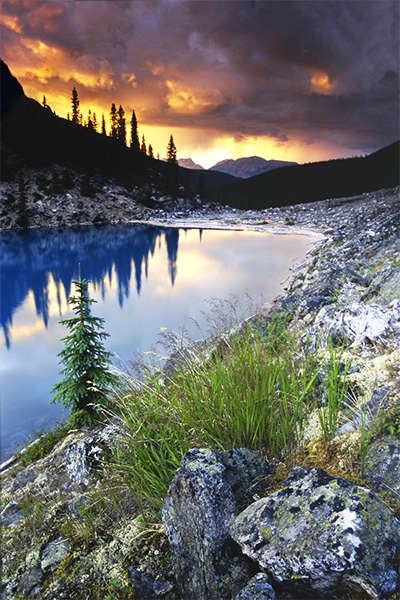
Moraine Lake, Alberta Canada (1997).  Nikon F601, Nikkor 24mm, f/16, (shutter speed unknown), Fuji Velvia and most importantly, Lee 3 stop GND filter.  This was the first image that I ever made that actually turned out how I thought it would!  Note that foreground elements don't have to be spectacular to work, they just have to be well arranged in the frame and complement the rest of the scene.  When I was learning, I found it easier to eliminate foreground distractions and make a 'tight' composition in the vertical format. As a result, I shot far too many verticals in my early days and very few good horizontal images...

Moraine Lake, Alberta Canada (1997). Nikon F601, Nikkor 24mm, f/16, (shutter speed unknown), Fuji Velvia and most importantly, Lee 3 stop GND filter. This was the first image that I ever made that actually turned out how I thought it would! Note that foreground elements don’t have to be spectacular to work, they just have to be well arranged in the frame and complement the rest of the scene. When I was learning, I found it easier to eliminate foreground distractions and make a ‘tight’ composition in the vertical format. As a result, I shot far too many verticals in my early days and very few good horizontal images…

Reason Two: Vertical Compositions can be more Dynamic

In this dPS blog post, I explained the principles of ‘dynamic landscape compositions’. What I didn’t reveal in that article (for some inexplicable reason) was that vertical compositions can often accentuate the dynamic qualities of an image – particularly when using an ultra-wide lens.
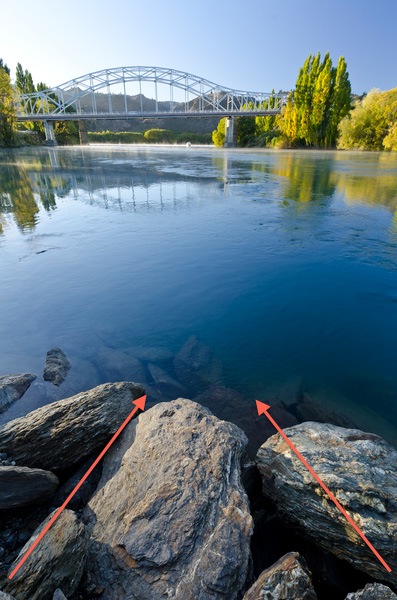
The Clutha River at Alexandra (it's not wonky, the bridge slopes downhill...).  Nikon D7000, Nikkor 12-24mm f/4 DX, Marumi Polarizer. 12 mm, f/11, 1/13th, ISO100.  The vertical format accentuated the leading lines present in the foreground rocks.  Getting low and tilting down on an ultra-wide lens distorts and extends the perceived length of leading lines in the foreground.
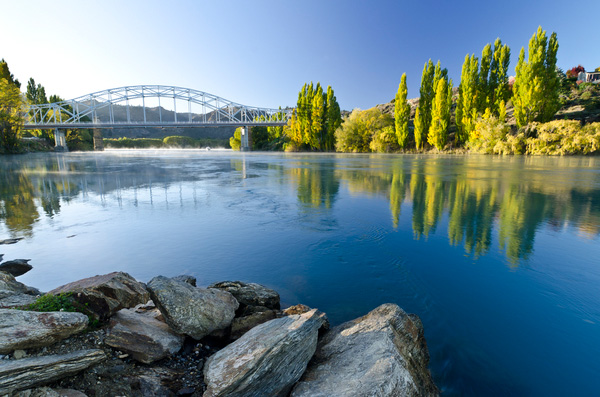
The Clutha River at Alexandra (it’s not wonky, the bridge slopes downhill…). Nikon D7000, Nikkor 12-24mm f/4 DX, Marumi Polarizer. 12 mm, f/11, 1/13th, ISO100. The vertical format accentuated the leading lines present in the foreground rocks. Getting low and tilting down on an ultra-wide lens distorts and extends the perceived length of leading lines in the foreground.

The Clutha River at Alexandra (the bridge still slopes downhill – I promise!).  Nikon D7000, Nikkor 12-24mm f/4 DX, Marumi Polarizer. 12 mm, f/11, 1/13th, ISO100.  When shooting horizontally, the bridge and trees would not be in frame if we used the same camera angles and proximity that were applied in the vertical format. In this case I had to step back and recompose to include everything, which reduced the dynamic impact of the rocks.

The Clutha River at Alexandra (the bridge still slopes downhill – I promise!). Nikon D7000, Nikkor 12-24mm f/4 DX, Marumi Polarizer. 12 mm, f/11, 1/13th, ISO100. When shooting horizontally, the bridge and trees would not be in frame if we used the same camera angles and proximity that were applied in the vertical format. In this case I had to step back and recompose to include everything, which reduced the dynamic impact of the rocks.

Reason Three: Verticals Sell Well

In the introduction I polluted the artistic sanctity of the article by mentioning ‘commercial reasons’. Five years ago we made most of our living from selling postcards of our images – horizontal postcards vastly outsell vertical postcards, and they fit better on a display stand, so I found myself inadvertently locked into a horizontal mindset (as I mentioned last week, deep thought and self-awareness are not my strong point). This sales trend is definitely mirrored in our website where the bulk of our print sales are horizontal.

However, In the past year we have ramped up our stock photography activity and this is one area where vertical images sell extremely well – especially for editorial usage and magazine covers where the format works beautifully with the vertical layout of printed media. Consequently, we are shooting a lot more vertical images. You may not be a full-time photographer but there are myriad ways to earn money from your photographic hobby these days, don’t leave money on the table – shoot verticals along with your horizontal compositions.

Vertical Shooting Tip 1: Get Low and Close

As I noted in the previous image, getting low and close accentuates the visual power of leading lines and dramatically increases the visual weight of foreground features. To go low you will need to use a tripod that has no centre column in order to get super close to the ground, I have detailed our tripod advice here which may be of interest if you are perplexed by the ins and outs of the tripod purchasing process.

Mount Egmont New Zealand. Canon 5d mkii, Canon 17-40mm f/4 ultra-wide, Marumi polarizer. 17 mm, f/16, 1 sec, ISO100. By getting implausibly close to the foreground grass in this scene I have eliminated other distracting elements, increased the visual weight of the grasses and accentuated the leading lines in the bottom right of shot. As well as being close, I was also very low to the ground while making this image.

Mount Egmont New Zealand. Canon 5d mkii, Canon 17-40mm f/4 ultra-wide, Marumi polarizer. 17 mm, f/16, 1 sec, ISO100. By getting implausibly close to the foreground grass in this scene I have eliminated other distracting elements, increased the visual weight of the grasses and accentuated the leading lines in the bottom right of shot. As well as being close, I was also very low to the ground while making this image.

Vertical Shooting Tip 2: Get High and Close

When using an ultra-wide lens it is possible to include the full sweep of a scene and accentuate the visual dynamics of the image by getting above the foreground elements and composing vertically. To achieve this you will need a tripod that extends well above the height of your subject matter and then angle the camera downwards.

Lupine flowers, Mackenzie basin New Zealand (by Sarah Sisson). Canon 5d mkii, Canon 17-40mm f/4 ultra-wide, Marumi polarizer. 17 mm, f/16, 1/8th sec, ISO100. Sarah had to fully extend her tripod and stand on a box in order to get the camera above these chest high lupin flowers.  The high perspective meant that all of the meadow is visible  and accentuated the space between flowers in the foreground.

Lupine flowers, Mackenzie basin New Zealand (by Sarah Sisson). Canon 5d mkii, Canon 17-40mm f/4 ultra-wide, Marumi polarizer. 17 mm, f/16, 1/8th sec, ISO100. Sarah had to fully extend her tripod and stand on a box in order to get the camera above these chest high lupin flowers. The high perspective meant that all of the meadow is visible and accentuated the space between flowers in the foreground.

Vertical Shooting Tip 3: Break down the Composition

When composing strong verticals I tend to ‘break down’ the scene into foreground, midground and background (the same thinking helps with horizontal images of course). A good composition will contain interest in all three of these visual zones – which roughly approximates the rule of thirds compositional guidelines.
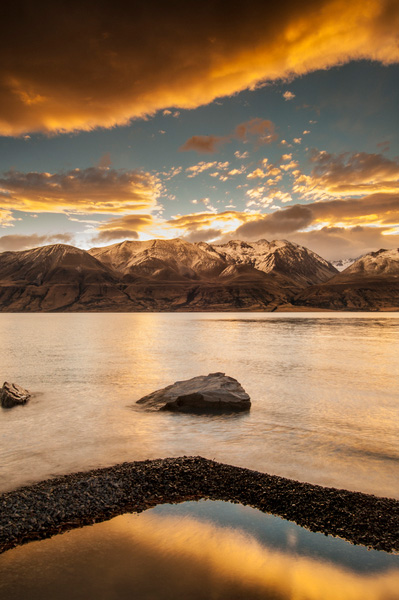
Lake Pukaki New Zealand.  Nikon D800e, Nikkor 17-35mm f/2.8 ultra-wide lens, Marumi Polarizer and Singh Ray 3 stop GND filter. This image has layers of visual interest in the foreground (gravel bar and rocks) mid-ground (reflected color & mountains) and the background (the sky). Note that the terms foreground, mid-ground and background align loosely with the principles of the rule of third – I find that I shoot more in sync with the rule of thirds for verticals than horizontals.

Lake Pukaki New Zealand. Nikon D800e, Nikkor 17-35mm f/2.8 ultra-wide lens, Marumi Polarizer and Singh Ray 3 stop GND filter. This image has layers of visual interest in the foreground (gravel bar and rocks) mid-ground (reflected color & mountains) and the background (the sky). Note that the terms foreground, mid-ground and background align loosely with the principles of the rule of third – I find that I shoot more in sync with the rule of thirds for verticals than horizontals.

Vertical Shooting Tip 4: – Leave some Space

Having just referred to the dreaded rule of thirds, I feel it my duty to throw a spanner into the works. Try messing with your vertical compositions by leaving ‘too much’ empty space. Dead space can look cool and graphic designers love it for dropping text into (sales tip).
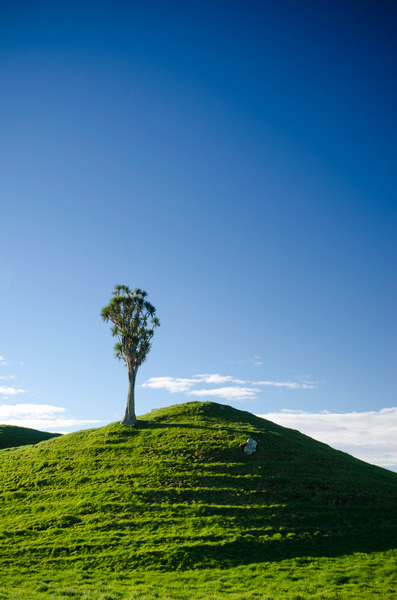
Lone cabbage tree, Taranaki New Zealand.  Nikon D7000, Nikkor 16-85mm DX, Marumi Polarizer. 35 mm, f/11, 1/20h, ISO100.  I think that vertical images often look great with plenty of empty real estate (I am a gleeful recidivist breaker of the rule of thirds). This image has sold several times as an interior page with text dropped over the sky portion.

Lone cabbage tree, Taranaki New Zealand. Nikon D7000, Nikkor 16-85mm DX, Marumi Polarizer. 35 mm, f/11, 1/20h, ISO100. I think that vertical images often look great with plenty of empty real estate (I am a gleeful recidivist breaker of the rule of thirds). This image has sold several times as an interior page with text dropped over the sky portion.

Vertical Shooting Tip 5: Try Telephoto Verticals

Telephoto verticals are a particularly attractive compositional option, particularly around mountains. Because the long edge is oriented top to bottom you can exploit telephoto compression more effectively (by allowing more foreground into the frame at longer focal lengths and emphasizing the height differential across the scene).
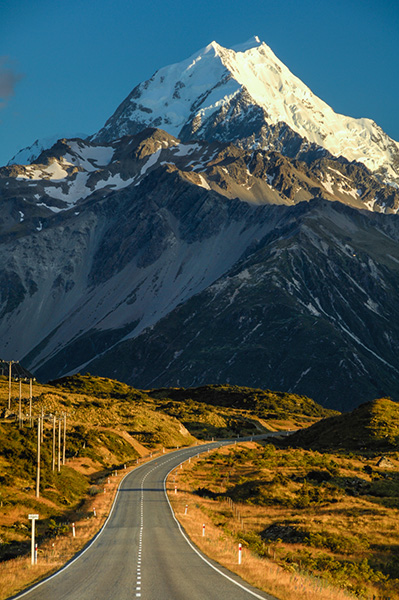
The road to Mount Cook New Zealand.  Nikon D7000, Nikkor 70-200mm f/2.8 Vrii, Marumi Polarizer. 135 mm (202mm 35mm equivalent), f/11, 1/15h, ISO100. The vertical aspect exaggerates the effects of telephoto compression in scenes like this.

The road to Mount Cook New Zealand. Nikon D7000, Nikkor 70-200mm f/2.8 Vrii, Marumi Polarizer. 135 mm (202mm 35mm equivalent), f/11, 1/15h, ISO100. The vertical aspect exaggerates the effects of telephoto compression in scenes like this.

Vertical Shooting Tip 6: Invest in an L-Bracket

An L-bracket or ‘L-plate’ is an L­-shaped (surprise, surprise!) tripod mounting plate that wraps around your camera body. This allows you to effortlessly mount your camera in the vertical orientation without having to flop the ballhead’s mounting point over on it’s side. Never again will you have to fight gravity and adjust tripod legs in order to get the camera leveled when shooting vertically – genius!

You will find a bit more information on the benefits of L-plates here on our website.

*I use the terms vertical or horizontal because the commonly used ‘portrait’ and ‘landscape’ terminology makes me abnormally irascible and grumpy. These terms are a nonsensical hangover derived from a Windows 95 printer options dialog box (maybe this riles my inner Mac Veteran). After all, a portrait can be photographed vertically or horizontally and likewise a landscape…..

Todd & Sarah Sisson are full-time landscape photographers based in Central Otago New Zealand. They are the authors of our new eBook Living Landscapes: A Guide to Stunning Landscape Photography.

Their work can be found as fine art prints & canvas prints at www.sisson.co.nz  They can be found on Facebook, Google Plus and Twitter.

Post originally from: Digital Photography Tips.

Check out our more Photography Tips at Photography Tips for Beginners, Portrait Photography Tips and Wedding Photography Tips.

3 Reasons to Shoot Vertical Aspect Landscapes and 6 Tips on How to Shoot Them

Digital Photography School

 
Comments Off on 3 Reasons to Shoot Vertical Aspect Landscapes and 6 Tips on How to Shoot Them

Posted in Photography


Vertical Garage: Hide Cars Below or Lift Your Ride to the Sky

11 Jul

[ By WebUrbanist in Technology & Vehicles & Mods. ]

japanese car lift stack

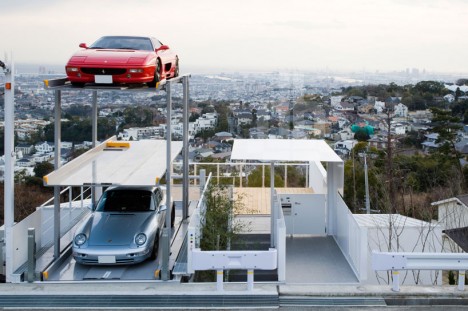
There are all kinds of houses designed to showcase your prized luxury vehicle or custom cruiser, but few can boast so blatant a mechanism to quite literally put your sports car on a pedestal.

car lift japanese house

Tucked into a hillside, the main house sits below the street level at which you drive up and enter, leaving only a driveway, walkway and deck visible from above … until, that is, you jack up your car collection two more levels into the air.

japanese top entry level

To be fair, this unusual architectural solution was designed by Atelier K (images by Kazushi Hirano) not to showcase the vehicles as such, but to simply make room for the owner’s Porsche, Ferrari and Honda on a narrow lot where a three-car garage or driveway was simply never going to work.

japanese vehicle centric home

Inside, modern simplicity and regional minimalism influence the interiors within the house, which hugs and runs along the steep hill behind it. The result is a series of cozy, house-scaled rooms more practical and conventional.

japanese wood minimalist view deck

japanese house top entry deck

Still, back up above, one has to imagine that at least from time to time it is tempting to hop in the top-stacked vehicle, push the button and ride up a few more meters for an even more amazing view of the Japanese city sprawled out below.

Share on Facebook


[ By WebUrbanist in Technology & Vehicles & Mods. ]

[ WebUrbanist | Archives | Galleries | Privacy | TOS ]


WebUrbanist

 
Comments Off on Vertical Garage: Hide Cars Below or Lift Your Ride to the Sky

Posted in Creativity


Earthscraper: Inverted Pyramid Spans 1000 Vertical Feet

21 May

[ By WebUrbanist in Architecture & Public & Institutional. ]

earthscraper underground

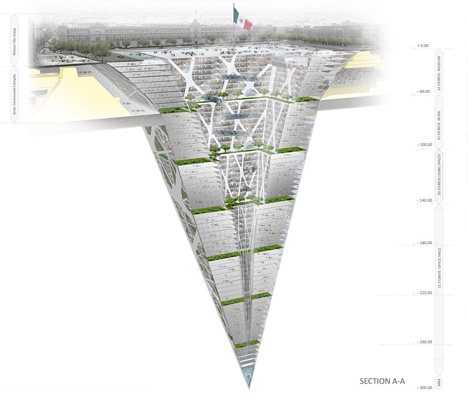
Skyscrapers are the traditional small-footprint solution for growing square footage in big cities, but what are developers to do in growing places like Mexico City where new building construction is limited to just ten stories tall?

earthscraper subterranean city park

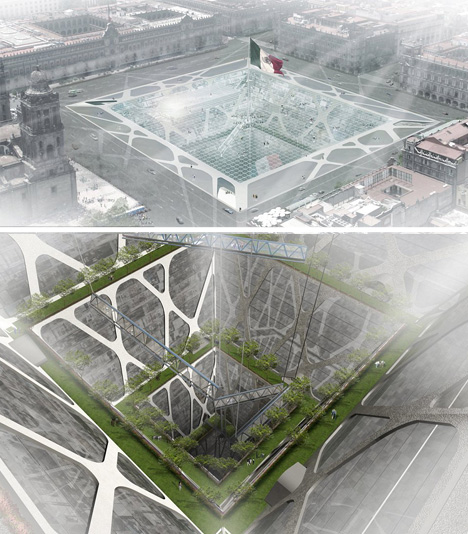
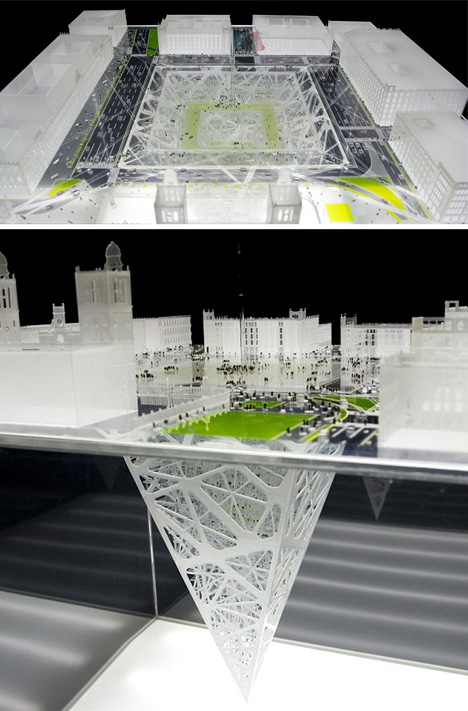
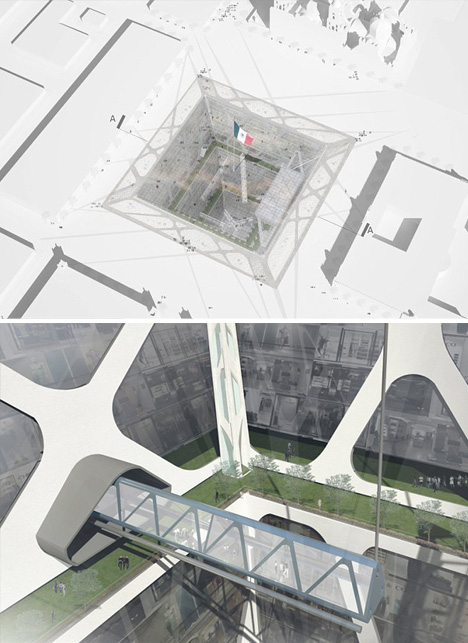
The only option, of course, is to reverse direction: build down instead of up. This his earth-scraper design by BKNR Arquitectura features a cental lightwell that doubles as a layered park, bringing illumination, ventilation and living greenery into the depths of the building.

earth scraper physical model

Since the ‘base’ of the structure is an open void rather than a filled volume, the existing city square is maintained – it becomes a transparent platform, effectively, adding dimension without subtracting functionality. This configuration provides not only a window to the world below that you can also walk on, still also allows for public gatherings, music festivals, open exhibitions, marches and parades.

earth scraping underground building

Below, the extensive building has multiple floors each of housing, shopping and office spaces, all arrayed around the exterior with views that face in rather than out – another inversion of expectations and conventions.

Share on Facebook


[ By WebUrbanist in Architecture & Public & Institutional. ]

[ WebUrbanist | Archives | Galleries | Privacy | TOS ]


WebUrbanist

 
Comments Off on Earthscraper: Inverted Pyramid Spans 1000 Vertical Feet

Posted in Creativity


Vertical Horizon: Urban Photographs Turn City Upside Down

08 May

[ By WebUrbanist in Art & Photography & Video. ]

vertical horizon hong kong

Hong Kong has to be one of the most-photographed cities on Earth, but these shots present a rarely-seen perspective by documentarians or pedestrians … unless they look straight up.

vertical urban photo shoot

From Vertical Art Space: “Romain Jacquet-Lagreze is a French graphic artist with a Masters in multimedia and art from East Paris University. His interest in photography began during his period of working in Los Angeles and Tokyo, and subsequently blossomed into a passion after his arrival in Hong Kong.”

vertical urban built environment

His Vertical Horizon series emphasizes the vast scale of tall structures, but also the “heterogeneous character” of the built environment – traditional alongside modern, scrappy versus refined, small set against large.

vertical city landscape photos

While some of his images are taken from the top down, or at an angle, many of the most powerful ones are straight-up vertical captures. Somehow, these more predictable approaches lack the striking gravitas of their deceptively-flat  cousins.

Share on Facebook


[ By WebUrbanist in Art & Photography & Video. ]

[ WebUrbanist | Archives | Galleries | Privacy | TOS ]


WebUrbanist

 
Comments Off on Vertical Horizon: Urban Photographs Turn City Upside Down

Posted in Creativity


Twin Tree-Covered Towers: The World’s First Vertical Forests

26 Mar

[ By WebUrbanist in Architecture & Offices & Commercial. ]

vertical towers construction progress

Concept designs from far-fetched futurists have toyed with the idea for years, but one firm has finally made the vision a reality: towers extensively populated with intensive (meaning: large and heavy) plant life. In short: trees!

vertical forest sky trees

Situated in Milan, Italy, many skeptics were sure these two towers were just another pie-in-the-sky plan for an impossible building. After all, the load-bearing requirements alone for over 10,000 trees and 5,000 shrubs are extreme. Stefano Boeri Architetti (photos by Marco Garofalo) is showing them otherwise.

vertical green skyscraper lighting

The added weight is not wasted, nor ornamental – the vegetation layers will reduce the need for temperature regulation within the building. They will also filter the congested air of the city and serve to help reduce the temperature (always higher in urban areas).

vertical forest tree diagrams

vertical forest buildings

The pre-grown plant life was carefully selected for the structure based on the regional climate, light and wind exposure, and is even now being hoisted into final positions. When complete, this will be, on some metrics, quite literally the greenest pair of buildings in the world.

Share on Facebook


[ By WebUrbanist in Architecture & Offices & Commercial. ]

[ WebUrbanist | Archives | Galleries | Privacy | TOS ]


WebUrbanist

 
Comments Off on Twin Tree-Covered Towers: The World’s First Vertical Forests

Posted in Creativity


Vertical Landfill: Monument to Civilization Honors Our Trash

10 Mar

[ By Steph in Architecture & Cities & Urbanism. ]

Monument to Civilization Vertical Landfill 1

Nearly all of our most majestic architecture reflects pinnacles of achievement for our species, and one architect aims to call attention to yet another way in which we are ‘spectacular:’ our unmatched ability to produce incredible amounts of waste. ‘Monument to Civilization‘ is a vertical landfill tower that offers both a serious solution for urban waste management and a commentary on our unsustainable habits.

Monument to Civilization Vertical Landfill 2

Monument to Civilization Vertical Landfill 3

The third place winner in eVolo’s 2012 Skyscraper Competition, ‘Monument to Civilization’ is not just a sobering daily reminder of how wasteful we can be, and the pressing need for new solutions. It’s also a power plant, harvesting methane gas from all that rotting trash and using it to help keep the city running.

Monument to Civilzation Vertical Landfill 4

Lin Yu-Ta envisions a narrow tower reaching high into the sky. Noting that we often “build towers for towers’ sake,” the Taiwanese designer puts some meaning behind the spectacle: the 1,318-meter (4,324-foot) height of this tower proposal represents the space that would be needed to store just a single year worth of trash from New York City alone.

Monument to Civilization Vertical Landfill 5

“The ever-growing Monument may evoke the citizens’ introspection and somewhat leads to the entire city’s waste-decreasing and better recycling. Perhaps all metropolitan cities would inverse the worldwide competition from being the tallest to the shortest.”

Share on Facebook


[ By Steph in Architecture & Cities & Urbanism. ]

[ WebUrbanist | Archives | Galleries | Privacy | TOS ]


WebUrbanist

 
Comments Off on Vertical Landfill: Monument to Civilization Honors Our Trash

Posted in Creativity


Vertical Landfill: Monument to Civilization Honors Our Trash

08 Mar

[ By Steph in Architecture & Cities & Urbanism. ]

Monument to Civilization Vertical Landfill 1

Nearly all of our most majestic architecture reflects pinnacles of achievement for our species, and one architect aims to call attention to yet another way in which we are ‘spectacular:’ our unmatched ability to produce incredible amounts of waste. ‘Monument to Civilization‘ is a vertical landfill tower that offers both a serious solution for urban waste management and a commentary on our unsustainable habits.

Monument to Civilization Vertical Landfill 2

Monument to Civilization Vertical Landfill 3

The third place winner in eVolo’s 2012 Skyscraper Competition, ‘Monument to Civilization’ is not just a sobering daily reminder of how wasteful we can be, and the pressing need for new solutions. It’s also a power plant, harvesting methane gas from all that rotting trash and using it to help keep the city running.

Monument to Civilzation Vertical Landfill 4

Lin Yu-Ta envisions a narrow tower reaching high into the sky. Noting that we often “build towers for towers’ sake,” the Taiwanese designer puts some meaning behind the spectacle: the 1,318-meter (4,324-foot) height of this tower proposal represents the space that would be needed to store just a single year worth of trash from New York City alone.

Monument to Civilization Vertical Landfill 5

“The ever-growing Monument may evoke the citizens’ introspection and somewhat leads to the entire city’s waste-decreasing and better recycling. Perhaps all metropolitan cities would inverse the worldwide competition from being the tallest to the shortest.”

Share on Facebook


[ By Steph in Architecture & Cities & Urbanism. ]

[ WebUrbanist | Archives | Galleries | Privacy | TOS ]


WebUrbanist

 
Comments Off on Vertical Landfill: Monument to Civilization Honors Our Trash

Posted in Creativity


Vertical Landfill: Monument to Civilization Honors Our Trash

08 Mar

[ By Steph in Architecture & Cities & Urbanism. ]

Monument to Civilization Vertical Landfill 1

Nearly all of our most majestic architecture reflects pinnacles of achievement for our species, and one architect aims to call attention to yet another way in which we are ‘spectacular:’ our unmatched ability to produce incredible amounts of waste. ‘Monument to Civilization‘ is a vertical landfill tower that offers both a serious solution for urban waste management and a commentary on our unsustainable habits.

Monument to Civilization Vertical Landfill 2

Monument to Civilization Vertical Landfill 3

The third place winner in eVolo’s 2012 Skyscraper Competition, ‘Monument to Civilization’ is not just a sobering daily reminder of how wasteful we can be, and the pressing need for new solutions. It’s also a power plant, harvesting methane gas from all that rotting trash and using it to help keep the city running.

Monument to Civilzation Vertical Landfill 4

Lin Yu-Ta envisions a narrow tower reaching high into the sky. Noting that we often “build towers for towers’ sake,” the Taiwanese designer puts some meaning behind the spectacle: the 1,318-meter (4,324-foot) height of this tower proposal represents the space that would be needed to store just a single year worth of trash from New York City alone.

Monument to Civilization Vertical Landfill 5

“The ever-growing Monument may evoke the citizens’ introspection and somewhat leads to the entire city’s waste-decreasing and better recycling. Perhaps all metropolitan cities would inverse the worldwide competition from being the tallest to the shortest.”

Share on Facebook


[ By Steph in Architecture & Cities & Urbanism. ]

[ WebUrbanist | Archives | Galleries | Privacy | TOS ]


WebUrbanist

 
Comments Off on Vertical Landfill: Monument to Civilization Honors Our Trash

Posted in Creativity


Microsoft Word 2010 – Gain a Few Extra Pixels; Disable the Vertical Scroll Bar

01 Mar

Turning off Word 2010’s vertical scroll bar may make it easier to view/edit documents without having to scroll horizontally.

If you have a smaller monitor or zoom past 100% to view and edit your Microsoft Word 2010 documents, you may be forced to scroll horizontally as the entire page width cannot be viewed onscreen.

If you need just a few more pixels to keep from having to scroll through your documents horizontally, how about removing the vertical scroll bar? If you don’t need it to navigate through your documents via the mouse (remember Page Up and Page Down work as well as your cursor keys), hide it by doing the following:…

Read more at MalekTips.
New Computer and Technology Help and Tips – MalekTips.Com

 
Comments Off on Microsoft Word 2010 – Gain a Few Extra Pixels; Disable the Vertical Scroll Bar

Posted in Technology


Nikon D300 – 8fps without vertical grip

13 Sep

Learn how you can set your Nikon D300 to shoot at 8fps without the vertical grip. There are limitations to this, of course, but it is still a nice thing to try. For more information, check out www.soonerzoom.blogspot.com
Video Rating: 4 / 5