RSS
 

Posts Tagged ‘vertical’

Vertical Cities: 12 Towers Take Urban Density to the Skies

18 Jun

[ By Steph in Architecture & Cities & Urbanism. ]

vertical cities singapore futuristic

Taking advantage of virtually endless vertical space within urban centers, entire cities-within-cities could spring up into the skies, packing in thousands of new housing units as well as parks, recreational space, offices, shops and everything else you’d expect to find on a typical block. These 12 residential skyscraper designs build up instead of out, often using staggered or stepped arrangements of stacked modules to maintain air circulation, access to daylight, and views. Rather than creating closed class-based communities, most make their communal spaces open to the public, and reserve the ground level for greenery.

High-Rise High-Density Tropical Living in Singapore
vertical cities singapore futuristic 2

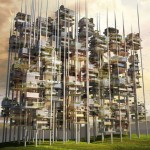
How do you pack 100,000 people into a square kilometer without sacrificing quality of life? WOHA’s entry into a competition to design a vertical city for Singapore devised a greenery-laden ‘lattice city’ made of staggered modules. This porous arrangement ensures that all levels get plenty of fresh air and daylight, free up the ground level for nature reserves and heavy industry, and weave social spaces throughout. The plan was created to be walkable, but large elevators and people movers can zip inhabitants vertically and horizontally as needed.

Stacked Modules in Vancouver

vertical cities geometric extruded 1

vertical cities geometric extruded

vertical cities geometric extruded 3

Conceived for Vancouver, this design by Ole Scheeren is made up of stacked rectilinear modules that poke out of the main tower at various angles, projecting the living spaces outward to mimic the spacious feel of living on the ground and create cantilevered terraces. The aim is to reconnect architecture with the natural and civic environment, encouraging social interaction between inhabitants.

Vertical Village in Singapore by OMA

vertical cities singapore village

vertical cities singapore village 2

Condo units that would take up a lot of space if there were all placed on the ground are instead stacked in hexagonal arrangements for The Interlace, a residential project by Ole Scheeren/OMA. 31 individual six-story blocks come together to create a network of both private living spaces and communal areas, with eight large courtyards and various terraced gardens.

Vertical City in Jakarta

vertical cities jakarta

vertical cities jakarta 2

vertical cities jakarta 3

The city of Jakarta in Indonesia is in need of both higher density housing and green space – but designs like these prove that you don’t have to choose. MVRDV has designed a 400-meter-tall tower called Peruri 88 that integrates housing, offices, retail, a luxury hotel, parking, a mosque, an imax theater and more into what is essentially its own city within the city.

Next Page – Click Below to Read More:
Vertical Cities 12 Towers Take Urban Density To The Skies

Share on Facebook


[ By Steph in Architecture & Cities & Urbanism. ]

[ WebUrbanist | Archives | Galleries | Privacy | TOS ]


WebUrbanist

 
Comments Off on Vertical Cities: 12 Towers Take Urban Density to the Skies

Posted in Creativity


Old New Jersey Factory to House Earth’s Largest Vertical Farm

22 Apr

[ By WebUrbanist in Architecture & Offices & Commercial. ]

aerofarm factory floor

Opening this year in Newark, this 69,000-square-foot space will grow 2 million pounds of pesticide-free produce each year, turning an old steel factory into the largest indoor farm on the planet, 75 times more productive per square foot than open fields. This AeroFarms facility is to serve both as the company’s global headquarters as well as the anchor project for a Maker’s Village designed to grow business in the city and provide a prototype for scaleable urban agriculture.

aerofarms aerial image

Plants rooted in reusable microfleece cloth and stacked in modular planters will be sprayed by a nutrient mist and illuminated by LED lights. These crops require no soil, 95% less water and create no harmful runoff.  Located on a 3-acre industrial site in the Ironbound neighborhood, the structure will expand the role of affordable and local urban farming in the community and provide nearly 100 long-term jobs for residents. Such an approach offers a new potential future role to rundown industrial districts around the world, turning unused infrastructure in struggling cities into fresh indoor farming space.

aerofarm interior space

More on the process and key materials: a “reusable cloth medium [supports] seeding, germinating, growing, and harvesting.” This critical cloth “has a number of benefits such as durability and reusability, increased cleanliness and sanitation, and the efficient harvest of a dry and clean product.”

aerofarms hydpropnic indoor agriculture

In terms of LED innovation and efficiency, the company is “targeting specific wavelengths of light for more efficient photosynthesis and less energy consumption. LEDs can also be placed much closer to the plants, enabling greater vertical growing for even greater productivity per square foot.”

aerofarm facility rendering market

Aeroponics is the key to the solution, limiting the need for conventional watering and representing “a cutting-edge type of hydroponic technology that grows plants in a mist. The aeroponic mist most efficiently provides roots with the nutrients, hydration and oxygen needed, creating faster growing cycles and more biomass than other growing approaches. AeroFarms has designed its aeroponics as a closed-looped system, recirculating our nutrient solution and using over 95% less water than field farming.”

aerofarms leafy greens

“We are delighted to introduce AeroFarms, a farming and technology leader, to the City of Newark, creating jobs for local residents and greater access to locally grown produce for our community,” said Ron Beit, founding partner and CEO of RBH Group. “AeroFarms will anchor our broader ‘Makers Village’ development project in the Ironbound neighborhood that will compete toe-to-toe with the Brooklyn Navy Yard in terms of a superior cost structure and greater transmodal access, bringing 21st century ‘maker-type’ businesses to Newark and the State of New Jersey.”

Share on Facebook


[ By WebUrbanist in Architecture & Offices & Commercial. ]

[ WebUrbanist | Archives | Galleries | Privacy | TOS ]


WebUrbanist

 
Comments Off on Old New Jersey Factory to House Earth’s Largest Vertical Farm

Posted in Creativity


Vertical City Farming: Undulating Mixed-Use Urban Community

12 Dec

[ By WebUrbanist in Architecture & Houses & Residential. ]

urban farming city concept

Designed to provide a spaces for public gardening as well as senior living, this hybrid complex has a rich array of green roofs, terraces and facades allowing for locally-grown produce as well as civic interaction.

urban farm terrace plan

urban farm gardening community

Responding to the fact that by 2030 a full 20% of Singapore’s population will be retirement-aged, SPARK Architects sought to address high-density housing, sustainable architecture and urban agriculture in this complex.

urban farm design concept

urban farm walkway singapore

The layered concept involves ground-level farms and gardens open to the citizenry as well as individual, upper-level plots that retired persons can work at their leisure.

urban farming design section

urban farming aquaponics module

urban farming design diagram

Further, “the environmental sustainability and efficiency of ‘Home Farm’ [is] enhanced by proposed features such as the collection of rainwater, for use in aquaponic systems, and the use of plant waste for energy production.”

urban farm ground floor

urban farm undulating form

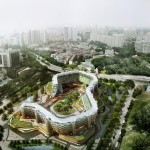
The curvilinear master plan provides maximum sun exposure and variegated views throughout the complex, encouraging residents to walk around to exercise, interact with neighbors and experience a diverse set of internal and city views.

Share on Facebook


[ By WebUrbanist in Architecture & Houses & Residential. ]

[ WebUrbanist | Archives | Galleries | Privacy | TOS ]


WebUrbanist

 
Comments Off on Vertical City Farming: Undulating Mixed-Use Urban Community

Posted in Creativity


Zombie-Powered Vertical Farm: Post-Apocalyptic Safe House

31 Oct

[ By WebUrbanist in Architecture & Houses & Residential. ]

zombie brains

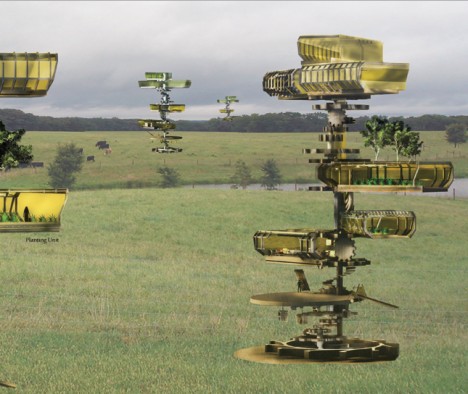
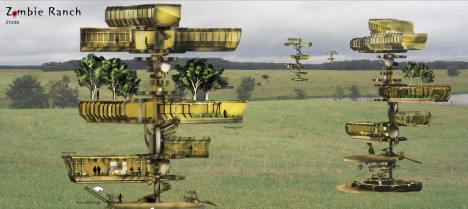
Strangely sustainable, this towering haven is designed to turn the energy of the undead toward a positive purpose, using zombies to turn a turbine in order to provide both power and water pressure in case of a viral apocalypse.

zombie ranch design details

As part of the Zombie Safe House competition, this Zombie Ranch entry goes above and beyond simply protecting people from risen corpses, turning their lust for blood and brains into a baited trap to keep life going above the ground.

zombie powered safe house

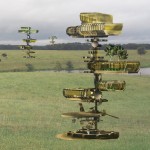
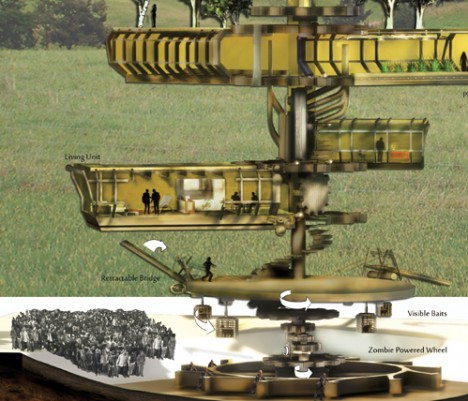
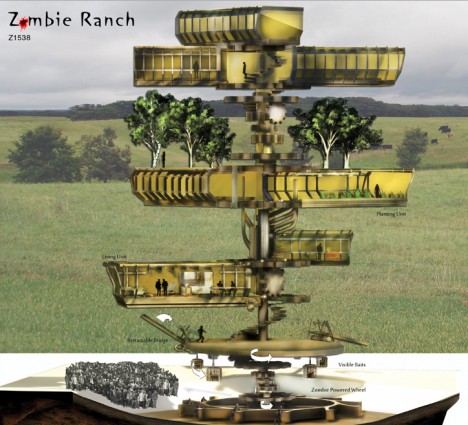
The slow-moving zombies push a twisting turbine that sends water up for drinking and farming on a second story – residents occupy the top level, presumably for an extra layer of safety and to get some distance from the groaning hordes.

zombie design raised lowered

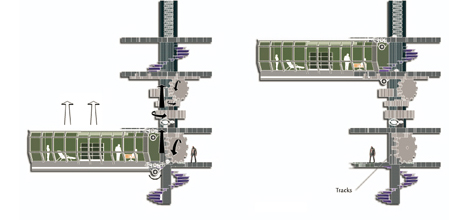
A series of spiral staircases and drawbridges provide ways to cut off attacks on each floor as well as a means of lifting the entire structure further skyward to make it less accessible when a swarm wanders through.

zombie ranch above below

Each zombie-resistant tower is designed to be fully self-sufficient so survivors can remain aloft indefinitely, leaving them free to enjoy the end of the world in relative luxury.

Share on Facebook


[ By WebUrbanist in Architecture & Houses & Residential. ]

[ WebUrbanist | Archives | Galleries | Privacy | TOS ]


WebUrbanist

 
Comments Off on Zombie-Powered Vertical Farm: Post-Apocalyptic Safe House

Posted in Creativity


Waltz on the Walls: Dancers Perform Daring Vertical Stunts

25 Sep

[ By Steph in Art & Photography & Video. ]

bandaloop3

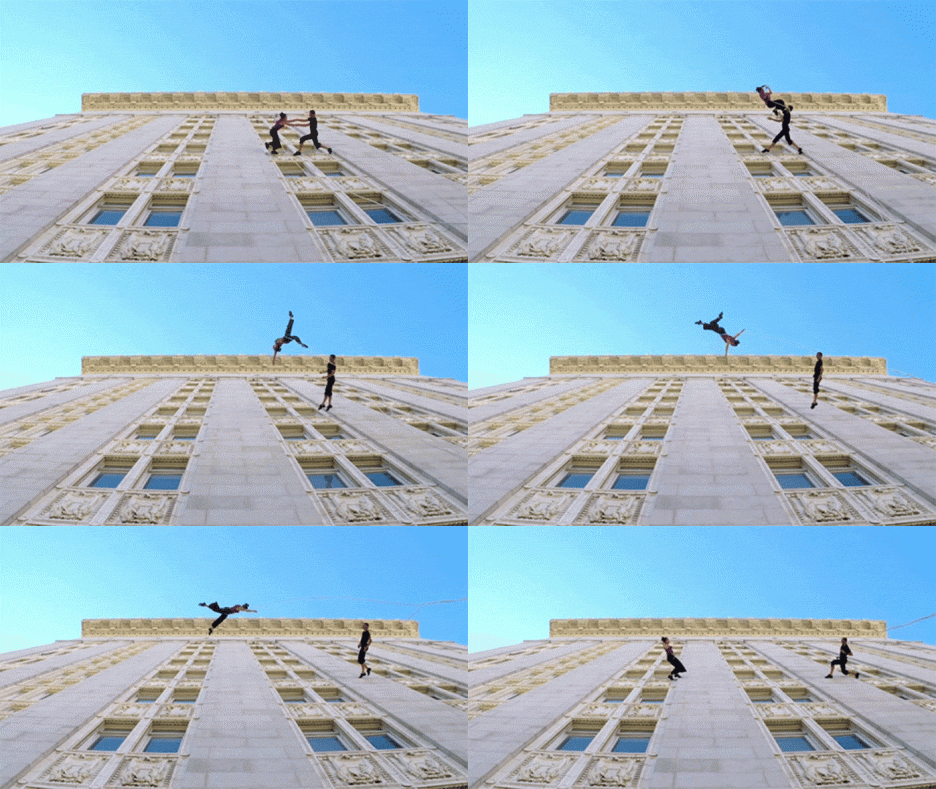
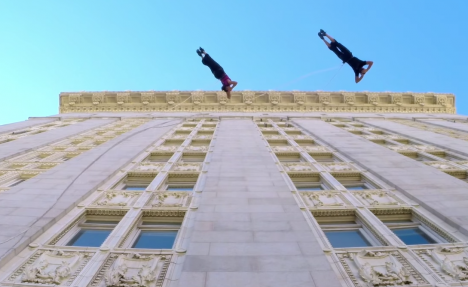
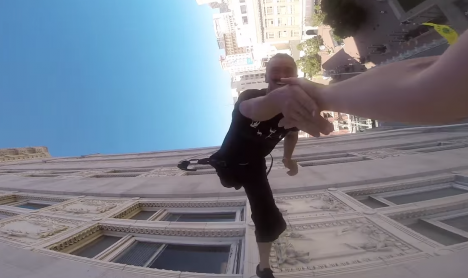
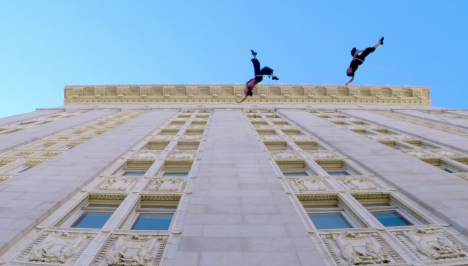
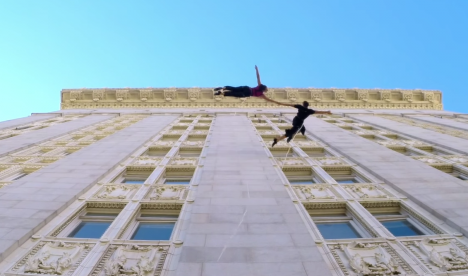
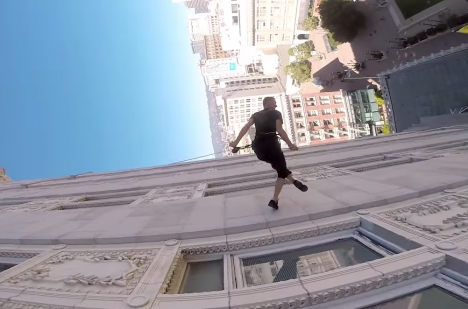
The first-person perspective seen on this video of two dancers vaulting effortlessly off the side of Oakland’s City Hall building might make you a little dizzy. Secured to the 18-story structure’s roof with safety lines, the duo run, flip and seemingly fly, captured from various angles that can be a tad disorienting.

Waltz on the Walls 1

Waltz on the Walls 3

The pair are members of the Bandaloop vertical choreography dance company, which staged the performance for the Art + Soul Festival in Oakland, California. GoPro cameras capture the action in all its elegance.

Waltz on the Walls 2

Waltz on the Walls 4

The company aims to “re-imagine dance,” performing these seemingly weightless feats on skyscrapers, bridges, billboards, cliffs and historical sights. Says founder and artistic director Amelia Rudolph, “They say what we do is death-defying. I’d say it’s life-affirming.”

Waltz on the Walls 5

Bandaloop Sundial Bridge

The images and the videos of the performances are breathtaking, particularly those of dancers rappelling off the 217-foot Santiago Calatrava ‘Sundial Bridge’ in Redding, seen above. Check them all out at the Bandaloop website.

Share on Facebook


[ By Steph in Art & Photography & Video. ]

[ WebUrbanist | Archives | Galleries | Privacy | TOS ]


WebUrbanist

 
Comments Off on Waltz on the Walls: Dancers Perform Daring Vertical Stunts

Posted in Creativity


5,000 Residents Being Evicted from World’s Tallest Vertical Slum

29 Jul

[ By WebUrbanist in Architecture & Cities & Urbanism. ]

tower david shelf wall

A forced relocation is underway as thousands of squatters are moved by authorities out of their homes and the city of Caracas, some of whom have called the infamous half-finished Tower of David home for as long as seven years.

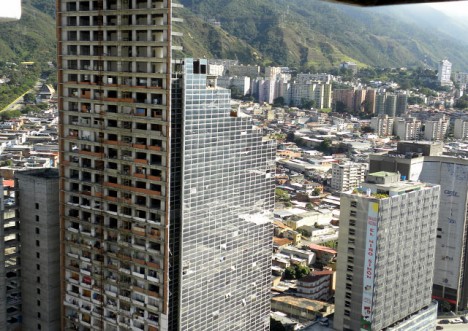
tower of david view above

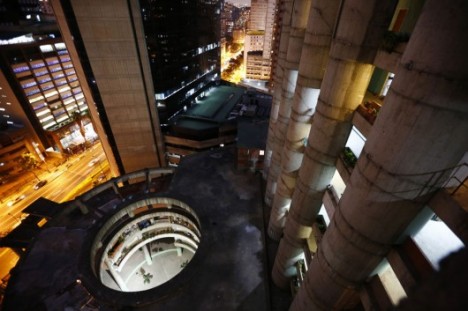
Rumors began a few weeks back as Chinese bankers expressed interest in purchasing the unfinished structure in Venezuela, with the intention of turning it back toward the (official and licensed) commercial and office uses for which it was originally intended. Currently, however, over 1,000 families live and work in the first few dozen floors of this 44-story skyscraper.

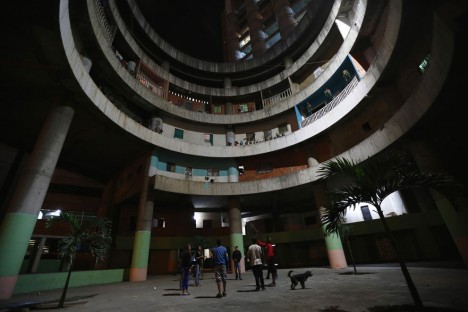
tower of david ground floor

With surprising speed over the past week, the government has already shifted over 100 of these to a settlement outside of town (three floors a time) and is set to displace everyone living in the building, primarily to Valles del Tuy in the state of Miranda.

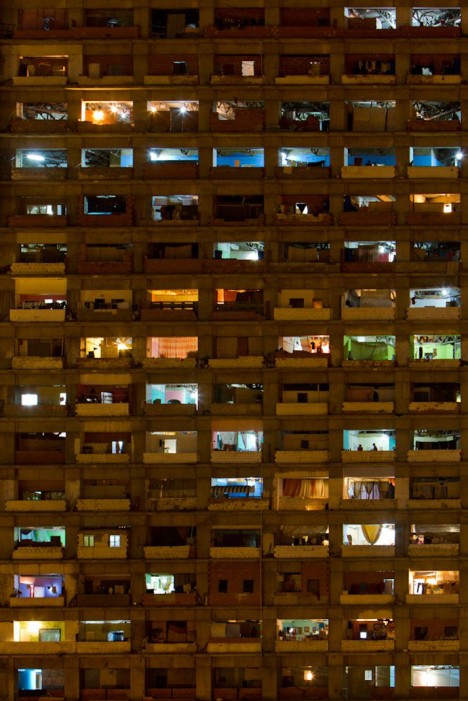
tower david tall pic

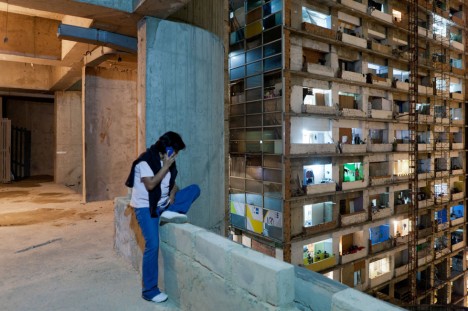
The tower was originally abandoned mid-construction in 1990 and eventually taken over by informal inhabitants who created not just homes but stores, offices, gyms, groceries, tailors, factories, churches tattoo parlors and even internet cafes within its walls.

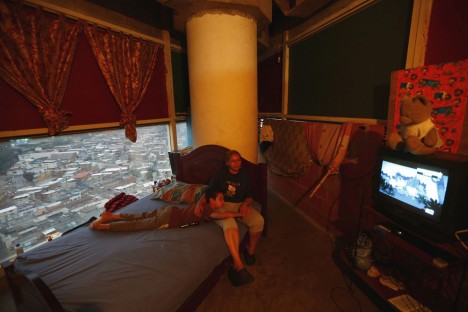
tower of david room tv

Without an elevator (and with missing windows on the top levels), its most prized spaces for occupants have been on the lower floors, with scooter taxis that ferry people up ramps to some levels adjacent to the parking structure. Like Kowloon Walled City, the place has its own rules and informal systems of bringing in and sharing resources, including limited water and power.

tower of david exterior view

The Urban Think Tank, which spent years studying the building (and writing Torre David: Informal Vertical Communities), has weighed in on the significance of the building and its occupants as well as its sudden shift in direction: “What we found was neither a den of criminality nor a romantic utopia. Torre David is a building that has the complexity of a city. It merges formal structure and informal adaptation to provide urgently needed solutions, and shows us how bottom-up resourcefulness has the ability to address prevailing urban scarcities.”

More from UTT: “When dealing with informal settlements, infusions of money for major public works and other approaches that involve large-scale rapid change – such as the razing of slums and relocation of poor populations – have generally failed in the complex setting of the city. The commercial housing market simply does not supply enough homes. There are too few units of social housing, and the majority of these are far beyond the reach of low-income families.”

“The dire asymmetries of capital in the global south do little to help; yet various forms of structural neglect have not always diminished great entrepreneurial vigor. Shunned by governments and the formal private sector, city dwellers, like those in Torre David, have devised and employed tactics to improvise shelter and housing.” Images via The Atlantic and Torre David: Informal Vertical Communities.

Share on Facebook


[ By WebUrbanist in Architecture & Cities & Urbanism. ]

[ WebUrbanist | Archives | Galleries | Privacy | TOS ]


WebUrbanist

 
Comments Off on 5,000 Residents Being Evicted from World’s Tallest Vertical Slum

Posted in Creativity


Vertical Forests: 2 Lush Urban Towers Support 16,000 Plants

25 May

[ By WebUrbanist in Architecture & Houses & Residential. ]

green tower real life

Skeptics of improbably green skyscraper concepts might want to take a moment of silence to appreciate the successful construction of these two beautiful buildings now nearly completion.

green tower lush views

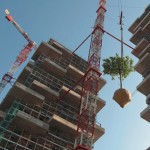
Designed by Stefano Boeri in Milan, Italy, the twin towers of the Bosco Verticale play host to nearly 1,000 trees, 5,000 shrubs and over 10,000 additional small plants.

green skyscraper tower design

The building was fully designed with its greenery in mind, including accommodations for irrigation, root systems, plant weights and wind loads within the city. This rich miniature ecosystem of plant life in turn helps filter the surrounding air, dampen urban noise and provide shade for residents. For its local environment, the building increases biodiversity and provides habitats for regional birds and insects.

green tower balcony trees

From the designers: The creation of a number of vertical forests in the city will be able to create a network of environmental corridors which will give life to the main parks in the city, bringing the green space of avenues and gardens and connecting various spaces of spontaneous vegetation growth. [This project] helps to build a micro-climate and to filter dust particles which are present in the urban environment. The diversity of the plants helps to create humidity, and absorb CO2 and dust, produces oxygen, protects people and houses from the suns rays and from acoustic pollution.”

Share on Facebook


[ By WebUrbanist in Architecture & Houses & Residential. ]

[ WebUrbanist | Archives | Galleries | Privacy | TOS ]


WebUrbanist

 
Comments Off on Vertical Forests: 2 Lush Urban Towers Support 16,000 Plants

Posted in Creativity


Cemeteries in the Sky: 7 Compact Vertical Burial Designs

21 May

[ By Steph in Architecture & Cities & Urbanism. ]

VERTICAL BURIAL MAIN

A skyscraper filled with corpses may sound morbid, but soon, such things may become a necessity. The earth is already packed with dead housed in oversized caskets that have been designed to outlive us all – so what are we going to do with the never-ending stream of human bodies as we face life’s greatest inevitability?

Skyscraper Cemetery for Norway

Vertical Burial Norway Cemetery Skyscraper

A metal exoskeleton around a central core serves as the framework for a multi-story graveyard that looks, on each individual floor, the way any ordinary graveyard would. It’s got trees, benches and memorials. The only difference is, it’s high above ground level, and roofed by the next level of graves. Norweigian designer Martin McSherry envisions the Skyscraper Cemetery that can help solve the problem of lack of burial space in the country, with a crane permanently situated beside the structure to constantly add new floors as needed.

Memorial Necropole Ecumenica, Brazil

Vertical Burial Brazil

The world’s tallest existing cemetery is Brazil’s Memorial Necropole Ecumenica, a 32-story high rise where tombs are rented by the year and private memorial rooms go for about $ 105,000. Because of the hot Brazilian climate, bodies must be interred within 24 hours, so the MCE, as it’s known, is open 24 hours a day, 365 days a year. The building also contains a chapel, lagoon, peacock garden, waterfalls, an aviary full of parrots and toucans and even a small restaurant.

Tower for the Dead, Mexico City

Vertical Burial Tower for the Dead

The population of residents aged 65 and older is expected to triple in developing countries over the next four decades. That’s a big problem when it comes to burying the dead, especially in places like Mexico City where buildable area is very scarce. Creating more conventional cemeteries would mean losing valuable agricultural land and what few unspoiled green spaces are left. This proposal, Tower for the Dead, actually combines vertical necropoles with inverted skyscrapers for an 820-foot-deep subterranean complex conceived as a massive screw driving into the earth. The experience might be a little intense, as each floor has a theme based on a stage of grief.

“This project proposes an underground vertical cemetery for Mexico City – a vision that takes into consideration the overpopulation, the scarcity of land, and the psychological and sensory experience of grieving. The ‘Tower of the Dead’ allows the family members of the deceased to be reborn, after a trip to the underworld, where they just buried their loved one.”

Vertical Cemetery for Paris

Vertical Burial Cemetery for Paris

This vertical cemetery concept for land-challenged Paris would create “a symbolic tower with a rightful place within the city that the deceased so much loved,” a city that currently has so little space for graves that many remains have still not been properly buried. A skylight pours natural light into the center of the tower, down into a water pond at the base, with a spiral ramp offering a walkway to the top floor. Flexible filaments on the outside of the tower each stand for a deceased person, aiming to embody their essence as they move in the wind.

Stacked Cemeteries of New Orleans

Vertical Burial New Orleans

New Orleans is one city that already stacks its dead vertically, up to four tombs high. The reason for this is simple: the city is set well below sea level, so the water table is far too high for underground burial. Dig just a few feet down, and you’ll hit soggy sand. For a while, residents attempted it anyway, stacking heavy stones on top of the caskets to hold them down, but storms would bring them floating up to the surface. Families are typically stacked together within individual vaults. At the city’s infamous Lafayette Cemetery, human remains are even interred right in the walls that surround it.

Moshka Tower Cemetery, Mumbai

Vertical Burial Moksha Mumbai

The Moshka Tower was designed for Mumbai to free up a significant amount of ground space for the living, accommodating all four of the major cultures and religions found within the city (Hindu, Muslim, Christian and Parsi.) Facilities are available for both garden burial and cremation. A tower of silence is located on the roof for Parsis, and additional space is available for worship, prayer and meditation. The multi-layered facade is filled with vegetation to absorb heat and CO2, and new technology enables more sustainable cremation that doesn’t fill the air with pollution.

Mountain of the Dead, Egypt

Vertical Burial City of the Dead

Egypt’s Mountain of the Dead, also known as Gebel al Mawta, is a Roman-era burial site that towers above the landscape of the Siwa Oasis, looking a bit like an ant hill. Made of limestone, it was developed during the 26th Dynasty of Egypt, and served as a hiding place for soldiers during World War II. Tombs cover virtually every square inch of its base as well as its terraces and all sides of the conical portion. Many of the tombs have been raided over the centuries, and robbery continues to be a problem.

Amphitheater for the Dead: Hong Kong Hillside Cemeteries

Vertical Burial Hong Kong 2
Vertical Burial Hong Kong 1

Look out onto the hillsides from a high-rise in Hong Kong and you’ll see something that’s highly uncommon in the west: tier after tier of graves built onto hillsides resembling ancient amphitheaters. Each grave within these cemeteries is shoehorned beside the other. It didn’t take long for this trend to die down in the city – the practice began in the ’60s, and by the ’80s, space ran out, so officials had resorted to interring bodies in nearby high-rise buildings. Hong Kong is twice as dense as New YOrk and four times as crowded as London, so it’ll be interesting to see what they come up with next.

Share on Facebook


[ By Steph in Architecture & Cities & Urbanism. ]

[ WebUrbanist | Archives | Galleries | Privacy | TOS ]


WebUrbanist

 
Comments Off on Cemeteries in the Sky: 7 Compact Vertical Burial Designs

Posted in Creativity


Parasite Tent Pods: Vertical Urban Wall Homes for Homeless

22 Dec

[ By Delana in Architecture & Cities & Urbanism. ]

parasitic homeless tent community

In cities around the world, people are feeling the effects of a weak global economy and homeless populations continue to rise. Taking shelter in cardboard boxes or in isolated tents can be dangerous – not only due to inclement weather, but also for the fear of robbery or violence.

hanging tents for homeless population

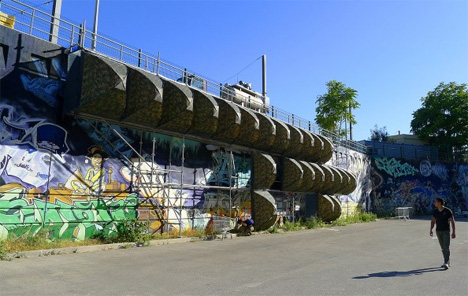
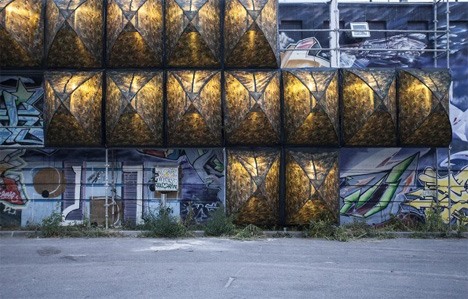
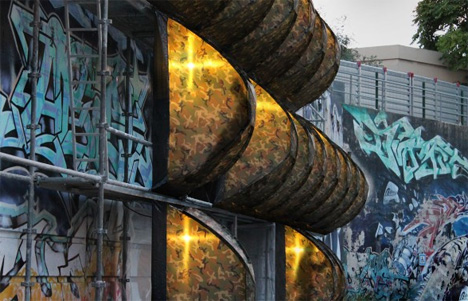
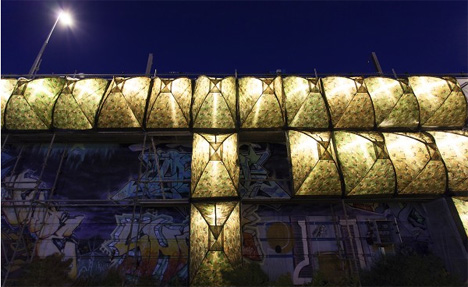
The A-Kamp47 project from Malka Architecture gives the homeless a safe place to sleep. Using a blank vertical expanse of wall, they installed 23 small tent pods. The pods are “parasitic” structures, meaning that they rely on another structure to provide them a place to sit.

suspended camp for homeless people

Each tent provides a private space for the city’s homeless. The grouping of tents embodies the old adage “safety in numbers.” Residents can enter their tents via the scaffolding between the wall and the tend pods.

a-kamp 47 homeless tent colony

The project is not without controversy; the wall used by the architects exists in a grey area between private and public space. They hope, however, that their efforts will lead to increased awareness of the homeless problem and encourage people to get involved in the cause.

Share on Facebook


[ By Delana in Architecture & Cities & Urbanism. ]

[ WebUrbanist | Archives | Galleries | Privacy | TOS ]


WebUrbanist

 
Comments Off on Parasite Tent Pods: Vertical Urban Wall Homes for Homeless

Posted in Creativity


Parasite Tent Pods: Vertical Urban Wall Homes for Homeless

11 Dec

[ By Delana in Architecture & Cities & Urbanism. ]

parasitic homeless tent community

In cities around the world, people are feeling the effects of a weak global economy and homeless populations continue to rise. Taking shelter in cardboard boxes or in isolated tents can be dangerous – not only due to inclement weather, but also for the fear of robbery or violence.

hanging tents for homeless population

The A-Kamp47 project from Malka Architecture gives the homeless a safe place to sleep. Using a blank vertical expanse of wall, they installed 23 small tent pods. The pods are “parasitic” structures, meaning that they rely on another structure to provide them a place to sit.

suspended camp for homeless people

Each tent provides a private space for the city’s homeless. The grouping of tents embodies the old adage “safety in numbers.” Residents can enter their tents via the scaffolding between the wall and the tend pods.

a-kamp 47 homeless tent colony

The project is not without controversy; the wall used by the architects exists in a grey area between private and public space. They hope, however, that their efforts will lead to increased awareness of the homeless problem and encourage people to get involved in the cause.

Share on Facebook


[ By Delana in Architecture & Cities & Urbanism. ]

[ WebUrbanist | Archives | Galleries | Privacy | TOS ]


WebUrbanist

 
Comments Off on Parasite Tent Pods: Vertical Urban Wall Homes for Homeless

Posted in Creativity