RSS
 

Posts Tagged ‘Unique’

Cubicle Typography: Unique Desks as Office Furniture Font

19 Mar

[ By WebUrbanist in Design & Graphics & Branding. ]

furniture font design space

One of the most dreary aspects of daily life in a cubical farm is the relentless sameness that pervades each office pod – perhaps it would help if each workspace were different, easy to assemble and simple to recycle.

furniture letter r desk

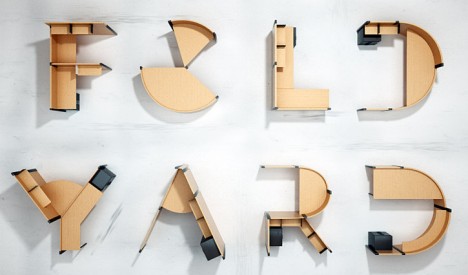
This Fold Yard typography of Benoit Challand has a touch of whimsy to be sure, but it also suggests a way to break out of the box by customizing each station at a given place of work.

furniture typography font concept

Who knows: these quickly-customized corrugated cardboard cubes (joined with modular plastic pieces) might be a good recipe for helping employees feel less like a hive of drones and more like individual workers with independent value and personal flexibility.

furniture fold yard set

furniture design title idea

About the creator: “Ben is a creative image maker focused on digital art, 3D illustration and typography” – his work includes CGI retouching and digital drawings, with a background in motion design (animation). He has done typographic and other work for major brands as well as creating a number of neat independent projects.

Share on Facebook


[ By WebUrbanist in Design & Graphics & Branding. ]

[ WebUrbanist | Archives | Galleries | Privacy | TOS ]


WebUrbanist

 
Comments Off on Cubicle Typography: Unique Desks as Office Furniture Font

Posted in Creativity


CP+ Sigma interview – ‘We survived because we make unique products’

16 Feb

yamaki.jpg

We’re at the CP+ show in Japan this week and one of the busiest stands belongs to Sigma. Best known for manufacturing lenses, Sigma is showing off its latest camera, the dp2 Quattro. Editor Barnaby Britton sat down with Kazuto Yamaki, CEO of Sigma, for a chat about the Quattro, as well as the challenges of the modern photography industry and what it’s like being the head of a family business.

News: Digital Photography Review (dpreview.com)

 
Comments Off on CP+ Sigma interview – ‘We survived because we make unique products’

Posted in Uncategorized


Tree Tombs & Cliffside Coffins: 13 Unique Cemeteries

21 Dec

[ By Steph in Global & Travel & Places. ]

Crazy Cemeteries Main

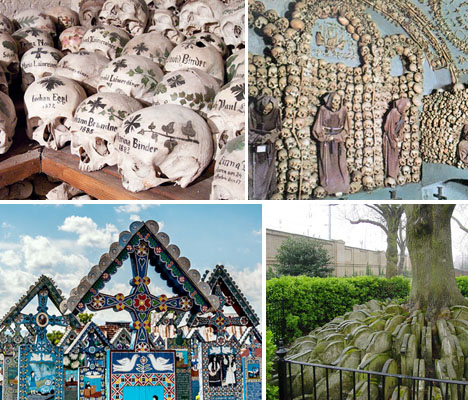
In America we have a seemingly endless succession of near-identical cemeteries, filled with orderly rows of bland stones that tell us nearly nothing about the people buried underfoot. But in other parts of the world, the final resting places of the dead are far more interesting, exotic, decorative and strange. Some tribes of the Pacific bury their babies in trees, while others hang their coffins from cliffs. Solemn ossuaries deep beneath churches in Austria and Italy hold thousands of hand-painted skulls, and colorful cemeteries in Romania tell dirty jokes about loved ones who have passed on.

Sedlec Ossuary, Czech Republic

Crazy Cemeteries Sedlec Ossuary 1

Crazy Cemeteries Sedlec Ossuary 2

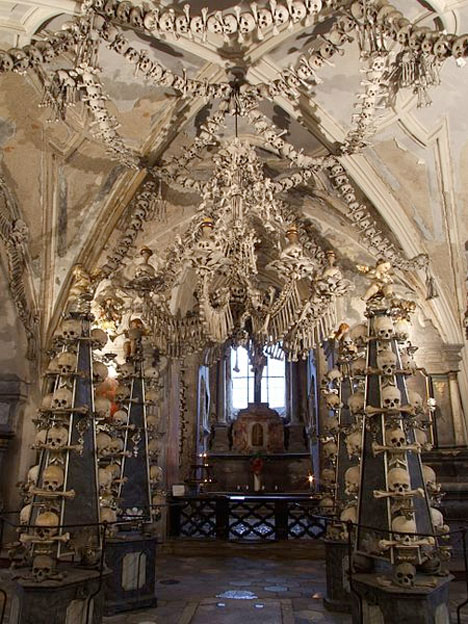
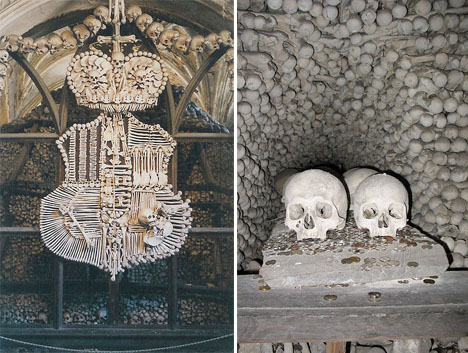
The skeletons of somewhere between 40,000 and 70,000 people are arranged in dazzling decorative patterns all over the walls and ceiling of the Sedlec Ossuary, a small Roman Catholic Chapel in the Czech Republic. Located beneath the Cemetery Church of All Saints, this subterranean ossuary attracts over 200,000 visitors per year who gape and gawk at garlands of skulls, a massive chandelier, ceiling patterns and other designs made of human bones.

Cliff-Hanging Coffins, Philippines

Crazy Cemeteries Hanging Coffins

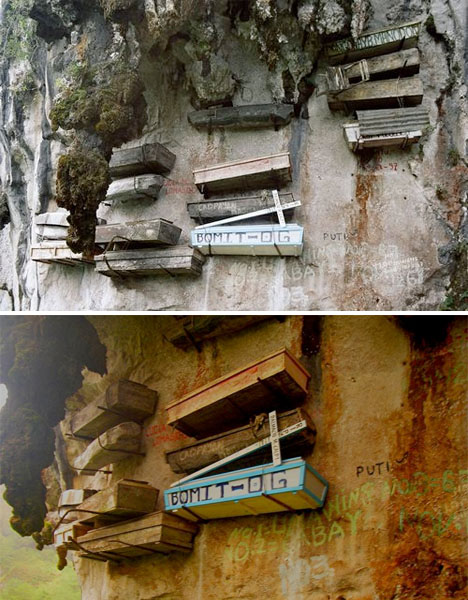
Coffins cling precariously to a cliffside at Sagada, on Luzon Island in the Philippines. Rebar is hammered into the limestone to support the coffins as part of a unique burial ritual; the coffins are typically made of hollowed-out logs. This tradition is thousands of years old, and some of the wooden coffins have begun to decay, providing glimpses of the skulls and other human remains held inside. Some of the coffins are in caves rather than clinging to the cliffs, making them more accessible. Unfortunately, not everyone is respectful of the customs, and there have been problems with tourists taking home bones as souvenirs.

City of the Dead, North Ossetia

Crazy Cemeteries North Ossetia City of the Dead

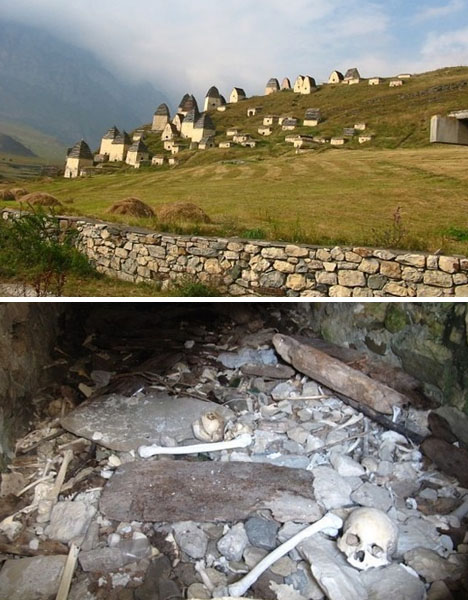
This looks like the remains of a medieval village, with small dwellings grouped together on a grassy hill. But go knocking on the doors, and you won’t find a living soul. That’s because this is the City of the Dead, an ancient cemetery near the village of Dargavs, Russia where residents have been burying their dead for hundreds of years. Legend has it that in the 18th century, a plague infected many of the townspeople. Those who didn’t have family to build quarantine houses for them and care for them simply went to the cemetery and waited to die.

Tree Graves for Babies, Indonesia

Crazy Cemeteries Baby Tree Graves

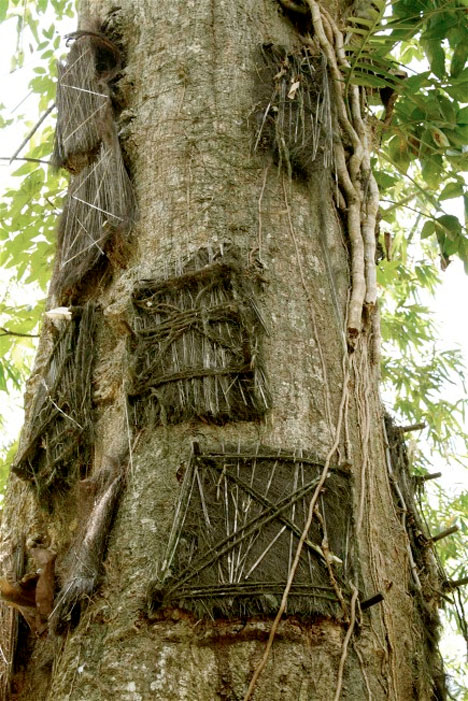
The small thatched doors on this tree in Indonesia are, sadly, not entrances to some kind of mythical fairy land. They’re graves for the babies of the Toraja ethnic group. The Torajans have a number of unusual death rituals, including hanging graves from ricky cliffsides like those in the Philippines. They also have a ritual called Ma’Nene, wherein the bodies of the deceased are exhumed, washed, groomed, dressed in new clothes and paraded around the village before being reburied.

Next Page – Click Below to Read More:
Tree Tombs Cliffside Coffins 14 Unique Cemeteries

Share on Facebook


[ By Steph in Global & Travel & Places. ]

[ WebUrbanist | Archives | Galleries | Privacy | TOS ]


WebUrbanist

 
Comments Off on Tree Tombs & Cliffside Coffins: 13 Unique Cemeteries

Posted in Creativity


Tree Tombs & Cliffside Coffins: 13 Unique Cemeteries

17 Dec

[ By Steph in Global & Travel & Places. ]

Crazy Cemeteries Main

In America we have a seemingly endless succession of near-identical cemeteries, filled with orderly rows of bland stones that tell us nearly nothing about the people buried underfoot. But in other parts of the world, the final resting places of the dead are far more interesting, exotic, decorative and strange. Some tribes of the Pacific bury their babies in trees, while others hang their coffins from cliffs. Solemn ossuaries deep beneath churches in Austria and Italy hold thousands of hand-painted skulls, and colorful cemeteries in Romania tell dirty jokes about loved ones who have passed on.

Sedlec Ossuary, Czech Republic

Crazy Cemeteries Sedlec Ossuary 1

Crazy Cemeteries Sedlec Ossuary 2

The skeletons of somewhere between 40,000 and 70,000 people are arranged in dazzling decorative patterns all over the walls and ceiling of the Sedlec Ossuary, a small Roman Catholic Chapel in the Czech Republic. Located beneath the Cemetery Church of All Saints, this subterranean ossuary attracts over 200,000 visitors per year who gape and gawk at garlands of skulls, a massive chandelier, ceiling patterns and other designs made of human bones.

Cliff-Hanging Coffins, Philippines

Crazy Cemeteries Hanging Coffins

Coffins cling precariously to a cliffside at Sagada, on Luzon Island in the Philippines. Rebar is hammered into the limestone to support the coffins as part of a unique burial ritual; the coffins are typically made of hollowed-out logs. This tradition is thousands of years old, and some of the wooden coffins have begun to decay, providing glimpses of the skulls and other human remains held inside. Some of the coffins are in caves rather than clinging to the cliffs, making them more accessible. Unfortunately, not everyone is respectful of the customs, and there have been problems with tourists taking home bones as souvenirs.

City of the Dead, North Ossetia

Crazy Cemeteries North Ossetia City of the Dead

This looks like the remains of a medieval village, with small dwellings grouped together on a grassy hill. But go knocking on the doors, and you won’t find a living soul. That’s because this is the City of the Dead, an ancient cemetery near the village of Dargavs, Russia where residents have been burying their dead for hundreds of years. Legend has it that in the 18th century, a plague infected many of the townspeople. Those who didn’t have family to build quarantine houses for them and care for them simply went to the cemetery and waited to die.

Tree Graves for Babies, Indonesia

Crazy Cemeteries Baby Tree Graves

The small thatched doors on this tree in Indonesia are, sadly, not entrances to some kind of mythical fairy land. They’re graves for the babies of the Toraja ethnic group. The Torajans have a number of unusual death rituals, including hanging graves from ricky cliffsides like those in the Philippines. They also have a ritual called Ma’Nene, wherein the bodies of the deceased are exhumed, washed, groomed, dressed in new clothes and paraded around the village before being reburied.

Next Page – Click Below to Read More:
Tree Tombs Cliffside Coffins 14 Unique Cemeteries

Share on Facebook


[ By Steph in Global & Travel & Places. ]

[ WebUrbanist | Archives | Galleries | Privacy | TOS ]


WebUrbanist

 
Comments Off on Tree Tombs & Cliffside Coffins: 13 Unique Cemeteries

Posted in Creativity


6 Tips for Creating Unique and Emotion Filled Wedding Photos

15 Sep

A post by wedding photographer Susan Stripling – one of the course presenters in this weeks Creative Live Photo Week – an event that showcases teaching by 50 photographers across 3 tracks including Weddings and Family.

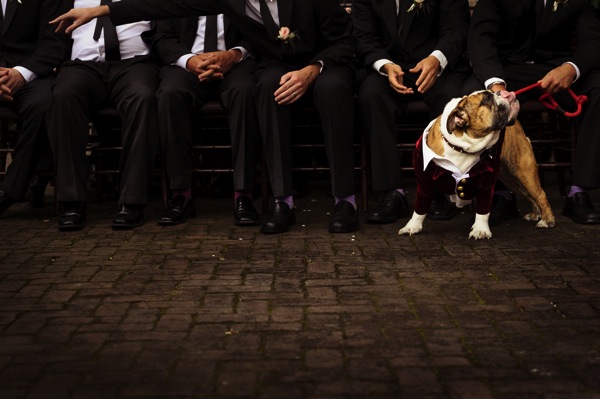
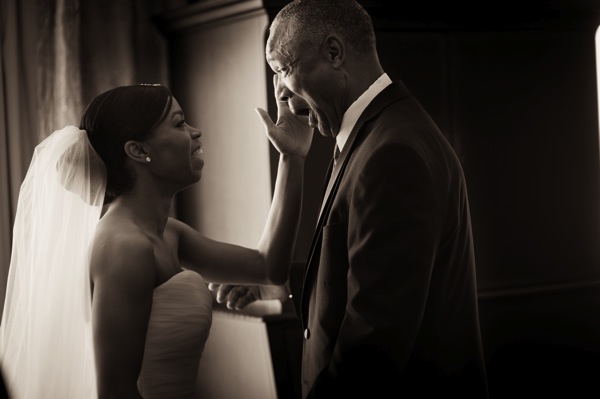
The best wedding photographers know how to create not only beautifully composed images, but also the moments of emotion and connection at the core of every dynamic wedding story. Focusing on capturing these unique, organic moments allows you to tell a story that’s true to the couple you’re working with. Here are some tips for finding and capturing the images that keep a wedding story dynamic and fresh.

Wedding photography emotion

1. Build the Right Relationship with the Right Client

It’s important to assess whether a client is the right match for your photography style and the stories you’re good at capturing. When you’re consulting with clients, ask questions about what exactly they want, and consider whether you’re prepared to offer the services they want. Once you’ve decided to work with a couple, cultivate a positive, communicative relationship. You don’t have to be best friends with every couple that you shoot, but a basic level of trust helps clients to be themselves on the wedding day. The more comfortable they feel with you, the more moments you’ll be invited to shoot.

2. Be Prepared

To capture unique moments, preparation is essential. Before you show up to shoot a wedding, think through the choices you’ll make about gear, lenses, equipment, and lighting. It’s inevitable that plans will change on the day of the wedding, and that’s okay. Being prepared doesn’t mean you have to be inflexible.

Wedding photography emotion 1

3. Check your Composition

If an image is too soft or technically imperfect, you can’t share it with clients. A poor image of a great moment is essentially the same thing as no image at all. Remind yourself of the basics both before and during a shoot. Be mindful of focusing and recomposing with the f-stops you choose, and make sure your shutter speed correlates with the lens you’re using.

4. Be aware of the Background

Nothing spoils a dynamic image more than a random person wandering through the background or an angle that makes everyone in the room look like they have lampshade hats on. Don’t just focus on the subjects of each image – focus on the entire frame.

Choose backgrounds that either enhance an image or that are clean and simple. For example, you might decide to photograph rings against the background of other sparkly jewellery the bride plans to wear. Or you might decide that it’s better to have a clean, simple background instead.

Wedding photography emotion 2

5. Challenge Yourself

When I’m photographing a wedding, I like to challenge myself to see how many unique moments I can capture in one single frame. This allows me to tell stories that are more complex. I might be able to catch the mother of the bride’s reaction as the bridesmaids help her daughter into her dress, or I might capture the flower girls dancing along to a couple’s first dance.

If you’re telling multiple stories in a single frame, each aspect of the story has to be dynamic and engaged. Make sure everyone in the frame is doing something interesting; no couple wants an image from their wedding day where half the people look bored. Know when to focus on a single, super-impactful image instead.

6. Watch and Wait

Watch for shots that both capture a unique moment and help advance the overall wedding story you’re telling. The balance between patient and proactive can be hard to strike, but it’s important.

Create a calm atmosphere and be a chilled presence – don’t constantly have cameras in people’s faces and shutters consistently going off. When a moment starts developing, be assertive about getting the shot you need, but find a way to do so without being intrusive.

Give the couple space to emote, but also be aware that some people might not be outwardly emotional, and that’s okay too. Capture the couple as they are, without trying to force specific moments, reactions, or feelings.

For more wedding photography tips, check out Susan’s upcoming creativeLIVE course during Photo Week which starts on Monday.

Photoweek logo

Susan Stripling is a world-renowned wedding photographer. She has won some of the photography industry’s most prestigious honors including 1st place in WPPI’s Wedding Photojournalism category and the Grand Award for Photojournalism. Susan has photographed weddings all throughout the US, the Caribbean, South America, Finland, France, and the Bahamas.

Post originally from: Digital Photography Tips.

Check out our more Photography Tips at Photography Tips for Beginners, Portrait Photography Tips and Wedding Photography Tips.

6 Tips for Creating Unique and Emotion Filled Wedding Photos


Digital Photography School

 
Comments Off on 6 Tips for Creating Unique and Emotion Filled Wedding Photos

Posted in Photography


How To Take Ridiculously Unique Photos

08 Sep

Take ridiculously unique photos 1

by Steven McConnell

How do you make your photography more meaningful, moving and unique?

Lately, I’ve been fascinated with the idea that our motivations significantly influence the quality of photography we create.

This sentiment is expressed particularly well in The Foutainhead by Ayn Rand. The character is an architect, rather than a photographer, though his lessons apply to any artist who wants to create great work:

“Nothing can be reasonable or beautiful unless it’s made by one central idea, and the idea sets every detail. A building is alive, like a man. Its integrity is to follow its own truth, its one single theme, and to serve its own single purpose.”

Pleasing Everyone Doesn’t Work

In the novel, the hero makes a strong point that, when artists attempt to fulfil on competing needs they tend to create uninspiring, soul-less compromises.

In the context of architecture it might look like this:

  • A building gets an impressive facade, because the owners want to impress the neighbours.
  • It adheres to rules of traditional architecture, because that’s what the architect’s boss wants.
  • It features a striking look, because the architect knows its a good way to attract some publicity to himself.
  • Its materials are dictated by the budget, rather than their suitability for the task.

And so on.

The hero’s point is that the most beautiful building is one which follows a single, unyielding purpose: to create most liveable space for the people who will inhabit it.

Take ridiculously unique photos 2

Why Do We Take Photos?

I think as photographers, we often fell into the same trap. We are either unconscious to our motives, or we consciously lose focus because we try to satisfy too many ends.

In doing so, we cease creating art and start creating generic commodities.

What Drives Us?

I’ve been paying a lot of attention lately to what drives me and how it affects the photography I create.

For me personally, I notice that photography serves as a means to these ends:

  • A way to escape from something.
  • A way to get approval.
  • A way to challenge myself.
  • A way to make a difference.

Neither one of them are right or wrong, better or worse. But some are more conducive to a more powerful focus. Which, in turn, brings about stronger results.

Photography Assignment

Let’s say I have a day off and I decide to spend it taking photos. Where do I go? What do I photograph? Who do I show the photos to?

If I approach the day from a space of needing approval, for example, then my focus will be extremely broad. Anyone or anything which gives me recognition will satisfy that need.

I am free go take snaps of everything from the Opera House to my neighbour’s cat, and show off what I did to my friends, family, other photographers on online forums and so on.

Take ridiculously unique photos 3

Narrowing Focus

However, if I consciously decide to make this day about making a difference to someone, then my focus narrows significantly.

I can still go take a photo of the Opera House, for example. But a pretty picture, which has also been taken by millions of people, won’t do now.

If I’m going to hold myself to account and really make this day about making a difference to someone through my photography, I’ll need to dig much deeper.

Creating Art

I’ll probably look at the issues surrounding it today (art vs politics, need for funding and redevelopment, modern society vs art, budget cuts, people who make it all work) and attempt to take photos which tell those stories in a powerful way.

My audience would also be much more narrow – I’ll have to connect with people who have a need for such photos and offer it to them as a gift.

In the end, 99.999% people in the world would never see, or appreciate those photos. But those who do, because they really have an interest in the story I’ve told, will be touched forever.

Default Isn’t Good Enough

If left to our own devices, our brain will pick a purpose for us, depending on the wiring from our past.

Because we’re human, most of the time we default to the “escape” and “get approval” kind of space. Unfortunately, that headspace gives rise to generic kind of results.

Escape is a powerful motivator, but it’s vague. You can escape anywhere, doing just about anything you’re trying to escape from.

Desire for approval is even more powerful, but it comes hand in hand with a fear of disapproval, which makes it difficult to say something original.

I find that I produce best photography when I consciously come from “challenge myself” or “make a difference” type of mindsets.

Take ridiculously unique photos 4

Purpose Is Changeable

We are in control of our motives – not the other way around. Which means we’re entirely in control of the level of photography we produce.

The first step is awareness. Moment by moment, we can ask ourselves – what’s driving me now? What end am I serving?

The second step is change. If we discover that we’re serving too many masters, we can change our purpose to one which gives us a more powerful focus.

So, what’s your photography assignment for today? And, more importantly, why?

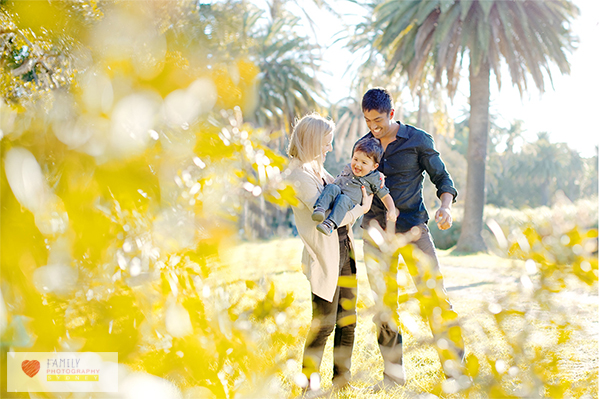
Steven McConnell is a family photographer at Family Photography Sydney. You can connect with him on Google+. and Twitter.

Post originally from: Digital Photography Tips.

Check out our more Photography Tips at Photography Tips for Beginners, Portrait Photography Tips and Wedding Photography Tips.

How To Take Ridiculously Unique Photos


Digital Photography School

 
Comments Off on How To Take Ridiculously Unique Photos

Posted in Photography


Ten unique cameras from the dawn of consumer digital photography

21 Aug

coolpix100_hand-trans2.png

Do you remember having to change floppy disks on your Sony Mavica? Or perhaps plugging your Coolpix 100 into the side of your laptop? The early days of consumer digital photography were filled with cameras that broke new ground, though not necessarily in directions that were widely adopted. In this article, DPReview’s Jeff Keller takes a look back at ten unique cameras from the era of PC Cards and SCSI ports. Follow the link to explore some of the interesting dead-ends of early digital photography.

News: Digital Photography Review (dpreview.com)

 
Comments Off on Ten unique cameras from the dawn of consumer digital photography

Posted in Uncategorized


Canon announces unique Vixia Mini camcorder with fisheye lens

01 Aug

VIXIA-Mini-5main2.png

Looking more like a projector than a camera, the Canon Vixia Mini made its debut today, its aim to serve bloggers, youtubers and apparently guitarists. Its 16.8mm equivalent fisheye lens is designed to capture video and stills with a unique perspective, and users can switch from wide to close-up mode while recording for an interesting live ‘cut’ effect, while maintaining Full HD video recording. Its built-in touch-sensitive LCD flips to face forward or backward, and a tripod mount can hold the device firmly in place. Click through for more information, and images.

News: Digital Photography Review (dpreview.com)

 
Comments Off on Canon announces unique Vixia Mini camcorder with fisheye lens

Posted in Uncategorized


How To Create Your Own Unique Textures and Apply Them To Your Photography

16 Jul

I would like to take you through a journey today and show you how some very ordinary looking photographs of the world around us can be combined to create some very interesting and one-of-a-kind pieces of art. Some might argue that what I’m doing is no longer considered photography, but I’d argue that everything presented within the final image was at one point captured using a camera, and therefore still falls under the category of photography albeit slightly manipulated.

The world around us is filled with textures and abstract patterns that often go overlooked in pursuit for larger more dramatic subjects. No matter what type of photographer you are and whether or not you’d go so far as to do what I’m sharing today I do think it’s worth it to spend some time learning about how to capture these kinds of images as it will help you see the world differently.

Texture-11

So What Is A Texture?

Texture in art (at least in how we’re using it today) can be defined as: the visual ”feel” of a two-dimensional work.

When I first started getting into photographing textures I wasn’t sure that it could be all that interesting. I thought that a texture had to be something very traditional like sand, or wood, or rust. I soon realized that in reality just about anything can be considered a texture if you want it to be, you just have to use it as such in your final image.

That said I do think the best textures are more abstract images with a bit of depth to them. If the image you’re using as a texture is too clearly defined then you’ll end up having a difficult time separating your texture from the subject of the image you end up applying it to.

Capturing Textures

texture2

There are simple textures like – wood, rust, paint, sand, stone – and more complex textures like – a dirt path through the woods, a canopy of a forest, a collection of flowers, the list goes on forever.

Ideas to Keep in Mind When Capturing Textures

  • Fill the Frame
  • Look for Compositional Elements (Like the beam in the photo above)
  • Don’t rule something out just because it doesn’t look like a texture.
  • Don’t worry too much about your camera’s settings
  • Be creative

Texture-8

Creating & Using Textures in Your Workflow

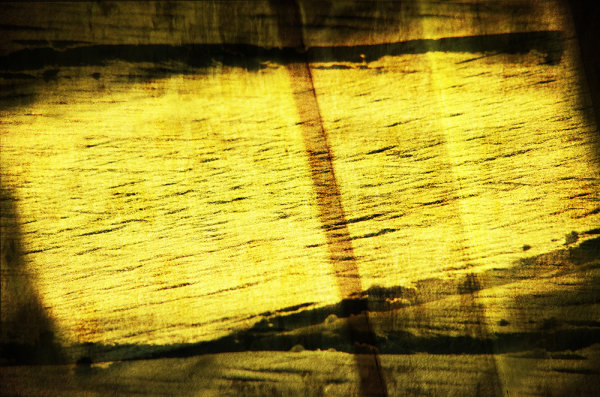
The first step in the process is to take the individual textures that you’ve collected and create your own unique texture.

Texture-8

This texture is the image that I applied to the lightning bolt photo at the bottom of this post and is a combination of the three textures that you’ve already seen above (the waterfall, the ceiling and the frozen lake).

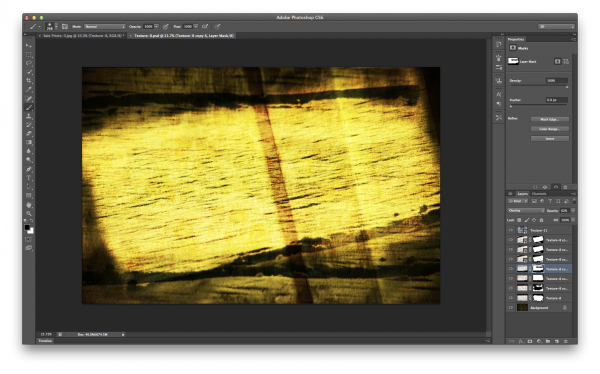
I won’t go through every step, but instead I’ll give you a general idea of how I went about creating this texture in a simple five step process that you can use as a guideline to create your own.

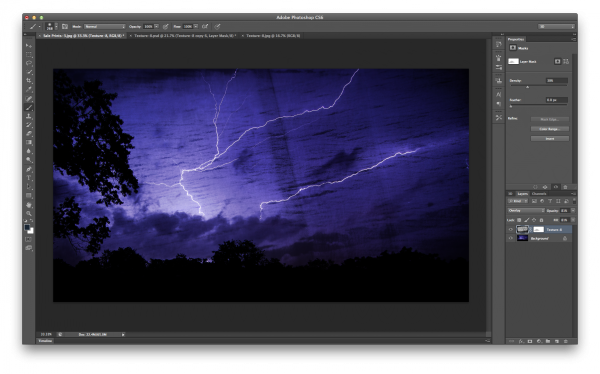
Screen Shot 2013-07-14 at 4.01.37 PM

Click to Enlarge

  • Bring all your textures into photoshop as different layers
  • Determine what you’d like the strongest element of your texture to be – here I choose the ceiling and placed it as the bottom layer (the background).
  • Determine if you want to duplicate any of your textures for a stronger appearance . Here I choose to duplicate the frozen lake a total of 7 times.
  • You don’t have to keep all your layers in the same orientation. Here I’ve rotated two of the frozen lake layers slightly and flipped one upside down. I then applied various layer masks and blending modes to get the final look that I wanted.
  • Play with different blending modes. I find that overlay is my go to blending mode, but subtraction and soft-light work well too. Try them all and have some fun – after all this is creative expression through experimentation!

Once I create the texture I save it as a JPEG and toss the PSD. I find that there’s no need to really save the PSD as they take up more space and if I want to change the texture in the future I’d rather just try and create something completely different than make subtle changes to one I already have. Of course you’re free to do that differently if you so choose.

The next step is to apply our newly created texture to our subject photo and create our final piece of photographic art. To do this you pretty much do the same process as we went through above. Bring your texture and your photo into Photoshop as layers, set your photograph as the background and then blend your texture into your photograph.

Screen Shot 2013-07-14 at 4.44.02 PM

Click to Enlarge

For this photograph I dropped my texture in on top of the lightning bolt photo, popped it to an overlay and reduced the opacity slightly. I then applied a quick mask to remove some of the brightness that was created around the base of the lightning bolt, and finally converted the textured layer to black and white to let the true colors of the background layer show through.

I realize this style of processing photography isn’t for everyone and I might be pushing the limits of creativity and for some this might be too much, but I do find it fun and enjoyable to go about creating these images and I hope you’ve learned something today and maybe even got inspired to try it yourself.

A Few Examples Before I Go

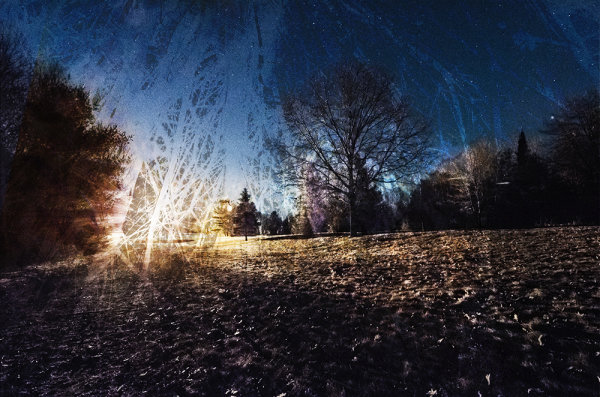
In closing I’d like to share with you a few examples of what I’ve been able to come up with so far and I hope you enjoy what I’ve created.

Some Fun with Textures

TexturedExample3

lightningtextured

Post originally from: Digital Photography Tips.

Check out our more Photography Tips at Photography Tips for Beginners, Portrait Photography Tips and Wedding Photography Tips.

How To Create Your Own Unique Textures and Apply Them To Your Photography


Digital Photography School

 
Comments Off on How To Create Your Own Unique Textures and Apply Them To Your Photography

Posted in Photography


Panasonic adds ten unique designs to their budget-friendly Lumix XS1

27 Apr

DMC-XS1PZK05-trans.png

Panasonic is now offering its Lumix DMC-XS1 compact camera – which was first introduced at CES in January – with ten custom ‘skins’. The themes for these skins include pop art, gift wrapping, floral nature, digital, texture, and Japanese traditional. The XS1 features a 16 megapixel CCD, 5X (24-120 mm) optical zoom with image stabilization, a 2.7″ LCD, and 720p video recording. Pricing for the new ‘skinned’ models isn’t available quite yet, though the traditional red, silver, and black XS1 sells for $ 129. We don’t know yet if these designs will be available outside of the US in the future.

News: Digital Photography Review (dpreview.com)

 
Comments Off on Panasonic adds ten unique designs to their budget-friendly Lumix XS1

Posted in Uncategorized