RSS
 

Posts Tagged ‘Tips’

Photography Tips From Fine Art Photographer Huntington Witherill

22 Oct

www.silberstudios.tv Fine art photographer Huntington Witherill joins us today on the Marc Silber show to share tips about photography and his views on the process as a whole. He reminds us that it is important to focus on the process of being the photographer rather than constantly looking to get the next photograph or image. A passion for the medium is one of the most important components—being engaged and passionate about anything takes a lot of patience, persistence and hard work. Huntington also advises people to get rid of preconceptions when going out to a location to shoot photos. It’s easy to carry a preconceived idea when you’re going to a specific place, but you might happen upon something completely different that creates an amazing photo. As for practical tips, he believes that 2D design classes are helpful for visualizing composition for photographs. Learning how to arrange forms and lines is useful for creating balance and a sense of purpose in a photograph.
Video Rating: 5 / 5

New Directions in Contemporary Photography Charlotte Cotton, Anne Hardy, Clarisse D’Arcimoles and Aaron Schuman in conversation 7.30pm, Monday 17 January 2011 www.saatchigallery.com One of the great paradigm shifts in contemporary art over the past 20 years has been the movement of photography into the realm of fine art. The critical and commercial success of artists such as Wolfgang Tillmans, Thomas Struth and Andreas Gursky, who are represented by contemporary art galleries, and the appointment of photography curators to top public galleries such as Tate Modern and Guggenheim, has ensured that the medium is increasingly regarded as a vital part of contemporary artistic practice. With digital techniques of manipulation becoming more and more advanced, photography stands to continually develop and change as a tool for artists. Given that the first photograph was produced in 1826, why did it take so long for photography to be accepted by the art world? How reliable is a photograph as evidence of the real world? What makes a documentary photograph different from a ‘fine art’ photograph? How will the increasing impact of digital manipulation impact upon the medium? What might the future developments in photography be? These are some of the questions that curator Charlotte Cotton, photographers Anne Hardy and Clarisse D’Arcimoles and Aaron Schuman will discuss as they explore the most pressing questions regarding photography today. Speakers Aaron Schuman Aaron Schuman is a

 
Comments Off on Photography Tips From Fine Art Photographer Huntington Witherill

Posted in Photography Videos


Tips on How to work with Models

22 Oct

A Guest Post by David Haworth.

Lucy 21 sml

I’ve no doubt you’ve read many articles on the ins and outs of portrait photography. Many words have been written giving advice on the use of flashes, studio lighting or using natural light on location. Posing techniques and making the best use of the subject’s features, while addressing each model’s physical attributes, are covered in a myriad of magazine and online articles.?
The purpose of this article is to share my experiences with you, and by doing so I hope to help you avoid the mistakes I made and give you the benefit of advice passed down to me by experienced mentors

Elizabeth 5 sml
?You have made contact with a willing model (for this article’s purposes, a female) and wish to know how to proceed. If at all possible I advise you to meet with the person first. This will give you a good idea of her personality, her confidence level, her physical appearance and put you on a friendly footing. Photographers planning involved shoots with props and stylists will often use a test shoot to assess potential models. ??At the very least, move beyond the impersonal communications of texts and internet messages and call her on the phone to discuss her expectations and your requirements. Part of the enjoyment of doing portrait shoots on a regular basis is meeting new people and developing your people skills. I was quite shy and not a really good conversationalist. I had to learn to initiate conversations and really listen to my model. If you are being comfortable with yourself, you will project an air of confidence to the model, which in turn will help make her at ease. This will come with practice.?
My advice on meeting a model, at the start of a shoot, is to leave your camera in its bag and to engage her in conversation. If you can find some area of common interest it will break down barriers quicker. Ask her questions about her previous modeling experiences, her clothes or makeup and be genuinely interested in her answers.

Drea 7 sml
?Remember, she may have a degree of nerves and trepidation about being in front of a camera with a photographer she does not know.?
I approach a shoot with the realization that unless the model is very experienced, the first 30 minutes of the shoot will rarely produce the best images. This is the period of building a rapport with the model and getting her comfortable with you and the camera. If you are on location I suggest the best areas of the locale be saved for the latter half of the shoot.??If you are in a studio setting I am a believer in the power of music to create a comfortable ambience. I provide a player and ask the model to bring music she enjoys. This is played as background music allowing conversation and interaction.
?While shooting there are a few rules I have made for myself. I find the model appreciates being shown the progress by reviewing the camera screen at intervals. Often they will pick up on awkward shapes, slipped bra straps and have suggestions of how they can improve what they are doing. This also involves the model in the process. Some models have told me that they don’t like working with photographers who decline to do this. Always be respectful and professional in your interactions. This does not mean that you cannot have fun and one of the best comments you can get at the end of a shoot is “I really enjoyed that!”??If you are working to a concept, either keep the concept photos in your head or on your phone. Don’t show your model photos of other models. Your model is the most important person in the world while you are shooting.

Rebecca 4 sml

Praise while shooting will give positive reinforcement and spur her on to better things. To point your lens and just shoot, is to have the model working in a vacuum.  If you engage your model in conversation while you are shooting you will create an atmosphere of camaraderie. You will find when you are working well as a team that the shoot will flow. The model will respond to the click of the camera or the flash of the strobe as an indication that she is finding the right look and position and will be encouraged to find new poses.??New and inexperienced models will need direction on the shoot. Point out to them that they do not need to look at the camera and many of the most attractive photos will be when she is looking away. Move in and out and around your model, ask her to change position of her own volition and if she finds a great position, this is the time to stop her with a superlative and work to refine that photo with small adjustments. Beginner models need to be shown how to move and refine positions in very small incremental movements. Alternatively it is just as acceptable to free shoot with your model and let the shoot happen organically with little adjustments from you. ??Variation in expression is important. You don’t want a camera full of images with the one expression. Ask your model to remember things that made her happy, sad, melancholic or any other moods she can think of. When you are confident in your rapport ask her to play-act scenarios. Variations such as mouth open, half open or closed and even eyes shut should be tried. Asking a model to close her eyes and imagine something and then open her eyes before you shoot can produce good results. Use movement even to the point of blur. Dancing around will often produce a sense of fun and physically relax the model. Dancers often make wonderful models as they have a great awareness of their bodies.??One of the best pieces of advice I was given is to consider that you will only ever be in the one place with this model at this time and to make the most of it. I was capturing up to 200 images per three hour shoot. I now shoot between 400 and 500 images. Capturing that pose with the right expression is more likely to be a success if you maximise the possibilities.??Zoe 1 sml

When the shoot is finished, be prompt and professional. Your model will be very interested in the results. Try not to make them wait longer than necessary. Every photographer will have their own way of dealing with this process. My choice is to shoot small Jpeg along with RAW and upload a PRIVATE set of Jpegs to my Flickr pro account with an emailed invitation to view. This can be done on the evening of the shoot and I then can process the model’s choices as well as my own favourites. Surprisingly these only occasionally coincide. I then email small web size images as I process them so the model can upload them to the web as she sees fit.??Models can be found on the websites Model Mayhem and Starnow
?It’s best to join these websites when you have at least 8-10 quality images as models will look at what you can do when you approach them. Photograph friends and acquaintances, ensuring you get their permission to show their photos on the web.
?Facebook is a great place to meet models and makeup artists and get inspiration from other photographer. I have a personal page and also a fan page where I promote my photography. Most models you will shoot will have a Facebook page and will know other people in the industry. Women’s fashion retailers, both mainstream and alternative clothing companies have pages and you will soon build a network of models, photographers ?hair stylists and makeup artists. It’s a good idea to comment on other’s photos when you see impressive work and you will become well known to them and they will encourage you when you post your work. There are also groups such as Women in the Industry and Artistic Collaborations where you can arrange to work with others or find collaborators for your projects.?When you have a body of work, be sure to set up a website as well, as not everyone uses Facebook. Print some business cards with your website email and Facebook fan page addresses and hand them out at all opportunities.??Working with models creating unique and personal images is fun, challenging and ultimately very rewarding.

See more of David Haworth’s work at his website and connect with him on Facebook.

Post originally from: Digital Photography Tips.

Check out our more Photography Tips at Photography Tips for Beginners, Portrait Photography Tips and Wedding Photography Tips.

Tips on How to work with Models


Digital Photography School

 
Comments Off on Tips on How to work with Models

Posted in Photography


Article: Fashion Shoot Tips from a Pro

21 Oct

Gallagher_090512_0702.jpg

With beautiful models, elaborate lighting set-ups and an army of willing assistants, the idea of a fashion shoot can seem very glamorous. In this article, professional photographer Martin Evening takes you behind the scenes with a look at the amount of often mundane preparation that goes into making a beauty or fashion shoot come off seamlessly. Click through to find out why taking the picture is ‘the easy part’.

News: Digital Photography Review (dpreview.com)

 
Comments Off on Article: Fashion Shoot Tips from a Pro

Posted in Uncategorized


Halloween Photography Tips

21 Oct

Halloween-Photography-Tips-1
Photo by Maharepa

With Halloween just around the corner I thought it was time to update our Halloween Photography Tips article with some new information and photos.

Photography Tips to Keep in Mind for Halloween

There are plenty of subjects around to photograph at Halloween ranging from the traditional jack-o-lantern through to people in costume, to trick or treat ‘treats’ etc. It’s a time of color, emotion and lots of interesting subjects.

The keys to capturing them are not that different from the normal keys to good composition in photography. As you photograph Halloween this year keep in mind some of the basics of good digital photography. I’ve selected the following tutorials that we’ve written before that should be helpful in your Halloween photography:

Get more tips like this by Subscribing to Digital Photography School

Find Points of Interest
Halloween-PhotographyPhoto by Sara Heinrich

Before hitting the shutter ask yourself ‘what is the focal point (or point of interest) in this image?’ All good images have something in them that holds the attention of those who view them – learn more about focal points and how to enhance them here.

Rule of Thirds

One way of enhancing the composition of your shots is to place your points of interest inn smart positions. While the rule of thirds can be broken with great effect it’s a useful principle to keep in mind.

Fill Your Frame

Halloween is a time of drama and you can add to this in your images by getting in nice and close and filling the frame with your subjects. Whether it’s people or objects – getting in nice and tight will usually add punch to your shots.

Give Subjects Space to Look into

When photographing people one of the most effective compositional techniques is to use the space around their faces effectively by giving more room on the side of their face that they’re looking into.

Find Fresh Angles

Halloween-TipsPhoto jen clix

I suspect that the day after Halloween that photo sharing websites will be filled with images of pumpkins that all look much the same. Make your images stand out by finding fresh perspectives to shoot from.

Photograph the Details

It’s easy to be distracted by the flashy parts of a time like Halloween but it’s often when you step back, take a look around and notice the smaller details that you find the ‘money shots’. Times like Halloween are filled with all kinds of smaller details and photo worthy moments including decorations, carving the pumpkin, people getting dressed in costumes, sleeping kids at the end of parties, bags full of treats at the end of the night, the ‘fangs’ in Aunt Marie’s mouth, before and after shots of parties, close ups of food etc

Group Photos

Halloween is a time that people gather together and it’s an ideal time to practice your group photo techniques.
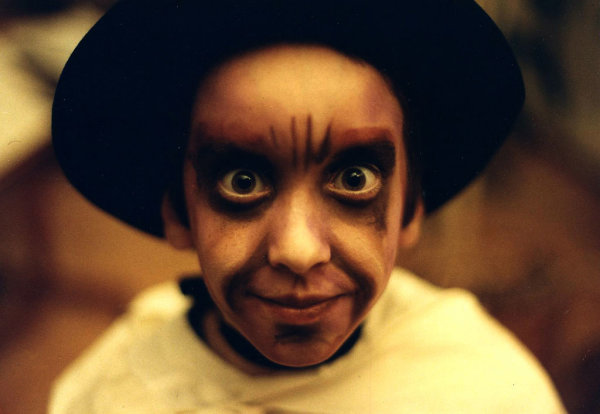
Image by John Althouse Cohen

Candid Photography

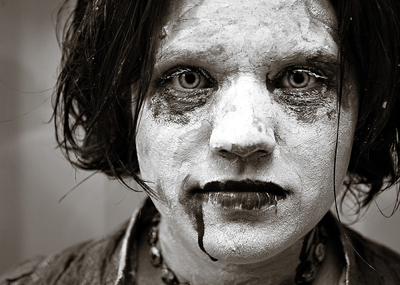
Halloween parties are a great time to get your camera out for some candid photos of your friends and family having a great time dressed up in all manner of costumes. Check out these 11 candid photography techniques.

Shooting in Low Light
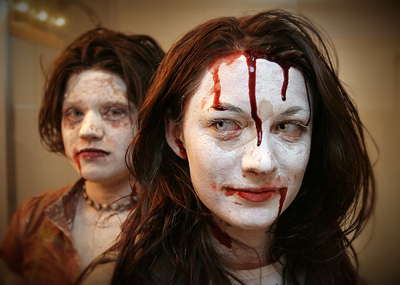
Halloween-Photography-TipsPhoto Sara Heinrich

The type of images that come to mind when I think of Halloween are fairly dark and spooky ones – candles in pumpkins etc. After all, the real action of Halloween seems to happen after dark. As a result you’ll want to think carefully about the light sources for your shots.

To really capture the mood of these situations you’ll want to avoid the stark and bright light of flash photography (or will want to at least pull it back a few stops and diffuse it) and so you’ll need to switch off your flash and do one (or all) of three things to some extent (this is from our exposure triangle series of posts):

  • increase your ISO – the larger your number the more sensitive your image sensor is to light and the darker conditions you can shoot in without having to slow down shutter speed. On the downside you’ll get more grainy/noisey shots.
  • slow down shutter speed – choosing a longer shutter speed lets more light into your camera. On the downside you’ll see any movement in your shots blur (which might add to the spookiness of the image but could also ruin it). Consider using a tripod if you lengthen your shutter speed.
  • use a larger Aperture – this widens the hole in your lens and lets more available light in. It will also lessen the depth of field in your shots. If you have a DSLR with a few different lenses is to use the ‘fastest’ lens you own as it will let you choose larger apertures. For example my f1.4 lens handles low light much better than my f4 lens.

Diffuse Your Flash

HalloweenPhoto base10

Another strategy that I’ve heard of some readers doing at this time of year is diffusing the flash on your camera with colored cellophane to try to lesson its impact upon your shot and also to give the light it produces a glow that might add to your shots – Red might be a good color to try. You’ll probably want to test this before the big night as getting the right density of diffuser will be critical.

Jack-o-Lanterns

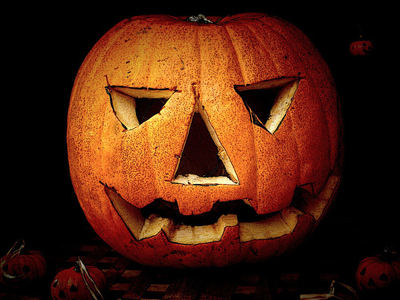
Photographing Jack-o-Lanterns is particularly tricky as to get the full effect of the glowing inside the pumpkin is a bit of a tightrope walk between overexposing and underexposing due to the light and dark patches in the shot you take. Instead of just one candle inside it is probably worth using two or three to give a little extra light. Also take a number of shots at different exposures (exposure bracketing) and you should get one or two that give you the impact you’re after.

Got some Halloween Photos to Share? Post them we’d love to see them over at our Forum.

PS: here’s one more shot from one of our forum members who has submitted some amazing pumpkin carving photographs here:
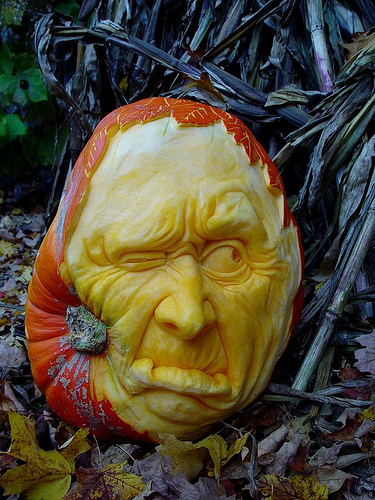
Halloween-Photography-Tips-2

Get more tips like this by Subscribing to Digital Photography School

Post originally from: Digital Photography Tips.

Check out our more Photography Tips at Photography Tips for Beginners, Portrait Photography Tips and Wedding Photography Tips.

Halloween Photography Tips


Digital Photography School

 
Comments Off on Halloween Photography Tips

Posted in Photography


Surf Photography: Chris Burkard’s Tips for Taking Great Outdoor Photos

20 Oct

www.silberstudios.tv We’re at Silber Studios with our guest Chris Burkard, a freelance surf photographer known for his distinct and creative photos. Unlike many professional photographers, 23-year-old Chris has not had formal training; instead, he developed his photography techniques through lots of practice with composition and natural lighting. His tips on composition and style will help any amateur photographer take better photos. I’m envious of the slew of big-name clients he’s managed to gather. Chris Burkard has been the Senior Staff Photographer for Water Magazine and Surfline.com and has already published his first book, The California Surf Project. Chris won the first annual Follow The Light Foundation grant and has worked with more than 35 national and international surf publications, including Surfer, Surfing Magazine and many others.
Video Rating: 4 / 5

An introduction to using long or telephoto dslr camera lenses. Lots of people have asked to have camera lenses explained and this is just one of our videos which will help you understand all about your camera lenses. To have camera lenses explained in full visit the lenses section of our video site www.photographycourses.biz for unique content that’ll explain all.
Video Rating: 4 / 5

 
Comments Off on Surf Photography: Chris Burkard’s Tips for Taking Great Outdoor Photos

Posted in Photography Videos


Top 5 Tips on How to Photograph Food

20 Oct

A Guest Post by Deidra Wilson.

Food Photographer Vegas Deidra Wilson DPS

Many of you may want to step up your food photography from iPhone to fabulous, but you’re sure that it’s quite impossible to do without a food stylist and ten grand worth of gear to help you make that dish look amazing. I am living proof that that’s just not the case. If you have a team that is willing to work hard and a location that allows for great lighting, you’re more than halfway there.

1. Work with a great Team – Even if You’re the Only One on it

Since you likely don’t have a food stylist, make sure you have a chef that’s willing to go above and beyond when it comes to plating the dish. You want everything to be brightly colored and placed neatly. Any garnishes should be super fresh (no wilted greens, please!). Sauces, when used as decoration, should be bright and shiny. Since you don’t have a stylist, you’re in charge of styling the food on the plate. Look through your lens and take a few test shots. Look at the images and determine what (if anything) is detracting from the image. If there is, fix it and try again!

2. Keep it Fresh

If you must photograph for an extended period of time, you may wish to replace parts of the dish as needed. For example – melted cheese will harden quickly and no longer appear appetizing. If you are photographing any type of meat, it will likely start to release juices that will mar the plate. Re-plate it and keep shooting! It’s better to take the time to redo something, rather than try to correct it in post-production.

3. Focus on the Details

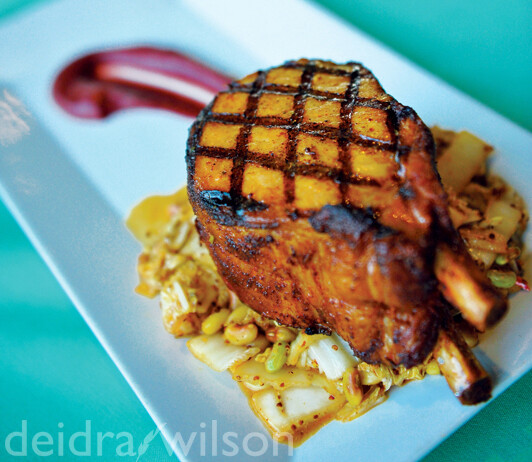
For example, if you have a piece of meat that is grilled, make sure those grill marks are beautifully straight and perfectly criss-crossed. If you have a sushi roll, make sure the pieces are placed in an appealing manner and that any details like sauces or garnishes aren’t detracting from the image. Sometimes less is better when it comes to food photography. A plate with too much going on will easily detract from the star of the image.

4. Use an Abundance of Natural Light whenever Possible

Natural daylight tends to be the most flattering for any subject, food included! I love to shoot food right next to a big window. You can either backlight it by shooting into the light, or use the available light to light your image. If you must use lights, try to use daylight-balanced hot lights or strobes (around 5000K if possible). This will nearly replicate natural light and allow you to achieve beautiful results.

5. Use a Shallow Depth of Field

This creates interest and drama in the subject and allows you to make the best of the available light. When you shoot with a shallow DOF, you’ll want to keep the focal point towards the front of the image. So, if you’re photographing a sushi roll, don’t focus on the pieces furthest from your lens – focus on the piece closest to the front and let the rest of the roll elegantly fade into a beautiful bokeh.

Overall, have fun with it! I’ve been photographing food as a commercial photographer for more than a decade. Every shoot is different and I’ve worked under nearly every condition imaginable, including completely dark rooms. Be creative, be willing to think outside the box and get ready to experiment and have fun.

Deidra Wilson is a Las Vegas Photographer who loves to make the best out of any lighting situation and create incredible images from seemingly nothing. You can follow her on Twitter at @deidraphoto

Post originally from: Digital Photography Tips.

Check out our more Photography Tips at Photography Tips for Beginners, Portrait Photography Tips and Wedding Photography Tips.

Top 5 Tips on How to Photograph Food


Digital Photography School

 
Comments Off on Top 5 Tips on How to Photograph Food

Posted in Photography


Inspiring Minds: Photography Tips by the Masters

18 Oct

This is the first of many interviews by photographer Robert Vasquez with the great photographers of our generation. Meet Mark Edward Harris as he gives valuable insight to the realm of magazine assignments and travel photography.
Video Rating: 5 / 5

 
Comments Off on Inspiring Minds: Photography Tips by the Masters

Posted in Photography Videos


How to get Fantastic Travel Photographs—Jeff Johnson’s Photography Tips, Full Version

17 Oct

www.silberstudios.tv This is the full edit version of Jeff Johnson, who has a dream job as a Patagonia staff photographer. He gives his tips for outstanding travel and photojournalistic images. Jeff is also the lead in the film 180 Degrees South which retraces the epic 1968 journey of his heros Yvon Chouinard and Doug Tompkins to Patagonia. Jeff talks about how the movie came about and his experiences along the way as a photographer. A few of the questions that Marc asked him were How do you tell stories with your photographs? What’s the story of making the film 180 South? How was it transitioning from still to motion? How do you approach a photojournalistic assignment? Any tips for capturing great light? How about your tips for composition? 7. How do you get the “mojo” in your photographs? but they talk about a whole lot more, so give it a watch! Hey tell us, what points really stand out for you?
Video Rating: 4 / 5

 
Comments Off on How to get Fantastic Travel Photographs—Jeff Johnson’s Photography Tips, Full Version

Posted in Photography Videos


Digital Photography Tips

17 Oct

froknowsphoto.com When it comes to selecting a lens for a specific photo shoot there are so many factors that come into play. Do you want to shoot wide angle and have everything in sharp focus or do you want to shoot super tight and blow the background way out. In the video below you see Greg demonstrating how by just changing the distance to the camera the background will totally change. The first section of the video is being shot with the Nikon D3s 70-200 2.8 VRI at 200mm. You can see that the background is blown out but you can still make out the shapes in the background. In the second part of the video Greg got closer to the lens and all that changed was the focus. Now you can see that being closer to the lens the background has been totally blown out and anything in the back is unrecognizable. You don’t always need to have the best glass or fastest F stop to blow out the background. If you get closer to your subject and have a deeper background you can still get a similar effect with a 5.6 lens. Sure it is harder to blow out shorter backgrounds but it is possible with just about any lens. Now lets look at what happens when you use wide angle lenses vs telephoto. When you use a telephoto lens you are compressing anything in the image, when you use wide angle you are doing the opposite of compressing. For example when I shoot head shots I love using my Nikon 70-200 2.8 VRII because I can isolate my subject form the background. I zoom in as well as get closer to my
Video Rating: 4 / 5

SUBSCRIBE/RATE VIDEO TOO =)! Manhattan and Bronx Surface Transit Operating Authority (MABSTOA) This Video was made due to a request, plus also wanted to do an action too. Videos from around 181st Street, Fort Washington Avenue thru Amsterdam Ave. PLUS George Washington Bridge Bus Terminal area! Over 20 Min of buses lol! Manhattanville Bus: M3 | Ft. George, Manhattan and East Village, via St. Nicholas Avenue M4 | 193rd Street to Penn Station via Fort Washington Avenue M5 | George Washington Bridge Bus Terminal to South Ferry via Broadway Michael J. Quill Bus: M98 Limited Express| 193rd Street to Midtown, Manhattan via 179th / 178th Crosstown and Harlem River Drive (Not officially express, but it does run as an Express via HRD non stop from Third or Park Avenue, 125th Street and 178th /179th Street, Amsterdam Avenue 100th Street Bus: M101 | 193rd Street to East Village via Amsterdam Avenue Kingsbridge Bus: Bx3 | GWB Terminal to Riverdale, The Bronx via 181st Street Crosstown Bx7 | 168th Street to Riverdale, The Bronx via Broadway US ROUTE 9 Bx13 | GWB Terminal to Yankees Stadium or Third Avenue via 181st Street Crosstown M100 | 125th Street to 220th Street via Broadway / US ROUTE 9 West Farms Bus: Bx11 / Bx35 | GWB Terminal to West Farms Road & Hoe Ave via 181st Street Crosstown Bx36 + LTD | GWB Terminal to Soundview, The Bronx via 181st Street Crosstown Fleets here: New Flyer D60HF / Orion V / VII Standard and Next Generation *NOTE* The First of the video WITH the Night

 
Comments Off on Digital Photography Tips

Posted in Nikon Videos


ASUS G55V Ivy Bridge GTX 660M 15″ Gaming Notebook Unboxing & First Look Linus Tech Tips

17 Oct

Gaming on the go in stereoscopic 3D is better than ever with ASUS’ new gaming notebook machine! CA: www.ncix.com US: www.us.ncix.com
Video Rating: 4 / 5

 
Comments Off on ASUS G55V Ivy Bridge GTX 660M 15″ Gaming Notebook Unboxing & First Look Linus Tech Tips

Posted in 3D Videos