RSS
 

Posts Tagged ‘this..’

Before and After: How This Photo was Processed in Lightroom

16 Sep

Andrew’s ebook Mastering Lightroom: Book Four – The Photos is available now at a special price of 40% off for a limited time from Snapndeals. It’s an advanced guide to processing photos in Lightroom’s Develop module, explaining how to use Lightroom’s powerful processing engine plus Develop Presets and plug-ins to create beautiful images.

Post-processing in Lightroom

The Story

A few years ago I passed through Bolivia, South America’s poorest and, in some ways, least developed country. I spent a few days in Potosí, a small, largely forgotten city whose history had a central role in shaping the modern world. Built at the foot of the Cerro Rico (Rich Hill), the silver mined in Potosí flowed across the continent, through the cities of Cartagena and Havana, and across the ocean to Sevilla and Madrid in Spain, where it powered the rise of European nations as the wealthiest and most developed of the era.
lightroom-post-processing-example-10

The silver no longer flows from Potosí, although the mines are still open. The city seems to exist on a mixture of mining output and tourism. It’s one of the world’s highest cities, sitting a little over 4,000 metres above sea level in the Bolivian Andes. It’s a cold place, even in the summer. Sleet or snow can strike at any time of the year.

I liked wandering the streets as dusk fell, watching the local people as they went about their daily activities. It was a busy time, with kids out of school, shops closing and people leaving work. Potosí is a city of contrasts: the poverty of some of the local inhabitants against the relative affluence of foreign travellers; the fading grandeur of the magnificent old colonial architecture against the newer mud brick houses at the edges of the city; the tragedy and scope of the city’s history against the snippets of modern daily life. The feeling that, even after hundreds of years, this is still a place where the traditions of the people who lived here before the Spanish came intersect with the ways of modern, European descended South Americans.

lightroom-post-processing-example-11

As I wandered around the streets, dusk falling, a Bolivian lady walked around the corner. She had tied her hair in two long plaits, and wore a Bolivian style sun hat on her head. There was a blanket slung around her shoulders, inside which sat a baby, hair styled in a topknot, looking behind it as his mother walked onwards. I had time to raise the camera and take a single photo before a second child walked around the corner and blocked my view.

This photo isn’t perfect. The baby’s face is slightly out of focus. The photo was underexposed (the moment happened so fast I didn’t have time to dial in exposure compensation). The rear light of a car and the out of focus man in the background are distractions (see the original version below). Yet that’s not important. Photography is about evoking emotion, and sometimes things happen too fast for technical perfection.

What matters is the moment. In this photo it’s the juxtaposition between the mother walking one way and her baby looking another. The atmosphere created by the fading light of another cold night in Potosí. The age of the building she is walking past. The intersection of ancient ways with the present day.

This is a photo I come back to again and again, reprocessing as my skills improve. Each time my approach is driven by my memory of that moment and how it felt. Ask yourself the same question when processing images. How did the moment feel? And how can you express that feeling with colour, light and shadow?

First steps

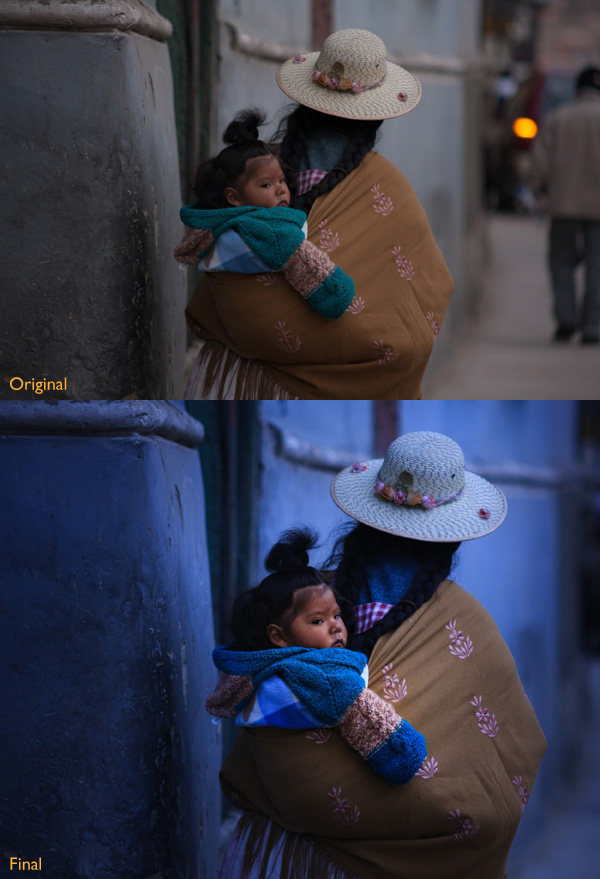
There are plenty of things wrong with the original photo (below). It’s underexposed, and needs brightening (although not too much as I want to retain the atmosphere created by the fading light). The background is distracting. The colours are muddy.

Post-processing in Lightroom

Step 1 Basic corrections

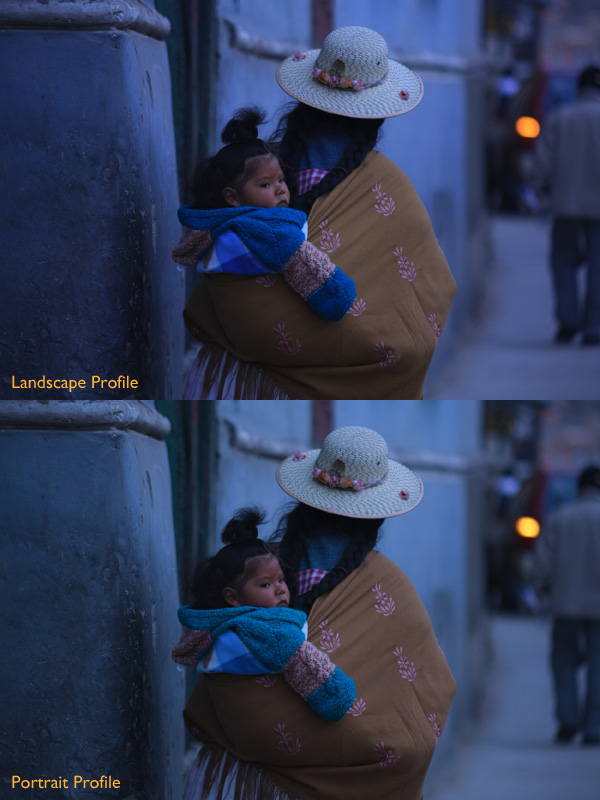
The baby is the natural focal point of the photo, and I wanted to emphasize it. I also wanted a lot of blue, the natural colour of light during dusk, in the photo. To start, I set Profile in the Camera Calibration panel to Camera Landscape. This setting is intended for use with landscape photos, but you can use it whenever you want to emphasize the colours blue or green. I also went to the Lens Corrections panel and enabled both Profile Corrections (with Vignetting set to zero) and Chromatic Aberration removal.

I went to the Basic panel and kept Exposure where it was, even though the photo was underexposed, because I liked the gloomy atmosphere. I set White Balance to auto, which gave a neutral colour, then reduced it (to 3639 Kelvin) to create a blue colour cast. This gave me a good starting point.
Post-processing in Lightroom

Two versions of the photo after the completion of step one. One has the Camera Landscape profile and the other the Camera Portrait profile. Even though it may seem logical to use the Camera Portrait profile on a photo containing people, Camera Landscape is the better option given my intention, as it gives the most appropriate colours.

Isolating the subject

My aim now is to continue the processing in a way that minimises distractions and places the emphasis on the baby.

Step 2 Crop

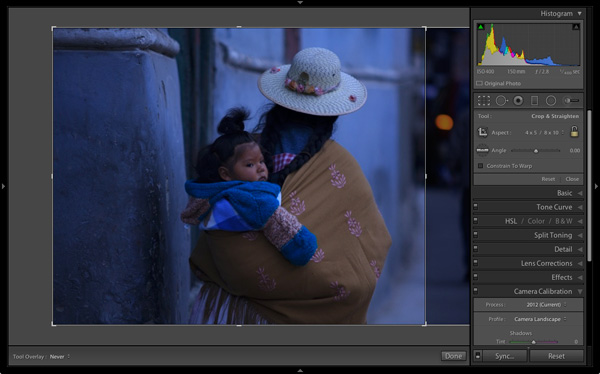
I used the Crop tool to cut the right-hand side of the photo, eliminating the distracting background. This makes a big difference as the eye is no longer being pulled away from the people by the blurred light.
Post-processing in Lightroom

Step 3 Local adjustments

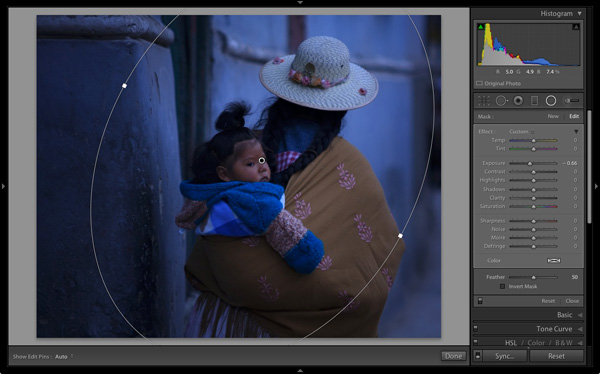
I added a Radial Filter and moved the Exposure slider left to make the background darker. The Radial Filter is new to Lightroom 5, but if you have an earlier version of Lightroom, you can do something similar with the Adjustment Brush (by painting in the area you want to darken).
Post-processing in Lightroom

Step 4 Add some punch

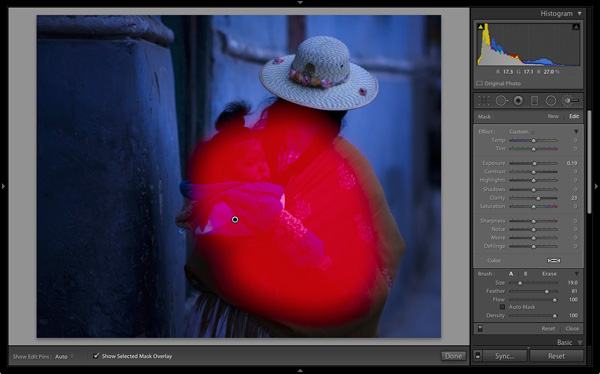
The photo was quite flat so I returned to the Basic panel and increased Contrast. Then I used the Adjustment Brush to make a selection over the woman’s back and the child, and increased Clarity and Exposure. The aim was to make the baby sharper, and a little brighter, than the rest of the image, encouraging the eye to go to that part of the photo.

This screen shot shows the mask created by the Adjustment Brush.
Post-processing in Lightroom

Step 5 Make color work

Next I used the Adjustment Brush again to select a smaller area and moved the Temp slider right, making that area warmer. The idea here is to work on the natural colour contrast between the colours of orange and blue.

This image below shows the result of these adjustments. The key was to make them subtle so the image looked natural and not over-processed.

Post-processing in Lightroom

Throughout the processing I imagined that I had taken the photo on slide film and that the scene really did look like that. The fact that the scene would have come out differently than my version is incidental. The idea was just a guide to the approach I should take.

Step 6 Darken edges of the image

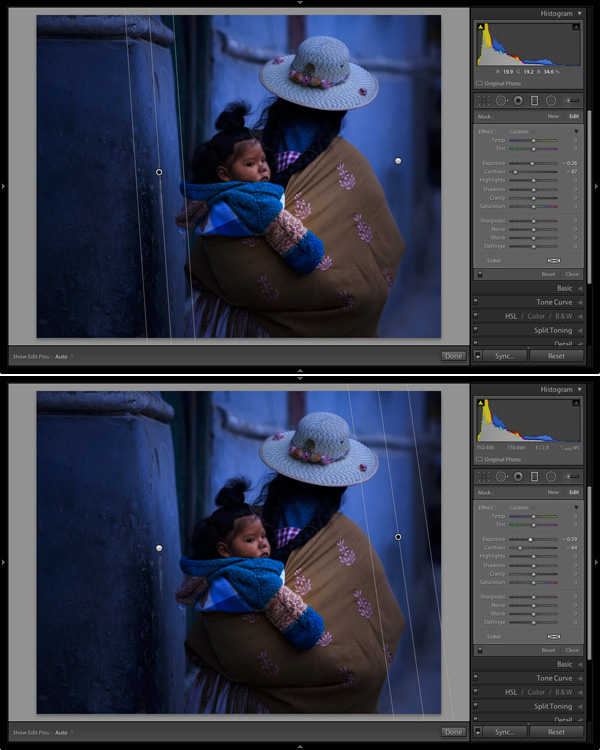
Next I created two Graduated Filters, one on either side of the frame. I reduced the Contrast in each one. A side effect of reducing Contrast is that the area affected also becomes lighter, so I adjusted Exposure to make them darker again.

These are subtle adjustments that reduce contrast at the edges to emphasise the area around the baby in the centre of the image, where I increased Clarity earlier.
Post-processing in Lightroom

Finally I decided the image was too dark and increased Exposure to compensate. Here’s the original and final versions together so you can compare them.
Post-processing in Lightroom

What do you think of these processing techniques and the style in which the photo was processed? Do you have any suggestions for an alternative interpretation of the original Raw file?  Please let us know in the comments.
Mastering Lightroom: Book Four – The PhotosAndrew’s ebook Mastering Lightroom: Book Four – The Photos is available now at a special price of 40% off for a limited time from Snapndeals. It’s an advanced guide to processing photos in Lightroom’s Develop module, explaining how to use Lightroom’s powerful processing engine plus Develop Presets and plug-ins to create beautiful images.

The post Before and After: How This Photo was Processed in Lightroom by Andrew S. Gibson appeared first on Digital Photography School.

Digital Photography School

 
Comments Off on Before and After: How This Photo was Processed in Lightroom

Posted in Photography


How Apple Botched This Morning’s Livecast

10 Sep

How Apple Botched This Morning's Livecast

I’m a huge Apple fan. My wife and I both have an Apple iPhone 5s and both own MacBook Pros as our primary computers. We have 5 Apple TVs connected to the 5 TVs in our home. We have Mac minis in the kitchen and in the home office.

I’ve pretty much purchased just about every iPhone ever sold. I waited in line overnight for the very first iPhone down in Palo Alto.

So, as you can imagine, I was looking forward to the this morning’s livecast of Apple’s new announcement.

Like millions of other Americans, however, the livecast took place at 10am on a Tuesday morning when I was at work. This is prime time as far as product announcements go. It doesn’t get any more prime time than Tuesdays at 10am.

I tried to watch the livecast at apple.com this morning from work. Unfortunately for me, however, the Apple livecast was only available on Apple products. That’s right, in order to watch this morning’s Apple livecast you had to stream the video from Safari, an Apple browser. So anyone on a PC could not watch.

Even though I’ve spent thousands of dollars buying Apple products for my home and for myself personally, like millions of other Americans, my work computer is a PC and that effectively locked me out of the Apple livecast. Why Apple can’t stream to Google Chrome, Firefox or Internet Explorer in 2014 boggles my mind, but for some reason this morning they could not.

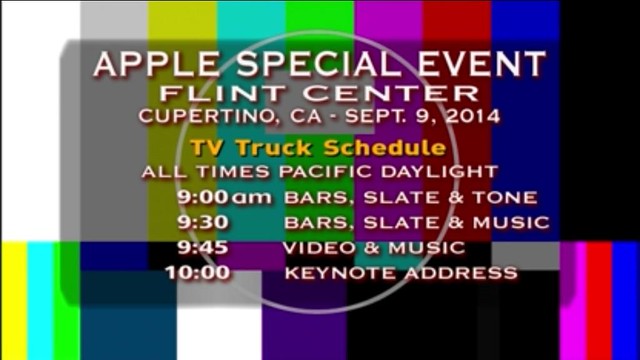
This left me having to try and watch the livecast on my iPhone. Here I tried watching for about 30 minutes and then finally just gave up. The first 10 minutes or so it just gave me the weird Flint screen at the top of this post. After that it sort of connected, but it was hard to follow because the livecast was overdubbed with an annoying translator translating everything live into Chinese. I kept trying to relaunch the livecast and it would hang, or wouldn’t work, and after about a half hour I just gave up.

I was watching CNBC and trying to follow the announcement on TV, but even there when they pulled to a clip of Tim Cook talking about the new product it was with the annoying Chinese overdubbed translator on it.

Personally speaking I don’t think I’ll get an Apple Watch or an iPhone 6 — but Apple lost a great opportunity to try to sell me and millions of other people one by botching up their livecast so badly.

As far as the watch goes, I’m just not sure why I’d want one. I asked my 13 year old son what he thought of the Apple watch and he told me he thought it was stupid. Why would you want a watch when it already shows the time on your phone, he asked. I guess I sort of feel the same way. I don’t know what the Apple Watch would do for me that would make me want to have an uncomfortable thing strapped to my wrist.

As far as the iPhone 6 goes, the best I can tell is that it’s bigger and bigger is supposed to be, well, bigger? I don’t need bigger on my phone. The size is fine as it is. There was also something about payments in today’s livecast I think, but I’m not sure why I would want to use my iPhone to pay for things. These days I mostly use credit cards because I try to maximize my points/miles I get on purchases. I suppose it would be cool if my phone stored my reward credit cards, but that’s not really something that would make me buy a new phone.

For future presentations, Apple should consider hiring a more reliable company to do the livecast for them. They should also be aware that if they are going to announce a new product at 10am on a Tuesday morning, that many of their potential customers will be at work and on PCs and they should consider allowing you to stream the livecast from your PC. It’s really not that difficult to stream video to a PC these days, certainly a technology company with Apple’s mad skillz can figure that out.


Thomas Hawk Digital Connection

 
Comments Off on How Apple Botched This Morning’s Livecast

Posted in Photography


Flexible Furniture: Mold this Seat into All Sorts of Shapes

07 Sep

[ By WebUrbanist in Design & Furniture & Decor. ]

the body modular seating

Sitting in a single position for long periods is not just uncomfortable but also a health hazard, but is the solution to be found in a single form or something more pliable and adaptable?

modular chair lying down

London designer Kirsi Enkovaara (images by Aava Anttinen) explores plasticity and comfort in this project titled The Body, a thesis work completed at the Royal College of Art.

the body chair design

The idea is in part to avoid presuppositions about ‘best ways’ to sit or lie down, letting a user bend and twist their furniture into shapes suitable for different activities and allowing for various positions of rest.

modular moldable furniture london

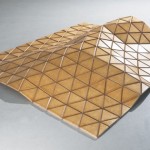
The structure itself is composed of canvass and filled with rice, giving it the right combination of flexibility and rigidity to support a person while also allowing it to be reshaped on demand.

modular seat design curve

From the designer: ‘The Body’ encourages a person to find their choice of sitting by discarding learned cultural norms. Trusting in their touch, movement and the feelings that arise in reaction to these in order to create the most comfortable way of sitting. The structure of ‘The Body’ is made from canvas and rice allowing it to be formed into reconfigurable rigid structures.

modular comfortable seat exploration

“The project started from an interest in emphasizing the psychology of sitting. When we are sitting or laying down we are less aware of our surroundings and in a more relaxed state. This is why the construction of the seat needed to reflect the qualities of human touch, the tactility and safety of which provides us with great comfort.” Many of her other works, both of art and design (or somewhere in between), likewise explore different relationships between ourselves and everyday objects.

Share on Facebook


[ By WebUrbanist in Design & Furniture & Decor. ]

[ WebUrbanist | Archives | Galleries | Privacy | TOS ]


WebUrbanist

 
Comments Off on Flexible Furniture: Mold this Seat into All Sorts of Shapes

Posted in Creativity


Over Board: Sink or Skate on This Amazing Floating Ramp

02 Sep

[ By Steph in Architecture & Cities & Urbanism. ]

Floating Skate Ramp 1

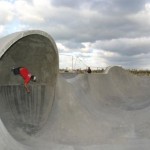
It’s hard to imagine a more idyllic place to practice skate tricks than a sculptural wooden ramp floating on the crystalline waters of Lake Tahoe. In some of the photos, it almost doesn’t look real, the skaters captured in mid-air seeming jarringly out of place agains the surface of the water.

Floating Skateboard Ramp 4

Skateboarding pro Bob Burnquist got the opportunity to build the ramp in 2013 when Visit California asked him to think big, coming up with an idea that might seem a little nuts at first but was actually achievable. Working with Miami art director Jerry Blohm, Burnquist created a wooden structure on a floating base, featuring a half pipe, a quarter pipe and a 45-degree ramp.

Floating Skate Ramp 2

Floating Skate Ramp 4

The fact that it sits entirely upon the surface of the water is part of what makes it seem so unreal. It’s built on a steel frame with weighted riggers that keep it from moving around too much in the water. It took 30 man hours and 1,250 screws to finish the 7,300-pound structure.

Floating Skate Ramp 3

FLoating Skateboard Ramp 5

You might be thinking, “Isn’t there a danger of skating right off the edge?” Yes, there definitely is, even for professionals – and that’s why Bob had a wet-suited snorkeler waiting to retrieve his skateboard anytime it went into the water during this shoot.

Share on Facebook


[ By Steph in Architecture & Cities & Urbanism. ]

[ WebUrbanist | Archives | Galleries | Privacy | TOS ]


WebUrbanist

 
Comments Off on Over Board: Sink or Skate on This Amazing Floating Ramp

Posted in Creativity


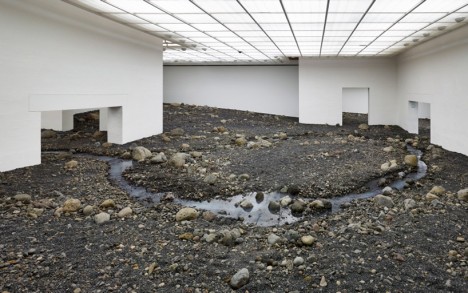
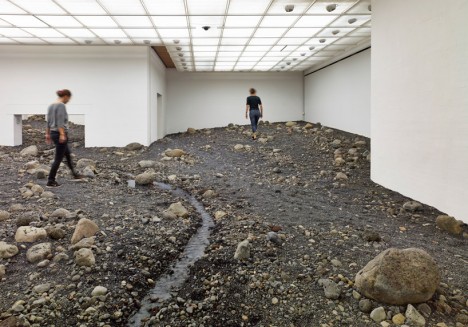
Interior Land Art: Riverbed Really Runs Through this Museum

31 Aug

[ By WebUrbanist in Art & Installation & Sound. ]

river interior museum gallery

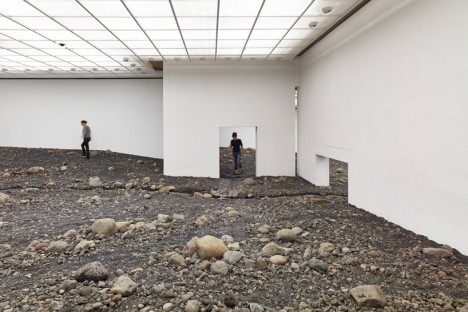
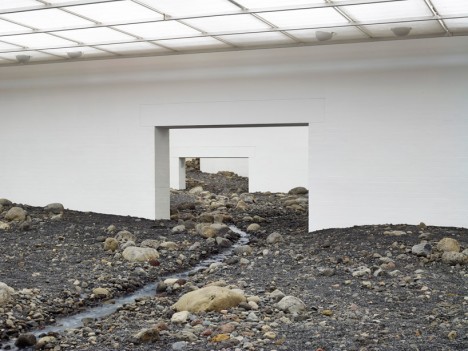
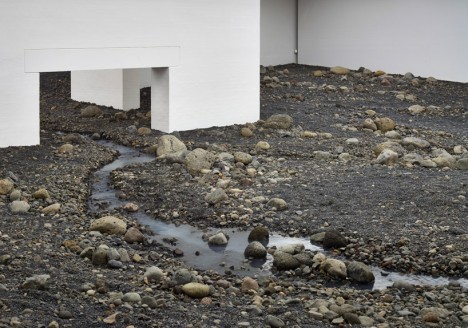
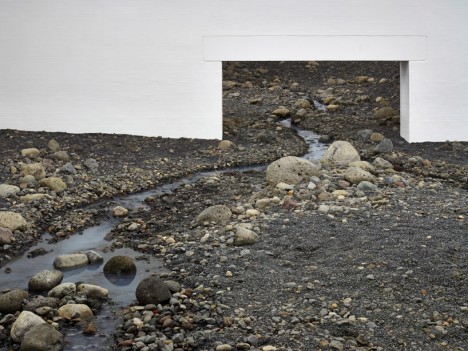
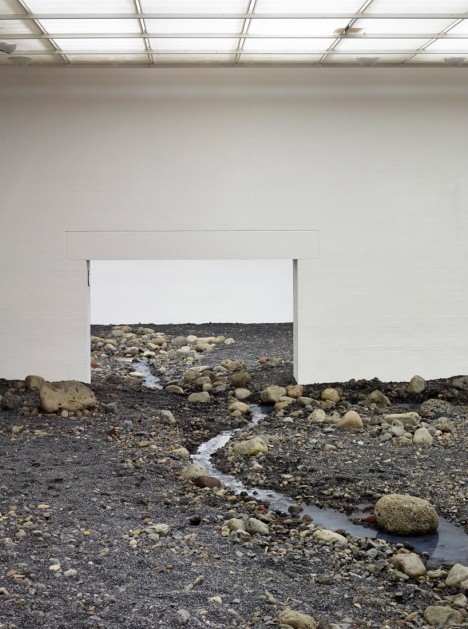
Art rarely gets as gritty and real as this, particularly in a gallery, with rocks, earth and water running through simple doors, between white-walled rooms and under uniform interior lighting.

riverbed walking closeup example

Olafur Eliasson, a Danish and Icelandic artist, created Riverbed as one of a series of installations for the Louisiana Museum of Modern Art in Denmark, challenging visitors to experience both museums and landscapes in new ways.

riverbed zoomed in doors

Meanwhile, the spaces become both intimate and perhaps uncomfortable as the earthwork slopes upward into ultimately-inaccessible areas.

river runs through art

The artist explains: “What I’m interested in with my work at the Louisiana isn’t really that you experience an object or an artwork. I am interested in how you connect this landscape to the rest of the world and ultimately, how you experience yourself within it.”

riverbed walking visitor tour

Traditional floor tiles slowly give way to a rugged landscape of stones and dirt, leading up to the sides of a real river inexplicably traversing the gallery interior.

riverbed art installation denmark

Aside from other references, the work is a nod to the sculpture garden that used to sit in the same spaces where this section of interior galleries now stands.

riverbed dirt rock water

“When we’re in our familiar surroundings, in our circle of family and friends, our senses are very finely tuned, but the further away we get from the local context, the cruder the sensing becomes. I wonder if our focus on the atmospheric can give us a relationship with something that is very abstract and far away.” (Images by Anders Sune Berg)

Share on Facebook


[ By WebUrbanist in Art & Installation & Sound. ]

[ WebUrbanist | Archives | Galleries | Privacy | TOS ]


WebUrbanist

 
Comments Off on Interior Land Art: Riverbed Really Runs Through this Museum

Posted in Creativity


Top 7 Gear Picks 2014 to Try This Summer

18 Jul

Summer is a great time to get outdoors and shoot amazing photos. The weather is sublime, the plants are all blooming and it’s just an all around great time of year. The last thing you want to do is lug around your hunky DSLR. This list of sleek and compact image makers will provide you with all of the best Continue Reading

The post Top 7 Gear Picks 2014 to Try This Summer appeared first on Photodoto.


Photodoto

 
Comments Off on Top 7 Gear Picks 2014 to Try This Summer

Posted in Photography


Do This: Sara Lando in US for Workshops in August

07 Jul

Whatcha doing in mid/late August? If you are within striking distance of Baltimore or Atlanta, you have a one-off chance to do something cool and fun that will change the way you approach your photography: spend a day (or two) with Italian conceptual portrait photographer Sara Lando.

After spending a couple years convincing her to come to the US, Zack Arias and I are this summer hosting Sara for two weekends of seminars and workshops in Atlanta and Baltimore. We are doing this because A) it's an awesome experience (trust us on that) and B) it's a lot easier than getting all you guys over to Dubai for Gulf Photo Plus.

Read more »
Strobist

 
Comments Off on Do This: Sara Lando in US for Workshops in August

Posted in Photography


CityHome: Control This Smart House with a Wave of Your Hand

19 Jun

[ By Steph in Design & Fixtures & Interiors. ]

CityHome Smart House 1

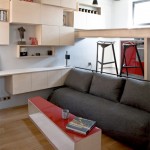
Two hundred square feet may sound absurdly small, even by New York standards, but what if you could make it feel three times larger with hidden furniture and other amenities that roll out and unfold at a wave of your hand? A team at MIT’s architectural program has come up with a smart solution for micro apartments that makes it quick and easy to reconfigure the entire space with virtually zero effort.

CityHome Smart House 2

CityHome Smart House 3

CityHome consists of a transformable wall system that condenses all the main functions of a bedroom, living room, dining room, kitchen and bathroom into a tiny space without sacrificing most of what you’d have in a larger apartment. You can still cook for and seat a group of six for dinner, sleep in a comfortable full-sized bed and enjoy a movie in a spacious living room.

CItyHome Smart House 4

You tell the room what you need through a combination of hand gestures, voice control and touch elements, with internal motors silently launching the furniture you require at your command. One gesture draws the bed out of the wall, while another calls forth a work desk that doubles as a dining table.

CityHome Smart House 6

Wave your hand to adjust the ambiance of the room via lighting and window blinds, and move the entire unit against a wall or into the middle of the room at the touch of a button depending on whether you want to divide up the space or gain use of the entire room.

CItyHome Smart House 7

For now, CityHome is just a concept, but MIT envisions turning it into an actual product, possibly through crowdfunding.

Share on Facebook


[ By Steph in Design & Fixtures & Interiors. ]

[ WebUrbanist | Archives | Galleries | Privacy | TOS ]


WebUrbanist

 
Comments Off on CityHome: Control This Smart House with a Wave of Your Hand

Posted in Creativity


Out of This World: 13 Extraterrestrial Architecture Concepts

03 Jun

[ By Steph in Conceptual & Futuristic & Technology. ]

Space Architecture Main

Artificial environments designed for space have thus far remained totally utilitarian, but what if more aesthetic considerations were brought into the mix? These design concepts range from constantly morphing art galleries for the International Space Station to a moon base built using existing 3D printing technology and designed by a renowned architecture firm.

Tate in Space: Cultural Center for the International Space Station
Space Architecture Tate

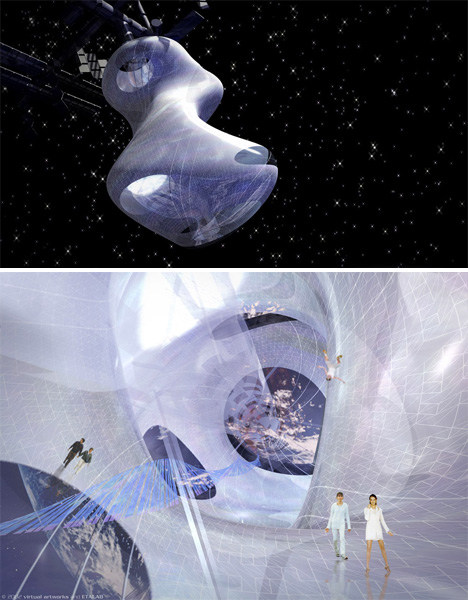
Artists, designers and other creatives haven’t exactly been included in the process of space exploration thus far, but this project by ETALAB aims to change that with an outer space gallery where artists, curators and visitors interact with works of art and architecture in zones of zero and partial gravity. Docked at the International Space Station, ‘Tate in Space’ features a flexible ‘envelope’ made from a smart material based on biomechanics that enables the space to constantly shift in shape.

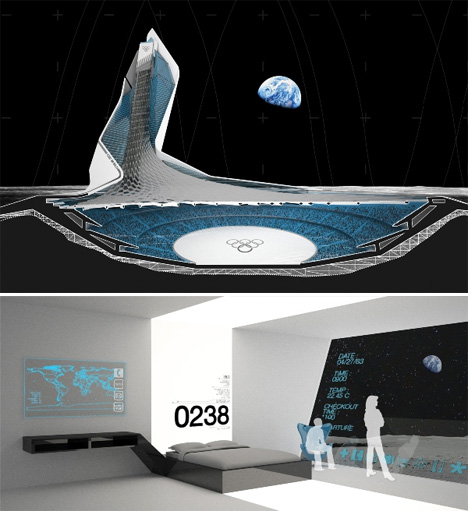
Olympic Stadium for the Moon
Space Architecture Stadium

Designed as part of the ‘MARS ONE’ project that aims to start colonizing Mars and other locations in space within a matter of mere years, SILO (Stadium International Lunar Olympics) is a stadium for the moon complete with a hotel, restaurants and a solar electric system as well as seats for 100,000. The designers say, “Within the lunar colonies of the future, recreational activities will arise and evolve to take advantage of the moon’s micro-gravity. The sports we know today will be modified, and brand new sports will be invented. Lunar sports associations will be created, teams will be sponsored, games will be televised, and people from all over the globe will watch as the best of the best compete in an arena in which all the rules have changed.”

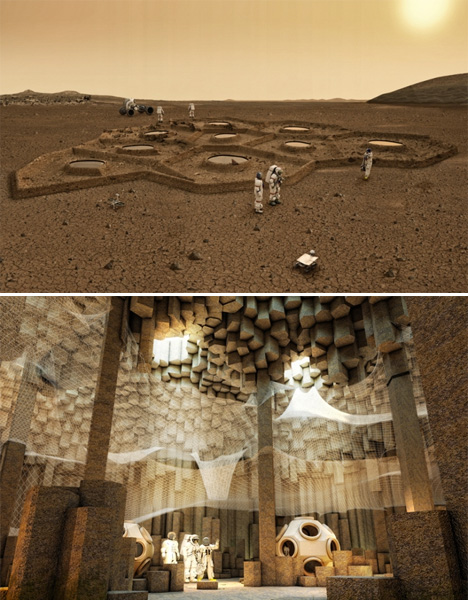
Mars Colonization by ZA Architects
Space Architecture Mars Colonization

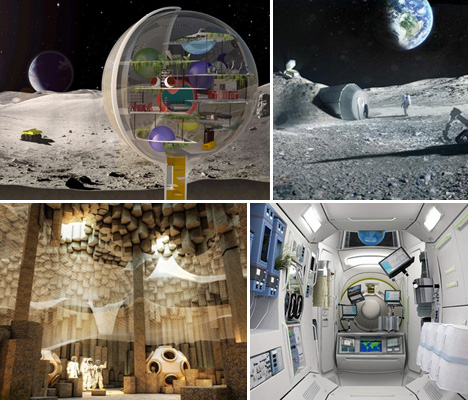
Solar-powered robots could excavate dwellings for humans on Mars before the people ever arrive in this concept by ZA Architects. Choosing areas where the basalt rock has formed into hexagonal columns, which can be easily removed to create cathedral-like spaces, the robots would weave web-like structures from basalt fibers to create floors at various levels within the caves.

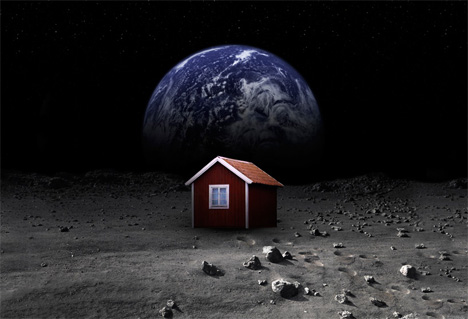
Self-Assembling House for the Moon
Space Architecture Self Assembling Moon

A crowd-funding initiative will send a self-assembling house to the moon in October 15th on SpaceX’s Falcon 9 spacecraft. The building, designed by American aerospace company Astrobotic, will be made from a thin sheet of specially developed cloth stretched over a carbon frame. Once it’s placed on the lunar surface, it will fill up with gas and stand erect within five to fifteen minutes.

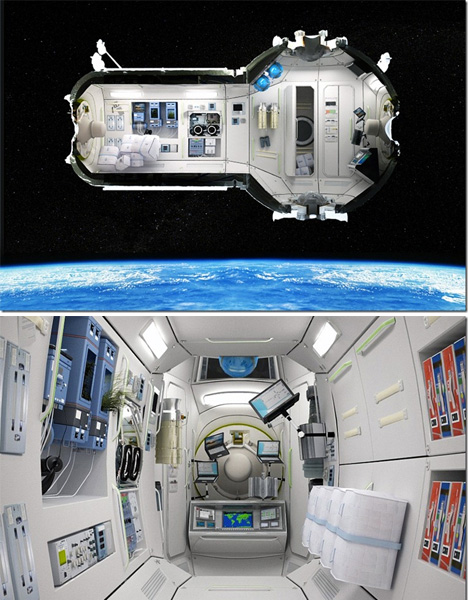
Russian Space Station Hotel
Space Architecture Hotel

Russia’s plans for a space hotel would house seven guests in four cabins, 217 miles above the surface of the Earth. The hotel would also function as accommodations for scientists on space-related missions, and as an emergency blowhole for astronauts aboard the International Space Station. A five-day stay will set guests back $ 100,000 in addition to the half-million it costs to get to space in the first place.

Mars: Adrift on the Hourglass Sea
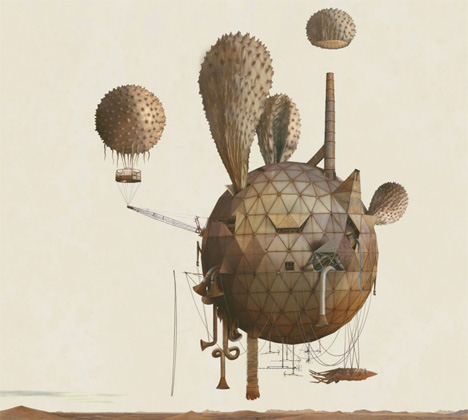
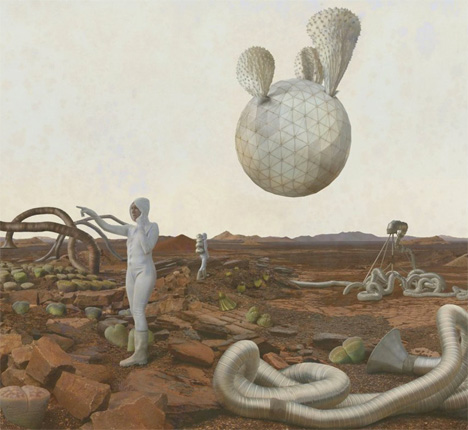
Space Architecture Adrift Mars

Space Architecture Adrift Mars 1

This series of fantastical images doesn’t even try to be technically correct or scientifically possible, but it was commissioned by NASA all the same to represent a vision of existence on Mars. The artists used photo-mosaic panoramas of expeditions by the rovers Spirit and Opportunity as backdrops for surreal scenes.

3D Moon Base by Foster + Partners
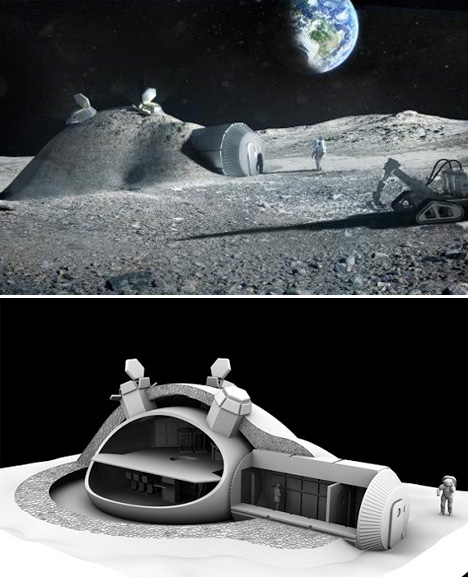
Space Architecture Foster moon

Architecture firm Foster + Partners, responsible for many iconic buildings on Earth, have designed a four-person lunar base that uses 3D printing technology to ‘print’ a protective layer of locally-sourced lunar soil over an inflatable dome. Commissioned by the European Space Agency, the project takes a look at the feasibility of actually building such a structure using currently existing technology.

Moon Dwelling by Royal Haskoning Architects

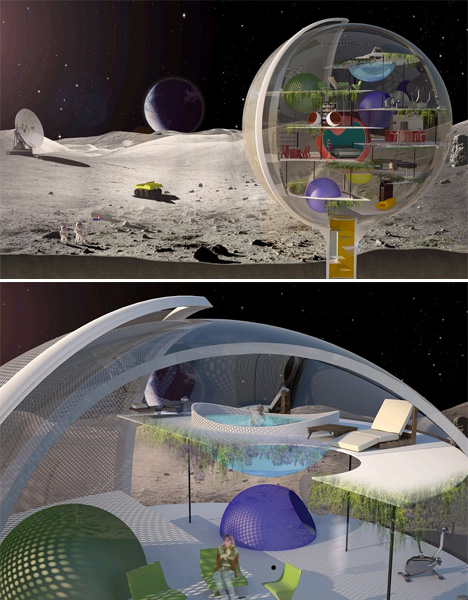
Space Architecture Royal
A transparent sphere houses living spaces for lunar residents in this concept by Royal Haskoning Architects, offering inhabitants unlimited views of the awe-inspiring setting if not a whole lot of privacy. But then again, who needs privacy when you live on the moon? A protective screen rotates around the sphere to protect the inside from the harsh rays of the sun. The sphere is envisioned as a mini-Earth with its own oxygen supply and various levels that inhabitants can simply float between rather than taking the stairs.

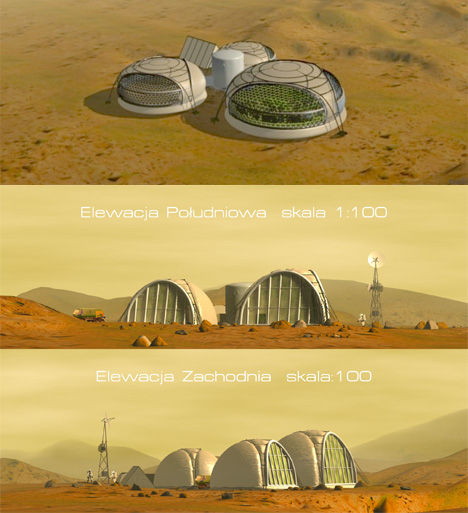
Martian Base by Janek Kozicki
Space Architecture Janek

Husband and wife design team Janek Kozicki and Joanna Kozicka have created a number of concept designs for Martian bases generally powered by either a radio-isotope generator or a small nuclear power plant, along with practical architectural guidelines for building on other planets. The design pictured above, by Kozicki, is a modular setup that would start with a single pod and grow with subsequent trips to and from Earth to ultimately accommodate several dozen people.

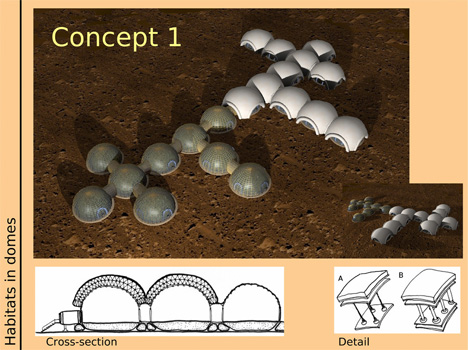
Inflatable Pods by Joanna Kozicka
Space Architecture Inflatable Pods

Kozicka’s solutions include inflatable pods that are lightweight, easy to deploy, and ultimately offer a bigger payoff in terms of square footage for the size of the load sent to Mars. The designs address the sociopsychological problems that the couple identified in relation to living on another planet, avoiding isolated and confined environments in favor of large, comfortable spaces that let in sunlight and allow contact with nature.

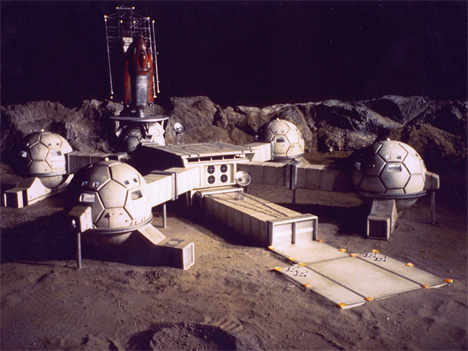
Shackleton Crater Lunar Outpost
Space Architecture Shackleton Crater

NASA’s Lunar Architecture Team is working on a design for a permanent lunar outpost that could be set up the next time humans land on the moon. Designed for Shackleton Crater, located at the south pole of the moon, the habitat would consist of larger modules sent ahead of time on a cargo lander.

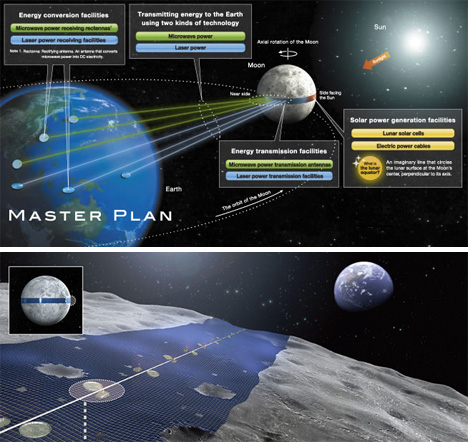
Luna Ring Concept
Space Architecture Luna Ring

The Luna Ring concept would put permanent solar collectors around the moon’s equator like a belt, with solar cells collecting energy that would then be beamed back to Earth via microwave power transmission antennae. A team of astronauts would supervise the robot construction workers carrying out the installation process.

Fractal Lunar Architecture
Space Architecture Fractal

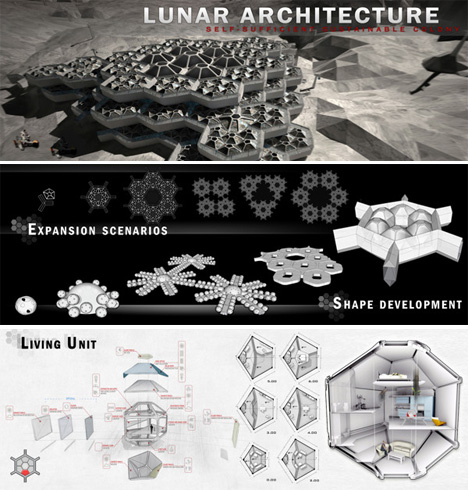
A fractal design for a lunar base by Hatem Al Khafaji of Dubai makes it easy to expand the available space as needed using a system of seven modular components of living pods, air locks, corridors and connectors. Layers of these modules would be placed around a central ‘heart’ and continuously stacked by teams of robots and human workers.

Share on Facebook


[ By Steph in Conceptual & Futuristic & Technology. ]

[ WebUrbanist | Archives | Galleries | Privacy | TOS ]


WebUrbanist

 
Comments Off on Out of This World: 13 Extraterrestrial Architecture Concepts

Posted in Creativity


Live Google+ Hangout at 10AM PST This Morning About How to Maximize Your Photos Through Social Media

11 May

Daniel Krieger
The Smoothest Dude Alive, Daniel Krieger.

My good friend Daniel Krieger (aka smoothdude), along with MacPhun’s Laurie Rubin, and I will host a live G+ hangout this morning talking about ways to promote your photography through social media. We’ll record the episode to my youtube account as well in case you can’t make it live and want to watch later.

Come join the show here if you can make it.


Thomas Hawk Digital Connection

 
Comments Off on Live Google+ Hangout at 10AM PST This Morning About How to Maximize Your Photos Through Social Media

Posted in Photography