RSS
 

Posts Tagged ‘Than’

Why does your camera see things differently than you?

23 Feb

Do you ever see a beautiful scene, take out your camera, take the shot and then wonder what went wrong? Why doesn’t the display on the LCD screen look at all like the scene in front of you?

Do you ever stand next to another photographer and wonder how they made an image that is better than the scene you see with your own eyes?

Understanding how the camera “sees” is the key to figuring out why this happens and what you need to do to take charge of your camera and make the images you envision.

If you’re already dreading the mathematical calculations, don’t worry! I’m not going to start measuring my eyeballs and pupils and trying to figure out what kind of lens my eyes are equivalent to in focal length, f/stops, and ISO, or how many megapixels my eyes see. That’s not what this is about.

It’s just about understanding how a camera works differently than our eyes.

When the camera’s “eye” is better than our own

Sometimes the best images show the very thing that we cannot see with our own eyes.

Low Light Levels

At low light levels our eyes are less sensitive to colour than normal. Camera sensors, on the other hand, always have the same sensitivity. That’s why photographs taken in low light appear to have more colour than what we remember.
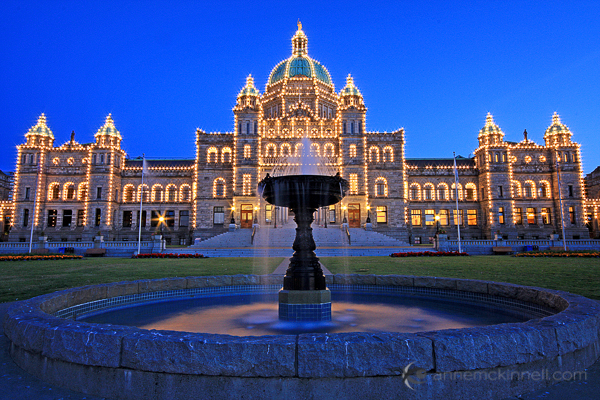
The Legislature in Victoria, British Columbia

When I made this image of the Legislature in Victoria, British Columbia, the sky was much darker and less blue to my eye.

Long Exposures

The longer the shutter remains open the more light can enter the camera and hit the sensor. Therefore long exposures can bring out objects that are faint in the sky whereas our eyes will perceive no extra detail by looking at something longer.
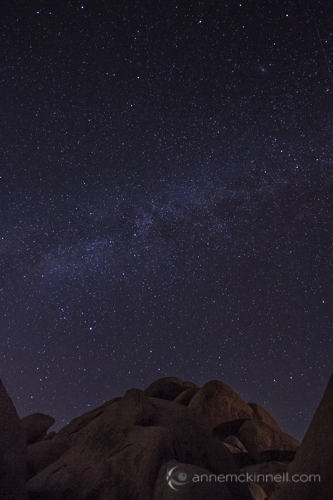
Starry Night at Joshua Tree National Park, California

The 30 second exposure in this image, made at Joshua Tree National Park in California, picked up more stars than I could see with the naked eye.

Long exposures also allow us to see the passing of time in a way we cannot with our eyes.
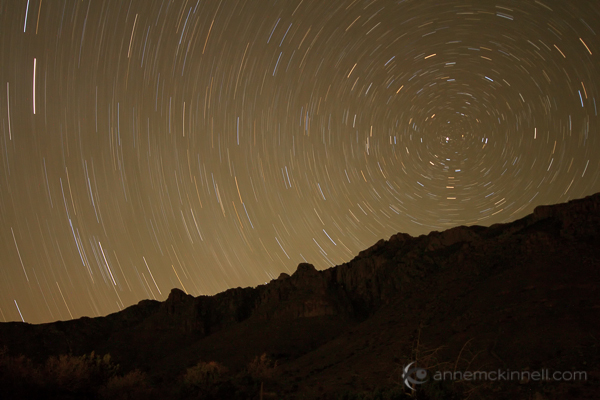
Star Trails in Guadalupe National Park, Texas

In Guadalupe National Park, Texas, I was able to capture the movement of the stars around Polaris, the north star, by leaving the shutter open for 30 minutes.
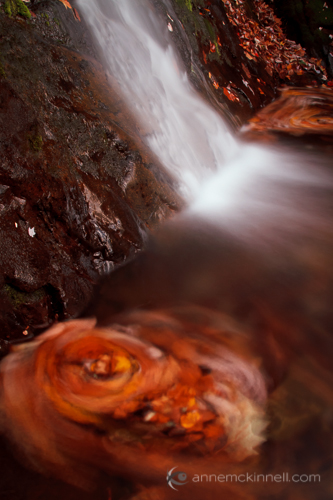
Fallingwater Cascades along the Blue Ridge Parkway, Virginia.

At Fallingwater Cascades along the Blue Ridge Parkway in Virginia, the movement of the water caused the maple leaves to swirl around in a circle. By using a 15 second exposure I was able to capture the movement of the leaves.

Short Exposures

On the other end of the scale, high speed photography can freeze motion and allow us to see something that would otherwise pass by too fast for our eyes to retain any detail.

Egret at Ding Darling Wildlife Refuge, Florida.

By using a shutter speed of 1/5000 second, I was able to freeze the water droplets as they swirled around the egret’s beak as he caught a fish.

Depth of Field

One thing that is somewhat similar between a camera and a human eye is aperture, but only if you hold it steady. For example, if you stare at one word in the middle of the this sentence and do not move your eyes, you can perceive that the other words are there but they are not clear. The part that is in focus is only the centre portion of your field of view.

That is the same as a camera with a small aperture. The difference is that you can’t actually look at the out-of-focus part. As soon as your eye moves to the out-of-focus words they instantly become in-focus.

Whereas if you are looking at a print or an image on your screen you can look at the out-of-focus part which is something we cannot do with our eyes. That’s why shallow depth of field images are so interesting to us.

Dandelion Seed

Colour

Most of us see in colour. Others see limited colours. But either way we are stuck with what we have. Maybe that’s why some people like or dislike black and white photography. For a long time colour was considered a limitation in photography and the human eye was obviously better. But now photographs give us the option of viewing things in a different way.
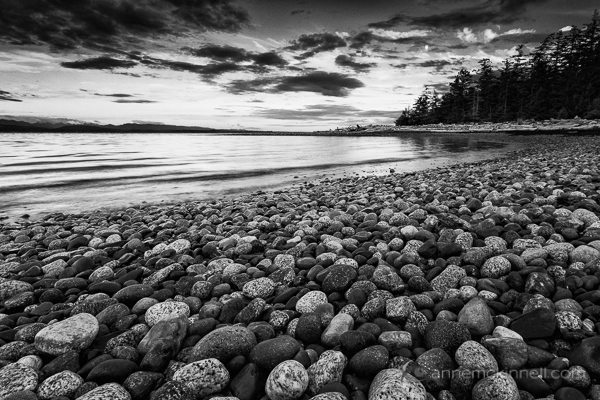
Rocks on the beach at Rebecca Spit, Quadra Island, British Columbia.

Rocks on the beach at Rebecca Spit, Quadra Island, British Columbia.

When the human eye (or brain) is better

Dynamic Range

One thing to keep in mind is that when we see something with our eyes, our brain is involved too. Think of optical illusions where you perceive something that isn’t actually there.

As we look around a scene our eyes quickly adjust to changing light. Take a scene with dark shadows and bright highlights for example. As your eye moves from one area to another it quickly adjusts so our eyes take in the right amount of light and we see detail in all parts of the scene. When we look at a scene it is like our brain takes numerous snapshots and what we perceive is the combination of those snapshots.

Your camera cannot do that. It simply records the light that hits the sensor at one aperture setting. It can only have one exposure for the whole scene.

That is where exposure blending, or high-dynamic-range (HDR) photography, can sometimes make a scene look more like what we perceived at the time.

On the other hand, depending on how you blend your images, HDR photographs can show us a lot more detail than what our eyes saw and then they don’t look realistic. Not that there’s anything wrong with that! It depends on whether you want your images to be realistic or not.
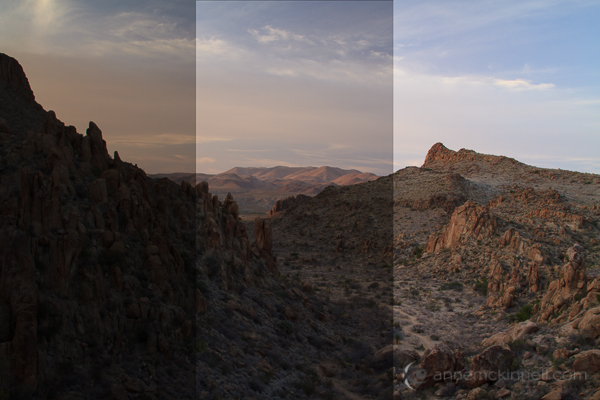
Grapevine Hills HDR Brackets

The image above represents the same scene taken at three different exposures. One exposure is for the shadows, another for the mid-tones and the other for the highlights.

Grapevine Hills, Big Bend National Park, Texas.

Grapevine Hills, Big Bend National Park, Texas.

I can blend those images together in photoshop and end up with an image like this. Our brain does that all by itself!! This more closely represents the image I remember in my mind.

Conclusion

The kinds of images that are considered good differ from person to person. It’s subjective.

Some people like images that are just like what their eyes saw or are capable of seeing — the realistic images.

Other people prefer images that show them what they cannot see such as black and white, long exposures, or HDR with tons of detail.

Either way, understanding why the camera “sees” things differently than you will put you well on your way to creating the kind of images you want to make.

Post originally from: Digital Photography Tips.

Check out our more Photography Tips at Photography Tips for Beginners, Portrait Photography Tips and Wedding Photography Tips.

Why does your camera see things differently than you?


Digital Photography School

 
Comments Off on Why does your camera see things differently than you?

Posted in Photography


Annemarie Busschers: 11 Clearer Than Life Portraits

11 Jan

[ By Marc in Art & Drawing & Digital. ]

Annemarie-Busschers-Montage

Annemarie Busschers is a contemporary artist from the Netherlands who creates portraits that beautifully captures the raw emotion of her subjects, often photorealistically.

Annemarie-Busschers-3

Annemarie Busschers works, most of which can be found on her site here, follow similar themes of “saying goodbye to the self” (in the artist’s own words). Even when she’s setting out to to capture her subject’s emotion, the realism of her depiction gives it a photo realistic aspect. These examples show several self portraits (top right photo, and bottom).

Annemarie-Busschers-2

This painting, via PulpFactor, is one of Annemarie Busscher’s earlier works, and an excellent example of the emotional realism that continues through her most recent portraits. The second image comes via Booooooom and gives a good perspective on the size of her canvases.

Annemarie-Busschers-4

These Annemarie Busschers paintings are excellent examples of the amount of texture she attains with her artistry. The size of the canvas gives her room to create a landscape out of skin and facial features, creating an image that’s an incredibly clear treatment of her subject.

Annemarie-Busschers-5

Found on entremundos and galeriebrandt, these pieces reveal the contrast between Annemarie’s treatments of different subjects. Each subject requires a different approach to capture their personality.

Annemarie-Busschers

Annemarie Busschers has incredible talent that’s constantly evolving, but always sticks to one essence: that the subject will have their essence captured in whatever way serves them best.

Share on Facebook


[ By Marc in Art & Drawing & Digital. ]

[ WebUrbanist | Archives | Galleries | Privacy | TOS ]


WebUrbanist

 
Comments Off on Annemarie Busschers: 11 Clearer Than Life Portraits

Posted in Creativity


More Real Than Reality: 7 Artsy Augmented Reality Projects

26 Dec

[ By Delana in Conceptual & Futuristic & Technology. ]

augmented reality

Technology has taken over so many facets of our lives that the real world sometimes seems a little boring by comparison. Never fear – technology is slowly creeping into even the most mundane corners of our existence, making sure that we never have to face reality without some sort of augmented component ever again. These 15 designs, apps, inventions and gadgets put a digital element right into the real world – for better or for worse.

Virtual Mask

Augmented reality has the amazing ability to transform our world while also transforming ourselves, as the Zaphat proves. Put on the Zaphat and your whole identity is immediately transformed…at least when you’re seen through the camera of a mobile device running the Zappar app. The little patch on the front of the hat is actually a target that indicates your head location and orientation to the app, which then overlays a three-dimensional virtual mask on top of your face. The person operating the device can manipulate the type of mask and even interact with it virtually.

Street Art Comes to Life

Typically, street art is a fairly stationary form of personal expression. But thanks to futuristic augmented reality, street art can come to life and dance around right in front of observers. The LZRTAG augmented reality app allows people to aim a smartphone at a target in order to see a short animated street art clip. Anyone at all can upload an animation and print out a tag to decorate the world, all for free.

Finding Twitter Friends

Twitter’s geotagging feature allows friends to find one another in real life with an app called Twitter 360. Using an iPhone’s camera, the app creates an augmented reality overlay map that guides the iPhone holder to nearby friends based on their geotagged tweets. Users just have to follow the arrows that appear on the screen to be led directly to the nearest contact.

Augmented Reality Cinema

If you’ve ever traveled to a specific geographic spot just because it was featured in a favorite movie, the AR Cinema app from developers Halocline will be an exciting concept. The smartphone app senses when you’re in a movie-related location and shows you the famous scene(s) shot there. It’s an interesting way to combine a love of travel and a love of movies – and maybe even our collective love of smartphones.

Window Games

On a long car or train journey, boredom can set in pretty quickly. This conceptual game would use a Kinect and other simple hardware to create an augmented reality overlay on the actual scenery outside of the vehicle in which you’re traveling. By touching the window, players would be able to add all kinds of fun objects and elements to the passing scenery. The game, called Touch the Train Window, is from Tokyo design team Salad.

Augmented Reality Park

augmented reality park

(images via: Daily Mail)

If the beauty of nature is getting a bit boring, perhaps you’d like to spice things up a bit by throwing in some psychedelic visions and experiences. Swiss designer Jan Torpus has created a project called lifeClipper, in which visitors put on head-mounted display equipment for a walk through the park. The display shows the user’s actual surroundings but adds an extra layer to reality. This additional layer includes vivid colors, surreal characters, and an imaginatively enhanced landscape.

Real-Time Selective Video Editing

Changing your reality is simple when you’ve got high-tech augmented reality tools on your side. Software from a German university allows you to remove unsavory objects from your video footage as you’re filming it – just tell the software what you want to disappear and it magically erases it. The whole process takes only microseconds and is convincing to all but the sharpest eyes.

Share on Facebook


[ By Delana in Conceptual & Futuristic & Technology. ]

[ WebUrbanist | Archives | Galleries | Privacy | TOS ]


WebUrbanist

 
Comments Off on More Real Than Reality: 7 Artsy Augmented Reality Projects

Posted in Creativity


Nikon 18-105mm VR Review: More Than You’d Expect For the Price

23 Dec

www.artoftheimage.com – Reviewing the Nikon 18-105mm VR, a lot more lens than you’d expect considering the price.
Video Rating: 4 / 5

This is my entire Supra collection to date, all 20 pairs! Still buying more as we speak! FOR DOPE STREETWEAR CHECK OUT… www.martiangang.com


Nikon SB-700 Speedlight Flash – Much More Than Just An Up-Date to the SB-600

16 Dec

www.artoftheimage.com – Reviewing the impressive new Nikon SB-700 Speedlight Flash and discussing why it’s much more than just an up-date to the SB-600.
Video Rating: 3 / 5


more than your wedding day…

21 Nov

Editorial Engagement Shoot by Steven Branstetter Photography
Video Rating: 5 / 5

 
Comments Off on more than your wedding day…

Posted in Photography Videos


CANON 60D better than any VIDEO CAMERA

27 Oct

quick test of the movie mode on the 60d

My review of Flycam nano. Using Canon 60d, Tokina 11-16 2.8 with Manfrotto quick release model 323 RC2 To learn how to balance the flycam go to Em’s blog: www.vimeo.com

 
Comments Off on CANON 60D better than any VIDEO CAMERA

Posted in Nikon Videos


Raw vs Jpeg: Is your jpeg better than your RAW?

25 Oct

dombowerphoto.blogspot.com here it is shot on the nikon d300 with nikon cls and it is a jpeg vs raw video What is the surprising affect is that how much i am having to edit the raw to make it as good as the jpeg and then to make it better. I would say at the start i like the Jpeg 20%more than the raw after 10 minutes of editing i like them both the same then after another 3 minutes i then like the raw more. thus you understand why it takes so long to edit a photoshoot!
Video Rating: 4 / 5

 
Comments Off on Raw vs Jpeg: Is your jpeg better than your RAW?

Posted in Nikon Videos


Nikon D2X review (Part. 2) – Is it better than today’s consumer level DSLRs?

25 Aug

I look at a more in-depth review, and consider it’s eprformance in relation to today’s consumer level DSLRs.
Video Rating: 4 / 5

******************Copyright Nikon Corporation******************
Video Rating: 4 / 5


SWEETER than KANDEE!?

02 Aug

Thanks Kandee! www.youtube.com retouchmeyt blog: retouchmeyt.blogspot.com
Video Rating: 4 / 5