RSS
 

Posts Tagged ‘Test’

Review and Field Test of G-Technology G-Drive ev ATC Portable Hard Drives

18 Sep

As photographers, keeping our data safe is of the utmost importance. Being able to trust your hard drives to work and survive all types of conditions and hardships is something to consider. As a wildlife photographer, I often find myself out in the elements, and when traveling, my gear has to put up with the rugged nature of travel, while still being ready to work when called upon. Recently I have been putting the G-Technology G-Drive ev ATC hard drives through their paces and I think these might just be one of the best rugged and solid ways to keep data safe on the move.

Review G Technology G Drive ev ATC Portable Hard Drive

G-Drive ev ATC hard drive features

The ATC is part of the G-technology ev series, a set of drives offering a simple workflow from the field to the studio. The ATC builds upon the standard RaW and ev drives by adding a polycarbonate protective shell to the main drive offering protection from bumps, dust, sand and even full submergence in water to keep your drive and data safe.

The case itself is solid – the simple blue and black design that is stylish and bright enough to easily find in dark conditions. The polycarbonate shell feels very solid in the hand and fits the drive like a glove. It seals closed with a latch system that might seem flimsy, but offers a solid click and seal to ensure the drive is closed off from the elements.

G-Drive ev ATC hard drives - The G drive inside the ATC case

G-Drive ev ATC hard drives Locking mechanism for waterproof closure

The G-Drive ev ATC comes in two varieties, offering Thunderbolt or USB-3 connections for your chosen device. The cords are built into the case itself so you don’t need to worry about forgetting them, a really well thought out design. Of course, the case adds an extra amount of bulk to the setup that might be a problem for those photographers wanting to keep things as small as possible, but personally, I think the extra size is a worthy trade off for the added protection.

Testing the drives during travel

Testing the drives out, they have accompanied me on a few international trips, coming as my primary and backup drives for work in the Falklands, Canada, and Finland. On each trip I have worked with two drives, keeping one as a primary and the other as secondary backup. The fast data transfer speeds were great, 1GB of data transferred in less than a minute over USB-3 meaning backups were swift and simple.

On returning flights keeping data separate is important (in case of a lost bag) and I had no worries about packing one of these with the G-Drive ev ATC hard drives into my checked baggage, knowing the solid construction would keep it protected from any rough handling from the dreaded baggage handlers! On all of my trips, the hold drive never skipped a beat, being ready to upload as soon as I got home to my office.

G-Drive ev ATC hard drives Using the internal drive with the EV docking station

The drive easily pops out and can be inserted into the G-Dock for easy file transfer back home.

In the office the workflow is simple. Popping the drives out of the housing I can easily slot them into the Ev docking station (called G-Dock) that gives me Thunderbolt speeds to upload images directly to my main drives for editing, backup and archiving. The ease of being able to just slot in one drive saves faffing around with multiple SD and CF cards again, keeping my workflow streamlined.

Extreme testing

To further test the drives I wanted to put them through the mill so I decided to rough them up with some real world testing. Grabbing one of the drives in the ATC case I took it out onto location and basically treated it like I didn’t care it was full of precious data. Dropping it onto the ground, into muddy puddles and even throwing it into my local river before rescuing it again down stream.

G-Drive ev ATC hard drives Tested in the dirt and mud without a hitch

Each test was passed with flying colors and even after fully submerging the drive underwater with my hand for a minute, it was in perfect working order. Of course, one problem with the drive is that you do need to check that everything is latched down. Human error, not fully closing the latch or getting something stuck into the gasket could compromise the waterproofing and seal, so it’s best to always be careful. I mean I doubt too many of us regularly throw our drives in a river intentionally…

G-Drive ev ATC hard drives Underwater isnt a problem for the ATC

As a drive, they are built solidly, but one area that I feel would be a great improvement is the use of SSDs rather than normal disk drives. Including an SSD would just add another level to the rugged nature of the drives making them even more durable for life on the road, while also giving faster transfer speeds. This would be especially useful for those editing and working with video files on the move as well.

As a photographer, G-Drive ev ATC hard drives suit my needs very well. The large 1TB hard drive easily has enough storage for a long photo shoot on location and with the protective shell offering great durability to my drives I am sure they will be part of my workflow for many years to come.

The post Review and Field Test of G-Technology G-Drive ev ATC Portable Hard Drives by Tom Mason appeared first on Digital Photography School.


Digital Photography School

 
Comments Off on Review and Field Test of G-Technology G-Drive ev ATC Portable Hard Drives

Posted in Photography


Ford Disguised a Person as a Seat to Test How We React to Driverless Cars

16 Sep

[ By SA Rogers in Technology & Vehicles & Mods. ]

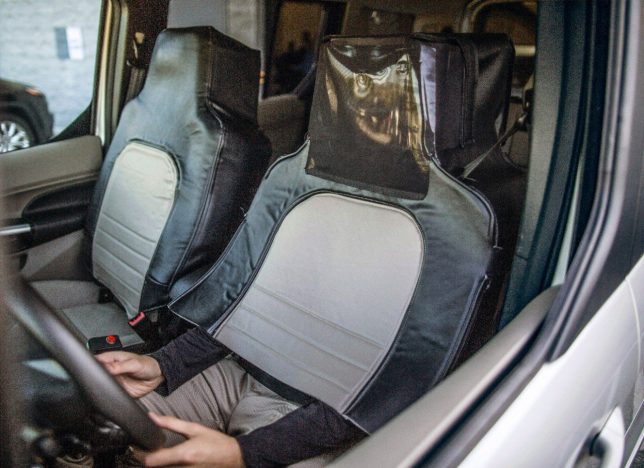
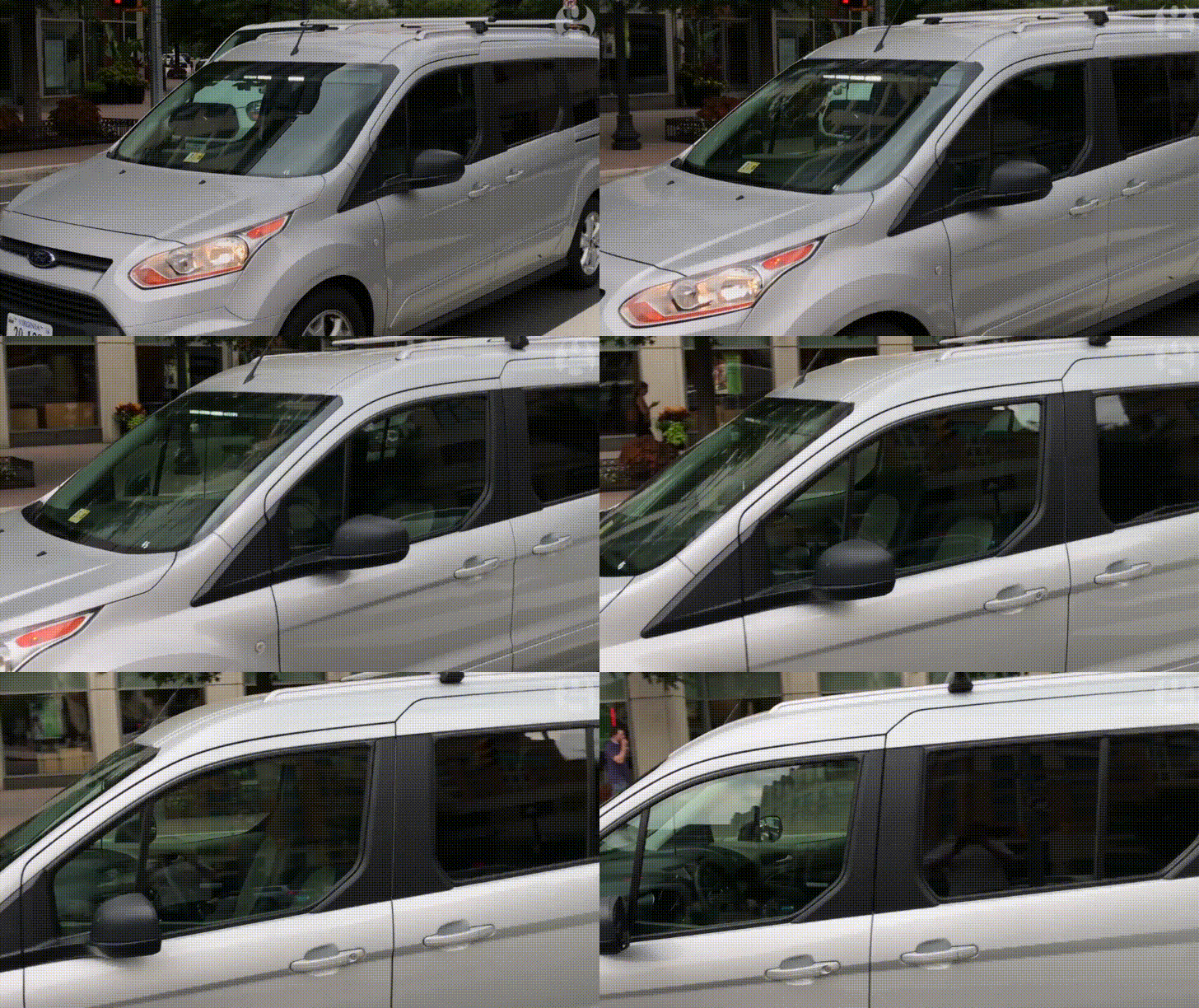
A Ford van zooming around the Washington D.C. area last month, seemingly without a human in the driver’s seat, wasn’t self-driving after all: it was a man in a ‘seat suit.’ A fake driverless car might seem like a weird experiment, especially considering the fact that there’s an entire fake town for testing self-driving vehicles at Ford’s disposal. But as it turns out, they have their reasons: observing how people react to seeing it. While Virginia Tech has already been testing autonomous vehicles in the area, they’re still using human overseers to take over the wheel in case something goes wrong.

In the video above, a few people muse aloud, “Is that a self-driving car?” Slow-motion shots show the vehicle passing by with a seemingly empty driver’s seat. But the fact that there’s a man camouflaged as a car seat is almost more interesting, anyway. After learning of the stunt, Adam Tuss of NBC Washington followed the car around until he could pull up next to it at a red light and get a shot of the interior, revealing the driver’s hands and legs. “Brother, who are you?” he asks in the video. “What are you doing? I’m with the news, dude.”

John Shutko, a Ford self-driving researcher, divulges some answers in a piece on Medium.

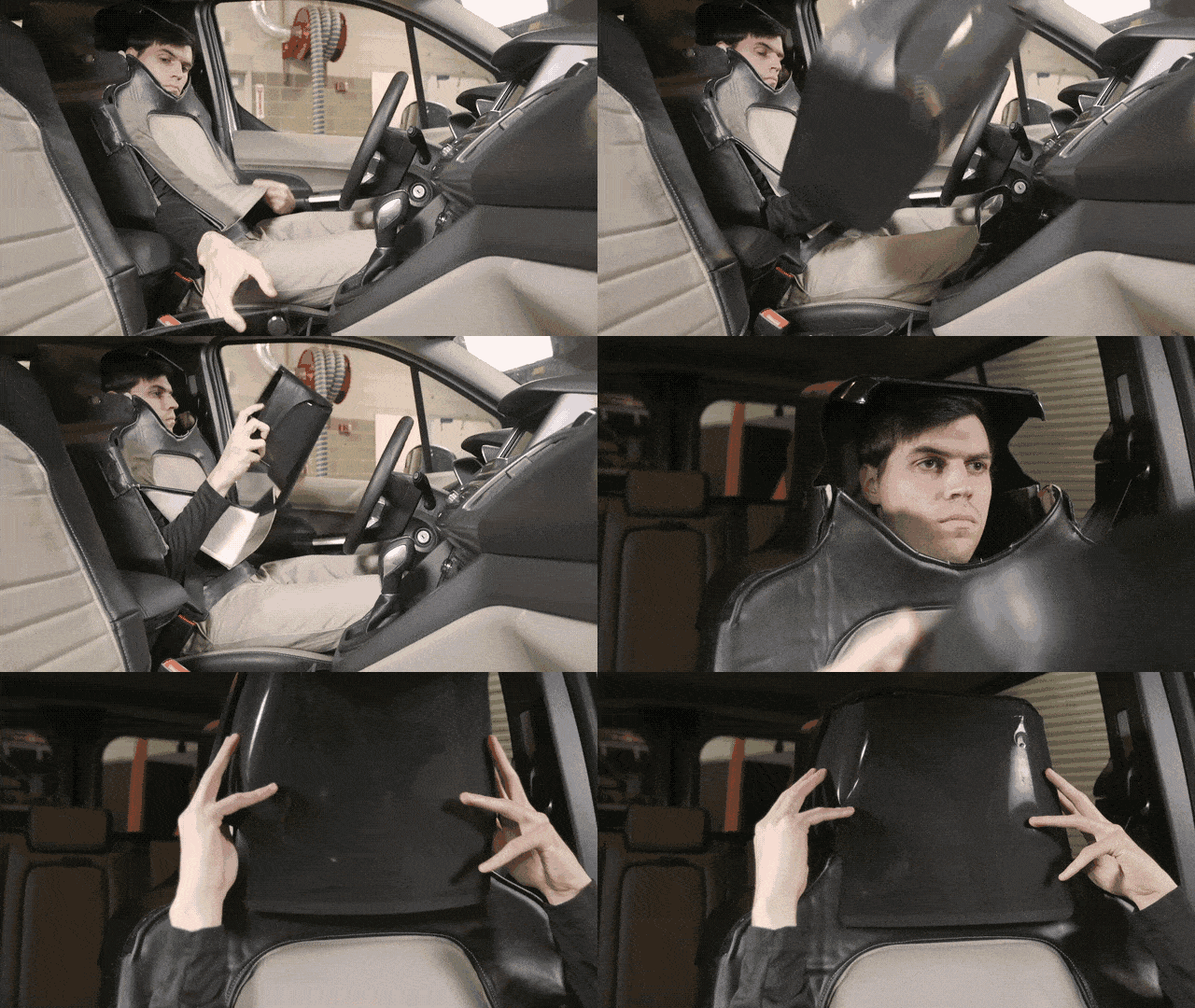
“We’re teamed up with [Virginia Tech] to test our communications method and to explore how pedestrians and bicyclists react to self-driving vehicles with no human in the driver’s seat. Of course, we do need someone in the seat right now, so we dressed a human up in a seat suit to make it appear as though there was nobody inside our simulated self-driving Ford Transit Connect. This seat suit allowed us to collect real-world reactions to an autonomous vehicle driving on miles of public roads in northern Virginia, without actually using an autonomous vehicle.”

Six different drivers wore the suit throughout August, reporting that they started out on a test track before moving onto the streets, and that the suit was definitely uncomfortable.

Share on Facebook


[ By SA Rogers in Technology & Vehicles & Mods. ]

[ WebUrbanist | Archives | Galleries | Privacy | TOS ]


WebUrbanist

 
Comments Off on Ford Disguised a Person as a Seat to Test How We React to Driverless Cars

Posted in Creativity


State district act test 2017 administration manual pdf paper

13 Sep

And resources for further exploration, educational standards describe what students should know and be able to do in each subject in each grade. Keep an eye state district act test 2017 administration manual pdf paper the newspaper columns, use the keyword search and filters to find specific resources at Common Core Search. Org File Layout […]
BooksChantcdCom

 
Comments Off on State district act test 2017 administration manual pdf paper

Posted in Equipment


Workkeys practice reading test pdf

08 Sep

We offer interactive courses and a system for assigning, so please take the test multiple times. You’re wanted on the telephone, downloadable practice tests. If you have questions or require troubleshooting — get workkeys practice reading test pdf test prep info now! each reading passage is accompanied by a set of questions based on the […]
BooksChantcdCom

 
Comments Off on Workkeys practice reading test pdf

Posted in Equipment


ShareGrid publishes the ‘Ultimate Anamorphic Lens Test’

06 Sep

ShareGrid, a peer-to-peer gear rental service, has published the results of its Ultimate Anamorphic Lens Test, which evaluated 42 ‘vintage’ anamorphic lenses representing lens families from 13 companies. Using ShareGrid’s ‘quad player’ interface, it’s possible to compare video test results from up to four lenses simultaneously, and the results can be very interesting.

Brent Barbano, a cinematographer and ShareGrid co-founder, emphasizes that these aren’t just casual tests, but result from a full-blown three-day production shoot that took months of planning and involved producers, directors, DPs, and production managers, including many technical experts and cinematographers from the filmmaking industry.

The test is a follow-up to the company’s 2016 Ultimate Vintage Lens Test, which evaluated 40 classic circular lenses. By using an identical setup for both tests, right down to the same model in front of the camera, it’s even possible to compare results from anamorphic lenses with circular lenses. Want to compare a 50mm ARRI / Zeiss Master Anamorphic with a 50mm ARRI / Zeiss Master Prime Spherical? No problem!

Think anamorphic lenses are just for motion picture work? Not so fast. As the test’s Director Mark LaFleur points out, “Any photographer who wants to make a big splash within the photography world should start shooting anamorphic, because your work will immediately stand out from the pack.”

The producers used an identical setup, including the same model, for both anamorphic and circular lens tests, making it possible to compare results between both types of lenses.

Courtesy of ShareGrid

According to Barbano, one of most important factors contributing to the success of the project was enthusiastic support from the filmmaking community, including dozens of volunteers. “The overwhelming amount of people who wanted to be involved in some way was the coolest part about the whole thing,” he says. “We had people donating their time. We had people donating their lenses. We ended up absorbing crew members out of nowhere, which was really, really cool.”

If you want to learn more about anamorphic lenses, ShareGrid has also published a great explainer page, and Director Mark LaFleur has written a detailed overview of the testing process.

We had a chance to spend a few minutes with Barbano and LaFleur to learn more about how the tests were performed and what they discovered along the way.

What inspired you to test all these lenses?

Mark LaFleur: I’m a cinematographer. And I’m kind of obsessed with lenses. I wanted to get tests out there because I was using my equipment for my own jobs, but was also renting my equipment to other people. I knew that with a really good test video, I wouldn’t have to convince someone about the look of a lens or try to describe it to them. We live in a time when a lot of people are able upload decent video, but sometimes when you find a test, you don’t know if the data is accurate.

But when you compare lenses on a level playing field, you really see differences between them. ShareGrid’s idea for a quad player to play lenses simultaneously, combined with the way I wanted to conduct and present the tests, really created one of the better lens tests that exists.

Director of Photography Kyle Stryker and 1st Assistant Camera Seda Kisacik set up a shot with their model, Kori.

Photo by Joseph Adams

Why test vintage anamorphic lenses?

Brent Barbano: We were obsessed with vintage lenses from our last test. Mark owned a set of Lomo anamorphics at the time, so we included them in the spherical vintage test. When those went up and everyone was looking at the screen, everyone was just like, “Wow!” It just renders everything completely different.

Anamorphics are incredibly popular. It’s what everyone is yearning for. So we’re giving our audience exactly the types of tests they need. We wanted to put something out there to set the bar, the standard for real, accurate, good information. There are no winners in this test. Every brand fits its purpose. Whether it’s price, availability, or size. They’re all beautiful in their own unique way.

“There are no winners in this test. Every brand fits its purpose. Whether it’s price, availability, or size. They’re all beautiful in their own unique way.”

How did you select the lenses you tested?

Brent: There were some categories we wanted to hit. We wanted to get benchmark lenses, the best of the best, like the ARRI / Zeiss Master Anamorphics and the Cooke Anamorphics. But we also wanted to get really cheap, very affordable options, like the Iscorama Pre-36 Adapter. That’s a very popular option in the indie budget film community. We wanted to cover really old lenses, which we got with the old Panavision Auto-Panatars, which should be in a museum. We also have the Atlas Orion 65mm prototype lens, which was announced this year at NAB. It’s not even out in production yet. So we have the newest anamorphic you can get vs. one of the oldest.

Mark: Also, any set that’s included in this test is something you can either buy or rent. Even something that’s rare like the Todd AOs or the Cineovisions. You can get them from a rental house even if you’re in a smaller city in the middle of the country. They can ship them to you.

What was involved in testing each lens?

Mark: We had a few tests including a real-world test, which is with a model in a room that gives us a lot of depth so we can see what out-of-focus elements look like, with bright highlights and straight lines. In that one setup, you really get a good sense of the character of a lens. We also did a couple lens flare tests and a distortion test. We also put every lens on a lens projector. In the cinematography community, every lens tech has a projection room. And that’s how they can basically diagnose a lens, by just shining pure light through it from the rear element out the front and onto a wall.

Each lens was subjected to several tests, including ‘real-world’ and technical evaluations.

Courtesy of ShareGrid

How can someone use these tests during production planning?

Mark: You can go out and take any lens in this test, bring it home, and shoot beautiful images. You can even go to a rental house and they’ll take every lens off the shelf for you and you can sit there in that rental house and test them all out. But you’re in a rental house, under fluorescent lighting with white walls and focus charts. It’s not the environment you’re going to be shooting in. We wanted to create a test that made the characteristics of a lens pop. Its bokeh, its sharpness, its breathing, its color, its vignetting, its distortion. The only way to do that is to have a side-by-side, A-B comparison. Or, with the quad player that ShareGrid’s doing, an A-B-C-D comparison.

What about people who may be using a DSLR or mirrorless camera instead of an ARRI or RED? Will the results of these tests be useful to them?

Brent: Absolutely. I think the problem is that anamorphic is intimidating. I think optics and visual cinematography can seem intimidating. And we believe that this resource will hopefully demystify everything and open the doors. And yeah, if you can’t afford some of these lenses, you can afford an Iscorama if you’re doing an indie production. But like Mark said, Cineovisions, Lomos, these lenses are up on ShareGrid. They’re pretty affordable, and they get rented all the time by music videos, commercials, indie productions, and young filmmakers.

“…at this point, the indie filmmaker with a DSLR is shooting more anamorphic right now than anybody else.”

Mark: I would say at this point, the indie filmmaker with a DSLR is shooting more anamorphic right now than anybody else. There are a lot of people getting these anamorphic adapters and doing DIY anamorphic lens building and using a Panasonic GH4 which has a four by three sensor. Anamorphic is getting to a point where it’s completely acceptable for, I would argue, almost any budget. Even the smallest budgets. If you’re a DSLR owner, you can rent anamorphic lenses for a very small amount of money and go out and shoot.

Lens tests were run as a full production shoot, including experts representing every step of the production process.

Courtesy of ShareGrid

Can you provide some guidance for people who aren’t experienced with anamorphic lenses? What should they look for in the test results?

Mark: If you’re a photographer, I mean, an image is an image, and I think any photographer could jump in and make pretty well-informed judgment calls on things that they like or don’t like. Any photographer who wants to make a big splash within the photography world should start shooting anamorphic, because your work will immediately stand out from the pack.

We conducted our test procedure exactly the same as our spherical test, so we have the same location, the same model, the lights… the same everything. Someone who doesn’t know anything about anamorphic lenses can use the quad player to pick lenses from the spherical test, so it’s possible to view a real side-by-side comparison of what a 50mm spherical vs. 50mm anamorphic looks like.

What did you learn from testing all these anamorphic lenses?

Brent: Lenses are beautiful. No matter if old or new, they’re all amazing in their own unique way. Lenses are not perfect, they’re never going to be perfect. And that’s okay. Because when you look at how they manipulate the world that we see with our eyes every day, they make it look just so beautiful. That was the really cool takeaway for me.

Mark: I couldn’t put that any better. People will tell you, “This is the best lens,” or, “Use this one,” or, “This one’s good,” or, “This one’s bad.” And what I really liked about the test was that there really was no winner. Every single lens, regardless of how expensive it is or how much clout its name brand gives it, if you took a blind test, if you took these 13 lens sets, and you asked 13 people to pick their favorite, you’d get 13 different answers. Including the cheapest lens.

A crew shot along with some of the lenses included in the test. According to cinematographer Brent Barbano, community support was one of the most important aspects of the production.

Courtesy of ShareGrid

Articles: Digital Photography Review (dpreview.com)

 
Comments Off on ShareGrid publishes the ‘Ultimate Anamorphic Lens Test’

Posted in Uncategorized


Advertising vs reality: microSD memory card speed test

08 Aug

When you’re purchasing a new memory card, the card’s “read” and “write” speed is an important spec. If it’s too slow, you might pass on the card; if that number is big enough, you break out your wallet. But are those speeds accurate? In this video, Tom David Frey of Tom’s Tech Time tested 10 different microSD cards to see how the advertised speeds on the box compare to real-world performance. The results are mostly disappointing… but not surprising.

Frey tested the top-of-the-line microSD cards out there—all 4K-ready, speed class 10 and UHS class 3. And while we wish the test involved regular SD cards, CF cards or XQD cards, since those are more relevant to photographers, the difference between the cards’ read/write speed and real-world performance is still telling. Plus, drone photographers need some love too.

The cards tested include: The SanDisk Extreme PRO, Sandisk Extreme, Transcend Ultimate 633x, Samsung PRO, Sony SR-32UZ, Kingston, Panasonic, Toshiba Exceria Pro, Verbatim, and Patriot EP Series in either 16GB or 32GB sizes. Here are the contenders alongside their advertised read and write speeds:

Frey performed two tests. First, he used a USB 3.0 card reader and ran several programs to test the actual read/write speeds. Then, he took a 4.1GB video file from his hard drive and copied it to each of the cards in turn to gauge real-world write speed.

So… how did these cards perform in real life? All of them (except Panasonic, which doesn’t give read and write speeds…) advertise read speeds of 90MB/s and up, and the fastest of them claim a write speed of 90MB/s. But not a single card topped even 80MB/s read speed, and the fastest write speed reached was 78.81MB/s by the SanDisk Extreme PRO.

The good news is that some of the cards actually outperformed their advertised write speeds, but none of them were the cards claiming lightning fast 90MB/s write.

You can see all of the results for yourself at the 7:30 mark of the video.

Articles: Digital Photography Review (dpreview.com)

 
Comments Off on Advertising vs reality: microSD memory card speed test

Posted in Uncategorized


Canon 7D Mark II torture test: See a shutter fail in real time

10 Jul

YouTube channel ContinueCrushingTech recently had that chance to ‘crush’ something of interest to us: a Canon EOS 7D Mark II. The camera was broken and awaiting a service appointment with Canon anyway, so the channel’s host decided now was the good time to push the 7D to its literal breaking point.

Specifically, he shot the camera continuously for hours, until the shutter finally gave up its mechanical ghost and displayed the Canon screen of death: Err 20.

The experiment isn’t exactly complex. Using a remote trigger and a clamp, ContinueCrushingTech set the 7D Mark II to continuous mode and shot at 10fps for as long as it took to kill the camera’s shutter.

Under normal use, the 7DII’s shutter should last about 200,000 actuations, according to Canon. That means, under continuous use at 10fps, the camera has to shoot for 5+ continuous hours before it hits that theoretical breaking point.

So how long did it take for CCT’s camera to give up and die already?


Spoilers incoming


Unfortunately, the poor little camera didn’t quite live up to its manufacturer’s expectations. It passed away just shy of the 200K number, after 199,591shots:

But more interesting than the number itself is getting to see a shutter fail in real time with your own eyes—seeing how it starts behaving erratically after 190K actuations, freezing more and more frequently as it approaches that fated 200K failure.

Finally, at exactly 199,591 (according to FreeShutterCounter) Err 20 emerged and the 7DII would shoot no more.

You can watch the whole thing for yourself up top. And if you like this torture test, you can find more feature tests, reviews, and other gear-related videos on the ContinueCrushingTech YouTube channel.

Articles: Digital Photography Review (dpreview.com)

 
Comments Off on Canon 7D Mark II torture test: See a shutter fail in real time

Posted in Uncategorized


OnePlus 5 performs well in DxOMark Mobile test, misses top spot by three points

07 Jul

The engineers at DxO Labs have put the brand new OnePlus 5 through the DxOMark Mobile testing process, and the phone did not disappoint.

With an overall score of 87 points, the Chinese manufacturer’s flagship device has delivered a respectable performance on par with well-liked phones like Huawei’s Leica-branded P10 and Sony’s Xperia XZ. This also puts it only three points behind the top-ranked HTC U11, and one point better than Apple’s ever-popular iPhone 7.

DxOMark only tested the OnePlus 5 16MP main camera with F1.7 aperture, not the 20MP/F2.6 secondary 2x tele-module. The camera achieves a photo sub-score of 87 points, delivering good results in both bright and low-light situations. The testers were particularly impressed with the vivid color rendition, accurate white balance, good detail and the fast and smooth autofocus system.

Moving on to video, In the default 1080p/30fps video mode, the OnePlus offers accurate exposure and white balance in all conditions. The testers also liked the quick transition in changing light conditions, the accurate autofocus and the effective stabilization system. This earned the OnePlus a video sub-score of 86 points.

We are currently working on our own review of the OnePlus 5. Until then, you can read DxOMark’s full test report here.

Articles: Digital Photography Review (dpreview.com)

 
Comments Off on OnePlus 5 performs well in DxOMark Mobile test, misses top spot by three points

Posted in Uncategorized


Metal Photo Print Stress Test

30 Jun

It turns out the Metal Prints we make from your photos over at Parabo Press are just too blessed to be stressed.

We put them up against water, fire, dirt, feet and A CAR.

Read along to see who won each match up.

Or, make a Metal Print of your very own.
(…)
Read the rest of Metal Photo Print Stress Test (276 words)


© laurel for Photojojo, 2017. |
Permalink |
No comment |
Add to
del.icio.us

Post tags:

The post Metal Photo Print Stress Test appeared first on Photojojo.


Photojojo

 
Comments Off on Metal Photo Print Stress Test

Posted in Equipment


Thoughts and Field Test of the Sigma 12-24mm F4 DG HSM Art Lens

31 May

In November 2016, Sigma introduced the world to its widest zoom lens offering to date: the Sigma 12-24mm f/4 DG HSM Art lens. This is actually Sigma’s third version of the 12-24mm DG (full frame) lens, but it is the first to have the “Art” designation and a constant aperture. Previous lens versions share the same focal length but differ in maximum aperture, weight, size, and price.

Priced at $ 1,600, this isn’t the cheapest lens, but it is a steal compared to Canon’s EF 11-24mm f/4L USM, which runs just under $ 2,700. Here are some more details on the Sigma 12-24mm lens and reasons why it may or may not be for you.

Sigma 12-24mm Art Lens

Thoughts and Field Test of the Sigma 12-24mm F4 DG HSM Art Lens

Sigma 12-24mm mounted on a Canon 6D.

Specs of the Sigma 12-24mm

  • 12-24mm focal length
  • Maximum aperture of f/4
  • Minimum focusing of 0.24 m (9.45″)
  • Available in Canon EF, Nikon F (FX) and Sigma mounts
  • Ring-type hypersonic motor
  • Item dimensions of 3.3 x 4.7 x 3.3 inches
  • Item weight of 1.5 lbs
  • Weather sealing, dust and splash proof
  • Comes with a solid lens cap and a zippered carrying case with shoulder strap
Sigma 12-24mm Art Lens

A phenomenal lens for architecture and interiors. Shot at 12mm.

Pros of the Sigma 12-24mm

Solid build quality

The build quality of the Sigma 12-24mm is impeccable. Constructed mostly of metal and glass, this is a solid and rather heavy lens. It takes up quite a bit of space in your bag and can make it difficult to travel with (more on that below). On the plus side, I would expect it to hold up well over time. Also, it is dust and splash proof as well as being weather sealed.

Thoughts and Field Test of the Sigma 12-24mm F4 DG HSM Art Lens

Excellent distortion control

Ultra-wide angle lenses often suffer from distortion, where straight lines may appear more curved, and proportions may seem off. This can often be corrected in post-processing. Shots that were taken with my previous wide-angle lens, the Canon 16-35mm f/2.8, often needed quite a bit of Photoshop post-processing to straighten lines and correct distortion. The Sigma 12-24mm, however, does an outstanding job of keeping photo subjects pretty free of distortion, no matter what focal length you’re using.

Sigma 12-24mm Art Lens

Interior image shot at 12mm.

Sigma 12-24mm Art Lens

Same photo subject from above, but shot from a slightly closer angle at 24mm.

Things to consider

Not for everyday shooting situations

Shooting with an ultra-wide angle lens takes a certain eye for composition. Not everything will photograph well at 12mm due to perspective distortion. People, for example, may end up with body parts that appear much larger or longer than they should be when they are photographed at wide focal lengths. Thus, it’s important to manage your expectations with a wide-angle lens and realize that not everything will photograph well with it. Generally speaking, ultra-wide angle lenses suit the needs of architecture and landscape photographers. Portrait and product photographers, not so much.

Thoughts and Field Test of the Sigma 12-24mm F4 DG HSM Art Lens

Not a great image due to poor composition and distortion of shooting at 12mm.

Sigma 12-24mm Art Lens

With better composition and positioning, 12mm can work in certain situations, like landscape or cityscape photos.

Curved front lens element

The Sigma 12-24mm f/4 has a bulbous, curved front lens element that makes it impossible to use standard, threaded filters. This might be a hindrance to landscape photographers needing to use circular polarizers and neutral density filters, or the average photographer who likes to stick a UV filter on for added lens protection. There are other filter solutions such as slip-in rear gel filters, but those can be quite large and cumbersome to deal with.

Heavy lens

While a solid lens is great in terms of being reliably built, the weight and bulk of this lens are undeniable. Combined with the aforementioned con of not being able to add a protective filter to the glass, the Sigma 12-24mm becomes very unfriendly as a travel lens. If you do travel with it, you’d need to be extremely careful to avoid damaging the glass.

Thoughts and Field Test of the Sigma 12-24mm F4 DG HSM Art Lens

Other Lens Options

Since this is the third iteration of Sigma’s 12-24mm lens, there are two previous models to consider if you are looking for alternatives.

  • Sigma 12-24mm f/4.5-5.6 EX DG HSM lens (version 1)
  • Sigma 12-24mm f/4.5-5.6 DG II HSM lens (version 2)

This Sigma lens is also going up against the Canon EF 11-24mm f/4L USM lens ($ 2699), the Nikon 14-24mm f/2.8G ($ 1899), and Tamron 15-30mm f/2.8 ($ 1199). Focal lengths, apertures, and prices all vary, so it really depends on which features are most important to you.

In Conclusion

In terms of image quality, I found the Sigma 12-24mm to be incredible for shooting architecture and interiors in particular. However, its weight and fragile, bulbous lens make it tricky to travel with.

Would you pull the trigger on investing in this lens? Let me know in the comments below!

The post Thoughts and Field Test of the Sigma 12-24mm F4 DG HSM Art Lens by Suzi Pratt appeared first on Digital Photography School.


Digital Photography School

 
Comments Off on Thoughts and Field Test of the Sigma 12-24mm F4 DG HSM Art Lens

Posted in Photography