RSS
 

Posts Tagged ‘Subject’

Learn How To Connect With Your Subject

26 Oct

I was reading through the comments left on a recent post that I wrote here on DPS and one of them really spoke to me and ultimately inspired me to write this post for you today. For reference I’ve quoted the comment below by Justin Donie.

p165722407-4

All the tips given here are relevant and true. And I won’t minimize the value of any of these tips. They will all help you have a better experience and create something closer to what you want than if you don’t follow them. I thank the author of this post for sharing these practical tips … they are all good and useful. But let’s also remember that we need to spend time … and not just a little time … on our inner preparations as well.

All the technology, technique and work-flow management in the world can’t make up for what will be missing from our images if we never learn how or take the time to infuse the power of our personal inner experience of life into uniquely expressed, emotionally moving visions. I believe, as photographers, we must begin focusing more of our time and energy and even money on these aspects of our art.

Preparing for a successful shoot … a REALLY successful shoot … must include a powerful immersion in our personal relationship with the subject, a passionate exploration of different ways of visualizing and of sharing our individual inner experience, and a careful nurturing of the emotional connection we’re creating with our intended viewers.

Over the last 40 years of my creative experience it has gradually become clear to me that we photographers face a challenge in our art that most other artists do not. We can far too easily let “the gear” and “the work flow” and our fascination with them get in the way of the core and essence of all art … “the experiences of life we’re exploring … what we have to express … and how we choose to expressing it.”

All art utilizes some form of media, directly or indirectly. But in other arts, the act of creating may actually put the artist more closely in touch with the thoughts or feelings they are trying to explore and express. In photography, the very tools of creativity are so numerous and so complex that they can distance us from the raw experience of self-exploration and self-expression, ESPECIALLY because vast majority of photographic instruction tends to focus on technology and technique and not self awareness, other-awareness, emotional honesty and ever-more creative modes of revealing our inner selves to the outer world. I believe it’s time for that to change.

Justin Donie

What really stuck out to me was the way Justin closed his comment – “…photographic instruction tends to focus on technology and technique…” he’s got a point. Just look around DPS or any other blog related to photography training and you’ll find post after post teaching you how to use your camera, how to compose your scenes better, how to use Lightroom or Photoshop or some other software to enhance the images you have captured – the list goes on. However, when you look for information on how to actually dig deep into the emotional side of capturing a piece of art and translating that emotion to a still image – it gets a bit more difficult to find.

This is not a bad thing so don’t get me wrong it’s just something we have to be aware of. As Justin mentioned at the start of his comment these techniques and skills are important and will help you make better photographs in the end, but like Justin, I think the point here is that to truly capture powerful images we have to learn how to translate our emotions from the scene we’re photographing through the camera and into a still image.

p471780900-4-1
I’ve thought about how I was going to write this article for quite some time. I knew it wasn’t going to be an easy piece to write, but I wanted to bring attention to the concept that Justin brought up and try my best to get us, at least started down the road to, an answer for it.

My hope is that through the community here at DPS we can come up with a massive list of ideas for connecting with our subjects – Whether you photograph the stars that fill our skies, shoot macros of the smallest insects or anything in between – How do you connect with your subject?

Here are a few ideas that I’ve come up with – I hope you’ll continue to add to the list in the comments below.

A Four Step Process On How To Connect With Your Subject and Better Your Photography

1.) Put Down the Camera

The first step in this process is to put down the camera and step back from the scene. The camera in some instances is very much like a security blanket it’s a buffer between us and our subject, by putting it down, you remove that buffer and you start to see the scene differently. The idea here is simply to free yourself from the camera for a minute and remove yourself from the need to adjust your settings.

2.) Define Your Subject

Next on the list is to truly define the subject of your photograph. If you can’t tell me what the photograph your taking is about then you probably shouldn’t be taking a photograph of the scene after all.  If you’re photographing a model it can be quite easy to do this, but when you’re in a vast and open landscape, sometimes the subject is so big it’s hard to find a way of defining it within the limits of the camera’s frame.

Spend some trying to describe what it is you’re trying to capture to yourself or to a friend. The more you do this the better you’ll be at being able to pick out the little things that really will start to help you tell a story with an image.

3.) Meditation

This is something I haven’t done yet, but I’m actually going to attempt to give it a try on my next shoot. My idea here is going to be to show up extra early to the location I want to photograph. Set up my camera and determine my subject. After that I’m going to sit down, close my eyes, and drift away for a few minutes to clear my head. Once this meditation is over I’m going to once again return to step two and see if anything has changed or if I’ve noticed any finer details of the scene.

I do this before  I write long articles or when I find myself struggling for ideas to write about. So the thinking here is that if it can help clear my head for writing, maybe, just maybe, it can help clear my head on a shoot.

4.) Talk it Through

This tip tends to shadow the idea of number two, but here rather than specifically talking about the subject you’re capturing, talk about everything on a whole. What kind of photograph are you looking to make? Is it black and white? Is it an HDR? What do you want your viewer to feel – what are you currently feeling?

Whether you’re with another photographer, a model or alone in the wilderness it’s amazing to simply put words to the emotions that you’re feeling. Describing the scene out loud might seem strange at first, but it will help you see it better in your mind.

Connect with your subject
It’s so important to never forget that gear, software and knowledge of what we should do in the scene can only take us so far. To truly capture the world around us we have to connect with the scene that we are capturing and transfer the emotions that we feel into the still image. Without this connection – we might end up with technically sound photographs that lack power or purpose and ultimately that is what gets people to stop and look at the photographs that you’ve created.

Now – I’d love for you to take a moment, or a day, and come up with a few of your own techniques for connecting with subjects and leave the answers you find in the comment below so others might be able to learn how to connect with their subject and ultimately take better photographs.

Post originally from: Digital Photography Tips.

Check out our more Photography Tips at Photography Tips for Beginners, Portrait Photography Tips and Wedding Photography Tips.

Learn How To Connect With Your Subject

The post Learn How To Connect With Your Subject by John Davenport appeared first on Digital Photography School.

Digital Photography School

 
Comments Off on Learn How To Connect With Your Subject

Posted in Photography


The Soul Behind the Subject by Kelly Kirkpatrick

25 Sep

To quote Jean-Luc Godard, “when you photograph a face you photograph the soul behind it”. While I have been a shutterbug all my life, it wasn’t until 2006 when I really started studying photography and working as a professional. Through education and building on my own experience, there are many things I could say on […]
dslrBlog

 
Comments Off on The Soul Behind the Subject by Kelly Kirkpatrick

Posted in Photography


Anatomy of a Subject

30 Aug

So much of what we do is defined by the elements that embody the concept.  The three elements of the exposure triangle help us understand “proper” exposure.  Every light source has three distinct qualities (color, quality, direction).  Even the physical tools at our disposal can be broken down to a simple trifecta– light, lens, and camera.  Being able to break something down into its components helps the beginner by giving them a road map– a series of steps that simplifies the process and makes it easier to understand.  With enough repetition, that same road map becomes a mental checklist for the more advanced photographer.  Over time, that checklist hopefully just becomes second nature.  That photographer might not actually be thinking “foreground, subject, background” each time they compose an image in the viewfinder, but the elements are present, both in the planning and execution of the shot.  Taking this concept of breaking down composition a step further, we can even break down the subjects in our images into distinct visual components.

SHAPE or OUTLINE

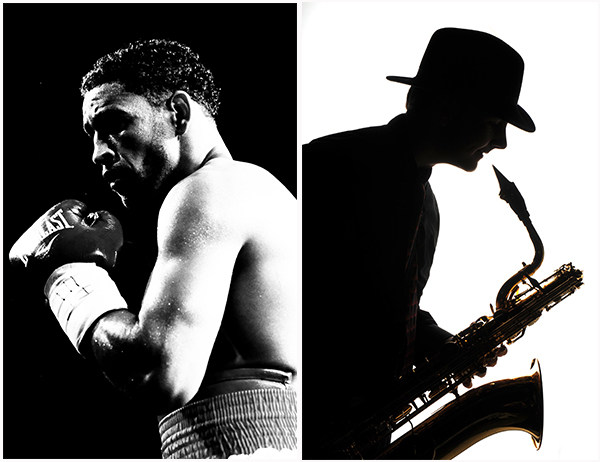
Perhaps one of the most fundamental of these components is shape.  Regardless of whether we are photographing people, buildings, landscapes, or any of the other endless possibilities, every subject has shape.  Definition.  It can be subtle or dramatic, but everything we photograph is defined to a certain extent by its outline.  The most graphic representation of shape comes from a back-lit silhouette or underexposure, either of which draws less attention to individual features and more to the overall shape of the subject.  While this photo of a boxer is very brightly lit from the side, the high contrast lighting and black background combine to engage the viewer with a strong emphasis on the shape and outline of the subject.  In a more classic silhouette, the sax player was lit completely from behind.  The soft, wraparound quality of the light does bring out a bit of detail in the instrument, but the visual emphasis rests primarily on the shape and outline of the musician, creating an entirely different overall feel to the image.

001-Shape

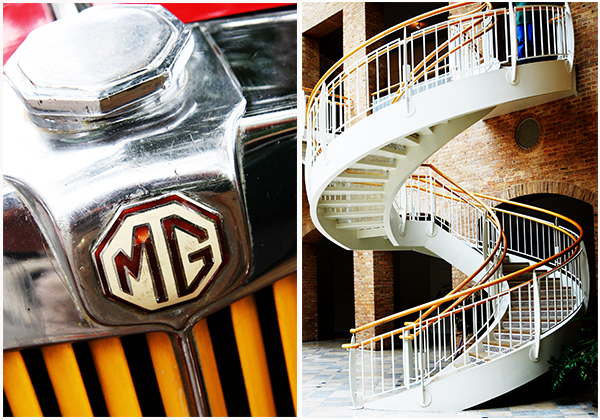
Obviously, high contrast and silhouette are not the only ways to illustrate the shape of a subject.  As noted, everything that comes in front of our camera has shape.  How and to what extent you choose to highlight it relies on how you choose to place it in your frame.  The photograph of the staircase was taken for an ABC project entirely because of its shape, while the radiator grill of the 1938 MG has multiple shapes and lines which draw the viewer’s eye into the photo from top to bottom.

002-Shape

COLOR & TONE

While color often grabs our attention first, sometimes we take the extra steps to actually plan for it.  Bright and bold.  Soft and muted.  Contrasting or Complementing.  In the portrait of the boy with the football helmet, the bright red obviously grabs your attention and draws you in.  In the low-key portrait on the right, however, it was the darker tones and color palette that caught my interest.

003-Color and Tone

FORM & TEXTURE

When we start introducing light and shading across a subject we produce various qualities of shape, shifting lines, and intensity of color.  While our silhouette primarily emphasizes a subject’s two-dimensional  shape, it is “form” that best describes the three-dimensional qualities of a subject.  Form gives substance, depth, and definition to the silhouette– bringing it out of the shadows and into the foreground.  Here is where the combination of light, color, and shadow combine to create texture in our images.  In each of the images below, the form and textures are created and accentuated not only by the composition, but also by the way the light falls across the subject.

004-Form and Texture

As is the case with things like the exposure triangle  or characteristics of light, the extent to which each of these is emphasized in any given photo is going to rely heavily on the photographer and how they express their personal vision and individual style, as well as the mood they are trying to convey and the story they are trying to tell.  In virtually every situation, however, one of these components plays a huge role in making a photographer stop in their tracks and say, “I need to photograph that.”

Post originally from: Digital Photography Tips.

Check out our more Photography Tips at Photography Tips for Beginners, Portrait Photography Tips and Wedding Photography Tips.

Anatomy of a Subject


Digital Photography School

 
Comments Off on Anatomy of a Subject

Posted in Photography


Modular concept camera captures photographer and subject simultaneously

20 Jul

duogood3.jpg

It’s not uncommon for photographers to feel much more at ease behind the camera rather than in front of it. Duo, a concept from Chin-Wei Liao, a Korean design school graduate, aims to transform the person behind the lens into photographer and subject simultaneously. Each half of the Duo is an individual camera. Assembled as one unit, pressing the shutter will record and an image while capturing a picture of the person using the camera. Click through to read more about this modular camera system.

News: Digital Photography Review (dpreview.com)

 
Comments Off on Modular concept camera captures photographer and subject simultaneously

Posted in Uncategorized


Researchers in Tokyo develop high-speed subject tracking system

17 Jul

Screen-Shot-2013-07-16-at-11.01.35-AM.jpg

Engineers at Tokyo University’s Ishikawa Oku Laboratory have come up with new technology to track extremely fast motion. Their new system – which uses ‘Saccade Mirrors’ for pitch and tilt, a ‘pupil shift system’, and very fast image processing – is able to keep even the quickest subject in the center of the frame at all times. According to engineers, the initial application for this system could be to capture video at sporting events. They expect it to be market-ready in about two years. Follow the link for a video demonstration of this intriguing new technology.

News: Digital Photography Review (dpreview.com)

 
Comments Off on Researchers in Tokyo develop high-speed subject tracking system

Posted in Uncategorized


3 Tips for Taking Portraits that Reflect the Character and Spirit of your Subject

23 May

A Guest contribution by Hailey Bartholomew from You Can’t Be Serious.

1. Do Something

Who are you photographing? If you don’t know them well, find out what they love to do and where they relax the most.

Maybe they love to row boats or take picnics at their favourite park every Sunday.

Maybe you are photographing your grandmother who loves to be out in her garden. Go and do that with them.

Whatever they love to do to relax, tag along with your camera.

But don’t sit back on the sidelines hoping to catch a moment from far away – get down and into whatever they are doing. You need to be in IN that row boat and if your nana is kneeling in the dirt, you should be too. Get into the action and photograph your loved one or client doing what they love.

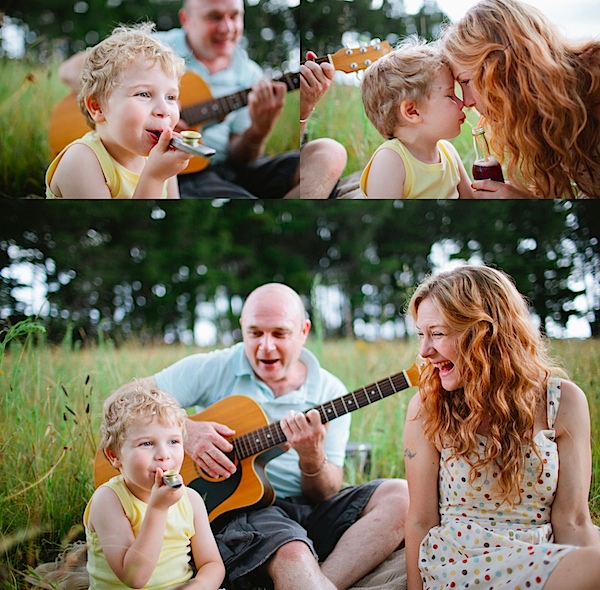
The family below loved playing music together and going on picnics… We did that!

Katie-6.jpg

This couple love drinks by the pool….

Ali+Chris_12.jpg

2. MOVE!

Set your camera settings to multiple shots so you can shoot lots of frames quickly. Then, either get your subject to move around, or YOU move with them.

If you have little kids and they keep wanting to run around, hold their hand and say pull me along! Select follow focus and start shooting. You will create natural moments but also fun energetic photos.

Your subject will forget it is about being formal and ‘looking’ good’ if you are moving and having fun. Same if they are moving around.

I love to get my subjects to piggyback each other or walk in a row or play around. Be there to catch the action and you will find your subjects are relaxed. Maybe play some music and dance!

NewImage

NewImage

NewImage

3. Have your Camera Handy

The perfect photo opportunity occurs when a real perfect moment is actually happening!

The best way to get someone being real is to capture a real moment of joy or happiness or reflection. If I have my camera way upstairs and in it’s case I am much less likely to capture everyday perfect moments with my kids.

So I keep my camera handy. It sits out of the case on a bench or is in a bag I take everywhere. Then when the right something happens I am ready to go!

Try a week long challenge and have you camera handy all week long. Keep it on your shoulder or on the bench in the lounge – somewhere you can grab it quickly. See what perfect and REAL moments you can capture!

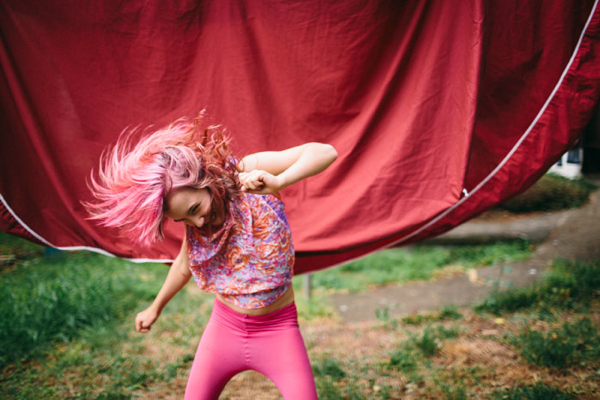
Below is a moment with my daughter… after hanging out the washing she came to show me her rockstar outfit… ;) So glad I caught this moment. So perfectly her!

NewImage

And another great ‘real’ moment was this recently on the beach we found an old trampoline and dug a hole for it. My daughter had the best time leaping off and onto the sand!! Lucky I had my camera with me!

NewImage

Lastly.. keep it real by being real yourself. Be honest and true to who you are. Don’t try to be all professional and formal and knowing everything rather relax, explore photography and be yourself. This keeps things not too formal. Have fun!

Hailey Bartholomew is an award winning film-maker & photographer who is in love with real and fun work that hopefully either makes you smile or makes you think. Hailey works for international aid organisations, shoots TV commercials, documentaries, family portraits and promo videos. You can see some of her work at her site You Can’t Be Serious.

Post originally from: Digital Photography Tips.

Check out our more Photography Tips at Photography Tips for Beginners, Portrait Photography Tips and Wedding Photography Tips.

3 Tips for Taking Portraits that Reflect the Character and Spirit of your Subject


Digital Photography School

 
Comments Off on 3 Tips for Taking Portraits that Reflect the Character and Spirit of your Subject

Posted in Photography


Photographer’s copyright suit lists his subject as defendant

21 Mar

desmond-howard-ann-arbor.jpg

US photographer Brian Masck has filed suit against several parties over unauthorized and unpaid use of a photograph he shot 22 years ago that has since become an iconic image recognizable to almost any US sport fan. Among the defendants is the subject of the photo himself, Desmond Howard, who used the image on his own website.

News: Digital Photography Review (dpreview.com)

 
Comments Off on Photographer’s copyright suit lists his subject as defendant

Posted in Uncategorized


1 Subject 3 Shots: Weekly Photography Challenge

08 Dec

untitled.jpgThis week your photography challenge is to shoot the one subject in three different ways.

The idea came off the back of our recent post – Make Your Last Shot Your Best Shot – in which Anne McKinnell challenged us to not stop shooting after we get our first good shot but to look for new ways to photograph a scene or subject in the hope of making the followup shots even better than the first.

She showed some great examples (pictured) of how she went beyond the first ‘obvious’ shot in a scene to take some interesting shots from different angles and perspectives.

So here’s the challenge – choose a subject (it could be a portrait, landscape, cityscape, still life, glamour shot…. anything) and aim to take at least 3 different shots of the one subject.

You might like to add variety to your shots by:

  • shooting from a different angle or direction
  • shooting with a different focal length
  • changing up your settings
  • trying a new technique (panning, slow sync shutter etc)
  • changing the composition

Once you’ve taken your shots we’d LOVE to see them so please share 3 or so shots in your series and tell us a little about how you progressed them and changed things up!

Once you’ve taken and selected the ’1 Subject 3 Shots’ images that you’d like to share – upload them to your favourite photo sharing site or blog and either share a link to it or – embed them in the comments using our embed tool to do so.

If you tag your photos on Flickr, Instagram, Twitter or other sites with Tagging tag them as #DPS3SHOTS to help others find them. Linking back to this page might also help others know what you’re doing so that they can share in the fun.

Also – don’t forget to check out some of the great shots posted in last weeks challenge – Food challenge where there were some great shots submitted.

Post originally from: Digital Photography Tips.

Check out our more Photography Tips at Photography Tips for Beginners, Portrait Photography Tips and Wedding Photography Tips.

1 Subject 3 Shots: Weekly Photography Challenge


Digital Photography School

 
Comments Off on 1 Subject 3 Shots: Weekly Photography Challenge

Posted in Photography