RSS
 

Posts Tagged ‘stock’

Hurry Up! Premium Stock Photos For Ultra-low Prices At MightyDeals.com

29 Oct

Stock photos are professional images of ordinary locations, events, nature, landmarks and people. They’re purchased as well as sold on a royalty-free agreement, and what makes them so useful is, of course, the fact that they can be constantly used for commercial-design applications. The photographer who snapped the stock photos owns them, but the person who purchased them gets to Continue Reading

The post Hurry Up! Premium Stock Photos For Ultra-low Prices At MightyDeals.com appeared first on Photodoto.


Photodoto

 
Comments Off on Hurry Up! Premium Stock Photos For Ultra-low Prices At MightyDeals.com

Posted in Photography


Instagram Stock Sites Struggle, Art Sells

28 Oct

Backed by Facebook, Instagram is now the main platform for shooting and sharing. With more than 130 million members, 45 million images uploaded each day and a billion daily likes spreading those photos across accounts, Instagram is the most important tool for casual snappers and photography enthusiasts who want to capture interesting scenes and show them to their friends.

But what about professionals — or at least people who want to earn like them? Is it possible for Instagram users to shoot, share and cash in on their images? It’s not easy and the numbers so far aren’t huge but there are ways to turn a photo-sharing following into a profit stream, with more on the way. We assess five of them:

1.     Sell Access to Your Followers

The Mobile Media Lab has been described by AdWeek as “a marketing agency for Instagram.” Created in April 2012 by three popular Instagramers, the company is used by brands that want to push images of their events to social media audiences. Those clients have included fashion firm Michael Kors, sports company Puma and even Delta Airlines which hired the company to shoot a New York Rangers playoff game as part of its team sponsorship.

After receiving an enquiry, Mobile Media Lab matches the brand to one of its photographers whose network might enjoy the images. In practice, the photographer might post just a handful of photos during the course of an event but in return they may receive access to a sports meeting, travel and a payment. A sign-up form on the website lets other popular Instagramers sell their networks.

2.     Instastox

The Mobile Media Lab model is fun and lucrative — and proven to work. But it depends as much on a large audience as high quality images. The three Instagramers who founded the company are effectively charging companies to advertise to their followers. A better option would be to offer companies the chance to license images posted on Instagram.

Until Instagram provides an easy way for firms to buy licenses off-the-shelf, the same way that they can buy microstock images, a number of companies are trying to fill the gap.

Instastox is currently preparing to launch. It’s not saying too much yet but prices appear to be microstock level and it’s accepting requests for invitations from photographers. Others, though, include…

3.     InstaStock… and InstaStock Images

According to an April press release, InstaStock Images was due to open in August 2013. So far, it’s still talking lorem ipsem and it’s going to need to move fast to live up to its tagline of “the first royalty-free stock photography marketplace just for Instagram photos”; the similarly named Instastock is at roughly the same level of development.

Both firms have issued press releases, launched sites and are taking enquiries from contributors although neither are open for business just yet. The bidding war looks interesting though: Instastock has promised a 50/50 split with photographers; Instastock Images are offering 60 percent and predicting that contributors will make three times the 25 cents they earn on “some competitor stock photography sites.”

Don’t expect those Instagram stock shots to make you rich.

4.     DotSpin

While photo entrepreneurs race to push out Instastox, Instastock and Instastock Images, one company is already up and running. It’s just not paying. DotSpin sticks closely to the way Instagram is currently being used. The service provides a way for Instagramers to apply Creative Commons licenses to their images. The pictures are rated by the community and those that win the most votes are given “dotcredits” that they can redeem for rewards. At the moment, DotSpin has some agreements with Amazon but when we contacted him earlier this year, founder  Gaston Paladini was confident he would be able to bring in brands looking to push their products to Instagram users willing to share their images.

It’s not a service that’s going to bring in bucks but if you don’t mind people taking your photos and doing whatever they want with them — and if Gaston Paladini can persuade firms to donate — you might find it’s a fun way to pick up some goodies from your Instagram use.

5.     Instaprints

Instaprints might well have been the first Instagram service to actually make money from Instagram and to allow photographers to do so too. While digital stock sites are struggling to get  off the ground, Instaprints, which comes from Fine Art America, does things the old fashioned way: it lets art-lovers buy prints of the images they love on Instagram. And those sales do appear to be coming in.

The success of Instaprints at actually generating sales can be put down to three vital factors. First, the site has the backing of an established company with an audience used to searching and buying art.

Second, sellers at Fine Art America are used to marketing their works. While stock contributors tend to upload, forget and wait for the checks to roll in, art sellers know they need to build their own fan bases and do their own marketing. On Fine Art America they were already doing it. The company’s Instaprints just gave them another way to bring images they were shooting and sharing anyway to those markets.

And perhaps most importantly, the service sells the kinds of images that Instagram’s users are creating naturally on the social media service. Even if one of the Instagram-based stock companies does take off, the photos it sells might be good for one or two uses but they’re unlikely to be flexible enough for the kinds of multiple sales necessary to earn significant income. Those stock companies might well find that the photos they offer are better sold on a rights managed basis rather than copying the microstock model.

It would be great to say that Instagram’s massive userbase and giant number of uploaded images represent a huge opportunity for people hoping to make money from their images. It is worth keeping an eye on the stock sites that are currently being built but in practice the best bets appear to be turning your account into a marketing agency or selling prints of your mobile pictures as art.


Photopreneur – Make Money Selling Your Photos

 
Comments Off on Instagram Stock Sites Struggle, Art Sells

Posted in Equipment


Making Your Stock Photography Sell Like Crazy

24 Oct

Photographers get into stock photography in order to sell their pictures and make a respectable amount of extra money. Unfortunately, this is easier said than done since so many things can get in the way. For many photographers, their experimentations with stock photography simply amount to a waste of time and effort, which is unproductive. However, setting up and editing Continue Reading

The post Making Your Stock Photography Sell Like Crazy appeared first on Photodoto.


Photodoto

 
Comments Off on Making Your Stock Photography Sell Like Crazy

Posted in Photography


How to Prepare your Photographs for Stock Submission

10 Jul

Post processing is an important part of photography. No matter how good you are at photography, your commercial success depends entirely on your final product. Using Adobe Lightroom and other post processing software, you can transform your photograph into a truly remarkable commercial success. Stock Photography is one of the most proficient ways of earning money for photographers but it Continue Reading

The post How to Prepare your Photographs for Stock Submission appeared first on Photodoto.


Photodoto

 
Comments Off on How to Prepare your Photographs for Stock Submission

Posted in Photography


So You Want to Be a Stock Photographer, Part II

18 May

Preface:  There will be no images included in this entry. The point is to have the reader start reviewing the work of  great stock shooters. Stock photography is work and part of that work is research.  In this entry I have dropped names and agencies.  Now the research begins. Check out Part I of this series here. -DW

Stock photography has been going through an evolutionary process since the beginnings of photography as a popular hobby, and continues to be an industry in search of itself. The foundation is well established, but the end means is being continually in a state of flux by technology.

From its inception stock photography has been the process of making photographs on a speculative basis, for the most part, and despite the changes in the industry this notion has not changed.  Up until the early 1980’s, the collectives and libraries concentrated on global spot news, photo essays and photojournalism with a particular emphasis on editorial content.

One of the most respected of these original agencies, Black Star, who opened their doors in 1936, and remains a force in the editorial world to this day.  Many of the leading magazines, such as Time and Life, owe countless covers and visual content to Black Star, and its stable of noted photographers such as Robert Capa, Henri Cartier-Bresson, and other others.

Capa, Cartier-Bresson, and fellow photographers George Rodger and Chim Seymour would eventually move on and start the agency Magnum Photos. Magnum also attracted the best shooters of the day and concentrated on covering global wars and human interest photo essays.

Both Black Star and Magnum continue to be leading editorial content providers and are very selective of the photographers they will represent, ensuring editorial integrity as a cornerstone of their respective businesses.

Although there were stock houses concentrating their efforts on licensing commercial and advertising photography before the 1980’s, Miller Services and  Comstock were several of earliest libraries that blazed the way for photographers to have the possibility of earning a living shooting stock images exclusively.  As commercial image libraries matured, along came the likes of Tony Stone, Masterfile, Image Bank and many others. These agencies would license image rights, as opposed to selling a picture in what was known as a Rights Managed business model. Consequently an advertiser licensing the image could be assured of not having the image also licensed by a competitor, and this exclusivity came with a premium pricing formula.

Several of the early agencies accepted image out-takes from assignment shoots; however, they soon realized good stock photography had a unique look and feel and those agencies that didn’t maintain high content standards were eventually swallowed and spit out by the dedicated and exclusive stock houses.

During the so-called heydays of the 90’s and early into the new millennium, skilled stock photographers were experiencing annual sales figures in the hundreds of thousands of dollars, or more.  Many photographers would claim their average license fee was in the vicinity of $ 400 per license, and monthly revenue with the better agencies could be estimated to average around $ 17.50 to $ 20.00 per image on file, per month, and with some select artists that number was much higher. These were no longer the days where stock images were outtakes from an assignment, but highly executed imagery with very sophisticated and targeted approaches to visually portray the art directories anticipated copy writing.

In the early 1990’s Corel™, out of Ottawa, Canada, started buying images outright for inclusion in CD bundles that being sold to a relatively new player in the field – desktop publishing.  By the mid-90’s Adobe Photoshop™ was coming into the mainstream, and digital camera’s of some consequence were starting to appear by the year 2000.  Next was the digital revolution and the start of a whole new business model in the world of stock photography.

In 2000, based out of offices in Calgary, Canada, a new upstart called iStockphoto would turn the stock photo business into a period of uncertainly.  Based on a concept of primarily giving access to amateur photographers the opportunity to earn a few bucks from their pictures, microstock was born. No longer was stock photography the exclusive milieu of dedicated full time image makers.

Seasoned stock photographers had difficulty comprehending why anyone would want to give an agency their work for a royalty as low as 15%, especially when traditional stock was providing photographers, on average, 50% of the license fee. There was even further confusion when the micro agencies demanded the photographer ensure the image was categorized, captioned, keywords applied and a myriad of other backend metadata duties became the requirement of the photographer; this work that had previously been completed by the agency as part of their cost in the Rights Managed world.

Many cigar chomping photographers dismissed this new revolution that came crashing at their doors in the form of microstock. Within a very few years there was a deluge of microstock agencies available to photographers —mostly amateurs with no previous skill or training—but with the technology advances in both cameras and post production software it quickly became inevitable this tidal wave was here to stay and would be a storm that would inflict change in its evolutionary wake.

Many agencies today continue to offer Rights Managed content for their clients, clients who require the knowledge that they have the opportunity to license an image with some degree of exclusivity. These rights managed images continue the trend of being highly executed stock images with unique looks and feel. The same agencies also offer Royalty Free images for those clients who are not concerned if their business competition uses the same images in similar media.

While microstock initially featured the work of amateurs, there have been professional photographers who have learned how to make the model work for them, and, indeed, work very well. However, the majority of microstock contributors continue to be the part-time pro, or amateur, who are complacent with potentially earning a few bucks for pizza and beer.

It really is anyone’s guess at this juncture what the long term prospects for stock photography as a business will be, and whether the photographer will have the capacity to develop a successful business model. The one thing that is showing trends is the very fact that a phenomenal number of images are being loaded to stock photography portals every day. As with any business, stock photography also subscribes to the concept of supply and demand. With such an oversupply of certain categories the price for images has plummeted. In some cases agencies are giving away images for free in an effort to keep those potential clients who are browsing their site.

One thing is certain, good stock images will always be in demand. The question is whether they can be created and marketed in such a manner that everyone can earn a living? With a royalty retention of 20%, or less for the photographer, it is highly unlikely the ROI (Return on Investment) will be sufficient to justify being a full-time, exclusive stock photographer.

Who knows, in 5 years everything will probably have changed again.

Postscript:  In Part III we will start discussing the process of how to learn what makes a stock photograph. 


Post originally from: Digital Photography Tips.

Check out our more Photography Tips at Photography Tips for Beginners, Portrait Photography Tips and Wedding Photography Tips.

So You Want to Be a Stock Photographer, Part II


Digital Photography School

 
Comments Off on So You Want to Be a Stock Photographer, Part II

Posted in Photography


Selling Stock

26 Apr

I just prepared a short post on how I’ve found a market for some of my past images for members of the online photography workshop at www.shootforlove.com. In the meantime …
Jake Garn Photography

 
Comments Off on Selling Stock

Posted in Uncategorized


So You Want to be a Stock Photographer, Part I

16 Apr
The photographer has spent a fair amount of time creating this image both in shooting the elements and model, and compositing in post production.  But as a stock image - what does it say?  How will the end user use the image for their messaging?  License cost was 3 credits or about $  2.58; photographer will receive about 52 cents.

The photographer has spent a fair amount of time creating this image both in shooting the elements and model, and compositing in post production. But as a stock image – what does it say? How will the end user use the image for their messaging? License cost was 3 credits or about $ 2.58; photographer will receive about 52 cents. How much is the photographers time worth?

A few weeks back there was an opinion piece posted on dPs that raised the ire of many, and garnered supporters from others.  The fact remains that while it was an interesting read from a single individual, there were several inaccuracies in that piece.

First,  iStock was not the first microstock agency to enter the marketplace; the most widely known perhaps, but it definitely was not the first.  That claim to fame can be laid on another Canadian upstart – Corel.  While I can’t recall the exact dates, in was around 1993-94 time frame when Corel started to purchase images outright for inclusion in CD bundles and incorporation in Corel Draw and Word Perfect. In those days it was pretty much called clip art.  Now it can be argued that Corel wasn’t a microstock agency. I would suggest they were as they purchased images from amateurs and professionals alike. The only difference between them and an iStock, for example, was that Corel purchased the rights and owned the image whereas the microstock agencies today simply work on a royalty basis with the contributor.

The other inaccuracy in the article was the implication that agencies only provide 20% royalty to the photographer.  In some cases this may be true; however, there are also agencies that provide 50% royalty to the contributor, and any percentage combination below that which you can think of.  Usually, the extreme low percentages are in microstock and traditional agencies marketing RF images.  However, in order to compete traditional rights managed agencies are also making package and bundle deals that can see rights managed license fees dramatically reduced to levels even below royalty free image fees.

But let’s not get hung up on the 20% royalty. Yes, the contract most likely states that the photographer will receive 20% royalty from “monies received.” Let’s put that in context.  Somewhere else in that contract you are most likely giving the agency the exclusive right to redistribute the image through their other supply networks.  What this means is that you will not get 20% of the purchase price, but 20% of your contracted agencies receipts.

Put in context it translates to this:  Photographer A makes an image available to his contracted agency – let’s call them Agency X.  Agency X then places that image in the redistribution circuit with Agency Y.  (Photographer A usually does not know who Agency Y is or what the financial arrangement between Agency X and Agency Y might be.)  Agency Y licenses the Royalty Free image to a client for $ 10.00 USD.  Agency Y then remits $ 5.00 to Agency X (assuming their split if 50%), and agency X then redistributes its 20% obligation amounting to $ 1.00USD to Photographer A.

This is a really nicely executed stock image. Are the two ladies friends, or lovers? Is this image about fashion, seasons, or simply looking toward the future? The image provides options for the copy writer, and the more options provided typically the better sales. However, this image has only been licensed twice in more than one year. The license for appearance here cost one credit or about 60 cents; the photographer will receive, unfortunately,  about 12 cents.

This is a really nicely executed stock image. Are the two ladies friends, or lovers? Is this image about fashion, seasons, or simply looking toward the future? The image provides options for the copy writer, and the more options provided typically the better sales. However, this image has only been licensed twice in more than one year. The license for appearance here cost one credit or about 60 cents; the photographer will receive, unfortunately, about 12 cents… it is most definately worth more just in production value alone.

So as you can see, if you are signed with a small agency who more than likely is clamouring to get their material with the large image machines that have far reaching marketing clout, you are more than likely only going to receive 10%, or less, of the initial license price.

Let’s put this financial translation into further context.  I am going to assume you are a Canon user, and you need a new popular lens; let’s say the 70-200mm F4L which retails for about $ 700.  You offer that you can warrant purchasing the lens because of your stock sales and over time you will recover the purchase price.  But wait, when you receive the $ 1.00 from that sale, that is not a deposit in your bank account.  How much time did you take to edit and prep the image by sizing and ensuring the right colour space? How much time did you spend ensuring the correct metadata and keywords were applied. How much is your time worth?  Now that you have received your royalty I suspect you have the usual income tax deductions that can range anywhere from 15-40% depending upon where you live. And on it goes – the list of expenses is endless. However, a general rule of thumb is to endeavour that you would like to retain 30% of your gross income as profit … although many stock photographers today are suggesting they are in a negative profit position and are getting out of the business.

Therefore, and assuming we are going to keep good business practises and retain 30% of the gross sale, we would have 30 cents from each sale from which to purchase that lens. (I don’t want to get into the minutiae of whether or not your capital reserve is included in your business plan.)  Quick translation realizes that we would have to make 2,333 sales in order to purchase that lens!  I can tell you that in more than 20 years as a full time stock photographer I have not had one image be licensed for even half that many times.

So the point of this primer on the financial benefit of the microstock industry and part-time photographer is this: There probably isn’t any financial benefit and in all likelihood it will cost you money.

So yes, if you want to continue shooting for pizza and beer go for it; but at the same time you should calculate all your costs, including time, to see if you would be further ahead by spending that time and money with family.

In the next installment we’ll take a look at cost per image versus return per image.

Post originally from: Digital Photography Tips.

Check out our more Photography Tips at Photography Tips for Beginners, Portrait Photography Tips and Wedding Photography Tips.

So You Want to be a Stock Photographer, Part I


Digital Photography School

 
Comments Off on So You Want to be a Stock Photographer, Part I

Posted in Photography


iStockPhoto Founder Re-Creates Two-Tier Stock Industry

14 Apr

stocksy

When Bruce Livingstone launched iStockPhoto thirteen years ago, he split the stock industry. For the first time, enthusiasts — people with no connections to the photography industry, no professional training and no experience of creating for a market — could upload their photographs and make money from their talent. The result was a revolution. While established professionals were able to continue selling through Corbis and Getty (although against greater competition), engineers like Sean Locke, one of iStockPhoto’s first contributors, were able to quit their day jobs, buy a consumer DSLR and make livings, sometimes good livings, as microstock photographers. Other enthusiasts with careers they didn’t want to leave have been able to make a bit of extra cash shooting and uploading at the weekends.

That revolution has been grinding to a halt. Multiple platforms have followed iStockPhoto but the sale of the site to Getty in 2006 for $ 50 million allowed it to outgrow its copycats, become the biggest microstock site on the Web — and slash commissions until they were as low as 15 percent. Yuri Arcurs, arguably the world’s most successful microstock photographer, quit iStockPhoto last year to focus on direct sales, claiming that the prices and commissions were now too low to cover the costs of production. In March, iStockPhoto expelled Sean Locke after he pointed out on his blog that the company was giving away its photographers’ images to users of Google Docs.

Now though, a new revolution may be under way, and once again Bruce Livingstone is at the center.

bruce-livingstone

Profit-Sharing for Photographers

Stocksy, Livingstone’s latest enterprise, is a new stock site that takes a completely different approach to delivering images from photographers to buyers. Like many sites, photographers will receive 50 percent of the sales price of their photos but they’ll also receive 100 percent of the price of extended licenses and a share of the profits the company generates.

That’s because Stocksy is a photographer’s co-operative, owned and operated by the people who create the photos the site sells. Instead of generating profits for a corporation, Stocksy will distribute its profits to its contributors.

The idea came from photographers themselves, disappointed at the structure the industry had developed.

“Photographers came to visit us at our house in Los Angeles. They all said the same thing. They wanted more. They were disillusioned and frustrated with the state of affairs in the industry — artists were not fairly paid for the work they were creating,” Livingstone explained to us in an email from British Columbia. “We started talking about what would make a better business model, what would give photographers ownership, a decent royalty and a voice in how the business was run. Cooperatives in rural Canada and co-op structures are well developed and quite advanced as they have been around for a long time supporting group farms. The co-op keeps enough cash to operate, but the collective owners get all the money.”

Stocksy currently has 250 members. Most are photographers but some are employees and directors who provide advice. Each year, the co-op will hold an Annual General Meeting at which shareholders will vote on the running of the business. Once the firm is profitable, 90 percent of profits will paid to photographers with 10 percent going to employees, directors and board members.

That revenue-sharing may be unique in the world of photography but it also marks another change in the development of the stock industry. While anyone can upload an image and make it available for sale, following a review of the photo, on a microstock site, Stocksy maintains much of the exclusivity familiar to photographers who have tried to sell through Corbis or Getty. Photographers can apply to sell through Stocksy but the co-op will only invite photographers to join if their images match the co-operative’s aesthetic criteria. Stocksy is looking for photographers who can demonstrate a style and workflow that is consistent and unique, and who produce images that go beyond “too-perfect models pretending to do things, floating in white space or anything that appears to be forced conceptually.”

If that means that the site will have a relatively small collection, that’s fine with Bruce Livingstone.

“Something that’s really important for us is not to compete with any other agency on numbers of images or numbers of photographers,” says Livingstone. “That game is old and already has a winner. The size of the collection creates too much competition for photographers, dilutes earnings and disappoints buyers when presented with tens of thousands of bad results. The bigger the collection the worse the experience for everyone. It becomes unmanageable and inexplicably overwhelming for the consumer…. Each picture found on Stocksy should be inherently useful and special.”

Prices for the images are generally higher than those found on microstock sites, with RF licenses for small images starting at $ 10 and rising to $ 100 for X-Large photos of 2829 x 4242 pixels. Licenses for unlimited print runs or resale products cost even more. Livingstone, though, is confident that buyers will be willing pay a premium not just for the higher quality of the site’s curated collection but because supporting a sustainable model for photographers is the right thing to do.

The Return of the Two-Tier Stock Industry

Despite deliberately avoiding direct competition with iStockPhoto’s giant collection, Stocksy is clearly intended as an alternative to the microstock site that Livingstone created. Asked how he felt regarding the way the site has developed since its sale to Getty, Livingstone responded with a mixture of admiration at the growth Getty was able to create and disappointment at what they did with that growth.

“Getty grew the revenues on iStock exponentially. I couldn’t have done that alone. It’s what happened to iStockphoto after I left that is really at issue. The focus on corporate profits, not on fair pay for photographers is what we believe is problematic.”

If Stocksy succeeds, it will go some way towards solving that problem. But the co-op’s exclusivity means that it can only solve the problem partially. Livingstone recommends that photographers who want to succeed in stock find a niche, specialize and commit to shooting it full-time. Enthusiasts who want to remain part-time will have to stick with sites like iStockPhoto, creating a two-tier stock industry made up of committed professionals working and selling together, and part-timers accepting the small fees delivered by microstock sites.

“If that’s how it plays out,” says Livingstone, “then I think that’s fine.”


Photopreneur – Make Money Selling Your Photos

 
Comments Off on iStockPhoto Founder Re-Creates Two-Tier Stock Industry

Posted in Equipment


iStockphoto founder launches Stocksy, an artist-owned stock photo service

27 Mar

homepage-logo.png

Bruce Livingstone, founder of iStockphoto (which has since been acquired by Getty Images), has launched Stocksy, an artist-owned stock photography co-operative. Under its licensing terms, photographers receive 50% of each royalty transaction. Each photographer also receives equity and is entitled to a share of the co-operative’s annual profits. This launch comes hot on the heels of a recent and controversial deal between Getty Images and Google, in which Google Drive’s image vault gives public access to over 5000 Getty images with very little compensation to the photographers.

News: Digital Photography Review (dpreview.com)

 
Comments Off on iStockphoto founder launches Stocksy, an artist-owned stock photo service

Posted in Uncategorized


Why I Quit Getty Images and Why I’m Moving My Stock Photography Sales to Stocksy

26 Mar

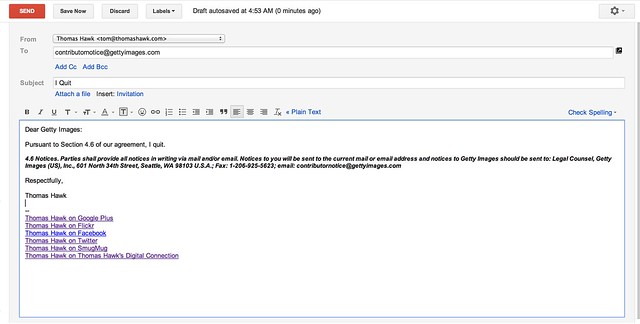
Dear Getty, I Quit

Dear Getty Images: I quit.

I just sent Getty Images the email above, which, I think, is how I terminate my relationship with them. Hopefully. I’m not 100% sure, but I can’t seem to figure out any way to do it online, so I’m hoping that email works.

Why am I quitting?

Well, I’m sitting here typing this at 4:56 in the morning on my “vacation,” getting ready to get an early up to the top of a mountain in Idaho to shoot sunrise and I’m not a skier. It’s dark, it’s cold — and maybe, just maybe, with $ 10,000 worth of camera gear on my back, I’ll get something that works from this shoot. After I shoot several thousand images today I’ll go home and spend hours and hours processing them. Finally, I’ll upload them online and maybe sell some. If I do sell some though, bottom line is I feel that I’m getting ripped off with Getty’s lousy 20% payout.

I don’t care how you look at it, for me, 20% is not fair. It’s too low. I’ve been complaining about it for years, but have just grumbled along because Getty felt like the only game in town for stock photo sales. Artists and photographers *deserve* more than 20% payouts. I understand that Getty has the buyers, that Getty is the 800 pound gorilla, but still, photographers deserve a better split than 80/20 against them.

There are other reasons why I’m quitting Getty Images too though.

Since the Carlyle Group (read their wikipedia page actually, it’s fascinating) has taken over Getty Images, things seem to have changed. Maybe Getty’s parent is trying to wring as much profit as their stock business as they can, but it feels like artists are getting the short end of the stick even more these days.

In the private, closed, Getty Photographers group, managed by Getty on Flickr, there were almost 3,500 replies to a thread about Getty’s deal with Google Drive. Whatever you think about this deal, there are ALOT of photographers who are unhappy at Getty about an arrangement where they receive a pittance for their work. The 20% payout is already pretty low, but when you combine it with a $ 12 image buy, some photographers feel that was pushing things too far.

The fact that Getty made this deal doesn’t bother me as much as how they’ve handled the criticism from their members over it. The above mentioned thread is now closed and locked by Getty Images. As a result of the thread, a member was banned and removed from the group — this is the second time that a Getty photographer has been booted from this group that I know of. An earlier member Alex Hibbert was also banned for criticizing Getty.

One of the Getty admins in the group, said that the more recent member was booted not because of his criticism, but because he wasn’t respectful with his criticism. I asked the question if respectful criticism would be allowed to stand and was told yes. I’m going to post this blog post into that forum and I guess we’ll see if this is true. For me, while critical, this post is entirely respectful. I’m still not sure it will get to stay there though.

When you start to see a company fighting with it’s contributors, banning contributors, even FIRING contributors, it makes me feel like maybe it’s time to go. This doesn’t feel like a healthy “relationship” any more. Paying me 20% and keeping 80% already felt a little insulting, but I think we deserve to be treated better.

So where am I going?

This has been the hardest part of all about leaving Getty earlier, there didn’t really seem like there was any place good to go — before today.

Today I’m pleased to announce that I’m going to start selling my stock photos on Stocksy.

Stocksy is a revolutionary new photo agency started by Bruce Livingstone, the founder of iStockphoto. A lot of my friends are there selling photos now too. I’m pleased to be joining some of the most talented photographers I know in a new sort of photographer-owned coop.

While Stocksy isn’t exactly “occupy” stock photography, rather than me getting 20% and Carlyle getting 80%, I’ll be paid a much fairer 50% payout. The exciting part about Stocksy though isn’t just the higher payout, it’s that the members of Stocksy actually OWN the agency. That’s right, after paying out costs, Stocksy will distribute profits to it’s members — so members will get dividends and actually hold real equity in the business.

Now THAT is an idea that I can get behind, and one that’s been long overdue. Fairly compensating photographers while running an agency with some of the most talented photographers in the world today? Sign me up!

Today Stocksy is launching to the rest of the world. You can read more about that here.

If you are a photographer, consider signing up. One bit of warning here though, Stocksy is being *very* selective about the photographers that they are adding. I have felt a little bad because some of my good friends and talented photographers haven’t been asked to join.

Especially early on, Stocksy is trying to build a super premium library of images and sometimes this means making hard choices about who you will launch with. They are also trying to keep Stocksy small where the editors and members can know each other on a personal level. I’ve already made lots of new friends at Stocksy and I’ve appreciated the valuable advice that the editors there share with me about why an image may or may not be right. At Stocksy editors and management do Google+ hangouts with photographers. At Getty all they seem to do is fight.

If you are an image buyer, consider looking at images on Stocksy the next time you need to buy. Not only will you find some of the best, fresh, and most authentic images in the marketplace today, you can feel good about buying them, knowing that they are treating the photographers fairly.

As fellow creative professionals, you are one of us — if given a choice, where would you rather your money go — to actual photographers who create the images, or to Carlyle? Even if you don’t care, still give Stocksy a look, because the imagery there really is miles ahead of what you see in the run of the mill stock photography library out there today.

Let Stocksy make you and your clients look the best they possibly can. You are the ones we need to embrace this idea most of all.

I’ll blog more about Stocksy as time goes on. For stock photography it will be the primary place where I market my own images (like the other photographer members my images for sale on Stocksy will be exclusively offered there) and I’m looking forward to a long and successful relationship.

Here’s Stocksy’s announcement on today’s launch.

Update: well that was fast. I’ve been banned from Getty’s Forum. I’m fine with that as I’m not a member, but I’m told that my post criticizing them has also been deleted. I hope those that are still in the forum can keep up the good fight, demanding more for photographers. I’m disappointed (although not surprised) that after being told that respectful criticism would be allowed that Getty deleted my respectful criticism there.

Update #2: More from Stephen Shankland over at CNET. PetaPixel republished my article as a guest post here. My good friend Trey Ratcliff is also joining Stocksy.

Update #3: Fast Company’s article on Stocksy here.


Thomas Hawk Digital Connection

 
Comments Off on Why I Quit Getty Images and Why I’m Moving My Stock Photography Sales to Stocksy

Posted in Photography