RSS
 

Posts Tagged ‘Start’

Start To See Photographically In Six Easy Steps

19 Nov

We are living in a time of unlimited free shutter clicks. This is both an advantage, and a disadvantage for you as a photographer. On one hand, the learning curve is faster, easier and definitely a lot cheaper. On the other hand, many photographers have a tendency to shoot without taking much care in their composition and rely on the occasional lucky shot.

Stop shooting randomly and start photographing with intent. Before you click that shutter, ask yourself: “What do I want to convey? What story do I want to tell?” There are many ways to achieve this, here are few easy steps to help you step up your game, no matter what camera or lens you use.

Six Steps to Start Seeing Photographically

1 – See the light

Play with light and shadows. Be aware of the quality of light around you (hard versus soft light) and its effect on objects, buildings, etc. The more aware you become of the quality and quantity of light, the better you will be at harnessing it and making it work for you, no matter the time of day.

See the light, its effect on building and objects around you.

See the light, its effect on buildings and objects around you ©Valérie Jardin
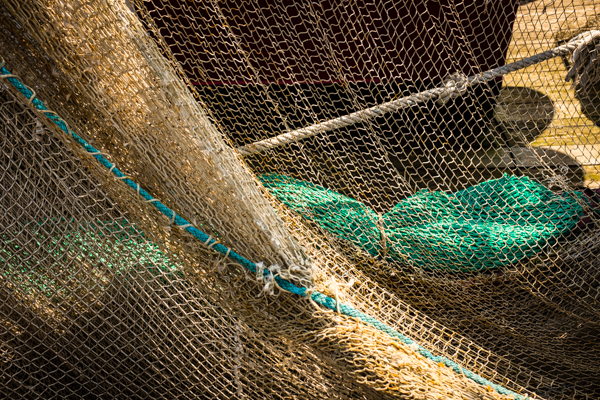
When you see light, any ordinary object will become a wonderful subject. ©Valérie Jardin

When you see light, any ordinary object will become a wonderful subject ©Valérie Jardin

2 – Express your vision with basic composition rules

There are many ways to express your vision and they all start with the decisions you make before you press the shutter.

Use focus point and depth of field

The obvious way to lead the eye of the viewer is by focussing on the subject and using the right depth of field so that there is no mistake as to where the eye should go. It only takes a fraction of a second to lock your focus and recompose. You have to put some thought into it and soon you will make quick decisions that will make your images stronger.

Use focus point and depth of field to lead the eye to your subject ©Valérie Jardin

Leading lines

Too often ignored, the use of lines is a powerful tool to lead the eye.
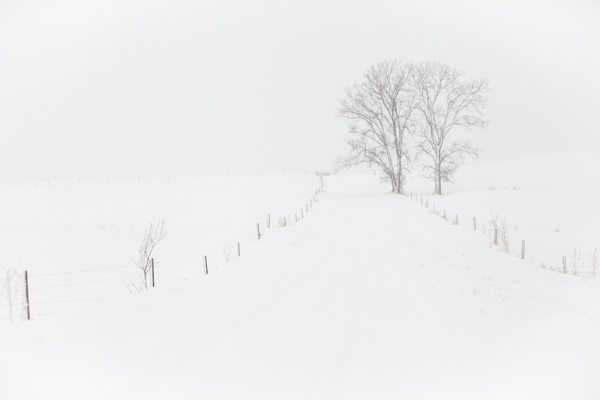
Use leading lines in your composition. ©Valérie Jardin

Use leading lines in your composition ©Valérie Jardin

The rule of thirds

Positioning your subject in your frame is one of the most important decisions you will make in regards to your composition. You cannot overuse the rule of thirds, but it’s okay to break it as long as it is done intentionally.

The rule of thirds works, use it! ©Valérie Jardin
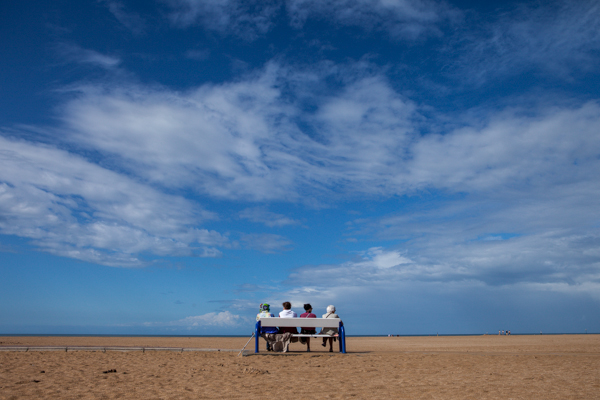
The rule of thirds works, use it! ©Valérie Jardin

Break the rule of thirds as much as you want, as long as you know why you’re breaking it. ©Valérie Jardin

Using color

Just like using focus point to draw the eye, using color is another powerful compositional tool. Alternatively, because color draws the eye, it is also a reason to convert your color image into B&W to remove distracting colorful elements and make stronger images!

Negative space

The clever use of negative space makes stronger images as it puts more emphasis on the subject (positive space).
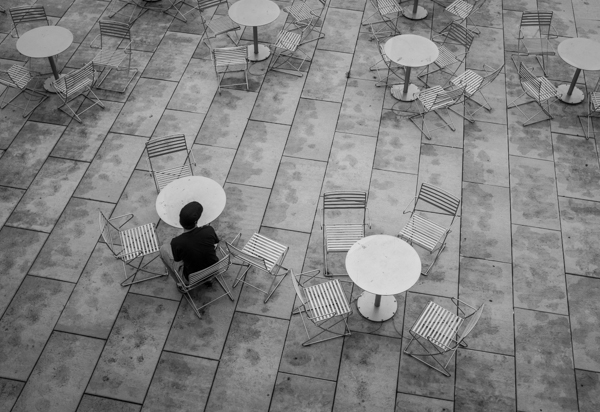
Use negative space to give more impact to your images. ©Valérie Jardin

Use negative space to give more impact to your images. ©Valérie Jardin

Patterns

See and use repeated patterns or, even better, look for breaks in the pattern!
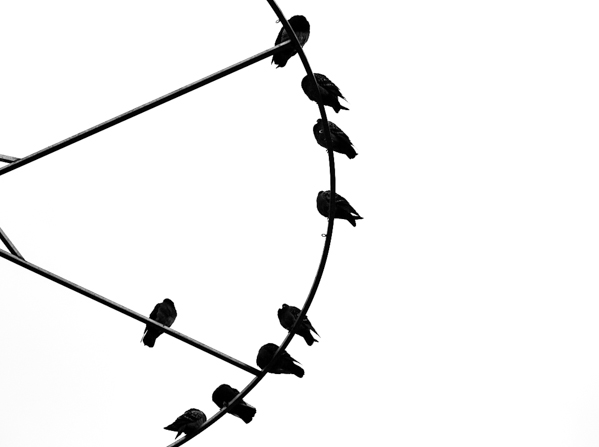
See repeated patterns. Even better: a break in the pattern!  ©Valérie Jardin

See repeated patterns. Even better: a break in the pattern! ©Valérie Jardin

Soon you will see stronger images that incorporate several element such as repeated patterns, leading lines, rule of thirds and color that draws your eye to the main subject. Use focus point and depth of field to lead the eye to your subject. ©Valérie Jardin

Soon you will see stronger images that incorporate several elements such as repeated patterns, leading lines, rule of thirds and color that draws your eye to the main subject. ©Valérie Jardin

3 – Less is more

Learn to make stronger images by leaving unnecessary elements out of the frame. One thing I notice all the time when I look at my students’ work is that they tend to include too much in their frame. What you decide to leave out of the frame during your composition will make or break the image. Keep it simple. Learn to see and crop in camera.

You don't need the subject in it's entirety to have a strong image. Practice cropping in camera. The use of a fixed lens will help you! ©Valérie Jardin
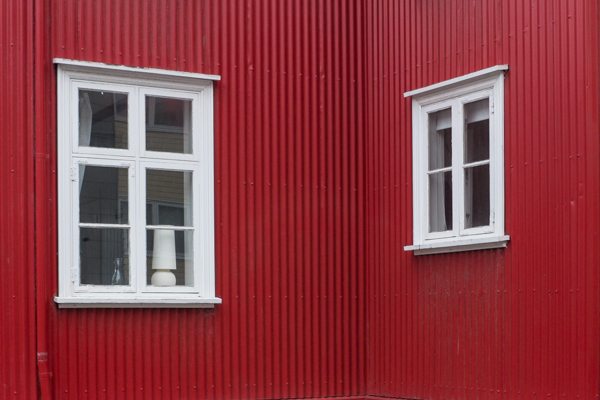
You don’t need the subject in its entirety to have a strong image. Practice cropping in camera. The use of a fixed lens will help you! ©Valérie Jardin

Less is more, think minimalist and give more impact to your images! ©Valérie Jardin

4 – Get close and fill your frame

Objects, even the most ordinary ones, look more interesting if you frame them tight. Get close. You think you’re close enough? Now get closer!

Fill your frame! ©Valérie Jardin
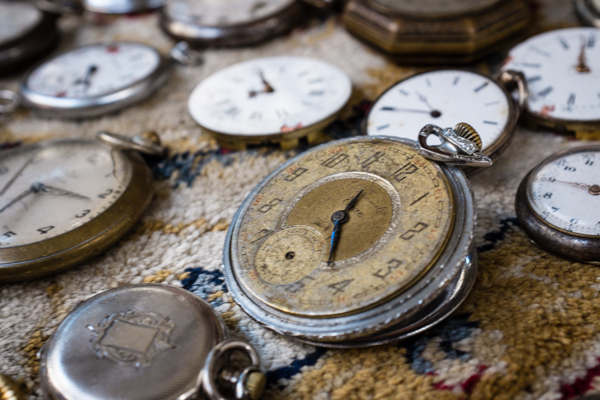
Fill your frame! ©Valérie Jardin

Get close, and then get closer! ©Valérie Jardin

Get close, and then get closer! ©Valérie Jardin

5 – Work your frame

Try shooting from different perspectives, shoot high, shoot low. Tilt your camera for more dynamic images.

Work your frame: Shoot high, Shoot low... Things don't look very interesting at eye level. ©Valérie Jardin

Work your frame: shoot high, shoot low… things don’t look very interesting at eye level. ©Valérie Jardin

6- Watch your background!

It only takes a second to scan the edges of your frame and check your background for distracting elements. It also only takes a quick second to move one step in either direction to get rid of a distracting element or avoid a branch to stick out of someone’s ear.
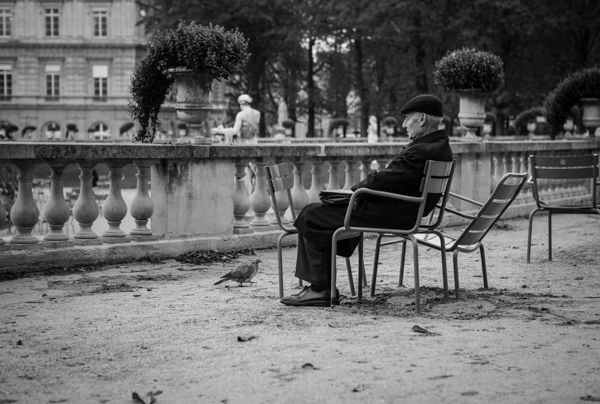
This image would have been ruined had I not stepped slightly to the right to avoid the potted plant to be directly on top of the gentleman's head...  ©Valérie Jardin

This image would have been ruined had I not stepped slightly to the right to avoid the potted plant to be directly on top of the gentleman’s head… ©Valérie Jardin

Next time you go out with your camera, try to slow down and think more about what you want to convey with your images. Unless you are photographing birds, busy toddlers or action sports, try to make every shutter click count!

Soon these composition rules will become second nature. You will see them without having to even think about them, you will learn to see photographically, and your work will improve.

Have fun!

Post originally from: Digital Photography Tips.

Check out our more Photography Tips at Photography Tips for Beginners, Portrait Photography Tips and Wedding Photography Tips.

Start To See Photographically In Six Easy Steps

The post Start To See Photographically In Six Easy Steps by Valerie Jardin appeared first on Digital Photography School.


Digital Photography School

 
Comments Off on Start To See Photographically In Six Easy Steps

Posted in Photography


Get a Jump Start on Your Gift List

12 Nov

The Early Bird may get the worms but trust us, your loved ones don’t want worms as gifts.

We’re here to help! We’ve organized our best phoneography presents by your pals’ preferred gizmos and apps.

Are they an Android Addict? An iPad Enthusiast? A fisherman?

If they’re a fisherman we may have mispoken, they probably want worms. If they’re an avid gadget user read this guide to find out what they really want.

iPhone Lovers
For the iPhone addicted among us (*guilty as charged*)
we’ve got phoneccessories to kick their photo game up a notch.

Impossible Instant Lab

Turn any iPhone photo into a real live instant print, instantly! → More

iPhone Lens Wallet

The perfect carrying solution for five great iPhone lenses. → More

Pocket Spotlight

Add soft even light anytime. Buh-bye harsh flash. → More

The Keyprop

Holds up any phone for shakefree vids and selfies. → More

iPod Fanatics
Fewer phone calls, more photos!
Get the most out of your iPod Touch with these goodies.

Bamboo Solar Charger

Give your pod a boost while you’re photoing the day away. → More

Gorillapod Mobile

A perfectly portable mini tripod, that bends to fit any sitch. → More

Smartphone Spylens

Take photo from new angles and shoot candids on the sly. → More

Jelly Phone Filters

Starburst, kaleidoscope and wide angle lenses add fun FX. → More

iPadographers
The biggest viewfinder in town comes equipped
with quite the camera too! Just add these handy gadgets.

Sony QX Smart Lenses

This pro camera uses your tablet or phone as a viewfinder. → More

Eye-fi Wireless SD Cards

Send files from your DSLR to your iPad with no wires. → More

iPad Telephoto Lens

See 10-12x farther with optic zoom and adjustable focus. → More

iPad CF/SD Card Readers

Get files from a memory card to your pad, on the quick.→ More

Android Enthusiasts
We’ve found that Android Users
(and Androids themselves) love these photo gizmos.

Photojojo Lens Series

Pro-quality telephoto, wide angle, macro and fisheyes. → More

USB Chargecard

A credit card sized charging cable that fits in your wallet. → More

Macro Lens Band

Get incredible close-up shots. It stretches to fit any phone.→ More

Une Bobine

A charging cable that’s also a phone stand. Double duty. → More

Instagram and Vine Addicts
For maximum “Likes” and “Revines”
you’re gonna need just a couple of these…

The Kick Light

Completely customizable light. Controlled by your phone. → More

The Slingshot

It’s a tripod and also a grip for super smooth pans. → More

iPhone Boom Mic

Get a quality audio recording to go with that video of yours. → More

Pocket Reflector

Add light to your photo right where you want it. → More

Related posts:

  1. Photojojo’s Holiday Gift Guide 2012, Part 2! It’s the most wonderful time of the year! Some would…
  2. Photojojo’s Gift Guide 2010, Part 3 It’s the holiday home stretch! This mid-December, may you stuff…
  3. Photojojo’s Holiday Gift Guide 2011, Part 1! You calmly plug your ears at the first hint of…


Photojojo

 
Comments Off on Get a Jump Start on Your Gift List

Posted in Equipment


Get a Jump Start on Your Gift List

12 Nov

The Early Bird may get the worms but trust us, your loved ones don’t want worms as gifts.

We’re here to help! We’ve organized our best phoneography presents by your pals’ preferred gizmos and apps.

Are they an Android Addict? An iPad Enthusiast? A fisherman?

If they’re a fisherman we may have mispoken, they probably want worms. If they’re an avid gadget user read this guide to find out what they really want.

iPhone Lovers
For the iPhone addicted among us (*guilty as charged*)
we’ve got phoneccessories to kick their photo game up a notch.

Impossible Instant Lab

Turn any iPhone photo into a real live instant print, instantly! → More

iPhone Lens Wallet

The perfect carrying solution for five great iPhone lenses. → More

Pocket Spotlight

Add soft even light anytime. Buh-bye harsh flash. → More

The Keyprop

Holds up any phone for shakefree vids and selfies. → More

iPod Fanatics
Fewer phone calls, more photos!
Get the most out of your iPod Touch with these goodies.

Bamboo Solar Charger

Give your pod a boost while you’re photoing the day away. → More

Gorillapod Mobile

A perfectly portable mini tripod, that bends to fit any sitch. → More

Smartphone Spylens

Take photo from new angles and shoot candids on the sly. → More

Jelly Phone Filters

Starburst, kaleidoscope and wide angle lenses add fun FX. → More

iPadographers
The biggest viewfinder in town comes equipped
with quite the camera too! Just add these handy gadgets.

Sony QX Smart Lenses

This pro camera uses your tablet or phone as a viewfinder. → More

Eye-fi Wireless SD Cards

Send files from your DSLR to your iPad with no wires. → More

iPad Telephoto Lens

See 10-12x farther with optic zoom and adjustable focus. → More

iPad CF/SD Card Readers

Get files from a memory card to your pad, on the quick.→ More

Android Enthusiasts
We’ve found that Android Users
(and Androids themselves) love these photo gizmos.

Photojojo Lens Series

Pro-quality telephoto, wide angle, macro and fisheyes. → More

USB Chargecard

A credit card sized charging cable that fits in your wallet. → More

Macro Lens Band

Get incredible close-up shots. It stretches to fit any phone.→ More

Une Bobine

A charging cable that’s also a phone stand. Double duty. → More

Instagram and Vine Addicts
For maximum “Likes” and “Revines”
you’re gonna need just a couple of these…

The Kick Light

Completely customizable light. Controlled by your phone. → More

The Slingshot

It’s a tripod and also a grip for super smooth pans. → More

iPhone Boom Mic

Get a quality audio recording to go with that video of yours. → More

Pocket Reflector

Add light to your photo right where you want it. → More

Related posts:

  1. Photojojo’s Holiday Gift Guide 2012, Part 2! It’s the most wonderful time of the year! Some would…
  2. Photojojo’s Gift Guide 2010, Part 3 It’s the holiday home stretch! This mid-December, may you stuff…
  3. Photojojo’s Holiday Gift Guide 2011, Part 1! You calmly plug your ears at the first hint of…


Photojojo

 
Comments Off on Get a Jump Start on Your Gift List

Posted in Equipment


When to Stop Being a Photographer and Start Being a Photo Editor

03 Sep

At some point, every photo shoot comes to an end.  Every portrait session, cookbook shoot, family vacation, ad campaign, college graduation, wedding, and photo essay eventually gets to the point when it’s time to put the camera down and see what you’ve got.  Congratulations–  You’ve just become a photo editor.  To be clear, I’m not talking about correction or manipulation in Lightroom, Photoshop or any of the other image editing software packages available.  I’m talking about the task of sitting down with the 367 images that you’ve just downloaded and being able to look at your own work with an objective, critical eye, and whittle them down to your best work.  Truthfully, this is one of those benchmark qualities that defines the term “professional photographer.”  Some people define the term based on the gear, while others base it on whether you are paid for your photography (and if so, how much).  For me, I define it in large part based on the photographer’s ability to at least temporarily sever their emotional tie to the work and realize that they shouldn’t be uploading ten images of the same sunset to their Flickr or 500px accounts simply because the angle is ever so slightly different in each.

I first learned this lesson several years ago when I started out as a second shooter for a high-end wedding photographer.  I showed up at the studio one Monday morning after a big weekend wedding, all excited to help with The Culling.  The preliminary critique the night of the wedding had been very positive, so I was feeling good.  Until we started going through the images.  “You’re deleting THAT one?  Seriously?  Wait a minute– what was wrong with THAT one!?!”  By the time we were done I was seriously questioning my new career choice.  My boss tried explaining that when the bride started going through the proofs she was going to get overwhelmed (and not in the good way) by having so many similar photos, that picking her favorites and placing an order would be an insurmountable task.  There wasn’t enough that was different about them.

As much as I didn’t want to admit it, he was right.  I hate it when that happens.

The bottom line was that the bride really didn’t need five 3/4 portraits with varying degrees of tilt when two– MAYBE three– would more than suffice.  The point of the lesson was learning to edit yourself by thinking like a client.  It’s a lesson I’ve tried carrying with me on every assignment since.  Think about it like this– have you ever had to sit through a three-hour marathon session of being forced to look at each and every photo your best friend took on their summer vacation?  Of course you have.  We’ve all been there.  How much better would it have been if they had edited themselves down to their twenty best?  See where I’m going with this?

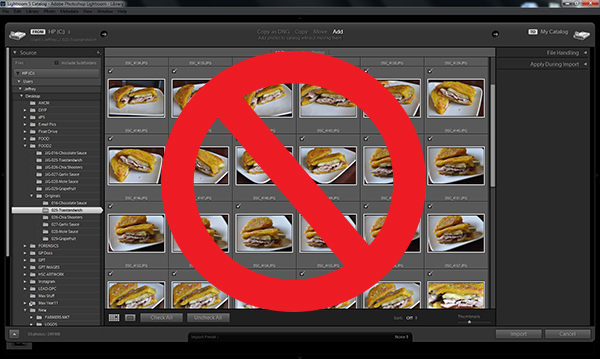
This was a Lightroom import from last week while I was shooting the last four dishes of the thirty I’d been commissioned to shoot for an upcoming cookbook.  I seriously overshot this one.  The screen capture only shows 24 of the 39 frames I shot of a sandwich.  Thirty-nine frames of a sandwich!  Not only do I not want the client to have to go through that many images to select the one that will go in the book, I don’t want them knowing that it took me 39 frames to take a picture of a sandwich!  Knowing how to edit yourself is crucial.  Unfortunately, not enough photographers learn how to do it well.

Editing-001-copy

The rule of thumb here is not to only show your best.  It’s to show the best of your best.  If I’ve taken 100 photos, chances are that maybe 50 go in the “selects” folder.  Of those 50, maybe 30 are really good.  Keep cutting your numbers in half as you move from “really good” to “THAT’S what I’m talking about!”  If I’m your client, I’ve already spent considerable time and money in hiring you.  I know you’re good.  Show me just how good you are by not wasting my time and showing me your best.  As soon as you can take your own emotions out of the equation you’ll be thinking like a photo editor and will be much better prepared to present only your best work, whether the client is a bride, a band, or a book publisher.  (As a side note, the same advice applies to entering photography competitions.  Think like the judge, not the photographer).

I see some you nodding your heads, but some of you are still skeptical.  “I got up at 3:00 in the morning to get to the location and set up just in time to see the sun come up over the crest of the mountain…”  Stop right there.  Rule #1 of critique with my photography students is “No talking once your photo is up on the screen.  The old cliche that every picture tells a story is true, but you need to let the picture tell it.  I don’t care about how difficult it was to get the shot or that you were happy/depressed/angry/indifferent when you took it.  While the result always matters,  you can’t necessarily say the same for the back story.  Save the stories for when you write your book some day.  For now, the work needs to speak for itself.

Learning to edit yourself pays dividends across the board.  If you are a professional photographer, your clients will appreciate both your quality and professionalism.  Professionals, hobbyists, and enthusiasts can not only get better at selecting the cream of the crop, but can also eventually start mentally editing themselves before they even push a shutter button.  Digital has made it easier than ever to walk away from a shoot with several hundred images.  That’s great, I suppose, but why create so much extra work for yourself?  Learn to think like a photo editor and all that extra work goes away.


Post originally from: Digital Photography Tips.

Check out our more Photography Tips at Photography Tips for Beginners, Portrait Photography Tips and Wedding Photography Tips.

When to Stop Being a Photographer and Start Being a Photo Editor


Digital Photography School

 
Comments Off on When to Stop Being a Photographer and Start Being a Photo Editor

Posted in Photography


Kubrick’s f/0.7 lenses now available for rent (but start saving up)

06 Aug

50mmf07.jpg

Legendary filmmaker Stanley Kubrick pushed the boundaries of moviemaking in many ways, and was responsible for some of the most enduring visuals in cinema. When he made Barry Lydon in 1975, Kubrick shot with two ultra-rare Carl Zeiss primes, which had originally been created for NASA. Using the 50mm and 35mm f/0.7 lenses, Kubrick was able to film some scenes purely by candlelight. Now, Germany-based company P+S Technik has announced that they’ve modified a PS-Cam X35 HD to be able to accept Kubrick’s primes, and the whole package is available to rent. Click through for more details. 

News: Digital Photography Review (dpreview.com)

 
Comments Off on Kubrick’s f/0.7 lenses now available for rent (but start saving up)

Posted in Uncategorized


Start Feeling GOOD About YOUR Photography

24 Jul

As I’ve begun teaching others how to edit their photos I’ve begun to realize that a lot of new photographers lack the confidence in their own work. I get questions like “Why don’t my photos look like this?” or “Should I buy a D800 so I can take better photos?” all the time and I’m starting to wonder if it’s simply because people don’t feel good about the work that they do create.

I’ll be the first to admit that I’m my hardest critic, but I do always feel good about the photographs that I share, even if I wish I’d done something differently I am always happy that I got a result and gained some experience in the process.

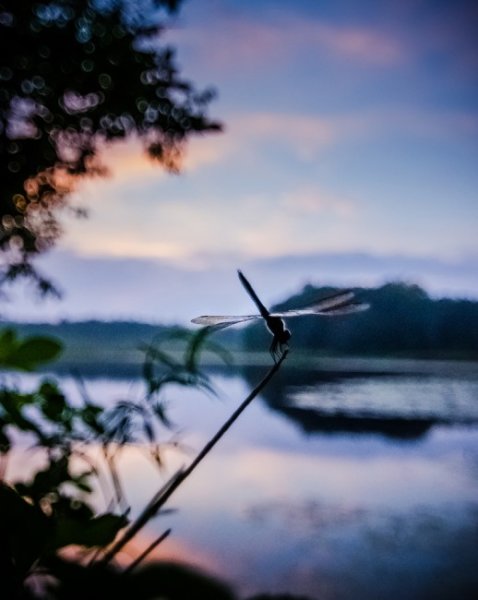
Dragonfly-Watching-Sunset-518x650

Of course, it can be pretty obvious why people might feel this way when you think about it. After all the internet is filled with amazing photographs, just look at any of these inspirational posts on DPS and unless your one of the featured photographers you might wonder how you too could get to that level.

The simple answer is… First you have to feel good about your photography, because the instant you start doubting your own work, your work will start to suffer.

Of course that’s easier said than done, so confronted with these questions about confidence, I decided I’d take the time to come up with five little nuggets of inspiration that everyone should keep in mind. By doing so I think you will start to feel good about your photography no matter who or where you are in your journey.

Compare Yourself to Yourself Three Months Ago – Not To Art Wolfe

No matter who you are the best benchmark for improvement is yourself in the past. Take a minute and dig through your archives look back at the photos you took three months ago, a year ago, or even further.

When I do this task I’ll notice that my composition and my choice of settings continue to improve. I make smarter choices for focal points and I get better and better at picking the right exposure in camera. Whatever you do don’t compare your photography to another photographer’s work – good or bad – it’s not a fair benchmark and you won’t be helping yourself appreciate your work.

Defeat Gear Envy

Gear envy is something we all struggle with from time to time and unless you’ve been blessed with that mythical tree made of money you’re going to be doing more wanting and less buying. Don’t let the idea that a better camera, lens, accessory, gadget or what-have-you will make you a better photographer – it won’t – and worrying about it won’t help either.

Be happy with what you have and spend your time learning to get the best photos that you can out of this equipment instead of daydreaming about your dream machine – your wallet will thank you later.

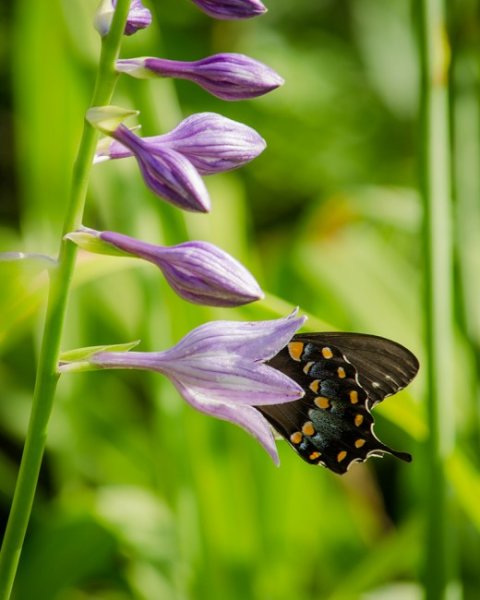
Out-in-the-Backyard-520x650

Beat the Critics By Remembering Your Fans

Even if the only fans you have are your friends and family let them be your motivation to continue to produce more work and better quality work. Let them move you beyond the point your at now and push you to where you want to be. Be happy with every like they give you on Facebook or every comment they leave on your site – or even – every time your mom tells you that she got your newsletter and loved the photo of that flower that you took at her house last weekend.

Fans are why I do what I do and I still remember when my Facebook page had less than 30 likes and almost no interaction. It takes time and a lot of work to grow, but if you’re consistent, true to yourself, your fans, and always remember it’s not a race you’ll start to feel good about what you’re doing and then the rest will fall into place.

Know Why You’re Photographing

Are you taking photos because you want to pass time on the weekends, record family moments, or are you trying to make a career out of it? There many reasons why we take photos and before you can truly be happy with the results you capture you should define why you’re picking up the camera in the first place.

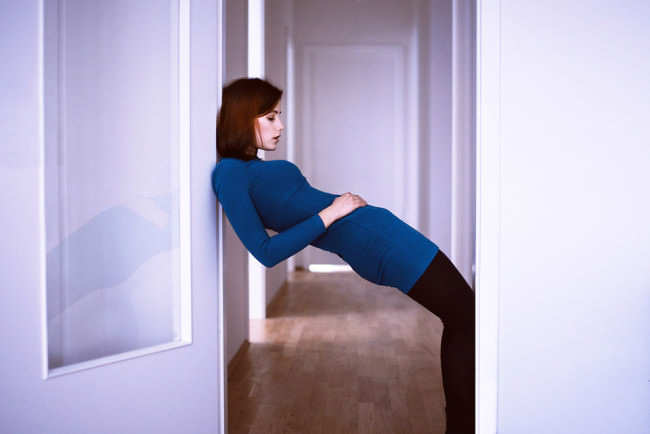
A-Fantasy-World-521x650

Share Your Work

And finally – this is probably the most important one – share what you do. Open yourself up to the world and let others see the what you’ve captured. Take the critiques with dignity and class and revel in the compliments from your fans and family.

If you need a stiff kick of inspiration here are some tips to help you get the confidence to share your photos I wrote for my own site a few months ago. The truth of the matter is the more you share the more you’ll improve and the more you improve the more you’ll be able to look at step number one and say – “Wow, look at how far I’ve come!”.

And that is what feeling good is all about.

Post originally from: Digital Photography Tips.

Check out our more Photography Tips at Photography Tips for Beginners, Portrait Photography Tips and Wedding Photography Tips.

Start Feeling GOOD About YOUR Photography


Digital Photography School

 
Comments Off on Start Feeling GOOD About YOUR Photography

Posted in Photography


5 Ideas to Kick Start Your Photography Again

15 Jun

Image by Eric May

Last week I was speaking with an amateur photographer who told me that he’s been struggling for photographic inspiration and ideas lately.

He reflected that he felt like he’d become something of a lazy photographer and was in a bit of a rut – always photographing the same things in the same ways.

I shared a number of ideas from my own experiences of seeking photographic inspiration (some of which I’ll share below) but it struck me halfway through the conversation that a lot of the ideas I was suggesting was actually about him limiting himself in his photography in some way – in order to find inspiration.

Let me explain by looking at 5 photography ideas that I shared with him.

Note: by no means am I suggesting that these are the only ways to get inspired – they’ve just helped me at times.

5 Ideas to Kick Start Your Photography Again

1. Fixed Focal Length Shoots

I wrote about this recently in a challenge here on dPS. The idea is to choose a focal length and only shoot at it for a period of time.

While many of us have become used to (or reliant upon) shooting with a zoom lens – there’s something about shooting with a prime lens (fixed focal length) that makes you think about the composition of your shots a little more.

So choose a focal length that you don’t shoot at much and stick with it for a week and see how you go (and if you don’t have a prime lens to do this with – use your zoom but simply stick at one end of its range for a week).

Variation: another option for this is to choose a lens that you may not have used much before. Many photographers buy multiple lenses but then stick with one, ignoring others. Alternatively swap lenses with a friend for a week or even try renting one for a short period.

2. The 1 Roll Rule

Image by Paul G

I was out shooting with a photography enthusiast friend recently and was amazed at the number of shots he took. At one point we were photographing his son (who was quietly playing with lego) and my friend shot off a burst of 20 or so shots at 4 frames per second.

Considering his son was sitting still and only really moving his fingers for those few seconds I did wonder at the need to shoot so many shots.

Of course I also know the temptation – shooting heaps of shots is easy to do. It doesn’t really cost you anything (although fills up hard drives pretty quick) and some might think it increases your chance of capturing the perfect moment.

The problem is that when you rely upon the quantity of your shots to improve the quality of your images that you can easily become lazy and complacent.

Here’s my challenge – next time you go out on a shoot – limit yourself to 36 shots (the number in a roll of film). In doing so you’ll find yourself really thinking about your shots. You’ll time them better and make sure each shot counts!

3. Turn Off the Live Preview/Review

Image by Alan Antiporda

Speaking of old school film photography – do you remember that feeling when you got to the end of shooting a roll of film and wondering how your shots would turn out?

You’d put the film in for processing and wait a week or so for them to be ready and then go to the photo lab with anticipation… rip open the package and go through them one by one – reliving the moments you captured a week or so ago?

I love that digital photography gives us instant access to the images we take – but sometimes I wonder if by having that little screen on the back of our cameras we might be missing something from the experience of photography?

There are certainly advantages of being able to quickly review our shots or compose them on a larger screen – but similarly to my point above on shooting lots of shots I wonder if the instant review could be making us a little lazy? We’ll just keep taking shots till we’re happy.

I personally also find myself looking at my camera a whole lot more than I am looking at the scene in front of me and wonder if some of the joy of the moment could be lost.

So try this – turn off your LCD screen. Some cameras let you do this in your settings while others might take a little self discipline to do this – but I’d be interested to see what impact it has.

4. Manual Focus

Image by Shazeen Samad

Shooting recently with the Leica M9-P (a fully manually focused camera) reminded me how little I shoot with manual focus these days.

I admit it – I’ve become lazy and have relied too much upon Auto Focus.

Shooting with the M9-P also reminded me how focusing manually can open up all kinds of possibilities. Just thinking about your focus rather than relying upon those 21 auto focal points your camera has (or how every many there are) puts you in a different frame of mind.

I find shooting in manual focusing mode makes me slow down a little, consider my shots and get a little more creative.

So switch to Manual Focusing and see what impact it has on your photography! I’d love to hear how it goes for you in comments below.

5. Limit Yourself to an Aperture

Image by Travis Lawton

I was flicking through some of my shots recently in Lightroom and as the images opened in front of me I noticed something that I’d not considered much before. Almost every shot I’d taken over a month or so had been taken at the maximum aperture of the lenses I was using.

I was shooting wide open almost all of the time.

There were a number of reasons for this – partly I shoot a fair bit indoors where the extra aperture lets more light in – but I guess it is also part of my style. I love narrow depth of field shots – bokeh is my friend.

However I wondered whether by shooting wide open so much I perhaps was ignoring other possibilities. Perhaps some of my portrait work would have been better if I shot with a smaller aperture and included more in focused backgrounds to give my subjects context (environmental portraits).

For the next week I began to shoot with a smaller Aperture – it was challenging at first and I wanted to give up – but at the end of the week I realised I was again being more thoughtful with my shots and had expanded the possibilities of styles at my fingertips when shooting.

Share Your Ideas for Finding Photographic Inspiration

These are about half of the ideas I shared with my friend – I’ll write up the others in the coming week – but in the mean time I’d love to hear ideas from others too. What do you do when you find yourself in a photography rut needing inspiration?

Post originally from: Digital Photography Tips.

Check out our more Photography Tips at Photography Tips for Beginners, Portrait Photography Tips and Wedding Photography Tips.

5 Ideas to Kick Start Your Photography Again


Digital Photography School

 
Comments Off on 5 Ideas to Kick Start Your Photography Again

Posted in Photography


Selbstportraits: Ein guter Start in die Portraitfotografie

21 May

Wie wahrscheinlich die meisten habe ich nach meinem ersten Kamerakontakt Blumen und Katzen fotografiert. Das sind eben auch relativ dankbare Anfängermotive. Und wahrscheinlich würde ich heute noch auf dem Bauch liegend Gänseblümchen im Garten ablichten, wenn ich mich nicht auf Flickr angemeldet hätte.

Dort gab es viele schöne Bilder von Blumen und Katzen, die zeigten, dass auch diese Motive weit mehr als Anfängermaterial sein können – aber das war es nicht, was meine Welt veränderte.

Es waren vor allem Fotografinnen wie Kalie Garrett und Rosie Hardy, die mich in die wunderbare Welt der Selbstportraits entführten. Ich war begeistert und bin versucht zu sagen, es war Liebe auf den ersten Blick. Ich wusste, ich wollte Menschen fotografieren.

Die Frage war nur: Woher die Menschen nehmen? Wer hat Zeit und Lust, miese Anfängerfotos von sich machen zu lassen? Denn nicht jeder hat eine hübsche kleine Schwester, gutmütige Freunde mit viel Zeit oder Lust, Geld für Modelle auszugeben. Und vor allem: Woher das Selbstbewusstsein nehmen, sich selbst als Portraitfotograf anzupreisen? Daher schienen Selbstportraits erst einmal die einfachste Möglichkeit zu sein.

© Laura Zalenga

Klar, der Anfang war auch hier nicht leicht. Ich habe ein Weile gebraucht, bis ich herausfand, wie ich das Bild wirklich scharf bekomme, wenn ich im Moment der Auslösung nicht hinter der Kamera stehe. Aber durch diese technischen Fragen habe ich meine Kamera kennen und verstehen gelernt.

Die ersten Ergebnisse waren trotzdem enttäuschend. Ich konnte zwar nicht genau definieren, woran es lag, aber verglichen mit meinen Vorbildern sahen sie einfach nicht gut aus. Nach und nach entwickelte ich dann einen Blick für das, was mir nicht gefiel und versuchte, es zu verändern. Bis ich dann schließlich Fotografien machte, mit denen ich zufrieden war, dauerte es allerdings trotzdem noch eine ganze Weile.

© Laura Zalenga

Erst seit kurzem arbeite ich regelmäßig mit anderen Menschen vor meiner Kamera und erst jetzt wird mir bewusst, wie sehr ich dabei von meinem Selbstportraitstudium profitiere. Nicht nur, weil ich alles in Ruhe lernen konnte, ohne meine Unsicherheit vor einem Modell verstecken zu müssen. Nicht nur, weil ich jederzeit üben konnte, weil ich ja nur mich und die Kamera brauchte.

Nicht nur, weil mir nichts peinlich sein musste, weil nur ich die Ergebnisse zu Gesicht bekam. Nicht nur, weil ich völlig frei experimentieren konnte, weil ich allein der Auftraggeber war. Sondern auch, weil ich heute weiß, wie sich die Person hinter der Kamera fühlt, denn ich kenne ihren Blickwinkel.

© Laura Zalenga

Alles, was ich heute über Komposition, Motiv, Posen, Licht und Kameratechnik weiß, habe ich an mir selbst getestet und gelernt. Und zwar allein durch erkannte Fehler. Besser sich selbst den Kopf angeschnitten als einem Kunden und lieber an sich selbst erkennen, dass die Schärfe auf den Augen liegen sollte und nicht auf der Nase.

© Laura Zalenga

Worauf ich hinaus möchte? Jeder, der bei sich die Liebe zur Portraitfotografie entflammen spürt, aber nicht weiß, wie und mit wem anzufangen, sollte die Selbstportraitschule in Betracht ziehen. Die zeitliche Unabhängigkeit, völlige Sicherheit vor peinlichen Momenten und die Freiheit, jedes noch so unmögliche Experiment wagen zu können, sind doch ein gutes Angebot oder?

Eine eventuelle Nebenwirkung sollte aber nicht unerwähnt bleiben: Selbstportraits sind nicht nur Schule, sondern auch sehr viel Spaß, daher besteht in manchen Fällen Suchtgefahr. Diese ist nicht behandelbar, aber nach bisherigen Erkenntnissen ungefährlich.


kwerfeldein – Fotografie Magazin

 
Comments Off on Selbstportraits: Ein guter Start in die Portraitfotografie

Posted in Equipment


Sigma UK to start shipping USB dock and 120-300mm F2.8 from May 2013

13 Apr

120-300mm.png

Sigma UK has announced its new USB dock for lenses will be available from May 2013 at a retail price of £39.99 (including VAT). The company has also announced the 120-300mm F2.8 DG OS HSM lens will start shipping in Canon and Sigma mounts around the same time but has not confirmed the price. Launched at Photokina 2012, the USB dock enables users to easily update lens firmware and fine-tune focus parameters, while the 120-300mm F2.8 lens comes with a button to adjust the focus speed and the focus limiter.

News: Digital Photography Review (dpreview.com)

 
Comments Off on Sigma UK to start shipping USB dock and 120-300mm F2.8 from May 2013

Posted in Uncategorized


Nikon School to start in London from April 2013

01 Mar

shared:NikonLogo.png

Nikon has announced the launch of its Nikon School in UK. The company’s education and training program that has been popular in the US for a decade will start in London from April 2013. It will offer photography courses, from beginner to advanced, to product specific courses and workshops. The company is currently offering £20 discount for online bookings. Click through for more information and links to the School’s website.

News: Digital Photography Review (dpreview.com)

 
Comments Off on Nikon School to start in London from April 2013

Posted in Uncategorized