RSS
 

Posts Tagged ‘Sony’

Sony announces alpha 99 Mark II

19 Sep

Sony has announced the a99 II, a 42MP A mount SLT camera to mark the tenth anniversary of the alpha series. It features 5-axis image stabilization and 4K photo with no binning.

The camera will be capable of shooting at 12 frames per second with AF/AE tracking. It has 79 AF points on its dedicated PDAF sensor, which work in conjunction with 399 on-sensor PDAF points.

Kimio Maki VP of Digital Imaging Group said: the market is changing. The move is towards an increased proportion of enthusiast photographers, he said. These customers demand sensitivity, resolution and speed.

Articles: Digital Photography Review (dpreview.com)

 
Comments Off on Sony announces alpha 99 Mark II

Posted in Uncategorized


Sigma 30mm F1.4 DC DN Contemporary for Sony E-mount lens review

13 Sep

The Sigma 30mm F1.4 DN DC Contemporary was announced in February 2016, and sits atop Sigma’s line of DN mirrorless lenses, with a two-stop advantage over their previous 30mm F2.8 offering. It’s currently the only APS-C F1.4 autofocus lens currently available for the Sony E-mount and has an MSRP of $ 339.00.

With F1.4 and a 45mm equivalent field of view, this lens on paper appears to be a good choice for a ‘walkaround’ normal prime lens. The bright aperture will satisfy low light shooters and bokeh fanatics, and the near 50mm field of view puts it right inside the versatile ‘normal’ lens range. While it won’t replace a dedicated macro lens with its magnification ratio of 1:7, it still is able to focus down to a working distance of 30cm (less than a foot).

The relatively low price, especially for an E-mount lens, means it’s also accessible to beginners and enthusiasts alike, making it sound like an ideal prime lens that may never leave the front of the camera once it’s mounted.

Within the E-mount system this lens has one natural competitor: the Sony 35mm F1.8 OSS. Let’s look at how the two stack up on paper:

  Sony E 35mm F1.8 OSS Sigma 30mm F1.4 DC DN | C
MSRP $ 448 $ 339
Image Stabilization Yes No
Max Aperture F1.8 F1.4
Minimum Aperture F22 F16
Aperture Ring No No
Diaphragm Blades 7 9
Number of elements 8 9
Number of groups 6 7
Special elements/coatings 2 aspherical elements 1 aspherical and 1 double-sided aspherical
Minimum Focus 0.30 m (11.81?) 0.30 m (11.81?)
Maximum Magnification 0.15x 0.14x
Motor Type Stepper motor Stepper motor
Full Time Manual No No
Weight 155 g (0.34 lb) 265 g (0.58 lb)
Dimensions (DxL) 63 x 45 mm (2.5 x 1.8 in.) 65 x 73mm (2.6 x 2.9 in.)
Sealing None None
Filter Thread 49mm 52mm

In terms of just spec we see a couple of major differences. First, while the Sony is 2/3 of a stop slower than the Sigma, it does include optical image stabilization. That alone gives it a better chance at being the preferred lens for video, although when shooting 4K the slightly wider FOV of the Sigma might fare better on any body that gives an additional crop.

In stills terms, though, there’s little real-world difference between the Sigma’s 45mm equivalent view and the 52.5mm equivalent of the Sony. The difference between them doesn’t suddenly open one up to a type of photography that couldn’t be achieved with the other.

Build quality between the Sigma and the Sony is fairly similar. They both use a machined metal chassis with plastic internals. Compared to older Sigma DN lenses, the 30mm F1.4 doesn’t let its focus elements rattle about when unmounted, which is a very welcome change. The focus ring is also an improvement, and a step above the Sony. The rubber grip turns smoothly and easily with minimal effort, making the Sony feel a bit stiff. The only downfall in terms of build is the Sigma’s lens hood, which doesn’t seem to confidently click in to place, and is made of rather fragile feeling plastic.

The long barrel of the Sigma, and even longer overall dimensions do make it quite large in comparison to APS-C Sony Alpha cameras, but the weight isn’t entirely off-balance. While heavier and much bigger, it is less expensive and brighter than the Sony 35 F1.8. The question is, does the extra weight and lack of OSS keep it from topping the Sony as the ideal ‘normal’ for APS-C E-mount shooters?

Articles: Digital Photography Review (dpreview.com)

 
Comments Off on Sigma 30mm F1.4 DC DN Contemporary for Sony E-mount lens review

Posted in Uncategorized


Sony offers E PZ 18-110mm F4 G OSS for Super 35mm/APS-C

09 Sep

$ (document).ready(function() { SampleGalleryV2({“containerId”:”embeddedSampleGallery_3521924563″,”galleryId”:”3521924563″,”isEmbeddedWidget”:true,”standalone”:false,”selectedImageIndex”:0,”startInCommentsView”:false,”isMobile”:false}) });

Sony has announced the E PZ 18-110mm F4 G OSS power zoom lens for Super 35mm/APS-C format, designed for video shooters. It’s the second lens in Sony’s lineup to use the company’s Smooth Motion Optics (SMO) design to prevent focus breathing, focus shifts and axial image shifts while zooming. Other potential benefits to movie makers include a dust- and moisture-resistant design, built-in SteadyShot and quiet operation, as well separate, geared rings for focus, zoom and aperture control.

The Sony E PZ 18-110mm F4 G OSS will be available in November for $ 3500. 

Press release:

Sony introduces 18-110mm Super 35mm / APS-C lens with power zoom capability

  • E PZ 18-110mm F4 G OSS (SELP18110G) with 6.1x high zoom ratio
  • High resolution suited to professional 4K movie production
  • Smooth Motion Optics (SMO) design and construction to minimize unwanted focus and image shifts while focusing or zooming
  • Advanced operability including three separate focus, iris and zoom rings for professional operation
  • Optical SteadyShotTM in-lens image stabilization
  • Compact, lightweight design with dust and moisture resistance

Offering moviemakers a powerful new creative tool, Sony has developed an advanced Super 35mm / APS-C format power zoom lens that starts at 18mm wide angle and extends to 110mm at the telephoto end (27mm – 165mm equiv. in 35mm formatii). The new lens has a 6.1x high zoom ratio, even with inner focus, and maintains a constant F4 maximum aperture throughout its zoom range for beautiful depth of field effects and stable exposure control.

An ideal companion to a wide range of ? cameras, from the PXW-FS7 professional camcorder to interchangeable-lens cameras such as ?7 series and ?6300, this G LensTM delivers image quality that will satisfy even the most demanding of professional users. It consists of 18 elements in 15 groups, including 6 aspherical elements and 3 ED (Extra-low Dispersion) glass elements and features a 7 blade circular aperture design. This highly intricate design delivers extremely high resolution image quality and is particularly suited to professional 4K movie shooting.

The E PZ 18-110mm F4 G OSS is only the second lensiii to benefit from Sony’s Smooth Motion Optics (SMO) design and construction, which has been developed to eliminate unwanted image shifts while making adjustments during movie shooting. SMO addresses three particular aspects of lens operation that can have a significant impact on movie quality: Focus Breathing, where shifts in angle of view during focusing are minimized by an internal focus mechanism; focus shift, where small shifts in focus that can occur during zooming are eliminated by precise focus tracking adjustment, and Axial shift, where axial image shifts during zooming are minimized by a constant length design.

The high level of operability and quiet operation of the new lens makes it a compelling proposition for its integration into professional movie production environments. Its three separate rings give control over focus, zoom and aperture, with optimal torque for a satisfyingly responsive, professional feel. Both servo and responsive manual mechanical zoom are fully supported and the zoom ring direction is switchable to match individual user preferences. Additionally, the lens length remains constant during any changes, making it easy to use with matte boxes and other lens accessories. Also, in a first for Sony ? lenses, a 0.8mm pitch focus gear is built right onto the ring, providing direct compatibility with standard focusing accessories.

Optimum optical performance and operability is complimented by a dust and moisture-resistant designi, making the lens ideal for location use. Extra versatility is afforded by Optical SteadyShot technology that provides in-lens image stabilization during handheld shooting. The lens also features a compact and lightweightiv design making it a truly mobile solution. Additional flexibility is afforded when used with the SEL14TC and SEL20TC teleconverters for 1.4x and 2.0x extension of focal range.

The E PZ 18-110mm F4 G OSS Super 35mm / APS-C power zoom lens for professional movie-makers and photographers will available in North America from November 2016, priced at approximately $ 3,500 US / $ 4,500 CA.

i Not guaranteed to be 100% dust and moisture proof.

ii With interchangeable-lens digital camera incorporating an APS-C type image sensor

iii The only other lens to benefit from SMO technology is the SELP28135G

iv 1105g without tripod mount

Articles: Digital Photography Review (dpreview.com)

 
Comments Off on Sony offers E PZ 18-110mm F4 G OSS for Super 35mm/APS-C

Posted in Uncategorized


Throwback Thursday: Sony Cyber-shot DSC-F707

08 Sep

Sony’s camera designers have never been shy about trying something different, which explains a lot about the DSC-F707. Introduced in 2001, it was a follow-up to the DSC-F505V, running with that camera’s ‘swiveling lens attached to a body’ design. The F707 appears to be more lens than camera, resulting in what we called ‘a surprisingly usable and ergonomic design’ when we reviewed it. Here’s what the F707 had going for it:

  • 5MP 2/3″ CCD sensor
  • 38-190mm equiv. F2-2.4 lens
  • 1.8″, 123k-dot LCD
  • Built-in EVF
  • 2.8 fps burst (capped at 3 frames)
  • ISO 100-400
  • Memory Stick slot

The F707 had more than a few tricks up its sleeves, something you might guess from its Swiss Army Knife-like appearance. So just what set it apart?

Frickin’ laser beams

The camera was capable of focusing in total darkness thanks to a Hologram AF feature, which throws a Class 1 laser pattern onto its subject and uses that to acquire focus. We found it required some workarounds when trying to focus on certain subjects. And sure, AF assist lamps get the job done now reasonably well, but they’re not nearly as cool as lasers (though nearly as blinding.)

The F707 projected a cross-type pattern with its onboard laser, which it used to focus. The top two “holes” on the list are IR blasters, while the laser can be found toward the right side.

Sadly, NightShot disappeared after the DSC-F717 that followed the F707. Why that happened is unclear, though one wonders if people just didn’t feel comfortable having a laser shined in their eyes.

Night vision… sure, that’s not creepy

The F707 offered Night Framing and Night Shot modes, flipping the Infrared filter out of the way and engaging two IR lamps on the front of the lens. The image on the LCD would turn green, just like night-vision goggles. NightShot mode actually took ‘green’ photos which, while cool, was of limited use. Night Framing, on the other hand, could capture regular color (flash) photos in total darkness. You composed your shot in ‘green’ and when you pressed the shutter release, up came the flash and a color photo was taken.

Here’s the NightShot version of a sunflower, taken in total darkness. Photos by Jeff Keller. And here’s the results you get using Night Framing.

NightShot is probably most famous – or infamous – for different reasons. Sony camcorders (and the F707/F717) equipped with NightShot could be modified to ‘see through’ clothing and other objects. So, if you happen to see an F707 with a dark IR filter on it, run the other way.

Is it a lens? Is it a camera?

Is it a lens? Is it a camera?

The F707 offered an unusual camera-to-lens ratio, which at first seemed unwieldy. But when you stopped fighting the F707’s unconventional design, you found a camera that was surprisingly comfortable to use. Like we said in our review, ‘You find yourself carrying the camera by the lens and using the rear ‘body’ more as a viewing / control platform, which was after all the design aim.’ We chalked it up as a ‘love it or hate it’ feature in our conclusion, ultimately coming down on the side of ‘love it.’

We may have taken a shine to it, but the design eventually trended toward the DSLR-shaped ultrazoom we know today – the DSC-F828 took another stab at the swiveling lens, but 2005’s DSC-R1 embraced a traditional, non-swiveling design. You’ve got to hand it to Sony, though. They haven’t all enjoyed longevity in the market, but some of their ideas have certainly looked well outside of the box.

$ (document).ready(function() { SampleGalleryV2({“containerId”:”embeddedSampleGallery_8204641098″,”galleryId”:”8204641098″,”isEmbeddedWidget”:true,”standalone”:false,”selectedImageIndex”:0,”startInCommentsView”:false,”isMobile”:false}) });
Articles: Digital Photography Review (dpreview.com)

 
Comments Off on Throwback Thursday: Sony Cyber-shot DSC-F707

Posted in Uncategorized


Sony announces Xperia XZ flagship device with triple-sensor camera

02 Sep

Sony has announced its new top-end device in the Xperia Z line at IFA in Berlin and in the camera department the new model comes with what the company calls ‘triple sensor’ technology. In practical terms this means that the Sony IMX300 1/2.3” 23MP image sensor with on-sensor phase detection is accompanied by a laser that measures the distance to the subject and improves AF speed and accuracy in low light; and an RGBC-IR sensor that measures the color values of a scene in order to fine-tune the white balance system. The hybrid AF-system is also predictive and can track subjects in motion.

The Sony G lens comes with a 24mm equivalent focal length and an F2.0 aperture. In video mode the camera can record footage in 4K resolution and the Xperia XZ is also the first device on which Sony has implemented 5-axis electronic video stabilization. At the front there is a 13MP 1/3″ sensor with F2.0 aperture and 1080p video, specifications that would have been worthy of a main camera not too long ago.

The Android 6.01 system is powered by a Qualcomm Snapdragon 820 chipset and 3GB of RAM. 32 or 64GB of internal storage are expandable via microSD card. Intelligent battery management means you are getting as much time as possible out of the 2900 mAh battery which also supports quick-charging. With a 1080p resolution and 5.2” diagonal the display specifications have not changed from previous high-end Xperia devices.

All the technology is wrapped up in an 8.1mm thin metal body with rounded edges, that is water and dust tight (IP65/68). A fingerprint sensor has been integrated into the power button for added security. The Sony Xperia XZ doesn’t offer any huge improvements over previous devices in the series but looks like a solid update. It will be available in Europe from October for €699 (approximately $ 780), there is no word on availability in other regions yet.

Articles: Digital Photography Review (dpreview.com)

 
Comments Off on Sony announces Xperia XZ flagship device with triple-sensor camera

Posted in Uncategorized


Sony Xperia X Compact offers high-end camera in smaller format

02 Sep

Along with the Xperia XZ, Sony has launched the Xperia X Compact. It’s aimed at users who want a powerful camera in a compact body but can live with a slightly less powerful chipset.

The X Compact comes with the same 23MP ‘triple sensor’ main camera with laser-AF and color sensor as the Xperia XZ, but doesn’t offer 4K video and uses a front camera with a lower 5MP resolution, compared to the XZ’s 13MP. Like previous Sony Compact models the new device has a 4.6” display with 720p HD resolution, putting it in direct competition with Apple’s iPhone 6s. The Sony is powered by a Qualcomm Snapdragon 650 chipset and features 3GB of RAM in conjunction with 32GB of internal storage. The latter is expandable via a microSD slot. Power is provided by a 2700 mAh battery, that, like on the larger model, supports smart battery management and quick charging.

The power button doubles as fingerprint reader to ensure secure device access and online shopping. In contrast to the Xperia XZ the Compact model comes with a plastic body that does not feature any environmental protection. However, this is reflected in pricing. The Xperia Z Compact will be available in Europe from September for a more affordable €449 (approximately $ 560).

Articles: Digital Photography Review (dpreview.com)

 
Comments Off on Sony Xperia X Compact offers high-end camera in smaller format

Posted in Uncategorized


Sony introduces FE 50mm F2.8 Macro with 1:1 reproduction

30 Aug

$ (document).ready(function() { SampleGalleryV2({“containerId”:”embeddedSampleGallery_2105353860″,”galleryId”:”2105353860″,”isEmbeddedWidget”:true,”standalone”:false,”selectedImageIndex”:0,”startInCommentsView”:false,”isMobile”:false}) });

Sony has announced the FE 50mm F2.8 Macro, a full-frame lens with true 1:1 macro magnification. It provides a minimum focus distance of 16cm/6.3in and is resistant to dust and moisture. Its design includes 8 elements in 7 groups and a rounded 7-blade aperture.

The Sony FE 50mm F2.8 Macro will sell for $ 500 when it goes on sale in September.

Press release:

Sony Releases Full-Frame FE 50mm F2.8 Macro Lens

A lightweight and compact standard 50mm F2.8 macro prime lens that offers versatile shooting experience

SAN DIEGO, Aug. 30, 2016 – Sony Electronics, a worldwide leader in digital imaging and the world’s largest image sensor manufacturer, has today introduced a new full-frame lens for their E-mount camera system, the FE 50mm F2.8 Macro lens (model SEL50M28).

Ideal for everyday photography, this 50mm macro lens features an F2.8 maximum aperture that offers outstanding image quality and bokeh, while its 1:1 macro capability allows the photographer to get sharp close-up shots of their subject. Additionally, its comprehensive range of controls including focus-mode switch, focus-range limiter and focus-hold button ensure an effortless shooting experience for a wide range of users.

The lens offers a 6.3 inch minimum focusing distance and a wider field of view for capturing more background, compared to longer focal-length macro lenses. Weighing in at a mere 8.4 oz., it’s extremely lightweight and portable, making it easy to carry around.

The new FE 50mm F2.8 Macro lens features an ED (Extra-low Dispersion) glass to effectively compensate for axial chromatic aberration at close focus, allowing it to create consistently sharp and high quality images. The optical and mechanical construction of the lens has less glare and ghosting, even without a lens hood. The lens is also dust and moisture resistant.

Pricing and Availability

The new FE 50mm F2.8 Macro lens will be available in September for about $ 500 US and $ 650 CA, respectively. It will be sold at a variety of Sony authorized dealers throughout North America.

Sony FE 50mm F2.8 Macro specifications

Principal specifications
Lens type Prime lens
Max Format size 35mm FF
Focal length 50 mm
Image stabilization No
Lens mount Sony FE
Aperture
Maximum aperture F2.8
Minimum aperture F16
Aperture ring No
Number of diaphragm blades 7
Optics
Elements 8
Groups 8
Special elements / coatings Extra-low Dispersion glass
Focus
Minimum focus 0.16 m (6.3)
Maximum magnification 1×
Autofocus Yes
Full time manual No
Focus method Extending front
Distance scale Yes
DoF scale No
Focus distance limiter Yes
Physical
Weight 236 g (0.52 lb)
Diameter 71 mm (2.8)
Length 71 mm (2.8)
Sealing Yes
Colour Black
Filter thread 55.0 mm
Hood supplied No
Tripod collar No

Articles: Digital Photography Review (dpreview.com)

 
Comments Off on Sony introduces FE 50mm F2.8 Macro with 1:1 reproduction

Posted in Uncategorized


FotodioX Lens Adapter – How to Put Your Canon EF Lens on Your Sony E-Mount Camera

29 Aug

One of the big hurdles for DSLR camera owners considering the switch to mirrorless, is the notion of having to buy brand new lenses to accompany their new purchase. While it’s ideal to have brand name lenses that match your camera body, it’s not at all necessary, thanks to third-party lens makers and lens adapters. This article discusses the latter option, specifically, a lens adapter that allows just about any Canon EF lens, to be used with a Sony E-Mount camera.
ony Canon Lens Converter

My Camera Background

As a corporate event and food photographer, the Canon 5D Mark III, plus an array of Canon zoom lenses and a handful of primes, are my go-to choices for professional photo work. However, the desire to carry a smaller camera while traveling casually, led to my recent purchase of a Sony a6300 camera, my first investment in a mirrorless system. While I did opt for a Sony 16-50mm kit lens and a 20mm f/2.8 prime lens, I wasn’t financially ready to invest in any more Sony brand lenses. Instead, research and recommendations from other fellow photographers led me to purchase a lens adapter, which promised the ability to use my existing Canon EF lenses with my new Sony E-Mount camera body.

If you’re in a similar position, where you’ve accumulated a collection of DSLR lenses and are considering adding the Sony a6300 to your kit, this article is for you!

ony Canon Lens Converter

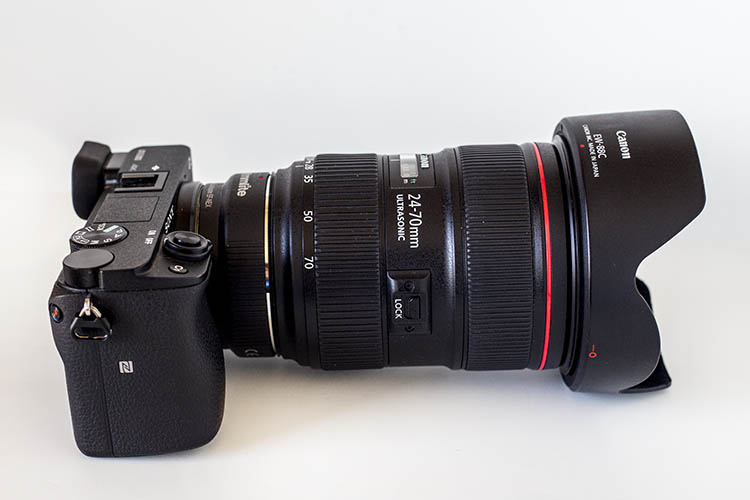
Sony a6300 body with a Canon 24-70mm f/2.8 lens, mounted using the Fotodiox adapter.

Lens Adapter Options

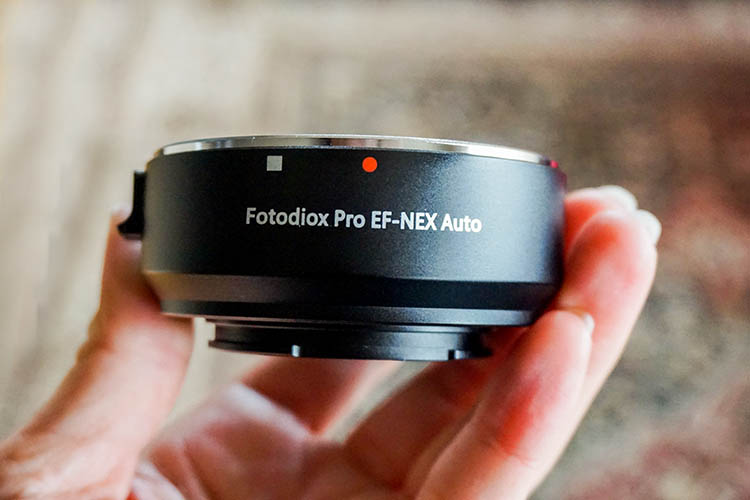
Third-party brands have already hopped on the lens adapter train, and there are quite a few options available, but two main ones that came up in research were the Metabones Smart Adapter IV and the FotodioX AF Adapter. At first glance, both options seemed comparable in their offerings:

  • Compact, lightweight, all-metal design.
  • Allows for automatic focus and aperture control from the Sony E-Mount camera body.
  • Infinity focus allowed if needed.
  • Removable tripod mount included to help distribute the weight.

The main difference between the two products came down to price: the Metabones version is priced at $ 385.99, while the FotodioX option is considerably cheaper at just $ 99.99. In the end, the price was the determining factor, and I went for the FotodioX lens adapter.

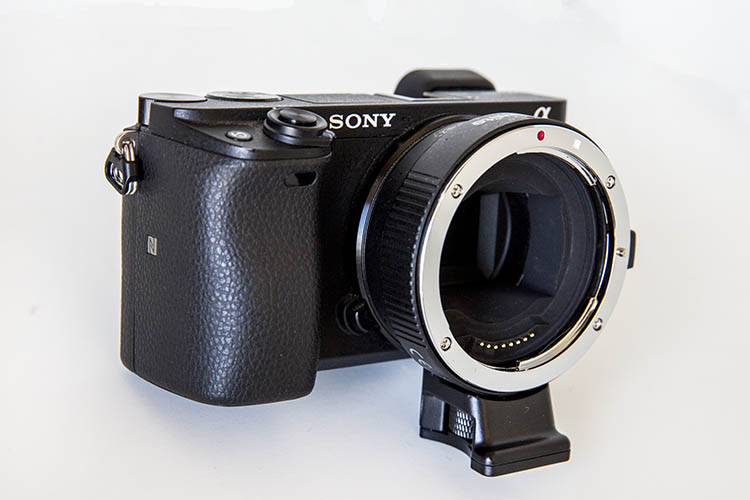
ony Canon Lens Converter

Sony a6300 with the FotodioX AF Adapter attached.

How did it perform?

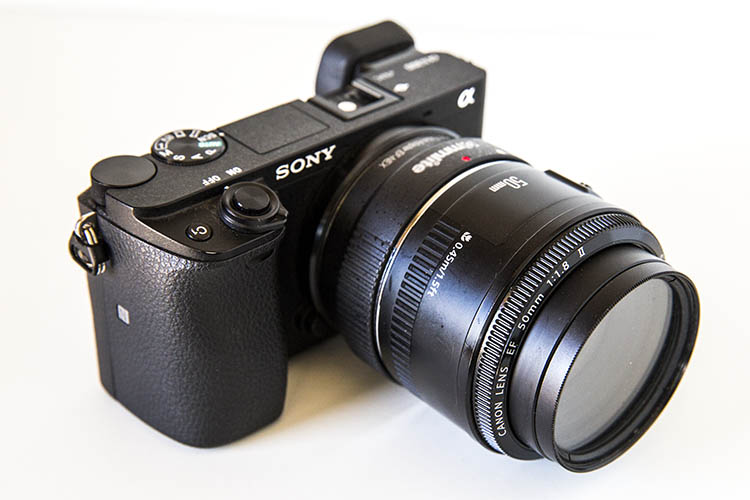
The first thing to note about using an adapter is how it will impact the overall heaviness, bulk, and appearance of your system. The FotodioX adapter itself is truly compact, and isn’t much larger than the Sony a6300 kit lens. As a result, it looks like a natural complement to the a6300 when it’s connected. Adding on Canon EF lenses changes the look and feel of the a6300, depending of course, and which lenses are paired. Small, lightweight, prime lenses such as the Canon 50mm f/1.8 don’t add a lot of bulk to the camera, and also look like a natural fit.

ony Canon Lens Converter

Sony a6300, FotodioX AF Adapter, and Canon 50mm f/1.8 lens.

However, adding larger zoom lenses such as the Canon 24-70mm f/2.8 definitely make the camera more front-heavy, to the point that it makes sense to grip the rig by the lens rather than the camera body. Still, the rig is considerably lighter than pairing the same Canon lenses with a DSLR such as the 5D Mark III.

ony Canon Lens Converter

Apart from aesthetics, the adapter actually performed surprisingly well! There are many reports of adapters causing autofocus to be either painfully slow, or lost altogether. While autofocus was not as snappy and accurate as it was using a Sony brand lens, the a6300 was still decently responsive, even with the FotodioX adapter and a Canon EF lens attached. If autofocus wasn’t working properly, which tended to happen for close-range shots, it was easy to switch the lens to manual focus and still capture a photo. Image quality was also tack-sharp, here are some image examples:

ony Canon Lens Converter

ony Canon Lens Converter

ony Canon Lens Converter

ony Canon Lens Converter

ony Canon Lens Converter

ony Canon Lens Converter

Overall thoughts

Using a lens adapter isn’t a perfect solution. The lagging autofocus was fine for casual use, but eventually became more noticeable and cumbersome when trying to shoot anything that moved. I’d hesitate to rely on an adapter when shooting something where quick autofocus mattered. It also felt like a pretty big tradeoff to not be able to take full advantage of what Sony purports to be the “world’s fastest autofocus” in the a6300. But other than that, the ability to use my existing DSLR lenses with a new camera body made by another manufacturer is a convenient luxury.

Have you tried a lens adapter before? What was your experience like?

googletag.cmd.push(function() {
tablet_slots.push( googletag.defineSlot( “/1005424/_dPSv4_tab-all-article-bottom_(300×250)”, [300, 250], “pb-ad-78623” ).addService( googletag.pubads() ) ); } );

googletag.cmd.push(function() {
mobile_slots.push( googletag.defineSlot( “/1005424/_dPSv4_mob-all-article-bottom_(300×250)”, [300, 250], “pb-ad-78158” ).addService( googletag.pubads() ) ); } );

The post FotodioX Lens Adapter – How to Put Your Canon EF Lens on Your Sony E-Mount Camera by Suzi Pratt appeared first on Digital Photography School.


Digital Photography School

 
Comments Off on FotodioX Lens Adapter – How to Put Your Canon EF Lens on Your Sony E-Mount Camera

Posted in Photography


Tamron announces SP 90mm F2.8 Di Macro and TAP-in console for Sony A-mount

20 Aug

Japanese optical manufacturer Tamron has announced it is to launch its exiting 90mm macro lens in a Sony A-mount, and that Sony users will now be able to update and customise some of their Tamron lenses using the company’s TAP-in lens console. The Sony version of the SP 90mm f/2.8 Di Macro 1:1 USD will be the same as the versions produced for Canon and Nikon users, but will not feature Tamron’s Vibration Correction system as Sony cameras have their own in-body stabilization.

The TAP-in console allows customers to tune focus, update firmware and customize features such as focus limiters and full-time manual focus in those lenses that offer them. The console is compatible with the latest batch of Tamron fixed focal length lenses, including the 85mm f/1.8 which the company has yet to launch in Sony mount.

The SP 90mm f/2.8 Di Macro 1:1 USD and the TAP-in console will be available from 25th August. Although the press release doesn’t mention prices, the console for Canon and Nikon users currently sells for $ 60/£55 and the lens for $ 749/£579.

For more information visit the Tamron website.

Press release:

Tamron announces the launch of the SP 90mm F/2.8 Di MACRO 1:1 USD (Model F017) for Sony mount

August 18, 2016, Saitama, Japan – Tamron Co., Ltd. (President & CEO: Shiro Ajisaka), a leading manufacturer of optics for diverse applications, announces the launch of the SP 90mm F/2.8 Di MACRO 1:1 USD (Model F017) for Sony mount.

Model F017
MACRO 1:1 USD (Model F017) for Sony mount*
Date of Launch: August 25, 2016

*The Sony mount model does not include VC (Vibration Compensation), since the bodies of Sony DSLR cameras include built-in image stabilization functionality. The name of the Sony mount model is “SP 90mm F/2.8 Di MACRO 1:1 USD” without the VC designation

Product Highlights

Built upon the outstanding optical performance of the legendary Tamron 90mm Macro

Inheriting the optical design of the previous 90mm Macro lens (Model F004), the new Model F017 delivers the same excellent resolving power and remarkably soft background blur effects (bokeh). The advanced construction includes one LD (Low Dispersion) glass element that maximally limits the dispersion properties of light and two XLD (eXtra Low Dispersion) glass elements that correct dispersion properties to an even greater extent. The special elements optimally compensate for on-axis and lateral chromatic aberrations from macro shooting range to infinity. Furthermore, the design ensures the best imaging performance at any range by adopting the Floating System which shifts the location of a group of elements to the best possible position as the focusing group travels relative to shooting distances. From 1:1, life-size close-ups to the most distant horizon, this new 90mm Macro lens achieves outstanding image quality.

Optimized for spectacular background blur effects (bokeh)

Earlier models of Tamron’s 90mm macro lens received high acclaim for their spectacular blur effects, and the new 90mm macro builds upon this legacy. To continue this commitment, thorough optical simulations were conducted. Careful examinations were performed to minimize any blurring with a doubled image appearing for a single line because that phenomenon has a considerably negative impact on background image quality. As a result, the lens achieves both sharp, vivid images and spectacular background blur effects. This combination is highly prized by portrait photographers.

Moisture-Proof and Dust-Resistant Construction

Areas of possible ingress surrounding switches and the boundary between the focus ring and the lens barrel are protected by special seals. These provide stronger protection against the intrusion of dirt, dust and moisture compared to the Moisture-Resistant Construction used previously. This additional protection assures even more wide-ranging opportunities for using this lens.

A durable Fluorine Coating on the front element repels water and fingerprints

The water and oil repellant coating applied to the front element surface allows instant removal of dirt or smudges with ease. The coating also provides a reasonable level of durability, and will sustain its effectiveness for years. The Fluorine Coating technology that Tamron developed for use in industrial optics applications was first used on the SP 15-30mm which was introduced in 2014.

USD actuator maximized for macro photography is fast, accurate and quiet

The control software program for the USD (Ultrasonic Silent Drive) actuator has been revised to provide substantially improved focusing speed and accuracy when using AF. The USD quickly addresses any out-of-focus condition caused by back-and-forth camera movement (which commonly occurs during macro photography) ensuring better results when shooting at close range.

Advanced coating technology reduces flare and ghosting

Two advanced coating technologies, both providing outstanding anti-reflection performance, are applied to critical element surfaces for maximum light transmission. eBAND (Extended Bandwidth & Angular-Dependency) Coating boasts outstanding anti-reflection performance across nearly the entire range of visible rays, and BBAR (Broad-Band Anti-Reflection) Coating utilizes traditional multi-layered, anti-reflection technology. This combination virtually eliminates extraneous reflections and substantially reduces ghosting and flare which enables the lens to achieve flawless, crystal clear images.

Use of circular aperture to achieve beautiful, rounded blur effects (bokeh)

When shooting a scene that includes a point-source of light in the subject background, marvelously tuned blur (bokeh) can be obtained without generating undesirable polygonal shapes of aperture patterns thanks to the circular aperture. The 9-blade diaphragm retains a nearly perfect circular opening even when stopped down by two stops.

Focusing options perfectly suited to a macro lens

The new 90mm macro has a focus limiter that makes it possible to shorten the time for accurately focusing on a subject when the working range is known. The lens also features an Internal Focusing system, so the overall length of the lens never changes, not even when focusing. As a result, the user is assured of a comfortable working distance of at least 139mm (5.5 in) from the front of the lens. In addition, the lens is equipped with a Full-time Manual Focus override mechanism which makes it possible to flexibly choose focal points. Even with the AF driving system in action, it is possible to instantaneously override it to make manual fine focusing adjustments without switching the AF-MF mode back and forth.

Compatibility with TAMRON TAP-in Console™

Always as new as tomorrow: You can update firmware, customize autofocus positions and adjust the mechanical setup and preferences of the 90mm lens by simply attaching it to the TAMRON TAP-in Console and connecting it via USB to a personal computer. (The TAP-in Console is an optional accessory.)


TAMRON TAP-in Console™ (Model TAP-01)
Sony mount model launched

Tamron Co., Ltd. (President & CEO: Shiro Ajisaka; Headquarters: Saitama City), a leading manufacturer of optics for diverse applications, announces the launch of the TAMRON TAP-in Console (Model TAP-01), a lens accessory that enables firmware updating and customized setups for selected Tamron lenses, for Sony cameras (Sony A mount model).

For the first time, customers can update firmware in selected Tamron lenses and customize various lens functions to meet their needs simply by attaching a TAMRON TAP-in Console and running the TAMRON TAP-in Utility software on their PC or Mac.

Previously, firmware updates could be performed only at a TAMRON Customer Service Center. Using the new accessory and an internet connection, customers can access a dedicated website and update firmware themselves anytime, anywhere. In addition, selected lenses can be customized by changing various settings (described below) to match the customer’s preferences based on how they like to use the lens, making it even more versatile and user-friendly.

Custom Options

With a TAMRON TAP-in Console, customers can do the following things.

  • Update firmware
  • Update the firmware of compatible lenses
  • Update the firmware of the TAP-in Console itself
  • Customize functions of selected lenses
  • Focus adjustment
  • Focus distance limiter customization (only for lenses that have the Focus Limiter feature)
  • Full-time Manual Focus override customization (only for lenses that have the Full-time Manual Focus feature)
  • Save customized data files

Because Tamron lenses compatible with Sony cameras are not equipped with the VC (Vibration Compensation) system, the Customize function for VC adjustment, which is available for the Nikon and Canon mount models, is not available for the new Sony mount model.

TAMRON TAP-in Utility Software
 
Customers download the free TAMRON TAP-in Utility and install it on their Mac or PC. Updating firmware and customizing various lens functions is as easy as connecting the TAP-in Console with a USB cable and making selections. An internet connection is required for firmware updates.

Updating Firmware
Customers can update firmware of selected Tamron lenses using this utility software. Additionally, the firmware in the TAP-in Console unit can be updated as needed. Using an internet connection and the utility software, users can access a dedicated website and easily confirm that the lens attached to the TAP-in Console—and the Console itself—have the most up-to-date firmware. If a newer version is available, updating is quick and secure.

Customization of Selected Tamron Lenses
Various lens functions can be customized, depending on the lens model and built-in features.

(1) Focus adjustment
Focus can be adjusted in three distance regions: close, intermediate, and far ranges. For zoom lenses with variable focal length ranges, adjustments can be made for up to eight segments, which means that focus adjustment for a combined total of up to 24 regions is possible. Fixed-focal length lenses have only one segment, so customization for the three distance regions is possible. The conditions and range of possible adjustments may differ according to the lens model.

(2) Focus distance limiter customization
For lenses equipped with a Focus Limiter switch, it is possible to adjust the autofocus drive range by setting the near and far limits according to user preferences. If the Focus Limiter switch has three positions, setting the middle position is also possible. Only lens models equipped with the Focus Limiter function can be adjusted. The conditions and range of possible adjustments may differ according to the lens model.

(3) Full-time Manual Focus override customization
For any lens with a Full-time Manual Focus override system, you can set the mode to ON or OFF. In addition, you can optimize the sensitivity of the focus ring to your preference relative to its angular rotation anywhere between High and Low, when setting the manual focus mode menu button to ON.

Compatible Tamron Lenses (As of August 2016)

  • SP 85mm F/1.8 Di VC USD (Model F016) for Sony: To be launched soon
  • SP 90mm F/2.8 Di MACRO 1:1 VC USD (Model F017) for Sony: To be launched on August 25, 2016
  • SP 45mm F/1.8 Di VC USD (Model F013) for Sony
  • SP 35mm F/1.8 Di VC USD (Model F012) for Sony

Articles: Digital Photography Review (dpreview.com)

 
Comments Off on Tamron announces SP 90mm F2.8 Di Macro and TAP-in console for Sony A-mount

Posted in Uncategorized


Firmware update for Sony a7R II improves stability, adds support for radio controlled flashes

19 Aug

Sony has released a firmware update for its a7R II full-frame mirrorless camera which improves camera stability while adding support for the company’s new radio controlled lighting system.

The official list of improvements in version 3.30 include:

  • Support for Radio Controlled Lighting System
  • Improved stability in picture shooting mode (by optimizing temperature control)
  • Allows for HDMI output while using Remote Camera Control software
  • Improves overall stability and operability of the camera

The firmware is now available and can be downloaded right here.

Articles: Digital Photography Review (dpreview.com)

 
Comments Off on Firmware update for Sony a7R II improves stability, adds support for radio controlled flashes

Posted in Uncategorized