RSS
 

Posts Tagged ‘Social’

Apple patent hints at ‘social camera flash’ using multiple iOS devices

16 May

applelogo.jpg

A patent filed by Apple in 2011 and discovered this week by aoppleinsider.com seems to hint at a ‘social camera flash’ system, allowing multiple iOS devices to be connected and used as secondary strobes for impromptu flash setups. The patent is filed as an ‘illumination system’ and describes ‘initiating a master-slave relationship between the image capture device and at least one secondary device’. Click through for more details.

News: Digital Photography Review (dpreview.com)

 
Comments Off on Apple patent hints at ‘social camera flash’ using multiple iOS devices

Posted in Uncategorized


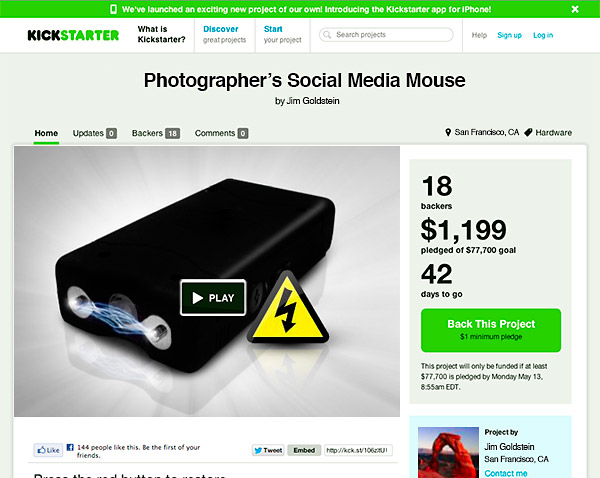
My New Kickstarter Project: Photographer’s Social Media Mouse

01 Apr

Ever since evangelizing the importance of social media to fellow photographers in 2006, I’ve long yearned for a tool to help balance photo/video editing time with the incredibly important task of marketing myself on social media. After years of research and prototyping I’m happy to announce a new Kickstarter project to realize my dream, a mouse designed especially for photographers who are super active on social media.
I’ve titled this project the Photographers’s Social Media Mouse.

Kickstarter Project: Photographer's Social Media Mouse

How it works is quite simple. Employing Bluetooth wireless technology the Photographer’s Social Media Mouse detects when a photographer has navigated to a web browser. With in 10 seconds of detecting activity on Facebook, Twitter, Google+, Flickr, Instagram, 500px, MySpace, and Friendster a gentle yet firm 7,800,000 volt shock is applied to the finger of the user. The momentary sensation causes brief paralysis in the arm reminding the user that more important editing or business communications are the order of the day.

Additional Features

  • Designed for travel – More comfortable than a touchpad, instant-on performance for maximum productivity on the road
  • Smart power management – Long battery life, on & off switch, power-saving modes and a low-battery indicator light
  • Precision optical performance – 1000-dpi optical sensor technology for incredibly smooth, precise tracking
  • Convenient carrying case – Comes with pouch for easy storage.

Important product information: Batteries are not included, use of mouse is not recommended by left handed users to avoid direct current to the heart and avoid data loss by keeping mouse on an approved non-conductive mouse pad.

Your support is needed to make this a reality. To contribute visit my Kickstarter page.

Product Details
Product Dimensions: 8.5 x 7 x 2.5 inches
Shipping Weight: 11.2 ounces
Shipping: Currently, item can be shipped only within the U.S.

Note: The Photographer’s Social Media Mouse is restricted and cannot be shipped to CT, IL, HI, MA, MI, NJ, NY, RI, and WI. They are also restricted in Annapolis, MD; Baltimore, MD; Baltimore County, MD; Chicago, IL; Dension/Crawford County, IA; Washington DC; and Philadelphia, PA. Any orders for these areas/states will be canceled.

Copyright Jim M. Goldstein, All Rights Reserved

My New Kickstarter Project: Photographer’s Social Media Mouse

The post My New Kickstarter Project: Photographer’s Social Media Mouse appeared first on JMG-Galleries – Landscape, Nature & Travel Photography.


JMG-Galleries – Landscape, Nature & Travel Photography

 
Comments Off on My New Kickstarter Project: Photographer’s Social Media Mouse

Posted in Equipment


Don McCullin on Social Documentary Photography

20 Jan

In 2009 Don McCullin spoke to The National Media Museum about Social Documentary Photography as part of his In England exhibition at the museum. For current exhibition information, visit the website nationalmediamuseum.org.uk


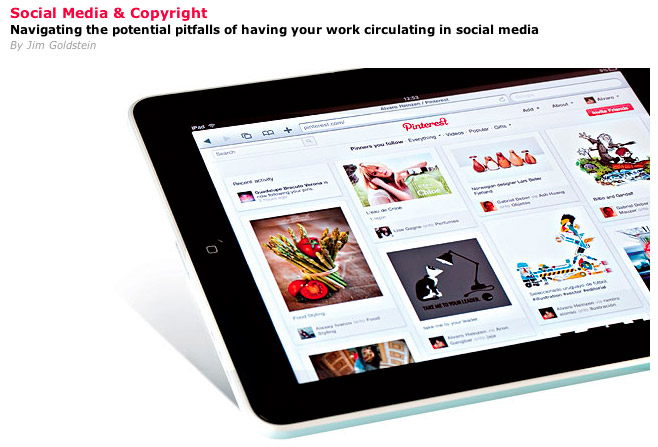
Recommended Reading: Social Media & ­­­­­Copyright

12 Dec
Social Media & ­­­­­Copyright: Navigating the potential pitfalls of having your work circulating in social media

Social Media & ­­­­­Copyright: Navigating the potential pitfalls of having your work
circulating in social media

In case you missed it my article Social Media & ­­­­­Copyright was recently published in Digital Photo Pro magazine. This article is the second part of my earlier article Social-Media Marketing Essentials. Missing from my earlier article was a discussion of copyright concerns most common to photographers and other creatives. If you missed it I highly recommend reading it. While the social media landscape changes quickly the foundational elements of this article will help you keep your sanity for years to come.

Related articles:
How I Evaluate Terms of Service for Social Media Web Sites – Google+ 

Evaluating Terms of Service Documents: Resources

More of my articles on Social Media for Photographers


Copyright Jim M. Goldstein, All Rights Reserved

Recommended Reading: Social Media & ­­­­­Copyright

The post Recommended Reading: Social Media & ­­­­­Copyright appeared first on JMG-Galleries – Landscape, Nature & Travel Photography.


JMG-Galleries – Landscape, Nature & Travel Photography

 
Comments Off on Recommended Reading: Social Media & ­­­­­Copyright

Posted in Equipment


Google+, The Nicer Social Network for Photographers

16 Nov

Are You on Google+ Yet?  If So Please Post a Link to Your Google+ URL Here

For the last few weeks I’ve been thinking a lot about online conversations. It feels like I’m constantly in one somewhere on some site.

More and more for me these are happening on Google+. I used to spend almost all of my social time online in Flickr group discussion threads. I stopped visiting Flickr groups for a while due to personal harassment — but you know what, it wasn’t just me who left, the velocity of quality conversations in Flickr groups have gone wayyyy down more broadly speaking in the past year.

This is not just a subjective thing — it’s easily measured ojbectively as well. Flickr Central is one of the oldest/largest/most active groups on Flickr. Over there years (as counted by threads) 11,503 conversations that have gone on there. Some are very successful, some are not.

If you look at Flickr Central today you’ll see that the time stamp for discussions on the first page goes back two weeks. This was not always the case. It used to be that the entire first page of discussions in Flickr Central were from the past 48 hours. Clearly the velocity of conversations in this Flickr group has gone way down. I suspect the same goes for other groups as well. Many of the groups recommended to me as “groups that Flickr has noticed” on the groups page haven’t had conversations in months, in some cases even years.

Meanwhile, over at Google+, in the past year I’ve been involved in some of the best conversations that I ever remember happening anywhere on the web. Interesting conversations about photography and art and meetups and hangouts and all kinds of fun things. it seems like there is always some great conversation somewhere on Google+ to jump into.

Over the course of the past few weeks I’ve jumped back into a few Flickr conversations to see what it feels like. What I’ve noticed is that the tone of conversations on Google+ feels so much more positive than it does at Flickr. There’s so much less snark and bitterness and negativity overall. I hadn’t seen the difference so dramatically before, but after having been gone awhile it felt more evident.

This made me think about what Google+ was doing right for community that Flickr is not.

When I first joined Google+ one of the things that I noticed is that some of the more hostile individuals from many of the old Flickr groups showed up. Some personal attacks took place, they aired their gripes about different things, typical BS hater stuff — but you know what? These people were quickly marginalized and moved out of the way to create a more positive environment. I blocked many of these people and so did so many other photographers on G+.

A few weeks went by and these people were just as hostile and negative but they were basically shouting to an empty room. The majority of positive forward thinking photographers on G+ had tuned them out with the tools that we were given. What we were left with was a more positive filtered G+ experience. I went back a few days ago to look at a few of the accounts of people that I blocked and you know what — they are gone. They quit G+. By empowering a mostly positive oriented community these people found no audience to bitch at and they left. Meanwhile, more constructive social photographers on G+ carry on.

Now, one worry with filtering out criticism is that it hurts meaningful conversation because all conversation is not always puppy dogs and roses, but that also hasn’t happened on Google+. Lots of criticism has gone on in tons of threads. The difference is though that the criticism feels much more respectful than some of what I’ve experienced in Flickr groups. People disagree on Google+ they just do it respectfully.

By giving users more powerful blocking tools on G+ Google has built a nicer community. A nicer community feels so much more enjoyable.

Every so often I’ll find someone new who comes along and leaves some sort of assholish comment in a thread on Google+. It’s almost delightful at how easy it is to block them and make them invisible.

In poking around Flickr Groups over the past week I did find what felt like some high quality conversations to me, I read them, I lurked — but I didn’t participate. The reason why I didn’t participate was that I noticed some of the toxic types that I’d run into previously on Flickr or G+. I’m sure I would have jumped into these conversations if I hadn’t seen them there, but what’s the point of jumping into a conversation about fine art photography when you know someone is just going to be a jerk?


Thomas Hawk Digital Connection

 
Comments Off on Google+, The Nicer Social Network for Photographers

Posted in Photography


Ways to Redesign Flickr Groups to Make Them More Social, Addictive and Powerful

16 Oct

Flickr is currently in the process of redesigning the Groups section of their site. Initial comments by some beta testers have suggested that more emphasis will be placed on photos and less on discussion threads. I’m not a part of this new beta group, but I thought I’d share a list of ways that Flickr could improve Groups anyways. I believe that Groups represent Flickr and Yahoo’s greatest chance at making progress in social — an area increasingly being dominated by Google+, Facebook, Twitter, Instagram, Pinterest and other Yahoo social competitors.

Although I have not been as active in Groups over the past year, I’ve literally spent thousands of hours in Flickr Groups and feel like I understand how they work and their dynamics very well.

1. It cannot be overstated. The power of Groups are in the discussion threads. The power of Groups are in the discussion threads. The power of Groups are in the discussion threads. Discussion threads, positioned correctly, can be like crack. They can be terribly addictive. Flickr should be doing everything that they possibly can to push people to the discussion threads in Groups. This is how you turn a casual user into a hardcore top 1% Flickr user. If you can suck someone into the discussion threads you can get 100x the use of Flickr out of them. These are the most valuable members on Flickr. These are the biggest Flickr evangelists. These are the ones who will promote the site more than everyone else. Every design decision around groups should be made with the idea of how can we suck more users into the group discussion threads.

2. Toxic people are like cancer. Toxic people will drive people away from Flickr. Toxic people are the single biggest impediment for Flickr Groups to overcome today. The answer to protecting Flickr members from toxic people is simple. Create a more robust blocking mechanism which allows users to block each other. Online harassment that turns into real life harassment will drive even the most hardcore Flickr Group addict away from social. The best way to prevent this harassment is to allow users the ability to block each other. This seems so basic. Google got this super right a long time ago with Google+.

If I choose to block you then you should be made completely and entirely invisible on the site. Poof. Gone. Vanished. It’s not that you still can’t harass, but it makes it harder to harass someone when you are invisible to them in any profile they create that gains momentum on the site. This would encourage people to behave more civilly towards each other if such a tool existed.

Civility will help social for groups.

3. The goal for Flickr should be to create a page of discussion threads that are irresistible to me — an entire page of threads that I simply can’t help myself but click and converse. Any thread that is not of interest is a waste of space. Allowing me to mute or hide threads will ensure that I will be more social because I will see more opportunities to be social. There is no reason for me to see a thread about baseball that keeps popping to the top if I don’t care about baseball.

Muting threads also helps with trolling.

4. Flickr already has a super powerful tool that they are using in their help forum that they are not using in their Groups. If they’ve already coded it for the help forum it seems like a total non-brainer to simply port it to other Group discussions. This is the button that shows me posts that I’ve posted in. Obviously I care more about the threads that I’ve posted in than the threads that I haven’t.

5. Flickr needs to allow me to subscribe to threads that I’m particularly interested in and aggregate these threads on a single page sorted by recent activity. If you want people to be active in multiple groups (and you do, trust me) you want them to be able to easily follow the conversations that they care about in multiple groups. This does not happen today. Instead you have to go to group by group by group by group to hunt around for the conversations that you care about. Alternatively you can bookmark them all and go back and check them manually over and over and over again. You quickly tire of bookmarks because you are only interested in a Group conversation if there is new activity. Having a page to view subscribed threads could become the most powerful page for social on the web.

6. Flickr can’t fight anonymity at this point. It’s too late. Google and Facebook forced this issue early on by requiring users to use names that they are commonly known by. There would be too much of a revolt if Flickr even tried to institute anything like this. However, they can allow verified profiles. By allowing users to opt in to verified profiles they would give these accounts more credibility. Verification could be done similar to how Google used to do it by having users submit a Government ID or simply enter in a credit card number on a credit card. NOTE: I’m suggesting this be made voluntary and OPT IN. If people want to opt in, why not let them? If someone wants to keep their hackerboy6969 anonymous ID this is fine too.

7. Groups need to be promoted more heavily by Yahoo and Flickr across other sections of the site. Yahoo especially and Yahoo search especially, should be driving traffic to Group discussions. Although Yahoo probably has to talk to the boss (Bing/Microsoft) at this point to try to have any input on the search algorithm, if I were Yahoo I’d try to get multiplier algorithm weightings for public group conversations and general group pages. If someone is searching for information on a new Canon 5D Mark III, by all means, Yahoo should try to route them to a Canon Group on Flickr where they can find discussion about this. It’s relevant and invites them to be more social on a Yahoo property.

8. Group invitations should be super easy. New blood is vital to ensuring Group success. Flickr should make it as easy as possible both to invite other Flickr members to your Groups and also equally important to invite people outside of Flickr to your Groups. A Group invitation section should be made which will invite Facebook friends, people in your address book, etc. to your Group. A few years back Flickr made it actually harder to invite people to Groups. They probably did this due to criticism about people spamming Group invitations. Instead of making Group inviting harder, they should simply allow users to mute these notifications by category.

9. Flickr needs to come out with a super easy way to consume and converse in Group discussion threads on both iPhone and Android.

10. Create a +/@ mentioning system for Groups. If someone +/@ mentions me in a Group (or on a photo page discussion as well), I should receive a notification. This is smart and will invite and encourage me to respond.

Flickr Group discussion threads represent the future for social at Yahoo not just for the photo community that is Flickr. Group discussion threads represent the future for social ideally for millions of other topics. To this end, Flickr Photo Groups should be considered as much a social lab as anything for Yahoo. Thoughtful consideration should be made as to how to push this Group format out to the rest of the social web, inviting people to create and manage groups about everything from knitting to hang gliding. Yes, photos are important. Every Group should have a photography function, but the discussion threads really are the power.

By making Groups more about photos and less about discussions Yahoo squanders this important opportunity.

I also believe that Yahoo should consider hiring some people to live in Groups for a while. They should hire some super smart people who understand psychology and just have them live in Groups. Their entire job should just be to participate in Groups all day long and then thoughtfully consider how to make them more and more social.

Although Yahoo staffers are in some Groups today, I can’t think of any who are particularly hyperactive there. It’s hard to be social in Flickr Groups when you’re so busy writing code all day, but Yahoo does need some talent to really get in there and understand what they have — because today I don’t think they really do and I’m not sure there’s ever any HOPE that senior management at Yahoo will ever truly understand what they have with social in the form of the seedling that is Flickr Groups.


Thomas Hawk Digital Connection

 
Comments Off on Ways to Redesign Flickr Groups to Make Them More Social, Addictive and Powerful

Posted in Photography


Photowalking als Social Event

15 Sep
Stefan und Chris sind seit mehreren Jahren leidenschaftliche Fotografen aus München, die sich hauptberuflich im IT Umfeld bewegen. Zusammen haben sie vor 2 Jahren das Projekt Photowalkingmunich ins Leben gerufen. Der folgende Artikel soll das Thema Photowalking als Social Event näher beleuchten.

Gerade mit dem letzten, von Scott Kelby im Juli 2010 ausgerufenen WorldWide Photowalk, ist das Thema Photowalking wieder einen Schritt weiter ins Rampenlicht gerückt. Stellt sich jedoch die Frage: Was hat es eigentlich damit auf sich? Photowalking?

Fangen wir mit der gängigen Übersetzung von Photowalking an: so wirklich gibt es dafür natürlich keine. Die Umschreibung „Spazieren bzw. Wandern mit einer Kamera“ trifft es jedoch ziemlich genau und da eine Kamera üblicherweise zum Fotografieren genutzt wird, wird neben dem Spazieren oder Wandern mit der Kamera auch das eine oder andere Motiv fotografiert oder, landläufig formuliert, ein Bild geschossen.

Kommen wir damit zum Verständnis von Photowalking der Gruppe Photowalkingmunich: Klar, dass die Fotografie irgendwie den Mittelpunkt eines Photowalks ausmacht.

Aber Photowalking ist mehr als das alleinige und einfache Fotografieren und so wird die Fotografie gewöhnlicherweise verstanden: eine Tätigkeit, die man alleine ausübt – beispielweise im Urlaub, auf einer Städtetour, in der Natur, wo man natürlich oft zu zweit unterwegs ist, jedoch nur einer die Kamera in der Hand hält.

Genau hier setzt Photowalking als Event mit sozialem Charakter an: Es stellt ein gesellschaftliches Ereignis dar, bei dem Fotobegeisterte aller Art (jeder mit eigener Kamera) gleichgesinnte Menschen aller Altersklassen treffen. Im Vordergrund steht also der gemeinschaftliche und soziale Aspekt – etwas zusammen zu erleben. Das Reizvolle beim Photowalking ist, Menschen zu treffen, die man sonst kaum kennenlernen würde – die aber, und das ist das Besondere, eine gemeinsame Leidenschaft verbindet: die Fotografie an sich!

Wie aber sieht nun so ein Photowalk aus?

Die Rahmenbedingungen eines jeden Walks werden von dem jeweiligen kreativen Organisator der Photowalking-Gruppe festgelegt: Dieser sucht eine geeignete Lokation in Form einer Stadt, eines Stadtteils oder auch einer Veranstaltung, wie Jahrmarkt, Ausstellung etc. aus. Am Beispiel Photowalkingmunich funktioniert das über einen Artikel mit allen wichtigen Infos zum kommenden Walk. Teilnehmer haben die Möglichkeit, sich online anzumelden und finden sich zu der verabredeten Zeit am verabredeten Ort ein. Es darf dabei jeder mitmachen, egal ob analog oder digital, ob mit Kompakt- oder Profikamera unterwegs. Hauptsache es wird Spass am gemeinsamen Fotografieren mitgebracht.

Weiterhin wird ein sehr grober Ablaufplan vorgegeben (diese Vorgehensweise leben zumindest wir Münchner Photowalker so, was im Übrigen sehr gut ankommt). Vorteil unserer eher groben (Zeit-) Planung ist, dass beispielsweise keine Hektik entsteht, von einem fototypischen Ort zum nächsten zu kommen. Jeder Photowalker hat somit genug Zeit und Muße, sein Fotothema zu finden – und nebenbei die anderen „Mitwalker“ kennenzulernen bevor es gemeinsam, in mal mehr, mal weniger großen Gruppen, weitergeht.

Der Austausch von Fotoideen, Hilfestellungen, Verbesserungs-vorschlägen für den einen oder anderen Anfänger und ganz einfach der gemeinsame Spaß an der Ausübung des schönen Hobbys kommt somit ganz automatisch.

Pause oder Abschluss eines jeden Photowalks stellt häufig ein zwangloses Get Together, in Form eines gemeinsamen Café-, Restaurant oder Barbesuches dar. Selbstverständlich wird im Zeitalter der digitalen Fotographie bereits hier das eine oder andere Bild begutachtet. Und auch hier steht der soziale Aspekt des sich Kennenlernens in zwangloser Form im Vordergrund.

Der soziale Charakter findet weder vor noch während oder nach dem Walk sein Ende – im Gegenteil: Nach dem Walk ist vor dem Walk – so die These eines jeden einzelnen Photowalkers. Insbesondere in heutigen Zeiten des Internets ist der weitere Kontakterhalt problemlos möglich.

So laden Teilnehmer im Nachgang des Photowalks ihre Werke auf Flickr hoch und bleiben beispielsweise in einer Gruppe bei Flickr oder generell bei Facebook sowie anderen gängigen Online-Foren und Communities in Kontakt.

Hier wird sich über die erzielten Ergebnisse ausgetauscht, oft gelobt, fast nie getadelt und natürlich viel gefachsimpelt. Manche Teilnehmer nutzen eine weitere Form des Internet und twittern vor, während und nach einem Walk ihren Status bzw. Bilder. Wiederum alles ohne Zwang und Vorgabe – so wie es jedem einzelnen beliebt.

So wie es jedem einzelnen beliebt ist auch die Teilnahme am nächsten Photowalk zu verstehen: freiwillig natürlich, ohne Muss und Zwang – dafür aber mit jeder Menge Spaß und gleichgesinnten Menschen. Zu finden auf Photowalkingmunich.de.


***
Werbepause: Buchtipp – Vom Alltäglichen zum Besonderen!


KWERFELDEIN | Digitale Fotografie

 
Comments Off on Photowalking als Social Event

Posted in Equipment


Social Search: Competition = Opportunity

02 Mar

Last week in my post Social CRM: Opportunity Knocking I discussed the flip-side of common online privacy concerns highlighting opportunities for individuals and small businesses. With the rise of Social CRM solutions aggregating personal information to paint a picture of who you are to others I noted the importance of  actively managing your online profiles and accounts. To extend this point further I wanted to share with you another area of opportunity for those who are managing their online presence in the Social Search space. Enjoy Part 3 of 3 on the topic of privacy and social media.

It’s been roughly 14 months since I wrote Why Social Media Matters to Photographers and in this time it’s very likely that the exploration of this new communication medium has resulted in your creation of multiple accounts either to experiment with or align into a larger communication strategy. In the past year Social Media use has exploded and the large search engines have taken note. So as to not become obsolete search engines have begun spidering entries in many social media communities to display alongside their traditional search results. Google quickly realized the best way to make sense of all this information in relation to individual identity was not to necessarily rely on algorithms to map things together, but to rely on individuals to piece their online presence together into a single profile… enter Google Profiles in mid-2009. In creating your Google Profile you can actively list sites that pertain to your online persona and footprint in a similar fashion noted in Social CRM: Opportunity Knocking. As an example here’s my Google profile page… feel free to follow me.

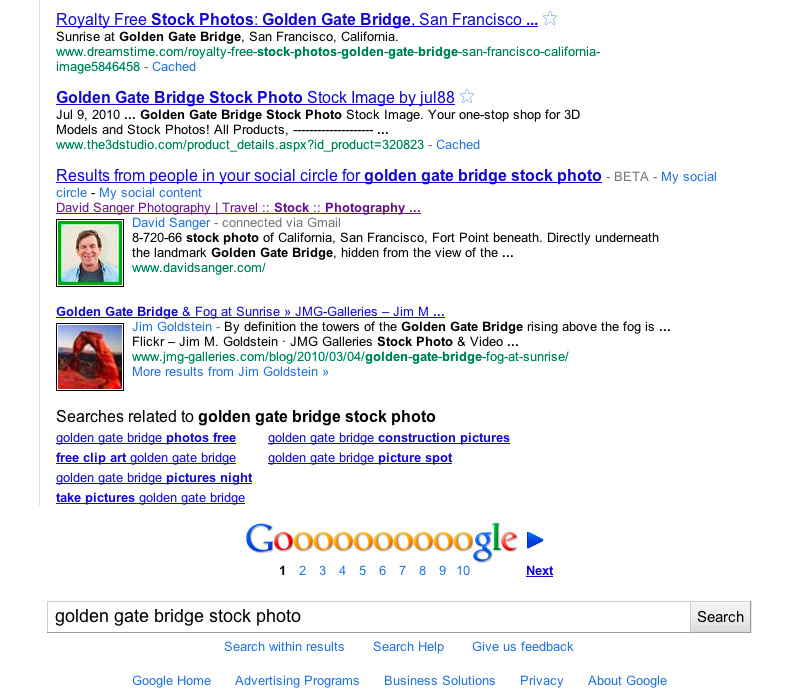
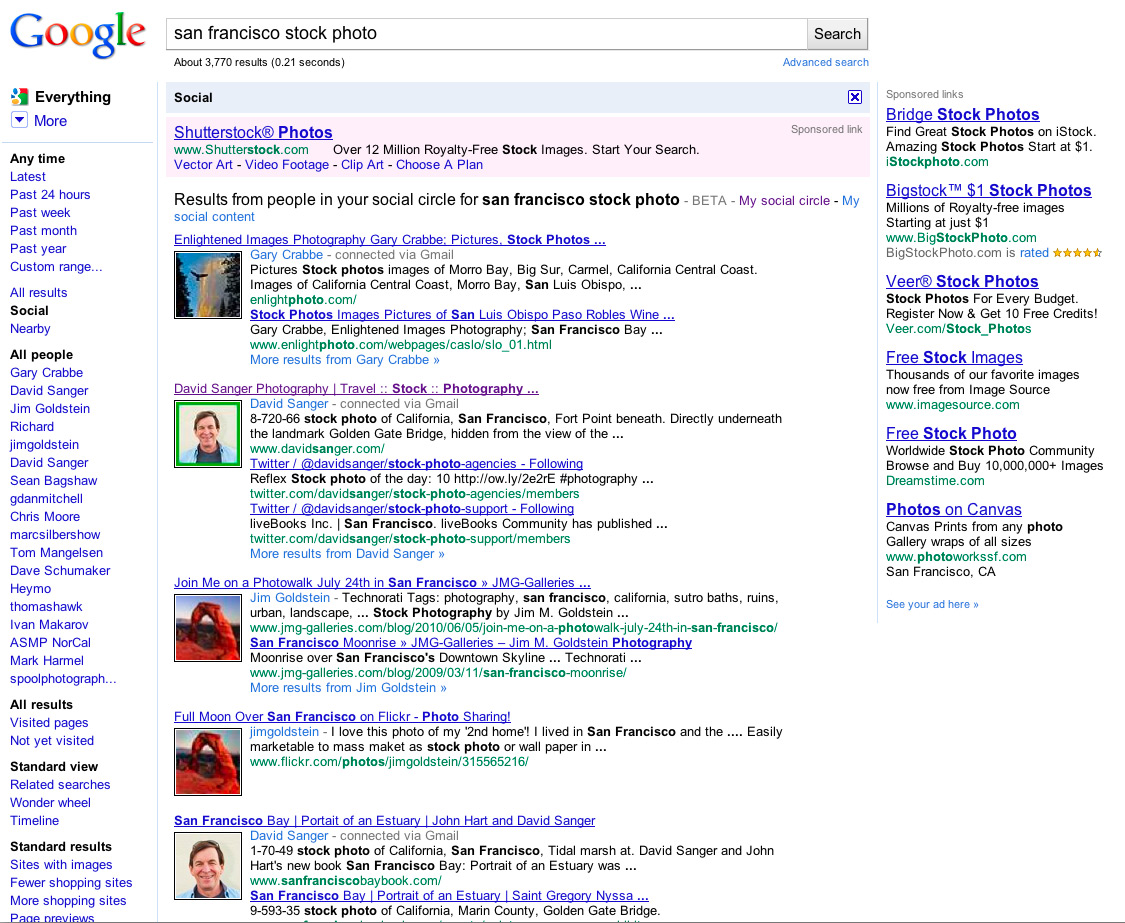
In late 2009 Google launched Social Search, 6 months after the launch of Google Profiles, enabling a new means to find information with in your social network. Google maps your relationship to the contacts in your social network and spiders content found with in the listed sites of each of your friends Google Profiles. The end result… for each of your searches Google will present the traditional results reflective of all content across the web and a special sub-set of results reflective of content amongst your contacts. To get a better idea of what this means see the video and screenshots below. (more after the jump)


Example 1

Click to Enlarge
Example 2

Click to Enlarge

Why is this of importance?

To beat the same drum in Why Social Media Matters to Photographers being networked provides benefits. In an almost counter intuitive fashion the greater you’re networked with your professional contacts, peers and even your competition the greater likelihood that a client can find you or your work. With “Google Profiles” and “Google Search” Google enables the intelligent creation of custom search based on niche.

To exemplify my point, in the screen captures to the left, I conducted a Google search for “Golden Gate Bridge Stock Photo”. As you’d imagine there are many web entries for this. At the bottom of the normal Google search results in Example 1 you’ll find a brief listing of results from my network. In this case content from my competition and friend David Sanger is included with my own. Clicking on “Results from people in your social circle for Golden Gate Bridge Stock Photo” displays the full listing of results as seen in Example 2 (enter another competitor and friend Gary Crabbe). With the proper connections it is possible for others in and beyond your known social network to find you.

If you’re at the top of the rankings for certain search terms you might be resistant to the idea of going networking crazy with Google Profiles, but no one can be at the top of every result nor can one be at the top of one result indefinitely. Google is constantly changing their algorithms and Social Search provides an alternate mechanism in the mysterious world of Search Engine Optimization (SEO).

I’m of the mindset that participation in Google Profiles and leveraging Social Search is of greater benefit to my business than detriment. Whether networked in this fashion or not my competitors and I surface in search results on several keywords as it is. We also compete regularly through placement of our images in agencies. I’m happy to let my work stand on its own and any way it can be found is a good thing.

The combination of Google Profiles, which provides an active mechanism to manage ones public information and shape ones online persona, and Google Social Search, which creates a unique custom search between you and your social network,  feeds the maturation of user defined custom search. A custom search powered and shaped by data you actively provide. This is an incredibly valuable resource particularly coming from the 800 lb. gorilla in the search industry. Google as of April 2010 accounted for over 65% market share in the search space.

Given the ubiquitous nature of Google it’s critical to make it as easy as possible to be found and Google Profiles and Google Social Search enable you to do just that. So consider this a gentle reminder while its fair to be concerned about privacy and rights grab concerns with social media sites, don’t let it blind you from seeing emerging opportunities where you can manage and leverage your public information. Making your personal data and/or information public can be of benefit just be sure to manage it wisely and leverage it through trusted resources.

You’ve found my blog, but you’re only seeing the tip of the iceberg… follow me on Twitter, Facebook and FriendFeed.I also invite you to listen and subscribe to my podcast “EXIF and Beyond” featuring photographer interviews and the chronicles of creating some of my photography.

Related Articles:
How Google Social Search Can Help You Get New Business for Your Photo Studio – Trevor Current
(coincidentally posted today as well)

Technorati Tags: , , , , , ,

Copyright Jim M. Goldstein, All Rights Reserved

Social Search: Competition = Opportunity


JMG-Galleries – Jim M. Goldstein Photography

 
Comments Off on Social Search: Competition = Opportunity

Posted in Equipment