RSS
 

Posts Tagged ‘Shows’

Teardown video shows how the Galaxy S9 variable aperture works

15 Mar

The YouTube channel JerryRigEverything recently tore down (or rather tore apart…) the new Samsung Galaxy S9, giving us the closest look at yet at the new smartphone’s camera hardware. So if the still images in the iFixit teardown weren’t quite interesting enough for you, this might just do the trick.

The camera teardown is about one minute and a half long, running from the 3:30 mark until about 5:00. In that time, we get to see the Optical Image Stabilization system demoed and torn open to reveal the magnets inside:

Then, we get really close look at one of the phone’s most intriguing features: the variable aperture. It turns out the system works using a little lever on the side of the housing. So when the phone senses that there is enough light to justify it, it’ll flip this switch electronically and switch from it’s world’s-brightest F1.5 setting to F2.4.

Here’s a very close look at that switch in action:

You can check out the full teardown in the video at the top. And stay tuned, because we’ll be bringing you a full smartphone camera review of the Samsung Galaxy S9 just as soon as we can put a unit through its paces.

Articles: Digital Photography Review (dpreview.com)

 
Comments Off on Teardown video shows how the Galaxy S9 variable aperture works

Posted in Uncategorized


iFixit teardown finds Samsung Galaxy S9 Plus difficult to repair, shows dual-blade aperture

12 Mar

The team at iFixit.com has taken apart Samsung’s brand new Galaxy S9 Plus flagship smartphone and given it a pretty low repairability score of 4/10 points. The testers liked the fact that many components are modular and can be replaced independently, but found accessing the battery to be an unnecessary challenge.

The device’s display and glass back also increase the chance of breakage, and make repairs difficult to start. The need to remove the rear glass panel and disassemble the entire phone when replacing the display was listed as another negative point.

During the teardown, the iFixit crew also had a closer look at the smartphone’s 12MP optically-stabilized camera module with 2x zoom. The dual-camera comes as a single unit on a single PCB and with a single connector. Inside, they found the DRAM chips that power the 960 fps super-slow-motion mode.

The S9 Plus main camera uses a variable F1.5/F2.4 aperture, and the close-up images show the design. Instead of a diaphragm-design with several aperture blades, the lens comes with a simpler construction, comprising of two rotating, ring-like blades for switching between its two aperture values.

Head over to iFixit.com to read the full report.

Articles: Digital Photography Review (dpreview.com)

 
Comments Off on iFixit teardown finds Samsung Galaxy S9 Plus difficult to repair, shows dual-blade aperture

Posted in Uncategorized


Associated Press photographer’s video shows ‘travel photographers’ staging photos

22 Feb

Last month, Associated Press photographer A. M. Ahad shared a video on Facebook that shows something disappointing… if not terribly surprising. His video, captured at a train station in Bangladesh, shows photographers shooting staged images of a boy who is posing out a train window as if in prayer.

Ahad criticized the photographers’ actions, saying such staging is used in an effort to capture award-winning images at the expense of professional etiquette.

Speaking with PetaPixel, Ahad explained that a large number of camera-wielding tourists show up for Eid al-Adha and Bishwa Ijtema to snap images that are often posed: “They are all around making images and ruining things for professional photographers.”

“Bangladesh is not for people like this who came to ruin professional photographers etiquette for the sake of winning medal,” Ahad said in the Facebook post that accompanies the video, expressing frustration that photographers who are staging scenes are getting in the way of actual professionals. “Stop telling us that you are foreign media covering the congregation when you have no proof to show us […] just stay home, for goodness sake.”

Articles: Digital Photography Review (dpreview.com)

 
Comments Off on Associated Press photographer’s video shows ‘travel photographers’ staging photos

Posted in Uncategorized


This video shows that everyone takes the exact same Instagram travel photos

02 Feb

After reading our recent coverage on Instagrammers hurting an iconic tree in New Zealand just to snap the same photo everyone else has already taken, photographer and videographer Oliver KMIA decided to put together a short video with a single, tongue-in-cheek purpose:

I wanted to show how people take the same picture over and over again while traveling.

The result is Instatravel, a video slideshow made out of thousands of Instagram travel photos that look pretty much identical. All of the typical tropes are covered: the passport photo, the pretty girl leading you by the hand, the airplane wing, and all of the most iconic landmarks being photographed from the same old locations in the exact same way.

We can’t decide if the video is funny or depressing, so we’ll let you do that. Alternatively, this is probably a good video to reference the next time you find yourself tempted to take one of these cliché travel shots. We’ve all done it, but a few seconds of hesitation might just yield something a bit more unique.

Articles: Digital Photography Review (dpreview.com)

 
Comments Off on This video shows that everyone takes the exact same Instagram travel photos

Posted in Uncategorized


DJI AeroScope demo shows drone tracking tech in action

21 Nov

In October, DJI introduced a new technology called AeroScope that makes it possible for law enforcement and other officials to track drones that broadcast info. The system was launched to address growing concerns about drones being operated in forbidden locations, such as near airports or over wildfires. AeroScope works by picking up telemetry and ID data broadcast by DJI drone.

The Verge recently shared a video showing AeroScope in action.

The system, which is a box-shaped device that includes a touchscreen display, issues an alert when it detects a drone nearby. Officials can pull up the ID and telemetry info the drone is broadcasting and potentially use that to identify the operator. A explained in the video, AeroScope shows the operator’s email address, which officials can message for direct contact.

Speaking to DIY Photography, DJI said that email addresses were displayed to users in a beta version of the AeroScope software, and that such abilities won’t be included in the final version.

There are some limitations to the AeroScope system. For example, drones that aren’t registered won’t provide info that helps officials identify the operator. As well, the system is localized, meaning it can only detect drones within a couple miles of the device. DJI previously explained that it chose this localized tracking method to prevent drone data from being easily amassed in government databases.

Articles: Digital Photography Review (dpreview.com)

 
Comments Off on DJI AeroScope demo shows drone tracking tech in action

Posted in Uncategorized


This animation shows the chaos a drone caused at a London airport

03 Nov

The sequence of diversions and re-routing caused when a drone was sighted close to one of London’s busiest airports has been turned into an amazing animated map by the UK’s National Air Traffic Service (NATS), to demonstrate the level of disruption even short airport closures can create.

The video map shows what happens to normal air traffic at Gatwick airport when the runway was closed in response to a drone in the vicinity. The closure lasted only nine minutes, but in that time two holding areas away from the airport became congested and some aircraft had to divert to alternative airports over fuel concerns.

The incident happened on a Sunday during the summer when the airport was particularly busy with summer holiday traffic. A drone was spotted close to the runway, but seemed to disappear before returning when the runway reopened, causing it to be closed again for another five minutes. In total, the runway was only closed for 14 minutes, but the level of disruption is easy to see on the map as aircraft circle and shift into safer holding areas with other planes waiting to use the airport.

In all, four holding areas had to be used, and four planes needed to land at different airports because it wasn’t clear how long the closure would last.

“The disruption was significant and took hours to clear; it was around midnight before everything was fully ‘back to normal’ and even then, hundreds of passengers had ended up away from their intended airport and thousands of passengers had been delayed,” reports the NATS blog. “All as a result of one drone pilot flouting the rules. “

NATS encourages all drone pilots to read the Civil Aviation Authorities’ Drone Code and to download the Drone Assist app to ensure they fly safely.

You can find out more about the incident and air traffic control on the NATS website.

Articles: Digital Photography Review (dpreview.com)

 
Comments Off on This animation shows the chaos a drone caused at a London airport

Posted in Uncategorized


Sea Wall: Dark Multi-Story Mural Shows Stormy Waters on City Streets

07 Oct

[ By WebUrbanist in Art & Street Art & Graffiti. ]

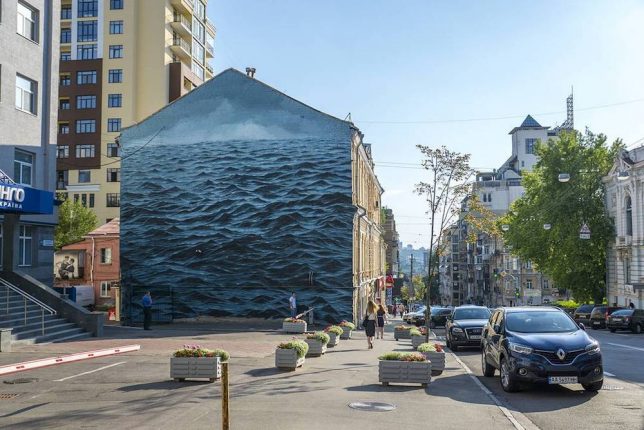
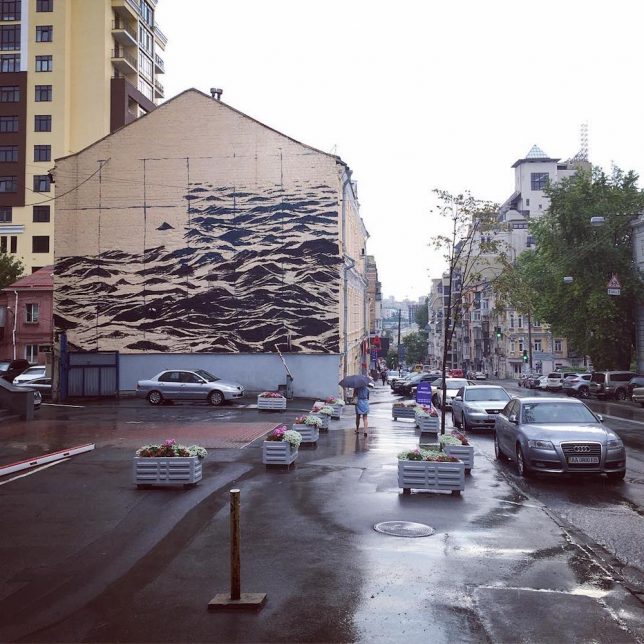
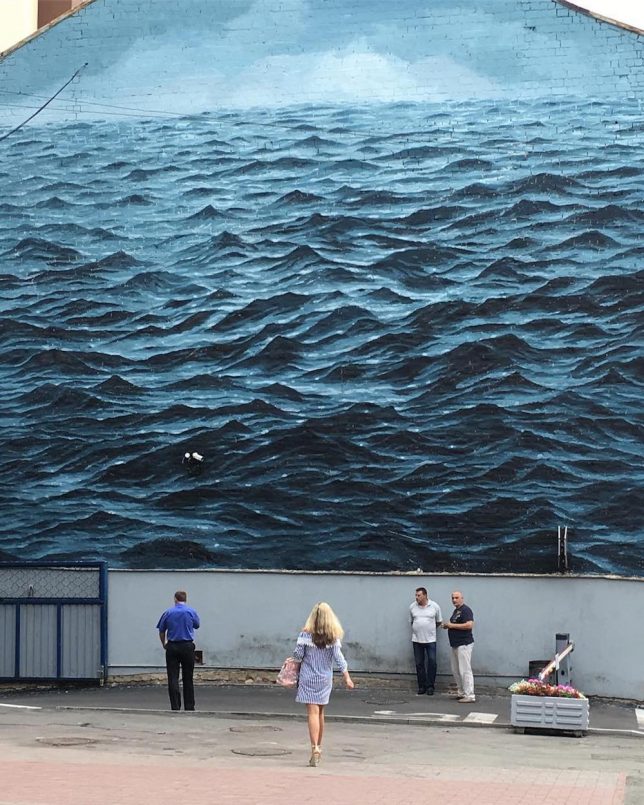
Lapping up the side of a three-story building in Kiev, Ukraine, this dark mural mixes blue and gray hues to capture dark waters and skies of the Black Sea.

Originally from London and based in Cape Town, South Africa, artist Jake Aikman enjoys working on extreme and dramatic landscapes, from dark blue oceans to dark green forests and distant lonely mountains.

The focus in most of his pieces is not so much the scene but the setting — especially at larger scales and absent figures, as in this piece, they create a tone or mood rather than telling a particular story. In short: they leave a lot to the imagination, like a blank canvass providing a time and place but no characters.

This particular piece is one of his largest to date and was produced for Art United Us. Spanning the entire side of a structure, it was completed in just over a week.

Share on Facebook


[ By WebUrbanist in Art & Street Art & Graffiti. ]

[ WebUrbanist | Archives | Galleries | Privacy | TOS ]


WebUrbanist

 
Comments Off on Sea Wall: Dark Multi-Story Mural Shows Stormy Waters on City Streets

Posted in Creativity


Lens Rentals test shows all circular polarizing filters work great, price doesn’t matter

20 Sep
Photo: Roger Cicala/Lens Rentals

Our friend Roger Cicala over at Lens Rentals is at it again: buying up super expensive optical testing equipment because someone asked him why LR carries the circular polarizing filters they do. The answer, until now, was simple: make the expensive one on the market their high-end rental, and the cheapest one their “basic.” But is there really any difference?

That’s what Roger set out to figure out, and the answer might save you a little bit of cash.

You can read the full post and see all of the detailed results on the Lens Rentals blog, but the most surprising and positive conclusion was this:

All circular polarizers, regardless of price, are 99.9% effective at polarizing light.

Translation: if you’re looking for a circular polarizer because … well … you want to polarize light then save your money because the cheaper ones work just as well as the more expensive ones.

In addition to their ability to do what they say they do, Cicala and LR team tested CP filters for overall transmission (how much light to they let through) and transmission by wavelength so you can see what effect each filter has on the colors your camera sees. Check out the results here.

Articles: Digital Photography Review (dpreview.com)

 
Comments Off on Lens Rentals test shows all circular polarizing filters work great, price doesn’t matter

Posted in Uncategorized


This eclipse photo shows the crazy dynamic range of today’s image sensors

23 Aug
Nikon D750 without any filters at 1/8s, F11, and ISO 100. Photo by Dan Plucinski

We talk about dynamic range (or lack thereof) a lot here at DPReview. But with all of the granular comparisons between the newest models, it’s easy to forget how incredible many of today’s image sensors have gotten in this regard. So here’s a quick example from photographer Dan Plucinski, who captured this photo in Oregon during the total solar eclipse on Monday.

The photograph on the right is a single image, not a composite. Plucinski simply took the shot on the left and pulled the shadows up in post; what you see on the right is the same image, with all of the shadow detail recovered.

The lesson is pretty straight-forward: always shoot Raw.


Photo by Dan Plucinski and used with permission.

Articles: Digital Photography Review (dpreview.com)

 
Comments Off on This eclipse photo shows the crazy dynamic range of today’s image sensors

Posted in Uncategorized


Apple patent shows camera system that helps you take better selfies

19 Jul

A newly granted Apple patent details a new type of camera system that aims to produce higher-quality selfies. The patent, first filed with the US Patent and Trademark Office in 2015, describes using a wider field-of-view with the iPhone’s front-facing camera when taking selfies in landscape mode. The wider FOV wouldn’t be fixed, however, with the camera reverting to a narrower FOV when a selfie is taken in portrait mode.

These field-of-view effects are designed to improve selfies when taken both in groups of people and alone. In the case of groups, the patent explains that turning the phone sideways would expand the camera’s field-of-view to cover a wider angle, ensuring everyone in the group is featured in the selfie. A self-only selfie taken in portrait mode, though, would feature a more traditional aspect ratio such as 4:3 and a narrower FOV.

The camera system in this patent would also be able to intelligently prod the user to take better selfies by selectively narrowing the FOV in portrait mode, requiring the user to extend their arm further away. The system could also adjust the previewed image in such a way that the user will need to change the camera’s angle, the end result being an overall better selfie with a more natural look, reduced distortion, and other improvements.

Explaining that latter point, the patent says the camera system may ‘crop/scale/zoom/shift the image window to coax the user to hold the camera device in a more optimal ‘self-taking’ position.’ As with any patent, it is possible Apple will never implement this technology into a consumer product, but it’s good to know so much technical thought is being put into… selfies.

Articles: Digital Photography Review (dpreview.com)

 
Comments Off on Apple patent shows camera system that helps you take better selfies

Posted in Uncategorized