RSS
 

Posts Tagged ‘Shows’

Google shows off Pixel imaging capabilities in demo video

19 Oct

Nat and Lo is a YouTube Channel that started out as a ‘20% project’ within Google and has an objective to ‘demystify the technology in our everyday lives.’ Now the makers of the channel have published a video that was almost entirely shot with Google’s recently announced Pixel high-end smartphone.

The Pixel comes with a A 6-element lens with F2.0 aperture, a 1/2.3″ 12.3MP sensor with 1.55µm sized pixels, on-sensor phase detection with laser-assist and a gyroscope-based electronic video-stabilization system. The demo video shows off all of those capabilities and features, mixing 4K output of the front camera with 1080p Full HD footage from the front camera and some slow-motion sequences. A comparison shot shows the efficiency of the new video stabilization system and viewers can enjoy some nice still images and panorama shots of New York City. 

The video doesn’t really show anything that we would not have seen before on various other mobile devices but gives a good overview of the Pixel’s imaging capabilities. To judge for yourself watch the video at the top of this page and don’t forget to flick on the 4K switch on YouTube.

Articles: Digital Photography Review (dpreview.com)

 
Comments Off on Google shows off Pixel imaging capabilities in demo video

Posted in Uncategorized


Voigtlander shows off three new lenses including 65mm F2 Macro for E-mount

06 Oct

$ (document).ready(function() { SampleGalleryV2({“containerId”:”embeddedSampleGallery_9965740614″,”galleryId”:”9965740614″,”isEmbeddedWidget”:true,”standalone”:false,”selectedImageIndex”:0,”startInCommentsView”:false,”isMobile”:false}) });

Lens manufacturer Voigtlander is set to introduce three unusual lenses this autumn and has posted pictures and specifications on its website, but isn’t letting on when they will arrive.

The most interesting, visually at least, is a VM 50mm F3.5 Heliar designed for M-mount bodies. It uses an almost symmetrical configuration of five elements in three groups and forms a conical shape reminiscent of the Tessar 50mm lenses of the Carl Zeiss Jena Werra cameras. The lens will have a minimum aperture of F22 and will use a 10-bladed iris that promises nice circular out-of-focus highlights. Remarkably, the aperture ring will be without click stops.

A more popular lens will be the 65mm F2 Macro Apo-Lanthar for the Sony E-mount system. This will have a closest focusing distance of 0.31m and will be able to transmit EXIF data to the camera as well as trigger manual focus assistance such as automatic magnification and peaking. It will have 10 elements in 8 groups and will offer apertures down to F22. The company has yet to decide whether the aperture ring will feature click stops, but again the iris will use 10 blades.

The third lens on display is a SL ll – S 58mm F1.4 Nokton designed for Nikon AI-S bodies. This new version of the company’s existing SL ll – N lens appears to be optically unchanged but it offers a more retro barrel design that echoes Nikon’s own manual focus lenses, and it has the addition of a meter coupling prong that will allow it to be used with much older bodies.

The company has not given any information on pricing or delivery dates, but you can read more specification on the Voigtlander website.

Articles: Digital Photography Review (dpreview.com)

 
Comments Off on Voigtlander shows off three new lenses including 65mm F2 Macro for E-mount

Posted in Uncategorized


Blackmagic Design shows off Video Assist monitor/recorders

23 Sep

We dropped in on indie/pro video camera and grading software maker, Blackmagic Design and were impressed by their Video Assist monitor/recorders.

Alongside demos of various cameras (which now range from Micro Four Thirds mount drone-ready cameras up to the PL-mount, 4.6K global shutter Super 35 URSA) and the latest version of its DaVinci Resolve grading software, Blackmagic Design has a display of its Video Assist models.

The Video Assist and Video Assist 4K are external monitors (HD and 4K respectively) that can be mounted on DSLR and mirrorless cameras to boost their video features and make them easier to work with.

The touchscreen panels are connected via HDMI or SDI connectors (with the option to then output the signal over either connection) and add zebra warnings and focus peaking, regardless of whether that feature is offered by the host camera. With the recently-announced firmware, they also add false color overlays for an alternative means of judging expose.

The units also act as external recorders, meaning you can capture your camera’s HDMI output to SD cards (UHS-II in the case of the 4K model) in more sophisticated codecs than most cameras can, including Apple ProRes 422 HQ or LT, or Avid DNxHD and DNxHR.

At a cost of €549/$ 495 and €979/$ 895 respectively, we think they make an interesting option for the videographer looking to expand beyond their camera’s immediate limitations. We’re hoping to get hold of a sample to see the results, as soon as we can.

Articles: Digital Photography Review (dpreview.com)

 
Comments Off on Blackmagic Design shows off Video Assist monitor/recorders

Posted in Uncategorized


HumanEyes Technologies shows off Vuze VR 360 degree 3D camera

21 Sep

At HumanEyes Technologies’ Photokina booth we had the chance to look at some of the first production models of the Vuze VR 3D 360 degree cam, first announced at the Cannes Festival in May. The camera uses 8 Full-HD cameras with wide-angle lenses that are arranged in pairs on the corners of the device to record 360 degree video in 3D. Of course you can also record standard 2D footage at a 4K output resolution and 30 frames per second. Each lens covers a 120 degree angle of view horizontally and 180 degree vertically.

A standard tripod mount allows for easy mounting to any camera support, including the combined tripod/grip that comes in the package. The camera is operated via a single button on the device and settings can be changed via the Vuze App on any smartphone. The app also allows for management of footage that has already been saved on the microSD card and for a preview of the final video. 

Stitching and editing of recorded footage is done in the Vuze Studio software on a PC or Mac and final results can be viewed on the included VR headset that is compatible with most smartphones. The Vuze will be available soon for $ 799.

Articles: Digital Photography Review (dpreview.com)

 
Comments Off on HumanEyes Technologies shows off Vuze VR 360 degree 3D camera

Posted in Uncategorized


This vibrant hyper-lapse shows off New York in 8K

26 Aug

One of the great innovations of digital photography is time-lapse photography. By now we’ve all seen enough time-lapse sequences that they may not be as novel as they once were, but every now and then an artist comes along with one that still makes us go ‘Wow!’

Such is the case with Vimeo user Jansoli, who recently published a video called “8K Colors of NewYork 2016.” It’s a beautiful short that captures the beating pulse of New York City, built around technicolor imagery, and which should prove inspirational and aspirational to time-lapse and hyper-lapse photographers everywhere.

Have a favorite time-lapse or hyper-lapse sequence you’ve shot? Share it in the comments below!

Articles: Digital Photography Review (dpreview.com)

 
Comments Off on This vibrant hyper-lapse shows off New York in 8K

Posted in Uncategorized


First impressions review: Lenovo Moto Z Force shows promise

26 Jul

The Moto Z Force is Lenovo’s brand new, top-of-the-line smartphone. Currently exclusive to the Verizon network in the US as the Moto Z Force Droid Edition, we expect an international launch of the device in the near future. 

The device packs a 21MP image sensor with a 1.12 µm pixel size, an F1.8 aperture, on-sensor phase detection, laser-assisted AF and an optical image stabilization system into its camera module. The camera app offers full manual control and the Moto Z Force can save DNG Raw files with third party apps, such as Manual Camera.

The metal and glass body is just under 7mm thin and comes with a shatterproof 5.5″ Quad-HD AMOLED display and a beefy 3,500 mAh battery. The Android 6.0.1 Marshmallow OS is powered by a Qualcomm Snapdragon 820 chipset and 4GB of RAM. Mobile photographers will also appreciate the microSD-slot for easy storage expansion. 

In addition, Moto Z Force users can select from several Moto Mods accessory modules which connect to the back of the device magnetically and via 16 connection points. So far there are the InstaShare projector, a JBL Soundboost 6 Watt speaker and a 2220 mAh battery pack. The Moto team has promised more Moto Mods for the future and according to rumors, one of them could be a camera grip. For now we’ll have to make do without the latter, but that hasn’t stopped us from shooting with the brand new Moto device. Read on for our first impressions. 


Image Quality

In bright light conditions the Moto’s 21MP sensor resolves a good deal of detail. Under close inspection some smearing of fine detail and textures is noticeable, but on the other hand luminance noise is very well controlled. During our brief testing, exposure was reliable but in very bright scenes, such as the one below, the image processing’s strong contrast can results in some clipped highlights. That said, overall the Moto Z Force does well in these conditions.

 ISO 50, 1/760 sec

Color tends to be quite saturated, but neutral and without any notable casts. This includes bright red tones which many smartphone cameras struggle with, especially under strong illumination.

 ISO 50, 1/452 sec

At higher ISOs the camera finds a good compromise between noise reduction and detail retention. The ISO 320 shot below was captured in a fairly well-lit interior space and shows very good edge detail. 

 ISO 320, 1/33 sec

The ISO 500 shot below shows some more luminance noise in the mid-tone areas of the frame but the noise pattern has a fairly fine grain and is not too intrusive. Chroma noise is well under control and the image still shows a very good amount of fine textures and detail.

 ISO 500, 1/25 sec

The Moto Z Force maintains good exposure and color down to very low light levels. The challenging lighting conditions in the shot below lead to some channel clipping in the illuminated stage area, but overall the scene is captured very nicely. The slow shutter speed of 1/10sec results in some blur on moving subjects but the optical image stabilization does a very good job at counteracting camera shake. 

 ISO 1250, 1/10 sec

Special modes

The Moto Z Force comes with Motorola’s usual HDR mode which does an efficient job of protecting the highlights in high-contrast scenes, such as the one below. Using the standard auto exposure mode, some clipping occurs on the light colored elements in the frame. Using HDR mode, image clipping is noticeably reduced. Shadows are lifted very slightly but overall the image still looks pleasantly natural.

 ISO 50, 1/1468 sec, standard exposure
 HDR exposure

Night mode is not a new feature for Moto devices but the latest incarnation works in a slightly different way than before. In low light scenes the camera automatically triggers multi-frame capture which produces clean images but struggles with moving subjects, which often show pronounced motion blur. On the new device, night mode now saves a standard exposure in addition to the night mode image, allowing the user to pick the version which best suits their purposes.

The sample images below both report ISO 1000 and a shutter speed of 1/10sec in the EXIF data. However, as you can see at close-up view they look very different. The multi-frame night mode image on the left is cleaner but shows motion blur, even on slow-moving subjects. The accompanying standard exposure shows better edge definition on moving subjects but noticeably higher levels of luminance noise. 

Night mode Standard exposure
100% crop 100% crop

In video mode the Moto Z Force is capable of recording both 1080p Full HD and 4K footage. The combination of digital and optical stabilization keeps things steady and allows for smooth panning. The 1080p video below shows similar tonal characteristics to the still images and decent detail but very occasionally we found the lens refocusing for no obvious reason.

The 4K video mode offers noticeably better detail for those who need it. It also allows users to grab 8MP video stills for those occasions when the full 21MP still resolution is not needed.

First impressions 

With its solid build, large high-resolution screen and metal frame the Moto Z Force looks and feels like a premium device. The Snapdragon 820 chipset under the hood ensures the performance of the Android operating system matches the device’s high-end exterior and the 3,500 mAh battery lets you shoot, edit and share images for a long time away from a power outlet.

The camera module’s 21MP captures a good level of detail and offers plenty of scope for cropping. There are the usual signs of smearing of fine textures at base ISO, but in low light the camera finds a good balance between noise reduction and detail retention. In addition, night mode lets you pick between a clean multi-frame image that works best for static scenes, and a standard exposure that shows more noise but is capable of freezing at least some motion. 

Colors are mostly quite saturated and contrast is strong which can lead to some highlight-clipping in high-contrast scenes. However, HDR mode does a very efficient job of protecting highlight detail, and in addition the Moto Z Force allows for the capture of DNG Raw files with third party camera apps, such as Manual Camera. This allows you to apply your very own mix of contrast, saturation, noise reduction and other image parameters in post processing. Add the camera app’s full manual control into the mix, plus the potential of a camera-grip add-on module in the nearer future, and the Moto Z Force is one of the year’s most interesting mobile photography products thus far.

Articles: Digital Photography Review (dpreview.com)

 
Comments Off on First impressions review: Lenovo Moto Z Force shows promise

Posted in Uncategorized


Slow motion video shows glass shattering at 343,000 fps

21 Jul

YouTube channel ‘The Slow Mo Guys’ has posted a new video showcasing its fastest frame rate content to date: 343,915 fps, to be precise. The duo behind the channel, Dan and Gav, used a Phantom v2511 camera to record glass Pyrex dishes shattering with speeds starting at 28,546fps. At its fastest frame rate, the camera captured the glass shattering at a rate 13,756 times slower than real time.

At the fastest frame rate, the Phantom camera recorded for a duration of 5.1 seconds and during that time captured 19.5 hours’ worth of video footage. 

If you’re having trouble sleeping, you can check out the full 19+ hour slow-motion shatter video here. 

Via: Bokeh

Articles: Digital Photography Review (dpreview.com)

 
Comments Off on Slow motion video shows glass shattering at 343,000 fps

Posted in Uncategorized


Tag, You’re It! Banksy Shows Softer Side, Makes Mural for Kids

16 Jul

[ By WebUrbanist in Art & Street Art & Graffiti. ]

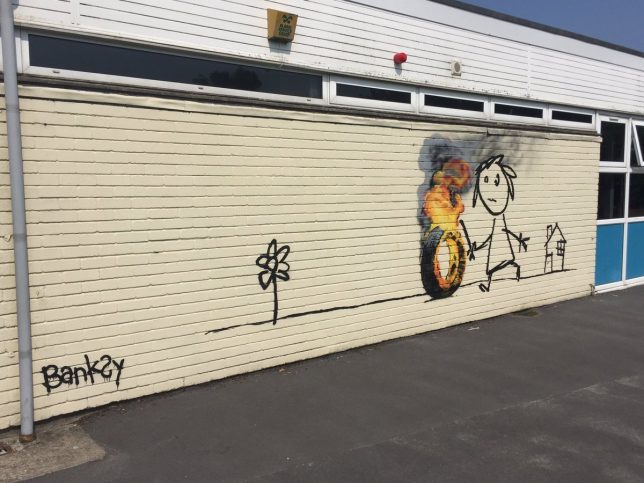
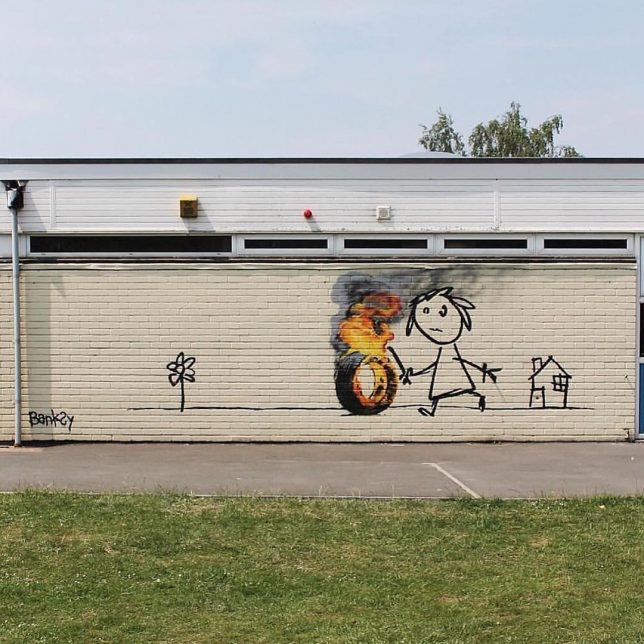
banksy stick figure art

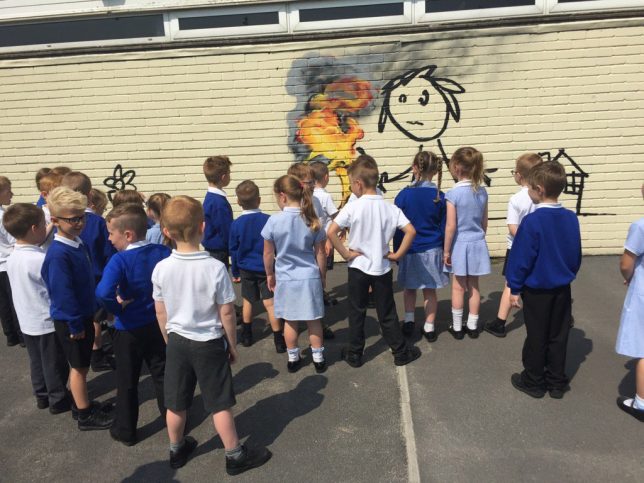
Best known for biting political commentary and poignant artistic critiques, mysterious artist Banksy showed a somewhat friendlier side of his personality in gifting a mural to elementary students who named a building after him.

banksy in bristol

Students at the Bridge Farm Primary School in Bristol, thought to be the anonymous street artist’s hometown, renamed several campus structures in a contest. Among the winners were Blackbeard, Cabot and Banksy.

banksy rolling tire

The work itself features a child playing with a hoop, but because it’s Banksy … the hoop was turned into a tire, and the tire was set on fire. Banksy stopping by to make a mural was surprise, but he also left a note, which is even more out of character (though the work has been confirmed authentic):

banksy hand written note

“Dear Bridge Farm School,” the letter reads. “Thanks for your letter and naming a house after me. Please have a picture, and if you don’t like it, feel free to add stuff. I’m sure the teachers won’t mind. Remember, it’s always easier to get forgiveness than permission. Much love, Banksy.”

banksy school mural stick

In a somewhat ironic twist, the school is forbidding children from painting over or around the mural, perhaps out of respect or because if its doubtless high monetary value – either way, one can be sure Banksy would approve should one of those students break the rules (images by Jon Kay via Colossal).

Share on Facebook


[ By WebUrbanist in Art & Street Art & Graffiti. ]

[ WebUrbanist | Archives | Galleries | Privacy | TOS ]


WebUrbanist

 
Comments Off on Tag, You’re It! Banksy Shows Softer Side, Makes Mural for Kids

Posted in Creativity


No alias: Pentax K-1 Pixel Shift shows impressive early results

06 May

It’s been a long wait for the arrival of our Pentax K-1, but it finally is here. We wasted no time taking Ricoh’s new flagship DSLR to our studio to see how the long-awaited full frame 36MP sensor stacks up to the competition. Huge thanks to LensRentals for renting us the lens for these tests.

$ (document).ready(function() { ImageComparisonWidget({“containerId”:”reviewImageComparisonWidget-21512957″,”widgetId”:354,”initialStateId”:2458}) })

Pixel Shift

It’s worth calling out in particular one of the major highlights of the K-1: its Pixel Shift Resolution mode that debuted in the APS-C format K-3 II last spring. We’re only showing you this mode at ISO 100 for the time being, but we’ll be updating our widget with higher ISOs once ACR support is updated.

The K-1’s Pixel Shift Resolution mode takes four consecutive shots and moves the sensor by a single pixel each time. This means that each of the original pixel positions gets sampled by a red, a blue and two green pixels. This has a few major benefits. First, it removes the need to demosaic: you don’t have to interpolate data from the surrounding area to build up color information, which leads to less color aliasing. It also brings a modest increase in resolution because you’re sampling luminance (green) information at every pixel position and not effectively blurring it by borrowing it from surrounding pixels. The increased resolution can easily be seen by looking at the color resolution targets, or looking at the text in the center of the studio scene, which shows no aliasing and can be read down to the very last line.

Another benefit to Pixel Shift is better noise performance: because you’re taking four shots, the camera essentially captures four times as much light, which decreases relative shot noise contributions. The decreased noise levels lead to better high ISO performance, and increased dynamic range.

There’s yet another benefit to Pixel Shift: the camera locks up the mechanical shutter and mirror, and uses a fully electronic shutter instead. This removes any risk of vibrations that might be caused by the mechanical shutter. For example, there’s a very tiny amount of blur in single shot mode at 1/40 sec, although it’s near-imperceptible without a direct comparison to a sharper, Pixel Shift image.

Articles: Digital Photography Review (dpreview.com)

 
Comments Off on No alias: Pentax K-1 Pixel Shift shows impressive early results

Posted in Uncategorized


CP+ 2016: Nikon shows off new D5, D500 and DL compacts

29 Feb

CP+ 2016: Nikon shows off new D5, D500 and DL compacts

Attendance is up at this year’s CP+ show in Yokohama Japan, and that’s partly thanks to new products from some of the biggest camera manufacturers, including Nikon. We’re at the show, where large crowds are gathering around Nikon’s booth to get their hands on the new DL-series compacts, and two new DSLRs, the D5 and D500. 

CP+ 2016: Nikon shows off new D5, D500 and DL compacts

Here’s the new D5, Nikon’s new flagship FX format DSLR. Built around a new 20.8MP full-frame CMOS sensor, Nikon claims the D5 to offer leading high ISO performance due to color filter array tweaks that allow the sensor to capture more light than before. The D5 also features a newly-developed EXPEED 5 image processor. This powerful processor is necessary to provide continuous shooting at 14fps and 4K video capture.

CP+ 2016: Nikon shows off new D5, D500 and DL compacts

The D5 features a new autofocus system with 153 AF points, 99 of which are cross-type. All points focus down to -3EV. Only 55 points are user-selectable, but that’s OK: in AF-C, Nikon’s trustworthy 3D tracking system will automatically select the right point for you as it tracks your initially selected subject. And it’s more reliable than you might think.

Here’s why: the camera’s metering sensor has doubled in resolution compared to the 91k-pixel sensor in the D4s, to 180k. The increased resolution makes a big difference in the camera’s ability to identify and follow a subject you initiate focus on. It even means that face detection now prioritizes eyes during viewfinder shooting (you’ll literally see the camera automatically select an AF point over a person’s eye in Auto Area mode), and continues to follow them no matter where they move to within the frame – even at 12 fps. 

Frankly, we’ve never quite seen anything like it.

CP+ 2016: Nikon shows off new D5, D500 and DL compacts

CompactFlash media has been around a long time, and slowly, other formats are emerging which may ultimately replace it. Canon’s new Canon EOS-1D X Mark II features twin card slots for CF and CFast, but Nikon has chosen a different route (and different media) offering two versions of the D5, one with support for twin CF cards (shown here) and one with dual XQD cards. XQD is capable of greater data throughput but for now, the cards are pricey, and lack the familiarity (and ubiquity) of CF cards and card readers.  

CP+ 2016: Nikon shows off new D5, D500 and DL compacts

Nikon’s circular screw-in eyecups have been a feature of its professional SLRs for decades, but the D5 features a distinctly Canon-like removable eyepiece, which can be replaced with various forthcoming viewfinder accessories – details are currently a bit vague. One thing that we did learn, however, is that once it has been removed, this eyepiece is very difficult indeed to get back on

CP+ 2016: Nikon shows off new D5, D500 and DL compacts

Ethernet, USB 3.0, HDMI and a microphone jack are just some of the D5’s many I/O ports. Few will be routinely used by the average enthusiast, but this is a camera built for the many and various needs of professional photographers in various fields. 

CP+ 2016: Nikon shows off new D5, D500 and DL compacts

As such, the D5 is built like a very nicely sculpted brick. Fully weather-sealed and manufactured to the highest standard that Nikon can manage, the D5 is designed to withstand heavy professional use for many years.  

CP+ 2016: Nikon shows off new D5, D500 and DL compacts

Next up is perhaps the most keenly-awaited camera (at least among our readers) of recent years. The D500 is Nikon’s long-awaited replacement for the venerable D300S. We thought the day would never come, but here it is. At 20MP, the D500 offers lower resolution than the D7200, but an altogether higher quality of build and a deeper feature and performance set. It’s also the first DX camera to offer button illumination.

CP+ 2016: Nikon shows off new D5, D500 and DL compacts

Key to this feature set is autofocus. The D500 uses the same AF system as the D5, but because its sensor is smaller, the AF array covers more of the frame. Almost all of it, horizontally. This – plus the 1.5X crop factor of the APS-C format sensor, makes it very attractive for sports and wildlife photography. And a maximum frame-rate of 10 fps doesn’t hurt.

CP+ 2016: Nikon shows off new D5, D500 and DL compacts

Although not quite as bulletproof-feeling as the D5, the D500 is without doubt a ‘pro’ camera and one that we suspect will find its way into many professional photographers’ hands. It’s a great second camera to a D4 or D5, but also makes an attractive ‘long lens’ body for anyone shooting a full-frame Nikon system.

Like the D5, the D500’s autofocus system seems to be spookily capable of tracking subjects around the frame (‘3D tracking’), even in our limited use of the camera up to this point. It can even do so effectively at its maximum 10 fps frame rate, no doubt aided by the faster processor and the same high-resolution 180k-pixel RGB metering sensor that’s in the D5. We’re hoping to be able to shoot with a final shipping sample in the next few weeks. 

CP+ 2016: Nikon shows off new D5, D500 and DL compacts

The D5 and D500 both replace previous cameras, but the DL range is all-new. Nikon released three DL-series compacts at CP+, the DL24-85, DL18-50 and DL24-500. All three are built around 20MP 1″-type CMOS sensors (probably the same sensor used in the 1 J5), and the model names denote the equivalent lens ranges of the cameras. 

CP+ 2016: Nikon shows off new D5, D500 and DL compacts

The reason behind this, Nikon explained to us, is that the company wants people to buy the cameras as if they were shopping for lenses. So someone who needs an 18-50mm lens might reach for the DL18-50, while someone looking for ultimate flexibility might reach for the DL24-500.

CP+ 2016: Nikon shows off new D5, D500 and DL compacts

The DL-series is aimed specifically at DLSR users who want a smaller second (and third, and maybe forth) camera. The question of where this leaves the slightly stagnant-looking 1 system remains open. We asked Nikon but didn’t get a definitive response. Clearly, executives are keeping future product strategy on the DL…

Articles: Digital Photography Review (dpreview.com)

 
Comments Off on CP+ 2016: Nikon shows off new D5, D500 and DL compacts

Posted in Uncategorized