RSS
 

Posts Tagged ‘shots’

Heavy hitter: Sony FE 24-70mm F2.8 GM first shots

06 Feb

$ (document).ready(function() { SampleGalleryV2({“containerId”:”embeddedSampleGallery_9303055313″,”galleryId”:”9303055313″,”isEmbeddedWidget”:true,”selectedImageIndex”:0,”startInCommentsView”:false,”isMobile”:false}) });

Note: if you’re viewing on mobile, please click here.

Sony has made some strong claims about its new G Master lens series. Unveiled earlier this week, the FE 24-70mm F2.8 GM is one of three in the lineup to make its debut, giving Sony’s full-frame mirrorless customers a fast, constant standard zoom for the first time. We had a few moments to shoot with the lens at Sony’s press event in New York, and while we only provide a small sampling of shots at this time, we will be updating this gallery as soon as we can. 

Our initial impressions are extremely positive: sharpness appears to rival prime levels wide open, and there’s very little axial chromatic aberration to speak of. Sony’s claims may not be exaggerated at all.

We need to make a note about lens corrections: it seems that the camera we were handed had vignetting and chromatic aberration corrections turned on. The way this feature works is that these corrections are applied even in Raw mode (technically, vignetting correction is applied prior to writing the Raw file, while chromatic aberration correction information is embedded in the Raw and irreversibly applied by ACR).

The good news is that we’ve looked at Raw conversions from third-party converters that ignore the CA correction profile, and CA from this lens appears to be very minimal. Watch this space for more sample images, hopefully very soon.

Articles: Digital Photography Review (dpreview.com)

 
Comments Off on Heavy hitter: Sony FE 24-70mm F2.8 GM first shots

Posted in Uncategorized


5 Tips for Striking Getting Ready Shots of Brides

06 Nov

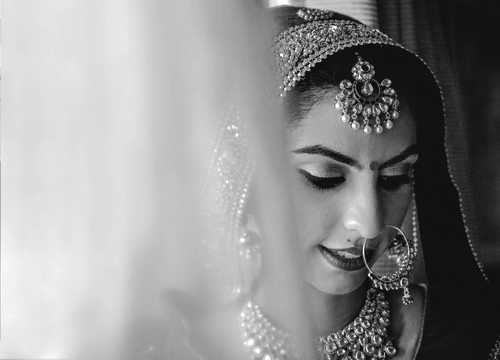
The Bride in her wedding dress, shy and tense, beautiful and alluring. She provides quite a conundrum for a wedding photographer. How does one work towards capturing the emotions that often rush over the bride as she prepares for holy matrimony?

DPS2

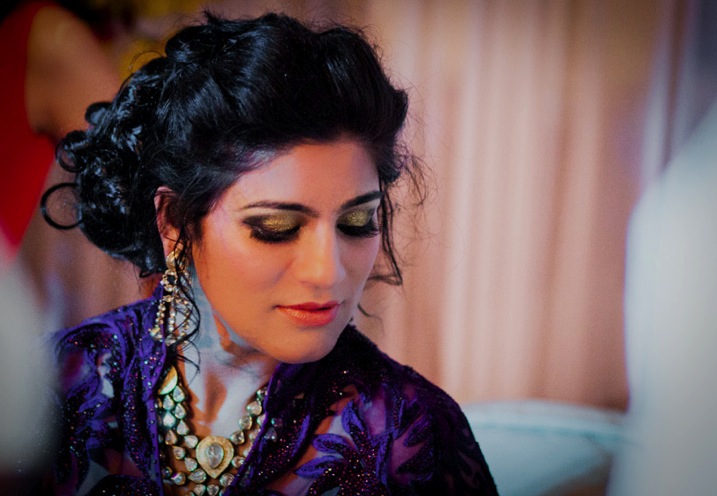
Over the years that I’ve shot weddings in India, I’ve come to appreciate the Bridal getting ready session. This is the calm before the storm when the bride will look her best, and it is the least interrupted time the photographer has with the bride. Below are a few tips and tricks I’ve honed that help me capture my brides at their best in some pre-wedding getting ready photos:

1. Work with the most important person in the room.

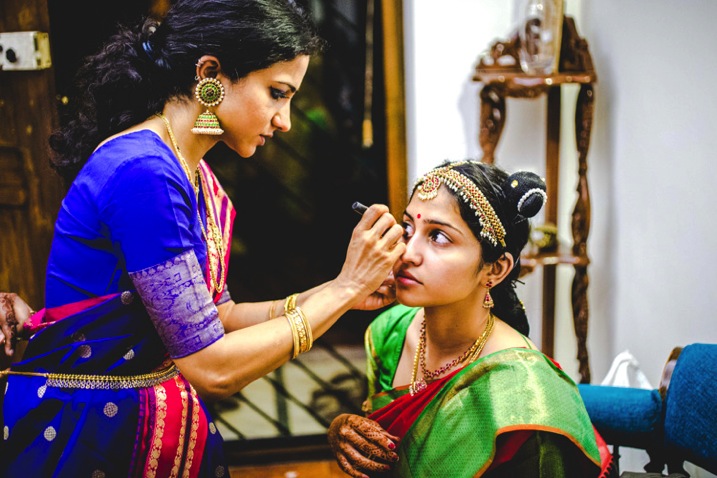
The bride typically gets ready in a room in the presence of the make-up artist and supportive sister(s) and friend(s). In this group, the most important person is the make-up artist. Work with him or her to understand their work flow. Is she left handed or right handed? What is the order in which she does her stuff? Does she schedule her breaks??
All this information is critical for you to capture the best angles, and moments, in the getting ready process. You don’t want to interrupt another wedding professional when she is in her zone. Respect her and together you can make the bride look her best and capture the process.

DPS1

2.The Three Perspective Rule

Every wedding photographer has been taught to capture the subject from multiple perspectives. While I agree with this, I believe there are three specific perspectives that are critical for capturing the bride getting ready. They are:

The Top Down

These shots provide a god view of the process and often help focus the viewer’s eye on a specific aspect of the process. Below is a top-down of the eye liner getting done. A lot of clutter in the room (weddings are messy !) can be worked around and simple moments like the addition of lipstick or the adjustment of a dress can be shown with a certain dramatic flourish.

DPS3

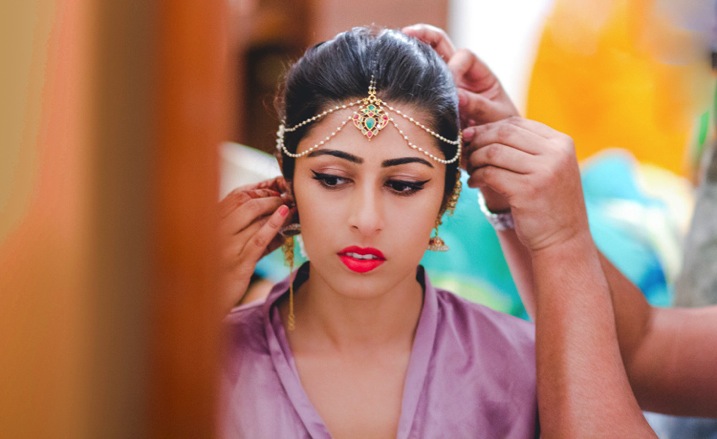
The Bride’s View

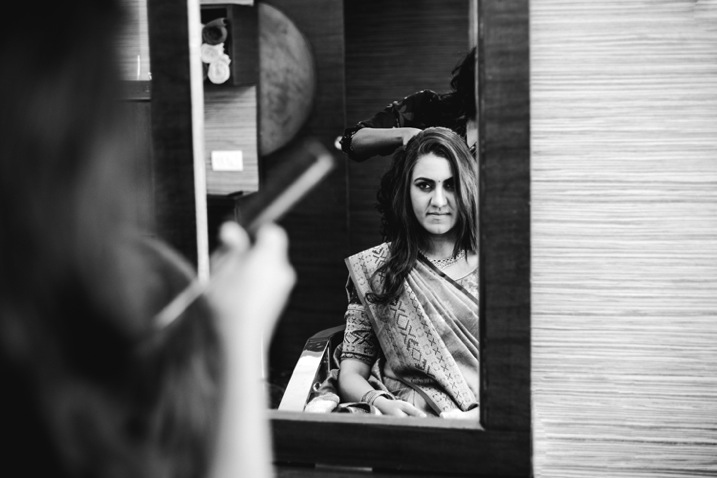
Do not forget that the most important person after the make-up artist is the bride. It’s important to capture this session from her perspective too. Get down to her level if she is sitting. Imagine what she is going through. Follow her eyes to see what is capturing her precious attention. Make use of a mirror to capture her in a moment of self-reflection. Below is a picture of bride when she is just looking at herself while her friends are helping her with her earrings.

DPS4

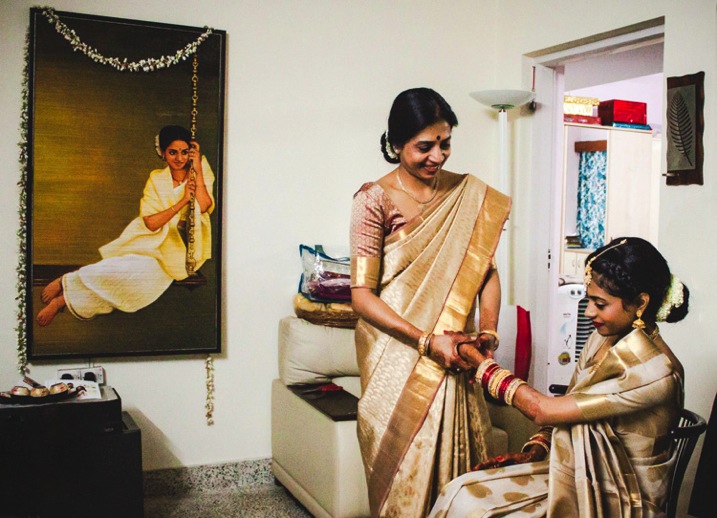
The Fly on the Wall

Remember that clutter I mentioned? That is part of weddings. They are like the handwritings of the bride and her sisters. Try going to the corner of the room with a wide angle lens and capture the confusion and chaos in all its glory. Get on a chair and view the room from above and try to spot what is adding color and personality to the room. Maybe it’s the jewellery spread carelessly on the bed. It could be the mother happily putting bangles on the bride’s arm, or maybe the groom trying to look through the window (it’s happened!).

DPS5

3. Expect the Unexpected

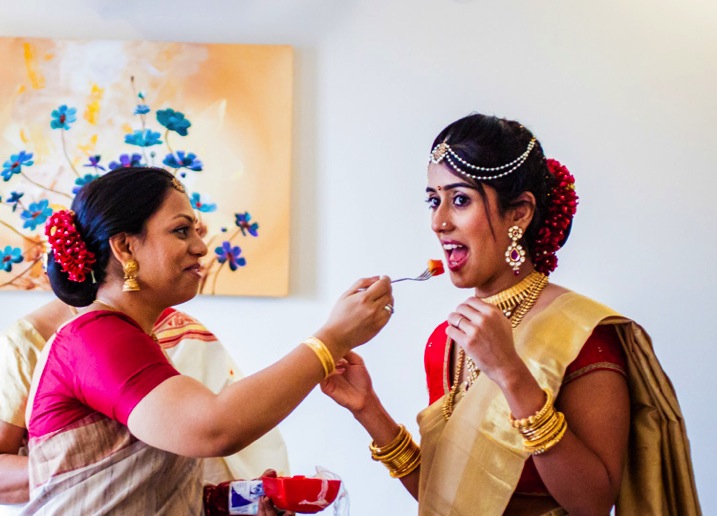
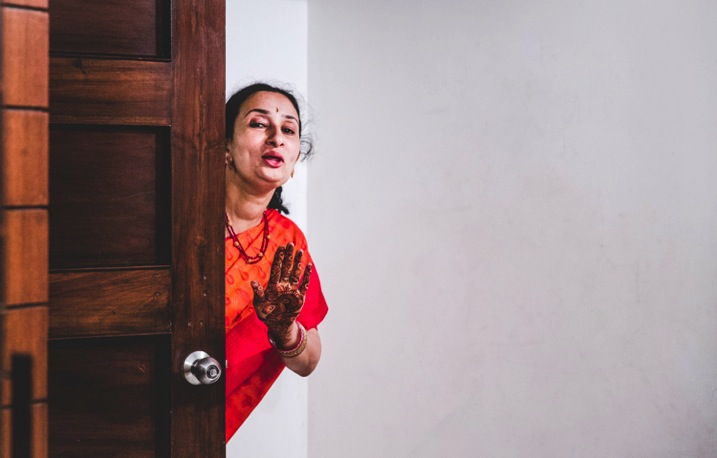
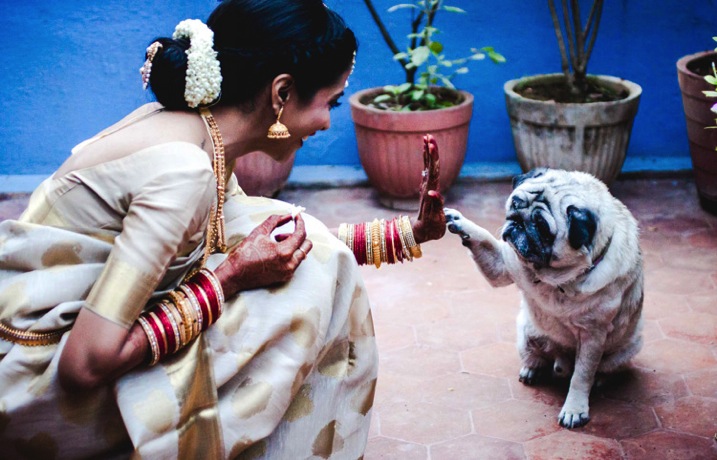
Wedding photographers should approach the weddings with the attitude of a journalist looking for a scoop. Still, during the getting ready time, it’s easy to let your guard down as everything seems pre-planned, and in motion. Some of my most candid pictures have been taken in moments of delightful serendipity. Below are pictures from different weddings.

DPS6

A sister-in-law feeding the bride minutes before she stepped out

DPS7

The bride’s aunt reminding her that she has just five minutes to go

DPS6b

And then sometimes the pet just walks in to say the final goodbye!

4. The Trousseau and Trinkets

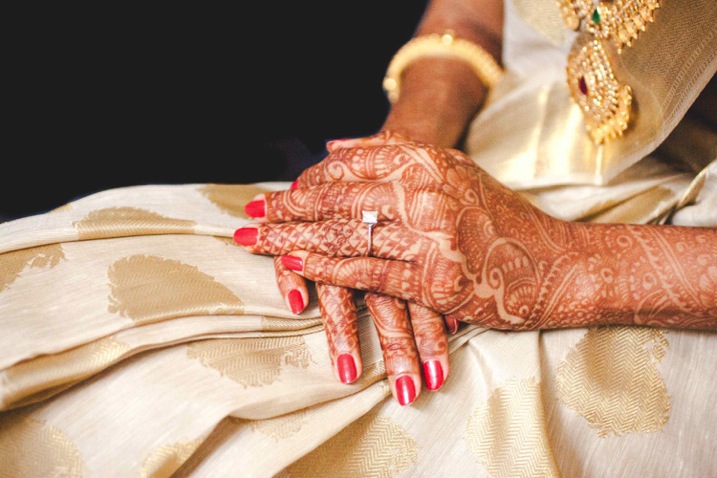
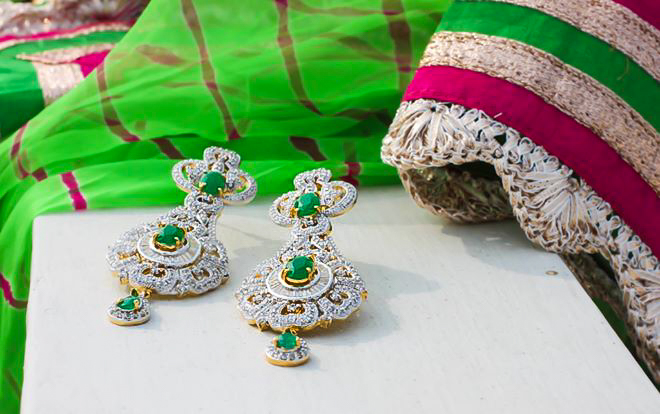
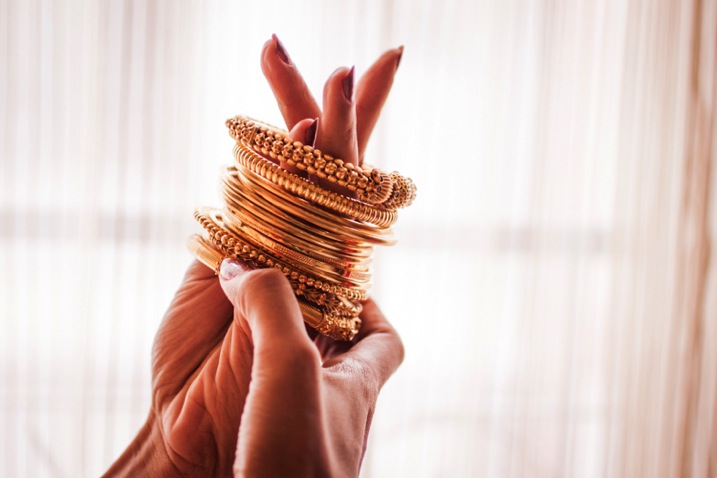
There are brides that wear a simple white silver bracelet, and others that wear elaborate gold chains, adorned with peacock and mango motifs, that were made nearly a century ago for their grandmother’s wedding. The Wedding Trousseau and the accompanying trinkets say a lot about the personal choice of the bride and her traditions. It is important to capture them with respect, and a certain sensitivity, as these hold meaning for a family more that what we as a person viewing in from outside can appreciate.

These items could simply be the Wedding Trousseau itself, which the bride, her sister, and friends would have spent weeks agonizing over, and probably spent many woman-hours putting together.

DPS8b

DPS8 DPS9


DPS9b

5. Lights, Camera, Action!

Light – what else is there for a photographer to contemplate? The challenge doing portraiture for a bride getting ready is that the event sometimes occurs in a small compact bedroom, studio, or dressing room at the temple, church, or hotel where the wedding is taking place.

It’s important to understand what the sources of lights in the room are, and perfectly professional to ask the make-up artist and bride to reorient themselves, or the way they face to make the pictures look better.

Be prepared to use white curtains to bounce of light from your flash or shoot from outside the room through a window to get light right!

DPS10 DPS11

I hope you find these tips helpful, whether you are doing wedding photography as a professional, or at a friend or relative’s wedding. Please share your own tips and comments below, as well as your images.

googletag.cmd.push(function() {
tablet_slots.push( googletag.defineSlot( “/1005424/_dPSv4_tab-all-article-bottom_(300×250)”, [300, 250], “pb-ad-78623” ).addService( googletag.pubads() ) ); } );

googletag.cmd.push(function() {
mobile_slots.push( googletag.defineSlot( “/1005424/_dPSv4_mob-all-article-bottom_(300×250)”, [300, 250], “pb-ad-78158” ).addService( googletag.pubads() ) ); } );

The post 5 Tips for Striking Getting Ready Shots of Brides by Manvi Gandotra appeared first on Digital Photography School.


Digital Photography School

 
Comments Off on 5 Tips for Striking Getting Ready Shots of Brides

Posted in Photography


How to Take Creative Landscape Shots using Intentional Camera Movement

19 Aug

Many photographic situations rely on keeping your camera as still as possible during exposure for pin-sharp images. You may have practiced hard to develop a steady hand and you’ve probably used tripods, remote shutter releases or image stabilisation to reduce the risk of camera shake. But, is keeping your camera still always a good thing? Every now and again, why not throw caution to the wind, move your camera while the shutter is open, and explore the range of creative opportunities this offers you as a photographer.
Bluebellwoodsblur750

What is Intentional Camera Movement and why use it?

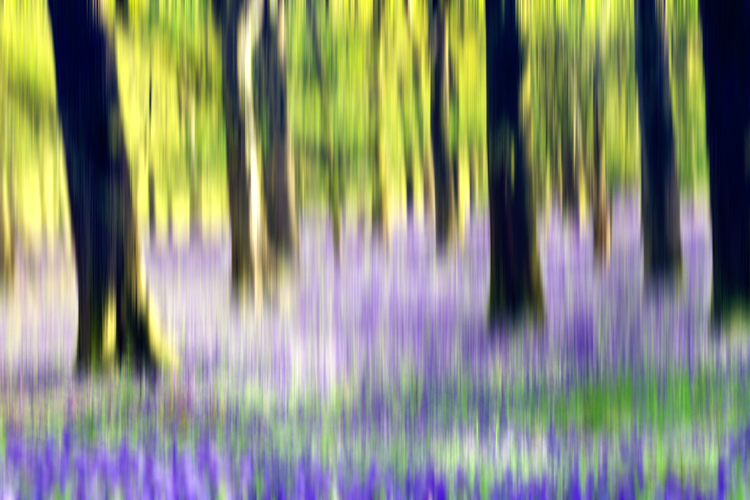
Intentional Camera Movement (or ICM for short) is a photographic technique where the camera is moved as the image is being taken. One example is panning. The camera movement mimics that of a moving subject to keep the subject sharp and the background blurred. However, moving your camera during exposure can open up a lot more creative options for you to try out. In particular, ICM can be used to take some truly unique landscape shots. The technique can be exceptionally liberating and, by reducing the amount of sharp details in a landscape, it allows you to concentrate on lines, form and colour in your images. A scene that you may ordinarily consider too cluttered, might just come to life through ICM by letting you blend colours and shapes for an interesting abstract shot.

One of the reasons that I have grown to love ICM is that it enables you to capture a landscape in a unique and personal way that cannot easily be reproduced. It can even breathe new life into overly familiar landscapes, letting you see and capture something new about a location you may have photographed many times before. If you are struggling to find inspiration for your next photographic project, or you want to get your creative juices flowing, this is a technique that you should try at least once. It is relatively easy to take some striking shots, you are sure to end up with a unique set of landscapes and it can also be a lot of fun.
ICMburtonbshorejul15750

Slow Shutter Speeds

A key factor to get right when using ICM is the shutter speed. It needs to be long enough to capture significant motion blur; anything from 1/3 or 1/2 second exposure times, up to multi-second exposures. Because of these slow shutter speeds, shooting in low-light conditions is ideal for ICM. During the daytime, it may be harder to achieve the required shutter speeds even at the lowest ISO setting and the smallest aperture (highest f-stop number). You may need to use a polarizing filter, a neutral density (ND) filter, or a combination of both. Personally, I prefer to use a polarizing filter as a starting point as this helps to boost colours and cut down on reflections and glare. I will then add a 2-stop or a 4-stop ND filter if the shutter speed needs to be slowed down any further.

When starting out with ICM, it may help to shoot in Shutter Priority mode. Set the shutter speed to around half a second to start, and turn the ISO to the lowest available setting on your camera. Once you have practiced at this shutter speed, you can then get longer exposure times by using a combination of low-light and/or filters. Focus manually and turn off the autofocus to prevent the camera searching for focus during exposure. Also, if you are using a lens that has image stabilization, remember to turn it off.

RockpoolsportlandICM750

Moving the Camera

Once you have taken control of the shutter speed, how you move the camera is totally up to you. Get creative, there are no rules. You could move the camera vertically, horizontally, or diagonally – fast or slow. Alternatively, you could rotate the camera 360 degrees during exposure to create a spiral effect, or change the focal distance on a zoom lens during exposure to create a zoom effect. With practice, you can combine two or more of these movements to create something truly unique. The look and feel of your final images will be determined by the speed, direction, and smoothness of your chosen movements. If you wish, you can use a tripod to control the camera movement. This will help you to capture a smoother movement, which can be useful if you wish to retain a straight horizon line. I prefer to work hand-held when moving the camera, as it offers greater flexibility and provides more opportunities to experiment with different movements.

Bold movements can sometimes be more effective as there is a risk that too subtle a movement may end up looking like camera shake in the final image. Waving your camera around may not come that naturally, and it may result in you getting some funny looks from amused onlookers, but the end results definitely can make it worthwhile.

ICMwarehamtreesunset750

What to Shoot

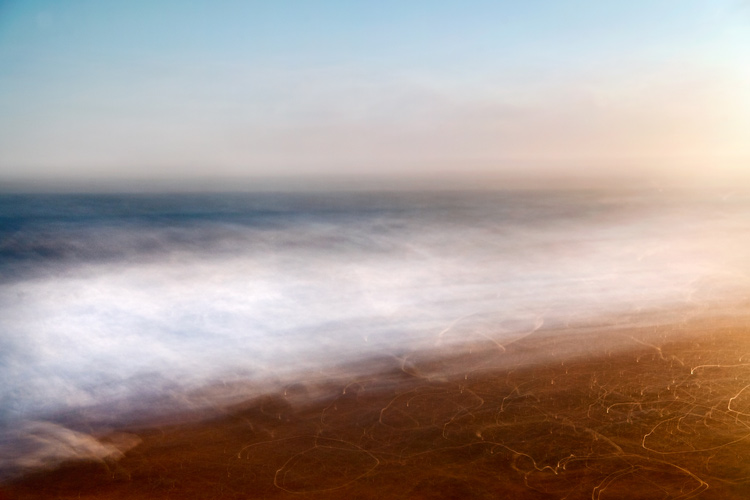
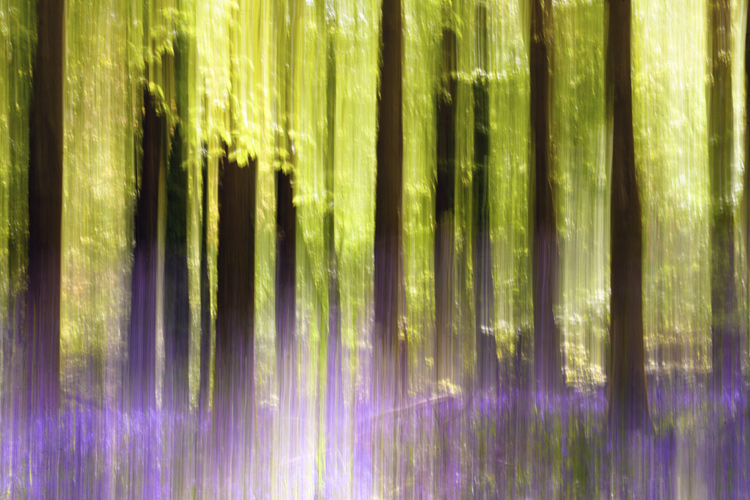
A good place to begin using ICM in your landscape shots is to look for locations that offer striking colours, lines, or patterns. Woodland is a favourite ICM subject of mine, particularly during the spring and autumn seasons. Clean, parallel lines provided by the trees and vibrant colours of nature (provided by bluebells in the spring and fallen leaves in the autumn) lend themselves to a vertical camera movement. This can be from the top-down, or from the bottom-up and can be a quick or slow movement. It really just depends on the effect you wish to capture, and how experimental you want to be. Seascapes can be a good starting point for side-to-side camera movement, panning the camera in line with the horizon.

Alternatively, in rougher waters, you could try to match the movement of your camera to the movement of the waves for an altogether different effect. Shooting at sunrise or sunset could provide you with a greater variety of colours to work with, and shooting city lights after dark can also offer a wide range of creative options.

Once you have found a suitable location, you will probably find yourself taking multiple shots with various different movements. (I should warn you that this technique can sometimes be quite addictive, and you may find your memory cards filling up quite quickly!) You may find it useful to set your camera to shoot in Continuous Shooting Mode so that you can take a series of shots in quick succession, while moving the camera in a particular direction.
Bluebellaction750

Final Tips

As with any type of photography, images created using this technique are not going to be to everybody’s taste. It is highly subjective and what works for you will not work for others. Just keep in mind basic principles of photography such as composition and exposure – these are still just as important. Also, while this technique will render much of the landscape abstract, you may find it helps to have at least one element of the landscape sharp, or recognizable in the final image.

There is an element of trial-and-error when starting out with Intentional Camera Movement. You should soon find out what works for you and what doesn’t; this will help you to develop your own style. Don’t be too concerned if you do not get an effect you like right away – the technique can be quite hit-and-miss sometimes. Take a lot of shots, and don’t be too quick to delete shots that you feel haven’t quite worked out as you had hoped. There is a chance that, after a few days, you may take another look and see something that you like in there after all.

One of the great things about this technique is that it is all about how you express yourself through photography – think of your camera as your paintbrush. Get creative, have fun, and start seeing landscapes in an exciting new way.
RiverweedsICMblandford750

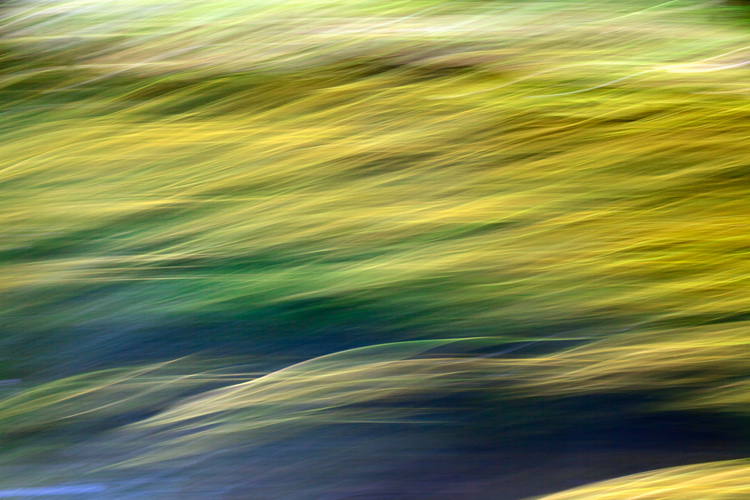
I have included several of my attempts at ICM landscape shots. Please feel free to share your own in the comments section.

googletag.cmd.push(function() {
tablet_slots.push( googletag.defineSlot( “/1005424/_dPSv4_tab-all-article-bottom_(300×250)”, [300, 250], “pb-ad-78623” ).addService( googletag.pubads() ) ); } );

googletag.cmd.push(function() {
mobile_slots.push( googletag.defineSlot( “/1005424/_dPSv4_mob-all-article-bottom_(300×250)”, [300, 250], “pb-ad-78158” ).addService( googletag.pubads() ) ); } );

The post How to Take Creative Landscape Shots using Intentional Camera Movement by Richard Beech appeared first on Digital Photography School.


Digital Photography School
 
Comments Off on How to Take Creative Landscape Shots using Intentional Camera Movement

Posted in Photography


Hot Shots: Sony Cyber-shot DSC-RX10 II real-world samples

04 Aug

Sony’s Cyber-shot RX10 II looks a lot like its predecessor, with a similar form factor and the same 24-200mm equivalent F2.8 lens. However, it adds some interesting new technology in the form of a 20MP stacked CMOS sensor, enabling 4K video, 14 fps burst shooting and slow-motion video recording. We recently got our hands on a full-production model – take a look at some initial real-world samples. See gallery

Articles: Digital Photography Review (dpreview.com)

 
Comments Off on Hot Shots: Sony Cyber-shot DSC-RX10 II real-world samples

Posted in Uncategorized


A Little Sleight of Hand for Surreal Shots

21 Jul

The Great Outdoors definitely lives up to its name, but sometimes the summer heat is just too much. Staying in doesn’t have to be a total wash though, there’s loads of creative photos you can take in the Cool Indoors!

We’re totally digging these 10 tricks for setting up surreal snaps at home. Create mini worlds with a little papercraft, fool gravity with glue or create some intruige with smoke. Most of these fun setups require supplies you likely have already. So you’ll feel resourceful and productive on your day in.

Also check out some of our own ideas for indoor fun. Now you have all the excuses you need to keep out of the heat!

Stay cool, yo.

Photo by Dina Belenko


© Erin for Photojojo, 2015. |
Permalink |
No comment |
Add to
del.icio.us

Post tags:


Photojojo

 
Comments Off on A Little Sleight of Hand for Surreal Shots

Posted in Equipment


My Latest Interview: Finding Your Own Vision vs Hunting Trophy Shots

18 Jun

_N2A1604-Pano

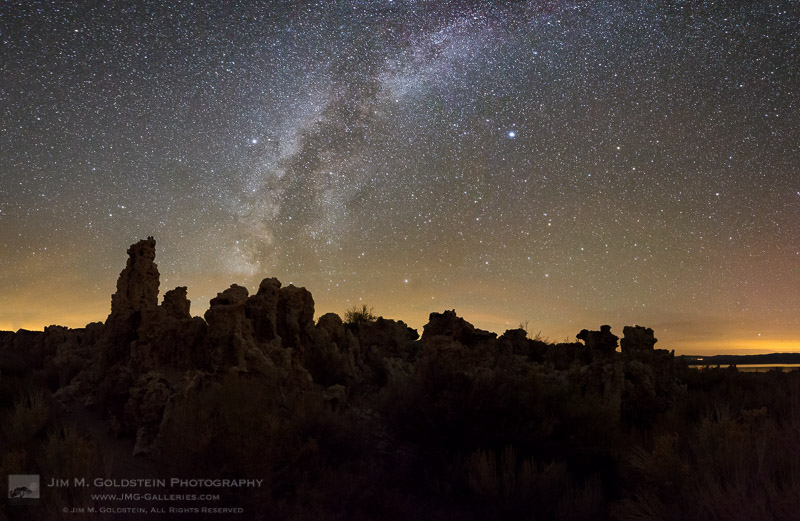
My latest interview with Rick Sammon on the DPExperience podcast talking about landscape trophy shots & finding your own vision is now online. If you’re looking for some ideas on how to improve your photography I recommend listening. My discussion starts around the 41 minute mark. Enjoy and feel free to ask me any additional questions in the comments of this post. Have great day!

Copyright Jim M. Goldstein, All Rights Reserved

My Latest Interview: Finding Your Own Vision vs Hunting Trophy Shots

The post My Latest Interview: Finding Your Own Vision vs Hunting Trophy Shots appeared first on JMG-Galleries – Landscape, Nature & Travel Photography.


Related Stories

  • Snowy Sunrise at Gates of the Valley
  • Remembering Rebecca Jackrel: Wildlife Photographer and Friend – Enclosure
  • Remembering Rebecca Jackrel: Wildlife Photographer and Friend
Feed Ads by FeedBlitz
powered by ad choices


JMG-Galleries

 
Comments Off on My Latest Interview: Finding Your Own Vision vs Hunting Trophy Shots

Posted in Equipment


Danny MacAskill leaps from Skye to eclipse other action shots

21 Mar

The weather spoiled today’s solar eclipse for many would-be watchers in the UK but it was visible in some parts of the country. Dutch photographer Rutger Pauw teamed up with trials biking genius Danny MacAskill to get a rather different shot. Using a long telephoto lens and shooting from over 300m away, Pauw had to communicate with MacAskill by radio to time the shot precisely, a process complicated by only having enough battery power to fire their super-powerful strobe once. Read more

Articles: Digital Photography Review (dpreview.com)

 
Comments Off on Danny MacAskill leaps from Skye to eclipse other action shots

Posted in Uncategorized


2014 DPReview Readers’ Best Shots: People

26 Jan

Picking favorites is hard. Nevertheless, our readers were up to the task when we asked them to submit their best shots of 2014. We received over 1400 submissions, and it was no small job picking favorites. We didn’t need the reminder, but it underscored just how talented our readership is. Photos were divided into three categories and we settled on a small selection to feature in each.

Articles: Digital Photography Review (dpreview.com)

 
Comments Off on 2014 DPReview Readers’ Best Shots: People

Posted in Uncategorized


2014 DPReview Readers’ Best Shots: Places

26 Jan

Picking favorites is hard. Nevertheless, our readers were up to the task when we asked them to submit their best shots of 2014. We received over 1400 submissions, and it was no small job picking favorites. We didn’t need the reminder, but it underscored just how talented our readership is. Photos were divided into three categories and we settled on a small selection to feature in each.

Articles: Digital Photography Review (dpreview.com)

 
Comments Off on 2014 DPReview Readers’ Best Shots: Places

Posted in Uncategorized


2014 DPReview Readers’ Best Shots: Things

26 Jan

Picking favorites is hard. Nevertheless, our readers were up to the task when we asked them to submit their best shots of 2014. We received over 1400 submissions, and it was no small job picking favorites. We didn’t need the reminder, but it underscored just how talented our readership is. Photos were divided into three categories and we settled on a small selection to feature in each.

Articles: Digital Photography Review (dpreview.com)

 
Comments Off on 2014 DPReview Readers’ Best Shots: Things

Posted in Uncategorized