Red has unveiled its latest camera body and announced its next-generation 8K sensor. The Weapon body will be produced in magnesium alloy or carbon fiber and is available as an upgrade for users with the 6K ‘Dragon’ sensor. Anyone making the upgrade to the Carbon Fiber version will then be able to pay extra to get the forthcoming 8K sensor. Read more
Tag: sensor
-
Canon C300 Mark II announced with new 8.85MP 35mm sensor and 4K recording
Canon has announced the EOS C300 Mark II Cinema EOS camera, updating its predecessor with a new 8.85 megapixel 35mm sensor allowing 4K shooting. Also new are Dual DIGIC DV5 processors bringing the ability to record 10-bit 4:2:2 4K (UHD or DCI) video internally thanks using the new XF-AVC Codec. Read more
-
Nikon 1 J5 offers 20.8MP BSI sensor and revamped look
The Nikon 1 J5 has been announced as the latest member of Nikon’s mirrorless lineup. It offers a more traditional shape and feel with a contoured grip and a command dial. Its 1″-type 20.8MP BSI-CMOS sensor offers a boost in resolution over its predecessor, and is capable of 4K video capture at 15 fps. Read more
-
Sony branches off audio and video business but remains committed to sensor development
Sony has announced that it will be branching off its audio and video departments into a separate subsidiary. Sony previously spun off its VAIO PC business one year ago, and the creation of new departments aims to make the company into a profitable entity. Read more
-
CP+ 2015: Canon shows off prototype 120MP CMOS sensor
We’re at CP+ in Yokohama, Japan, where Canon is showing off a prototype ultra high-resolution 120MP CMOS sensor. Canon is claiming it has a pixel count equivalent to the number of photoreceptors in a human eye. Its surface area is halfway between APS-C and full-frame, and it appears to be mostly directed at video applications, capable of recording at approximately 60x the resolution of Full HD. Click through to have a look
-
Samsung introduces NX500 with NX1’s 28MP BSI sensor
Samsung has announced the NX500, which borrows many features from the NX1 starting with a 28MP APS-C-size BSI-CMOS sensor. It too provides 4K and UHD video recording, a sophisticated hybrid NX AF system III, tilting Super AMOLED display, and (naturally) built-in Wi-Fi. Read more
-
Leica M9 users report sensor corrosion issue
A growing number of Leica users are reporting white spots appearing on images taken with M9, M9-P, M Monochrom and M-E cameras. The common element in all of these models is their 18MP full frame Kodak CCD sensor which is protected by a piece of Schott S8612 glass. Read more
-
Rumored Olympus OM-D E-M5 successor may offer resolution-boosting ‘sensor shift’
Rumors are circulating about a possible successor to the Olympus OM-D E-M5. According to rumor site 4/3rumors.com, the camera is likely to be called the Olympus E-M5II or the Olympus E-M5 Mark II and is said to feature a 16MP sensor but with a sensor shift function allowing users to boost resolution up to an equivalent 40MP. Read more (albeit not all that much more)
-
Sony debuts 21MP stacked CMOS sensor for smartphones
Sony has unveiled a new stacked CMOS image sensor for use in smartphones. Called the IMX230, it features 21 effective megapixels, on-chip phase detection AF and 4K video recording. The chip is a 1/2.4-inch type with square pixels measuring 1.12um x 1.12um each. Video of up to 4K (4096 x 2160) resolution is available with HDR function (also available in stills mode). Read more
-
Writer’s Favorite Lens the Nifty Fifty on a Cropped Sensor Camera
 Growing up, the first letter of my last name was towards the end of the alphabet, which meant that I was one of the last kids who got to choose my electives in high school. It was for this reason that I ended up with strange electives such as Physics, Advanced Placement Composition, Metal Shop, and eventually Black and White Photography. I was less than thrilled about taking Photography – I had SATs to take, colleges to get in to, and certainly did not have time for a photography class taught by the Psychology teacher who was notorious for making kids walking around campus with their hands in the shape of a rectangle, “visualizing” the shot. Despite my best efforts, somewhere between the enlarger and placing my paper in the developer for the first time, I fell in love.
I clung to black and white film photography for a number of years, until husband bought me my first DSLR – a Canon Rebel XS. One of the very first things I noticed was that something was wrong. Even when shooting with some of my favorite focal lengths, something looked off. After consulting Dr. Google, I quickly realized that the difference was that I learned photography in 35mm film format, and that the cropped sensor of the Canon XS made my lenses function in a different way than I was used to. There are plenty of articles that go into great depth explaining the hows and whys of cropped sensors, but what you need to know is that if you own an entry-level DLSR, you probably have one. If you do have a cropped sensor camera, you also need to know that a 50mm lens on a cropped sensor camera doesn’t actually act like a 50mm lens. Rather, APS-C (cropped sensor) cameras have a magnification factor of either 1.6x (Canon) or 1.5x (Sony & Nikon). So, you need to multiply the length of the lens on your camera by the magnification factor above in order to see what focal length that particular lens will function as on your camera. For example, if you put a 50mm lens on a cropped sensor camera, you have to multiply by 1.6x which means that your 50mm lens is actually functioning more like an 80mm lens.

This is important because when you see reviews of lenses, or even when professional photographers talk about lenses, chances are that the images that they include will be taken with a full frame camera, which does not have a cropped sensor. In other words, even if you buy exactly the same lens, your photos will probably not look similar if you are using a cropped sensor camera. Now, please hear me when I say that this doesn’t mean that your camera is “bad” or that you need to upgrade your gear – you are capable of taking some absolutely amazing photos with a cropped sensor camera and a nifty fifty lens. There is a TON of potential there at a fairly low price point, which is why the 50mm f/1.8 lens is the first upgrade that a lot of new photographers make, and rightfully so! Today, I’d like to showcase a few of my favorite uses of a 50mm lens on a cropped sensor camera. In fact, every photo in this article was taken with a Canon 50mm f/1.8 lens and either a Canon XS or Canon 60D, which are both cropped sensor cameras.
Newborn Photography

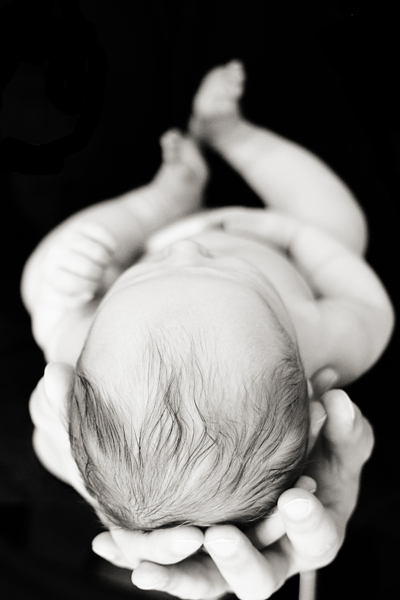
When I’m photographing newborns, I’d say that the 50mm lens is on my camera 90% of the time. I like to go to the new parents rather than have them come to me whenever possible because I tend to find that mom and baby relax a bit faster in their own space, and I like to include a lot of “lifestyle” images in the session as well. However, doing so comes at a trade-off, which is that I don’t have as much control over the light in their home as I would in my space. Yes, I can move furniture if necessary or even shoot in the kitchen if that’s where the best natural light is, but it’s also nice to have a lens that can accommodate lower-light situations if needed, and the 50mm certainly can do just that when I shoot wide open or close to it. I find that the sweet spot in terms of aperture with this lens is around f/2.5, which is typically sufficient, but I like the fact that I can go down even further if I want to bring the focus to little feet, hair, or newborn features.
Nature Photography

While I have experimented with landscape photography using my 50mm lens, I prefer a wide angle lens (somewhere around 35mm) for that purpose. That said, while the 50mm may not be your best option for capturing waterfalls or beautiful mountain ranges, the 50mm lens shines in capturing the smaller details of nature – think flowers, vegetables, fruit, leaves, snow covered branches, and buds on trees.

Portraits
Of course, one of the most common uses for the 50mm lens is for standard portraits. I use my 50mm lens most often for portraits of one or two people, but have pulled it out quite frequently for groups of about three to six people as well (any more than six, and I prefer a wider angle lens). When I first purchased the 50mm lens, I was so excited about the ability to create a blurred background in portraits that I almost always shot wide open, with the aperture at f/1.8. It was so exciting to be able to achieve that bokeh!
However, I also created a lot more work for myself and ended up with a lot fewer photos that nailed focus because the depth of field was so shallow, and any small movement of a kid could throw the focus out of whack . Now, I tend to set the aperture around f/2.5 when I’m shooting portraits, which still gives plenty of blur in the background but also makes my life a little easier. This is especially true when it comes to photographing toddlers and young kiddos that are often moving even when they’re “sitting still”. The bottom line? Don’t fall into the trap of shooting wide open all the time just because you can!

Unexpected Surprises
When I’m out and about, I often toss my camera with the 50mm lens in my purse or in the car. As I’ve mentioned, it’s my favorite lens, and the one that gets the most use, so it’s a generally safe bet. That said, there have been a handful of occasions in which my 50mm lens may not have been my first choice if I had other options with me, but it performed better than expected nonetheless.
One such instance was when we ended up at a ski resort on the day of their high school snowboarding competition. I grabbed my camera just for fun, and was surprised at how well the 50mm lens handled a shot that I’d typically prefer a wider angle for. So, don’t be afraid to experiment with a 50mm lens even beyond the standard portrait applications, there’s a whole lot of potential there!

Your Thoughts?
Do you own a 50mm lens? What do you find yourself using it for most often? Do you have a cropped sensor or full frame camera?
The post Writer’s Favorite Lens the Nifty Fifty on a Cropped Sensor Camera by Meredith Clark appeared first on Digital Photography School.