RSS
 

Posts Tagged ‘Rolling’

Tenba updates Roadie line of rolling cases

10 Jun

The cases come with a water-repellent exterior of 1680-denier ballistic nylon, YKK RC-Fuse zippers and aircraft-grade aluminum luggage handles. A rain cover provides additional protection in wet weather and the wheels are user-replaceable.

The new Roadie Roller 18, 21, Hybrid 21 and Air Case 21 all comply with most international and U.S. domestic carry-on regulations, while the Roadie Roller 24 is suitable for non-airline use only but can carry cameras and lenses along with flash and lighting systems. 70-200mm 2.8 lenses will fit standing vertically to maximize interior storage. More information is available on the Tenba website.

Press Release:

Tenba Roadies are sleek, discrete cases for uncompromising photographers and filmmakers that include some key “industry first” features like a removable camera insert, an exterior pocket for a portable battery, and an Air Case model with a rigid shell that can be safely shipped or checked at the airport. Roadies were designed with a high-end luggage aesthetic to ensure they look professional yet don’t draw unwanted attention to the gear inside.

Tethered Case Lid
Interior straps keep the lid upright when opened so it works as a mobile workstation, and they help the Roadie maintain a small footprint in tight environments.

Drop-In Tripod Carrier
This is Tenba’s quickest and simplest tripod carrier ever. Virtually any size tripod can be stored in just a few seconds. Also holds light stands when Roadie is being used for lighting gear.

Extra Bag Strap
A quick and hands-free way to attach a second bag to the Roadie, just like pilots and flight attendants do.

Leather Trimmed Handles
Padded top and side handles make the Roadie comfortable to carry even when fully loaded, and waterproof full-grain leather trim improves the grip.

Integrated TSA-Approved Security
The Roadie includes an integrated lock for the zipper on the camera compartment, plus an additional security cable and padlock to secure the case on location. Both locks are TSA approved.

Professional Features
Roadies are built to deliver on Tenba’s promise for durability, with a water-repellent exterior of 1680-denier ballistic nylon, YKK® RC-Fuse zippers and aircraft-grade aluminum luggage handles. For additional protection in wet weather, each bag includes a WeatherWrap rain cover. The user-replaceable wheels combine shock absorbing TPU with high carbon steel bearings so they are sure to roll smoothly and quietly over any surface.

The Roadie Roller 18, 21, Hybrid 21 and Air Case 21 all comply with most international and U.S. domestic carry-on regulations, while the Roadie Roller 24 is suitable for non-airline use. Roadies are available now at Tenba authorized resellers.

Introducing Roadie Air Case Roller 21, Roadie Roller 24, Roadie Hybrid Roller 21, and a Few Industry First Features

Introducing Our Checkable, Shippable, Uncrushable Carry-on Rolling Case
One model in the Roadie Collection, the Roadie Air Case Roller 21, utilizes Tenba’s patented layered wall construction to provide the protection of a hard-shell case at a fraction of the weight. It can withstand more than 400 pounds stacked on top, so it will ensure equipment protection when the case needs to be checked unexpectedly, like when airline overhead space has filled up, or when flying on a small regional jet.

Introducing the Roadie Roller 24
Due to its larger-than-carry-on dimensions, the Roadie Roller 24 can efficiently carry large systems in a single case. Cameras and lenses can be stored along with flash and lighting systems, and 70-200mm 2.8 lenses will fit standing vertically to maximize interior storage.

Introducing the Roadie Hybrid Roller 21
A comfortable backpack harness enables the Roadie Hybrid Roller 21 to be carried when terrain is not especially “wheel friendly,” such as on stairs or over sand or dirt.

Quick Access Battery Pocket
Available in all models except Roadie Hybrid Roller 21 and Roadie Air Case 21
The rear zippered pocket can hold a battery for charging mobile phones and other portable devices. Twin zippers allow cables to be easily threaded out of the pocket.

Removable Padded Camera Insert
Included with all Roadie Roller models except Roadie 18
The removable insert allows a camera and 2-3 lenses to be carried independently inside a smaller shoulder bag. The insert can be paired with Tenba’s Packlite 10 travel bag to create a portable camera bag solution, allowing the user to leave the rolling case behind and just carry a core camera kit.

Articles: Digital Photography Review (dpreview.com)

 
Comments Off on Tenba updates Roadie line of rolling cases

Posted in Uncategorized


Electronic shutter, rolling shutter and flash: what you need to know

22 May
The rolling shutter effect is usually seen as a damaging defect but even this can be used creatively, with enough imagination.
Photo by Jim Kasson, Fujifilm GFX 50S

Click! goes the camera and in that fraction of a second the shutter races to end the exposure. But, although it’s quick, that process isn’t instantaneous. Whether you’re syncing a flash, wondering why banding is appearing in your image or deciding whether to use your camera’s silent shutter mode, the way your shutter works has a role to play. This article looks at the different types of shutter and what effect they have.

At their most basic, cameras capture light that represents a fragment of time, so it shouldn’t be surprising that the mechanism that defines this period of time can play a role in the final outcome. It’s not nearly as significant as the exposure duration (usually known as shutter speed or time value), or the size of the aperture but, despite great effort and ingenuity being expended on minimizing it, the shutter behavior has an effect.

Mechanical Shutters

There are two main mechanical shutter technologies: focal plane curtain shutters and leaf shutters. The majority of large sensor cameras and nearly all ILCs use focal plane shutters while the majority of compacts use leaf shutters.

Focal plain shutters

Focal plan curtain shutters are what you probably think of when you think about shutters. At the start of the exposure a series of horizontal blades rises like a Venetian blind and, to end the exposure, a second series of blades rises up to cover the sensor again.

The first curtain lifts to start the exposure, then a second curtain ends the exposure. The shutter’s movement is shown as the blue lines on the graph. The time taken to open and close the curtains (red) is defined by the shutter rate, the exposure time is shown in green. 

These blades move quickly but not instantly. We’ll call the amount of time it takes the shutter to move across the sensor the shutter rate. This is not the same thing as shutter speed, which is the amount of time that elapses between the bottom of the first curtain lifting and the top of the second curtain passing that same point.

Leaf shutters

Leaf shutters work slightly differently. These are built into the lens, right next to the aperture, and usually feature a series of blades that open out from the center, then snap shut again to end the exposure. Because each blade doesn’t have to travel so far, these shutter rate can be much faster.

Leaf shutter still take a small amount time to open and close but they’re very fast. And, because they’re mounted so close to the aperture, they progressively increase or decrease illumination to the whole sensor, so there’s no difference between the slice of time seen by the top and bottom of the sensor.

However, since the same blades that start the exposure also end it, the maximum possible shutter speed is more closely linked to the shutter rate (because you can’t end the exposure until the shutter is fully open).

In addition, the distance the shutter blades need to travel depends on the aperture you’re shooting at (on some cameras, the shutter acts as the aperture). Consequently, it’s not unusual to encounter cameras that can’t offer their maximum shutter speed at their widest aperture value.

Electronic shutter

But why do we need mechanical shutters at all? Unlike film, digital sensors can be switched on and off. This reduces the number of moving parts (which both lowers cost and obviates the risk of shutter shock) and means you get a totally silent exposure, so why not use that?

The answer is that you can. However, there is a restriction: while you can start the exposure to the whole sensor simultaneously, you can’t end it for the whole sensor at the same time. This is because with CMOS sensors, you end the exposure by reading-out the sensor but, in most designs, this is has to be done one row after another. This means it takes a while to end the exposure.

Fully electronic shutter

This need to read out one row at a time has a knock-on effect: if you have to end your exposure one row at a time, then you have to start the exposure in a similarly staggered manner (otherwise the last row of your sensor would get more exposure than the first).

Electronic shutter tend to be comparatively slow in terms of shutter rate (red), leading to rolling shutter (note that exposure for the top of the sensor has already finished even before the bottom of the sensor has started. This is despite the use of a faster shutter speed (green)

This means that your shutter rate is determined by your sensor’s readout speed. Lower pixel count sensors have an advantage in terms of readout: they have fewer rows and each of those rows has fewer pixels in it, both meaning they can be read out faster.

Smaller sensors also have an advantage in this respect: less physical distance to travel means rows can be read-out quicker. This is why we saw 4K video in smartphones, then compacts, then larger sensor cameras and why cameras such as the Canon EOS 5D IV struggle with rolling shutter, even when only using the central region of their sensor. However, newer sensor designs are constantly striving to reduce the read-out time (and consequently increase the shutter rate).

Note from the diagram that even an exaggeratedly slow shutter rate doesn’t stop you using fast shutter speeds. In fact, the beginning and end of the exposure can be controlled very precisely, allowing super-high shutter speeds.

However, although each part of the image is only made up from, say, 1/16,000th of a second, the slow shutter rate means each part of the image is made up from different 16,000ths of a second. Essentially, you’re capturing the very short slices of time that your shutter speed dictates, but you’re capturing many different slices of time. And, if your camera or subject have moved during that time then that distinction becomes apparent. This effect, where the final image is made up from different slices of time as you scan down it is known as the ‘rolling shutter’ effect.

The same thing happens with any shutter that isn’t immediate, which includes focal plane mechanical shutters. However, these tend to be fast enough that the rolling shutter effect isn’t usually noticeable.

Electronic first curtain

Electronic first curtain shutter is an increasingly common way for cameras to work. As the name suggests, these work by using the fast mechanical shutter to end the exposure and then syncing the start of the electronic shutter to match its rate.

An electronic first curtain shutter avoids the risk of shake from the first curtain’s movement but avoids the downsides of fully electronic shutter.

This requires a mechanical shutter where the second curtain and be operated independently of the first curtain. But, in those circumstances, you get many of the anti-shock benefits of electronic shutter while retaining the speed benefits of a mechanical shutter.

Global electronic shutter

Sensors do exist that can read-out all their rows of pixels simultaneously to give what’s called a ‘global shutter.’ However, while these are great for video, the more complex technologies used to achieve this add both noise and cost. The added sensor noise limits dynamic range, so they are not yet common for those video or stills applications where image quality is critical. 

Find out about flash sync and working under artificial lights

Articles: Digital Photography Review (dpreview.com)

 
Comments Off on Electronic shutter, rolling shutter and flash: what you need to know

Posted in Uncategorized


Electroads: Wireless Vehicle-Charging Roads Rolling Out in Tel Aviv

11 Jan

[ By WebUrbanist in Conceptual & Futuristic & Technology. ]

electroads

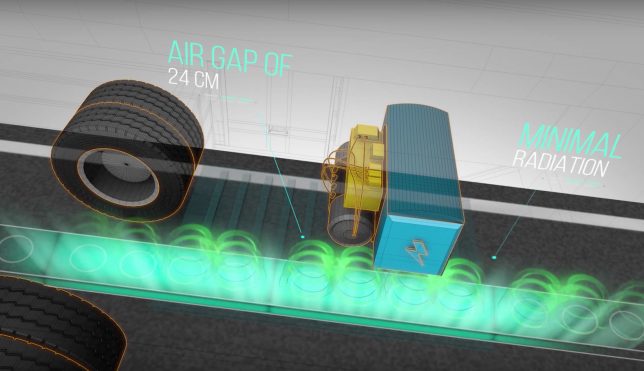
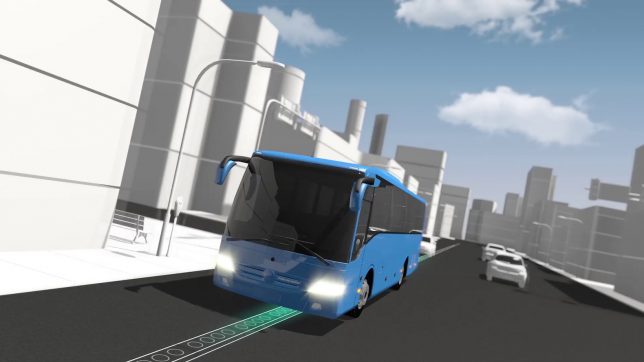
A series of roads and public buses in Israel are being retrofitted to test an electromagnetic induction system designed to recharge vehicles on the go, eliminating the cost, time, emissions and waste associated with conventional fuel and refueling stops.

smart-inverter

Electroad, an Israeli startup, boasts a relatively straightforward and fast-deploying system compared to competitors. Their copper and rubber chargers can be rolled out at a rate of a close to a half a mile per day into shallow trenches just a few inches deep. The ease of retrofitting is one of the striking advantages of the system — more involved variants can require ripping up substantial sections of pavement, taking longer and costing more to implement.

air-gap

Their technology has already been tested in controlled settings (small sections of test track outside Electroad’s lab) but will now be demonstrated at scale under real-world conditions along public transit routes. Like other induction technologies, no connection is needed between the vehicle and the road — a radiation-shielded coil simply picks up energy from the lines below, tied into the grid at intervals along the way.

eletric-bus-wireless-charging

To deploy the system, an asphalt scraper digs a trench while a second vehicle unrolls the the rubber-and-plastic strips. Electric buses following the revamped route will be able to store a charge for any jumps off the invisible grid. That may not sound like much, but the reduced storage capacity means the bus can travel lighter, using less energy and requiring a cheaper battery. Ultimately, the cost and power saved upfront will help pay back for the system installation more rapidly.

Share on Facebook


[ By WebUrbanist in Conceptual & Futuristic & Technology. ]

[ WebUrbanist | Archives | Galleries | Privacy | TOS ]


WebUrbanist

 
Comments Off on Electroads: Wireless Vehicle-Charging Roads Rolling Out in Tel Aviv

Posted in Creativity


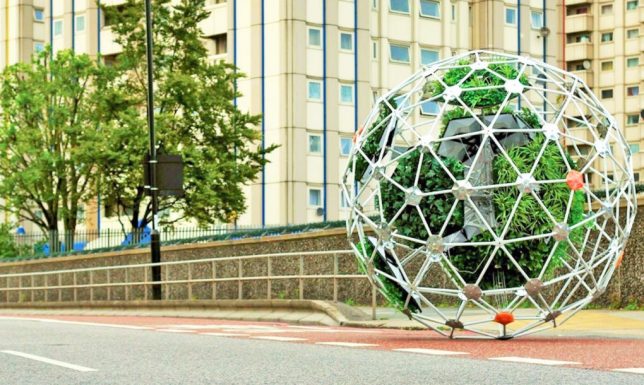
Rolling Landscape: Driverless Geodesic Garden Hits the Streets of London

10 Oct

[ By WebUrbanist in Conceptual & Futuristic & Technology. ]

geodesic-mobile-garden

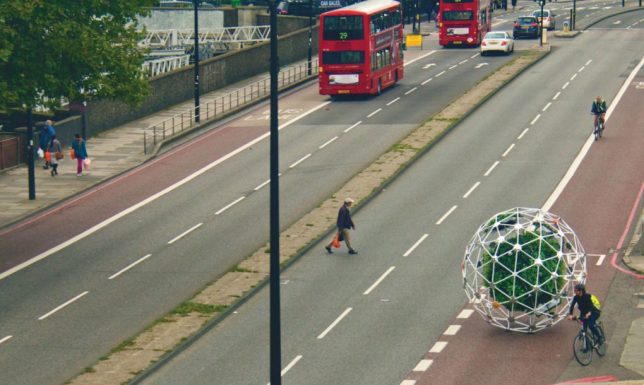
As robotic cars take to the streets, designers are beginning to see possibilities for urban mobility that go beyond human and cargo transport. What if plants, for instance, could be moved around automatically, seeking out sun, filtering dirty air and providing fresh greens within cities?

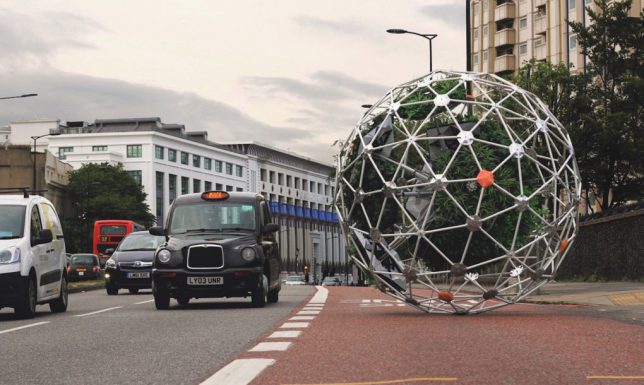
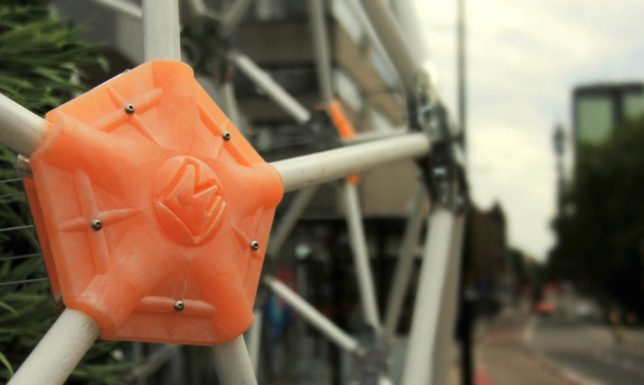
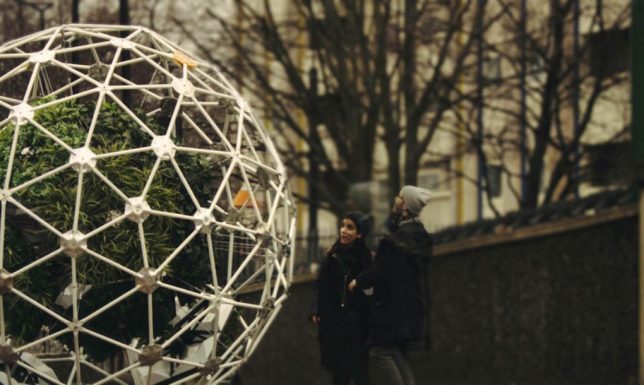
Inspired by Buckminster Fuller’s geodesic domes and Operating Manual for Spaceship Earth, the Interactive Architecture Lab at the University College London has designed and built Hortum Machina B (the last letter short for Bucky).

rolling-garden

An aluminum core houses the technology’s robotics, monitoring plants on the periphery and changing rotation and position to accommodate their needs. On-board water storage supplies moisture for growth while the ball stays in motion.

garden-sphere

This novel mobile ecosystem is solar-powered, so its search for sunlight fuels not only the plants on board but the system itself. With efficient water reclamation, the garden could stay on the move indefinitely.

garden-module-prototype-plan

The internal computer system not only keeps the plants healthy but serve as part of a larger set of smart-city initiatives. For instance, sensors can detect and seek out areas with poor air quality, letting the plants provide filtration on demand.

urban-farm-rolling

The sphere could also roll itself through urban food deserts, allowing people to pick edibles as it winds its way through a city. Of course, this shape may not be the most efficient manifestation of the idea, but as a conceptual model could inspire similar and more sustainable typologies.

solar-garden-london

street-garden-design

Presumably, in a future world of autonomous vehicles, there will be both mechanisms and space to accommodate driverless gardens as well as cars. Freed-up streets could be used to transport all kinds of things, not just conventional goods and people but also micro-ecosystems and other stuff we have yet to think of. For now the, the robotic garden has been tested in London and remains prototype. It might not be as productive per square foot of space as many new urban farm designs, but perhaps it makes up in novelty and mobility what it lacks in terms of strict productivity.

Share on Facebook


[ By WebUrbanist in Conceptual & Futuristic & Technology. ]

[ WebUrbanist | Archives | Galleries | Privacy | TOS ]


WebUrbanist

 
Comments Off on Rolling Landscape: Driverless Geodesic Garden Hits the Streets of London

Posted in Creativity


Don’t get ahead of yourself: Canon EOS 5D Mark IV rolling shutter test

27 Aug

Much of the initial concern about the EOS 5D Mark IV’s video has been about its substantial 1.64x crop (relative to the full width of the sensor, 1.74x compared to the 3:2 region) and its use of the inefficient Motion JPEG compression system (which limits the ability to use SD cards with any dependability).

However, upon shooting with the camera we found it to have significant rolling shutter. We’ve demonstrated the effect alongside the EOS-1D X Mark II, which reads out its sensor fast enough to exhibit pretty low levels of rolling shutter, and the Sony a6300, which shows a relatively high level of rolling shutter.

Obviously we’ve panned faster than you ever sensibly would, to make the difference clearer. If you’re careful with the way you move the camera, this rolling shutter effect may not be too apparent however, for some kinds of shooting, it can be distracting.

Articles: Digital Photography Review (dpreview.com)

 
Comments Off on Don’t get ahead of yourself: Canon EOS 5D Mark IV rolling shutter test

Posted in Uncategorized


Pelican Air 1535 Rolling Hard Case with TrekPak Dividers Review

16 Jun

Pelican Air 1535 Rolling Case w/TrekPak Divider System
$ 315/£220 | www.pelican.com | Buy Now

For decades now, Pelican cases have been the go-to solution for anyone who needs maximum protection for their equipment. The company’s website is filled with user stories about explosions, lion attacks, shifting pack ice and airplane crashes where the gear inside the case survived. Recently, Pelican introduced the Air series of cases designed to be up to 40% lighter than their standard cases, with the same promises of extreme durability.

Many working photographers will factor in things like maximum comfort and gear accessibility when choosing a bag. But when you travel thousands of miles every month and your gear puts the food on your table, getting everything there and home in one piece becomes secondary to things like leather accents or ventilated shoulder straps. In and out of planes, taxis, luggage carts and TSA inspection checkpoints, whatever is carrying your cameras, lenses, and accessories has to do its job well or you won’t have your job much longer.

$ (document).ready(function() { SampleGalleryV2({“containerId”:”embeddedSampleGallery_4024174850″,”galleryId”:”4024174850″,”isEmbeddedWidget”:true,”standalone”:false,”selectedImageIndex”:0,”startInCommentsView”:false,”isMobile”:false}) });

It’s on those high standards that Pelican has built its reputation for being the ultimate in gear protection. I still remember being seeing promotional material showing a Pelican case being run over with a car and thinking that was pretty amazing. While I never had a case subjected to any of that sort of treatment, I did drop one off a chairlift back when I was doing snowboard filming. While I felt like an idiot, the miniDV camera inside survived just fine.

At the time of announcement, Pelican also said that the Air cases (along with a few others in the lineup) would have the option of coming with the TrekPak divider system instead of the standard pick ‘n pluck foam or padded divider inserts. I recently had a chance to run the rolling airline carry-on sized Pelican Air 1535 with the TrekPak system through its paces.

Specifications

  • Exterior 55.8 x 35.5 x 22.8 cm (21.96″ x 13.97″ x 8.98″)
  • Interior 51.8 x 28.4 x 18.3 cm (20.39″ x 11.20″ x 7.21″)
  • Weight 3.9 kg (8.69 lbs) without foam/inserts

By way of comparison, the similarly sized Pelican 1510 weighs 5.4 kg (11.99 lbs) without foam. Pelican says that the weight savings in the Air series comes from a newly developed generation of their HPX resin as well as hollowing out or honeycombing areas (the latch clasps and the extending roller handle for example) that were previously solid.

In Use

Hard cases are big and clunky and something of a pain to use if you are used to soft bags and packs. They bang into things, aren’t particularly ergonomic, and are a hassle to schlep long distances. That said, one of the best compliments I can give the Air 1535 is that using it is just like the 1500 series cases I have used in the past, but much lighter. It loads, latches, and generally seems just as tough as every other standard Pelican case I have ever used.

I would encourage anyone looking to get a hard case of this size to be sure to choose one with the roller option. Your back will thank you as you try to make it across a busy airport for a connecting flight. Even with the weight savings of the Air line, these things are still heavy loaded up. The 1535 loaded with the gear shown in the article images checked in at a beefy 11.3 kg/25 lbs.

That said, there are a few minor frustrations that remain. For some reason, Pelican chose not to use the easy pushbutton latches from their Storm Case series. Pelican’s standard double-throw latches work well and have been proven over the years. However, they are also loud as heck (particularly when closing) and can be a bit difficult for some people to use because they require a bit of force to operate.

‘You should not expect the 1535’s wheels to
easily go off-roading’

Also worth noting is that the wheels on the 1535 do not protrude very far from the bottom of the case. This makes it easy to stack cases without them rolling around on each other, but it also means that there is not much ground clearance. You should not expect the 1535’s wheels to easily go off-roading, rolling on ground much rougher than airport concourses will lead to some scraping and scratches.

Like most hard cases, the lid of the Air 1535 doesn’t open much past 90 degrees (straight up) and can easily flop shut when bumped or jostled. Just another reminder that these cases are for transport far more than for working out of.

One nice new feature is the card holder. It clips in and out easily with the lid open, but locks in once the lid is closed, and can be mounted on the side or end of the case. It can be used as a luggage tag when traveling or for an equipment list while on location or in storage.

TrekPak system dividers

If the Air 1535 is the steady performer who has hit the weight room in the off season and come back in better shape, then the TrekPak system may be the rookie superstar.

$ (document).ready(function() { SampleGalleryV2({“containerId”:”embeddedSampleGallery_7830013549″,”galleryId”:”7830013549″,”isEmbeddedWidget”:true,”standalone”:false,”selectedImageIndex”:0,”startInCommentsView”:false,”isMobile”:false}) });

Both the pick ‘n pluck foam and padded divider systems have taken care of camera gear for decades. The pick ‘n pluck foam is extremely protective and customizable to exactly the size and shape of the gear you are carrying, and the padded divider sets allow you to change the layout of your case for different gear and still protect quite well. But the foam is also fairly tedious to cut out correctly and doesn’t offer a way to use the same case for different gear without buying a whole new set of foam. Dealing with velcro can also be a hassle, and the more you change it, the more it breaks down. The TrekPak system claims to improve on both by offering a completely customizable system that not only protects but is easily modified.

The TrekPak dividers are corrugated plastic sandwiched with 3mm/0.125″ of dense foam on each side. This makes for a light yet protective divider in between each piece of gear. Setup was easy – I took the gear that I wanted to carry in the Air 1535 and laid it out in the case. Then I took a measurement for each divider and used the clever TrekPak cutter to trim the sections to fit. A U-shaped pin with a ribbon pull-tab holds the dividers together and allows for legitimately quick and easy repositioning.

‘I do admit to feeling somewhat uncomfortable making the cuts, as if perhaps I had made a decision that I was going to regret down the road’

All together, it took me around 30 minutes to get everything cut and laid out. And to be honest, a lot of that time was spent dithering about how I wanted to organize. I do admit to feeling somewhat uncomfortable making the cuts, as if perhaps I had made a decision that I was going to regret down the road. This is probably a point in favor of the padded dividers, if I’m being honest.

That said, you do get 80 inches of the TrekPak dividers (and 20 ‘U’ pins) to set up your case. Extra divider sections are available and are not terribly expensive, ranging from $ 3.50 to $ 15 depending on size.

What’s the bottom line?

Hard cases are bulky, less comfortable to carry and heavier than soft-sided bags. But when you need a hard case, there is no soft case that can do the same job. If you are looking for an airline carry-on sized hard case, there is every reason to consider the Pelican Air 1535. Significantly lighter but just as tough as the original 1500 series cases, the Air 1535 will protect your gear while giving you a much better shot at avoiding airline overweight fees.

While the older style pick ‘n pluck foam and padded divider systems certainly worked well enough, the TrekPak system is well ahead of the other options for anyone who thinks they might be carrying different gear regularly.

Overall, the 1535 with the TrekPak dividers would easily be my first choice if I were going to be doing a lot of traveling with my gear. These cases aren’t cheap, but neither is the gear they protect. I wholeheartedly trust the Air 1535 to get everything there and back in one piece; there’s not a lot more you can ask from a case like this.

What we like

  • Lighter weight than previous Pelican cases, still tough-as-nails
  • Conforms to carry-on sizing rules (check your specific airline)
  • TrekPak is easy to customize while still light and sturdy
  • Roller option is a back-saver
  • Clever card holder

What we don’t like

  • Expensive
  • Still heavy compared to typical bags/packs
  • Latches are loud and can be tough to use

Articles: Digital Photography Review (dpreview.com)

 
Comments Off on Pelican Air 1535 Rolling Hard Case with TrekPak Dividers Review

Posted in Uncategorized


Instagram begins rolling out reordered feeds to all users

07 Jun

In March, Instagram announced plans to reorder user feeds using an algorithm, eliminating the chronological arrangement and replacing it with a personalized order that prioritizes content based on a user’s behavior. In a recent blog post, Instagram announced that it is now rolling out these reordered feeds to all of its users.

The initial feed change announcement was not well received; many users worried it would result in decreased usability, and a Change.org petition attempting to halt the plan garnered about 160k signatures. Still, Instagram went ahead and introduced the reordered feeds to small groups of users over the past couple months, expanding that rollout to all of its users over the course of June.

According to Instagram, users on the service don’t see approximately 70% of the content in their feeds. Reordering the feeds based on an algorithm will, in theory, ensure users see the content they’re most interested in while pushing the less desirable photos and videos to the fringes. In the past, Facebook enacted a similar feed change that replaced chronological posts with algorithm-based arrangements, but many users complained they no longer saw posts from people they were interested in.

The Instagram feed change hasn’t been wildly popular with some users who have already seen the update, judging from comments on Twitter using the hashtag #InstagramUpdate. They cite trouble finding newer posts, less posts surfaced from accounts they enjoy and difficulty seeing what others are up to in real-time.

Via: Instagram

Articles: Digital Photography Review (dpreview.com)

 
Comments Off on Instagram begins rolling out reordered feeds to all users

Posted in Uncategorized


Think Tank Photo launches largest rolling case for lighting

05 Apr

$ (document).ready(function() { SampleGalleryV2({“containerId”:”embeddedSampleGallery_0536172367″,”galleryId”:”0536172367″,”isEmbeddedWidget”:true,”standalone”:false,”selectedImageIndex”:0,”startInCommentsView”:false,”isMobile”:false}) });

Bag manufacturer Think Tank Photo has introduced a rolling case for lighting kit that it claims is the largest on the market. The Production Manager 50 is designed to hold a pair of studio-style heads with power packs, battery packs, dishes, umbrellas and even lighting stands. The case has internal dimensions of 38 x 125 x 25.4cm / 15.5 x 49.2 x 10in and comes with a collection of adjustable dividers so users can customize the layout of the interior. Zip-up pockets on the inside of the lid are designed to keep cables tidy, and straps on the exterior can be used to attach tripods and larger lighting stands.

The bag is made with ballistic nylon coated with a water-repellent agent that covers a rigid shell, and the shock-absorbing wheels are user replaceable should they get damaged. Think Tank Photo says that the idea of this big case is to make it easier for photographers to transport large amounts of kit in one load, and claims the Production Manager 50 can carry what it would normally require two assistants to manage.

The Think Tank Photo Production Manager 50 costs $ 599.75/£515. For more information see the Think Tank Photo website.


Press release:

Photographers Can Fit Lighting Equipment and Large Light Modifiers in One Rolling Bag with Think Tank Photo’s New Production Manager 50

Santa Rosa, Calif. – Think Tank Photo has released the largest rolling photography equipment case on the market, the Production Manager 50.  Designed to hold an immense amount of gear, including lighting equipment and large light modifiers, one photographer will now be able to transport what it used to take up to at least two assistants.  It is easy to move, carry, work out of, and stack among other gear.

This large rolling bag features stabilizing, wide-set, shock-absorbing wheels that roll smoothly and hold up under the toughest conditions, the ability to lock the main compartment and secure the bag with the included lock and cable, and a fully customizable interior with dividers to protect small and large lighting equipment including c-stands and large modifiers.

“Pro photographers usually travel by car or van to where they are going to shoot,” said Doug Murdoch, Think Tank’s CEO and Lead Designer. “Once a shoot is completed the set needs to be torn down and moved to the next location. Often times, there can be a time crunch where all the gear has to be loaded quickly. Carrying these bags up and down stairs and over rough terrain can be very cumbersome and often takes two people.  The Production Manager 50 makes this time-sensitive, cumbersome process easier and quicker.”

KEY ADDITIONAL FEATURES
* Large front zippered pocket for reflectors, umbrellas, extension cords, cables, etc.
* Attachments for lightstands or tripods on both sides (straps included)
* Rigid shell and stiffened dividers ensures gear protection
* Robust handles on four sides for easy loading and unloading by two people
* Heavy-duty aluminum side-frame protects axle from impact
* ID plate can be registered on the Think Tank site that may allow lost or stolen bag to be returned
* YKK RC Fuse zippers, 1680D ballistic nylon, and super-stick velex (interior) contribute to one of the most robust products on the market.
* Large interior mesh pockets for organizing pocket wizards, gels, cords, tape, batteries, and other accessories
* Ergonomic top handle for rolling or carrying by two people.
* Velex wrapped dividers for extra durability and longevity.
* Adjustable lid straps keep bag open and accessible
* Rear skid rails and custom wheel housings allow for loading and unloading from a vehicle with ease
* Business card holder for easy identification on top panel
* User replaceable wheels & hardware
* Seam-sealed rain cover included

MATERIALS
External: All fabric exterior treated with DWR while fabric underside is coated with PU for superior water resistance, 1680D ballistic nylon, YKK® RC Fuse (abrasion resistant) zippers, custom designed extra tall skid plates, replaceable custom-designed wheels, antique nickel plated metal hardware, nylon webbing, 3-ply bonded nylon thread

Internal: 210D silver-toned nylon, PU backed velex liner & dividers, 2x PU coated nylon 210T seam-sealed taffeta rain cover, closed cell foam & PE board stiffened dividers, belly-o mesh pockets, 3-ply bonded nylon thread

PRODUCT DIMENSIONS & WEIGHT 

Exterior Dimensions: 17.3” W x 53.1” H x 12.6” D (44 x 135 x 32 cm)
Interior Dimensions: 15.6” W x 49.2” H x 10” D (39.5 x 125 x 25 cm)
Weight:  20.7 – 29.8 lbs (9.4 – 13.5 kg)

Articles: Digital Photography Review (dpreview.com)

 
Comments Off on Think Tank Photo launches largest rolling case for lighting

Posted in Uncategorized


Baked In: Laser-Etched Rolling Pins Imprint Edible Patterns

06 Jul

[ By WebUrbanist in Design & Products & Packaging. ]

laser printed pin designs

Laser engraving wraps all the way around these clever and customizable pins, creating anything from robots and dinosaurs to mazes and words to liven up your edible creations.

laser maze pin

laser rolling pin array

laser cut rolling pin

In addition to animal, geometric and typographical themes, Valek Rolling Pins offers fully-custom options as well as designs sorted by holiday and season, including Christmas, Valentine’s Day and Mother’s Day.

laser made by pin

laser cat print

The pins are placed on a rotating spindle and then laser-engraved with a choice of patterns, the process leaving the wood char-darkened in the resulting voids against the lighter starting surface.

laser etched engraved wood

laser pattern pin dough

Aside from the appealing marks they make on dough for cookies, pies and otherwise, the patterns also add a display dimension for those who keep their rolling pins visible when not in use. In addition to the cute effects in this case, this array of options is also a good reminder of the non-standard creative possibilities for laser-etching technologies.

Share on Facebook


[ By WebUrbanist in Design & Products & Packaging. ]

[ WebUrbanist | Archives | Galleries | Privacy | TOS ]


WebUrbanist

 
Comments Off on Baked In: Laser-Etched Rolling Pins Imprint Edible Patterns

Posted in Creativity


Panono announces pricing and availability for rolling ball camera

26 Oct

German startup Panono has announced availability and pricing for its ball-shaped Panono Camera. The device shoots spherical panorama images and will cost $ 549/€549 when it ships worldwide in the spring of 2015. The first to receive the camera will be the backers of the crowd-funding project the company used to get started before the camera goes on general release. Learn more

Articles: Digital Photography Review (dpreview.com)

 
Comments Off on Panono announces pricing and availability for rolling ball camera

Posted in Uncategorized