Tag: reveals

  • Android Dreams: Google’s Neural Network Reveals AI Art

    [ By Steph in Gaming & Computing & Technology. ]

    google AI dreams 8

    Those of us working in creative fields have often consoled ourselves that although automation may claim many other jobs, at least robots can’t make art. That’s not exactly true for a variety of reasons (depending on how you define ‘art’), but it really goes out the window when you look at these astonishing images released recently by Google. The landscapes produced on the company’s image recognition neural network reveal the answer to the question, “Can artificial intelligence dream?”

    Screen Shot 2015-06-24 at 5.40.06 PM

    It turns out that it can – sort of. Google created a method to ‘teach’ its neural network to identify features like animals, buildings and objects in photographs. The computer highlights the features it recognizes. When that modified image is fed back to the network again and again, it’s repeatedly altered until it produces bizarre mashups that belong in a gallery of surreal art.
    google AI dreams 2

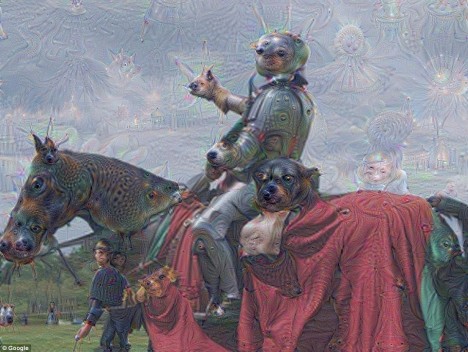
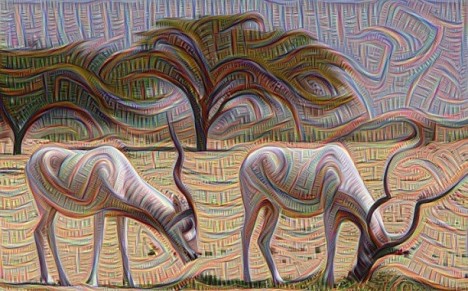
    Suddenly, an image of a knight on a horse is filled with ghostly impressions of frogs, fish, dogs and flowers. The knight’s arm seems to have sprouted a koala head, while the head of another unrecognizable animal emerges from beneath the horse’s tail. In another image, a tree and field turn cotton candy pink, and the clouds transform into conjoined sheep monsters.
    google AI dreams 7 Google AI dreams 6

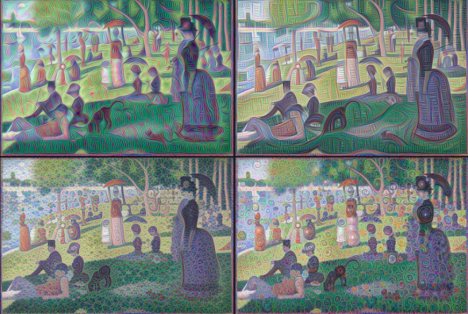
    Technically, it’s more like the computers were fed psychedelics and asked to paint, rather than capturing random images that might flash through their artificial ‘minds’ when they’re idle. The computers look for patterns and edges within the photos and paintings when they’re trying to identify objects and shapes, leading to those strange ghostly images scattered randomly throughout. Those edges are brought out more in each successive layer until the network starts thinking it sees all sorts of things within them.

    google AI dreams 3

    Google describes it as “inceptionism,” saying “We know that after training, each  layer progressively extracts higher and higher-level features of the image, until the final layer essentially makes a decision on what the image shows.”
    Screen Shot 2015-06-24 at 5.39.47 PM

    “So here’s one surprise: neural networks that were trained to discriminate between different kinds of images have quite a bit of the information needed to generate images too. Why is this important? Well, we train networks by simply showing them many examples of what we want them to learn, hoping they extract the essence of the matter at hand (e.g., a fork needs a handle and 2-4 tines), and learn to ignore what doesn’t matter (a fork can be any shape, size, color or orientation).”

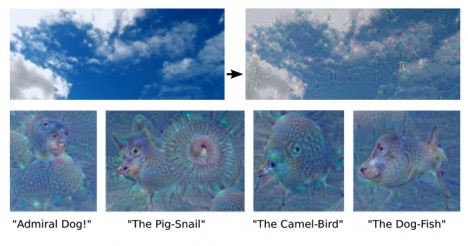
    “If we choose higher-level layers, which identify more sophisticated features in images, complex features or even whole objects tend to emerge. Again, we just start with an existing image and give it to our neural net. We ask the network: “Whatever you see there, I want more of it!” This creates a feedback loop: if a cloud looks a little bit like a bird, the network will make it look more like a bird. This in turn will make the network recognize the bird even more strongly on the next pass and so forth, until a highly detailed bird appears, seemingly out of nowhere.”

    Check out lots more examples on Google’s research blog.

    Share on Facebook


    [ By Steph in Gaming & Computing & Technology. ]

    [ WebUrbanist | Archives | Galleries | Privacy | TOS ]


    WebUrbanist

  • CP+ 2015: Tokina reveals new 24-70mm F2.8 and 11-20mm F2.8 zooms

    Tokina might not have the same presence at CP+ as Sigma and Tamron but its small booth is pretty busy, thanks to a brand new 24-70mm F2.8 for Nikon full-frame, and an 11-20mm F2.8 wideangle for APS-C. Just from first impressions, they seem impressively well-built, as we’d expect from Tokina. Click through for some images

    Articles: Digital Photography Review (dpreview.com)

  • Apple reveals Photos beta for developers

    Last year Apple announced that it would replace both its desktop image management and editing applications, iPhoto and Aperture with one single app called Photos. Now the company has released a preview of the new software with a beta version of OS X 10.10.3 which has been made available to developers. As expected, Photos is much more consumer-geared than pro, and emphasizes iCloud Photo integration. Read more

    Articles: Digital Photography Review (dpreview.com)

  • Panasonic reveals Lumix DMC-GF7 with tilting LCD

    Panasonic has taken the wraps off the Lumix DMC-GF7, a retro-styled 16MP mirrorless camera with a 180-degree upward-tilting screen ready for – you guessed it – selfies. Internally, it shares much of the GM1/GM5’s components including built-in Wi-Fi with NFC and a sensor it also shares with the Lumix GX7 offering 1080/60p HD video. Read more

    Articles: Digital Photography Review (dpreview.com)

  • Crowdsourced Data Reveals Most Beautiful Urban Walking Routes

    [ By WebUrbanist in Destinations & Sights & Travel. ]

    best walking routes study

    Using a mapping algorithm coupled with citizen reviews of sights and scenery, a team of researchers has developed a way to choose paths through cities based on beauty, quiet and happiness rather than simply the shortest distance between two points.

    shortest or beautiful route

    The project employed Google Street View and Geograph as well as Flickr images and their metadata to build out an initial estimation of probable best paths, then solicited human feedback (to check and enhance the results) from a group of participants on the website UrbanGems (shown above).

    london main sites map

    The study, published by Cornell University’s arXiv, came up with a number of route suggestions in Boston and London and contains a number of interesting findings. For starters, the ‘beautiful’ routes were only slightly longer than the shortest routes, and significantly shorter than typical tourist-oriented directions and guided-tour paths. As the algorithm improves, it is increasingly able to generate paths through new cities via metadata alone, reducing reliance on input from people.

    beauty and shortest boston

    boston main sights map

    The project’s creators included Daniele Quercia and Luca Maria Aiello of Yahoo Labs in Barcelona and Rossano Schifanella of the University of Torino, Italy. From their abstract: “When providing directions to a place, web and mobile mapping services are all able to suggest the shortest route. The goal of this work is to automatically suggest routes that are not only short but also emotionally pleasant.

    beauty walking route london

    shortest walking route london

    The assessments are not simply qualitative value judgments, but a hybrid of human and machine input: “Based on a quantitative validation, we find that, compared to the shortest routes, the recommended ones add just a few extra walking minutes and are indeed perceived to be more beautiful, quiet, and happy.”

    happy walking path london

    quiet walking route london

    From UrbanGems: “Buildings and neighbourhoods speak. They speak of egalitarianism or elitism, beauty or ugliness, acceptance or arrogance. The aim of UrbanGems is to identify the visual cues that are generally associated with concepts difficult to define such beauty, happiness, quietness, or even deprivation. The difficult task of deciding what makes a building beautiful, or what is sought after in a quiet location is outsourced to the users of this site using comparisons of pictures. With a comprehensive list of aesthetic virtues at hand, we would be more likely to systematically understand and re-create the environments we intuitively love.”

    Share on Facebook


    [ By WebUrbanist in Destinations & Sights & Travel. ]

    [ WebUrbanist | Archives | Galleries | Privacy | TOS ]


    WebUrbanist

  • Samsung reveals super-thin and high-resolution Galaxy S tablets

    Galaxy_Tab_S_10.5_inch_Titanium_Bronze_6.jpg

    Samsung has launched two new high-end tablets. The Galaxy Tab S 8.4 and 10.5 have very similar specifications and mainly differ in screen size. Both devices offer high-resolution SuperAMOLED displays with 2560×1600 pixels. Samsung’s earlier Tab Pro models came with the same resolution, but this is the first time Samsung combines such dense displays with SuperAMOLED technology. Learn more at connect.dpreview.com

    News: Digital Photography Review (dpreview.com)

  • Fake Chuck Westfall reveals identity and announces retirement

    chuck.jpg

    Chuck Westfall is the unassuming and authoritative head media liaison for Canon, USA. Fake Chuck Westfall is an invented anti-hero and the surly voice behind the Fake Chuck Westfall blog, a site that pokes fun at Canon, Nikon and the photo industry in general. After maintaining secrecy for six years the man behind the account has revealed his identity, announcing that he’s moving on from the blog.

    News: Digital Photography Review (dpreview.com)

  • Loop Portraits:Romain Laurent Reveals His Tricks

    When we see a photo that just makes us say, “How in the world?!” we just have to stop talking out loud to our computer screen, hunt down the genius behind said stunner and ask them…

    “How in the world?!”

    Turns out it’s Romain Laurent who crafts the mind bending, perfectly looped portraits that had us agog.

    So, we tracked him down and bombarded him with “hows,” “whys” and “you’re so cools.”

    Check out his answers and see more of his loop portraits over on our blog.

    Romain Laurent Reveals The Tricks to His Trade

    (…)
    Read the rest of Loop Portraits:
    Romain Laurent Reveals His Tricks (753 words)


    © laurel for Photojojo, 2014. |
    Permalink |
    No comment |
    Add to
    Romain Laurent Reveals His Tricks”>del.icio.us

    Post tags:


    Photojojo

  • Nikon reveals 70-300mm telezoom and 10-30mm powerzoom for 1 system

    70_300.png

    Nikon has announced two lenses for its 1 system mirrorless cameras, in the shape of a 70-300mm ultra-telephoto zoom and a compact 10-30mm powerzoom. The 1 Nikkor VR 70-300mm f/4.5-5.6 is designed for sports and wildlife shooting, and features optical image stabilisation to counteract camera shake; its SRP is $ 999.95 / £879.99. Meanwhile the 1 Nikkor VR 10-30mm f/3.5-5.6 PD-Zoom is a compact lens with electronic zoom control that will come in a kit with the 1 V3 camera, or be sold separately with an SRP of $ 299.95 / £249.99. 

    News: Digital Photography Review (dpreview.com)

  • Olympus reveals 25mm F1.8, compact 14-42mm, and 9mm F8 Fish-Eye

    NC_M2518_SLV_stand.png

    Alongside the OM-D E-M10, Olympus has also announced three lenses. First up is the M.Zuiko Digital 25mm F1.8, a relatively inexpensive fast normal prime, that looks specifically designed to complement the much-loved 45mm F1.8. Second is the 9mm F8 Fish-Eye Body Cap Lens (which Olympus technically considers an ‘accessory’); this offers a 140° angle of view in a tiny plastic body. Finally there’s a new ‘pancake’ kit zoom for the E-M10, the M.Zuiko Digital ED 14-42mm F3.5-5.6 EZ, which features an electronic zoom. Learn more

    News: Digital Photography Review (dpreview.com)