RSS
 

Posts Tagged ‘Reflector’

6 Ways of Using Reflector to Take Better Portraits

07 Nov

The post 6 Ways of Using Reflector to Take Better Portraits appeared first on Digital Photography School. It was authored by Dennis Drenner.

I’ve been making my living as a photographer for over 20 years, and I have accumulated thousands of dollars of gear in the process. I have the latest Canon DSLRs, a full complement of lenses, strobes, light stands, gels, filters, softboxes, tripods, and even some video and audio gear.

But the one thing that often makes the biggest difference in the quality of my portraits is a simple $ 20 reflector. I never leave home without one, and neither should you.

When shooting outdoor portraits, the first thing many photographers think about is the background – but first and foremost, the pros consider the quality of the light. They know, for example, that a portrait with nasty overhead lighting is not going to work, no matter how cool the background.

using a reflector examples

A reflector can help you salvage bad light, and turn okay light into something magical. You can use your reflector from below to fill in shadows, or from above to block distracting light. You can bounce the sun from a silver reflector to create a main light, or you can use a reflector with a black side to create deeper shadows. You can even sit on your reflector to keep your pants clean when shooting outside, or pop it open dramatically to dazzle young children.

Most of the photos in this article were shot with a 5-in-1 reflector you can buy for less than $ 20 USD. 5-in-1 refers to the fact that the reflector and cover can combine to give you five different options: white, silver, gold, and black sides, as well as a diffuser.

Here are six tips to help you use a reflector to transform your photos.

1. Use a reflector for fill light

The most traditional use of a reflector is to simply reflect light into the shadows. I took my wife, Karen, out into our local park to demonstrate this.

using a reflector

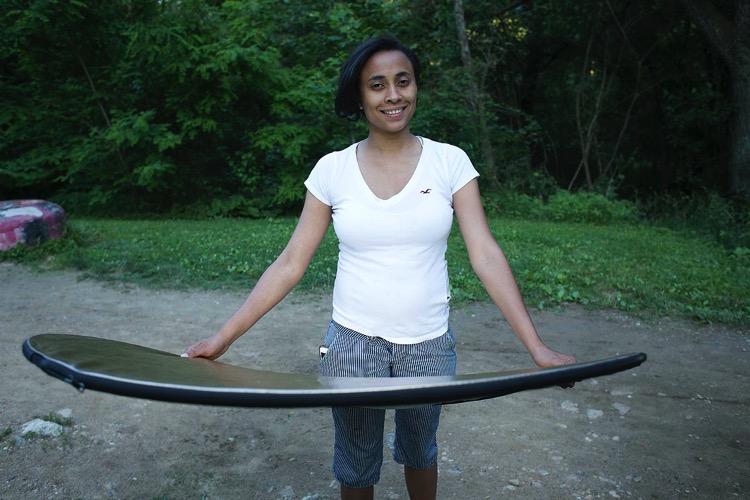
In the photo on the left (above), Karen is photographed in nice soft light, but there are still pretty deep shadows under her eyes and chin. In the photo on the right, however, she is holding a reflector at her waist. The shadows on her face are noticeably lighter and there is a subtle catchlight (a reflection of the reflector) in her eyes. If she were an older person with more textured skin, the contrast would be even more dramatic.

subject holding a reflector

Of course, you may not always want to fill in the shadows in this way, but if you are trying to flatter someone it almost always helps.

You don’t even need an official photo reflector. Anything that reflects light will work. In a pinch, I’ve used everything from old newspapers to a nearby person wearing a white shirt.

2. Use a reflector as the main light source

This is one of my go-to reflector moves, and it’s an easy way to wow your friends and family.

You position your subject with the light hitting them from behind, then use a reflector to bounce the light back into their face. You will get nice soft light on your subject’s face, with a dramatic rim light on the back of their head. The only trick is positioning yourself so the light doesn’t go straight into your lens and create lens flare (unless you like that look, of course).

using a reflector

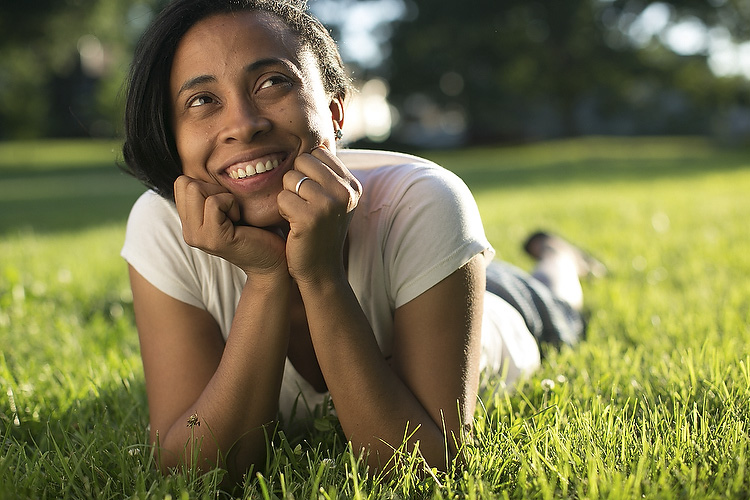
In the photo above, the sun is hitting the left side of my subject’s face and arm. The light from a reflector is bouncing some of the sun back to light up her face.

You may also notice the shallow depth of field in the photo above. If you are lighting with a reflector, you can jack up your shutter speed as much as you like to allow for a wide aperture (this photo was shot at 1/1250s at f/2.0 with a 50mm lens). If you were using flash to create this same effect, you would have to lower your shutter speed (to 1/250s or whatever matches your camera’s sync speed) to sync with the flash, requiring a narrow aperture and a greater depth of field (which will kill the whole look).

Yes, yes, some of you are no doubt thinking, “What about high-speed sync?” Well, yes, that could give you the same effect if you had the right equipment (and know how to pull it off). Or, you know, you could just use an old newspaper as a reflector.

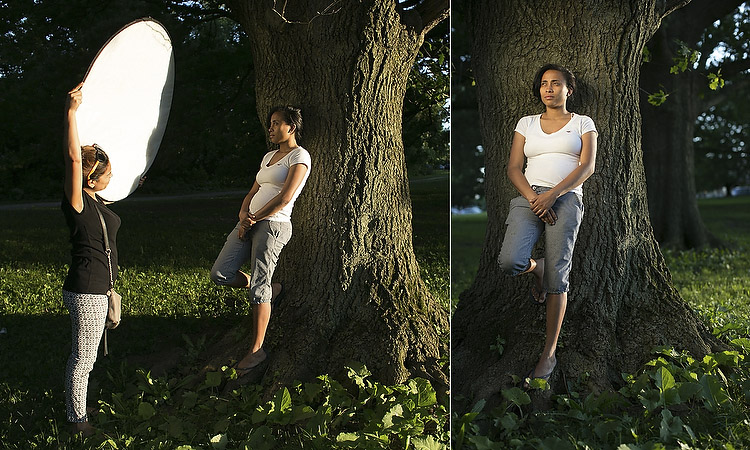
using a reflector

For the example above, I positioned Karen against a tree and had her cousin, Claudia, reflect a spot of sunlight on her from about 10 feet away. At this distance, the light from the reflector looks more like it is coming from a grid spot or snoot (hard light) – in other words, it’s a focused and dramatic beam (notice the fall-off of light on her legs). It’s a cool look that you can recreate with a reflector, a few feet of aluminum foil, or your bathroom mirror. Your friends will be wowed and ask what fancy gear you used for the shot (and your family will ask what happened to the bathroom mirror).

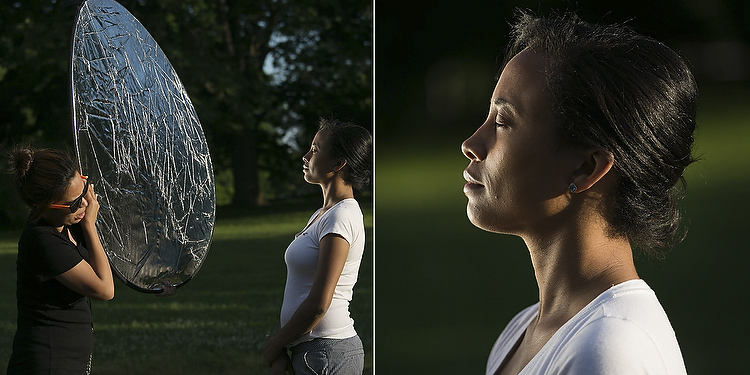
For a slight variation on this technique, we moved the reflector slightly behind the subject (relative to the camera) to create a dramatic rim light on the face in a profile shot (see below).

using a silver reflector

3. Use a reflector to block light

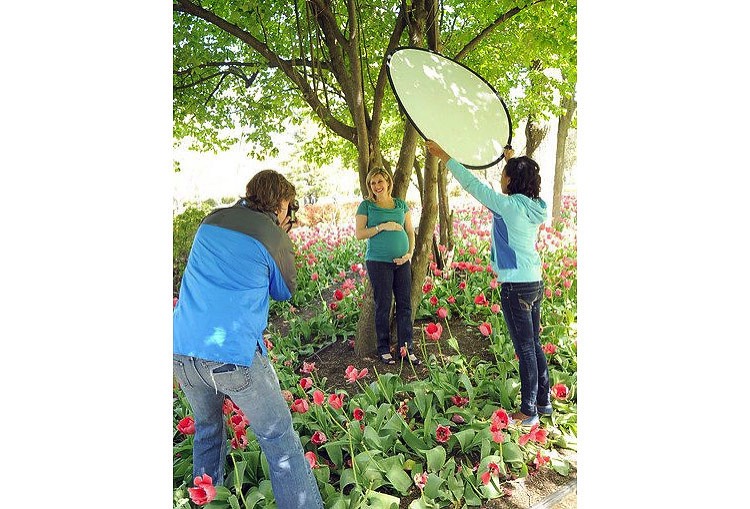
Sometimes you’ll find yourself in beautiful, shady light under a tree, except for that pesky sunbeam that finds its way through the leaves to light up your subject’s left ear. When this happens, turn your reflector into a light blocker (sometimes called a flag or gobo).

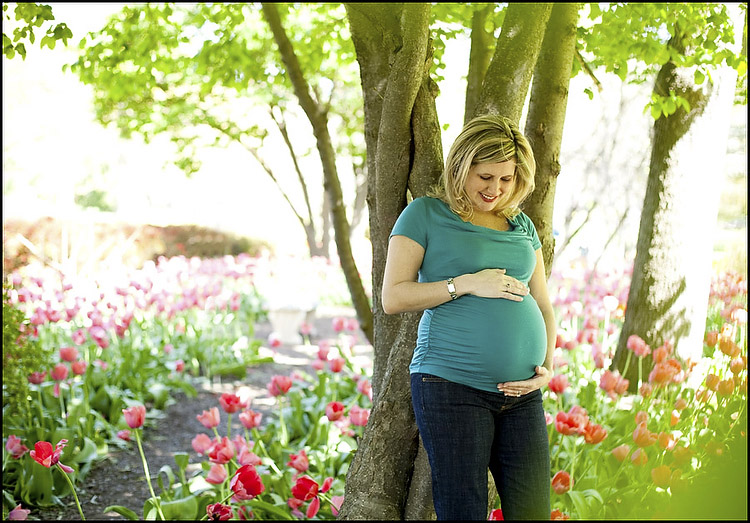
A few years ago, I was doing a maternity portrait in a local park when a newspaper photographer snapped my picture while I was using my reflector as a gobo (shown in the image below). If you look at the reflector, you can see the bright spots of sunlight that it’s blocking (imagine how those spots would have ruined the final image if we didn’t block them!).

using a diffuser
using a reflector

4. Use a black reflector to create more dramatic shadows

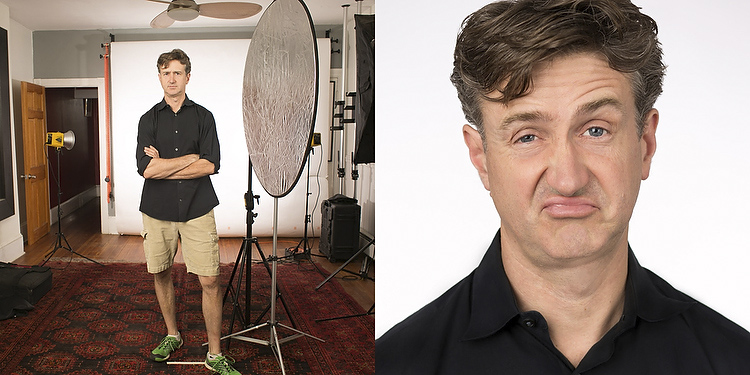
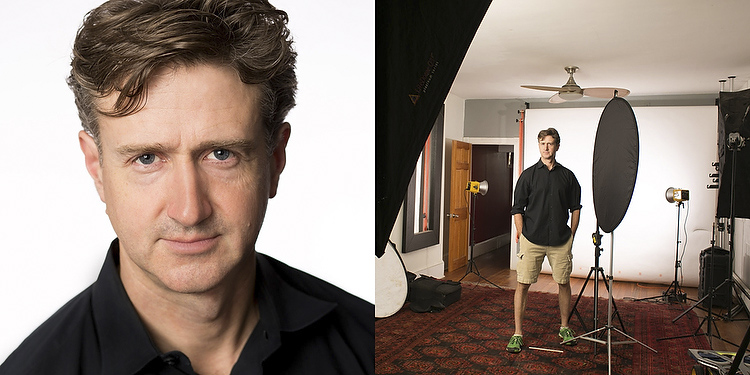
Sometimes, you actually want to deepen the shadows. I use this technique all the time in my headshot studio. Below is a photo of me with a white background. In the first shot, I have a silver reflector opposite the main light, sending light back towards my left cheek. In the second shot, the reflector has a black cover on it, gobbling up reflected light to leave a dark shadow on the cheek.

using a reflector
using a reflector

Except for the small change of literally flipping the reflector from one side to the other, the lighting setup is identical, but the effect is pretty dramatic. (For you studio lighting enthusiasts out there, my key light here is a large softbox, and there are two bare heads pointing at the background to make sure it is a nice, bright white).

This is the same technique used in the famous Steve Jobs portrait where he has his hand on his chin. In addition to creating a little drama, you can also use this technique to give someone a photographic face-lift by trimming pounds from the dark side of their face and under their chin.

5. Who holds the reflector?

You may be saying to yourself, “But I don’t have an assistant! Who’s going to hold the reflector for me?” I usually don’t have an assistant, either, but there is often someone nearby who is more than happy to help, be it a family member, passerby, intern, wedding guest, etc. Sometimes, you can even have the subject of the photo hold the reflector themselves. Of course, if you’re in the studio, or outside on a day without too much wind, you can just pop your reflector onto a light stand (like in the studio shots of me above).

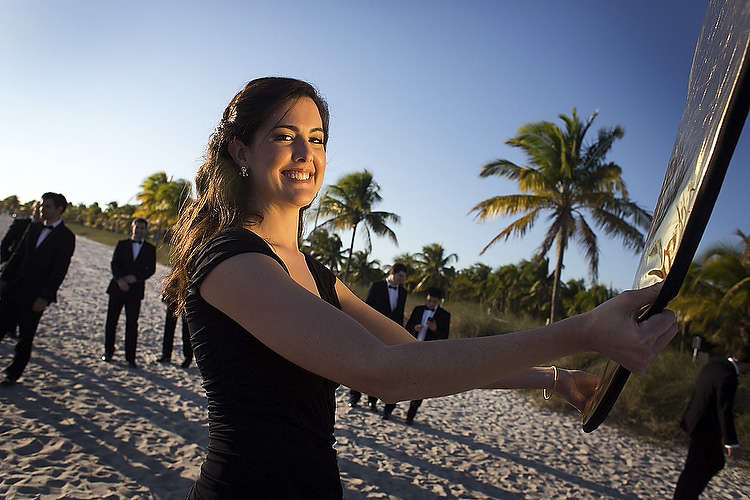
In the photo below, I was shooting wedding portraits on a beach in the Florida Keys. My reflector assistant that day was one of the bridesmaids, who truly enjoyed helping her friends out with their portraits.

using a reflector
using a reflector

6. Reflectors in the environment

Once you get the hang of reflectors, you’ll probably start noticing reflected light everywhere. Ever see a white building getting blasted by the sun? Well, that’s nothing but a giant reflector! Depending on what’s around it, you may have found yourself a giant studio with no rental fee.

Mind you, anything that reflects enough light can work as a reflector. A brick building, a large truck, or a flock of seagulls flying by at just the right moment – it all works!

Using a reflector: final notes

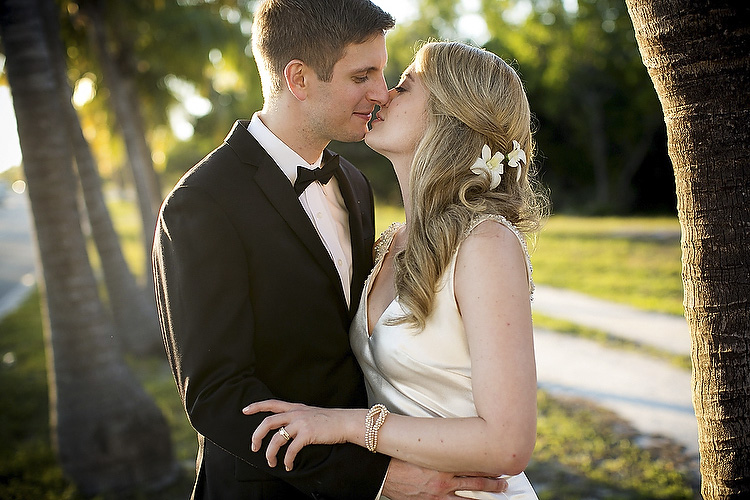
Although they may not be as sexy as strobe kits, reflectors can often yield similar or superior results for your portraits and are cheaper and easier to use. I will leave you with a few more example photos, shot using nothing more than a reflector.

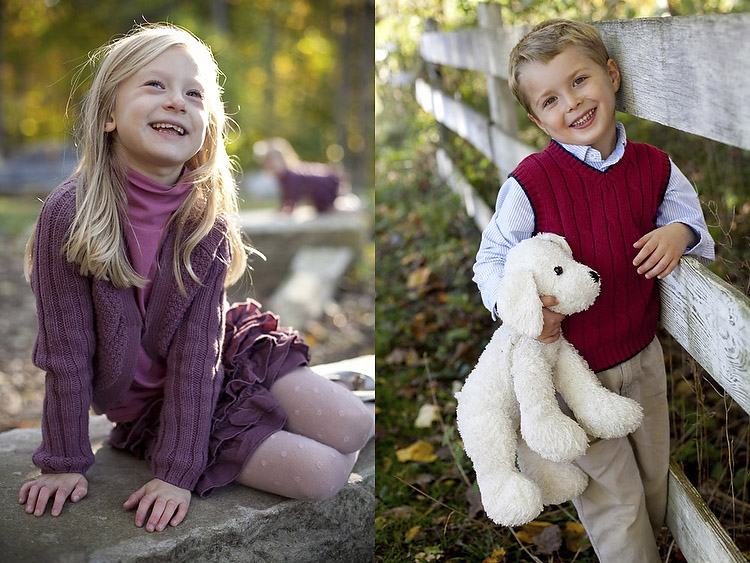
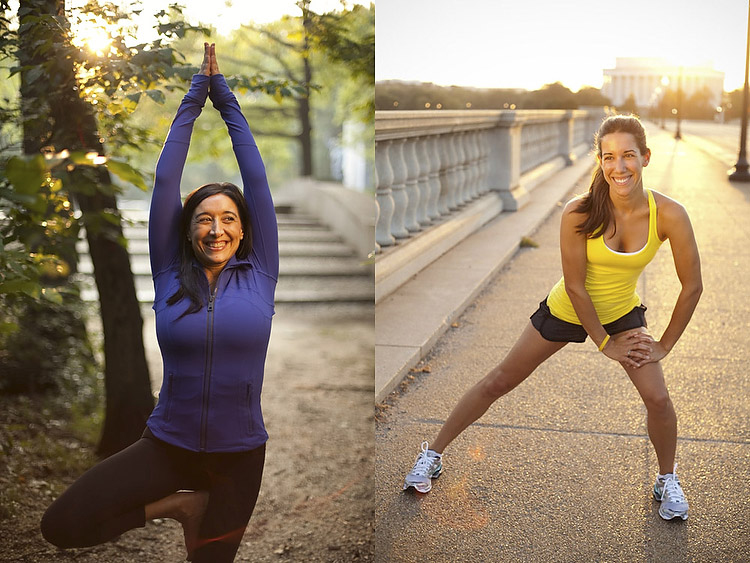
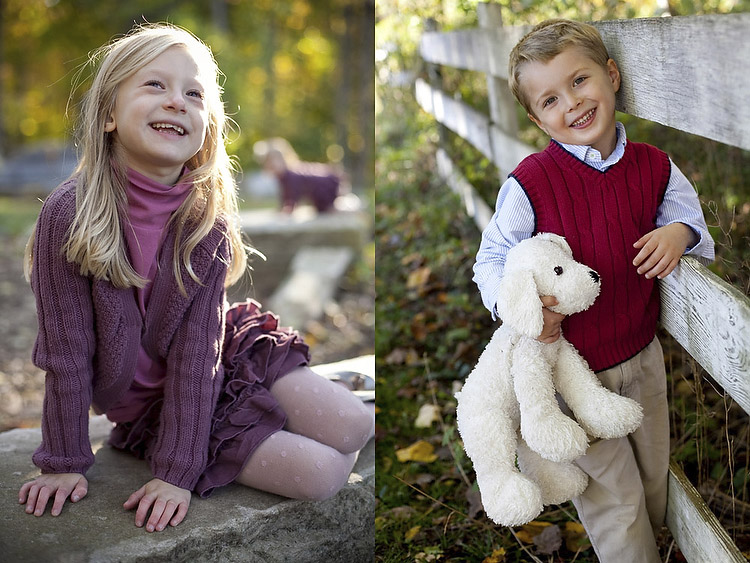
In the child portraits below, note that there is light behind the kids in both cases, but there is still beautiful light on their faces. Same goes for the athlete portraits.

athletes
using a reflector child portraits

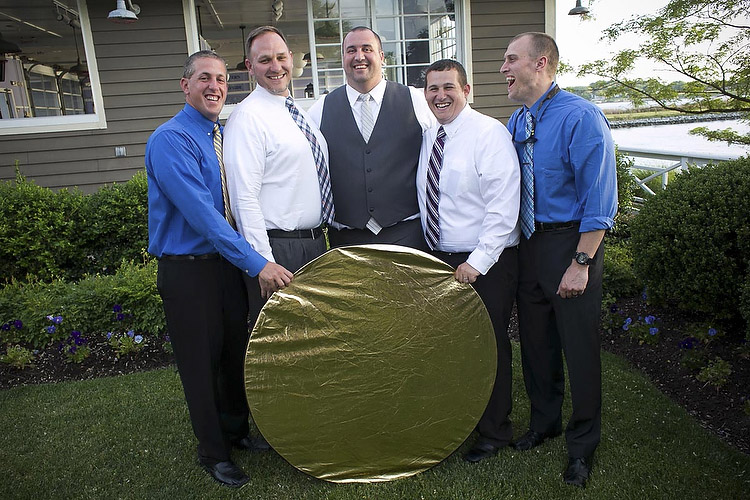
As a final image, I leave you with a group of wedding guests who were so enamored of my reflector that they wanted a picture with it. Hopefully, you will soon have similar feelings toward your own reflector!

using a reflector

Do you have any additional reflector tips to add? Please share them in the comments below!

The post 6 Ways of Using Reflector to Take Better Portraits appeared first on Digital Photography School. It was authored by Dennis Drenner.


Digital Photography School

 
Comments Off on 6 Ways of Using Reflector to Take Better Portraits

Posted in Photography


Gear Review: The Lastolite Halo Compact Reflector

08 May

The post Gear Review: The Lastolite Halo Compact Reflector appeared first on Digital Photography School. It was authored by Sean McCormack.

The Halo Compact is a new reflector/diffuser design from Lastolite (a Manfrotto company). In January, at The Societies Convention in London, I got a glimpse of the first batch on the Manfrotto stand. It looked great on display, and in the demo, it packed down really small. It was also attached to standard light stand fitting on display. As the owner of a few Lastolite products, I’m quite aware of how innovative they are, and that they do make quality products. Some of these are used day in and day out in the studio (e.g. the Hilite and the Triflector).

The Halo Compact on the Lastolite/Manfrotto stand at The Societies Convention.

Now I own a lot of reflectors. From large 5-in-1 disc reflectors to the already mentioned triflectors, to 6’X3’ frame reflectors; I even have a California Sunbounce. I’m not exactly in need of a new one, least of all something that’s well on the way to being €100 with shipping.

However, I was still interested in one major selling point – how compact it is when it is packed down. Seeing as I’d flown to the convention, I knew it would be a perfect travel reflector. I went to buy one. No luck. The small amount of stock that was in the shop at the convention was gone, so I left empty handed.

My next look at the Halo Compact in person was at The Photography Show in March. I happened to chat with one of the folks at the stand, and it turned out to be Matt Bailey. Matt had taken over from Gary Astil as a product designer, so we got chatting about the Halo, and how it solved quite a few problems.

Needless to say, I bought the diffuser version with the frame and a silver/white reflector cloth as well, to give me the best variety for shooting situations. I could have gotten the reflector with frame and the diffuser cloth if I preferred.

The Lastolite Halo Compact Reflector setup

The blue containing pouch

The Lastolite Halo Compact Reflector comes in a small, dark blue, zipped pouch. It has a carabiner to attach to a clips, belts or even belt loops. The material and finish are far better than the old royal blue material Lastolite formerly used, which tended to fray behind the zip, rendering the zip useless.

When you open the zip, it reveals what looks like a tent pole rods (but pre curled), and a fabric. You’ll also a find ¼” 20 screw back to back in the pouch so it can screw to a magic arm.

The rods are similar to tent pole, but curved.

You’ll find assembly is straightforward. Attach all the rods together. Finish the frame by pushing the two sides of the handle together in a kind of dove tail joint fashion.

The handle pushes together to make the frame rigid. It also houses a tripod fitting.

A quick glance at the handle and you’ll see the inbuilt ¼” 20 hole for a light stand in the handle. This is one of the great features of the Halo.

That’s it. It’s sturdy and firm.

To get either fabric on, you click a clip in place on either side of the handle and then clip them all on at even spacing around the frame.

The grip on the handle is great and I found it reasonably easy to hold outdoors, despite holding it in my left hand on my right side in the wind.

I’m not saying it’s not a kite, but it was far better than the floppy eBay reflector I’d used earlier that day.

Why do you need this?

So why would you bother with having this at all?

The answer is simple.

You want to have control of the light.

Here’s what undiffused evening sun looks like.

While it’s not as harsh as midday sun, it still has hard shadows and causing squinting.

By using the diffuser, the light is spread, making is softer.

Obviously it’s also lower in intensity, so you have to open your shutter to compensate.

Another typical way of shooting with evening sun is to use backlighting.

Here you can lose the direction of the light, but adding a silver reflector can bring back contrast and shape.


You could also opt for a more subtle white reflector.

Pros and Cons

Pros

  • Sturdy
  • Good modifier options with reflection and diffusion
  • Compact, perfect for travel
  • Reliable brand with known quality
  • Built in stand adaptor

Cons

  • Longer setup time than a popup
  • More expensive, but still not the most expensive

Conclusion

While a little on the expensive side compared to the eBay popups, the Lastolite Halo Compact Reflector is still an affordable product. Despite the longer setup time, I feel the compact pack means this product will live in or on my camera (via the carabiner) permanently, vs the pops that are left behind when I’m travelling more compactly.

I’ve included the downside of the price and longer setup time in my rating, but in truth, I’m delighted with this product.

Now to sell some of my other reflectors!

Have you used the Lastolite Halo Compact Reflector? What are your thoughts? Share with us and our readers in the comments below.


The post Gear Review: The Lastolite Halo Compact Reflector appeared first on Digital Photography School. It was authored by Sean McCormack.


Digital Photography School

 
Comments Off on Gear Review: The Lastolite Halo Compact Reflector

Posted in Photography


The Lastolite HaloCompact is a new reflector, diffuser with a collapsible design

13 Nov

Lastolite, a subsidiary of Manfrotto, has launched a new lighting tool it calls the HaloCompact.

The HaloCompact is a collapsible reflector/diffuser tool that comes in two versions: a double-sided reflector (with silver on one side and white on the other) and a two stop diffuser.

The defining feature of the HaloCompact is its RapidExoframe, a lightweight aluminum frame that slots together multiple sections to create a 85cm/33.5in base when fully constructed. When packed down, alongside the folding reflector/diffuser material, the HaloCompact is small enough to put inside your camera bag or attach to the outside.

The HaloCompact also has standard quarter-inch tripod threads along the frame so it can be attached to various arms and accessories for when you need an extra hand. Below is a video from Lensvid showing off the HaloCompact in person at Photokina 2018.

Both version of the HaloCompact has an MSRP of £71.95, but there’s no mention of availability and at the time of publishing this article the HaloCompact isn’t listed on the UK or US version of Lastolite’s online store. DPReview has contacted Lastolite for more information regarding US pricing and availability and will update this article accordingly when it receives a response.

Lastolite by Manfrotto Launch HaloCompact 85cm (33.5”)

Lastolite By Manfrotto, the world’s leading manufacturer of backgrounds and lighting control systems is proud to announce the launch of the HaloCompact Reflector and Diffuser.

The HaloCompact is a completely new, patent pending design concept that makes the everyday reflector and diffuser panel even more portable than ever!

Unlike many traditional reflector/diffuser panels that incorporate a steel rim pop up design, the 85cm (33.5”) HaloCompact is constructed using Lastolite By Manfrotto’s new innovative RapidExoframe™ technology. The collapsible lightweight aluminium frame quickly slots together and the reflector or diffuser fabric simply clips onto the frame. The cleverly designed RapidExoframe™ construction allows the frame to breakdown into small multiple sections and along with the folded fabric packs into a carry case measuring only 6.5 x 27 x 6.5cm (6” x 6” x 6”) weighing only 335g (reflector and case).

The ultra-compact folded dimensions make the HaloCompact the perfect solution for Photographers on the move or with very limited carrying space. It now means a reflector/diffuser can always be carried in the camera bag rather than having to consider whether to take an extra bag or not. A handy carabiner style clip also allows the user to clip the HaloCompact to their belt if out on location with their camera only and no camera bag.

The HaloCompact also features an ergonomically designed handle so it can easily be held and accurately positioned with one hand. The handle also incorporates a very useful ¼” thread (plus a ¼” to ¼” adaptor), enabling it to be easily attached to various different support systems, to offer secure positioning further away from camera position.

The HaloCompact is available in two versions – the first is a double-sided reflector, with silver one side and white the other. The second version is as a 2 stop diffuser.

The HaloCompact Reflector Silver/White (LL LR3300) has an RRP of £71.95.

The HaloCompact Diffuser 2 stop (LL LR3301) has an RRP of £71.95.

For more information, please visit www.manfrotto.co.uk/lastolite

Articles: Digital Photography Review (dpreview.com)

 
Comments Off on The Lastolite HaloCompact is a new reflector, diffuser with a collapsible design

Posted in Uncategorized


Tips for Using a Reflector the Right Way Outdoors

20 Jul

A reflector is easy to use, right? Just open it and put it under your model’s chin. WRONG!

Using a reflector may seem really simple but most new photographers make one big mistake with them. They put them in the wrong place to make flattering light on their subject.

Tips for Using a Reflector the Right Way Outdoors

In this video from Joe Edelman, see how NOT to do it, and get some tips on how to use a reflector the right way.

Items mentioned in the video:

  • California Sunbounce Mini-Reflector – $ 149
  • 32″ Soft white/silver reflector by Rogue – $ 29.95

Find other dPS articles about reflectors here:

  • 6 Ways of Using Reflector to Take Better Portraits
  • 10 Ways to Use a 5-in-1 Reflector
  • Tips for Using Reflectors to Create Beautiful Portraits
  • DIY How to Build and Use a Reflector to Take Better Portraits
  • Choosing the Right Color Reflector for Your Photography

The post Tips for Using a Reflector the Right Way Outdoors appeared first on Digital Photography School.


Digital Photography School

 
Comments Off on Tips for Using a Reflector the Right Way Outdoors

Posted in Photography


The Power of Shooting Simply with One Light and a Reflector

12 Jun

In this article, I’ll give the virtues and benefits of shooting simply, with only one light and a reflector.

Lighting is often perceived as a complicated beast, but does it have to be? Sure, in terms of technical aspects, there’s an awful lot to learn before you can truly master lighting. There are also plenty of techniques that involve numerous light sources at various power outputs, rigged together with any number of modifiers.

But are these necessary? If you want to learn every aspect of lighting inside and out, then the answer is yes. However, when you are a beginner, I would argue that it’s far too easy to get bogged down in those complications when in reality, you could conceivably go an entire photographic career without touching them.

One light

The Power of Shooting Simply with One Light and a Reflector - b/w portrait of a lady

With a single light source and a reflector for fill, you have enough creative options in terms of lighting that you could go an entire lifetime with nothing more and still fill a diverse and varied portfolio. Technically the reflector is a second light source if you want to get into that, but it’ll be referred to as a reflector for our purposes here.

You may not want to and it’s more than likely that once you’ve got the basics of lighting down, you’ll want to dive deeper and deeper until you get to those ultra complicated set-ups, but it is possible. One light set-ups can give you both dramatic, shadowy photos which ooze mood as well as bright, cleanly lit images with plenty of detail throughout.

The Power of Shooting Simply with One Light and a Reflector - 6 images of portraits of ladies

On top of that, there’s only one light to set up, only one light to modify and only one light to meter. If you’re working with limited time, say 20 minutes to set up, take a few shots and get out of there.

Four, five and six light set-ups just aren’t going to be an option. Of course, it’s also a whole lot easier to lug around one light then it is to take five.

Terms you need to know

This article will cover examples that are based in a studio where all ambient light is cut out (with one exception) and bounce is controlled through light placement or flags. As such, the light and the reflector are the only things lighting the images and each has its own respective role.

Key Light – The key light is your main light source. In these instances, it’s the actual strobe. It could just as easily be any other type of light source such as a window or a street light. This is the main light that you will be shaping your subject with.

Fill Light – In these examples, the fill light is the job of the reflector. When placed opposite the key light, the reflector bounces light back onto your subject and fills in the shadows. This helps to reduce contrast and also tends to lead to more flattering images of human subjects. A fill light does not have to be a reflector. Again, it could be any light source that acts independently of your key light to fill in shadows on your subject.

Reflector

The Power of Shooting Simply with One Light and a Reflector - studio setup with one light and a reflection

In all of these examples (except one that’s annotated), the reflector used is a large, cheap 5-in-1 reflector. You can buy one of these from just about anywhere that sells photo equipment for around $ 20 or less. Sure, there are expensive versions, but in my experience, they’re not worth the extra money. Get a good sized (32″ or 42″) cheap one and take it everywhere. Don’t be too precious with it and let it get dirty, battered and warped through use. They’re easily replaced.

If you don’t want to buy one, reflectors are pretty easy to make. White foamcore, posterboard, cardboard painted white, or a styrofoam insulation are all easily turned into reflectors.

Modifiers

Since the specific focus of this article is portraits, all of the modifiers used range from fairly big to huge. This is so that the light was as soft and flattering as possible. You can absolutely use a single hard light source with a reflector, so don’t consider the absence of examples of hard light here to be some kind of rule against it.

Example 1

The Power of Shooting Simply with One Light and a Reflector - color portrait of a lady

This shot is about as simple as it gets. The subject was placed a few feet from the background. The light source was a 5-foot octabox which was placed at forty-five degrees from the subject. The distance of the light was determined by watching how the modeling light fell on the subject and where the catchlights were in her eyes. It ended up about five feet away.

The Power of Shooting Simply with One Light and a Reflector - studio setup behind the scenes shot

Because the octabox is quite a big modifier, it would have been possible to get away without using a reflector. The soft light the large modifier produces would wrap around the subject in a pleasing way. It also means that the subject could turn and face any direction she wanted for posing.

Regardless, I still chose to add a reflector to bring up the shadow side. It was placed as close to the subject as possible so as not to interfere with composition.

Example 2

The Power of Shooting Simply with One Light and a Reflector - dark moody portrait

Much like the first example, this image was created with the light source at a 45-degree angle to the subject. This time, the modifier was a mid-sized 2×3′ softbox.

To get the softest quality of light, it was placed as close as possible to the model without interfering with image composition. There are few things as annoying as having to retouch the corner of a softbox or a beauty dish out of every frame.

The Power of Shooting Simply with One Light and a Reflector- lighting setup

This time, the reflector was turned slightly away from the light source. This was because I didn’t want the full surface area of the reflector to be filling in the scene as I wanted to retain some of the dramatic lighting that the single smallish light source provided.

Example 3

The Power of Shooting Simply with One Light and a Reflector - two images of a girl in studio

This is exactly the same set up as the previous example, all that changed here was the modifier.

The softbox was exchanged for a beauty dish to increase contrast and add drama. The reflector was turned slightly so that it had maximum impact on the shadow side.

The Power of Shooting Simply with One Light and a Reflector - lighting setup in the studio

Example 4

The Power of Shooting Simply with One Light and a Reflector - b/w images in the studio

To really take advantage of the contrasty lighting possible with one light, I opted for a large, gridded beauty dish in this example. Again, placed at forty-five degrees (notice a pattern here?), the light fall-off is much more abrupt than here, as compared with the bigger softboxes.

The Power of Shooting Simply with One Light and a Reflector - dramatic studio setup

At 120 cm, this particular beauty dish is quite a bit larger than normal. As such, it is still quite soft, with a bit more wraparound than its smaller, more normal sized siblings.

A silver reflector was added to bring up the shadow side of the subject in order to ensure separation from the background and to keep the shadows from becoming pure black.

Example 5

The Power of Shooting Simply with One Light and a Reflector - lighter portrait of a girl

In a previous article, I wrote that you may very well never use a gold reflector. I’ve been thinking about that a lot since I wrote it and endeavoured to do exactly that. Instead of using the gold side of a normal 5-in-1 reflector, I used a Westcott Omega reflector, on which the gold is far subtler and less intrusive, making it much, much more flattering for portraits.

The key light in this image was a five foot octobox. If you look at the catchlights, you will see two other light sources. To camera left, there was a wall of windows which was underexposed by a stop to act as fill. To camera right is the gold reflector.

By adding a single light source to the ambient light, you get an incredible amount of versatility of what you can achieve.

Example 6

The Power of Shooting Simply with One Light and a Reflector - studio portrait

This image was created exactly the same way as the previous one with the same octabox and the same gold reflector. This time, however, the power output of the flash was turned up so that it killed the ambient light from the windows. The reflector was also placed slightly to the rear of the subject in order to bring detail back into her hair.

The Power of Shooting Simply with One Light and a Reflector

Example 7

The Power of Shooting Simply with One Light and a Reflector

One technique that I really love is to place the light source directly in front of the model (it’s okay to move it to the side a bit so that you can shoot past it) and as close as possible. With a single light, this can create some lovely, dramatic images. This was done with a large beauty dish.

The Power of Shooting Simply with One Light and a Reflector

The white reflector was placed flat and rested on the subject’s knees. This results in a makeshift clamshell technique, but instead of two lights, you’re only using one.

Wrap-up

I could go on and on and on about this. The point here is to remind you to never forsake the power of simplicity when it comes to lighting techniques.

Sure, those set-ups with half a dozen lights, three reflectors, nine flags, your neighbor’s dog and a Swiss passport are great and you should absolutely explore them. Just be mindful that not every job has to rely on such complexities. Stripping things back to basics can, and does yield wonderful results.

Tips

Here are a few tips and trick to help you get the most out of your single one light source set-ups:

  • For portraiture, get the light in close. The larger the apparent light source, the softer the light. The softer the light, the more flattering it is for the subject.
  • Don’t just introduce a reflector blind and leave it there. Watch what it’s doing. Use modeling lights and learn to see the subtle differences the reflector creates. It’s hard at first, but with practice, you’ll start seeing the changes.
  • Meter with and without the reflector. As the reflector is acting as an independent light source, you can meter its exposure. If you want a specific ratio, or you know you want your fill two stops underexposed, meter it.
  • Don’t be afraid to turn the reflector at funny angles. If it’s a large reflector, in particular, you probably don’t want or need the whole surface area in use. Turn it any which way that provides the effect that you’re looking for.
  • You don’t shoot with off-camera lighting. So what? All of this applies to window light as well. A light source is a light source.
  • Don’t have a reflector? Buy one right now. Seriously. Stop what you’re doing and order one right now. They’re important and they’re not expensive. Godox sells one for less than $ 15.
  • Use these techniques on anything. I’m a portrait photographer, so the focus here has been portraits. But every single aspect covered here can be used when lighting any subject at all. Flowers? Check. Animals? Check. Food? Check.

Conclusion

In terms of variations on these techniques, this article hasn’t been anywhere near comprehensive. Honestly, using a single light and a reflector will give you an infinite variety of techniques to use in your photography.

When you’re starting out, I strongly encourage you to explore these as much as possible before moving on to more complicated set-ups as you may find, that most situations would benefit from the simplicity.

The post The Power of Shooting Simply with One Light and a Reflector appeared first on Digital Photography School.


Digital Photography School

 
Comments Off on The Power of Shooting Simply with One Light and a Reflector

Posted in Photography


How to Use a Reflector to Improve Your Natural Light Portraits

20 Aug

Reflected light can add depth and a fresh dynamic to your natural light portraits. Sometimes naturally occurring reflected light can be used, but by far the easiest way is to use a reflector. The most important thing is to learn to see the light falling on your subject and then control the strength and quality of the reflected light you are adding. Here are some tips to help you learn to use a reflector.

Hmong woman drying skeins of hemp thread outdoors - How to Use a Reflector to Improve Your Natural Light Portraits

Hmong woman drying skeins of hemp thread which are reflecting light back onto her face.

Naturally reflected light

When making candid portraits, I’m always looking to see if some reflected light is affecting my subject. At the right angle, any surface can bounce light back onto your subject. You can train your eye to see it.

It may be light bouncing off a nearby wall or pavement, an open newspaper or skeins of yarn (as in the photo above). With the strong sunlight behind the lady as she hangs out her skeins of washed thread, the light is reflecting softly back into her face.

Thai woman holding a bamboo tray of steamed fish - How to Use a Reflector to Improve Your Natural Light Portraits

A fish vendor at the fresh market with light reflecting onto her from an adjacent white wall.

Naturally reflecting light is easier to make use of if you are posing your subjects and have some control over where they are positioned. Finding a location where the sun is hitting a large light-toned neutral surface can provide you suitable reflected light for portraits.

In this photo of the fish vendor at the local fresh market, the light is reflecting off a white painted building behind me. Behind her is an open entrance to a room with no windows, providing a dark background to nicely isolate my subject.

Types of reflectors

Close up of a Kayan long neck girl with traditional face painting, make-up

Close up of a Kayan long neck girl with traditional face painting makeup.

When there’s no naturally occurring reflected light, a folding reflector is a fabulous accessory to have on hand. These reflectors are relatively inexpensive and come in various shapes, sizes, and colors. The most efficient are the ones which have multiple reflective surfaces.

Note: you can even DIY and build your own reflector.

These reflectors typically have a sleeve which covers a translucent fabric attached to the foldable frame. The sleeve is removable and reversible with four different surfaces (5-in-1 reflectors). Normally they are white, silver, gold, and black. Some even have more complex reflective surfaces. Learning to use this type of reflector well can take some practice, but it’s worth while for the fresh dynamic lighting it will bring to your portraits.

How to Use a Reflector to Improve Your Natural Light Portraits

One of my models assisting me during a portrait session.

How to use a reflector

Having someone to hold the reflector is the best way to use it as the direction of light and angle of the reflector in relation to your subject is important. If the reflector is not at the best angle you will have too much or too little light bouncing onto your subject. You may need to coach whoever is assisting you and demonstrate the effect the reflector has, so they can hold it precisely right for the best lighting.

Careful choice of reflective surface for whatever light you are working in is important too. If you are making portraits outside in full sunshine the use of the white reflector surface may be best. It’s likely the silver or gold surfaces will reflect too much light back onto your subject. Don’t be afraid to experiment though, as that is a great way to learn.

KAren Woman Smoking Her Pipe against a black background

Karen Woman Smoking Her Pipe against a black background.

Using a reflector in bright sunlight

In the bright sunshine, the person holding the reflector needs to be careful not to bounce strong light into your subject’s eyes as they are searching for the best angle to hold the reflector. That can be most uncomfortable for your subject. It’s a good idea to instruct your subject not to look directly at the reflector. If they have not seen a folding reflector before many people will look at it as it is unfolded.

Two long neck Kayan ladies laughing together in a village in Thailand - How to Use a Reflector

With this photo of the two laughing ladies, my wife was using a medium sized gold surfaced reflector. She is an expert assistant and photographer so she knows how to get the optimal reflected light in most situations. My subjects were standing in the shade of a tree and the reflector was also in the shade, so it was not bouncing back full sunshine.

I find the gold surface works well with Asian skin tones. With the strong back light, the bounce light fills in the shadows nicely reducing the over all tonal range in the photo. Because the reflected light is stronger on the ladies faces, (where I was taking my light reading from,) it is more balanced with the light in the background. The bright sun reflecting off the light colored ground also adds nicely to this photo. If my wife had been standing so the gold reflector was in the full sunshine the light would have been too bright and harsh, blinding our models and creating hard shadows on them.

How to Use a Reflector

Reflecting light to balance with the ambient light can reduce shadows without eliminating them.

Using a reflector in soft light

On overcast days a silver reflector will bounce a clean, soft light onto your subject. If you can position your reflector so it balances with the ambient light, gently filling in shadows on the face but not completely eliminating them, you can obtain some very pleasing results.

Varying the angle of the reflector in relation to the light source and your subject will vary the amount of light affecting your subject. You do not need to always have the reflector blasting out the maximum amount of light as this can look very unnatural. Using the white surface rather than the silver side will also reduce the amount of reflected light.

Senior Pwo Karen woman smoking a pipe against a black background - How to Use a Reflector

With the sun behind the model, an overhead diffuser and reflector to my left and the ground also reflecting light.

Other uses for reflectors

Black or white surfaces of very large reflectors can make great backgrounds and the translucent inner part can be used as a screen to hold above your subject to block direct sunlight. In the past, I have used this method but now prefer to use my *portable daylight studio to provide a black or white background and filtered back lighting, (in principle it’s the same thing.) I then use my large folding reflector to help control the light on the front of my subjects.

Sunlight also reflects off the ground. Typically in a northern Thai village, the earth is a light color and creates a pleasing reflection. But if I have to work on grass we lay down some large sheets of white plastic to avoid having a green color cast in the images.

*Reading Irving Penn’s book “Worlds In A Small Room” was the inspiration for my portable studio which I have used in many locations in the mountains of northern Thailand and occasionally when teaching our workshops.

Portrait on a black background of a senior Pwo Karen man - how to use a reflector

A careful balance of reflected and diffused light.

Conclusion

As you practice using a reflector you will learn to manipulate just the right amount of light onto your subject. At times you might prefer hard light and other times soft light will be more pleasing. Learning to see how light affects your subject and learning to control it will greatly improve your portraiture.

The post How to Use a Reflector to Improve Your Natural Light Portraits by Kevin Landwer-Johan appeared first on Digital Photography School.


Digital Photography School

 
Comments Off on How to Use a Reflector to Improve Your Natural Light Portraits

Posted in Photography


How to Photograph People Outdoors Without Using a Reflector

28 Apr
How to Photograph Outdoors Without Using a Reflector

Subject: Kota Wade

You just got booked for a marvelous portrait photo shoot out in a gorgeous natural landscape. You run out the door, with camera gear in tow. Then you arrive at the location, the fresh air filling your nose, the beautiful natural world flourishing all around. You meet with your lovely portrait subject. The sun is beating down on you from above. Then it hits you… you forgot your reflector at home.

Or maybe you don’t have a reflector, maybe you just never felt the need to spend money on one. All of this is totally okay because there are some tips and tricks to take stunning photographs without the use of a reflective disc! Keep reading to learn more.

How to Photograph Outdoors Without Using a Reflector

Subject: Bina Monique

What is a reflector?

A reflector is a simple tool that redirects existing light. A reflector does not illuminate, it merely allows you to manipulate the light that you already have.

Photographers use reflectors to fill shadows, which is why you often see them used in outdoor settings where you cannot control the light. Being at the mercy of the sun, you add a level of control to your situation with the use of a reflector. However, there are ways to take advantage of your situation without one.

How to Photograph Outdoors Without Using a Reflector

Subject: Skylar Roberge

Find even lighting

Essentially, part of the trouble with shooting outdoors comes from the lighting. Clients often see a clear blue sky with the beaming sun and think that is an absolute joy for photographers. But we shooters silently scream in agony at the prospect of overblown highlights, underexposed shadows, and the dreaded contrast.

What’s the best solution for this? Find some even lighting!

Positioning your subject under a tree, in the shadow of a building, or simply positioning yourself so that the sun hides behind a mountain can all make for some nice even lighting. Although the background might be overexposed if you are simply using a small patch of shadow, try to change your perspective to make the most of the situation.

How to Photograph Outdoors Without Using a Reflector

ISO 400 – Shutter Speed: 1/100 – Aperture: f/2.8
Even Lighting: Rooftop overhang

Make even lighting

Are you out in a field or a desert and don’t have access to any form of even lighting? Is the sun too bright to have on your subject’s face? Then it’s time to get creative!

You can make your own even lighting utilizing things you may already have in your car. Use an umbrella and position that over your subject, or to block out the sun in your frame. You can use a vehicle windshield cover or shade to do the same.

How to Photograph Outdoors Without Using a Reflector

ISO 1250 – Shutter Speed: 1/500 – Aperture: f/2.8
Even Lighting: Umbrella

Use the contrast to your advantage

Are neither of the aforementioned tips applicable to your scenario? Well then, this is where we get inventive.

Photography is an art form, and artists are creative, imaginative, and inspired. Instead of fighting against the contrast, why not use it to your advantage? Work your shoot around the contrasting shadows and highlights, and create dramatic photographs. Several well-known clothing designers, such as Prada and Dolce & Gabbana, use contrast in their fashion editorials to stage a theatrical scene and illicit an intense response in the viewer.

How to Photograph Outdoors Without Using a Reflector

ISO 200 – Shutter Speed: 1/1000 – Aperture: f/2.8

Shoot at the right time of day

When a choice presents itself, shooting at the correct hour of the day can ease your lighting woes. The golden hour is infamous for being an excellent time to photograph. Aiming to photograph when the sun is low and producing a more even light removes the need for a reflector.

How to Photograph Outdoors Without Using a Reflector

ISO 1600 – Shutter Speed: 1/640 – Aperture: f/2.8

Fill shadows by finding a natural reflector

Various surfaces can double as reflectors, such as water or windows from a building. Positioning your model just right can garner the same effect as if you had a reflector yourself.

How to Photograph Outdoors Without Using a Reflector

ISO 2000 – Shutter Speed: 1/320 – Aperture: f/2.8
Reflector: Car windshield, parked to his right side

Fill the shadows in post-processing

The computer is your friend, and it is okay to use programs to help you bring your vision to light (no pun intended). Shooting in RAW format (an image file that contains minimally processed data from the image sensor of a camera – Raw files are named so because they are not yet processed) gives you better control over your image when you edit it. RAW files have more shades of colors compared to JPEG files, higher image quality, significantly better control over editing lightness, white balance, hue, saturation, etc., and all of the changes made on a raw image file are non-destructive. You can use any post-production software to lighten the shadows in your image and darken the highlights.

Original image before processing.

How to Photograph Outdoors Without Using a Reflector

After processing.

There you have it, sounds like you have a solution to your no-reflector problem.

The post How to Photograph People Outdoors Without Using a Reflector by Anabel DFlux appeared first on Digital Photography School.


Digital Photography School

 
Comments Off on How to Photograph People Outdoors Without Using a Reflector

Posted in Photography


Westcott introduces one-of-a-kind Omega 360, a 15-in-1 reflector

09 Feb

Photography lighting accessory company Westcott has introduced a new Omega reflector product, the 15-in-1 Omega Reflector 360. Unlike the previous Omega reflector, this model offers 15 different usage scenarios, a world’s first according to Westcott. The reflector features a removable 13in / 33cm center disk, as well as multiple diffusion fabrics (white, silver, sunlight, black and 1-stop), a hanging hook, and a carrying case.

The Omega Reflector 360 is a 40in / 102cm ring-shaped reflector made with a spring steel riveted frame, pure white and black nylon, and double-laminated reflective cloth. The unit weighs only 2.5lb / 1.1kg, and can be collapsed down to a third of its open size. The 13in inner disk attaches to the reflector ring using Velcro.

Westcott is offering the Omega Reflector 360 now through its website for $ 130.

Articles: Digital Photography Review (dpreview.com)

 
Comments Off on Westcott introduces one-of-a-kind Omega 360, a 15-in-1 reflector

Posted in Uncategorized


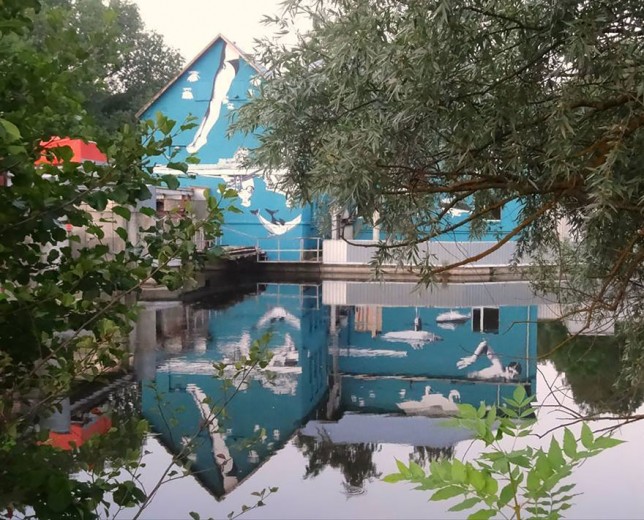
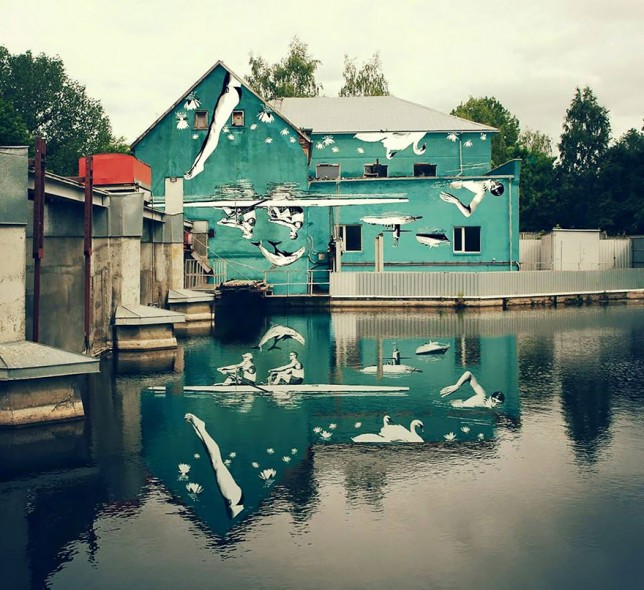
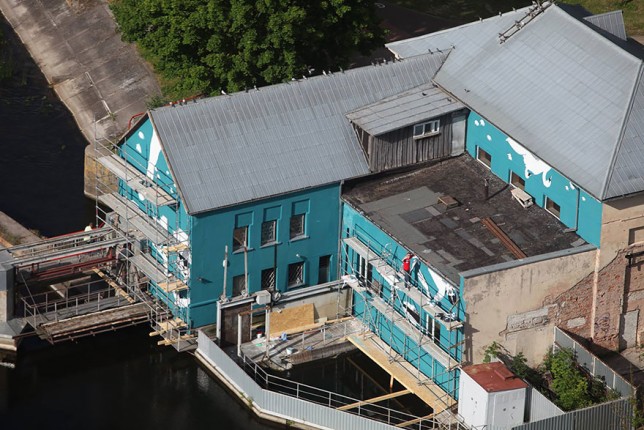
Just a Reflector: Upside-Down Mural Looks Right in the Water Below

18 Oct

[ By WebUrbanist in Art & Drawing & Digital. ]

mural painting actual

Designed to look right-side-up when reflected off the water below, this series wall murals features a series of nautical themes, including depictions of swimmers, rowers and swans. While the image above is accurate and untouched, a modified photo (shown below) shows a more idealized version that does not really reflect reality.

photoshopped reflective water mural

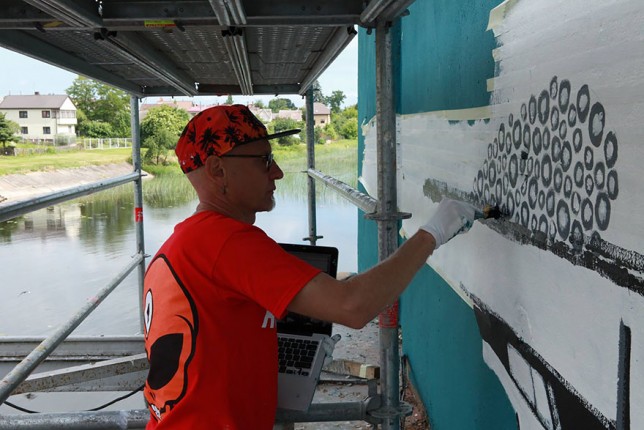
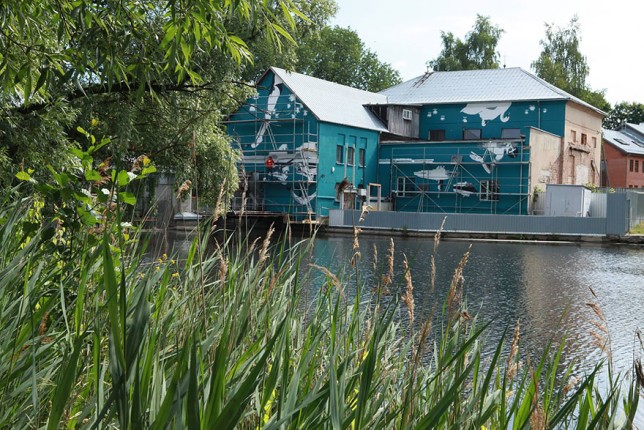
New York-based Ray Bartkus made this mural for the Lithuanian city of Marijampole, set alongside the river Šešupe, which flows through the city’s center. The artist is known for other works that rely on mirrors and reflections as well.

mural artists work

mural under construction

mural painting process

A bit like a trompe l’oeil illusion, the viewer’s position changes the composition, and their is an ideal spot for the optical effect in relation to the various vertical planes onto which the murals were painted.

Share on Facebook


[ By WebUrbanist in Art & Drawing & Digital. ]

[ WebUrbanist | Archives | Galleries | Privacy | TOS ]


WebUrbanist

 
Comments Off on Just a Reflector: Upside-Down Mural Looks Right in the Water Below

Posted in Creativity


6 Ways of Using Reflector to Take Better Portraits

03 Jul

I’ve been making my living as a photographer for over 20 years, and have accumulated thousands of dollars of gear over time. I have the latest Canon SLRs, a full complement of lenses, strobes, light stands, gels, filters, soft boxes, tripods, and even some video and audio gear. But the one thing that often makes the biggest difference in the quality of my portraits is a simple $ 20 reflector. I never leave home without it and neither should you.

When shooting outdoor portraits, the first thing many photographers think about is the background, but the pros consider the quality of the light first and foremost. They know, for example, that a portrait with nasty overhead lighting is not going to work, no matter how cool the background.

Photo12

A reflector can help you salvage bad light, and turn okay light into something magical. You can use your reflector from below to fill in shadows, or from above to block distracting light. You can bounce the sun from the silver reflector to create a main light, or you can use a reflector with a black side to create deeper shadows. You can even sit on your reflector to keep your pants clean when shooting outside, or pop it open dramatically to dazzle young children.

Most of the photos in this article were shot with a 5-in-1 reflector you can buy for less than $ 20. 5-in-1 refers to the fact that the reflector and cover can combine to give you five different options: white, silver, gold, and black sides, as well as a diffuser.

Here are 6 tips to help you use this versatile tool, a reflector, to transform your photos.

1. Using a Reflector for Fill Light

The most traditional use of the reflector is to simply reflect light into the shadows. I took my wife Karen out into our local park to demonstrate this.

Photo1

In the photo on the left (above), she is photographed in nice soft light, but there are still pretty deep shadows under her eyes and chin. In the photo on the right, she is holding a reflector at her waist. The shadows on her face are noticeably lighter and there is a subtle catch-light (reflection of the reflector) in her eyes. If she were an older person with more textured skin, the contrast would be even more dramatic.

Photo2

Of course, you may not always want to fill in the shadows in this way, but if you are trying to flatter someone it almost always helps. You don’t even need an official photo reflector. Anything that reflects light will work. In a pinch I’ve used everything from old newspapers to a nearby person wearing a white shirt.

2. Using a Reflector as the Main Light Source

This is one of my go-to reflector moves, and an easy way to wow your friends and family. You place your subject with the light hitting them from behind, then use a reflector to bounce the light back into their face. You will get nice soft light on their face, with a dramatic rim light on the back of the subject’s head. The only trick is positioning yourself so the light doesn’t go straight into your lens and create lens flare (unless you like that look, of course).

Photo3

In the photo above the is sun hitting the left side of her face and arm. The light from a reflector is bouncing back some of the sun to light up her face.

You may also notice the shallow depth of field in this photo. If you are lighting with a reflector, you can jack up your shutter speed as much as you like to allow for a wide aperture (this photo was shot at 1/1250th of a second at f/2.0, with a 50mm lens). If you were using flash to create this same effect, you would have to lower your shutter speed (to 1/250th or whatever matches your camera’s maximum) to sync with the flash, requiring a larger aperture and greater depth of field (killing the whole look).

Yes, yes, some of you are no doubt thinking, “What about high speed sync?!” Well, yes, that could give you the same effect if you had the right equipment (and know how to do that). Or, you know, you could just use an old newspaper.

Photo4

In the next example above, we positioned Karen against a tree and had her cousin Claudia reflect a spot of sunlight on her from about 10 feet away. At this distance, the light from the reflector looks more like it is coming from a grid spot or snoot (hard light) – in other words, it’s a focused and dramatic beam (notice the fall-off of light on her legs). It’s a cool look that you can recreate with a reflector, a few feet of aluminum foil, or your bathroom mirror. Your friends will be wowed, and ask what fancy gear you used for the shot (and your family will ask what happened to the bathroom mirror).

Using a slight variation of this technique, we moved the reflector slightly behind the subject (relative to the camera) to created a dramatic rim light on the face in a profile shot (see below).

Photo4a

3. Using a Reflector to Block Light

Sometimes you’ll find yourself in some beautiful shady light under a tree, except for that pesky sunbeam that finds its way through the leaves to light up your subject’s left ear. When this happens, turn your reflector into a light blocker (sometimes called a flag or gobo).

A few years ago, I was doing a maternity portrait in a local park, when a newspaper photographer snapped my picture using just this technique. If you look at the reflector, you can see the bright spots of sunlight that it’s blocking (imagine how those spots would have ruined the final image if we didn’t block them).

Photo5

Photo6

4. Using a Black Reflector to Create More Dramatic Shadows

Sometimes you actually want to deepen the shadows. I use this technique all the time in my headshot studio. Below is a photo of me with a white background. In one shot, I have a silver reflector opposite the main light, sending light back towards my left cheek. In the other, the reflector has a black cover on it, gobbling up reflected light, leaving a dark shadow on the cheek.

Photo7

Photo8

Except for the small change of literally flipping the reflector from one side to the other, the lighting setup is identical, but as you can see the difference is pretty dramatic. (For you studio lighting enthusiasts out there, my key light here is a large soft box, and there are two bare heads pointing at the background to make sure it is nice and bright white).

This is the same technique used in the famous Steve Jobs portrait where he has his hand on his chin. In addition to creating a little drama, you can also use this technique to give someone a photographic face-lift by trimming pounds from the dark side of their face and under their chin.

5. Who Holds the Reflector?

You may be saying to yourself, “But, I don’t have an assistant! Who’s going to hold the reflector for me?”. I usually don’t have an assistant either, but there is usually someone nearby who is more than happy to help, be it a family member, passerby, intern, wedding guest, etc. Sometimes you can even have the subject of the photo hold the reflector themselves (as in the photo of my wife holding the reflector at her waist in the photo above). Of course if you’re in the studio, or outside on a day without too much wind, you can just pop your reflector onto a light stand (like in the studio shots of me above).

In the photo below, I was shooting wedding portraits on a beach in the Florida Keys. My reflector assistant that day was one of the bridesmaids, who truly enjoyed helping her friends out with their portraits.

Photo9

Photo10

6. Reflectors in the Environment

Once you get the hang of reflectors, you’ll probably start noticing reflected light everywhere. Ever see a white building getting blasted by the sun? Well that’s nothing but a giant reflector! Depending on what’s around it, you may have found yourself a giant studio, with no rental fee.

Mind you, anything that reflects enough light can work as a reflector. A brick building, large truck, flock of seagulls flying by at just the right moment…

Final Notes

Although they may not be as sexy as strobe kits, reflectors can often yield similar, or superior results for your portraits, and are cheaper and easier to use. I will leave you with a few more assignment photos, shot using nothing more than a reflector.

In the child portraits below, note that there is light behind the kids in both cases, but there is still beautiful light on their faces. Same goes for the athlete portraits.

Photo11

Photo12

As a final image, I leave you with a group of wedding guests who were so enamoured of my reflector that they wanted a picture with it. Hopefully you will soon have similar feelings towards your own reflector!

Photo13

Do you have any additional reflector tips to add? Please do so in the comments below.

googletag.cmd.push(function() {
tablet_slots.push( googletag.defineSlot( “/1005424/_dPSv4_tab-all-article-bottom_(300×250)”, [300, 250], “pb-ad-78623” ).addService( googletag.pubads() ) ); } );

googletag.cmd.push(function() {
mobile_slots.push( googletag.defineSlot( “/1005424/_dPSv4_mob-all-article-bottom_(300×250)”, [300, 250], “pb-ad-78158” ).addService( googletag.pubads() ) ); } );

The post 6 Ways of Using Reflector to Take Better Portraits by Dennis Drenner appeared first on Digital Photography School.


Digital Photography School

 
Comments Off on 6 Ways of Using Reflector to Take Better Portraits

Posted in Photography