RSS
 

Posts Tagged ‘Project’

Enfojer project turns your smartphone into an enlarger for B&W prints

08 Sep

enfojer-1.jpg

Billed as a way to bring back the romance of the darkroom in the smartphone era, Enfojer is an indiegogo project which promises to make your smartphone into an enlarger to create real prints. Part app and part hardware, Enfojer enlarges the image displayed on a smartphone’s LCD, projecting it onto real photo paper to create genuine darkroom chemical prints. Click through to connect.dpreview.com for more on Enfojer’s efforts to bring smartphone photography into the darkroom.

News: Digital Photography Review (dpreview.com)

 
Comments Off on Enfojer project turns your smartphone into an enlarger for B&W prints

Posted in Uncategorized


15-Year Photo Project: Construction of a 150-Year Bridge

27 Aug

[ By WebUrbanist in Architecture & Public & Institutional. ]

joseph blum bridge photo

A photography project well over a decade in the making, these images by Joseph Blum show the human side and vast scale of construction behind the world’s largest self-anchored suspension bridge, slated to open this Labor Day Weekend in San Francisco and built to last for one hundred and fifty years.

blum bay bridge

Blum has a 25-year professional background in construction that informs his work but also gives him credibility with workers, enabling him to take close up and personal shots on site. He routinely braved dangerous heights with camera in hand, given remarkable behind-the-scenes access that in turn required extensive gear and safety precautions.

blum bridge above below

In the following interview with WebUrbanist, Joseph Blum goes into detail about his intentions, approach and what he learned about construction, photography and himself through this long and epic photographic journey.

blum bay construction workers

Notably, almost (if not every) image in the resulting series has a human element. “My intention on this job  and in all of my work is to document and honor the human labor involved in the project,” Blum explains. In this case, he “attempted to photograph the construction labor processes insofar as it was possible from the perspective of the workers actually doing the work” in order ” to show how they take the engineers’ plans and drawings and transform them into living structures of steel and concrete.”

blum san francisco series

Then there is the time frame of the project itself, spanning over a decade during which time there has been a massive shift from traditional film toward digital photography. Blum walks us through the timeline and his own transitions: “When I began this project I was shooting black and white film exclusively and did not believe that would ever change. During the course of the project digital photography burst on to the scene and became ever more sophisticated. I began shooting digital on the job as a supplement, but over time I began to rely upon it more and more.” Eventually, he started “to understand that in photography what is most important is the image and whether it is captured on black and white or color film or digitally is secondary.”

blum bridge construction detail

But the learning process also went beyond technical choices: “I also learned a great deal more about bridge construction and the work processes of the various trades.” Blum ended up “hanging out with the work groups for extended periods of time, forming relationships with the workers, getting to understand how they organized their work and their work relationships,” which in turn “increased my understanding of how this kind of labor is accomplished and also allowed me get images that no one else could.”

blum interview building detail

On a personal level, perhaps this photographer also found a secret to longevity in those high-flying spans overlooking the city: “Although the years went by and I got older, I felt that the project kept me young. photographing the bridge in the middle of the beautiful San Francisco bay required me to carry a substantial photo bag, to do a great deal of walking and climbing in all kinds of weather and i found that every single day that i went out to shoot was invigorating and energizing.” For more information about his work and exhibitions, as well as more images, click here to visit Joseph Blum’s website.

Share on Facebook


[ By WebUrbanist in Architecture & Public & Institutional. ]

[ WebUrbanist | Archives | Galleries | Privacy | TOS ]


WebUrbanist

 
Comments Off on 15-Year Photo Project: Construction of a 150-Year Bridge

Posted in Creativity


Faded dream: blogger looks back at the failure of the Silicon Film project

20 Aug

SiliconFilm.png

In the early days of digital photography a small American company, Imagek, started developing a digital sensor module that could be installed in film SLRs. The idea still generates excitement today, more than ten years after the company (by then named Silicon Film) failed. Photographer and blogger Olivier Duong has taken a look back at the promise and disappointment of the Silicon Film dream.

News: Digital Photography Review (dpreview.com)

 
Comments Off on Faded dream: blogger looks back at the failure of the Silicon Film project

Posted in Uncategorized


Teen photographer puts surrealist spin on summer photo project

13 Jul

iankomac3.jpeg

With summer finals out of the way, 17-year-old photographer Ian Komac has devoted his newfound free time to a photo project. Called 60 Days of Summer, the Belgian teen’s manipulated photos give landscapes and everyday objects a whimsical twist. Click to see more of his photos and gain a little inspiration for your own summer photo project.

News: Digital Photography Review (dpreview.com)

 
Comments Off on Teen photographer puts surrealist spin on summer photo project

Posted in Uncategorized


silent tapes- Klong Toei project by silent tapes

11 Jun

When we stepped foot onto Bangkok’s Klong Toey slum, we had no idea what to expect or what we were getting ourselves into. A juxtaposition of feelings is what would best describe us at that moment. The further we delved in, the more we became overwhelmed by the lives and the spirit of its people. Life seemed so surreal there and somehow living with close to nothing seemed acceptable. It was absolute functioning chaos but shed a light on the excessive lifestyles of not just the west, but of people all over the world who cannot fathom living without the many luxuries they have.

silent tapes1

The railroad tracks were cluttered with tiny wooden shacks, most of them falling apart with little or no windows at all. Families and friends were gathered around in circles, having a beer or two and sharing food. Children played on what seemed to be a perfect playground for their curious little minds; throwing fistfuls of dirt in the air and jumping on roofless mattresses on the trackside. The drug addicted roamed about, adding a bit of intimidation to the place but keeping to them selves most of the time. A melting pot of people lived along this path, all of which surprisingly seemed harmless. We were even invited to dinner by one local man, but didn’t want to press our luck considering we were new to the area!

silent tapes2

Deeper into the narrow alleyways were glimpses of family life, and their daily routines were no different from ours. It was close to sunset and the scent of Thai cooking was amidst! Every time we encountered a group of young teenagers, they took the opportunity to practice their English, so we’d exchange responses with them in Thai and learned a few new lines along the way. To our surprise, we even came across one young girl playing with a new Ipad!

silent tapes3

We tried to capture simple moments that wouldn’t patronize these ordinary people who often become stigmatized by the rest of society. There were moments where it seemed these people were just making the best of their situation, no matter how dire it may be. In essence, we all share the same emotions and handle the lives we were born into accordingly. The people in this community were nothing short of welcoming and vibrant. Their energy was infectious. The following photos are part of a project in progress.

silent tapes is a series of projects by 2 photographers, Francis and Stephanie Lane, focusing on documenting the lives of people from different cultures in various slums around the world, and generating funds for those communities through their works.
http://www.silenttapes.com

dslrBlog

 
Comments Off on silent tapes- Klong Toei project by silent tapes

Posted in Photography


Windows of New York: Weekly Documentary Design Project

05 Jun

[ By WebUrbanist in Art & Drawing & Digital. ]

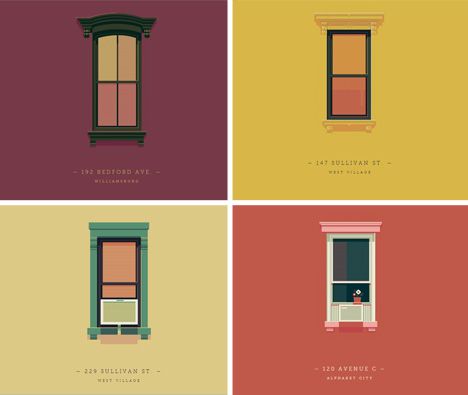
windows of new york

Fascination bleeds into fixation in this wonderful ongoing series of illustrations by a graphic designer who enjoys the nuances of fenestration in his favorite city.

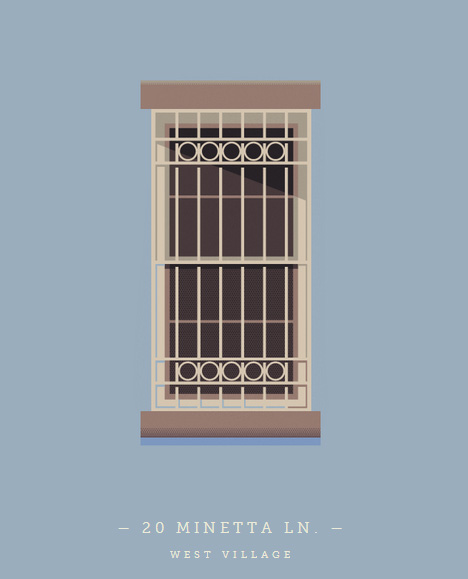
windows art project

Each piece in the series specifies not only the neighborhood (Hell’s Kitchen, West Village, East Village, Lower East Side, Alphabet City, SOHO, Williamsburg and more) but the actual address so truly curious fans can map out routes to find the source material.

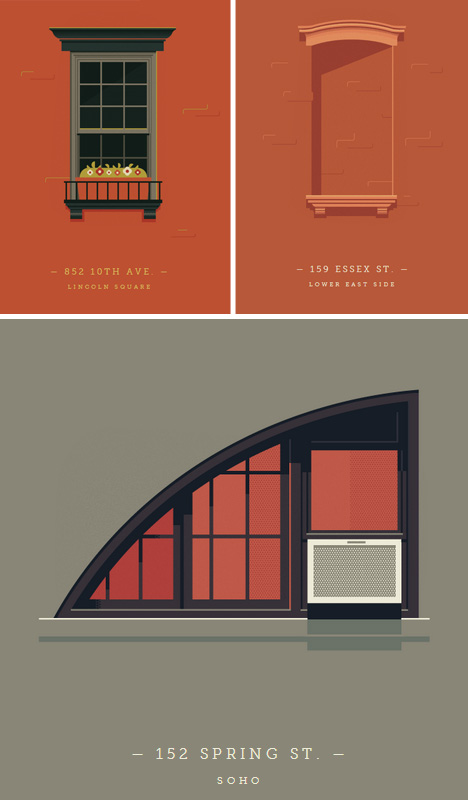
windows graphic design series

From creator Jose Guizar, “The Windows of New York project is a weekly illustrated fix for an obsession that has increasingly grown in me since chance put me in this town. A product of countless steps of journey through the city streets, this is a collection of windows that somehow have caught my restless eye out from the never-ending buzz of the city. This project is part an ode to architecture and part a self-challenge to never stop looking up.”

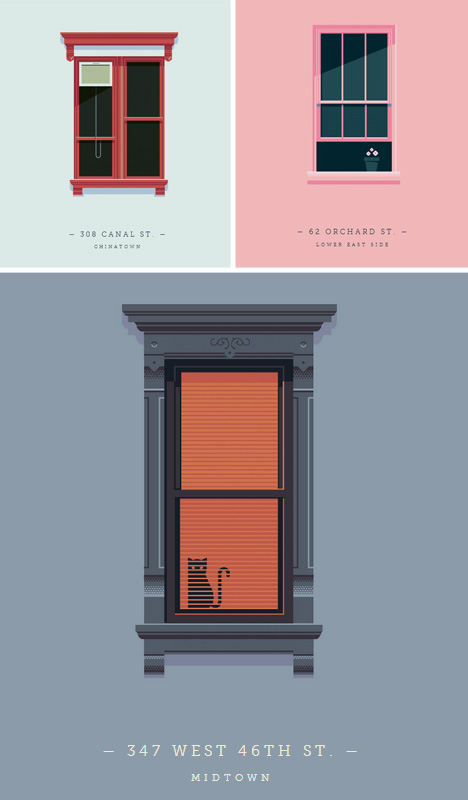
windows illustrations look up

There is a consistency to the visual language (from shapes to color palette) employed in each piece, which only serves to highlight the surprise differences between the various windows featured. Hacks and modifications make their way into the images as well, from protective metal grating and air conditioners to window-hanging flower boxes and curious cats. Even former windows, now filled in with bricks, or covered by doors, are candidates.

Share on Facebook


[ By WebUrbanist in Art & Drawing & Digital. ]

[ WebUrbanist | Archives | Galleries | Privacy | TOS ]


WebUrbanist

 
Comments Off on Windows of New York: Weekly Documentary Design Project

Posted in Creativity


A Twist on the 365 Project: One Second a Day Video Project

02 May

Extra photos for bloggers: 1, 2, 3

Doesn’t it feel like 2012 was just a couple weeks ago?

Maybe your New Year’s resolution was to start a 365 Project where you snap a photo every day.

Well, what if we told you that you can make a time-lapse of your life by taking a one second clip every day? That’s what Photojojo pal, James Bernal did for the all 366 days of 2012.

Think about how awesome yours would look — it’d be a 6-and-a-half minute mosaic of your year!

James put together an awesome guide detailing how to shoot, what to shoot, and how to keep going when you’re ready to set the camera down.

A Guide to Shooting One Second a Day

p.s. Win a traveling photo booth! We’re giving away an Instax camera & more with Brit+Co. Enter to win right here.

p.p.s. Even moar giveaways! Our pals at SnapKnot (the wedding photographer directory) are giving away a Nikon D800 or Canon 5D Mark III. Here’s how to enter.

Why it’s cool:

First, watch this. The one second a day video James made of his 2012.

2012 in 366 Seconds from James Bernal on Vimeo.

Sometimes, we take our days for granted. A project like this will help you reflect on your life as it happens.

Imagine being able to look back on any day and instantly remember what you did, who you met, what you learned, or how you felt.

While you’ll be able to have a really nifty video time capsule of your life and a fun way to share your year with others, it can also be an ingenious and powerful way for you to be able to remember what you’ve accomplished over the year and how you want to make it even better.

Undertaking this project will also improve your camera skills. For real! Keeping your eyes peeled for your one second each day, you’ll be sizing up the world for good moments and you’ll naturally want to attempt new shots to keep it fresh.

When to Start:

paint-sm While you might think you missed the boat with starting off your project on January 1st, 2013, the truth is, this is about your life and you can start your project anytime!

You can start it on your 27th birthday, the first day of your round-the-world trip, a random Tuesday, on your first day of college, or Chinese New Year!

There’s also no rule for how long it should be, so you can keep this up for 3 months or a whole year or even keep doing it for the rest of your life!

Tools For Putting it all Together:

paint-smA Camera.
Or even better, all the cameras. You can use any camera that’s able to take video, and preferably at least 720p so you can share it with the rest of the world.

You don’t have to stick to one camera either, so don’t be afraid to use different ones as long as their quality is as good as your main camera. Nowadays, most smartphones, point and shoots, and GoPros can shoot in glorious HD!

An Editing Program.
You’re going to need to put this puzzle together somehow! Some editing programs have more bells and whistles than others but you won’t need to get too over your head.

All you really need is to put your clips in order and find a sweet song to make it all flow together nicely. Our suggestion – iMovie and Windows Movie Maker are free and work just fine.

If you’re planning on using an iPhone exclusively as your one and only camera, then there’s now a recently launched app that helps keep you organized and edit all your footage together! It’s called One Second Everyday.

STEP 1: GET TO SHOOTING

paint-sm Get out there and shoot your one second clip everyday! Take your camera everywhere. Yeah guys, everywhere.

You never know what you’re going to encounter once you walk out your door. Take it to work, parties, the beach, school, the DMV, wherever.

Document the first time you tried a churro, your walk in the park, that bike ride over the Brooklyn Bridge, or maybe the impromptu dance party that erupted while you were waiting for the bus.

Take a Step Backward!
It’s easy to get so wrapped up in being a cinematographer that you forget to take a look around you and give us a little more context about where you are.

paint-sm

If you’re pointing your camera at a delicious pizza you’re about to eat, it could be even more interesting if you take a couple steps backwards (but watch your step!) and show us you’re eating a pizza … at the Grand Canyon.

Get Creative.
We’re not gonna lie, taking a memorable video of each and every day is going to be a tough workout for your eyes and brain, but hang in there. We know you can do this!

Try out new angles and different techniques, or maybe throw in a one second time-lapse in there if you’re pretty handy with that stuff. Don’t forget to hand your camera to others from time to time so you can also make a cameo in your video!

Sticking with this project, you’ll naturally become more creative with your shots when you’re forced to come up with something new every single day.

Get a reminder.
There might be days you’re so busy you forget all about your project. Don’t let up! Put an alarm or a reminder on your phone to make sure you remember to snap a video of something each day!

STEP 2: GET UP AND GO OUTSIDE

paint-sm Seriously, you guys, keep shooting.

There are 86,400 seconds in a day. More than a few of those are gonna be totally worth getting on tape!

Everything is fair game.
From your awesome roadtrip, to the C- you got on your biology test, to that flat tire you had to change (in the snow!), everything is worth documenting.

It’s natural to want to remember all the good times but don’t be afraid to point your camera at some of the less-than-stellar moments. It’s all part of the story of your life and every moment is equally important.

Don’t Stop.
This is the most important tip.

You’re gonna get tired of shooting a second a day, and you might want to skip a day. Don’t give up.

Even if you think there’s nothing interesting happening, go outside and make something happen. There’s always something worth documenting, even if it’s just you walking your dog (especially if it’s a particularly awesome dog).

I also found it helpful to tell my friends about my project and they were crucial in keeping me motivated. They’d even ask “Hey, can I be your one second clip today?”

STEP 3: DOWNLOAD YOUR FOOTAGE

paint-sm As the days fly by and you fill up your memory cards with footage, you’re gonna have to start downloading your footage to your computer.

It’s going to be a little different from computer to computer, but it’s pretty simple. Make a main folder, and organize your clips in a way you can easily keep track of what’s where.

More importantly, stay organized. Seriously, guys, 365 different video clips are as unruly as a bag full of puppies (although not as cuddly and definitely not as cute).

You’re gonna have a much easier time if you regularly organize your clips into folders for months over the course of your project. It would also be a really good idea to make a backup of all your footage so you don’t lose all your work in case an elephant stomps on your computer.

Step 4: START EDITING

paint-sm Import your clips into iMovie (free) or Final Cut Pro if you’re a Mac fan. If you’re running windows, try Windows Movie Maker (free) or Adobe Premiere.

Most movie editors are laid out with a little area for all your clips and another area called a timeline. The timeline is where you’re gonna be placing your clips and organizing them.

Editing is a lot like solving a puzzle – you’re moving all your clips around into the right order by date. While you rearrange the clips where they belong, you can start ‘trimming’ them down to 1 second each.

Those fun kids over at Vimeo have a couple good lessons to help get you started on whatever editing program you’ve got!

  • Editing with Windows Live
  • Editing with iMovie
  • Trimming & Cutting with iMovie

STEP 5: THROW A PHAT BEAT ON IT

paint-smJust like photography, music is a universal language. Go through your music library and find a bumpin’ song that you can add to your video!

Was there a song that was your jam while you were shooting this project? If Polka is your thing, that’s cool too! Try out a couple different songs and see which one sets the mood you’re going for and really goes with the flow of your movie.

STEP 6: THE HOME STRETCH

Add some titles, effects, and finishing touches to your video.

Hit the export or share button and upload it to Youtube or Vimeo, so you can showcase your masterpiece to the world!

Wanna see more examples? Here are two more of our favorites!

Brittany Bravo’s 2012.

Cesar Kuriyama’s Year 30.

1 Second Everyday – Age 30 from Cesar Kuriyama on Vimeo.

Take it further

  • Watch Cesar Kuriyama’s TED talk all about the making of video (above). It’ll inspire you!
  • Get more advanced with your video editing, try a time-lapse.
  • Learn how to make a stop-motion video!
  • Check out our guide to Project 365, the inspiration behind the one second a day video

Related posts:

  1. The Flip Video — The $ 100 Digital Video Camera that’s Tiny, Cheap, and Fun! Remember those shoulder-mounted VHS camcorders dad used to haul out…
  2. An Inspiring Stop-Motion Video (Modest Mouse Fan Video) Stop-motion photography ain’t easy. It requires patience, patience, planning, patience,…
  3. Vacation Photos with a Twist — or What to Do with All Those Pictures of Your Feet June’s Photojojo made possible by… ~Have a cool photo product…


Photojojo

 
Comments Off on A Twist on the 365 Project: One Second a Day Video Project

Posted in Equipment


My New Kickstarter Project: Photographer’s Social Media Mouse

01 Apr

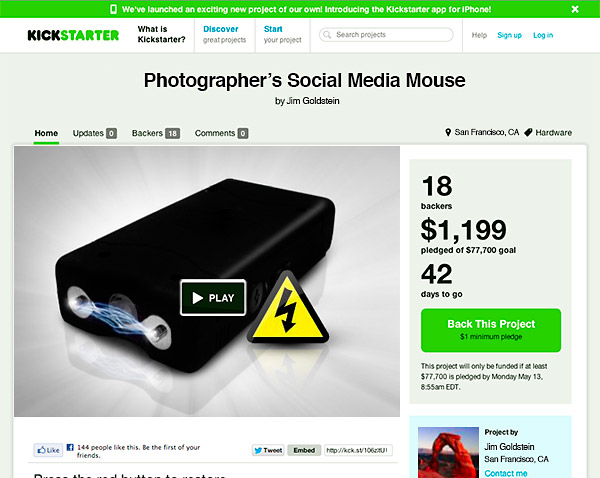
Ever since evangelizing the importance of social media to fellow photographers in 2006, I’ve long yearned for a tool to help balance photo/video editing time with the incredibly important task of marketing myself on social media. After years of research and prototyping I’m happy to announce a new Kickstarter project to realize my dream, a mouse designed especially for photographers who are super active on social media.
I’ve titled this project the Photographers’s Social Media Mouse.

Kickstarter Project: Photographer's Social Media Mouse

How it works is quite simple. Employing Bluetooth wireless technology the Photographer’s Social Media Mouse detects when a photographer has navigated to a web browser. With in 10 seconds of detecting activity on Facebook, Twitter, Google+, Flickr, Instagram, 500px, MySpace, and Friendster a gentle yet firm 7,800,000 volt shock is applied to the finger of the user. The momentary sensation causes brief paralysis in the arm reminding the user that more important editing or business communications are the order of the day.

Additional Features

  • Designed for travel – More comfortable than a touchpad, instant-on performance for maximum productivity on the road
  • Smart power management – Long battery life, on & off switch, power-saving modes and a low-battery indicator light
  • Precision optical performance – 1000-dpi optical sensor technology for incredibly smooth, precise tracking
  • Convenient carrying case – Comes with pouch for easy storage.

Important product information: Batteries are not included, use of mouse is not recommended by left handed users to avoid direct current to the heart and avoid data loss by keeping mouse on an approved non-conductive mouse pad.

Your support is needed to make this a reality. To contribute visit my Kickstarter page.

Product Details
Product Dimensions: 8.5 x 7 x 2.5 inches
Shipping Weight: 11.2 ounces
Shipping: Currently, item can be shipped only within the U.S.

Note: The Photographer’s Social Media Mouse is restricted and cannot be shipped to CT, IL, HI, MA, MI, NJ, NY, RI, and WI. They are also restricted in Annapolis, MD; Baltimore, MD; Baltimore County, MD; Chicago, IL; Dension/Crawford County, IA; Washington DC; and Philadelphia, PA. Any orders for these areas/states will be canceled.

Copyright Jim M. Goldstein, All Rights Reserved

My New Kickstarter Project: Photographer’s Social Media Mouse

The post My New Kickstarter Project: Photographer’s Social Media Mouse appeared first on JMG-Galleries – Landscape, Nature & Travel Photography.


JMG-Galleries – Landscape, Nature & Travel Photography

 
Comments Off on My New Kickstarter Project: Photographer’s Social Media Mouse

Posted in Equipment


Travel Photography Inspiration Project: Japan

26 Feb

Not only will this be one of the longest Travel Photography Inspiration Project posts to date, it is one I am very excited to put together. All of the participants not only delivered high quality images, but they all also held true to my request to provide you, fellow DPS readers, with helpful tips, either about travel in Japan or about specific photos.

Japan is on my list of places to visit and that’s just for the sushi. Putting together this post has opened my eyes to many of the beautiful areas of Japan as well as it backroads. I hope you enjoy this inspirational trip to Japan through the lenses of DPS readers.  If you have a moment, click through on the hyperlinks for each artists’ name to see more of their work.

Let’s wander around Japan in today’s installment of the DPS Travel Photography Inspiration Project.

And if you would like to be involved in the next country’s post, drop me a line here.
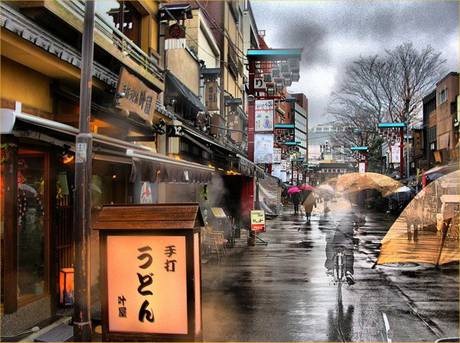
image014

Reflections in Time by Michael D.Keller

A part of old Japan, waiting for you to explore. After a while discard your map and just walk.

Hands of the Daibutsu

Hands of the Great Buddha, Kamakura by Angus McIntyre

Tip: Kamakura, just a short distance from Tokyo, has many beautiful temples.

SaraHentschke602

Sunset dreams by Pamela Oliveras

One of the many fantastic year round sunsets.

Tip: Okinawa is nearly 1,000 miles south of Tokyo and is known as the Hawaii of Japan for its sub-tropical climate and fantastic beaches. It is easy to reach from mainland via one of the domestic airlines.

DPS Japan 05

A-Bomb Dome, Hiroshima by Greg Knudsen

Surrounded by peace lanterns made by children, the A-Bomb Dome in Hiroshima Peace Memorial Park was left partially standing after the nuclear blast that leveled Hiroshima on August 6, 1945, hastening an end to WWII. Travel tip: The whole of Hiroshima Peace Memorial Park is a reminder of the horrors of war, yet now conveys a spirit of hope and peace.

We visited on the 59th anniversary of the bombing. Each anniversary and throughout the year, tens of thousands of origami cranes are delivered to the Children’s Peace Monument in memory of Sadako and her 1,000 cranes, whose story and some of her original cranes are among the displays in the haunting and moving museum.
image

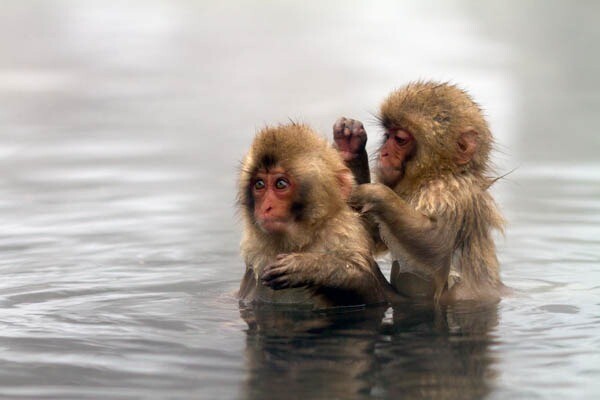
Baby snow monkeys, Nagano Prefecture by Oscar Tarneberg

I took this photo in the Jigokudani valley near a town called Yudanaka-Onsen in Nagano prefecture. The lighting conditions were challenging, being dimly lit and steamy due to the hot volcanic spring water, meaning the shot required the use of a fast prime (135mm F2.0) and a lot of post-processing to boost the contrast and sharpness.

Political self-promotion

Political Self-Promotion by Draycat

A Japanese politician stands outside a station promoting himself.

Tip. Use a wide aperture to blur out ugly backgrounds and make the subject stand out. Also try and capture a moment that contains some action to create a more interesting shot, which tells more of a story.

Silent Prayers (Daisho-in, Miyajima)

Silent Prayers (Daisho-in, Miyajima) by Beck

There are hundreds and thousands of temples in Japan – you can try to go to them all, hit up just the most popular (or “touristy”) ones, or be a little more adventurous and visit some of the smaller, lesser known sites. Daisho-in turned out to be one of my favourites – high up on a hill on the island of Itsukushima (also known more popularly as Miyajima) and with very few tourists about, we had the grounds of the temple almost entirely to ourselves. This allowed us to wander for as long as wanted, without crowds of people getting in our way, and to get as close as possible to the thousands and thousands of different statues and relics that coat the area. This was a great opportunity to practice taking photos from different angles – getting down low, shooting from up high, looking for reflections in ponds, and practicing a variety of other techniques such as working in AV mode rather than snap-happy-tourist-AUTO-mode.

Dragon of Izumo

Dragon of Izumo by Khoa Dinh

This is a statue of the mythical eight headed dragon that would terrorize the people of Izumo.

Advice: Take public transportation, subways or trains, while you travel in Japan. Taxis are expensive and traffic in Japan is horrible.

fhdbchgd

??????  (The Mikimoto Building) by Christopher Carlo Casilli

Tokyo is filled with interesting small scale architecture and the Mikimoto building is a favorite of mine. Looking to set it off and show it unique windows and facade, I decided to shoot this up angle in late afternoon to bring out the slight pink tones of the building reflecting the setting sun.

Sunset at Hakone

Hakone by Kishan Harwalkar

If you are visiting Tokyo on Business and have a spare day, then its best to book a day tour to Mount Fuji & Hakone or Nikku. Hop-on to one of the tourist buses and have a guided tour of your choice. You can go up to level 7 of Mount Fuji and also visit some beautiful regions in the area of Hakone. But beware, the traffic towards Tokyo in the evening (especially on weekends) is very heavy and expect delays.

The Tokyo View

Tokyo View by Simon Skipper

Tokyo is one of the largest cities in the world with the centre housing more than 13 million people. It’s worthwhile finding one of these tall buildings for a magnificent view, even in clear weather it’s difficult to see beyond the houses growing into the horizon.

the-candy-trail-JAPAN_1

Women of Tokyo by Michael Robert Powell

This juxtaposition of old and young was a lucky shot – I had my camera out just by chance. The out-of-focus background was softened futher by converting the image to black and white to give more attention to the older woman (as there was too much red around the young ladies).

Nagano-House-Matt-Gibson

Nagano House by Matt Gibson

Shooting at sunrise and sunset is always a good idea, but doubly so for travel photography when nearly all your shots are lit by sunlight.  This shot turned out pretty much only because the sun was setting and the light was right.

image015

Ueno Temple Roof by Michael D.Keller

This is from Ueno Park.  A must visit for any first timer to Tokyo. It is halfway between Asakusa and Akihabara,  on top of a few subway lines and the airport express. Keep your eye open for artifacts that spark interest.

Moving prayer tablets

Shinto priests, Hachiman-gu, Kamakura by Angus McIntyre

Tip: Shinto shrines and Buddhist temples are rich in colors and textures.

Eisa2012524

Faces of Eisa by Pamela Oliveras

10,000 Eisa dance festival. Naha, Okinawa

DPS Japan 04

Deer at 5-Story Kofuku-ji Pagoda, Nara by Greg Knudsen

A day-trip out of Kyoto, Nara is filled with historic temples and pagodas, and hundreds of free-roaming deer.

Travel tip: The deer are semi-tame, but I saw a couple of stags clashing antlers, so stay clear. Nara also includes the world’s largest wooden building, Todai-ji Temple, with a massive 15m bronze Buddha inside.

2222

Bamboo grove, Arashiyama, Kyoto Prefecture by Oscar Tarneberg

Arashiyama makes a great detour from Kyoto, as it is close by but also contains many temples, as well as incredible walks through bamboo groves, but without the crowds. This shot was taken several years ago on a camera with poor high ISO capability, so the main challenge was holding the camera steady enough to stop down enough to get a deep enough depth of field to get the whole path in focus.

Rush hour rush

Rush Hour Rush by Dreycat

A woman rushes to get to work during Tokyo morning rush hour.

Tip. The key to getting a shot like this is to use panning, where the camera is set to a low shutter speed and you track the movement of the person with your camera. You’ll often need a few attempts to get a good shot.

Kyoto Station

Kyoto Station by Beck

This shot was taken “from the hip” (literally) whilst I was waiting for a friend to join me at the station. I love people-watching but sometimes feel a little self-conscious doing it, especially as a foreigner who stands out in a country like Japan, and where traditional and personal values of the locals also make me hesitant to take photos of people. As such, I recently tried my hand at “shooting from the hip” and just waited to see what results I could achieve … I didn’t have my eye to the viewfinder nor could I see the LCD display – the camera was near my waist, I didn’t have a lens disrespectfully shoved in anybody’s face, and I simply clicked the shutter button. Sometimes it worked, sometimes it didn’t – but I’ve discovered it’s all about practice and having fun with it! You’ll be astounded at some of the shots you can achieve.

Shibuya cross walk

Shibuya cross walk by Khoa Dinh

This is the busiest and most famous crosswalk in Japan.

hggaigfd

??????????  (Crossing the Street in the Shinjuku Ward) by Christopher Carlo Casilli

Just outside the busiest train station in the world (JR Shinjuku in Tokyo) is a good place to really see the crowds typically frequenting this area of shops and restaurants…here on a warm summer’s eve. A slow shutter speed at night gave me that sense of a sea of motion set against the towering rows of tall buildings glowing with their bright vertical signs.
Streets of Shinjiku

Shinjiku: Animation & Neon all around by Kishan Harwalkar

Shinjiku is the main place of Tokyo housing Business centers on one side and bars & restaurants on the other. You get a glimpse of two shades of Tokyo from this place. A must visit place.
Japan, is also a place were Animation is worshiped. You can see people engrossed in animation all around you. Be it the comic books, mobile phones or hoardings on the Road, everything is centered around Cartoon characters.

The Mochi

‘Mochi’ is a traditional Japanese meal of rice especially eaten during winter by Simon Skipper

Looking for someone making it the traditional way is highly recommended, as it takes up to six hours involving a huge hammer and numerous people.

the-candy-trail-JAPAN_3

Women-only train carriage by Michael Robert Powell

Often ordinary things offer a great photo opportunity. A simple composition here with a vignette added, to partially shadow her face. (Note: the women-only rule is limited to rush-hour; so I was able to sit here).

image003

Japan Vending by Michael D.Keller

Vending Machines are everywhere, in numbers.  Many today even let you pay by cell phone! Make use of them, they are convenient and relatively cheap.

Frozen tuna

Tuna, Tsukiji fish market by Angus McIntyre

Tip: If you are able to visit Tokyo’s Tsukiji fish market, remember that it’s a working market; tourists were recently banned after one group behaved badly.

okuma280

Beach life: Northern Okinawa beaches in the summer by Pamela Oliveras

A 50mm lens would be a great all round lens to bring. A wide angle would also be an added bonus to capture the beauty of the landscapes and seascapes.
Summer is VERY VERY HOT and HUMID, but produces some thunderhead cloud phenomenal sunsets too. Nov it starts cooling down.

DPS Japan 02

Ryoan-ji Rock Garden, Kyoto by Greg Knudsen

My wife and daughter “deep in meditation” at Ryoan-ji Rock Garden, a 500+ year-old zen temple and UNESCO World Heritage Site.

Travel tip: Kyoto, which should not be missed, is best reached from Tokyo by Shinkansen (Bullet Train). We bought a 7-day Japan Rail Pass, which also took us to Hiroshima, Nara, around Tokyo on the JR Line, and back to Narita Airport. You must purchase the JR Pass before you arrive in Japan.

image3

Koya-san monks by Oscar Tarneberg

High in the mountains of Okayama prefecture, Koya-san it is the site of many ancient and holy temples. This shot was taken in the Oku-no-in graveyard, which is a fascinating and eerie place, particularly photogenic later in the afternoon when shafts of light come down through the trees.

Heavy Duty

Heavy Duty – A Sumo Training Stable by Drewcat

Sumo wrestlers training at a sumo stable in Tokyo.

Tip: Don’t be afraid to change your viewpoint and experiment with shutter speeds when taking action shots. Often getting low and close can make a stronger image than just shooting at eye level, while changing the shutter speed can help to inject more drama into the shot.

The Quiet Life (Asakusa, Tokyo)

The Quiet Life (Asakusa, Tokyo) by Beck

A simple snapshot of a simple life in a back street of Asakusa, Tokyo, taken early in the morning on my way to the train station. I love to get up early and go exploring whenever I’m travelling somewhere – and as many people in Asia, including Japan, like to rise early, this is a great time to start shooting! The light is also far less harsh in the early and late hours of daylight, rather than the hours around midday (when you probably want to be out of Japan’s heat and humidity any way!) – so don’t be afraid to get up early and go to bed early on one or two days if you want to find some great shots with softer lighting.

Tokyo from Odaiba Island

Odaiba Island by Kishan Harwalkar

Odaiba, a manmade island claimed from sea is an ideal place to spend a day. It offers a nice view of Tokyo town and houses several interesting buildings. The Tokyo Museum of Engineering Science & Innovation, which houses Asimo, the famous Honda humanoid Robot, is worth a visit. After a visit to this museum during the day, you can explore the interesting places near the Fuji centre in the evening. There are several restaurants to have a drink and some good Japanese good. You should stay here when sun starts to set and the lights come up in Tokyo. It’s a beautiful sight and a treat to watch. If you are lucky you’ll also see Hannabis, the famous Fireworks which take place from time to time. You need to take a tripod to capture those lights n Fire works . For more details you can visit: http://www.japan-guide.com/e/e3008.html

The Monkey

The Monkey by Simon Skipper

These Japanese Macaques are very unique to Japan, living in the area of Jigokudani where they enjoy the hot thermal springs in a very intriguing way, almost obsolete to the fact that thousands of tourists are around at almost all times.

the-candy-trail-JAPAN_2

Temple roof-tops at dusk by Michael Robert Powell

Arriving before dusk at the Senso-ji Temple meant that flood-lights were already on – but it wasn’t dark yet, so the red paint glowed golden and orange. Using a telephoto lens and then later adding a digital vignette, I managed to get a somewhat surreal image.

Horses in a landscape

Horses in a landscape, Mt Aso by Angus McIntyre

Tip: Despite the image of Japan as hugely urbanized, parts are surprisingly pastoral, offering opportunities to landscape photographers.

DPS Japan 03

Kiyomizu-dera, Kyoto by Greg Knudsen

One of my favorite sites, Kiyomizu-dera is a nail-less wooden temple built in 1633 on a hillside along a waterfall and stream whose pure water is said to have wish-granting powers.

Travel tip: Most visitors enter from the west up a long narrow street leading straight up to the temple. However, my preferred approach is from the north, starting near Shoren-in and Chion-in temples, through Maruyama Park, past the 24m Ryozen Kannon statue, through cobblestone village streets, then joining the upper climb to Kiyomizu.

image4

Mount Fuji, viewed from Kawaguchi-ko, Yamanashi prefecture by Oscar Tarneberg

Mount Fuji is the classic symbol of Japan, but getting a clean shot of it is harder than you think! Kawaguchi-ko, just a short journey from central Tokyo, offers stunning views with a range of natural foregrounds, including a lake. This photo was taken from a nearby hilltop around dusk for the best lighting; in March the air was relatively clear and the peak was still capped with snow.

Japanese School days

Japanese School Days by Draycat

Two schoolgirls walk through the entrance to a temple.

Tip. This type of shot is all about patience; once you see the possibility for a shot you need to wait until all the elements are in place to get it. In this case it’s all about making sure the schoolgirls are in the right place and that there are no distracting factors, like other people, elsewhere in the image.

Kamakura Fortunes

Kamakura Fortunes by Beck

These are hanging paper fortunes at one of the many temples in Kamakura, just south of Tokyo. The size of your aperture changes the depth of focus in your image, to create very different effects – but where exactly you make your point of focus (front, middle, distant) can also change the perception of the image. Mix it up occasionally to see what different results you can achieve – you may be quite pleasantly surprised!

The Buddhist

The Buddhist by Simon Skipper

In Zenk?-ji, Nagano you find one of the oldest buddhist temples of Japan, built in the 7th century. The site remains one of the last religious pilgrimages of the country, and many of the locals are very interesting to photograph.

Post originally from: Digital Photography Tips.

Check out our more Photography Tips at Photography Tips for Beginners, Portrait Photography Tips and Wedding Photography Tips.

Travel Photography Inspiration Project: Japan


Digital Photography School

 
Comments Off on Travel Photography Inspiration Project: Japan

Posted in Photography


Travel Photography Inspiration Project: Argentina

19 Feb

From the seemingly timeless Southern areas to the modern heart of Buenos Aires, Argentina is a lively county with wide spaces, soaring peaks and a unique culture.

Let’s wander around Argentina in today’s installment of the DPS Travel Photography Inspiration Project.

And if you would like to be involved in the next country’s post, drop me a line here.

PageImage-512483-3672802-FloridaStBuenosAiresJuly2011

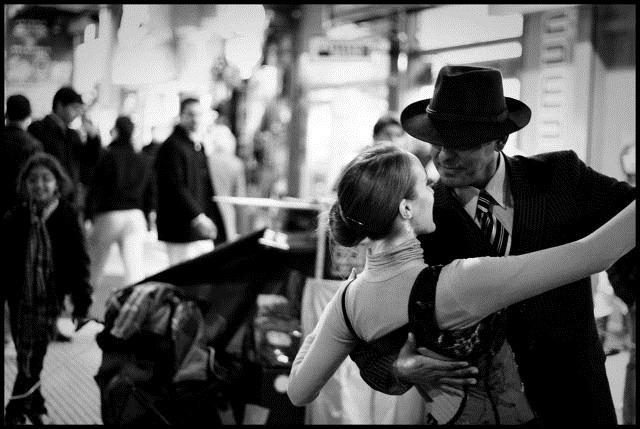
Street Tango in Buenos Aires  by Anand Gopol

Tango dancers strike a pose on Florida Street in Buenos Aires.

Tip: While in Buenos Aires, walk, walk, walk. It’s a great walking city and downtown is drizzled with street artists and dancers. On many street corners, one can find a tango troupe such as this one with a speaker busting out some music and a hat that’s being passed around.

DSC04313

Local young couple in colourful La Boca, Buenos Aires by Joshua Raif

IMG_0041copy

This is Buenos Aires’ iconic national historic monument, the obelisk, located in Plaza de la Republica by Ken Duquaine

We were in Argentina for a few days between Christmas and New Years Day this past year before leaving on a trip to Antarctica.  There is a considerable difference in weather conditions between Buenos Aires (very warm) and Ushuaia (much cooler), so anyone traveling to Argentina and planning on seeing both areas would do well to pack clothing that will accommodate a fairly wide range of temperatures. 

Glacier

Glacier trekking at Perito Moreno by Will Villiers-Tuthill

ARGENTINA-michael-robert-powell_1

rain-clouds over bariloche by Michael Robert Powell

I was above the town of Bariloche in Patagonia; bad weather can bring nice shots, too. The image was a bit flat so I tweaked it to make the image pop more (without getting too HDR).

DSC07209

Enjoying the local Mate by Joshua Raif

Colourful local characters on San Telmo square are usually happy to be photographed. In good weather the square is full of action: crafts stands, musicians, tango dancers, and is surrounded by old and beautiful architecture.

IMG_0158copy

A window with character in La Boca by Ken Duquaine

Right Whale Breeching

Right Whale Breeching: Puerto Madryn by Will Villiers-Tuthill

ARGENTINA-michael-robert-powell_4

girl staring into rainbow – iguazu falls by Michael Robert Powell

A lucky few seconds, in which I took a few shots and this was the best. Simply, have your camera ready.

DSC04914

Upsala Glacier Viewpoint, Patagonia by Joshua Raif

Since boat access has been blocked by the melting glaciers, this remote site now requires a full day trip which combines a boat ride on Argentina lake together with a 4X4 dirt road drive from Estancia Cristina. This full day trip contains a wide variety of photo opportunities which include icebergs on the lake, the old ranch itself, sculptured trees, rock formations recently sculpted by the melting glaciers and the panoramic viewpoint itself.

IMG_0110copy

Plaza de Mayo, the scene of the May 25, 1810, revolution leading to Argentina’s independence, and a major center for political activity in Buenos Aires by Ken Duquaine

Nest Building

Birds building nests outside Ushuaia by Will Villiers-Tuthill

quiet streets of downtown – buenos aires by Michael Robert Powell

DSC04353

A modern neighborhood of Buenos Aires by Joshua Raif

Ushuaia20111231_2327copy

Ushuaia, known in Argentina as the “End of the World” owing to its being the southernmost city in the world and the staging area for boat trips through the Drake Passage to Antarctica by Ken Duquaine

Ushuaia

Ushuaia – the coordinates are on the signposts by Will Villiers-Tuthill

ARGENTINA-michael-robert-powell_3

changing the guards – buenos aires by Michael Robert Powell

Get low for some shots. This was taken years ago on a video camera and hence is only a low-res still image (but better than nothing). I played with the lighting later.

DSC07238

A 19th century coffee shop on San Telmo square, still in operation by Joshua Raif

Buenos Aires still boasts 19th & early 20th century architecture and establishments which appear more authentic than those found in Europe or the U.S.


IMG_0140copy

The very colorful La Boca neighborhood of Buenos Aires where the sights, smells and activity complement the “over the top” colors of the buildings by Ken Duquaine

HDR tonemapped

snowy mountains behind ushuaia by Michael Robert Powell

Apart from the great scenery, the inclusion of a person (bottom left) gives it a real sense of scale. This is close-to straight out of the camera; a near-monochrome shot.

Thank you again to all the DPS reader-contributors who participated. If you would like to be involved in the next country’s post, drop me a line here.

Post originally from: Digital Photography Tips.

Check out our more Photography Tips at Photography Tips for Beginners, Portrait Photography Tips and Wedding Photography Tips.

Travel Photography Inspiration Project: Argentina


Digital Photography School

 
Comments Off on Travel Photography Inspiration Project: Argentina

Posted in Photography