RSS
 

Posts Tagged ‘Photos’

21 Images That Sing – Photos of all Things Musical

22 Mar

Music fills the soul – it also makes for a great subject for photographers.

Singers, concerts, musicians, bands, instruments, and more. See if you can hear the music in thees images!

By John Finn

By Ronald Rugenbrink

By Brian Tomlinson

googletag.cmd.push(function() {var gpt_slot = googletag.defineSlot( “/1005424/_dPSv5in-post-mobile(300×250)”, [300, 250], “pb-ruleset-mobile-ad-0” ).addService( googletag.pubads() );ruleset_mobile_slots.push( gpt_slot );});

googletag.cmd.push(function() {var gpt_slot = googletag.defineSlot( “/1005424/_dPSv5in-post-mobile(300×250)”, [300, 250], “pb-ruleset-desktop-ad-4” ).addService( googletag.pubads() );ruleset_desktop_slots.push( gpt_slot );});

By Mike Morbeck

By Bill Couch

By David

By dion gillard

By Eleonora Albasi

By Nate

By Mats Edenius

googletag.cmd.push(function() {var gpt_slot = googletag.defineSlot( “/1005424/_dPSv5in-post-mobile(300×250)”, [300, 250], “pb-ruleset-mobile-ad-1” ).addService( googletag.pubads() );ruleset_mobile_slots.push( gpt_slot );});

googletag.cmd.push(function() {var gpt_slot = googletag.defineSlot( “/1005424/_dPSv5in-post-mobile(300×250)”, [300, 250], “pb-ruleset-desktop-ad-5” ).addService( googletag.pubads() );ruleset_desktop_slots.push( gpt_slot );});

By Micha? Koralewski

By Sam Cox

By Arnold Manillier

By Marco Evangelisti Crespo

By Flavio~

By Brandon Giesbrecht

By Susanne Nilsson

googletag.cmd.push(function() {var gpt_slot = googletag.defineSlot( “/1005424/_dPSv5in-post-mobile(300×250)”, [300, 250], “pb-ruleset-mobile-ad-2” ).addService( googletag.pubads() );ruleset_mobile_slots.push( gpt_slot );});

googletag.cmd.push(function() {var gpt_slot = googletag.defineSlot( “/1005424/_dPSv5in-post-mobile(300×250)”, [300, 250], “pb-ruleset-desktop-ad-6” ).addService( googletag.pubads() );ruleset_desktop_slots.push( gpt_slot );});

By Machrouh Med Sami

By Grodenaue

By Alex de Haas

By ericzim

googletag.cmd.push(function() {var gpt_slot = googletag.defineSlot( “/1005424/_dPSv5in-post-mobile(300×250)”, [300, 250], “pb-ruleset-mobile-ad-3” ).addService( googletag.pubads() );ruleset_mobile_slots.push( gpt_slot );});

googletag.cmd.push(function() {var gpt_slot = googletag.defineSlot( “/1005424/_dPSv5in-post-mobile(300×250)”, [300, 250], “pb-ruleset-desktop-ad-7” ).addService( googletag.pubads() );ruleset_desktop_slots.push( gpt_slot );});

The post 21 Images That Sing – Photos of all Things Musical by Darlene Hildebrandt appeared first on Digital Photography School.


Digital Photography School

 
Comments Off on 21 Images That Sing – Photos of all Things Musical

Posted in Photography


How to Create a Solid Backup Strategy for Your Photos

09 Mar

Most people take reasonable precautions when engaging in activities that are potentially unsafe or harmful, like wearing seat belts in a car or even washing your hands before eating. The benefits of these basic procedures are easy to understand which is one reason these practices are so widely adopted. But things look quite different where our digital lives are concerned; in other words, a backup strategy.

Every mobile phone, laptop, and personal computer stores your photos, documents, and other data on either a small memory chip or a spinning hard drive and it is not uncommon for these to fail. In fact, due to the nature of how hard drives (which are still by far the most common method of storing data) operate, they are guaranteed to wear out over time. It’s just a question of when. Anyone even remotely concerned with making sure their digital files are safe and accessible one, five, 10, or even hundreds of years from now needs to have a solid backup strategy in case the unthinkable happens.

Solid Backup Strategy for Your Photos

Don’t let your photos disappear when your computer fails.

The challenge

One problem with creating a backup strategy is that it can seem so complex and convoluted it’s difficult to even know where to begin. From clouds to closets to safe deposit boxes, the world of data backup has so many options it’s enough to make your head spin. I’m going to explore three common options in this article, but before I get too far I want to remind you of the words of Carl von Clausewitz who said, “The enemy of a good plan is the dream of a perfect plan.”

Don’t get so caught up with finding the ideal backup strategy that you don’t do anything at all. The important lesson, no matter which method you use, is to create copies of your data – especially your photographs – so you can still get them if something bad happens.

3-2-1 Strategy

One of the best ways to approach backing up your data is the 3-2-1 strategy:

  • 3: Have three copies of your data.
  • 2: Keep them in two separate places.
  • 1: At least one must be offsite.

This might seem like a lot of hassle, but it’s similar to most things in life that require small behavioral changes. Once you get over the initial setup of utilizing a backup strategy it becomes a habit or better yet, a completely transparent activity that just happens in the background. As someone who has lost data, and has had friends and family lose thousands of photos thanks to computer failures and hard drive corruption, I can confidently say that it is well worth your time to back up your data. It won’t save your physical life, but it could save your digital life.

Solid Backup Strategy for Your Photos

A good backup solution doesn’t have to be complicated and can help make sure your memories stand the test of time.

Option #1 – External hard drives

Inside nearly every personal computer is a spinning hard drive that rotates at a mind-numbing speed of 5400-7200 rotations per minute, every day, for as long as the computer exists. Over time, hard drives have proven themselves to be simple cost-effective vessels for storing massive amounts of data. However, their mechanical nature makes them not only prone to failure but quite expensive and time-consuming to recover your files and photos if something does happen.

Because of these caveats, one of the simplest methods of backing up your data is to use software to make a clone of your hard drive onto – you guessed it – another hard drive. This duplicates everything on your computer so you can instantly access it in the case of an emergency. Thanks to the relatively inexpensive nature of external hard drives and backup software (which is often bundled with hard drives) the process is mostly painless.

Solid Backup Strategy for Your Photos

Backup hard drives are a cheap and effective way of making sure your data is safe.

File recovery

Mostly, that is, until it comes time to actually recover your data. In my experience, this method of file backup is best when your entire computer dies and you need to start from scratch, at which point a clone of your hard drive can be used to create an exact copy on a new computer. I have had to do this a few times with excellent results, and except for re-registering some serial numbers with Adobe I was up and running again in no time.

However, if you accidentally delete some data, such as an entire folder of images, and need to recover just those specific things from your backup it can be tricky depending on the software solution you are using. Apple’s Time Machine, for example, is designed to facilitate the easy recovery of an entire computer’s worth of data but many people (myself included) have found themselves more than a little frustrated when restoring individual files or folders. Microsoft includes software called Backup and Restore which will do the same thing for Windows users. Either one of these is a great solution if you want a simple way of making sure all the data on your computer is saved and stored in the event of a complete hard drive failure.

One significant benefit of both Time Machine and Windows Backup and Restore is that they run automatically in the background so you never have to think about it once you set them up. However, one drawback is that because they only backup to external hard drives, if you lose data to a catastrophic event such as a fire or flood, chances are your backup drive will be toast also. For that reason I like to keep a second backup hard drive at the office where I work and switch the hard drives out every Monday. That way even if my house explodes in a freak meteorite incident everything but the very latest files and photos will still be available on my backup drive at work.

Solid Backup Strategy for Your Photos

Mac users can use Time Machine to easily create automatic backups on an external hard drive.

Extra options

If you really want to go the extra mile with an external hard-drive-based backup plan, you can set yourself up with a multi-drive solution where all your data is copied to not only one, but several hard disks at the same time. This is called a RAID (Redundant Array of Independent Drives) system and while it’s more costly than a single drive solution, it’s virtually guaranteed to protect against data loss. If one of the drives in a RAID array fails you can usually just swap it out with a fresh drive and continue backing everything up.

Finally, if you are going to use external backups it’s important to keep them encrypted so prying eyes or thieving scoundrels can’t peek at your data. Time Machine lets you do this with the click of a mouse, and Windows has an option to do this as well using a setting called BitLocker. This adds a huge layer of security to your backups while taking almost no effort on your part. I highly recommend doing this.

Solid Backup Strategy for Your Photos

BitLocker offers a great solution for Windows users who want a simple and effective backup strategy.

Hard drives are so cheap these days that it’s hard to go wrong with this type of solution. If your backup drive ever goes belly-up you can buy another one for the price of a few movie tickets. I recommend buying a drive that is double the capacity of your computer’s internal hard drive which means you can restore old copies of files long after they have been deleted from your computer.

Option #2 – Save your data to the cloud

If you don’t want to bother with the hassle of setting up an external hard drive, encrypting your data, and switching out drives every week or every month, another good option is to go with a cloud-based backup service like CrashPlan, BackBlaze, or Carbonite. These companies offer paid plans that backup all the data on your computer, or just a portion that you specify, to their own servers automatically. In terms of convenience, these services are hard to beat since they require almost no interaction from you after the initial setup.

Drawbacks

One of the downsides is the price, as they require a recurring monthly or yearly fee which, though usually not too expensive, can add up over time. They also make the act of restoring all your data, such as in the event of a fire or flood, more difficult than just hooking up a spare hard drive with a full copy of everything. Thankfully many cloud-based services will actually mail you a hard drive with a full copy of your data on it for an additional fee if you really need to do a full restore of your entire computer. You also have the option of logging into your account from a web browser and selectively downloading individual files or folders, which can be useful if you just need to retrieve specific items and not restore your entire computer.

Solid Backup Strategy for Your Photos - CrashPlan, BackBlaze, or Carbonite - cloud options

One of the major drawbacks of cloud-based backup options involves actually getting your data to them in the first place. While broadband internet access is becoming increasingly common around the world, upload speeds still lag far behind download speeds. According to BackBlaze, a typical home internet connection will let you upload 2GB to 4GB per day, which means it could take several months to backup your entire hard drive! If you shoot in RAW and are constantly filling up your memory cards, you might find cloud-based backup services to be quite limiting unless you have a very fast internet connection!

Other cloud-based options are available that specifically address the needs of photographers. Google Photos allows unlimited storage for JPG pictures up to 16 megapixels, and Amazon allows unlimited photo storage for Prime members. Flickr, that longtime stalwart of online photo sharing, gives users 1TB (Terabyte, or 1024 GB) of storage for free. Services like Dropbox, OneDrive, and Apple’s iCloud offer paid plans that allow you to backup massive amounts of photos and other data for a fee while also syncing them across your devices.

Solid Backup Strategy for Your Photos

Even if you already share pictures on social networks, it’s a good idea to have a full backup of all your images and a dedicated cloud-based solution is a nice way to accomplish this.

Shop around for the best cloud option for your needs

If you are thinking about using a cloud-based solution I would encourage you to investigate some options and see what you think would work best for your needs. I have used CrashPlan, BackBlaze, and Carbonite, as well as solutions like Arq which store your data on the Amazon cloud. Each of these has its own strengths and weaknesses and because of that, it is difficult to recommend a single cloud-based solution as every individual has their own needs.

All of them are good, and you really can’t go wrong with any of them if you currently don’t have a backup solution in place. I also like to caution people that when you utilize free services like Google Photos or Flickr it’s a good idea to review their Terms of Service so you know exactly what information and personal data you are giving up in exchange for the free use of their storage.

Option #3 – DVDs and Blu-Rays

Longtime computer users might fondly remember the days when CD-ROM drives first entered the scene. In those heady days of the mid-1990s the idea of putting as much data as you could fit on an entire 500MB hard drive onto one single CD was basically a computing miracle, and as CD drives became more prevalent they also became a good way to backup data such as documents and photos.

However as digital cameras rose to prominence in the early 2000s it became painfully obvious that backing up data to CDs and, subsequently, DVDs was too slow and cumbersome to be a good solution. Burning the discs took time, and getting files off them could be a chore especially as more and more computers abandoned these types of disc drives altogether.

So why in the world would this type of solution even be considered as part of a balanced backup strategy in 2017?

Solid Backup Strategy for Your Photos CD and DVD

Behold the classic Compact Disc. You might not give this type of media much thought nowadays, but it can still be an essential component of a comprehensive backup strategy.

Cost and drawbacks

The answer to this question is mostly related to cost. Blank discs are cheap, and even if your computer doesn’t have a disc burner you can buy an external one for about $ 50-100. CDs hold about 600 MB of data, or enough for your vacation photos if you shot on medium-quality JPG. DVDs hold about 4.5 GB of data or a couple months of pictures (if you shoot RAW this will be more limited). Blu-Ray discs hold about 25GB of data or enough for an entire year’s worth of JPG images which make them very well suited for long-term image backup. Even if you already use a hard drive or cloud solution, it’s still a good idea to make regular backups of your pictures to some type of physical disc that you can then store in a safe deposit box or even mail to a trusted friend or family member.

One of the notable downsides to disc-based backups is that this media is prone to the same harsh realities of time as any hard drive. Sooner or later all discs that you create at home will fail due to a concept known as “bit rot” which is when the layer of dye inside a CD, DVD, or Blu-Ray that actually contains your data deteriorates over time. It might be a few years or 50 years, but it’s almost certainly going to happen to every disc you burn.

Thankfully some drives are capable of burning a special format of Blu-Ray called M-Disc which is supposed to keep your data safe for hundreds of years. Even though the actual discs are a little more expensive it could be well worth it to make sure your images aren’t lost to dust and decay over the years.

Solid Backup Strategy for Your Photos

It might be worth your time to dust off that old DVD or Blu-Ray burner and use it as part of your photo backup plan.

Annual plan

When adding a disc-based component to your backup strategy I recommend making it part of an annual ritual instead of something you do monthly or weekly. Get a Blu-Ray burner so you can store all your pictures from the whole year and make the process of burning a disc and taking it to a safe deposit box an annual tradition. It might seem silly at first, but it could really save your digital life if you ever need it.

The Solution

The great challenge with backing up your digital images is that all methods have their positive and negative aspects, no one single solution is best. And very few things in life are truly permanent, so even if you physically print your pictures they will eventually fade and will also be susceptible to mold, moisture, or physical damage.

Any digital backup option is better than none at all. If you leave your photos on your computer or phone without duplicates then you are at risk of putting all your eggs in one basket which is almost certainly guaranteed to fail. The solution, then, is to do something to make sure your pictures don’t meet a premature digital demise. It could be a second hard drive, a cloud-based solution, making a Blu-Ray disk, using a combination of all three, or another method I didn’t even mention.

My father still has a hard drive sitting in his closet filled with thousands of images he may never see again. The disk failed years ago and was not backed up. The same thing has happened to many photographers around the world. Don’t let it happen to you.

Read more here:

What about you? What solution do you use to make sure your pictures are backed up and ready to access if you need them? There are hosts of other solutions I didn’t address in this article and I’m sure other DPS readers would like to know what ideas you have and what works for you. Please share in the comments below.

The post How to Create a Solid Backup Strategy for Your Photos by Simon Ringsmuth appeared first on Digital Photography School.


Digital Photography School

 
Comments Off on How to Create a Solid Backup Strategy for Your Photos

Posted in Photography


How to Capture Mood and Atmosphere in Your Photos

24 Feb

Why is it so difficult to capture the cozy ambiance of a cafe in a picture? Or the casual atmosphere of a warm bonfire with friends on a summer night? Learning how to capture mood and atmosphere of a scene is a skill that is elusive for many photographers.

googletag.cmd.push(function() {
mobile_slots.push( googletag.defineSlot( “/1005424/_dPSv5topic-rhs(300×250)”, [300, 250], “pb-ad-124309” ).addService( googletag.pubads() ) ); } );

A man fishing, in a photo that has been taken to capture the mood and emotion of the scene.

This is because the finished product isn’t only about getting the technical settings and composition correct. The image needs to evoke something in the senses; it has to capture the visceral aspects of a scene, the sights, sounds and smells so that every time you look at the picture, you are brought right back into the moment.

As always, rules in photography are made to be broken. So this list is meant to help you explore the creative aspect of how to capture mood rather than a firm lecture on how x will help you accomplish y.

Here’s a rundown of some of the things to consider when you’re trying to capture the mood, atmosphere, and emotion of a setting. Your goal; looking at the picture later brings you right back into the moment.

Candid Versus Posed

Photography is artificial. That little black box that you use to take pictures necessarily is always between you and the subject. That’s why it is really impressive to see photographers who can take incredibly natural pictures – almost as if a camera wasn’t even involved in the process.

Two boys canoeing, in a photo taken to capture the mood and atmosphere of the shot.

When capturing a moment, your goal should be to take a candid photo, where your subject(s) are unaware of the camera. This helps to create a final image where the viewer feels like a fly on the wall. A picture where everyone is staring straight at the camera, on the other hand, pulls the viewer out of the moment and draws attention to the artificiality of the process.

Walk into a room with a camera and you can see how everyone changes the way they smile, their posture, etc. Everyone wants to look good for the camera. But by being super aware of the camera, the mood of the moment is lost.

Of course, it’s not always an option to take a candid photo. This is where you need to have the skill to make a natural picture by giving direction or helping the subject feel comfortable to the point that the shot looks real, rather than staged.

Consider the Lighting

Lighting always plays a huge role in your image. To capture the atmosphere of a specific moment, your goal should be to emphasize that lighting as much as possible. Typically, a warm or cozy setting will involve soft lighting. For example, with a summer evening comes soft orange light and a radiant glow outlining people lit by the sun.

So how can you show this? Experiment with shooting with the sun behind your subjects. A camera on automatic mode will struggle with this and will make your overall exposure too dark. Try either adjusting your exposure compensation to shoot a brighter picture, or go full manual and explore the creative possibilities!

Shooting into the sun also often results in lens flare – and you can use this effect to your benefit as well. Lens flare can help add a real mood of summer and warmth to a picture.

A warm, summery picture of a couple driving a car - capture the mood and atmosphere of the shot.

Low light pictures can also really stand out. The soft glow of a bonfire or candlelight often throws deep and intriguing shadows. To capture this, you need to consider the direction of the light. Someone looking away from the light source will have their face in deep shadow – and it likely won’t make for a very interesting image. But, by turning them back towards the light, you can really bring out texture and personality.

In low light, your camera will often tell you there isn’t enough light and will flip on the pop-up flash. What should you do then?

Ditch the On-Camera Flash

Using the flash on your camera is a sure way to add an unnatural feeling to an otherwise warm and cozy atmosphere. The main reason for this is because there are different temperatures of light. Some types of light look warmer; some look colder.

The light from your flash is balanced to match the type of light you’d find under the midday sun (daylight). Light from a bonfire or candle, however, contains a lot more orange. The light from your flash will look very blue in comparison, and this mismatch of colors is easy to recognize in the finished image.

Light from the flash is also on nearly same the angle as the image. Since we don’t normally view people or objects with light coming from the same angle as our eyes, this looks strange. This also has the effect of removing the shadows and textures that give the image a sense of dimension.

Of course, the reason your camera will want to use flash is because there isn’t much available light. This brings us conveniently right to the next point…

Use a Wide Aperture

If you can’t add light with flash, you’ll need to find another way to collect enough light to capture the image. This can be done by opening up the camera’s aperture. Aperture is measured by f-stops, with a lower f-stop number (like f/4) meaning that the lens is opened wider to let in more light.

A boy looking at a lantern, where the photo has been taken in low light - capture the mood and atmosphere

Prime lenses, or lenses that don’t don’t zoom, can typically open to a wider aperture. For this reason, they are an ideal choice for capturing the atmosphere of a setting when there isn’t much light to work with.

Besides just gathering more light, a wide aperture will give your image a more precise point of focus (shallow depth of field). Whether the focus is on a person or a detail, the viewer gets a sense of being close and intimate with the scene.

The bokeh, or out of focus area created by using a wide aperture, also throws the background into a creamy blur, which both helps to remove any clutter from the shot and lets our imagination wander to fill in the blanks.

Show the Setting and Environment

A man on a sailboat, with the photo taken to show the setting and capture mood

Whether you are using a wide aperture or not, you’ll want to show the setting the get a clear sense of content. Capture the details that make the setting memorable and put everything into context.

A technique I like to use is to include an object or person in the foreground of the shot. By framing the shot with foreground elements, I can create the illusion of being a participant in the event. This technique also gives a strong sense of depth to the image, which can help make it a more memorable photo.

A man on a mountain, taking a photograph

Capturing Emotions

More often than not, our fondest memories are closely tied together with the people we experienced them with.

For this reason, a good way to capture the essence of a moment is to get a shot of people interacting with each other. It can be through buoyant smiles, a tight hug, or a tear of joy rolling down a cheek.

A soccer player is nervous as her team takes penalty shots - capture mood

It isn’t always so easy to spot these little moments, and they also tend to disappear quickly. Likewise, it takes a bit of observation and creativity to find the moments that really bring out the drama or happiness of a scene.

Bringing out the Textures

Maybe you can’t capture sound and smell with a photo – but you can appeal to those senses by bringing attention to details that are familiar and remind us of a distinct sound or smell.

The sharp texture of stone or the gritty feeling of sand are very familiar to us, so having those textures prominent in a picture helps us experience the image more strongly.

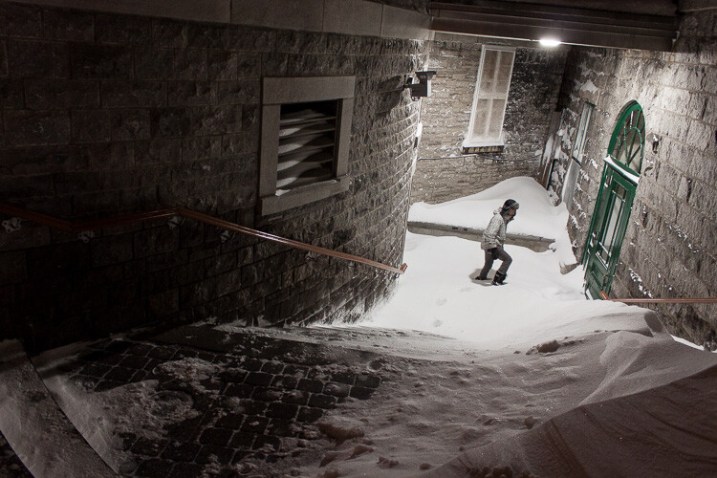
A man explores a snowy entranceway, with sharp textures giving the photo a mood

Editing Your Photos

Often, you can really bring out the mood of a shot during the editing process. Whether you are using Photoshop or a simpler editing program, here are some tips for emphasizing the style you want in your final image.

Consider how color influences your photo

Color is important for establishing the mood of an image. Muted or darker colors can give a feeling of reflection, sadness, or calm. Brighter and vibrant colors, on the other hand, suggest happiness.

Color temperature

A picture’s white balance can be set or adjusted to bring make an image feel hotter or colder. The difference between a warm summer evening and a cool winter’s night should be evident in your pictures.

White balance works on a sliding scale from yellow to blue. Experiment to find the right setting for your image. If you shoot in RAW, you will be able to freely adjust your white balance without any quality loss in your picture. If you shoot JPG, there won’t be nearly as much leeway.

A photo edited in two different ways, showing how white balance can influence the mood of an image

The strong blue tones in the original image on the left feel calming and introspective, while the edit on the right feels much more energetic. These two versions also give a very different impression of how warm or cold the morning was.

The Film Look and Experimenting with Black and White

Some editing styles can help invoke a sense of nostalgia. The “film look” adds a feeling of timelessness to a picture, even to those who are too young to remember the days of taking and developing pictures on film.

An image of a snowboarder, edited in a nostalgic and retro style

The editing of this picture gives it a retro feel, as though it was taken several decades earlier.

If you want to play around with this style, there are many different presets and filters that can get you started. This style will typically desaturate colors, remove some contrast, and add some grain.

Converting your image to black and white can also give your photos this sense of nostalgia. Play around with your edit and see what you can come up with!

An image edited in black and white to give it a feeling of melancholy and emotion

A black and white edit on this image makes the mood feel much more melancholic or thoughtful.

So good luck with your practice of taking images that capture the mood, atmosphere, and emotion of a scene. Until scientists invent a time-machine, it’s the best way we have to travel back and experience a friendly place or memory once again.

googletag.cmd.push(function() {
tablet_slots.push( googletag.defineSlot( “/1005424/_dPSv4_tab-all-article-bottom_(300×250)”, [300, 250], “pb-ad-78623” ).addService( googletag.pubads() ) ); } );

googletag.cmd.push(function() {
mobile_slots.push( googletag.defineSlot( “/1005424/_dPSv4_mob-all-article-bottom_(300×250)”, [300, 250], “pb-ad-78158” ).addService( googletag.pubads() ) ); } );

The post How to Capture Mood and Atmosphere in Your Photos by Frank Myrland appeared first on Digital Photography School.


Digital Photography School

 
Comments Off on How to Capture Mood and Atmosphere in Your Photos

Posted in Photography


StyleShoots Live robotic photography studio uses AI to shoot and process photos

24 Feb

A new robotic ‘smart studio’ device aims to increase brands’ photography efficiency and productivity by replacing, to a certain degree, professional human photographers with artificial intelligence and a robotic camera/lighting system. Called StyleShoots Live, this smart studio is equipped with robotic lighting, a Canon 1DX Mark II camera, and machine intelligence for shooting, processing and exporting photos and video automatically.

StyleShoots, the Dutch company behind the smart studio, unveiled the product on Wednesday, saying it is ‘designed to create instantly edited video and stills for fashion lifestyle and eCommerce shoots in minutes.’ This is made possible via a large steel enclosure in which a model is posed. A variety of technologies then make technical decisions, adjusting lighting and camera settings as necessary to shoot content that matches brand-specified customized styles.

The resulting content is automatically processed, including things like cropping images to certain aspect ratios or stitching together multiple videos. The final content can then be reviewed by the human in charge and, if approved, exported for various platforms. A human is given control over the entire process via a built-in iPad Pro with a Live View mode of the model.

Speaking about the smart studio, StyleShoots’ Head of Product Anders Jorgensen said:

‘Fashion brands need to keep their customers engaged with fresh content every day – and video shared on social media is the most powerful form of storytelling. To keep up with the continuous demand, StyleShoots Live creates stills and video ready for publishing on Instagram, Facebook, Snapchat, and websites within minutes – without any manual editing or post production.’

Of course, such a studio raises concerns about technology and its potential ability to replace human photographers with machines. In response to that concern, StyleShoots explained in a long FAQ sheet that it didn’t design its smart studio to be a replacement for humans. ‘To run a fashion shoot,’ the company explained, ‘you need a creative eye to compose the shot, pose the model and style the clothes — a robot can’t do that (yet).’

Source: StyleShoots

Articles: Digital Photography Review (dpreview.com)

 
Comments Off on StyleShoots Live robotic photography studio uses AI to shoot and process photos

Posted in Uncategorized


4 Simple Ways to Get Sharper Photos

23 Feb

If I were to ask you what the best way to make sharper photographs is, your mind might instantly jump to something like, “Get a better lens.” While the quality of your lens glass certainly does play a huge role in overall image sharpness, it is not an absolute guarantee.

googletag.cmd.push(function() {
mobile_slots.push( googletag.defineSlot( “/1005424/_dPSv5topic-rhs(300×250)”, [300, 250], “pb-ad-124309” ).addService( googletag.pubads() ) ); } );

There are many other factors that come into play when discussing image sharpness or lack thereof. I’ve even said things myself like, “If I only had this lens or that lens, I could make better photos.” But have you considered the other reasons why your images seem to lack that wonderful sharpness we all chase?

4 Simple Ways to Get Sharper Photos

Let’s face it, not all of us can afford the top of the line lenses that we believe will deliver the utmost clarity in our photographs. But there are so many other things that can be done to make sure you don’t stand in the way of even your kit lenses of delivering the best images possible. Here a few easy tips you can use right now to make sure you get the most out of whatever glass you might have on hand…or rather, on camera – and get help you get sharper photos.

#1 – Ye’ Olde Tripod

Here it comes. That same old practice that I’ve always implored you to do – use a tripod. There’s simply no escaping the fact that the more steady your camera is the sharper your images will be. Read: 5 Tips to Get Sharp Photos While Using a Tripod for more on this.

4 Simple Ways to Get Sharper Photos

The truth is, excuses for not using a tripod are becoming slimmer and slimmer. Lightweight travel-style tripods (like the Vanguard tripod I wrote about here) are becoming more readily available. These are small and light options that fit in your camera bag without dragging you down. While not always practical, of course, a tripod (even a monopod) is the single best option you have for steadying your camera while making a photo. But when a tripod isn’t possible there are still ways to physically steady your camera for the capture. Like these…

#2 – How to Hold Your Camera Steady

There isn’t a set way to place your hands for each and every camera you may encounter. But there are some basic principles to follow that can help you to keep your camera physically stable when shooting handheld.

The most important thing to remember is that the further your camera moves away from your center of gravity, the more inherent possible camera shake will become. This means that whenever possible you should hold your arms close to your body and avoid putting distance between yourself and the camera.

4 Simple Ways to Get Sharper Photos

Arms out making the camera unsteady.

4 Simple Ways to Get Sharper Photos

Arms and elbows tucked in, this is much more stable.

Furthermore, the manner with which you hold the camera in your hands becomes important. Keep a comfortable yet firm grip with your shutter hand while your left hand remains beneath the lens close to the camera body, all the while still being capable of adjusting the lens focus or zoom ring. Your left hand should be pressing slightly backward in opposition to your shutter hand.

4 Simple Ways to Get Sharper Photos

Hold the camera and lens firmly but stay flexible. Notice the left hand is under the lens.

This will allow more steady control of the entire setup to reduce shake. Again, experiment with different configurations of the same grip so that you become the most comfortable. Just remember to keep those elbows tucked in close to your body, with your left hand cradling the lens firmly underneath close to the camera. Your right hand should be gripping the camera equally as firmly with opposing forward pressure to your left hand.

If you want to test yourself, take in a deep breath before each shot and exhale half way before you click the shutter. These little nuances may seem somewhat neurotic but can help you to get sharper photos when the odds are against you.

#3 – The Importance of Shutter Speed

Much like the idea of preventing camera shake, the faster the shutter speed you can use the better it is in terms of making your images sharper. Motion is always your enemy. Unless you purposefully want to impart motion to your photograph the more helpful arresting it in your frame will be. One of the most helpful methods you will find to reduce both camera shake and subject blur when shooting handheld is something called the Reciprocal Rule. Which really, is more of a guideline than a rule.

The Reciprocal Rule is simply a calculation based on whatever focal length lens you happen to be using. Just take the focal length in millimeters and make it a fraction. If you’re shooting a 50mm lens your maximum shutter speed should not be slower than 1/50th of a second. If you’re shooting a 24mm lens then the shutter speed should be at least 1/24th second; a 300mm lens would need 1/300th, and so forth. If the exact shutter speed isn’t available just round up to the nearest speed (or faster).

Here are a couple of examples of the improved sharpness based on an increase in shutter speed according to the Reciprocal Rule:

4 Simple Ways to Get Sharper Photos

Shot at 1/40th of a second with 85mm lens – notice how it’s not quite sharp. Usually when you see a sort of  double image like this – it’s due to the shutter speed being too slow. 

Now notice the reduction in motion blur once the shutter is increased to 1/100th second.

4 Simple Ways to Get Sharper Photos

Shot at 1/100th of a second with an 85mm lens

This is an easy and quick way to prevent your images from suffering sharpness robbing blur due to camera shake. While not perfect, the Reciprocal Rule will become your best friend in the field.

#4 – What’s a Sweet Spot Anyway?

Regardless of the lens you happen to be using, it has what is often referred to as a sweet spot. This is the aperture range of your lens that will produce the sharpest images. This range varies even between lenses of the same make and model, so personal experimentation is a must in order to determine where the sweet spot of your particular lens may be. Read: How to Identify Your Lens’s Sweet Spot

4 Simple Ways to Get Sharper Photos

Begin at the largest aperture (smallest f-number like f/4) and make photos at each aperture up to the minimum aperture (largest f-number like f/22 or f/32) of your lens. Adjust shutter speed and ISO as you go to normalize the exposure. Then examine each image throughout the frame, especially at the corners, to see which apertures give you the best sharpness. This is a somewhat tedious process, but I assure you it will pay off in more ways than you might imagine.

When in doubt, always place the subject of your photo towards the middle of the frame. The center of the lens glass will virtually always be the sharpest area. So, regardless of the aperture you happen to employ the more important aspect of your photo will benefit from the most physical sharpness possible.

Summing Up

  • When you can, use a tripod. A tripod really is your best friend.
  • Practice good camera holding techniques. Keep those elbows tucked in with your left hand firmly (yet still maneuverable) cradling the lens from underneath. Use your right hand to tightly grip the camera body in opposition to your left hand.
  • Use the fastest shutter speed allowable for your image effect. If you need to figure a maximum shutter speed quickly use the Reciprocal Rule (one over the focal length of your lens).
  • Learn the sweet spot of your lenses. Figure out the optimum sharpness aperture for each. If conditions don’t allow you to use that particular setting, then place your subject as close to the center of the frame as possible.

Have more tips that help you achieve sharper images? Please let us know in the comments please.

googletag.cmd.push(function() {
tablet_slots.push( googletag.defineSlot( “/1005424/_dPSv4_tab-all-article-bottom_(300×250)”, [300, 250], “pb-ad-78623” ).addService( googletag.pubads() ) ); } );

googletag.cmd.push(function() {
mobile_slots.push( googletag.defineSlot( “/1005424/_dPSv4_mob-all-article-bottom_(300×250)”, [300, 250], “pb-ad-78158” ).addService( googletag.pubads() ) ); } );

The post 4 Simple Ways to Get Sharper Photos by Adam Welch appeared first on Digital Photography School.


Digital Photography School

 
Comments Off on 4 Simple Ways to Get Sharper Photos

Posted in Photography


Neural network converts Game Boy Camera images into color photos

21 Feb

We’ve seen a lot of research lately that uses neural networks to upsample low resolution images and the results have been impressive – even a little creepy. Google recently showcased a system that can turn a low resolution 8×8 input image into a 32×32 sample that’s remarkably close to the original image. Inspired by recent breakthroughs, research engineer Roland Meertens found another application for neural networks – one that’s highly relevant to our interests. He created an application that turns low-res, monochrome Game Boy Camera images into photorealistic color images.

Original images in the center, Game Boy-ified images on the left and image generated by neural network on the right


A network must be trained, and training means feeding it input images. To create a training data set, Meertens gave some ‘real life images’ a Game Boy Camera treatment by re-creating them in four shades of black. By comparing the Game Boy-ified images with the originals, the network is ‘taught’ how to convert the images to color. With the network trained and ready, Meertens began testing it on celebrity photos as well as images from the Game Boy Camera (including the game’s mysterious character at the top of the page).

Finally, Meertens uses the application on an image taken with the Game Boy Camera. Naturally, it should be a selfie, as it is here. If you have all of the necessary components, taking a photo with the Game Boy camera is easy. Getting it onto your computer is another story. Lacking a specialized cable, Meertens did his best to photograph the Game Boy screen. As a result the lighting is slightly uneven, which affects the output from the network, but the re-creation is still pretty darn cool. Our hats are off to him.

Articles: Digital Photography Review (dpreview.com)

 
Comments Off on Neural network converts Game Boy Camera images into color photos

Posted in Uncategorized


How to Use Neutral Density Filters to Make Better Landscape Photos

20 Feb

In an earlier article, I wrote that neutral density filters are the secret weapon of the landscape photographer. I couldn’t work without mine and I suspect most landscape photographers would say the same.

But why are they so useful? There are two reasons. One is that neutral density filters give you control over exposure, and the other is that they give you creative control over shutter speed.

Neutral density filters

Let’s take a closer look at these concepts.

What is a neutral density filter?

First, some definitions. A neutral density filter is one that blocks light. The result is that less light passes through the lens and reaches the camera’s sensor (or film).

There are several ways of measuring the strength of neutral density filters, but they are basically all different ways of stating how many stops of light the filter blocks. Typical strengths are one stop (0.3 or ND2), two stops (0.6 or ND4), three stops (0.9 or ND8), six stops (1.8 or ND64 )and ten stops (3.0 or ND1024). Some manufacturers even make neutral density filters that block 16 stops or more light, although these are more of a specialty item.

This photo shows a ten stop neutral density filter mounted on a lens. As you can see the filter is nearly opaque and you can’t see through it well.

Neutral density filters

Different kinds of ND filters

Neutral density filters block light evenly across the frame. Graduated neutral density filters, on the other hand, block light across just part of the frame. Half the filter is clear, and half is opaque, with a graduated area in-between (hence the name).

This photo shows a two stop Lee graduated neutral density filter in a square filter holder. The top half of the filter is dark (to block light) and the bottom is clear.

Neutral density filters

Graduated neutral density filters and the landscape

Graduated neutral density filters (often just called grads or GND filters) are used by landscape photographers to control exposure.

Imagine you are taking a landscape photo that includes the sky and the setting sun. In this scenario, the sky is much brighter than the foreground. If you expose correctly for the sky, the foreground goes dark. If expose correctly for the foreground, the sky is burnt out.

A graduated neutral density filter blocks light from the sky without affecting the foreground. If for example, the sky is three stops darker than the foreground then a three-stop graduated neutral density filter will help even out the difference between the two, allowing you to capture the scene in a single frame.

Here’s an example

For this first photo below I set the exposure by exposing to the right (on the histogram) so that there were no clipped highlights. The problem is that the bottom half of the photo is too dark. You can make it lighter  in Lightroom, but not without introducing noise.

Neutral density filters

I made another photo (below) and increased the exposure by two stops. The foreground is exposed properly but now the sky is burnt out. There is no way to bring back the lost highlight detail in Lightroom.

Neutral density filters

I made this last photo using a three-stop soft graduated neutral density filter. The filter allowed me to capture detail in both foreground and sky.

Neutral density filters

The advantage of using the filter is that it let me continue working as the light faded, taking longer exposures without having to bracket. The last photo of the evening had an exposure time of six minutes.

It also saves time in post-processing compared to using techniques like exposure blending or HDR in Lightroom. Before digital cameras (and processing), graduated neutral density filters were the only way that photographers had to balance out exposure between foreground and sky.

Disadvantages of graduated neutral density filters

Graduated neutral density filters do have some disadvantages.

The first is that they don’t work well with scenes broken by something that sticks up above the horizon (like a tree or mountain).

The photo below is a good example. The sky is a small part of the frame and it’s impossible to cover it with a graduated neutral density filter without making the rocks darker as well. The only solution was to take two different exposures, one for the foreground, the other for the sky, and blend them in post-processing.

Neutral density filters

Another disadvantage is that good quality graduated filters are expensive.

Despite this, some landscape photographers like to use them as it gives them choice. With graduated neutral density filters you can decide which technique is best suited for the scene you are photographing.

Neutral density filters and the landscape

Landscape photographers use neutral density filters for creative control over shutter speed.

Think about the exposure settings landscape photographers tend to use. You normally set ISO to the lowest setting and aperture to f/11 or f/16. This gives you maximum image quality (low ISO) and good depth-of-field (narrow aperture).

The shutter speed required to give the correct exposure will depend on the ambient light leves. In bright light, it might be around 1/125th of a second. In the fading light at the end of the day, it might be around 1/2 second.

But what if you want a longer shutter speed? This is where neutral density filters come in. They block light so that you can get longer shutter speeds. Longer exposures allow moving parts of the landscape (like clouds or water) to blur, which in turn creates mood and atmosphere.

The ultimate example of this is long exposure photography, where exposures of several minutes are used to blur the motion of the sea and clouds. Here’s an example. This photo was taken at ISO 200, at f/11 for 1/125th of a second.

Neutral density filters

With a neutral density filter, I was able to turn that into a shutter speed (exposure time) of 210 seconds. The photo is transformed.

Neutral density filters

The neutral density filters I use

One of the problems with neutral density filters is that there are so many to choose from. How do you know which ones to buy? Ultimately you have to decide how much you want to spend and then look at the options. But I can start by telling you which filters I own, why I bought them, and give you some tips for choosing filters.

Take note – filter size is a factor

But before I do that, I’d like to make the point that filters are very closely related to lens size. The bigger your lens, the bigger the filter required to cover the front element, and the more expensive it will be to buy. The difference can soon add up to hundreds of dollars. You have to bear in mind the filters you may want to buy later when you buy the lens itself.

My Neutral Density Filter Kit

My neutral density filter kit is the circular Formatt Hitech 72mm Firecrest Joel Tjintjelaar Signature Edition Long Exposure Kit #1. It contains three neutral density filters with strengths of three, six and ten stops respectively. You can also use two filters together to block nine, 13 or 16 stops of light. I bought the circular filters because they are less expensive than the square ones. (NOTE: if you plan to use your filters on multiple lenses, buy the size you need for the largest one, and get step-down rings to adapt the filters to fit the smaller ones – OR get the square drop-in kind instead.)

My Graduated Neutral Density Filter Kit

My graduated neutral density filter kit is the Lee Seven5 system, which I bought in a set that includes the filter holder, an adapter ring, and four graduated neutral density filters. The Lee Seven5 system is smaller (and less expensive) than Lee’s full size filters and is designed for mirrorless camera systems. This comes back to the point I made earlier about lens size.

I love these filters because they help me take photos like this.

Neutral density filters

I would love to hear from you what neutral density filters you use. Which ones did you choose and why did you buy them? What brands would you recommend to other photographers? Please let us know in the comments below.


If you enjoyed this article and would like to learn more about landscape photography then please check out my ebook The Black & White Landscape.

googletag.cmd.push(function() {
tablet_slots.push( googletag.defineSlot( “/1005424/_dPSv4_tab-all-article-bottom_(300×250)”, [300, 250], “pb-ad-78623” ).addService( googletag.pubads() ) ); } );

googletag.cmd.push(function() {
mobile_slots.push( googletag.defineSlot( “/1005424/_dPSv4_mob-all-article-bottom_(300×250)”, [300, 250], “pb-ad-78158” ).addService( googletag.pubads() ) ); } );

The post How to Use Neutral Density Filters to Make Better Landscape Photos by Andrew S. Gibson appeared first on Digital Photography School.


Digital Photography School

 
Comments Off on How to Use Neutral Density Filters to Make Better Landscape Photos

Posted in Photography


2017 Underwater Photographer of the Year: winning photos announced

19 Feb

2017 Underwater Photographer of the Year

‘Dancing Octopus’ Gabriel Barathieu/UPY 2017 

The winners of the 2017 Underwater Photographer of the Year compeition have been announced, and the photos are absolutely spectacular. The overall winner was Gabriel Barathieu with his image of an Octopus taken in the Lagoon of Mayotte on Mayotte Island.

He says, ‘In the lagoon of Mayotte, during spring low tides, there is very little water on the flats. Only 30 cm in fact. That’s when I took this picture. I had to get as close as possible to the dome to create this effect. The 14mm is an ultra wide angle lens with very good close focus which gives this effect of great size. The octopus appears larger, and the height of water also. Also, I didn’t need flash because I had lots of natural light.’

2017 British Underwater Photographer of the Year

‘Out of the Blue’ Nick Blake/UPY 2017

Kukulkan Cenote, Yucatan Peninsula, Mexico

Kukulkan Cenote on Mexico’s Yucatan Peninsula forms part of the Chac Mool system and is noted for the spectacular light effects as the sun penetrates the darkness. I left my strobes behind for the natural light shot I wanted and positioned myself in the shadows of the cavern. Moving my eye around the viewfinder, I could see that the rock outline of the cavern around me made for a pleasing symmetry and I adjusted my position to balance the frame. The light show flickered on and off as the sun was periodically covered by cloud and as it reappeared, I beckoned to my buddy and dive guide, Andrea Costanza of ProDive, to edge into the illumination of some of the stronger beams, completing the composition. My journey from diver to underwater photographer has brought many amazing photographic opportunities and I feel humbled and privileged that this image has achieved such recognition.

2017 Up and Coming Underwater Photographer of the Year

‘Oceanic in the Sky’ Horacio Martinez/UPY 2017

The Brothers, Egypt

This was my first Red Sea experience, and my first live-aboard-based photo workshop, so everything was interesting… but arduous. We were on the last dive of the day and I ventured a tad deeper to get closer portraits of the Oceanic White Tips, when I noticed this shark patrolling in the distance. I took a few shots to expose for the sun beams and the surface, and was pleased by the dreamlike effect. Oceanics are great subjects for close ups as they are anything but shy. Yet, every now and then it is great to try and capture their apparent loneliness, their wandering, and their independence in the big blue.

2017 Most Promising British Underwater Photographer

‘Orca Pod’ Nicholai Georgiou/UPY 2017

Tromso, Norway

Orcas are easily the most beautiful, intelligent and confident animals I’ve ever had the honor of spending time with. This photo was taken during an amazing week freediving with wild Orca in Norway. The days are quite short in winter and the water was around 5 degrees but we wore a thick wetsuit and of course with Orca around, the cold was quickly forgotten. The light had a really nice colour from the setting sun as this graceful pod of Orca swam by nice and close. It was a moment which will be hard to top and I’m glad to have this image to share it.

2017 Underwater Photography Awards

‘Frozen Hunting’ Fabrice Guerin/UPY 2017 

Andenes, Norway

Judge’s comments:

A stunning behavioral image of a humpback in shallow water scattering herring taken in very tough conditions. The photographer did very well in very dark waters to record this breath-taking scene sharply.

2017 Underwater Photography Awards

‘Finally Whalesharks’ Patrick Neumann/UPY 2017

Gorontalo, Indonesia, Central Sulawesi

Although I have been diving for more than 30 years with over 3000 dives, I had never saw a Whaleshark before. When I was working on a liveaboard in Thailand twice the whole boat saw one but not me and my group. Among my friends it was already a running gag. If you want to see Whalesharks don`t dive with Patrick. On our latest trip through Indonesia a friend told me that recently there are some around the Gorontalo area so we changed our plans and went there to end my whaleshark dilemma. We drove out to the divesite and everything was perfect. Very good visibility, no waves and a bright sunny day. Now only the big guy had to be there to make it really happen. When we entered the water there was not one Whaleshark… but 6 of them! You can imagine my happiness.

2017 Underwater Photography Awards

‘Views at Dawn’ Pasquale Vassallo/UPY 2017

Miseno, Gulf of Naples, Italy

Over the past few months, my photographic work has focused primarily on the large presence of species of jellyfish Rhizostoma pulmo, in the Gulf of Naples. In this picture a couple of crabs, Liocarcinus vernalis species, are its tenants.
When the jellyfish rub the sandy seabed, the crabs jump on it and get carried to different areas.

2017 Underwater Photography Awards

‘Humpback whale feeding on krill’ Jean Tresfon/UPY 2017

A few miles offshore from Hout Bay, Cape Town, South Africa

Every summer hundreds of humpback whales gather off the Cape Town coast in a massive feeding aggregation. Working as part of a film crew I was privileged to have a chance to photograph this phenomenon. Although the water visibility was really good, inside the krill patch it was much reduced. Without warning the whales appeared just metres away with their pleats distended as they surfaced with huge mouthfuls of krill. Realising that they must be feeding deeper down I descended into the darker water to find the thickest concentration of krill. Suddenly a humpback appeared right in front of me, its huge mouth wide open as it sieved the water for the tiny crustaceans. I took several images before it disappeared into the gloom and then I was surrounded by a multitude of massive bodies as the rest of the pod took its turn to feed. Not a little intimidating! 

2017 Underwater Photography Awards

‘Big Red’ Guglielmo Cicerchia/UPY 2017

Giannutri Island, Italy

During the dive I found a fishing net in which many fish were trapped still alive. They were struggling to get free. Using a slow shutter speed and zooming during the exposure I wanted to emphasize the attempt to break free from the fishing net. 

2017 Underwater Photography Awards

‘Imp of darkness’ Damien Mauric/UPY 2017

Isla Fernandina, Galápagos Islands, Ecuador

On his visit to the Galapagos islands, Charles Darwin was revolted by the animals’ appearance, writing: “The black Lava rocks on the beach are frequented by large, disgusting clumsy Lizards. They are as black as the porous rocks over which they crawl & seek their prey from the Sea. I call them ‘imps of darkness’. They assuredly well-become the land they inhabit.” The marine iguana are all but monsters. Endemic to the Galapagos, it’s a rare privilege to share a moment underwater with this animal now considered as an endangered species.

2017 Underwater Photography Awards

‘Green Turtles in the rays’ Greg Lecoeur/UPY 2017

Tenerife, Spain

During a diving trip to Tenerife, I came across these green turtles. It was early morning and the sunbeams pierced the surface. I adjusted the setting of my camera and I waited for the turtles to come close enough to trigger my camera. After a little while, the turtles were circling around us and it was a great opportunity to photograph them.

2017 Underwater Photography Awards

‘Clownfish Swirl’ Katherine Lu/UPY 2017

Semakau, Singapore

I shot this photo in the local waters of Singapore where the visibility is 3m on average. Scuba divers I know are always surprised that I dive there and most don’t even know there is great macro right off our shores. I wanted to do something different and turn a nudibranch commonly found in our waters into a piece of art. I have always been fascinated by bubbles and the inspiration for this photo came about when I was reading about aquatic plants that produce oxygen bubbles from photosynthesis. The images of the bubbles sticking to the green leaves had an abstract quality and hence came the idea to create Nudibranch Art.

2017 Underwater Photography Awards

‘Prey?’ So Yat Wai/UPY 2017

Anilao, Phillipines

This photo was shot during a blackwater dive in Anilao. Even though the larvae mantis shrimp (left) is very small, it still a predator which uses its raptorial appendages to hunt. Has it spotted the prey and is ready to pounce?

2017 Underwater Photography Awards

‘Competition’ Richard Shucksmith/UPY 2017

Shetland Isles, United Kingdom

I was out off the coast making images for SCOTLAND: The Big Picture – a project about re-wilding that produces images to amplify the case for a wilder Scotland. Hundreds of gannets were circling the boat looking for the fish that were being thrown over the side. Suddenly a single bird dives and the others seeing it as an indicator and 20, 30, 40 birds are diving at once. Because of this behaviour competition between gannets is always going occur creating several gannets diving for the same fish. I could hear the birds as they hit the water right above my head just before they appeared in front of the camera. A great experience. 

2017 Underwater Photography Awards

‘Capturing History’ Tanya Houppermans/UPY 2017

Wreck of the U-352, North Carolina, US

An underwater photographer lines up a shot of the conning tower of the wreck of the U-352 off the coast of North Carolina, USA. During WWII, German U-boats patrolled the waters just off the east coast of the U.S. In May 1942 the U-352 fired upon the USCGC Icarus but missed. The Icarus retaliated, and sunk the U-352 in 120ft of water 26 miles southeast of Beaufort Inlet. During this particular dive the visibility was especially good, so my goal was to capture wide angle images with as much of the wreck in the frame as I could get. As I was lining up the shot, a fellow photographer was focusing on the conning tower, so I decided to include him in the image to give a sense of scale to the wreck.

Articles: Digital Photography Review (dpreview.com)

 
Comments Off on 2017 Underwater Photographer of the Year: winning photos announced

Posted in Uncategorized


5 Tips to Get Sharp Photos While Using a Tripod

11 Feb

We all love to admire landscapes and cityscapes. The moment we witness the beauty of nature we instantly take out our camera and start clicking photos. If you are travelling with a tripod you would most probably be using it to take photos in low light conditions or to capture creative long exposure shots.

Shooting with your camera mounted on a tripod might seem easy and a quick fix, but it is equally important to know a few things in order to capture sharp photos. Simply follow these five tips and by end of this article you may be able to figure out why you were not able to capture sharp photos using a tripod before.

Tips sharp photos tripod 01

1. Extend the tripod legs only when needed

While buying a tripod we all research about the maximum height and how tall it can stand, which is completely fine. I have seen many budding photographers extending the legs of their tripod fully the moment they take it out to shoot. But, it does not mean that you always have to fully extend the legs just because your tripod allows to do so.

As you go on extending the length of the lens, the stability and sturdiness of your tripod starts reducing. This gets worse when you are shooting landscapes or stars at a windy location. Even if you wish to extend the legs, start opening up the top (larger/thicker) most section of the legs and then move to the lower (thinner) ones. The last thing to extend should be the neck of your tripod, as it is most prone to causing shake.

Tips sharp photos tripod 02

2. Switch-off image stabilization while using a tripod

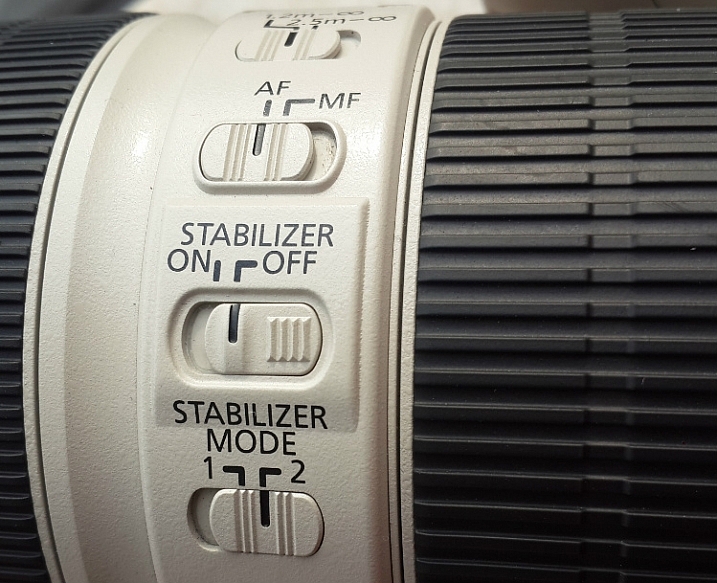
It is fairly possible that you possess a lens which features image stabilization (IS or VR) and there are fair chances that you may be using your lens with IS/VR switched on. It is fine when you are shooting at a high shutter speed using a tripod, but as you slow things down, that’s when the real problem starts.

Check your lens for the IS or VR switch.

When you are shooting with IS/VR switched on, your lens generates a minor shake (meant to counter-act your hand movements) which ultimately reaches the camera. This minor vibration can introduce shake in your photos when shooting on a tripod, especially at slower shutter speeds.

While shooting landscapes in the evening, star trails, light trails, or any long exposure shot, you need to slow down your shutter speed. As you cannot shoot these types of photos handheld, you will need a tripod. I would advise you to switch off the IS/VR on your lens in order to eliminate the minor shake that would have been generated otherwise.

Tips sharp photos tripod 03

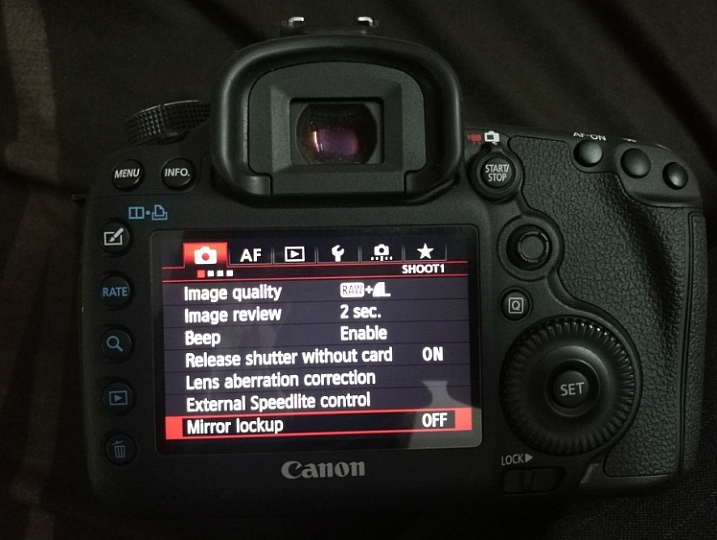
3. Use the mirror lock-up feature on your camera

You may be aware of the fact that there is a mirror inside your digital camera (except for mirrorless cameras) that moves to expose the image sensor when you press the shutter release button. This movement of the mirror can cause a minor shake while the camera is mounted on a tripod, thus affecting the sharpness of your photos.

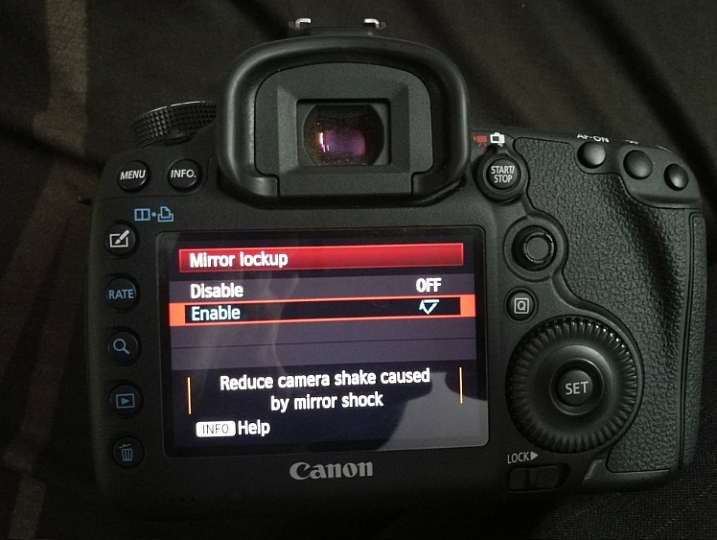
This shake caused by the mirror may not affect your photos while you are shooting at a fast shutter speed, but as you slow down the shutter speed the shake would become visible in your photos. In order to eliminate this, you can manually lock the movement of the mirror. This can easily be done by activating the mirror lock-up feature (look through your camera’s menu settings or consult the user manual).

Tips sharp photos tripod 08

As you activate the mirror lock-up feature on your camera, the camera will raise the mirror up and keep it there until you disable the feature. So when you press the shutter release button the mirror will not move and the chances of minor shake being generated would be eliminated.

Mirror Lockup feature on Canon

Mirror Lockup enabled.

Note: This works differently on some camera models. Some the mirror stays up until you release it, on others you press the shutter button twice – first one lifts the mirror, second one takes the shot and lowers the mirror. The latter requires you to do it each time, but you can see your scene through your viewfinder between shots. In the former you cannot as the mirror blocks light coming to the eye piece.

Tips sharp photos tripod 04

4. Use the 2-second timer or a remote shutter release

Do you use the shutter release button to take a photo when the camera is resting on a tripod? If you said yes, then make sure that you switch on the 2-second timer in your camera. Do not assume that if the camera is on a tripod there will be no shake no matter what. When you press the shutter button you introduce a minor shake by applying some pressure to the camera. By using the 2-second timer feature you can do away with the camera shake as you are allowing 2 seconds for the camera to absorb that minor shake before exposing the photo.

Use a remote trigger or your 2-second timer to eliminate camera shake.

If you want to be extra cautious and not take any chances, you can use a remote shutter release or cable. The remote allows you to go wireless and click photos without even touching the camera, thus ensuring that your images will be crisp and sharp. A wired trigger is equally useful except for the fact that there is a cable attached to the camera, otherwise it functions exactly the same as a remote.

Tips sharp photos tripod 05

5. Shoot at the lowest ISO possible

The lower the ISO, the less sensitive the camera’s image sensor is to light and the chance of noise and grain is lessened. While you are shooting with your camera on a tripod, likely you may be working in low light conditions or doing long exposures. You would usually shoot at high ISO in order to compensate for slow shutter speed, but that is not necessary while using a tripod.

If you are shooting in low light conditions, using high ISO would obviously introduce noise or grain into your images. As you are already using a tripod, you do not have to worry about camera shake because of slow shutter speed. Without any second thoughts set the ISO sensitivity to the minimum value available on your camera, this will result in a sharp and grain free image.

Tips sharp photos tripod 06

Conclusion

So if you have had issues getting sharp images while shooting with a tripod, I hope these tips will help you solve them. Please share your comments and thoughts below.

googletag.cmd.push(function() {
tablet_slots.push( googletag.defineSlot( “/1005424/_dPSv4_tab-all-article-bottom_(300×250)”, [300, 250], “pb-ad-78623” ).addService( googletag.pubads() ) ); } );

googletag.cmd.push(function() {
mobile_slots.push( googletag.defineSlot( “/1005424/_dPSv4_mob-all-article-bottom_(300×250)”, [300, 250], “pb-ad-78158” ).addService( googletag.pubads() ) ); } );

The post 5 Tips to Get Sharp Photos While Using a Tripod by Kunal Malhotra appeared first on Digital Photography School.


Digital Photography School

 
Comments Off on 5 Tips to Get Sharp Photos While Using a Tripod

Posted in Photography


9 Tips for Taking Better Photos of Cats

10 Feb

For many of us, pets are such a vital part of our lives that we love them like our own flesh and blood, sometimes more! It’s only natural that we should want to capture them on camera and hold their memory close to our hearts. The problem is that taking great pet photos can be tricky, especially when the animal is a single-minded cat.

If you’re reading this, chances are you have a cat or two of your own, or maybe a whole pride of them (wrong cat, maybe). You might just be someone who enjoys photographing cats around your neighborhood. Whatever your story, I’m going to help you take great feline shots with these tips for getting better photos of cats.

Tips photos cats 01

1 – Patience is key

First things first; when photographing cats, you should expect a high failure rate. The more discerning you become as a photographer, the more this is the case. Cats are not an ideal subject for impatient types since they don’t strike obliging poses for long. Just as you’ve framed the shot, they’re likely to walk up to you and sniff the lens. If not that, they’ll turn their heads at the precise moment you release the shutter. Guessing what they’ll do next is part of the fun.
Have your camera ready.

Cats tend to strike random funny poses, especially when they’re lolling about half asleep. To capture these comical moments, it’s best to always have a camera handy, even if it’s a phone. If you need to go dig out your camera before taking a shot, the cat will most likely hear you and move. Likewise, if you’re outside with your cat, have your camera ready for some outdoor action shots. You’ll miss great pictures if you first need to fetch your gear from inside a bag.

Tips photos cats 04

2 – Attention seeking

By now, you’ll know how much your cat likes to thwart you at every turn and foil your photo attempts. However, there are tactics you can use to get the pictures you want. When working alone, learn to use your camera one-handed, even though it’s not textbook technique. Set everything up on Auto so you don’t have to fiddle around before taking the shot. With the other hand, you’ll be attracting your cat’s attention. Clicking the fingers usually works for a time, until the cat wises up to it.

Cats are intrigued by rustling noises too, so you can crunch a paper bag to make the cat look towards you. Use a cat toy if you want a livelier picture, but the success rate will be lower. You’ll make life easier if there’s a window behind or beside you, so plenty of natural light falls on your cat’s face.

Tips photos cats 09

3 – Getting down to your cat’s level

One common mistake made by budding pet photographers is that they photograph their cat or dog from a human height. This rarely works well. Photos of animals taken on their own level tend to have more impact and show the animal’s personality better, from the perspective of an equal.

If you want to capture a cat in hunting mode, getting down to ground level gives the feeling of being the cat’s prey and adds drama to the photo. If it’s hard to adopt these low positions, you’ll achieve the same thing using a digital camera with a swivel screen. Since cats like to climb, you won’t always have to stoop to be at eye level.

Tips photos cats 08

4 – Frame your subject

Framing your cat in the shot with surroundings like long grass, shrubs, or tree foliage gives the photo added depth. It also creates the feeling of peeking into the cat’s own natural habitat, or his world. It’s a technique you’ll often see in wildlife photography. Indoors, you can frame your cat by including any cubby holes or hiding places that cats generally like. Comfy towel cupboards are a frequent favorite.

Tips photos cats 02

5 – Focus on the eyes

If you’re taking a close-up portrait of your cat, it’s important to make sure the eyes are in focus. This is surprisingly easy to get wrong in animals since it takes only slight carelessness to focus on the nose instead. The camera you use and its sensor size will affect how easy this is. A phone camera will typically give you loads of depth of field, so it’s difficult to get the eyes out of focus, whereas an SLR with a larger sensor gives a shallower depth of field and demands more control over technique.

If you’re taking the portrait from an angle, try to have the nearest eye in focus, as it looks unnatural to have only the far eye sharp. These same principles are generally applied to human portraits, too. They are only guidelines, however, so you can ignore them if you’re going for a specific effect.

Tips photos cats 10

6 – Lighting for cats

You’ve probably seen photos of people taken at night that exhibit the dreaded red-eye effect. This is the result of using a flash, either built into the camera or directly mounted onto it. Blood vessels in the back of human eyes create a red reflection. Cats and other animals have a special reflective layer in the back of their eyes that enhances night vision. This causes a variety of colors to be bounced back when a flash is aimed at them, but typically it will be blue in a kitten and green in an adult cat. These colors are more attractive than red, but still undesirable in your photo.

By mounting or holding a flashgun away from the camera, you can take night photos of your cat without this demonic eye effect. Covering the flash with a softbox will help avoid harsh shadows. High-quality flash photography requires a further investment in gear and is not strictly necessary when window light provides an easy and effective alternative. As well, digital cameras have greatly improved in high ISO performance in recent years, so you can grab photos in relatively low household light and avoid excessive noise in the picture. The only downside with that is you’ll be often forced to correct the color cast created by electric light bulbs.

Tips photos cats 06

Try photographing your cat outside when the sun is low in the sky. You’ll achieve some very attractive photos if the sunlight catches the cat’s fur, which requires that you shoot towards the sun. In this situation, you can sometimes get away with using a flash directly on your camera for a little “fill-flash”. The harsh green-eye effect that happens at night doesn’t occur if the flash is diluted by enough daylight. This avoids the cat itself being underexposed, which is a possibility when shooting into direct sunlight.

7 – Lens choice

A portrait lens around 85-130mm (or equivalent) works well with cats, giving just enough working distance that they don’t instantly make a beeline towards you. If it’s also a macro lens, like the classic Tamron 90mm 1:1 macro, you’ll have the option of moving in for some ultra-close photos of eyes or even paws.

Tips photos cats 12

Wider reportage type lenses around 35mm are good for grabbing full-body photos of your cat. At the other end of the scale, a long telephoto lens allows a greater working distance and lets you be more selective about the background, as it will have a narrower field of view. You’ll probably go for a shorter lens indoors since you won’t need as much light to keep the photo sharp.

Tips photos cats 07

Compact cameras or a mobile phone will normally let you move in so close to your cat that you’re almost touching him or her, but be aware that this closeness distorts perspective and your cat’s features. Despite this drawback, the resulting photos are often pleasing enough.

8 – Camera settings

Manual Mode + Auto ISO

If you have a solely automatic camera, you can ignore this section, but it’s a neat trick for anyone with access to Manual mode and an Auto ISO feature. A lot of experienced pros and amateur photographers routinely set their cameras to Aperture Priority mode (Av/A) and have their ISO set to a low value for minimum image noise. The camera is then left to automatically adjust shutter speed for the correct exposure. This is fine, but it reduces the chances of taking sharp action photos in low light, as the shutter speed will often end up too slow. For cat photography, that’s a potential problem.

Tips photos cats 03

By setting the camera to Manual Mode in combination with Auto ISO, you always have control over the aperture and shutter speed settings, while the ISO is sorted out by the camera. In fact, the “manual” setting in this instance is no less automatic than aperture priority (Av/A) or shutter priority (Tv/S) modes but gives more creative control over the photo. This technique is more viable nowadays than it was a few years ago since modern digital cameras produce high ISO images with very little noise. That said, if you try this technique in poor indoor light you’ll be pushing your camera’s limits and may well be dissatisfied by the results. Given a reasonable amount of light, it’s a versatile way of working.

Camera settings – Continuous Drive mode

Capturing pictures of your cat chasing a toy, leaping or running around a garden or scurrying up a tree is not going to be easy if you leave your camera in single shot mode. That is true unless you literally have lightning reflexes or get lucky with the timing. Therefore, if you know you’re going to be attempting action shots, switch your camera to its continuous drive or burst mode. You’ll need to set a fast shutter speed too if you want to freeze the action (I’d suggest a minimum of 1/500th of a second).

While this may be less skillful than snatching single photos with ninja-style dexterity, there is no shame in stacking the odds in your favor. Remember that your audience won’t usually care about how you took the photo but will admire great results.

Tips photos cats 05

9 – Black cats, white cats

Left to its own devices, your camera’s exposure meter will often underexpose a white cat and overexpose a black cat, particularly if they take up a large portion of the photo or are set against a similarly toned background. The white cat will look murky gray and the black will lose the deep luster of its fur and appear grayish, too. You can remedy this by using your camera’s exposure compensation feature and dialing in one or two stops of overexposure for a white cat or underexposure for black. While it’s generally better to do this in-camera, with digital you can usually fix it later when editing. Being aware of the issue is the main thing.

Tips photos cats 11

Lastly, take plenty of photos

If you keep pets through much of your life, sooner or later they’ll break your heart. Don’t be caught when it’s too late without any good photos of your beloved cat. Think about his or her personality and try to record their various traits on camera. Take lots of photos to enjoy during and after your pet’s lifespan, including selfies of you both together. Cherish your cat and celebrate living!

For more info check out: Your Essential Guide to Photographing Cats and Dogs: Snap’n Paws

Did I miss anything? Please share your cat photos and tips below as well.

googletag.cmd.push(function() {
tablet_slots.push( googletag.defineSlot( “/1005424/_dPSv4_tab-all-article-bottom_(300×250)”, [300, 250], “pb-ad-78623” ).addService( googletag.pubads() ) ); } );

googletag.cmd.push(function() {
mobile_slots.push( googletag.defineSlot( “/1005424/_dPSv4_mob-all-article-bottom_(300×250)”, [300, 250], “pb-ad-78158” ).addService( googletag.pubads() ) ); } );

The post 9 Tips for Taking Better Photos of Cats by Glenn Harper appeared first on Digital Photography School.


Digital Photography School

 
Comments Off on 9 Tips for Taking Better Photos of Cats

Posted in Photography