Digital Art and Photography at AISB High School have been exploring the medium of stop-motion videos.
Digital Art and Photography at AISB High School have been exploring the medium of stop-motion videos.

City Photographed: Bucharest, Romania. www.libanyusuf.com Buy photo prints! http Music: Beautiful Calm Piano Music Instrumental (Original) by user: www.youtube.com Equipment: Nikon D300, Photoshop & Final Cut Pro. Thanks for watching, please rate, fav and subscribe! Liban
Video Rating: 4 / 5
This is the first of many interviews by photographer Robert Vasquez with the great photographers of our generation. Meet Mark Edward Harris as he gives valuable insight to the realm of magazine assignments and travel photography.
Video Rating: 5 / 5
A Guest Post by Marlene Hielema
Video is all the rage. With virtually all digital cameras now able to capture live video, if you’re not shooting video you’re going to start to feel left out.
Yes it does, but that doesn’t mean it’s impossible to get going. In this post I’m going to tell you about three ways you can use video to promote your photography, and I’ll start on the shallow end of the learning curve.
In a word: Traffic.
The goal of these videos is lead generation and they are used for marketing.
I’ve talked to photographers who have been scared off of YouTube. I say, “Embrace it and use it for what it’s best at”. Use YouTube for traffic, visibility and lead generation. Use YouTube for your public side, and save Vimeo and private hosting for private client videos.

1. Portfolio video: Slideshow of still images – simplest way to get a video online
2. Profile: About you – builds trust and rapport
3. Behind the scenes: Show what happens on one of your photo shoots
Shooting video is relatively simple, especially if you start by using your iPhone. The steep part of the learning curve is the editing and exporting for web use.
In future tutorials I’ll show you how to approach each method in greater detail, and some tools you can use to produce your videos.
Do this next: Watch the video above to see an example of how I used it to drive traffic to this blog post. I’ve got an invitation and a benefit at the end of the video for you too.
Are you using video to promote your photography yet? Let us know what technique you use in the comments.
Marlene Hielema teaches photography and photo editing online, in the classroom, at corporate workshops and one-to-one. She’s also a camera raw evangelist and YouTube video blogger. Find out more about what she can help you with at www.imagemaven.com and look for her weekly video blog post on YouTube.
YouTube:
Post originally from: Digital Photography Tips.
Check out our more Photography Tips at Photography Tips for Beginners, Portrait Photography Tips and Wedding Photography Tips.
YouTube for Photographers: 3 Ways to get Started Using YouTube to Show and Promote your Photography
A Guest Post by Anne McKinnell
Most of us start out in photography because we love to make images, it gets us outdoors, and helps us explore our creative selves. We do it for ourselves because it makes us happy.
But there is different side of photography that adds another dimension to the experience: sharing images with others. It’s one of the most popular things to do on the internet.
We do it to share experiences with our families and friends, get feedback from other photographers, and attract customers or clients.
There are three steps to making a big impression online:
So, you want to put all of your images online for everyone to see, right? That’s a really bad idea. Not putting them online – the bad part is putting *all* your images online.
Imagine you are looking at a photographer’s portfolio and they have hundreds of images. Some are architecture, some are seascapes, some are portraits, some are still life. You’re going to see a lot of these. Hundreds of photographers will all blend together in your mind because they are indistinguishable from each other.
On the other hand, let’s say you look at a photographer’s work and they have 20 images all of which are black and white seascapes. He becomes the “black and white seascape guy”. Or let’s say they are all dog portraits. She becomes the “dog portrait woman” in your mind.
That doesn’t mean that if you are the dog portrait woman you cannot make images of architecture. You don’t have to choose right at the beginning what kind of photographer you want to become. Just choose one selection of your images to show the world right now. That will make you stand out in people’s minds and you will grow a bigger following because people can identify with you.
Pick a theme to work on. My first theme was seascapes at twilight.
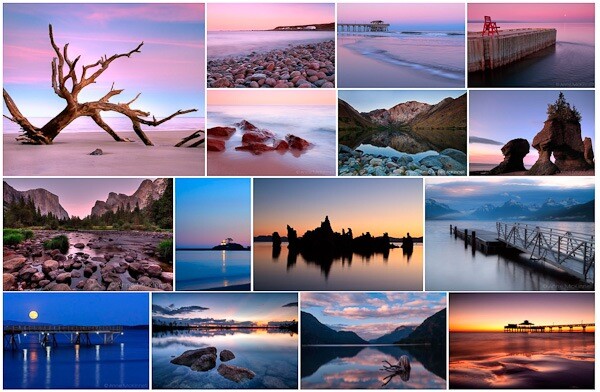
Notice how all the images have a certain look to them. They fit together as a group. And there are less than 20. That’s what you need to do.
Now that you have a great set of images to share with the world you need to choose a method for getting them online.
But … where to start? There are so many options!
So many that I could never summarize the pro’s and con’s of every available alternative but I will share what I have learned so you can get going quickly and easily. And I’m only going to suggest sites where your photos are sure to look great (sorry Flickr that leaves you out)!
The first thing is to determine what your goals are right now.
Let’s look at these options one step at a time.
500px is the best option for you. Images look absolutely stunning on the site and it is free if you upload fewer than 10 images per week. For only $ 20 per year you can upload as many as you like.
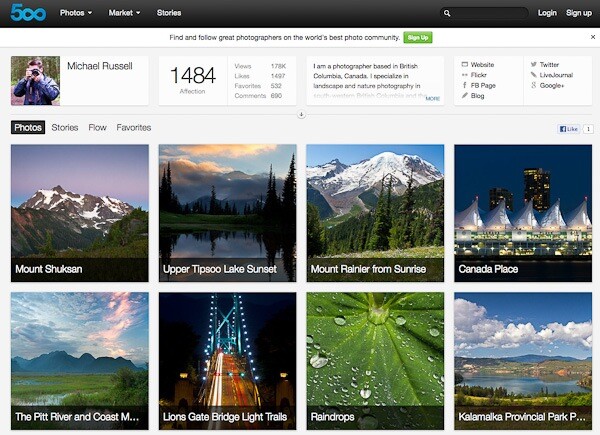
This screenshot is from Michael Russell‘s page on 500px.
Note that you can sell digital downloads on 500px too. The only print product you can sell is a fixed price canvas print which just doesn’t cut it if you are interested in selling print products.
SmugMug, Redbubble, DeviantArt, Photoshelter, Photocrati, Snapfish, Twitpic, Zenfolio – the options are endless and you could research forever before being able to make a decision.
I’ve tried many of these services, some paid, some free, and I’m going to tell you which one is super easy, looks great, and is totally free. It’s Redbubble.
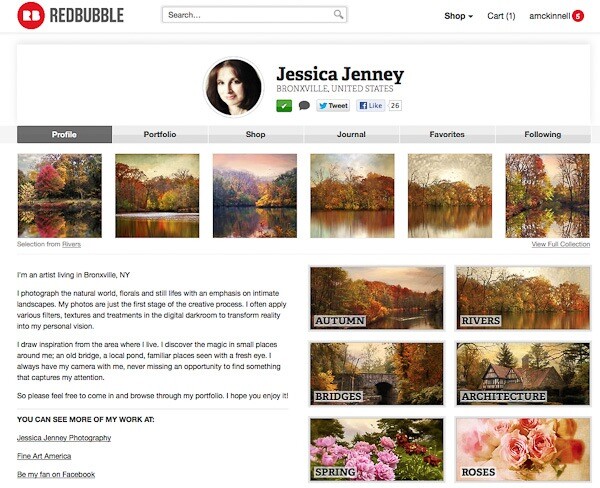
This screenshot is from Jessica Jenney’s page on Redbubble.
Redbubble offers lots of different products. I have ordered many of them myself and am always impressed with the quality. You can set your own prices and Redbubble makes a small commission from any sales. The only drawback is that you cannot sell digital downloads – only products.
If you want to sell both products and digital downloads take a look at Zenfolio.
The two big players in this field are Blogger and WordPress.
Blogger is very easy to setup and adding content is straightforward but there are fewer options for design and custom features than WordPress offers.
WordPress has a steeper learning curve but if you are going to have a blog you probably want it to have a really nice design and some customizable functions. And it’s way easier to just start with WordPress than it is to try to move a blog from Blogger to WordPress later.
You can start a WordPress blog at wordpress.com or you can start a WordPress blog on your own website with WordPress.org.
The bottom line is that Blogger is a better option if you want your blog to be super simple to set up and add content and you don’t need a lot of bells and whistles. WordPress is a better option if you want more advanced features and customization.
Both options are free and both have plugins that allow you to display your gallery.
If you are already really serious about your photography and you want to have your own website with your own domain name and have a blog and a gallery in the same place, and perhaps sell products and advertising, then get ready to roll up your sleeves or get out your wallet! (Probably a bit of both.)
You might want to hire someone else to set up the website for you if you’re not tech-savvy and then all you have to do is add blog posts and new images.
If you want to take it on yourself you need to choose to a webhost, buy a domain name (yourname.com) and a web hosting package. If you want to blog you will need to install WordPress and find a theme you love and install that.
Next you will need to choose a method for displaying your image gallery:
Creating your own website is a huge topic so if you are going to delve into it you have some researching to do.
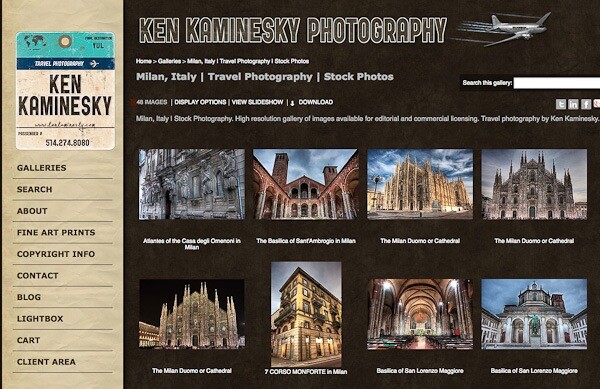
This screenshot is from Ken Kaminesky’s website built with Photoshelter.
For my own website, I use WordPress with a theme from Graph Paper Press and Photoshelter for my gallery.
If you want to promote your photography beyond your family and friends you should start building your audience right away. Using social media is the best and fastest way to find people who love to look at your images and might become customers or clients in the future. As well, they will be your marketing department by helping to spread the word about your photography.
There are so many different social networks out there. Again it is a learning curve just to figure out which ones will work best for you and how you should use them. So let me give you a quick primer on the five social networks that have worked best for me.
Twitter is my favourite social network and the first one I started. A “tweet” has a maximum of 140 characters so it is quick to sift through a lot of information to find what you are interested in.
Most photographers post links to their images and their blog posts. If you are interested you click, if not you move on.
If you want to grow your audience on twitter it is important to promote other people’s work as well as your own.
Google+ is the social network that was designed for photographers. In many ways it is the opposite of twitter because people tend to post very long posts and have conversations in the comments section.
Because of this engagement within G+, people rarely click links which makes it difficult to drive traffic to a blog. But if you put your whole blog post on G+ you might get more interaction and comments there than you do on your blog.
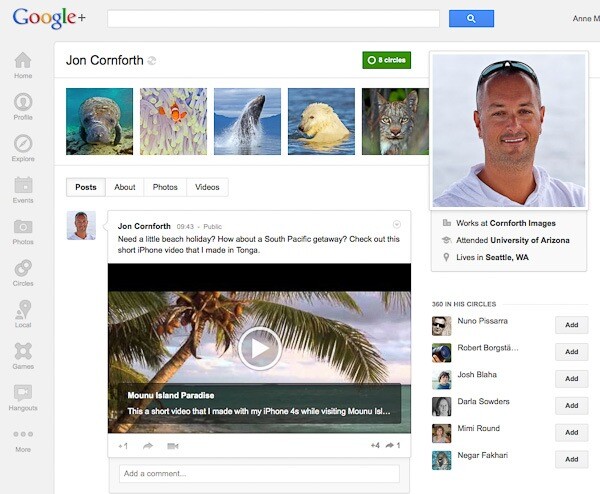
This screenshot is from Jon Cornforth’s page on Google+.
StumbleUpon is a bit like rolling the dice. You have no idea what it is going to land on but it will be something interesting to you. The idea is that you follow people who have similar interests and when you “stumble” you see the pages that they like. Or you can stumble certain topics like photography or travel.
The difference here is that you are not supposed to stumble your own links and you get penalized if you do it too often. It’s really better to put a StumbleUpon button on your website or blog and hope that other people stumble it. When they do you will get a huge spike in traffic.
Do you like scrap booking or collecting things? This social network is the one for you.
In Pinterest you have boards where you pin groups of images you like, just like pinning an image you cut out of a magazine on a cork board. It’s a great place for collecting images that inspire you, or places you want to go, or whatever you are interested in.
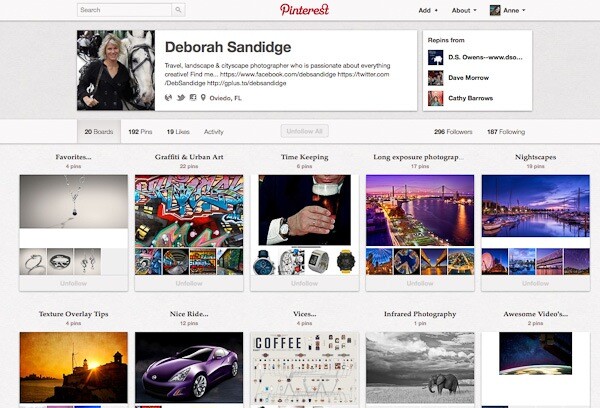
This screenshot is from Deborah Sandidge’s page on Pinterest.
When you follow someone you will see the images they pin on their boards. If you like an image and want to add it to your collection you simply re-pin it to one of your boards. You can pin your own images too and people who follow you will see them.
I hate to say it but I do get a lot of traffic from Facebook and it would be negligent of me to leave it out. Even though it is the most difficult, confusing, frustrating and sometimes outright stupid system to use. But because it was first almost everyone is on it.
Unfortunately, I don’t have the power to make everyone stop using it so it’s one of those “if you can’t beat them, join them” kinds of things. Regardless of my opinion, Facebook will generate traffic and help you build your audience.
If you do not yet have a gallery of images or a blog and you just want to get some stuff online quickly and easily, start with Redbubble. It is free, easy to use and comes with a great community of photographers. It’s a great place to get your feet wet.
Anne McKinnell is a photographer, writer and nomad who travels around North America in an RV photographing beautiful places. You can read about her adventures on her blog. She is also the author of several eBooks on photography. This post contains excerpts from her latest eBook “8 Ways To Accelerate Your Photography.”
Post originally from: Digital Photography Tips.
Check out our more Photography Tips at Photography Tips for Beginners, Portrait Photography Tips and Wedding Photography Tips.
Sharing Your Photography On The Web

razzi.me www.facebook.com www.PhotographersOnUTube.com https A Manual Mode Tutorial to balance the exposure.
www.silberstudios.tv This is the full edit version of Jeff Johnson, who has a dream job as a Patagonia staff photographer. He gives his tips for outstanding travel and photojournalistic images. Jeff is also the lead in the film 180 Degrees South which retraces the epic 1968 journey of his heros Yvon Chouinard and Doug Tompkins to Patagonia. Jeff talks about how the movie came about and his experiences along the way as a photographer. A few of the questions that Marc asked him were How do you tell stories with your photographs? What’s the story of making the film 180 South? How was it transitioning from still to motion? How do you approach a photojournalistic assignment? Any tips for capturing great light? How about your tips for composition? 7. How do you get the “mojo” in your photographs? but they talk about a whole lot more, so give it a watch! Hey tell us, what points really stand out for you?
Video Rating: 4 / 5

froknowsphoto.com Before I get into talking about goals I want to thank each and every one of your for your continued support of this community. Over the last year it has grown so much and helped so many people become better photographers. It means so much to me that you guys come back day in and day out to learn, help and even teach me new things. I look forward to bigger and better things to come in 2012. As we 2011 ends and 2012 begins I wanted to share with you my photographic goals for 2012. One of my major goals is to further my photographic education, continue to learn and expand my knowledge. This could be from books, videos or other photographers I work with. If you could take a min to leave a comment about what some of your goals are for 2012 along with your fav video from 2011 that would be great.
Video Rating: 4 / 5
just a quick video i did for my photography work, under the theme light and shadow, looking at hoe film use light and shadow to create eerie scenes and suspense.
Video Rating: 0 / 5
froknowsphoto.com When it comes to selecting a lens for a specific photo shoot there are so many factors that come into play. Do you want to shoot wide angle and have everything in sharp focus or do you want to shoot super tight and blow the background way out. In the video below you see Greg demonstrating how by just changing the distance to the camera the background will totally change. The first section of the video is being shot with the Nikon D3s 70-200 2.8 VRI at 200mm. You can see that the background is blown out but you can still make out the shapes in the background. In the second part of the video Greg got closer to the lens and all that changed was the focus. Now you can see that being closer to the lens the background has been totally blown out and anything in the back is unrecognizable. You don’t always need to have the best glass or fastest F stop to blow out the background. If you get closer to your subject and have a deeper background you can still get a similar effect with a 5.6 lens. Sure it is harder to blow out shorter backgrounds but it is possible with just about any lens. Now lets look at what happens when you use wide angle lenses vs telephoto. When you use a telephoto lens you are compressing anything in the image, when you use wide angle you are doing the opposite of compressing. For example when I shoot head shots I love using my Nikon 70-200 2.8 VRII because I can isolate my subject form the background. I zoom in as well as get closer to my …
Video Rating: 4 / 5
SUBSCRIBE/RATE VIDEO TOO =)! Manhattan and Bronx Surface Transit Operating Authority (MABSTOA) This Video was made due to a request, plus also wanted to do an action too. Videos from around 181st Street, Fort Washington Avenue thru Amsterdam Ave. PLUS George Washington Bridge Bus Terminal area! Over 20 Min of buses lol! Manhattanville Bus: M3 | Ft. George, Manhattan and East Village, via St. Nicholas Avenue M4 | 193rd Street to Penn Station via Fort Washington Avenue M5 | George Washington Bridge Bus Terminal to South Ferry via Broadway Michael J. Quill Bus: M98 Limited Express| 193rd Street to Midtown, Manhattan via 179th / 178th Crosstown and Harlem River Drive (Not officially express, but it does run as an Express via HRD non stop from Third or Park Avenue, 125th Street and 178th /179th Street, Amsterdam Avenue 100th Street Bus: M101 | 193rd Street to East Village via Amsterdam Avenue Kingsbridge Bus: Bx3 | GWB Terminal to Riverdale, The Bronx via 181st Street Crosstown Bx7 | 168th Street to Riverdale, The Bronx via Broadway US ROUTE 9 Bx13 | GWB Terminal to Yankees Stadium or Third Avenue via 181st Street Crosstown M100 | 125th Street to 220th Street via Broadway / US ROUTE 9 West Farms Bus: Bx11 / Bx35 | GWB Terminal to West Farms Road & Hoe Ave via 181st Street Crosstown Bx36 + LTD | GWB Terminal to Soundview, The Bronx via 181st Street Crosstown Fleets here: New Flyer D60HF / Orion V / VII Standard and Next Generation *NOTE* The First of the video WITH the Night …