RSS
 

Posts Tagged ‘Photography’

Basic Flower & Macro Photography

03 Nov

cazillo.com Flower photography is enjoyed by many people all over the world. Do a Google Images search for flowers and you will come up with millions of samples. In my video I go over timing, lenses, depth of field, focus points, focus modes and some composition tips for capturing great macro and flower photographs.
Video Rating: 4 / 5

 
Comments Off on Basic Flower & Macro Photography

Posted in Nikon Videos


Digital Photography – ISO

02 Nov

froknowsphoto.com One of the very first things in photography you will want to understand is ISO. ISO controls the sensitivity of your images sensor or how much light gathering ability your sensor will have. When we were shooting FILM it was called film speed, examples are 100-200-400-800 and 1600 ISO. Now, we no longer have film but it is still called your “film speed”. In the digital camera you still have the ability to change your ISO generally from 100-3200 and in some cameras all the way up to 120000 ISO. You are no longer locked into one film speed until you finish the roll, you can change your ISO for every picture if you would like. Would it be a good idea to let the camera select the ISO for you? Absolutely not, you, are better able to determine what your settings should be. Let’s dive into this head first and make it as simple as possible. Before I get into what ISO you should set for what situation lets look at what ISO directly controls. It controls how sensitive your sensor is meaning how much light it will gather. The brighter it is outside or in the situation you are photographing the lower your ISO can be. Keep in mind that ISO will directly effect your shutter speed. As you raiser your ISO your shutter speed will follow. For example if your shutter speed is 1/60th of a second at 100 ISO and you bump your ISO to 200 your shutter speed will jump one stop and go to 1/125th. The brighter the situation the lower the ISO, the darker the situation the higher
Video Rating: 4 / 5

I had another version of this up(the only difference with this one is this is a new soundtrack my friend composed specifically for this. In order to be a partner with youtube, you must have the rights to all the music, so this was our attempt at that. My friend Stephen composed the music for this, it’s an original piece specifically for this. You can contact him here. Stephen Anderson. www.stephenjanderson.com As for me.. I’m a freelance cinematographer. For any potential job offers, feel free to contact me through my youtube page, or through my email at dpdevin@gmail.com Here’s some footage I shot with my Canon 5D Mark II while in Canada with my family last week. We spent 10 days on Vancouver. Most of that time was spent in one of my favorite places, Barkley Sound. It’s an area with 150 islands in a 5 mile radius. We canoed from one island to the next, camping on them. On a technical side, it was all shot on the Canon 5D Mark II. Most of the shots were done with the Canon 16-35mm 2.8 L Series. A Nikon 50mm 1.8 adapter, and a Nikon 70-200 2.8 with Canon/Nikon lens adapter. The smooth shots were done with a glidecam 2000. You can check out the exact model on their official website here where you can also buy them. www.glidecam.com I had my tripod as well, with several shots handheld, with a “smooth cam” filter applied to it with Final Cut pro. For BUSINESS ENQUIRERS ONLY, you can contact me at this email. devinsupertramp@gmail.com
Video Rating: 4 / 5

 
Comments Off on Digital Photography – ISO

Posted in Nikon Videos


What Causes Blurry Photos? Photography Lessons by Berger Bros Camera

02 Nov

www.berger-bros.com One of the biggest problems for people new to photography is taking blurry photos. There are many reasons why photos can come out blurry. Here are several frequent causes of blurry photos. 1. Improper Shutter Speed 2. Being Out of Focus 3. Failing to Keep the Camera Still While Taking a Photo Yvonne Berger, one of the photography instructors at Berger Bros Camera in Amityville and Syosset Long Island, explains how to solve the issues that can cause your photos to come out blurry.
Video Rating: 5 / 5

 
Comments Off on What Causes Blurry Photos? Photography Lessons by Berger Bros Camera

Posted in Nikon Videos


What’s in my photography studio

01 Nov

A cool look into the Hardy and Nance street studios of Houston
Video Rating: 4 / 5

Questions? Go here: www.youtube.com Quick overview on the Nikon’s SB-400 speedlight. SB-900 is compatible with these cameras: These cameras have Optional Flash option available in the menus when SB-400 is turned on. You can adjust the flash compensation in iTTL mode or flash value in M (manual) mode. D40 D40X D50 D60 D70-Series D80 D90 D3000 D3100 D3200 D5000 D5100 D7000 D200 D300-Series D600 D700 D800-Series SB-400 is compatible with these cameras, below, however. They don’t have Optional Flash option available in the menus. iTTL and Red Eye, Slow Sync, and/or Rear Sync are available. Flash compensation cannot be changed and iTTL is fixed. No manual option available. F6 D2-Series D3-Series D4-Series

 
Comments Off on What’s in my photography studio

Posted in Nikon Videos


Glasgow Night Photography

01 Nov

Various night shots from around the city of Glasgow. Including City Chambers, Western Infirmary, Charing Cross, Argyle Street, Kelvingrove Art Gallery, Caledonian University, Ingram St, George Square, the M8 motorway, The Mitchell Library, Glasgow University, St George’s Mansions, Sauchiehall Street, Buchanan Galleries. Please visit my site: www.rosslennoxphotography.co.uk
Video Rating: 5 / 5

 
Comments Off on Glasgow Night Photography

Posted in Nikon Videos


Wedding Photography – How we photograph a Wedding Part 2 – The Ceremony

01 Nov

How we photograph a wedding ceremony. Website www.davenunnstudios.co.uk Wedding photography Moxhull Hall

 
Comments Off on Wedding Photography – How we photograph a Wedding Part 2 – The Ceremony

Posted in Photography Videos


Aspect Ratios in Landscape Photography

31 Oct

Composition is often the key to the difference between a good landscape photograph and a great landscape photograph.  There are oft quoted rules that we all try to adhere to and break in equal measure (rule of thirds, leading lines, golden spiral etc.) yet when considering what we are trying to capture within the frame, we don’t always consider the frame itself.

The aspect ratio of the photograph can make or break the composition by both emphasising the subject and removing distractions, or by putting the whole scene off-balance.  When looking through the viewfinder, about to press the shutter, it’s a good idea to try and envisage the final shot, including the aspect ratio, in order to optimise your composition (too often the aspect ratio is an after-thought, being edited and applied during post-processing to correct for poor compositional choice).

But how does each aspect ratio impact our composition?  Hopefully, that’s where this article comes in.  I’m going to discuss a few common aspect ratios, with examples, and show the benefits and draw backs for each, considering where each one may be applied.

(Note, there is an argument for cropping your photo without sticking to a defined ratio to give an image a custom ratio based on your subject matter.  I believe that can make printing/framing awkward so will therefore be sticking to well-defined ratios that most should be familiar with).

1:1 –Square format

The square format can often be used to simplify an image and give a subject a striking presence at the centre of the frame.  By keeping the width equal to the height, the way in which we read the photograph changes, as there is less of a need to move left-to-right through the frame.  The square format lends a good opportunity to break the rules we so often follow – place the horizon along the centre of the image or place a subject in centre of the frame, and the composition may only get stronger.  You’ll often see a 1:1 aspect ratio used to emphasise minimalism (again, along the theme of simplification).
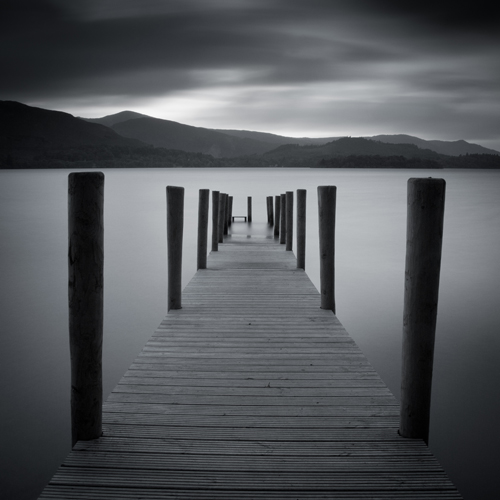
Derwent Water, Lake District, UK presented in a 1:1 aspect ratio

A 1:1 aspect ratio used to add to the simplicity of this image

4:3 – Four-thirds format

This format is the default aspect ratio of cameras that use four-thirds sensors.  The image is wider than it is tall, meaning that the eye naturally wants to move left-to-right through the image.  However, given that the image is still fairly tall, in relation to the width, this ratio is perfect for leading the eye into the scene through leading lines from foreground interest.  The relative height of the image encourages the use of wide-angle focal lengths to capture the depth of a scene within an image, without capturing excess details at the edge of each frame.
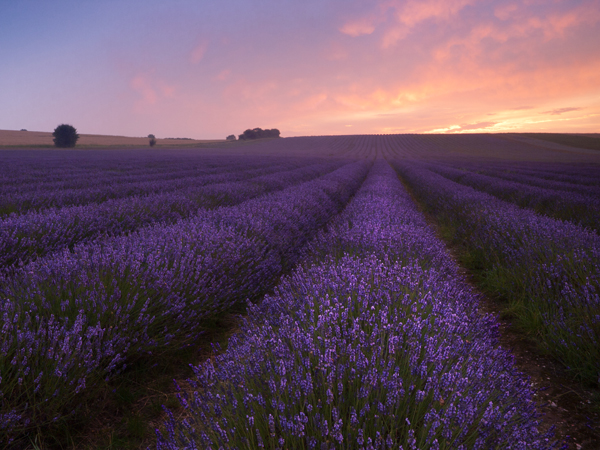
Lavender field at sunrise presented in a 4:3 format

A 4:3 format allows for capturing close foreground detail and leading lines to draw the eye into the image

6:4 – 35 mm format (also called 3:2)

This is the default aspect ratio for 35 mm film, and therefore for full frame and APS-C sensors used in most Nikon/Canon cameras.  The width of the image is significantly wider than the height that, again, encourages reading through the image from left-to-right, meaning diagonal leading lines can work a treat.  A limitation of this aspect ratio is that the height is that much shorter in relation to the width, meaning that capturing foreground detail using a wide-angle lens becomes more difficult due to the limited vertical space with which to work.  It can cause the subjects within the frame to become too disparate and therefore lose impact.  The 6:4 ratio can however be a format that is suited to capturing scenes where there is little to no foreground interest, with mid-range focal lengths (e.g. 35 mm).
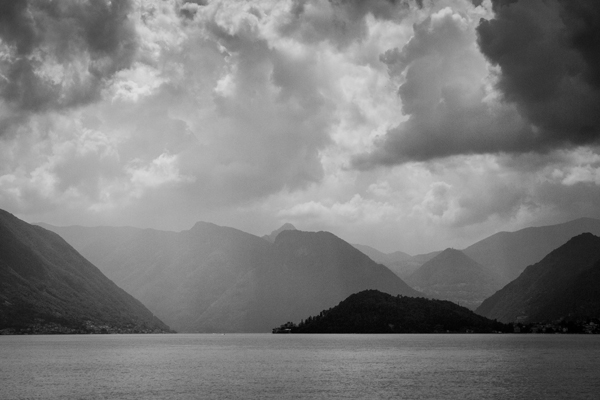
Rain over Lake Como presented in a 6:4 aspect ratio

A 6:4 aspect ratio is used here as no close foreground detail is being captured, yet the scene still benefits from a wide aspect

16:9 – widescreen panoramic

This format was supported in film by the advanced photo system (APS) on its introduction and has recently become more popular due to the prevalence of 16:9 aspect ratio displays in the home – tvs, computer monitors, mobile devices.  With this format, the width of the image is dominant, meaning leading the viewer in from the foreground is difficult, but the format is ideally suited to presenting portions of landscape scenes captured with longer focal lengths (i.e. zoom lenses) from a distance.
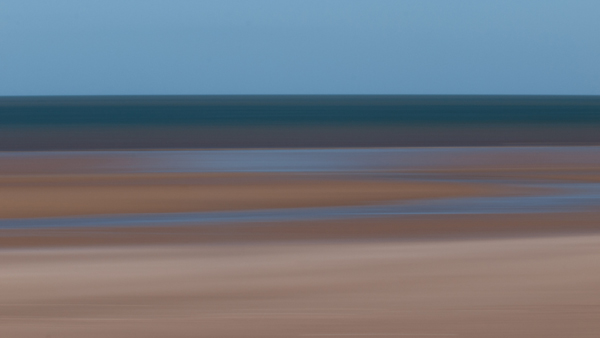
Beach abstraction presented in a 16:9 format

A wide and narrow 16:9 format was used here to emphasise the horizontal bands of colour

12:6 or 18:6 – panoramic (also called 2:1 or 3:1)

I’ve chosen to adopt 12:6 or 18:6 as the panoramic format here for a few reasons.  Both 2:1 and 3:1 seem to be fairly well supported in that panoramic picture frame options are typically either 2:1 or 3:1.  2:1 is a panoramic format supported by a number of medium format film cameras and 3:1 was supported by the APS.  Typically, panoramic ratios will be used to present the result of stitching 2 or more images together – it’s quite challenging to capture a 3:1 aspect ratio image from one frame and it sill be large enough to print at any meaningful size – and often frames to be stitched will have been captured using a longer focal length in order to pick out details distant in the landscape.  There is no real option of including foreground detail here.
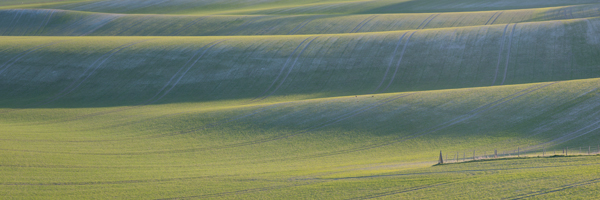
Chalkfields at sunrise presented in a 3:1 aspect ratio

An ultra-wide 18:6 (3:1) aspect ratio was used to present this panorama of 7 stitched images, captured using a focal length of approx. 140 mm

‘Portrait’ mode

I’m aware that I’ve discussed a number of different aspect ratios in the ‘landscape’ format and not in ‘portrait’ format.  That is because I believe the options for successful presentation of landscapes in ‘portrait’ format to be much fewer in number.  For a landscape to work, you need to balance the composition throughout a frame and aspect ratios such as 6;4 make that very difficult due to the image being too tall, relative to its width.  For ‘portrait’ landscapes to work, fatter rectangles such as 4:3, 7:6 or 5:4 are ideal, 5:4 being heavily used by professional landscape photographers using medium and large format cameras.  These formats allow the eye to be taken through an image, still from-left-to-right, without having an excess amount of sky putting the frame off-balance.
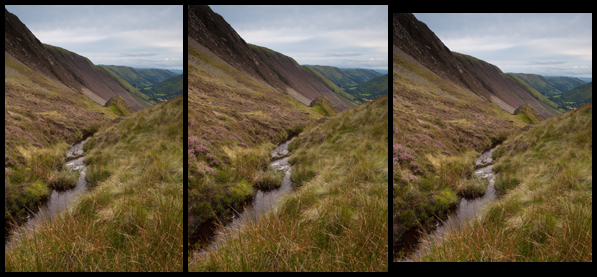
Bwlch Y Groes, Wales, UK presented in three different portrait formats

From left to right: 6:4, 4:3, 5:4. Which one looks best?

Conclusion

Whilst I have tried to describe specific uses to certain aspect ratios, I am aware that not all scenes will follow the suggestions I’ve made, and some images may well work in one ratio, not another, contrary to what I’ve suggested.

However, I’m hoping this introduction to aspect ratios will encourage you to think about them when composing your shot, before pressing the shutter.  It isn’t always ideal to fill the frame of your camera with the landscape in front of you, and knowing that the aspect ratio you choose is not dictated by which camera you use means you may be able to use them effectively to boost the impact of your landscape photographs.

Post originally from: Digital Photography Tips.

Check out our more Photography Tips at Photography Tips for Beginners, Portrait Photography Tips and Wedding Photography Tips.

Aspect Ratios in Landscape Photography


Digital Photography School

 
Comments Off on Aspect Ratios in Landscape Photography

Posted in Photography


Top 10 Piano Songs by Ludovico Einaudi (Photography by Pianopod)

31 Oct

The 10 pieces featured on this video are taken from a solo concert played by Ludovico Einaudi in Dublin in October 2009. The full version of each of these may be found on my channel. www.youtube.com Andare youtu.be Tu Sei youtu.be Uno youtu.be In Un’altra Vita youtu.be Indaco youtu.be i Giorni youtu.be Oltremare youtu.be Le Onde youtu.be Divenire youtu.be Nuvole Bianchi youtu.be Playlist for full Dublin concert: www.youtube.com www.facebook.com This is a selection of my photographs taken in various places around the world. If you would like any information about the photographs or the locations, please contact me. Ludovico Einaudi – www.einaudiwebsite.com Photographs copyright Pianopod 2011

 
Comments Off on Top 10 Piano Songs by Ludovico Einaudi (Photography by Pianopod)

Posted in Photography Videos


Canon EOS – Getting Started: Moving to the Next Level of Photography Tips

31 Oct

Here we introduce the next level of tutorials – Creative Tutorials, where you can increase your photography knowledge and continue on your journey from taking good photos to taking great photos. Join in, find the inspiration for your photography and share at www.canon.com.au/worldofeos
Video Rating: 4 / 5

 
Comments Off on Canon EOS – Getting Started: Moving to the Next Level of Photography Tips

Posted in Photography Videos


How to manually Focus the lens to Infinity the RIGHT way. DSLR Photography tips

31 Oct

razzi.me www.facebook.com www.PhotographersOnUTube.com https This tutorial will teach you how to set the manual focus to infinity on any lens that can be manually focused.
Video Rating: 4 / 5

by aplus [Nikon D90+18-105 vr]

 
Comments Off on How to manually Focus the lens to Infinity the RIGHT way. DSLR Photography tips

Posted in Nikon Videos