RSS
 

Posts Tagged ‘Photography’

How to Use Photography to Help in Natural Disasters — Operation Photo Rescue

21 May

You’ve run through this fire drill a million times over: first, you grab the family cat, then your family photos.

Sadly, it doesn’t always work out that way. While many are grateful to survive a natural disaster, they’re still left devastated from the loss of everything they own.

The worst of it might just be the loss of irreplacable family photos.

Operation Photo Rescue is a league of photographers and graphic designers who set out to help survivors get their treasured memories back.

OPR’s first mission was Hurricane Katrina in 2005. Since then, they’ve restored 9,000+ photos in other disasters like Hurricane Sandy.

If you’re itching to help, OPR’s always looking for skilled photo restorers and fundraising.

You can help folks get back photos from their wedding day, that regal portrait of their great of grandpa, and snapshots of their daughter’s first birthday.

Won’t that feel awesome?

Operation Photo Rescue

p.s. WE ARE HIRING A WEB DEVELOPER. If you love photography and San Francisco and codes, APPLY HERE.

p.p.s. WE ARE ALSO HIRING AN EVANGELIST/BIZ DEV HERO. Creative deal-maker types, APPLY HERE.

Related posts:

  1. 100 Cameras — How to Improve Kids’ Lives Through Photography Photo by Brooke Schwab Photography is a solo sport. It’s…
  2. No light? No hot shoe? No problem. The Metz 28 CS-2 Digital Slave Flash to the Rescue! Nothing will ruin a shot quicker than on-camera flash. Unless…
  3. How Street Photography Can Turn into Astrophotography Those Star Trek special effects guys are going to feel…


Photojojo

 
Comments Off on How to Use Photography to Help in Natural Disasters — Operation Photo Rescue

Posted in Equipment


10 Photo Sharing Websites That Will Supercharge Your Photography Presence

20 May

I’ll admit it, I’m a latecomer to the whole photography game.  I minored in it during college, but that ended up being a few classes using only black and white film cameras, darkroom fundamentals, film developing, and a dab of portrait basics.   When it was all said and done, I knew more about taking negatives and turning them into Continue Reading

The post 10 Photo Sharing Websites That Will Supercharge Your Photography Presence appeared first on Photodoto.


Photodoto

 
Comments Off on 10 Photo Sharing Websites That Will Supercharge Your Photography Presence

Posted in Photography


When Mobile Photography Beats Traditional Photography

19 May

mobile-phone-photos

Photography: Star Rush

For most photographers, the lens on a smartphone is a fun toy. It provides a way to capture a moment — a moment to which they hadn’t brought their DSLR — and it lets them share those snaps with friends and family. But it’s not a real camera. It’s not a device that they would use to shoot for a client or to create the kind of art that they’d expect to see in an exhibition or hang in a gallery. For other photographers though, an iPhone or Android is more than a telephone with some basic imaging capabilities; it’s their main tool, their go-to device for capturing landscapes, people and scenes… and the device they use to create the kinds of pictures that end up on gallery walls and win cash prizes in prestigious competitions.

Star Rush, a Seattle-based street and documentary photographer, has been shooting as a “serious hobbyist” for more than twenty years. She now focuses on mobile photography and last year founded Lys Foto, an online magazine that showcases images captured on mobile phones. Her own work has been displayed in solo exhibitions in Seattle and she’s contributed to group shows in London and Rome. Her 20-photo solo show is currently in preparation for the City of Edmonds Arts Commission in 2014. While the venues and publications that have shown her photos were not exclusive to mobile photography, all of the work was captured using an iPhone 3GS or an iPhone 5.

The Device Determines the Picture

Star’s shift towards mobile photography was inspired by her desire to see what a simple, utilitarian device would do for her photography, to discover what she could create and capture with a fixed lens, fixed aperture and limited exposure meter. The basic editing and sharing functions built into the device were also an attraction, allowing her to shoot, process and publish her imagery quickly and easily.

Asked about the advantages of mobile cameras over traditional cameras, Star listed nine benefits that included accessibility; integrated capture, edit and share functions; simplicity; access to the work of other photographers; reduced clutter; the focus on composition; and fun. All of them, she argues, change not just the way the picture is made but the picture that the photographer produces.

“In the end, it’s all photography, isn’t it?” she says. “The photo is a photo. But the medium and process by which one captures and makes that photo is going to differ and often the medium can impact the process — this is where mobile is different. So, for me, I use a smartphone because the best camera is the one you have with you, as Chase Jarvis has said.”

Star describes mobile photography as “connected photography,” emphasizing a mobile device’s ability not just to always be on the scene but to be connected to other photographers. She uses three photographic social media platforms and notes the difference between the communities found on each of them — and the cultures those communities have created.

Flickr, says Star, is still best used on the desktop and has the most effective tools for photo management. She uses the site to see and communicate with a wide variety of photographers, to access a broad range of different kinds of images and film, both mobile and traditional, and as an off-site back-up for all her photography. Unlike other social media sites, she notes, Flickr is entirely image-based with users sharing little text-based news or other information at all.

Google+ Star describes as a cross between Flickr and Twitter, despite its apparent attempt to compete with Facebook. She contributes to the site because of the diverse photographers in its community and sub-communities. The platform is also useful for building a personal brand.

“The site dynamics are such that an active stream with engaged followers does positively impact search rankings and other matrix, such as visitors to my own personal blog,” she says.

Star has also been active on EyeEm, a Berlin-based service that started when mobile photography was primarily part of the underground art scene. The community, she says, is image-centric rather than social media-centric. Its users are engaged and the quality of the images is high.

“Sometimes communities overlap among these three, but not that much really. So being involved in each permits me to extend my reach and engage followers from a wide spectrum of the photography world in a regular way. It’s rewarding as a photographer to see diverse images so regularly and to communicate with those who create them.”

No Instagram

Star’s following is large enough for her to receive frequent requests to test or join new apps, but one app she’ll no longer use is Instagram. She left during the debacle over their terms of service and hasn’t been back since. The platform, she argues, is not about photography but is an “image-centric social media tool” with too many false accounts and spam, and too little management. “Serious photographers,” she argues, don’t use Instagram’s filters. The service has developed into a network that competes with Twitter, rather than a photographic tool that can push photographers in new directions.

Star Rush does not describe herself as a professional photographer. (She teaches composition and rhetoric at Cornish College of the Arts.) Although she can see the benefits of mobile photography for photojournalists who can use a device that’s light, agile and connected, she concedes that commercial photographers will find the limitations more restrictive. A smartphone might be useful for test shots, for off-site client reviews and as a replacement for the old Polaroid but few commercial photographers will be swapping their Nikons for their iPhones.

“My thinking is this, if you were going to use a point-n-shoot in a commercial job, then sure, you’d use a mobile device. If you were never going to use a point-n-shoot, then you’re never going to use a fixed lens, fixed aperture, limited exposure meter mobile phone in a commercial job as the primary camera.”

Unless, of course, the photographer is switching to street shoots, documentary images and art photography. In that case, they might well find they’re able to conveniently shoot photographs that end up in solo exhibitions and winning awards.


Photopreneur – Make Money Selling Your Photos

 
Comments Off on When Mobile Photography Beats Traditional Photography

Posted in Equipment


Curves: Weekly Photography Challenge

18 May

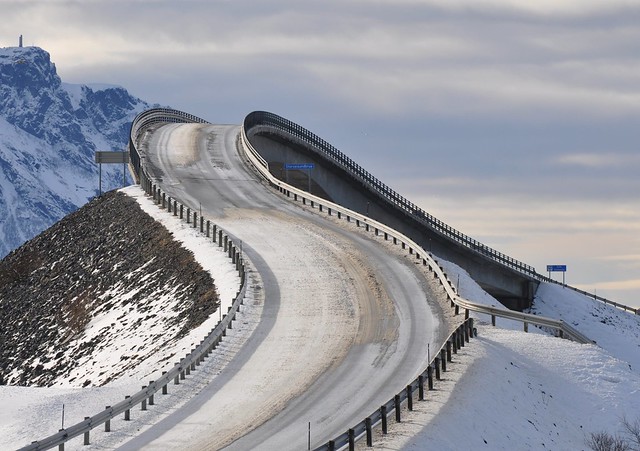
This week – as a follow up to our article Composing with Curves – your challenge is to take and share an image on the theme of ‘Curves’.

Atlanterhavsveien - "The Atlantic Road"

Read Composing with Curves, choose one of the types of curves mentioned (‘C Curves’, ‘Arches’, ‘S Curves’, ‘Circles’ or ‘Implied Curves’) and go out and try to capture some of them.

Arched people

Once you’ve taken your ‘Curves’ Photos – choose your best 1-2, upload them to your favourite photo sharing site either share a link to them even better – embed them in the comments using the our new tool to do so.

If you tag your photos on Flickr, Instagram, Twitter or other sites with Tagging tag them as #DPSCURVES to help others find them. Linking back to this page might also help others know what you’re doing so that they can share in the fun.

Beijing Opera House ("The Egg") - ?????

Also – don’t forget to check out some of the great shots posted in last weeks Headshots challenge – there were some great shots submitted.

Post originally from: Digital Photography Tips.

Check out our more Photography Tips at Photography Tips for Beginners, Portrait Photography Tips and Wedding Photography Tips.

Curves: Weekly Photography Challenge


Digital Photography School

 
Comments Off on Curves: Weekly Photography Challenge

Posted in Photography


20 Photography Tips Every Travel Photographer Must Know

17 May

1

1. Get up Early

The best light to capture most kinds of subjects is in the golden hours- one hour after sunrise and one hour before sunset (depend off course on where you are on the glove). So get up early to get that amazing photo opportunities, while all the other tourists are still asleep.

2. Do your research

Don’t leave it to chance and learn as much as you can about the place you are about to travel. The more you know, the more “intelligent” your images will be.

2

3. Learn your Craft

Don’t waste your expensive traveling time on learning how to operate that new camera, lens or flash. Do your homework at home.

4. Choice the Right Lodging

Staying on the center of town, or having a room with wonderful views can create a lot of great photo opportunities.

3

5. Say Hello

Learn how to say “Hello” in the local Language, and greet the locals when taking their photo.

6. Get Inspired

Watch the portfolio of other photographers in order to get new ideas and get inspiration. You can read the interview I did with Steve McCurry, the photographer of the “Afghan girl”, to get few great tips for a true master.Also, If you perceive yourself as an artist, you must acknowledge the work of other artists. Do not underestimate inspiration: visit art galleries, attend some photography lectures, listen to classical music, read good books.

4

7. Feel the Place

Photography is not only about visual inspiration. Try the local food, smell local markets and hear local music, this will help you to better understand the story of the place.

8. Find a Fixer

Talk to locals and seek their advice on great photo opportunities in their own country.

5

9. Travel Light

Don’t take your entire house with you. When I travel I take with me only two lenses: One zoom and one prime lens. This is extremely important tip if you plan to do some hiking or trekking.

10. Get off the Beaten Path

Yes I know that in Cuba they smoke cigars and that in Thailand they have monks. Tell your viewers something fresh and new. Share your own point of view of the place. You will be able to do so, only after following tip number 2 and 6.

6

11. Don’t try to get it all in once

Don’t try to see everything on your limited time. It is much smarter to get a better understanding about each place you visit on your journey. Slow things down, and your images will get better.

12. Travel Slow

If time allows you, always choice to travel by train or bus over flying. As it will allow you to have better Interactions with the locals.

7

13. Leave the Camera Behind Sometimes

Don’t spend your entire trip looking through the lens. Enjoy your time just traveling and enjoying the ride.

14. Keep it Natural

One of the most important and influential photographers of all time, Henri Cartier Bresson- Never ever used flash in his photography. A practice he saw as “impolite…like going to a concert with a pistol in your hand.” Try to learn how to use and enjoy the benefits of natural light before you buy that expensive flash or reflector.

15. Get Higher

Every good travel photo series must have at list is one bird’s eye view of the place (Being referred sometimes as the “establish shot”). Find yourself a vintage point overlooking the entire city or town.

8

16. Stop with the Excuses

“Well, if I had an expensive camera and lenses like you have” or “If someone would pay me to travel”, or “but, you have so much time on each destination”.

All of those, are excuses I often hear from my travel photography students. Excuses they tell themselves to answer the question of “Why cant I get Strong images?”
So, A. My first newspaper published cover image, was taken using a pocket camera.
yes, equipment is important and it certainly makes life easier. But don’t forget the camera is just an instrument. A “pipe” which captures your vision and thoughts. Do not cry over the equipment you don’t own. spend the time and money to learn photography, reading books about it and travel as much as you can.

And B. For my first 8 journeys, no one paid me anything. I worked very-very hard at my day job for a whole year, and then I spend my money on traveling. I slept in some shitty places got bus rides from hell. This lifestyle requires commitment. And today, even as I get paid for traveling somtimes. The lengths are usually one to two weeks per assignment. Two weeks to come back with an amazing results. Not excuses like “but it was raining and I was sick” are accepted.

So, stop the excuses, and get back to work.

17. Find Yourself a Master

: the best way to learn (anything) is by watching a master working on his craft. Try to find a photographer which you can accompany as his assistant. It is true that most travel photographers like to travel alone. But it doesn’t have to be a travel photographer. Most of my knowledge about using light, I learned from a great fashion photographer, which I served him as an assistant for a while.

18. Stop Using Excuses

“Well, if I had the time \ money to travel the world or if I had the money to buy that new camera \ new lens … I’d probably be an excellent photographer”. Excuses are just our way to explain ourselves why our photography doesn’t get any better. No matter where you live in the world: New York, the Middle East or a small village in France. Try to see the beauty of the place you live in. if you will find the beauty of that place and bring within your images, people will follow.

9

19. Don’t stop Traveling

A good travel photographer must keep is portfolio alive. Keep on traveling, and as the last tip mentioned: you don’t have to travel to far and exotic places to do so. As it is very easy to travel to India and get “good” travel photography. Try to bring the beauty of your own local town. Travel to the nearest market or attend the next festival as a way to keep your craft improving.

20. Be Human

Treat your subject as well as you can. Don’t shoot people for a far distance, don’t shot people who don’t want to get snapped. If you promise to send their photos, please do so. This will ensure that the photographer that will come after you will be received with a smile. And don’t forget, sometimes it is best to just leave the camera behind and enjoy the ride.

Oded Wagenstein is a Travel photographer and writer. He is a regular contributor to the National Geographic Traveler magazine (Israeli Edition) and his images have appeared in many national and international publications and websites.
He is known for his intimate culture portraits. In his works he put the emphasis on understanding the culture and achieving good relationship with the person being photographed pre-shooting.

You can join his Travel photography group on Travel photography group on Facebook and continue to discuss on travel and people photography.

Post originally from: Digital Photography Tips.

Check out our more Photography Tips at Photography Tips for Beginners, Portrait Photography Tips and Wedding Photography Tips.

20 Photography Tips Every Travel Photographer Must Know


Digital Photography School

 
Comments Off on 20 Photography Tips Every Travel Photographer Must Know

Posted in Photography


How Street Photography Can Turn into Astrophotography

16 May

Those Star Trek special effects guys are going to feel pret-ty foolish when they find out about Adam Kennedy.

Turns out you don’t need years of computer-generated image training to create breathtakingly detailed alien planets.

Adam finds his planets on the street! Fire hydrants, my friends.

He photographs, the rusted, peeling spheres that sit atop fire hydrants and edits them into wonderfully awe-inspiring habitats.

The best part about Adam’s planet project is that it started with a single imaginative thought.

It’s what inspires street art, photographers, and artists of every kind.

So the next time you think, hey that thing looks like that other thing, you know exactly what to do.

(Make art!)

Planets Made Out of Fire Hydrants

p.s. Wedding season is here! Get 40% off pro photo prints from Nations Photo Lab with code PHOTOJOJO.

p.p.s. We’re hiring A WEB DEVELOPER and AN EVANGELIST/BIZ DEV HERO. If you love photography and San Francisco, APPLY HERE.

Related posts:

  1. The Ultimate Tool for Street Photography, Kid Photography, and the Camera-Shy Welcome back to returning sponsor Lensbaby and their cool new…
  2. Low-Fi Street Lenticulars = Photo Inspiration in Street Art ~ BACK IN STOCK! The Chalkboard Speech Bubble (Our oh-so-popular-but-we-kinda-wish-you-weren’t-because-we-can’t-keep-you-in-stock…
  3. How to Make Tiny Planets
    in Google Street View Hackers do more than type fast and indiscriminately hax0r the…


Photojojo

 
Comments Off on How Street Photography Can Turn into Astrophotography

Posted in Equipment


Google Unveils Cutting Edge Photography Tools to Make Your Photos Look Better and the World A More Beautiful Looking Place

16 May

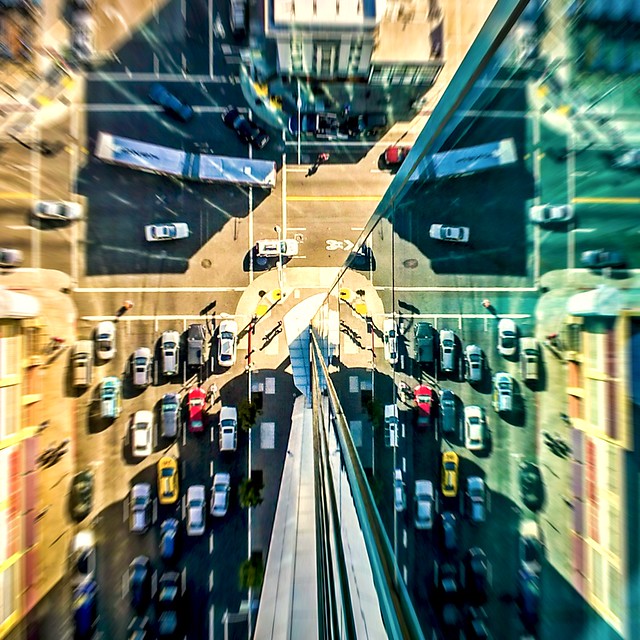
Through Glass

Google unveiled significant new innovation in the world of online photography this morning, continuing their rapid development pace on Google+. All in, Google+ pushed out 41 new features today.

Much of the new work is focused on post production photography to make people’s photographs look better than they can straight out of the camera.

Some have suggested that part of Instagram’s success has been their ability to enhance users’ photos with very simple, one touch filters. Instagram has focused on a faux film aesthetic which actually highlights the flaws in many photos to give them more of an artistic, old school feel. By contrast, Google’s easily and automatically applied post production tools, released today, work to make photos look more vivid, life like and realistic.

By using simple techniques like skin softening, clarity adjustment, smart vignetting, HDR and other enhancements, Google, by default, now offers an enhanced photo for every photo uploaded by users to Google+. Also, with this new tech, Google will give you the ability to view the before and after results and decide which you prefer to use. For photographers who do not want their photos altered in any way, these users can turn this default functionality off.
Google Releases New Tools for Photographers Using Google+

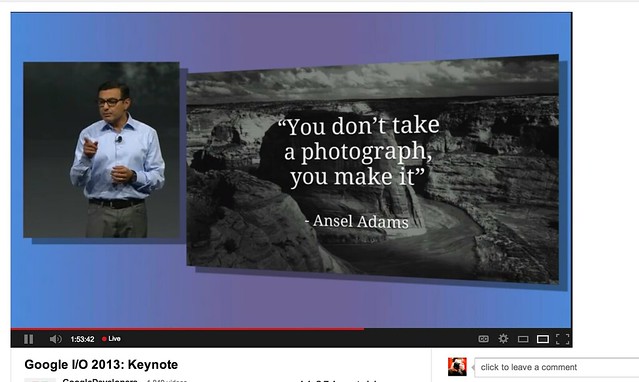
As a photographer, I have long been a believer of photo manipulation and post processing technology. Ansel Adams said “you don’t take a photograph, you make it,” as highlighted in Google Social Chief Vic Gundotra’s keynote this morning. Much of Ansel Adams’ genius has been attributed to the work that he did in the darkroom with his photos, his zone system, his post production technology of his time.

I post process all of my photos. The photo at the top of this post is the very first photo that I made with my new Google Glass that I bought yesterday. While I was able to get the composition to a point where I wanted in camera, much of the pop of that image is done with my own post production technique and style.

Many of my photographer friends also spend a great deal of time post processing their images — but the vast majority of the people out there really don’t post process at all. These people don’t own Lightroom and Photoshop or Nik Suite or Aperture or whatever else they might use to improve their photos. These are every day non-photographers who are still enamored with photography and imagery.

By applying some very basic algorithmic based enhancements, Google can make photos for the masses look much better than straight out of the camera. This is a very smart move on Google’s part. Where Instagram makes your bad photos look purposefully worse, Google now makes your bad photos look purposefully better! I stole that line from an unnamed source, btw. ;)

Where this new tech is especially powerful is in photos of people. By using basic skin softening post production tech, photos of people will look better on Google+ than on other social networks. By appealing to our vanity, this gives Google a big advantage. If people can post photos of themselves on Google+ that make them look BETTER than on other networks, many more people will choose to post their photos on G+. Just watch as people post photos of themselves on G+ for auto beautification and even download and post them to other networks I bet.

All of this sort of fancy post production *can* be done today by skilled post production photographers who spend hours and hours behind Photoshop. Now much of it will be automated and released to the masses.

There will undoubtedly be some naysayers about this tech. The same folks who moaned about the Instagramification of mobile photography will probably also complain about this new tech too. Google was smart here by giving users a very simple way to deal with this, by simply turning off this feature.

While the photo enhancements were the sizzle of Google’s announcements today, there were many other significant enhancements added to Google Photos.

Google will now begin to analyze your images and auto tag them. This is no trick where low paid overseas workers are manually reviewing your images; Googles’ algorithms now can look at the context of your photo and the actual subjects in your photos to identify possible tags for the images. If you post a photo of the Eiffel Tower, Google can detect the Eiffel Tower in your photo and add that tag for you. If Google gets the tag wrong, for whatever reason, it’s simple for you to just remove it.

What this means is that more of your photos will be seen in search by people using Google products. Many photographers are looking for more traffic and views on their photos. Who better to provide this traffic than Google Search, yes, using Google auto applied tags. This is the future of image search. If you are a photographer, especially one who depends on photography for your living, you cannot afford to ignore the significance of Google Search. Many of my own photo sales are made by people finding my photos while searching on Google. By uploading your photos to Google+, your photos will rank better in search and now even moreso with this new auto-keywording functionality.

Google Releases New Tools for Photographers Using Google+

Google also introduced a new smart algorithm that can analyze your photos and show you which ones Google thinks are the best of the batch, offering you highlights. Oftentimes we will “spray and pray,” taking 20 images of one person or subject. Google will analyze all of the images and suggest the best one for you. Google uses not just technical information about a photo (is it blurry or underexposed?) but they are using human tested aesthetics to look for what is most appealing.

But there’s more! In addition to the tech released above, Google has also added some very easy tools which will auto generate gifs for you of your photos, auto HDR bracketed shots, and suggest other compelling ways for you to present your photography to the world. Almost miraculously, Google can even look at photos of multiple people and merge the photos into a single photo that takes the best expression of each individual from *different* photos.

All of this also comes with an awesome new look and layout of Google+ which better highlights photography on the network. Popular photos will now be featured in jumbo new oversized form across a three column layout. For non highlighted photos, Google also made portrait oriented photos, especially, look better and bigger. In the past, the portrait format was the worst looking photo format on Google+, now it’s the best — that’s worth noting. ;) For folks who don’t like the three column layout, they can switch back to a single column if they’d like.

A couple of other notes: all of this work that Google does with your photos is done behind the scenes for your eyes only. You can use the tech or not use the tech. If you use the tech and like it, *you* then choose to share the image to Google+. Nothing is shared until you choose to share it.

The new technology will only work with the JPG format (hopefully Google comes out with RAW support down the road). Google increased everyone’s storage to 15GB of online storage, but note that any photo sized 2048 px or smaller does not count towards your 15GB storage limit (you can also buy more storage if you want to). Google allows unlimited uploading of photos that you either manually resize or allow Google to resize to 2048 px. There is an option on Google where you can set whether or not you want to upload full high res photos or resized 2048 sized images.

I upload some of my photos full res, and many of them I resize manually myself to 2048 px.

Google also introduced a free, stand alone hangout app that you can now use with your mobile phone or desktop device bridging text, photos and real time group video into a single app that preserves conversations (at your choice) over long periods of time. Hangouts have been one of the most popular Google+ feature and several photography related shows have been built around them.

More detail on these changes at Google here. More from Matthew Hanley here. Trey Ratcliff wrote insightful commentary here.


Thomas Hawk Digital Connection

 
Comments Off on Google Unveils Cutting Edge Photography Tools to Make Your Photos Look Better and the World A More Beautiful Looking Place

Posted in Photography


Make Time and Create Networks to Develop Your Photography

15 May

art-photos-2

Photography: Bruce Myren

Full time professional photographers complain about the competition from enthusiasts who don’t count their overheads. They worry about finding their next client, spend more time than they’d like on paperwork and marketing, and if they’re being honest, they’ll admit that not all jobs are equally exciting. But they still have one big advantage over enthusiasts: they get to take a lot of pictures. They get to hone their skills, they’re paid to build their experience and even if they’re not taking photos, they’re working with photography. By the time they hang up their camera for the last time, they can be confident that they’ll have had every opportunity to become as good a photographer as they’re ever going to be.

That’s not true for enthusiasts. People who work full-time and cram their picture-taking into their weekends and evenings have to battle to find the hours they need to improve their skills. There never seems to be enough time for photography tours and road trips. And as for building the kind of long-term personal projects that interest galleries and build a name as an artist, they can drag on through years of occasional weekends — if they ever start. There are things though that anyone can do — both professionals and amateurs — to keep their skills developing and to move their photography in the direction they want it to go.

Create Time and Make It Solid

The number of hours in the day are limited and when you fill it with an eight or nine-hour workday, take away sleep and time with the family, you can start to wonder how you ever find time to eat, let alone practice photography. But it is possible to arrange your schedule and use your calendar to create gaps for picture taking.

Bruce Myren, for example, is an adjunct professor of photography at the Art Institute of Boston at Lesley University, a job which should keep him in touch with imagery. Teaching as many as five classes each semester, though, makes finding time for personal projects no easier than for anyone working a full-time job.

“It is always a juggling act to find time to prep for teaching, doing freelance work, getting to the studio, and going out to make pictures,” he says.

Myren’s solution is to schedule one day each week as a studio day. He writes the day into his calendar so that it looks as real as any other appointment. While he doesn’t always make it there, he does try.

“The more I adhere to this the happier I am,” he says.

For people who don’t work in photography, scheduling an entire day in the studio is a little harder but it may be possible to schedule a couple of hours on a Sunday afternoon or an hour as soon as you get back from work. Like Bruce, you might find that family commitments and sudden work crushes mean that you don’t always make it, but if you can work your photography into your routine — instead of picking up a camera whenever you feel like it — you should find that it’s a habit that’s hard to break.

Network Now So That Supporters Know What You’re Doing

Scheduling time to take pictures will help to sharpen your skills and build your project. But you also want people to see those photos once you’ve created and edited them. Putting them online is easy enough and will give you some form of audience but no website is as prestigious or as rewarding as a photography book that people buy and enjoy or an exhibition of your photos that people can browse and admire.

bruce-photog

Photography: Bruce Myren

That requires building a platform before you publish your photos. You need to have people ready, waiting and keen to see your photos as soon as they come out.

Photography classes will give you access to a teacher’s network of gallery owners and editors. Visiting galleries can provide an opportunity to talk to staff, get to know them and their taste in photography — and make sure they know about you and your work. But even online networking can yield benefits too. Let family and friends know about your personal project. Build connections with other photographers and with people who have an interest in the subject of your images. Those connections will prove valuable when your pictures are ready to be seen.

Raise the Funds That Will Let You Shoot What You Want

And they’ll also prove valuable when you’re looking to fund your projects. When Bruce Myren turned to Kickstarter to fund a collection of images shot along the fortieth parallel, he was able to turn to friends and family on Facebook for the money and to ask them to share news of the project with their friends. He describes himself as “shameless” in his willingness to send direct tweets to companies he thought might be receptive and he had also built up a large email list over the last few years as he promoted his other work around Boston and the country. Having put together the promotional video and written up his campaign, he had all the sourcing funds he needed already in place to pay for his trip across the United States.

Altogether, Myren estimated he’d need around $ 15,000 to complete his project. He asked for $ 10,000, made that amount by the end of the first week and went on to collect $ 17,860.

“To be successful, you need to do your homework, plan everything out, account for contingencies, and remember that you did not think of everything,” says Myren. “It is a well-prepared person that can capitalize on an opportunity as it comes by.”

Bruce Myren describes himself as an artist and photographer. He’s had a long list of exhibitions and his work is noticed. But even he struggles to find the time and the money to shoot what he wants and to keep developing as a photographer. His solution, a mixture of scheduling and networking building, is one that can be used by all photographers, time-strapped enthusiasts and professionals alike.


Photopreneur – Make Money Selling Your Photos

 
Comments Off on Make Time and Create Networks to Develop Your Photography

Posted in Equipment


How to Master Sunrise Photography in the Most Effective Way Possible

13 May

Sunrise photography is underappreciated. Heck, many people take the sunrise for granted; after all, it happens every day! If this is the way you actually feel, you are missing out on a golden opportunity to capture some of the most breathtaking pictures on Earth. People seem to be more captivated by sunsets, but that’s really regrettable when you think about Continue Reading

The post How to Master Sunrise Photography in the Most Effective Way Possible appeared first on Photodoto.


Photodoto

 
Comments Off on How to Master Sunrise Photography in the Most Effective Way Possible

Posted in Photography


Headshots: Weekly Photography Challenge

11 May

ZoeThis week your photographic challenge is to take and share a ‘headshot’ portrait.

You’re welcome to photograph a friend, family member (adult or child), a stranger or even yourself – but we’re looking for something framed around head and shoulders but not much more than that.

There’s no wrong or right way to take a headshot and we’ll suggest some tutorials and resources to check out below – the key is getting your camera out and experimenting!

Reading on Taking Great Headshots:

  • How to Take Perfect Headshots: Six Tips
  • How to Shoot the Perfect Headshot (video)
  • Lighting Headshots

Also don’t forget that Phil Steele currently is offering dPS readers 30% off his Headshots and Portraits Course.

Once you’ve taken your ‘Headshot’ image and have upload it to your favourite photo sharing site either share a link to it or – embed it in the comments using the our new tool to do so.

If you tag your photos on Flickr, Instagram, Twitter or other sites with Tagging tag them as #DPSHEADSHOTS to help others find them. Linking back to this page might also help others know what you’re doing so that they can share in the fun.

Also – don’t forget to check out some of the images posted in our last challenge – Transport challenge where there were some great images submitted.

Post originally from: Digital Photography Tips.

Check out our more Photography Tips at Photography Tips for Beginners, Portrait Photography Tips and Wedding Photography Tips.

Headshots: Weekly Photography Challenge


Digital Photography School

 
Comments Off on Headshots: Weekly Photography Challenge

Posted in Photography