RSS
 

Posts Tagged ‘Photography’

8 Steps to Getting Your Photography Business Noticed

19 Sep

Photographers, photographers everywhere! It seems in this social media age, new digital photographers flood the industry every day. These “professionals” boast low prices and high quality. There’s nothing wrong with that, but how do you get your work to stand out from the pack? What makes your images different than Johnny Photographer who was given a DSLR for Christmas along Continue Reading

The post 8 Steps to Getting Your Photography Business Noticed appeared first on Photodoto.


Photodoto

 
Comments Off on 8 Steps to Getting Your Photography Business Noticed

Posted in Photography


Wise Words: Famous Photography Quotes and Their Relevance Today

19 Sep

In the early years of my study, I remember leaning over the photography department work bench, trying not to look disheartened, as my lecturer scribbled notes on the glossy finish of yet another proof sheet in red marker. +1, -5, underexposed, out of focus, crop, the irrefutable question mark with an arrow pointing to a light leak of frustratingly mysterious origin, or worse – the dreaded RESHOOT.

At the time, I was frustrated with my inconsistency both behind the camera and in the darkroom. My tutor’s favorite saying, “Your first 10,000 photographs are your worst” formed in my mind an image of piles and piles of failed photographs stacked up like an impassable mountain before me.

Filmexample2megankennedy

Light leak from a film camera.

It was only later in my career that I realized that what my teacher was saying was not a criticism, but her way of encouraging me to take advantage of the opportunity that the worst 10,000 provided. A foundation for the photography I hoped to produce in the future. Without those 10,000 duds my photographic feet would be steeped in the muddy waters of ambition with no way to see my visions through to a complete body of work.

Those initial 10,000 photos – many of which I have kept stacked in visual diaries and negative sheets to look back on fondly – provided a solid launching pad for my photographic practice and the impetus to advance. Nowadays I find myself delving into the words of photography masters for inspiration, tried and true technical advice, and occasionally a kick in the butt when motivation is lacking.

Henri Cartier-Bresson

“Your first 10,000 photographs are your worst”

Beingaware megankennedy

Be aware and ready for anything.

The inventive work of Henri Cartier-Bresson in the early 1930s opened up the creative possibilities of photography forever. Though he is known for his mastery of street photography, Cartier-Bresson was also known for his patience. The mythology of Cartier-Bresson’s “decisive moment” suggested that most of the photographs he took from the very start of his photographic career were taken with a single shot, at the precise instant of opportunity. In reality however, Cartier-Bresson honed his skill by making the most of a potential moment, sometimes shooting 20+ images of one scene. His single greatest images were preceded by the first 10,000 images that fell by the wayside.

Elliott Erwitt

“I always make it a point to carry a camera with me at all times…I just shoot at what interests me at that moment”

In photography, the whole world is a canvas. The special agony reserved for an unarmed photographer witnessing the perfect shot pass before their eyes, is something we have all experienced. Making a habit of always carrying a camera with you (beyond a camera phone, everyone has those!) is rewarding, and makes sure you will never suffer the regret of wishing you had.

Keepyourcameraonyou megankennedy

I personally keep a disposable (play) camera with me if my larger camera is too bulky. Not only do the plastic disposables ease the anxiety of being camera-less, they afford a less formal quick-draw camera for street photography. They also provide a refreshing aesthetic, and the occasional surprise. I always enjoy the odd incidental light-leak mark, a quirk of cheaper cameras that adds a real incidental feel to the image. Another upside is disposable cameras are inexpensive and (speaking from experience) they are also a bit bouncier if you drop them.

Robert Mapplethorpe

“The more pictures you see, the better you are as a photographer.”

Rainy shoots in the wilderness, urban exploration, and late night post-processing, means that often photography can be a lonely experience. But taking the time to check out other photographer’s work – from the past and present – can be a great way to get motivated and to immerse yourself in the photography headspace. Studying other artists’ work and dissecting their techniques can help you improve your own work or allow you to ease up a little and be open to experimentation.

If you usually take photographs of bustling subjects with loud, vibrant colors, try focusing on black and white minimalism for a change. Asking for advice, or perhaps even sharing your own insights, is a great way to build relationships with fellow photographers too.

Newthings megankennedy

Mary Ellen Mark

“Learning how to use different formats has made me a better photographer. When I started working in medium format, it made me a better 35mm photographer. When I started working in 4×5, it made me a better medium-format photographer.”

Taking the time to shake up your photographic practice is not only a liberating experience but an educational one. As memory cards get bigger, faster, and larger, the temptation to shoot rapid-fire and hope for the best is strong. When shooting with a film camera, however, you are restricted by the limited number of frames on the roll as well as developing costs. As a result, you will immediately start thinking much more about composition, subject matter, movement, and the technicalities of composing the shot correctly in terms of exposure, aperture, ISO, etc.

Filmexample megankennedy

Shoot with film for a different experience.

Taking the time to step back and focus on your craft will no doubt improve your technique and help you to slow down and reconnect with the process of capturing a great photo.

Imogen Cunningham

“Which of my photographs is my favorite? The one I’m going to take tomorrow.”

While it can be exhausting at times, maintaining the hunger for new and better photographs is what drives us photographers to keep going. We’re never satisfied, we never stop learning, and we never stop shooting. As with any artistic endeavor, creativity comes in waves. But to ride the good waves you’ve got to keep surfing.

Keep striving for that great shot, and when you get it, strive for the next one. You never know what’s coming, so be prepared!

Beprepared megankennedy

Ansel Adams

“You don’t take a photograph; you make it.”

The word take is often used to describe the process of capturing an image. But the difference between assuming an image is simply there to be taken and taking control of the image are two completely different things.

We all unconsciously make decisions about how to take a photo in terms of location, weather, time of day, etc., based on what catches our eye. So we are already exerting a lot of control over our photography. By being more aware of detail, the formal technique and execution of a photograph will invariably result in better considered and aesthetically pleasing images, which at the very least saves time on editing later.

Wisewords2 megankennedy

Do you have any favorite quotes from photographers past or present? What can we take from them and apply to our own photography? Please share your thoughts in the comments below.

googletag.cmd.push(function() {
tablet_slots.push( googletag.defineSlot( “/1005424/_dPSv4_tab-all-article-bottom_(300×250)”, [300, 250], “pb-ad-78623” ).addService( googletag.pubads() ) ); } );

googletag.cmd.push(function() {
mobile_slots.push( googletag.defineSlot( “/1005424/_dPSv4_mob-all-article-bottom_(300×250)”, [300, 250], “pb-ad-78158” ).addService( googletag.pubads() ) ); } );

The post Wise Words: Famous Photography Quotes and Their Relevance Today by Megan Kennedy appeared first on Digital Photography School.


Digital Photography School

 
Comments Off on Wise Words: Famous Photography Quotes and Their Relevance Today

Posted in Photography


Adobe Stock Apparel line celebrates the worst of stock photography

17 Sep

Adobe is promoting its stock photo service with a ‘limited edition clothing line’ celebrating such stock photo atrocities as ‘laughing woman eating healthy vegetable salad’ and ‘smiling seniors using laptop.’ The campaign pokes fun at famously bad images that services like Shutterstock are rife with, and commemorates the images by putting them on t-shirts and sweatshirts. Fortunately, or unfortunately depending on your views on ironic t-shirts, none if it is actually for sale, but you can view the whole collection in a mock lookbook. 

The promotion rests on the premise that Adobe Stock weeds out the so-called low quality images found in other stock websites, saving creatives from spending time sifting through the cheesiest of photos. It’s also worth noting this comes just after the news that Shutterstock is now offering a Photoshop plugin, making it possible for designers to access their extensive collections within Adobe’s own software. 

Articles: Digital Photography Review (dpreview.com)

 
Comments Off on Adobe Stock Apparel line celebrates the worst of stock photography

Posted in Uncategorized


Weekly Photography Challenge – Fall Leaves

17 Sep

Earlier I rounded up several images of fall leaves to get you thinking about shooting the autumn colors.

Now it’s your turn to get shooting.

Pedro Fernandes

By Pedro Fernandes

Randi Hausken

By Randi Hausken

Weekly Photography – Fall Leaves

If it is autumn or fall in your area the leaves may be changing color soon. So now is the perfect time to go shoot some great colorful images of leaves, landscapes, or even fall portraits. Even if it is not autumn where you live (southern hemisphere) try finding some interesting leaves, do a macro shot, or get creative with processing or composition.

Here are some articles that may give you ideas how to approach this subject:

  • Guide to Creative White Balance for Landscape Photography
  • Tips for Abstract Macro Photography; Using Texture and Light
  • 12 Tips to Help You Capture Stunning Landscape Photos
  • Backyard Macro Photography Safari
  • How to Create Strong Compositions Using Color Contrast
  • Add Contrast to Your Images by Using Complementary Colors
David Ohmer

By David Ohmer

Umberto Nicoletti

By Umberto Nicoletti

Stuart Williams

By Stuart Williams

--IZA--

By –IZA–

Vincent Brassinne

By Vincent Brassinne

Share your images below:

Simply upload your shot into the comment field (look for the little camera icon in the Disqus comments section) and they’ll get embedded for us all to see or if you’d prefer, upload them to your favourite photo sharing site and leave the link to them. Show me your best images in this week’s challenge. Sometimes it takes a while for an image to appear so be patient and try not to post the same image twice.

Share in the dPS Facebook Group

You can also share your images on the dPS Facebook group as the challenge is posted there each week as well.

Michael Salvato

By Michael Salvato

Elisa Greco

By elisa greco

Olli Henze

By Olli Henze

googletag.cmd.push(function() {
tablet_slots.push( googletag.defineSlot( “/1005424/_dPSv4_tab-all-article-bottom_(300×250)”, [300, 250], “pb-ad-78623” ).addService( googletag.pubads() ) ); } );

googletag.cmd.push(function() {
mobile_slots.push( googletag.defineSlot( “/1005424/_dPSv4_mob-all-article-bottom_(300×250)”, [300, 250], “pb-ad-78158” ).addService( googletag.pubads() ) ); } );

The post Weekly Photography Challenge – Fall Leaves by Darlene Hildebrandt appeared first on Digital Photography School.


Digital Photography School

 
Comments Off on Weekly Photography Challenge – Fall Leaves

Posted in Photography


How to Get Started Making Extra Money with Your Nature Photography

16 Sep

Photography is expensive, there’s no doubt about that. Nature photographers have it bad, though, especially if you’re buying long telephoto lenses for wildlife. The Canon 200-400mm lens will set you back $ 11,000 – ouch. So it’s no wonder that many people want to make it in photography and start monetising their work. But can you make money with your nature photography?

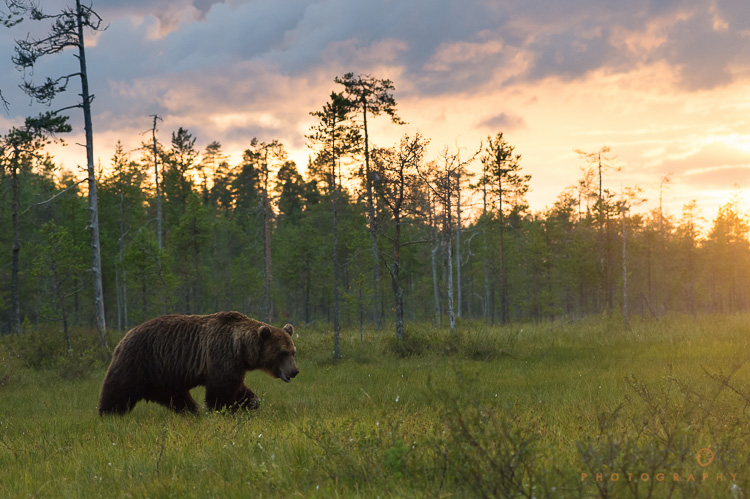
Brown Bear at Sunset

Making money from your photography isn’t easy, and it doesn’t get any easier as a nature photographer either. There’s less demand, and more people doing it. That means increased competition for a smaller slice of the pie. If you want to make money from your nature photos, then you must realize that it’s not easy by any means – but it’s also not impossible.

I’ve been working as a professional nature photographer for about six years now. What I’ve learned over my relatively short career so far is that you need to think outside the box to stay ahead of the competition. A bit of a cliché statement maybe, but one that you’ll have to embrace – especially if you want to be a full-time photographer.

But you’re probably reading this wondering how you can make a bit of extra cash from your photos on the side, rather than an entire life-altering career move. Well, that I can help you with! Let’s take a look at some of the main ways you can start to make money with your nature photography.

Prints and Other Products

The first print I ever sold was in 2008. That’s eight years ago now, and I’ve been doing it ever since. To the surprise of some, people do buy photographs to hang on their walls. This isn’t a space reserved solely for paintings.

Personally, I have my photos printed and framed myself, but you can have this process automated by dedicated web hosts. Zenfolio is a popular choice amongst photographers for a website, and they offer the ability to have orders automatically fulfilled by printing labs. This means you can sit back and relax, selling prints from your website.

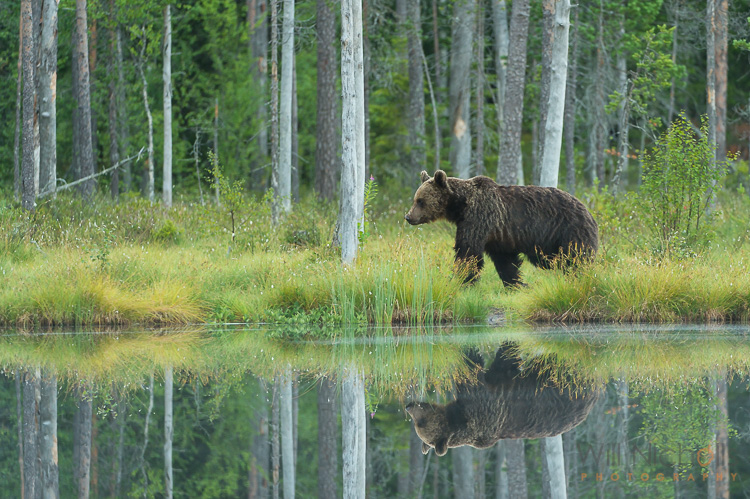
Brown Bear

Beauty and picturesque scenes sell better as prints, rather than action-packed shots.

It’s not just online though. You can sell prints in the real world too! Head to a market or trade show, set up a stall and get selling. It’s great fun talking to customers about your work and to sell your photos this way. Doing just a couple of shows a year can buy you a new camera or lens, so that’s something to think about.

What sells best? Well, I find the more traditional wildlife photography like; clean bokeh shots, cute animals, or dramatic scenes. You’re looking for something that someone will want to look at over and over again. After all, when was the last time you moved a framed picture in your house? They stay up for a long time.

Workshops

If you really know your way around your camera and can take a decent photograph, then this is something you could consider. Day workshops offer clients tuition in photography, let them know your secrets and just help them to take a better photo and understand their equipment. It’s a popular move amongst photographers nowadays, and almost everyone trying to make a living out of nature photography is offering workshops.

wildlife-photography

The best thing about it is that you can set your own hours and choose when you work. You can fit sessions in on the weekend around your full-time job, and have a little extra money coming in on the side. All of this helps to take the sting out the costs of new photography kit.

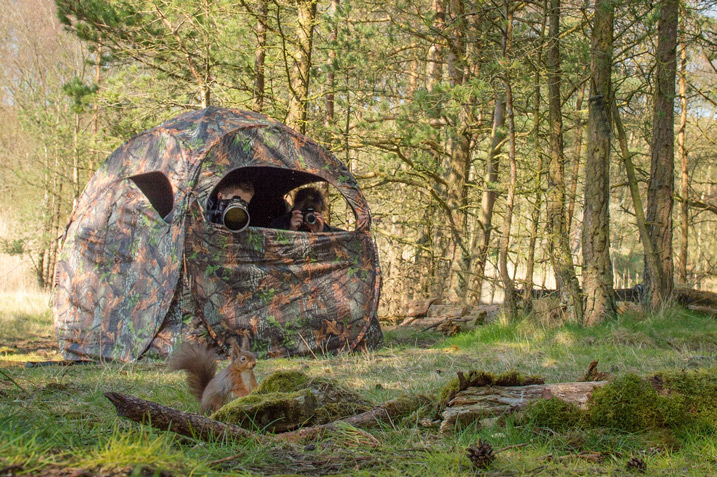
There are different types of workshops you can offer. Some photographers partake in one-to-one guiding days, showing clients different locations for landscapes or wildlife sightings while imparting photographic knowledge. Others may rent out a blind they have built to view a particular animal (see image above), something that is often in high demand by those who don’t have the time to create such possibilities themselves.

Sell Stock Images

The stock photography industry is depleting day by day, unfortunately. It used to be the case that you could make a five-figure salary, or more, from stock photography alone. Maybe not just as a nature photographer, but you could definitely make big bucks in comparison to nowadays.

nature-photography-money

But with the rise of microstock, photographers are seeing their earnings decrease. On top of that, many stock websites are taking increased percentages as a commission, leaving photographers with little left of the few sales they may still make.

Despite that bleak picture, there are specialist nature photography stock agencies you can submit to. The likes of Nature Picture Library still sell well, at least in the UK, and photographers are able to make a decent income from them. However, they are very selective about who they work with – you need something unique in your portfolio to be accepted.

Selling to Publications

This is where there is definitely still money. Selling images to newspapers or magazines can be pretty lucrative indeed – the trick is making it a regular gig. Publications are often looking to buy not just one photo, but a sequence of photos that tell a story. That’s where your best chance to get published sits.

Selling to newspapers and other publications can be a good source of income.

Selling to newspapers and other publications can be a good source of income.

Working with a press agency to get your photos syndicated and in front of the right people is the best way to go about it. While you can contact publications yourself, you’re likely to be ignored and if your photos are used you may have to spend months chasing them for payment. Press agents take the stress out of it. There are plenty around the world, and they’ll take a commission (usually 40-50%) of the sale price for their services. I work with

Press agents take the stress out of it. There are plenty around the world, and they’ll take a commission (usually 40-50%) of the sale price for their services. I work with REX Features, but there are plenty out there such as Caters News and Associated Press. If you think you have a good, fresh sequence of images then send some low-resolution copies over and you’ll soon find out if they are sellable or not.

nature-photography-money

In Conclusion

Here are just some ways that you can make money as a nature photographer. It takes work and dedication, especially if you want to make it a full-time job. It’s definitely not the path everyone will be able to take. But, there’s no harm in trying to make a bit of extra money at first and seeing where it takes you. You just have to take that first step.

googletag.cmd.push(function() {
tablet_slots.push( googletag.defineSlot( “/1005424/_dPSv4_tab-all-article-bottom_(300×250)”, [300, 250], “pb-ad-78623” ).addService( googletag.pubads() ) ); } );

googletag.cmd.push(function() {
mobile_slots.push( googletag.defineSlot( “/1005424/_dPSv4_mob-all-article-bottom_(300×250)”, [300, 250], “pb-ad-78158” ).addService( googletag.pubads() ) ); } );

The post How to Get Started Making Extra Money with Your Nature Photography by Will Nicholls appeared first on Digital Photography School.


Digital Photography School

 
Comments Off on How to Get Started Making Extra Money with Your Nature Photography

Posted in Photography


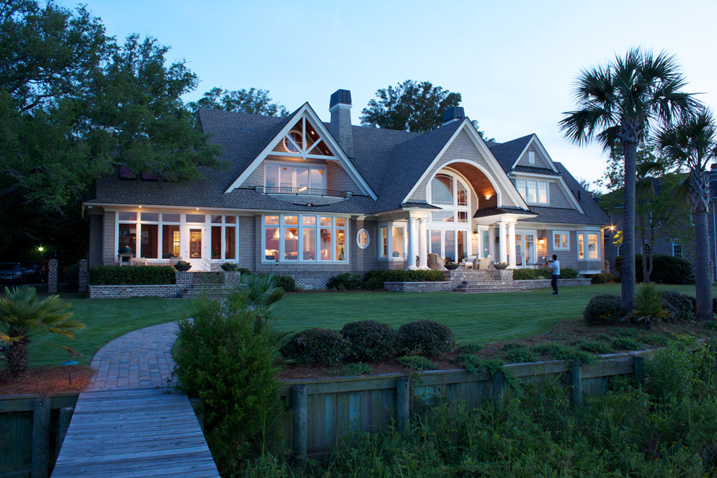
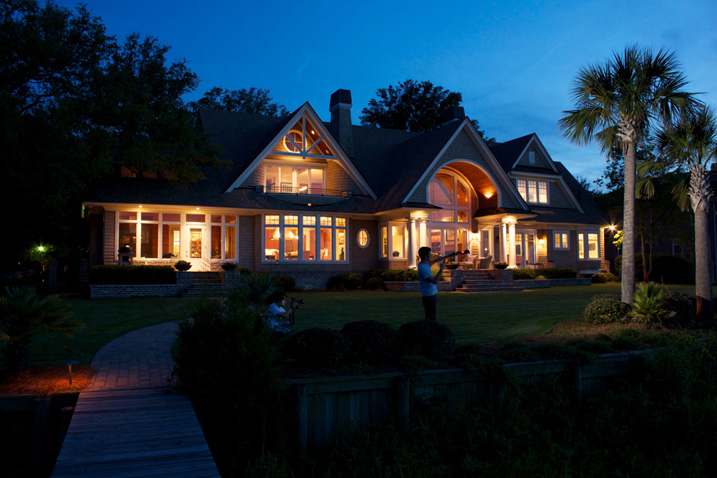
How to Create Stunning Architecture Photography by Painting with Light

15 Sep

My name is Mike Kelley. I’ve been lucky enough to travel the world and see incredible architecture while working for hotels, architects, designers, and developers.

Architecture tips 04

Architecture tips 07

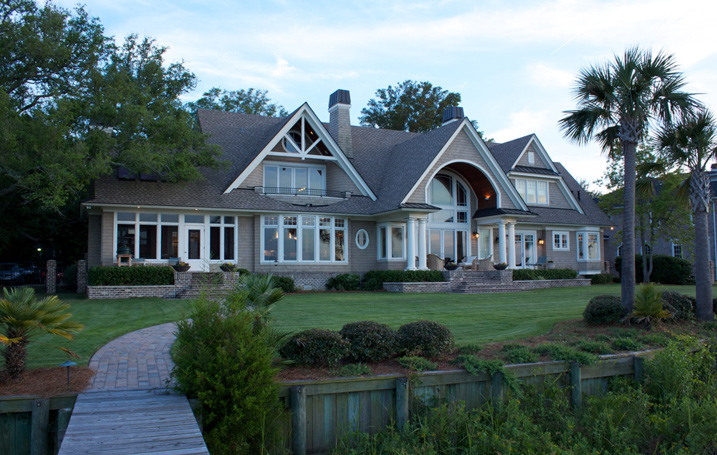
In this article, I’d like to share with you one of my favorite techniques for photographing architecture. If you’ve ever tried to photograph a building at twilight, you know how tough it can be to properly expose all parts of the scene. You know how some areas tend to fall into darkness.

When this happens, many photographers will just try to recover the shadows with a brighter exposure or some dodging and burning. Unfortunately, that can lead to muddy results which often display a lack of texture and color.

Although this article touches on my basic processes, a full tutorial on my workflow is $ 100 off right now over at Snapndeals – Mike Kelley’s Where Art Meets Architecture Course

Light painting for architecture photography

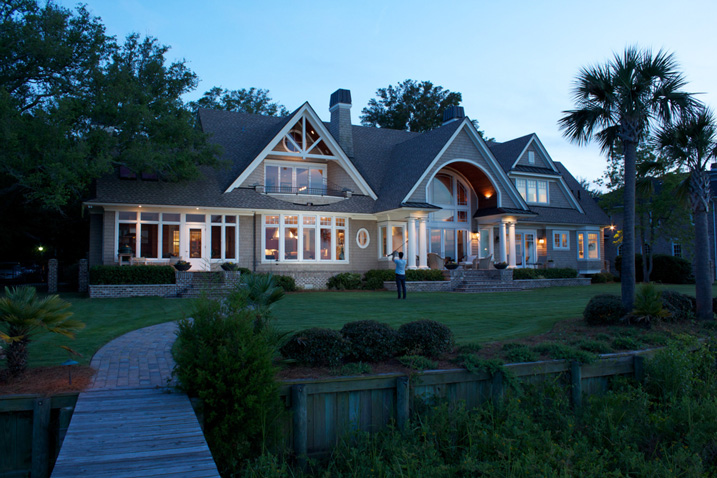
One technique that I’ve adapted to use with modern photographic tools is light painting. Back in the old days, depending on how old you are, there were many photographers who painted with light. They would literally stop down the aperture, wear an all-black outfit, and wave a light around for a 30-60 second exposure to fill in shadows and give the image some nice snap.

Luckily, things are a bit easier these days (to me, at least). You can use a single Speedlight and see the results instantly. All without burning through expensive sheets of 4×5 film, or having to dress like Steve Jobs to keep yourself from showing up in the exposure.

I personally use either a Lowel GL1, Yonguo Speedlight or Profoto B1 light to pull it off, depending on how much power I’ll need. The aim here is to add light in spots that appear to have natural light falling on them – either from landscape lighting or interior lighting. Adding flash or hot light will dramatically clean up the quality of light, by giving it direction and fall off. Whereas the ambient light may create a muddier appearance due to having no directionality, incoherent color casts, or being mixed with the falling light of the day.

Architecture tips 01

So you’re all set up for your twilight. You’re waiting for that perfect balance between falling ambient exterior light and interior glow. Before, during, and after twilight, you should have the camera set in one place on a tripod and every couple of minutes, shoot a bracketed set of images at 0 EV, -2, and +2, or something similar, whatever your preference may be.

Shooting at twilight

When the time for the perfect twilight has arrived, and the falling ambient exterior light and interior glow from the practical lights are perfectly balanced, it’s time to add your hot light or flash. Moving quickly (it helps to have a plan ahead of time for what you’ll flash) add light to areas that you think have fallen into too much shadow or places that could use a little texture and color.

I also recommend adding a CTO gel to your lights to warm them up so that they match the interior glow of the house or any exterior lighting that may be present. This process should take no more than five minutes and should be shot tethered, whether to a computer or a wireless solution like a CamRanger, so you can see what you’re doing immediately and adjust accordingly.

Architecture tips 12

Architecture tips 17
Architecture tips 27

After you’ve gone around and added light, continue to bracket exposures to cover your bases. Sometimes I’ll use an exposure from when it’s completely dark outside and the only light in my scene is from the interior glow to remove any distracting reflections or color casts that popped up.

Processing the images

When in post-production, try to keep it simple. I used to think it was a source of pride to edit these photos and have to use 50, 70, or even more layers. But the fewer layers there are in Photoshop, the less of a chance there is for something to go awry. Depending on the subject, 10-15 flash pops should be more than enough to get this amazing effect on your images. You may want to add or remove some color using curves, and it would also be wise to make sure that everything blends together seamlessly by setting the blend mode of your flash pop layers to Lighten.

Replace the sky if necessary

Lastly, in many of my images I end up replacing the sky. Don’t underestimate what an amazing impact a new sky can have on your image – but only when it’s done perfectly! If there’s anything that takes people out of an image and ruins the moment, it’s a poorly composited sky that doesn’t match the color and brightness of the rest of the image So choose your sky carefully. I personally like to vary the opacity of my sky layer to taste so that things all blend seamlessly.

No architectural photo would be complete without nice, straight verticals lines, so use CMD/CNTL + alt + shift + E to stamp all to a new layer. Then drag out some ruler lines and make sure there’s no distortion – we don’t need people thinking our clients can’t build straight homes.

Architecture tips 08

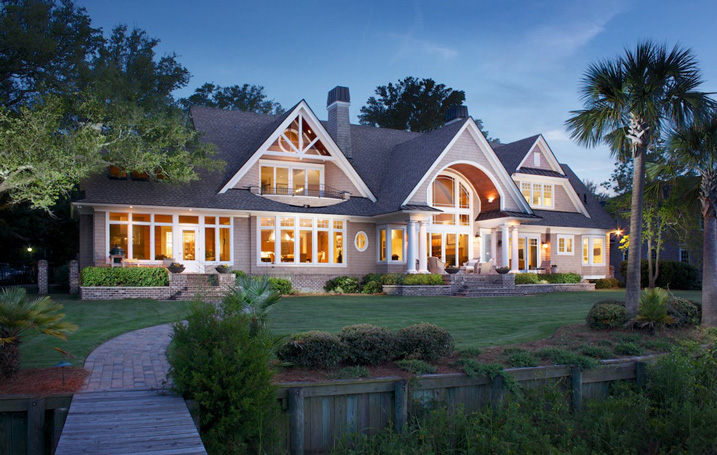
Here is the final image

You can watch a video of this entire process below and see me in action:

Summary

I hope you enjoyed this quick tour through one of my favorite techniques. The more you use it, the more flexible you will become with adding light and mood to make your photos really stand out.


If you would like to go more in depth with this technique and learn how to build your own business in real estate and architectural photography, Kelly’s full-length tutorial is currently 33% off over at Snapndeals – grab it before the sale ends September 27th, 2016.

googletag.cmd.push(function() {
tablet_slots.push( googletag.defineSlot( “/1005424/_dPSv4_tab-all-article-bottom_(300×250)”, [300, 250], “pb-ad-78623” ).addService( googletag.pubads() ) ); } );

googletag.cmd.push(function() {
mobile_slots.push( googletag.defineSlot( “/1005424/_dPSv4_mob-all-article-bottom_(300×250)”, [300, 250], “pb-ad-78158” ).addService( googletag.pubads() ) ); } );

The post How to Create Stunning Architecture Photography by Painting with Light by Mike Kelley appeared first on Digital Photography School.


Digital Photography School

 
Comments Off on How to Create Stunning Architecture Photography by Painting with Light

Posted in Photography


How to Use Angle of Light in People Photography for Added Punch

12 Sep

This may be something that you have already heard from landscape photographers. It is very important to be aware of the angle of the light (where does the light come from) to be able to get the best of a scene, and the best exposure for your image. Also, when using a polarizing filter, it is more effective when used at a 90 degrees angle to the sun for better blue sky results.

Angle of light – people photography

But when it comes to people photography I couldn’t find a lot mentioning the angle of light online. So here is what I think about it.

Keep the light behind you

When photographing people, it is also very important to be aware of the direction of the light. As I mention when teaching about composition, you should try, as much as possible, to keep the light behind you (or avoid facing the light). If the light remains behind you, the general exposure has more chance of being better, avoiding under and over exposed elements in the image.

JB 4997

Keeping the light behind you ensures a better general exposure through the whole image. Hoi An, Vietnam.

When facing the light, there are two options when it comes to people photography. You can either create a silhouette of your subjects while exposing for the brighter background. Or you can try to find a middle exposure, thus avoiding over exposing your background too much and keeping some details on the subject. This last method works very well in the early morning and late afternoon.

JB 8191
A silhouette created by directly facing the light. Isfahan, Iran.

The third option would be to expose for your subject and completely overexposing your background. I personally do not believe it looks that good though.

JB 6890

Finding a middle exposure between background and subject while facing the light works very well in the early morning and late afternoon. Kandovan, Iran.

Side light is magic

But when you put the light at a 90-degree angle, there is something magic that happens. When the light is softer and more colorful (at sunrise and sunset) it is possible to come up with some type of semi-silhouetted images. The part of your subject exposed to the light will be exposed correctly. The other part will be much darker (still preserving some details). That is going to create a more contrasty image, with a little more punch.

If you take an image which is slightly overexposed, there are no blacks in it and the histogram is slightly shifting to the right. As soon as the exposure goes down, some darker pixels will appear and add contrast to the image, making it instantly more powerful.

This is what a 90 degrees light will do to your subject: shadowing part of it and adding contrast and power to the image.

JB 4802

The light being on the right side, the back of this man is underexposed (in shadow), thus creating more contrast in the image. Hoi An, Vietnam.

For close-up portraits, the angle of the light has some superb effects on skin tones. Mostly when the tones are darker and more keen to reflect the light, this angle will enhance these tones. Because, as mentioned above, a part of your subject (the part which is not directly into the light) will be darker, the brighter parts will be enhanced.

Let’s compare

Here are two images of the same man, taken two minutes apart from each other. As you can see in the first one, the light is more even throughout the picture.

JB 2969

In this second image, there are some much darker areas on the left, adding contrast and punch to the image. The details on the skin tones are also much more interesting.

JB 4933

I hope that gives you some ideas for using the direction or angle of light to add punch to your people photography. Know where the light is coming from and make a conscious choice how to use it to your advantage.

Please share your people photos in the comments below.

googletag.cmd.push(function() {
tablet_slots.push( googletag.defineSlot( “/1005424/_dPSv4_tab-all-article-bottom_(300×250)”, [300, 250], “pb-ad-78623” ).addService( googletag.pubads() ) ); } );

googletag.cmd.push(function() {
mobile_slots.push( googletag.defineSlot( “/1005424/_dPSv4_mob-all-article-bottom_(300×250)”, [300, 250], “pb-ad-78158” ).addService( googletag.pubads() ) ); } );

The post How to Use Angle of Light in People Photography for Added Punch by Etienne Bossot appeared first on Digital Photography School.


Digital Photography School

 
Comments Off on How to Use Angle of Light in People Photography for Added Punch

Posted in Photography


Why Shooting with the Joyful Abandon Approach Can Improve Your Photography

12 Sep

A few months ago I was at a keynote speech given by a famous photographer and workshop leader (you’d know him). He had a lot of great advice to give, but one thing that he said still bugs me. He told us a story about one of his students who, at the end of a wildlife workshop, exclaimed that he’d captured over 8,000 images. In his keynote speech, this famous photographer laughed at his student for shooting so much, since he himself had only shot 800 images.

W5A4762Joyful Abandon B

Shooting with a goal

I never like it when a workshop leader pokes fun at his students but, as he explained further, his reason for telling us the story was a pretty good one. As a workshop leader he would always set a daily goal. He would decide ahead of time what he wanted to capture and then he’d focus on making those images. He coached his students to work that way too.

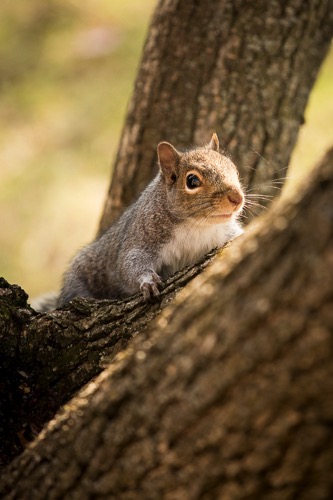
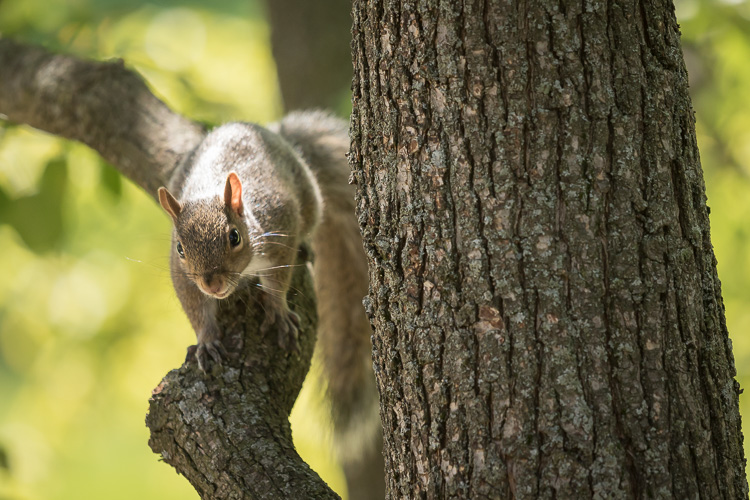
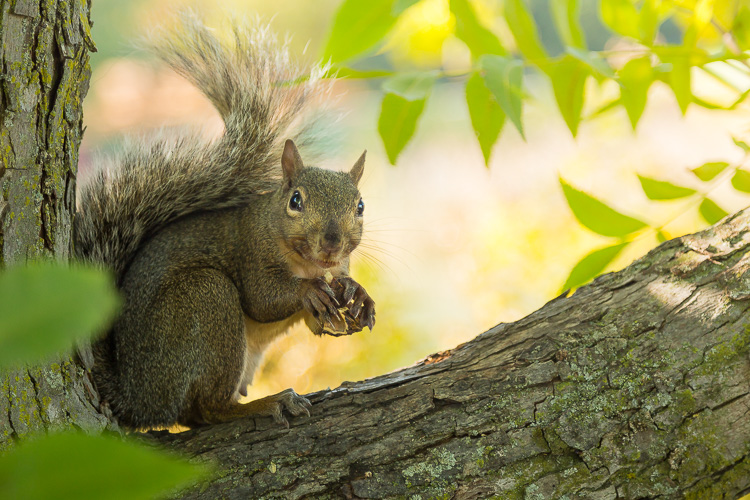
I love the idea of setting a goal and having a vision. Setting goals is part of how we improve our photography. Every fall the squirrels descend upon my backyard tree and gorge themselves on nuts. During this time of year, I stealthily make images of the little rascals. I don’t shoot aimlessly when I work on this project. My on-going goal is to capture soft golden light, creamy blurred backgrounds, sharply focused eyes and engaging expressions. Squirrels move fast and I’m neither as speedy nor as stealthy as I’d like to be. I shoot a lot of frames when I work on this project.

W5A2808Joyful Abandon A

1F8B8628Joyful Abandon B1

But…

You knew there was a but, right? The singular vision of this workshop photographer might not work for all of his students. As great a teacher as he is, the first morning you head out together, you probably won’t have enough information to have an instant vision of the work you want to make during the workshop. You might even struggle as you climb the steep learning curve of wildlife photography – and you may shoot a lot as you learn.

Plus, shooting with a goal doesn’t equate to less shutter clicks, it equates to more focus. You might need even more shutter clicks than you usually do, depending on the goal you’ve set yourself.

MG 9090Joyful Abandon C

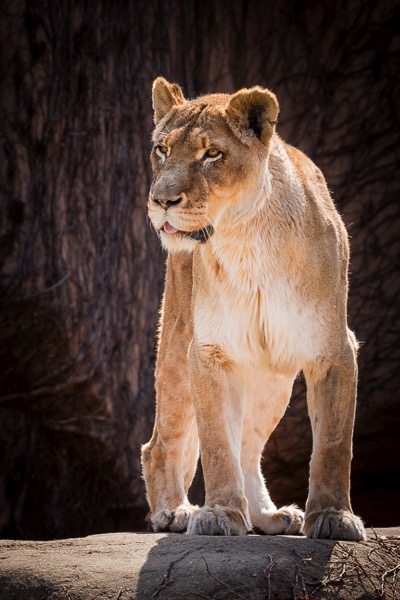
This big cat, photographed at Lincoln Park Zoo in Chicago, is one of the few images I’ve made there that I’ve been pleased with. Most of my images from the zoo don’t fulfill my vision. This one does because the she-lion is engaging with another lion (out of the frame). Her eyes are sharply focused and the background is not only blurred, but it frames her beautifully, and emphasizes her coloring.

I easily shot several hundred images of this lion one afternoon, to get this single image. Shooting my backyard squirrel project helped me define a vision of how I wanted this image to look, but it still took me a lot of frames to reach my goal.

Developing authentic vision

The way the keynote speaker made fun of his student for “over-shooting” bothers me because shooting wildlife images from inside a jeep or blind, elbow to elbow with four other workshop photographers, while steadying a super zoom lens, isn’t exactly easy stuff. Once you start to learn the technical aspects of this type of shooting, your authentic vision might kick in as early as Day 2 or 3 of your workshop. If it takes you all week to get comfortable with wildlife shooting techniques, your vision might not kick in until well after you get home.

Personally, that delayed vision is why I encourage photographers to shoot with what I call the joyful abandon approach. I especially recommend the joyful abandon approach when you’re visiting somewhere you’ve never been, or learning to shoot in a new way. Imagine that you do finally fully develop your vision well after you’ve finished your wildlife workshop. Won’t you want a huge pool of images to ensure that you have the raw materials to realize your vision?

IMG 065320131104Joyful Abandon D

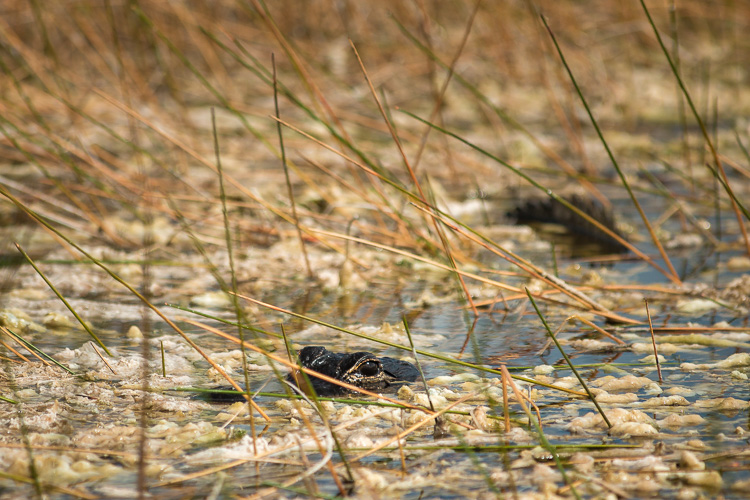
I’ve traveled to Florida dozens of times but up until a few years ago, I’d never visited the Everglades, or ridden in an airboat. Even with an amazing guide explaining the ecosystem and gliding the boat slowly up to known alligator dens, it was a technically difficult shoot. With the movement of the boat and the reeds, my camera struggled to grab focus where I aimed.

The result? I shot. And shot. And shot some more. I’m grateful for all that shooting, since this is the one image I walked away with (above). It has that blurred golden background I love and – key for me when I shoot wildlife – that engaged expression, and tack-sharp focus on the eye.

Build your portfolio

You may never again have a chance to return to that wildlife workshop location, but your workshop leader does. He has the luxury of going annually with his students. He can take years to develop vision, shoot with measured patience, and build a portfolio of the 25 best wildlife images anyone has ever seen.

You, on the other hand, should shamelessly fill memory cards so that when you arrive home, you have access to a massive database of images that might yield 200 shareable gems. It will take work to cull those images and get to those gems, but it’s worth it, isn’t it?

Since your workshop leader has been on this type of shoot over and over, all that familiarity gives him increased comfort, and that increased comfort opens the portal for him to be more focused, and more creative, while shooting fewer frames. Plus, he already owns all of those classic wildlife images that you’ll still want to bring home. He has the luxury of pressing that shutter button once every 15 or 30 minutes. You don’t. You have work to do and a portfolio to build.

W5A4327Joyful Abandon E

W5A4341Joyful Abandon E1

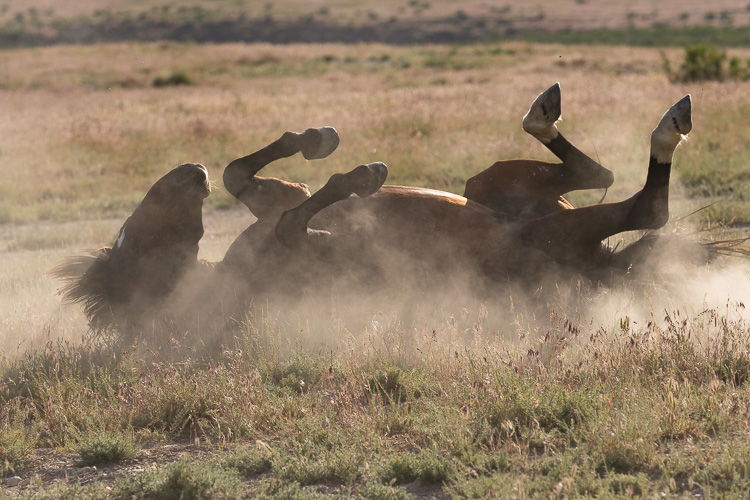
A wild horse rolling in dust is a classic, portfolio-building wildlife image. Over the years, I’ve easily shot a thousand frames of rolling horses, but for me, this is “the one.” The experience I’ve gained from shooting with joyful abandon taught me just where to stand and how to compose my image. To maximize the dust and light beams, while capturing all four legs in the air, a well-defined face, and a highlighted mane.

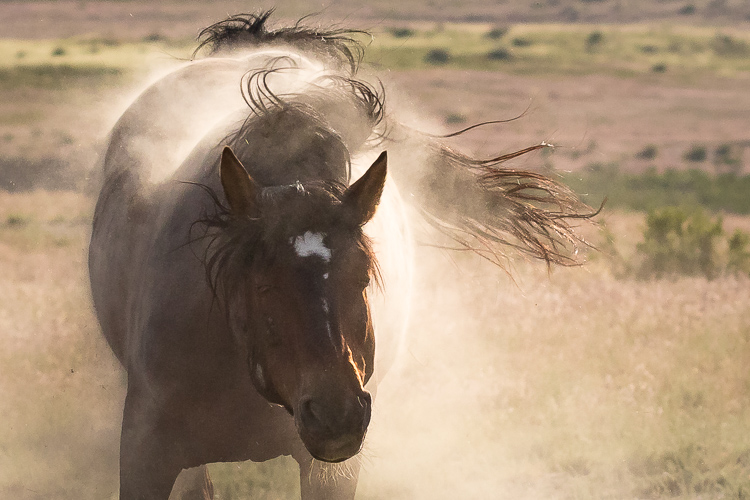
I continued to shoot as this horse lumbered back up to his feet and was rewarded with a glorious, dusty shake too.

Keep shooting with joyful abandon

While I’m using a wildlife workshop as an example, since that was this keynote speaker’s specific remark, this idea of shooting with joyful abandon really applies to any opportunity to shoot, anywhere, even if you’re not on a workshop.

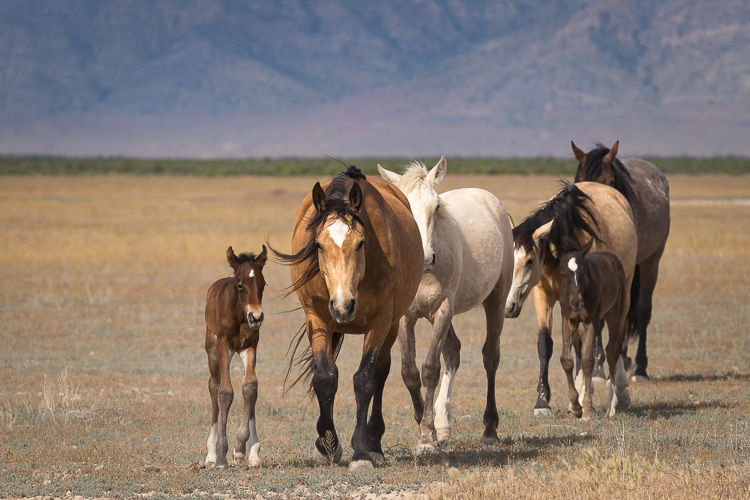
Whenever I travel to a new-to-me wild horse range, I carry massive amounts of memory cards and storage, and I shoot with absolute gleeful, joyful abandon. When I have a chance to return to that same wild horse range, I still have stacks of memory cards and storage, plus a more informed, authentic vision of the images I’d like to capture. I continue to shoot with joyful abandon and I promise you, over the course of a week, I’ll shoot far more than 800 frames.

W5A4799Joyful Abandon F

1F8B2291Joyful Abandon F1

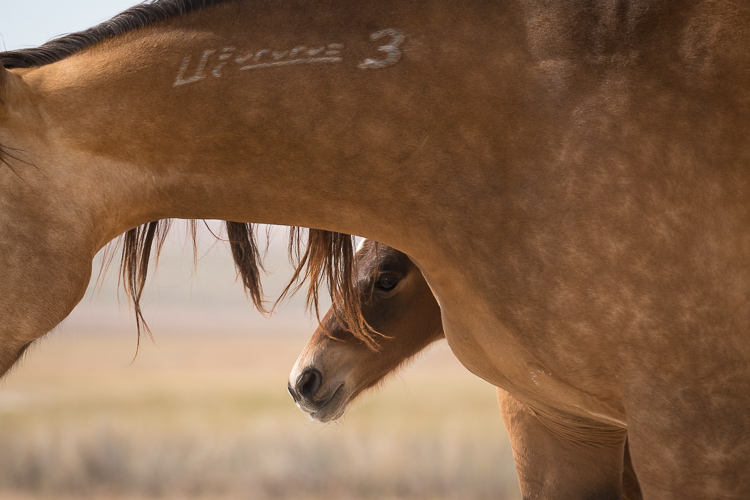
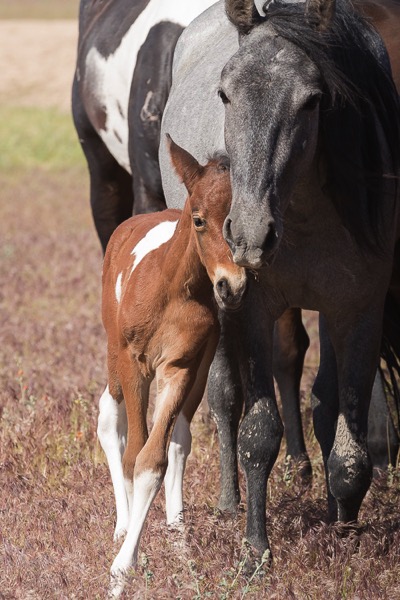
Making images isn’t just about how many frames we shoot, or how many keepers we get, it’s also about the process. Every single frame you shoot is part of your process, and that process helps you develop your unique vision. Whether that vision is focusing on the big picture or honing in on small details, or documenting grand moments or capturing subtle tender ones like these foals with their mothers, shooting with joyful abandon will help you achieve it.

The shooting with joyful abandon approach is how I’ve developed my vision – and how I continue to develop it and stay passionate about shooting. How do you develop your vision and fuel your passion for photography?

W5A4782Joyful Abandon G

googletag.cmd.push(function() {
tablet_slots.push( googletag.defineSlot( “/1005424/_dPSv4_tab-all-article-bottom_(300×250)”, [300, 250], “pb-ad-78623” ).addService( googletag.pubads() ) ); } );

googletag.cmd.push(function() {
mobile_slots.push( googletag.defineSlot( “/1005424/_dPSv4_mob-all-article-bottom_(300×250)”, [300, 250], “pb-ad-78158” ).addService( googletag.pubads() ) ); } );

The post Why Shooting with the Joyful Abandon Approach Can Improve Your Photography by Lara Joy Brynildssen appeared first on Digital Photography School.


Digital Photography School

 
Comments Off on Why Shooting with the Joyful Abandon Approach Can Improve Your Photography

Posted in Photography


Weekly Photography Challenge – City at Night

10 Sep

After the sun goes down it’s a great time to get out and photography in the city. Here are some good examples of photography in the city at night to give you some ideas.

Weekly Photography Challenge – City at Night

Andrew Xu

By Andrew Xu

Here on dPS we have lots of resources to help you get out and photograph your city at night. Check out these articles for some good tips:

  • Tips for HDR Night Photography to Retain Maximum Image Detail
  • How to Enhance Urban Night Photographs Using Luminosity Masks in Photoshop
  • 13 Great Subjects for Urban Night Photography
  • Tips for Getting Proper Exposure for Night Photography
  • 9 Tips to Help you get Sharp Focus at Night
  • Tips for Retouching a Night Photograph using Lightroom
  • How to do Long Exposure Photography and Light Trails at Night
  • Stacking Light Trails for Night Photography Special Effects
  • Tips for Doing City Photography from Above

Share your images below:

Simply upload your shot into the comment field (look for the little camera icon in the Disqus comments section) and they’ll get embedded for us all to see or if you’d prefer upload them to your favourite photo sharing site and leave the link to them. Show me your best images in this week’s challenge. Sometimes it takes a while for an image to appear so be patient and try not to post the same image twice.

Chris Chabot

By Chris Chabot

Vincent Anderlucci

By Vincent Anderlucci

T.E.A Photography

By T.E.A Photography

Share in the dPS Facebook Group

You can also share your images on the dPS Facebook group as the challenge is posted there each week as well.

googletag.cmd.push(function() {
tablet_slots.push( googletag.defineSlot( “/1005424/_dPSv4_tab-all-article-bottom_(300×250)”, [300, 250], “pb-ad-78623” ).addService( googletag.pubads() ) ); } );

googletag.cmd.push(function() {
mobile_slots.push( googletag.defineSlot( “/1005424/_dPSv4_mob-all-article-bottom_(300×250)”, [300, 250], “pb-ad-78158” ).addService( googletag.pubads() ) ); } );

The post Weekly Photography Challenge – City at Night by Darlene Hildebrandt appeared first on Digital Photography School.


Digital Photography School

 
Comments Off on Weekly Photography Challenge – City at Night

Posted in Photography


6 Reasons Why an iPad Makes a Good Photography Companion

08 Sep

I have an iPad Air 2 and I simply love it. It’s my portable digital workhouse. I can pop into most cafés where free wi-fi is the norm. I can enjoy a delicious cup of java, while checking my inbox, or pen a draft for my next article for dPS.

iPad Air 2

iPad Air 2

My main reason for purchasing the iPad was that I went back to college recently. I thought about buying a laptop. After a bit of research, I decided an iPad, paired with a keyboard case, essentially turned it into a mini laptop of sorts. Plus it was less expensive and more portable. I’ve completed the course, but the iPad has now become a great companion for my photography.

I was recently in a cafe waiting to meet a client, when an idea started to take shape about the advantages of having an iPad as a photographer. Following on from a previous article I wrote on “Can an iPad be used as a softbox or custom background?“, I realized that I am using my iPad more and more in my photography work than ever before.

ipad-paired-with-keyboard-open

iPad Air 2 paired with a Logitech keyboard

I could go on at length, extolling the many virtues of having an iPad/tablet as a photographer. Instead, I’ll limit my list for now to just six.

Here are my top six reasons an iPad makes a good photography companion

  1. Portability makes it handy to take anywhere
  2. Displaying your work or portfolio makes you look good
  3. Editing and sharing images is easy
  4. Reading and learning
  5. Spoiled for choice with so many Apps
  6. Google Drive

1. Portability of the iPad

The iPad Air 2 and other tablets are just so light, and even more portable than most laptops. The iPad Air for me is the ultimate Digital Briefcase! The dimensions are 9.4 x 6.6 x 0.24 inches (240 x 169.5 x 6.1 mm). It weighs just 0.96 pounds (436 grams). I feel like James Bond! (sorry Jane Bond)
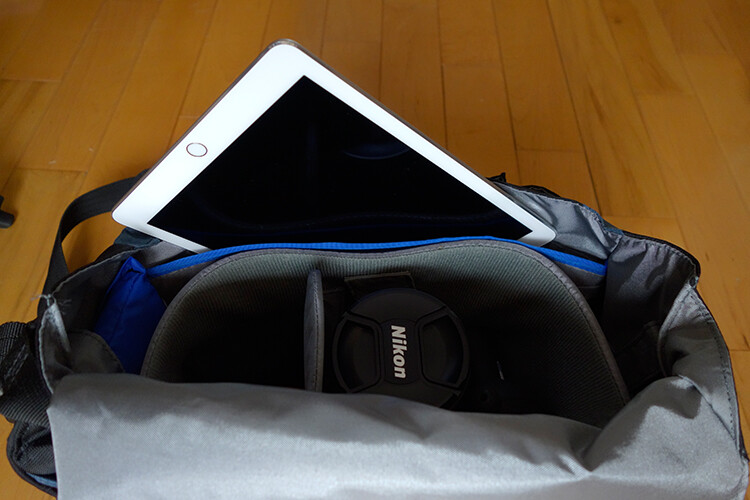
portability

The iPad fits snugly into my camera bag.

2. To display your work

As a photographer, your work should speak for itself. As a commercial photographer, it’s what gets you your next gig. Now more than ever, there are so many ways to get your work online.

The first option is to have a personal website. But this does mean paying for a domain name and hosting. So what if you don’t want to invest in a website? If you are just starting out in your photography career or you’re a keen hobbyist? Again there are many ways to showcase your portfolio online and in most cases for free. For example there is Behance Display, Flickr, 500px and Morpholio to name just a few.

The retina display on the iPad allows maximum clarity of your photos, and makes it very easy for the viewer to look at the details by easily “zooming in” by pinching the screen. Also, flicking through your images or albums with a swipe of a finger, makes the experience much more tactile and hands-on. Similar to flipping pages of a book.

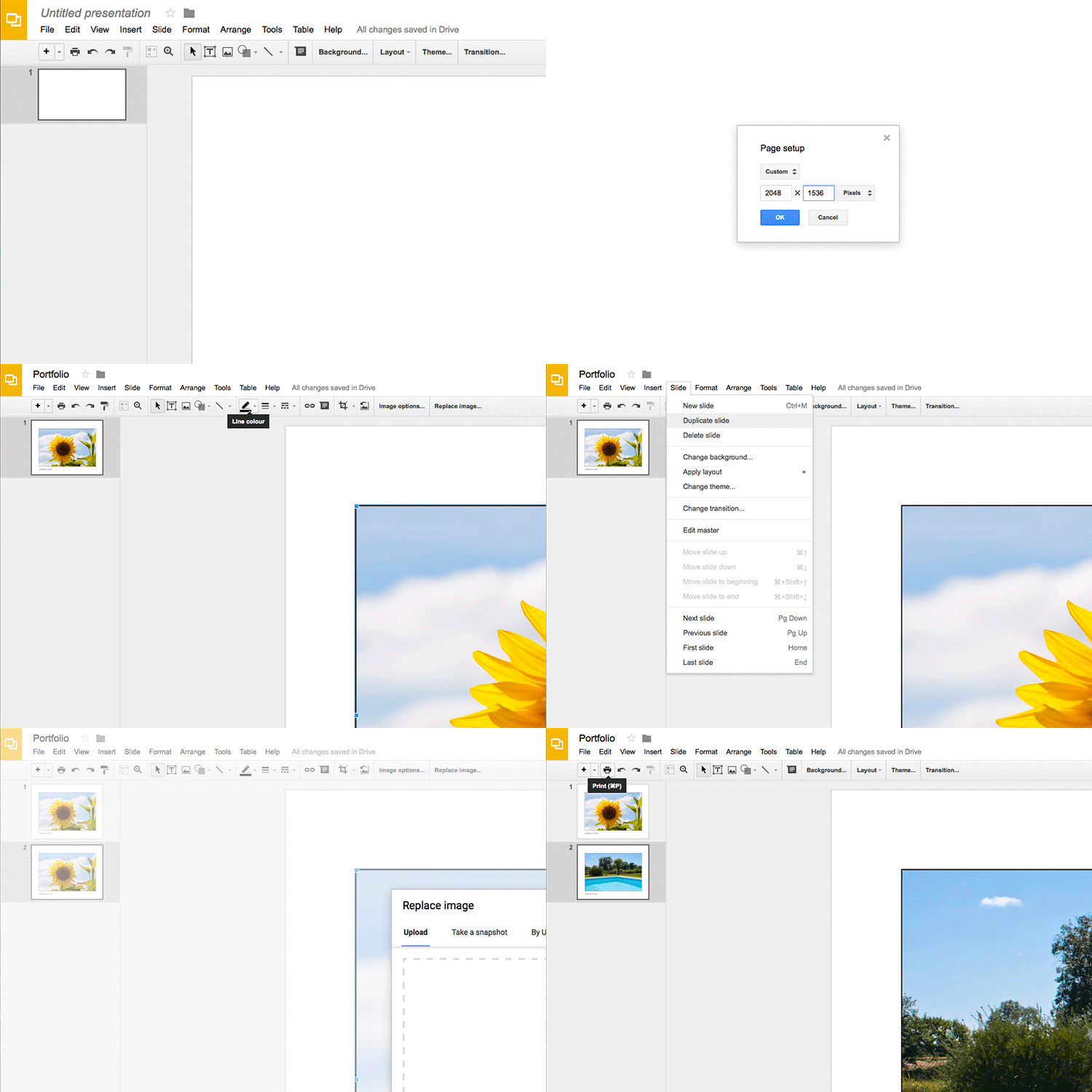
Recently, I met with a client and I needed to bring a digital portfolio with me. I don’t have my full range of work online. I also couldn’t rely on a solid wifi connection. So I put together a portfolio, saved it out as a PDF, and synced it to iBooks on the iPad. A typical page layout program, such as InDesign would be used to put a portfolio together. However, if you just have Photoshop, then here is a great way to create your own portfolio PDF for your iPad from multiple pages.

Creating a PDF portfolio from multiple pages in Photoshop

Open Photoshop and create all your pages the same size, 2048 X 1536 pixels. Place each image and text on a separate page. You can determine how many pages that you want in your portfolio. A general guide is 15-20 pages.

Go up to File>Automate>PDF Presentation. Check this box, “Add Open Files”, and click Save. Name your file and Save it to a location on your computer.
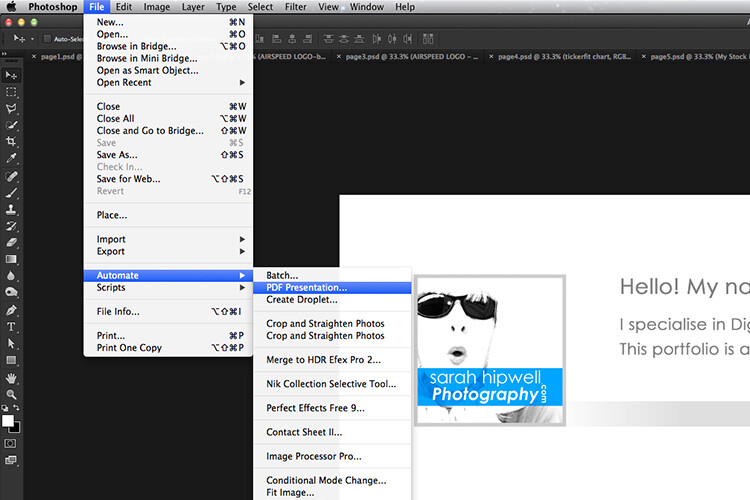
File-Automate-PDF-Presentation

This is handy tip in creating a pdf file from multiple pages or images in Adobe Photoshop.
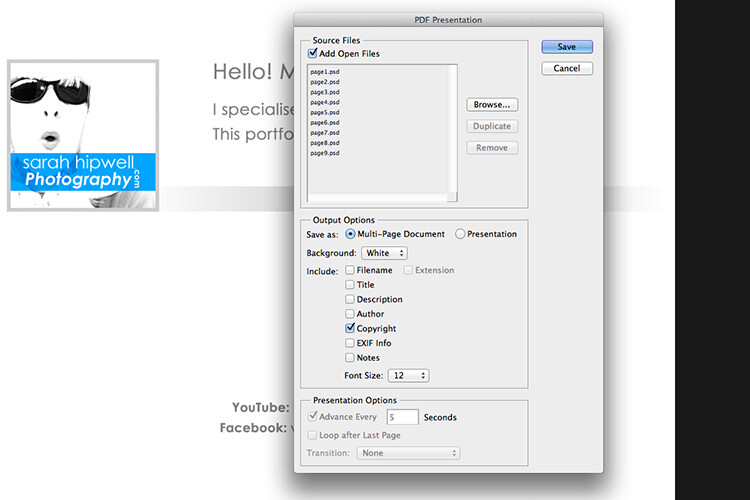
Make sure to check the Add Open Files box.

When another dialog box appears, make sure Optimize for Fast Web Preview is checked.
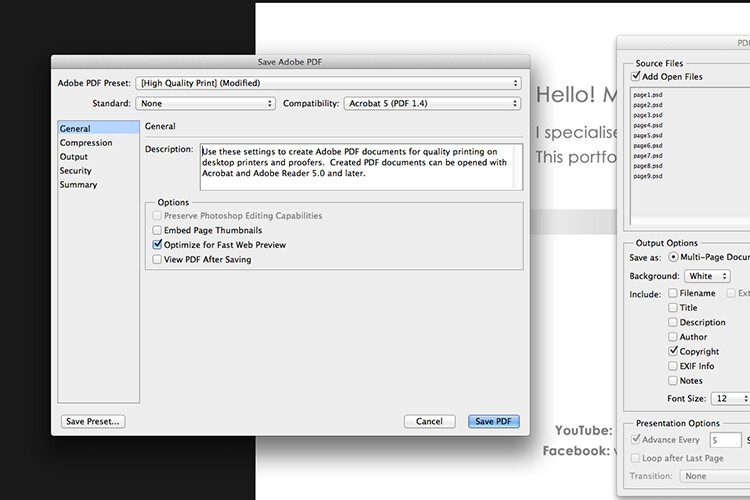
Optimize-for-fast-webpreview

Make sure that the Optimize for Fast Web preview box is ticked.

Click on Compression under General (on the left side, see below screenshot). At the top, change the Adobe PDF Preset to High Quality Print, and next to Image Quality, change the setting from Maximum to Medium. Then click on the Save PDF button.
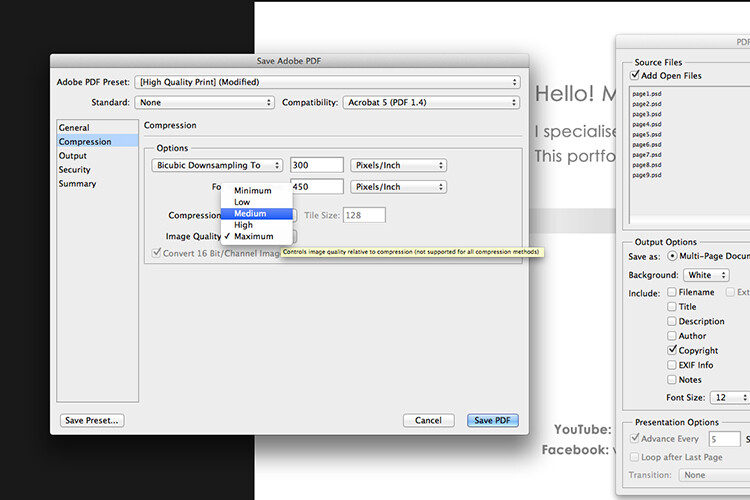
Compression-image-quality-medium

Choose the High Quality Print from the Adobe PDF Preset at the top. Then change Maximum beside Compression to Medium.

Tip: Try and keep the file size below 5mb so as you can email it to potential employers or clients. If you can’t optimize the file size to less than 5mb, then create another portfolio with less pages. PDF files can be viewed on a Mac or PC.

If you don’t have Photoshop, then read on to number six below, and I’ll show you how to create a PDF portfolio using Google Slides.

3. Editing and sharing images is easy

I haven’t done a lot of editing on the iPad. I prefer to do my post-processing at my desktop, where I have the big monitor and stylus. However, I think the iPad Pro could possibly change my mind.

I did try Snapseed. It’s impressive, so intuitive, and free. Other free editing apps are VSCO, Adobe Photoshop Express, and Instagram. What also makes these apps powerful is the ease with which you can share your images online to your social media accounts, or upload them to the cloud.

4. Reading and learning

I’m coming around to reading ebooks and PDFs on my iPad rather than a book. Although, you can’t beat a physical book in your hand. That said, from a practical point of view when travelling, carrying just one book takes up so much room!

I now have my Nikon D750 user manual downloaded on the iPad. This manual alone, although relatively compact in size, still has 507 pages and weighs 310g (11oz).

Tip: If you are using the Safari browser and open a PDF file, you can save it straight to iBooks.

5. Choice of Apps for the iPad

Given the array of apps already in the app store, it’s just not possible to run the gauntlet on them all. Here are a few that popped up on my radar.

  • LightTrac ($ 8.99): LightTrac calculates and plots the angle of Sun and Moon on top of a map, for any location.
  • The Photographer’s Ephemeris ($ 8.99):  TPE  shows you which direction the sun is shining at any given time during the day, no matter what location you choose.
  • Pocket Light Meter (FREE): A light meter that is always in your pocket. It is indispensable for film photography with a manual camera. Measures reflected light, and allows reciprocity calculations.
  • Simple DoF Calculator ($ 1.99): Simple DoF Calculator allows you to calculate the depth of field and hyperfocal distance for any given settings.
  • Take notes to a new level with Evernote (FREE), the productivity app that keeps your projects, ideas, and inspiration handy across all your digital devices.
  • Photography Releases – 500px has a free one. If you shoot Stock photography, a model/property release is a must have.
  • Snapwire also has a free model/property release. I downloaded this app and found it really useful, especially as it stores the photographer’s information. No need to keep filling in this info for every release. Plus it has the templates for all of the major stock sites.

6. Google Drive

What’s not to like about Google Drive? Google Drive is a complete office suite with Google Docs, Sheets, and Slides. Plus you get 15 GB free storage online. In Google Photos, images not exceeding 2048 x 2048 pixels, and videos shorter than 15 minutes ,also do not count towards this limit. It is hard to find fault with this setup when it’s all free!

It is really a Digital Photo Assistant. You can access email, write and publish blog posts, keep track of your schedule and contacts. Share out documents and collaborate with clients online. I also love that you can work with Google docs offline. This has proven as a great time saver if your internet connection is poor, or you simply don’t have access to an internet connection when you need it.

Google Slides is Microsoft’s version of Powerpoint. Here’s an animated gif to illustrate how easy it is to create your PDF portfolio. It’s well worth giving it a go.
animated-gif-slides-portfolio

An animated gif illustrating how easy it is to use Google Slides to create a PDF portfolio for the iPad.

To sum it all up

It was a challenge to keep this list to just six things. I know this could change over the next few months as I continue to use the iPad.

I didn’t mention uploading your photos from your camera directly onto the iPad. You can, but you need the Lightning to SD Card Camera Reader – $ 29.00 or the Lightning to USB Camera Adaptor – $ 29.00.
I only mentioned a mere smidgen of available apps, and most of those were free. This is only a tip of the app-iceberg-store. Some of the paid apps look interesting too.

It’s mind boggling just keeping up with trends. With the recent launch of the iPad Pro. It won’t be long before the iPad has morphed into a real contender, in place of a laptop, for the photographer out in the field.

Do you have an iPad or tablet? What apps do you use? Please share in the comments below.

googletag.cmd.push(function() {
tablet_slots.push( googletag.defineSlot( “/1005424/_dPSv4_tab-all-article-bottom_(300×250)”, [300, 250], “pb-ad-78623” ).addService( googletag.pubads() ) ); } );

googletag.cmd.push(function() {
mobile_slots.push( googletag.defineSlot( “/1005424/_dPSv4_mob-all-article-bottom_(300×250)”, [300, 250], “pb-ad-78158” ).addService( googletag.pubads() ) ); } );

The post 6 Reasons Why an iPad Makes a Good Photography Companion by Sarah Hipwell appeared first on Digital Photography School.


Digital Photography School
 
Comments Off on 6 Reasons Why an iPad Makes a Good Photography Companion

Posted in Photography