RSS
 

Posts Tagged ‘Photography’

How to Capture the Perfect Action Shot in Sports Photography

08 Oct

Sports photography is a fun challenge for any photographer. There is plenty of intensity and emotion to be found at any competitive event. These elements combine to create the potential for some truly memorable images.

At the same time, the speed and unpredictability of some games can be intimidating. Especially if you are used to dealing with slower-moving subjects, like portraits or landscapes.

Never fear! This article will arm you with helpful knowledge so that your next brush with sports photography will result in some fantastic captures.

Getting your settings right
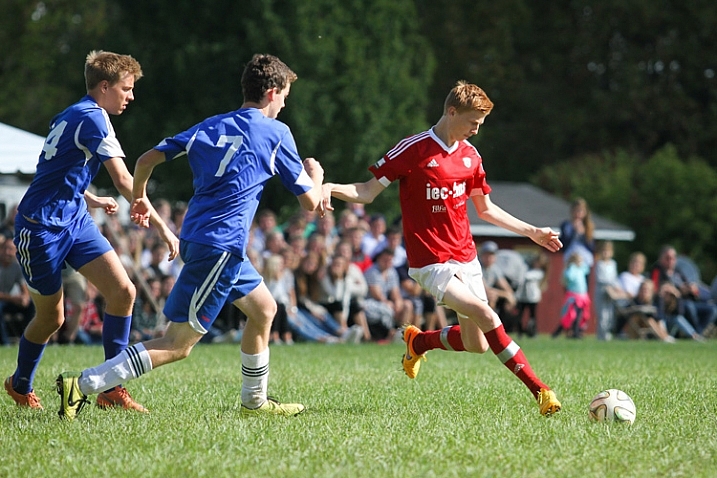
A soccer player about to kick a soccer ball, captured with a high shutter speed

This image was taken at 1/1600th of a second, which freezes the action completely. This super fast shutter speed is possible because there is a lot of sunlight.

Chances are that you’ve probably taken your fair share of blurry sports photo. Typically, players or athletes are moving at high speeds, and your camera doesn’t necessarily know for itself how to compensate.

Freezing the action

If you want to freeze the action in a photo, you’ll need to use to choose a fast shutter speed. But, how fast does it need to be? Well, that depends on the sport. 1/250th of a second should be enough to freeze kids playing soccer, but you’ll need to go a lot faster if you want to capture a baseball in mid-flight. Experiment and find what shutter speed you need to use in order to produce sharp images.

Adding motion

On the other hand, you can also experiment with slowing down the shutter speed and panning your camera throughout the picture to create a sense of speed and movement. It takes a bit of practice to get right, but if you match the speed of your subject, you can hold them in focus while the directional blur emphasizes the sense of movement.

Whenever possible, you will want to use a wide aperture, such as f/3.5 or lower. This will create a narrow depth-of-field, and helps the players to stand out, as the background distractions will be blurred.
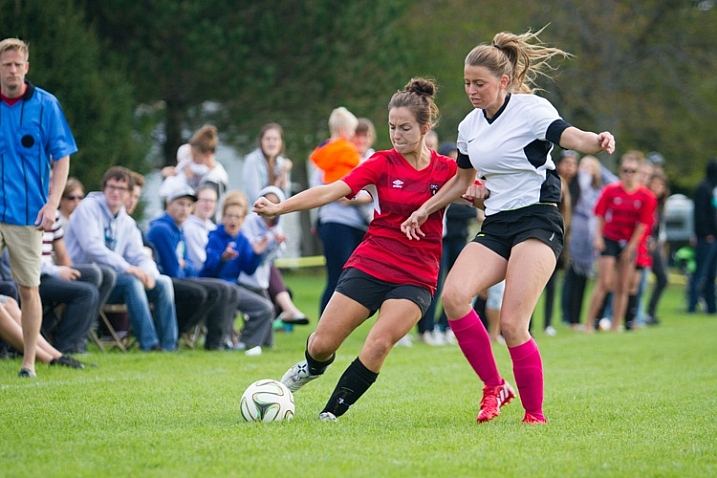
Two soccer players fighting for the ball with spectators watching the game behind them

This image was shot at an aperture of f/2.8 so that the spectators in the background don’t distract from the players chasing the ball.

If the sport is being held outside during overcast conditions or indoors with consistent lighting, consider using manual exposure mode and settings. It may take a bit of time to figure out, but you’ll get much more reliable and consistent images.

Pick your spots

When you first arrive at the field, arena, gym or track, consider all of your potential angles and options. Your options will be different depending on whether you have a short or a long zoom lens.

For many sports, you won’t be able to cover every angle. Getting up close with a wide-angle lens means you won’t be able to capture plays on the other side of the field. While using a long zoom means you may struggle to capture play right in front of you.

Find the “sweet spots” – the places on the field of play which are the perfect distance away for your camera and lens combination. You’re going to get your best images when the play is in these areas. Rather than trying to get an incredible picture when play is far away on the other side of the field, be patient and prepare so that you make the most out of every opportunity when play is in your sweet spots.

A hockey player tries to deke around the goaltender

When I stand near the benches with a 70-200mm lens, this play in front of the net is right in my sweet spot, which allows for strong composition.

Where possible, it’s a good idea to put yourself in a position where the players will be coming towards you. This allows you to see faces and get a better sense of depth than if you shoot from the sidelines and get a side profile view of everyone.
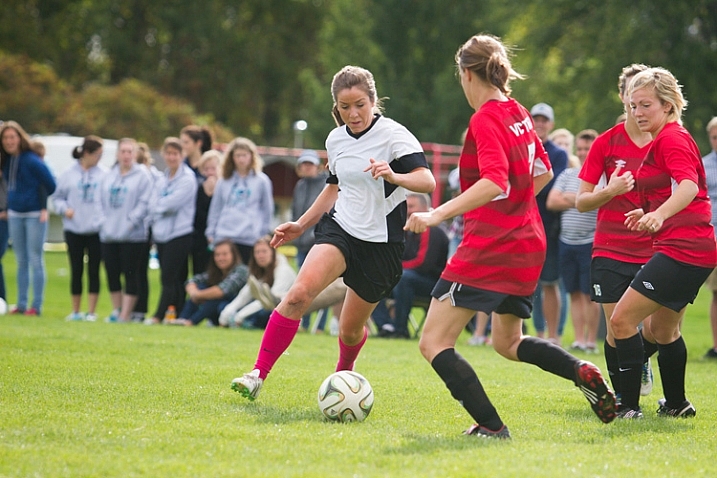
A female soccer player attempts to dribble the ball through two defenders

Get in the middle of the action

If you want to take a sports photo that will be memorable, you need to bring the viewer in as close as possible. Typically, this means using a zoom lens like the 70-200mm. If you don’t have a long zoom lens, simply get as close as possible to the field.

Perspective changes quite a bit as you zoom in. A wide-angle shot looks very different than a shot with full zoom (long telephoto). Consider how you can use this change in perspective to find some unique captures.

Many first-time sports photographers are nervous to zoom right into the middle of the action. Yes, it does come with some risks. You’re likely to snap plenty of frames where an unexpected zig or zag took the player partially out of the image. This is part of sports photography. Even the professionals aren’t able to nail the perfect shot every time.

A hockey picture where the focus has missed

In this shot, the referee passed in front of the camera and messed up the focus. Don’t feel upset if some pictures turn out like this! These kinds of images will be very familiar to any sports photographer.

Risks sometimes pay off

If you have trouble following the play, it definitely is an option to play it safe by taking a wider shot and then cropping in closer afterward. But by taking a high risk, high reward approach to composition will result in some magnificent images!

Another reason to use zoom: To capture expressions!

The most memorable sports shots show faces full of emotion – whether that is the joy of the game, the thrill of victory or the agony of defeat.


Image of hockey players celebrating on the ice after a goal

Image of two soccer players laughing while preparing for a corner kick

Timing is everything

There seems to be a furious competition between manufacturers to see who can make a camera that takes the most images per second.

Burst mode is an incredibly useful tool for sports photography, but all too often it can be a crutch. Just because you can take 10 pictures in one second doesn’t mean you should.
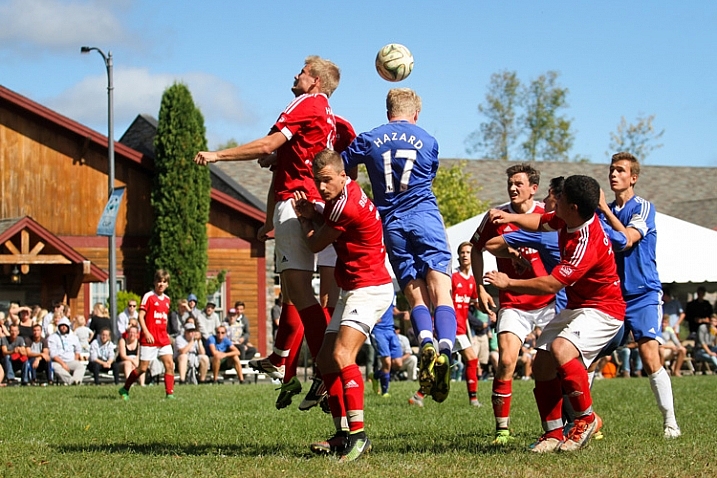
Soccer players attempting to head the ball into the net from a corner kick

Having the ability to take pictures in bursts should be secondary to anticipating the action. Understanding of the game and having a sense for what is going to happen next is more important than burst mode in every case. If you return from every event with thousands of pictures, all taken a fraction of a second apart, it’s going to be a strenuous job of sorting and finding the keepers.

With that said, burst mode can be a great tool if you don’t want to miss any opportunities and have lots of room on your card.

Lastly, don’t spend the whole game chimping! Chimping is when you get so caught up checking out all of your sweet pictures on your camera’s LCD screen that you miss an incredible play that happens right in front of you. Your pictures will still be there when the game is over. Focus on getting your shot!

Hitting your focus

Having the perfect settings, composition and timing won’t count for anything if you miss your focus.

With the possibility for spectators, colourful advertisements, and other players in the background of your images, your camera’s focus might wander and lock onto the wrong target.

For sports photography especially, you might want to consider using back button focus. With this method, your focus is controlled by a button on the back of your camera, which you can reach with your thumb. The shutter button doesn’t influence the focus at all.

By separating the actions of focusing and taking the picture, you will have greater control and independence over both roles. You may need to consult the manual for information on how to switch your camera to back button focus.

An sports action shot of hockey players fighting for the puck

Focus modes

Your camera comes with different focus modes that you can use to get more reliable results, even when dealing with fast and unpredictable subjects. The process for selecting these modes will be a bit different for every camera, so consult your manual for information on how to switch to these options.

First off, you can allow your camera to use all the focus points to determine the best target to lock onto. This can often go wrong, however, as the camera may choose the wrong point, leaving you with an out-of-focus image.

You can get a bit more specific with zone focus, which allows you to select a group of focus points that the camera uses to determine what it focuses on. This focus mode gives up greater control over what the camera locks onto, but still leaves some room for error.

If you want to be very precise, single point focus allows you focus based on just one point of your choosing. This is great if you want to focus on a specific player in a group. The drawback is that is may not be as accurate, and you may need to be very steady in order to stay locked on target.
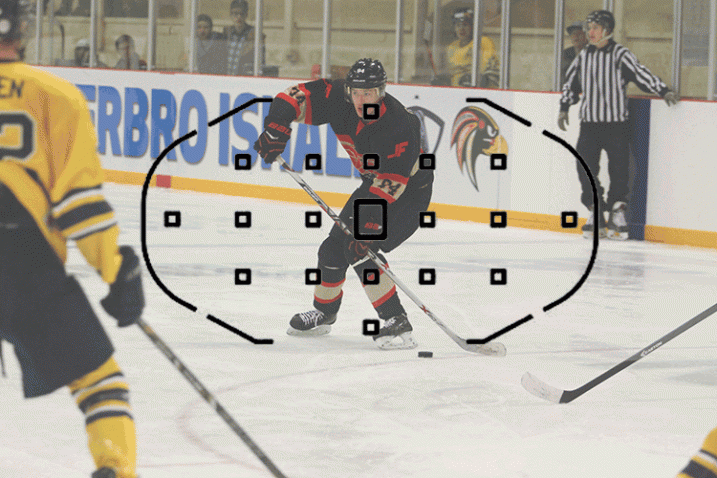
Shows all the different focus modes

This image shows three different focus modes as seen through a Canon 7D: Full Auto Focus, Single Point Focus, and Zone Focus

You can also select how the focus will track. These settings may have different names from manufacturer to manufacturer, but they do the same thing.

Continuous or AF-C (Nikon) / AI Servo (Canon):  In this mode, your focus will constantly seek for as long as you are holding your focus button down. This is ideal for moving subjects, and should be your first choice for sports.

Single or AF-S (Nikon) / One Shot (Canon):  In this mode, your focus will find a target and lock, even if you continue to hold down your focus button. While this is often slightly more accurate than servo focus, your subject may have already moved out of focus by the time you take the shot.

AF-A (Nikon) / AI Focus (Canon):  This mode is an intelligent blending of the two previous modes – it will determine if the target is moving and will lock or track accordingly.

Making the most of the focus technology your camera has to offer will play a big role in snapping some excellent sports shots!

Bonus tips and tricks

If you are photographing a car race or a long jump event, it can be a real challenge to track your subject in action. A fast moving car or runner isn’t an easy target for a lot of cameras.

One surefire way to hit your focus even under these tricky conditions is to prefocus. When using this technique, you pick a spot somewhere ahead on the track to carefully set your focus. Then, when your subject comes through, you simply snap the picture and voila!

Two hockey players in mid air after a body check collision

If you want to add drama and action to your images, consider shooting from a lower angle. This perspective can often make athletes seem heroic or larger than life. Shooting from a lower angle also means the background will show spectators or the opponents behind the player, giving a better sense of the setting and action.

Take Lots of Pictures!

When you get home and load the images on your computer, you’re going to find that many of your shots have missed focus, have players in awkward or unflattering angles, or other annoying distractions. This is perfectly normal! It isn’t easy to capture the chaos of sports, and you’re going to need to throw out a lot of shots.

Over time, as your feel for the game from behind the camera improves and as you begin to master these techniques, you will find yourself coming home with more and more keepers!

googletag.cmd.push(function() {
tablet_slots.push( googletag.defineSlot( “/1005424/_dPSv4_tab-all-article-bottom_(300×250)”, [300, 250], “pb-ad-78623” ).addService( googletag.pubads() ) ); } );

googletag.cmd.push(function() {
mobile_slots.push( googletag.defineSlot( “/1005424/_dPSv4_mob-all-article-bottom_(300×250)”, [300, 250], “pb-ad-78158” ).addService( googletag.pubads() ) ); } );

The post How to Capture the Perfect Action Shot in Sports Photography by Frank Myrland appeared first on Digital Photography School.


Digital Photography School

 
Comments Off on How to Capture the Perfect Action Shot in Sports Photography

Posted in Photography


Weekly Photography Challenge – Everyday Life

08 Oct

The first thing I want you to do it is to have a look at these photos of details of everyday life.

Sam Hawkins

By Sam Hawkins

Weekly Photography Challenge – Everyday Life

This one should be easy and hard at the same time. Easy in a sense of finding subjects because it’s the things you see and use every single day. Hard in a sense that you need to look at them in a new way. See them differently, and photograph them in a way that is interesting.

Look for light, shapes, shadows. Get creative with your post-processing. Put in a macro lens or extension tube and get in close. Try something new just for fun.

Ioiyyfv

By ioiyyfv

Aftab Uzzaman

By Aftab Uzzaman

Waferboard

By waferboard

8 Kome

By 8 Kome

Glenn Euloth

By Glenn Euloth

Damianos  Chronakis

By Damianos Chronakis

Share your images below:

Simply upload your shot into the comment field (look for the little camera icon in the Disqus comments section) and they’ll get embedded for us all to see or if you’d prefer, upload them to your favorite photo-sharing site and leave the link to them. Show me your best images in this week’s challenge. Sometimes it takes a while for an image to appear so be patient and try not to post the same image twice.

Share in the dPS Facebook Group

You can also share your images on the dPS Facebook group as the challenge is posted there each week as well.

Patrik Nygren

By Patrik Nygren

Juan Antonio F. Segal

By Juan Antonio F. Segal

Artjouer Street Art

By artjouer street art

googletag.cmd.push(function() {
tablet_slots.push( googletag.defineSlot( “/1005424/_dPSv4_tab-all-article-bottom_(300×250)”, [300, 250], “pb-ad-78623” ).addService( googletag.pubads() ) ); } );

googletag.cmd.push(function() {
mobile_slots.push( googletag.defineSlot( “/1005424/_dPSv4_mob-all-article-bottom_(300×250)”, [300, 250], “pb-ad-78158” ).addService( googletag.pubads() ) ); } );

The post Weekly Photography Challenge – Everyday Life by Darlene Hildebrandt appeared first on Digital Photography School.


Digital Photography School

 
Comments Off on Weekly Photography Challenge – Everyday Life

Posted in Photography


Tips for Getting Started with Coastal Photography

07 Oct

Many of us start out treating coastal photography the same as landscape photography. There are a lot of similarities. For both, you head out into the great outdoors, often to remote locations. You need a tripod and a remote shutter release for stabilization. You are capturing an entire scene rather than a discrete item or person. You want a deep depth of field. And so on.

But there are also differences between the two. In fact, treating coastal photography the same as landscape photography could leave you woefully unprepared when you head out. It could also lead to confusion as to how to set up and expose your photos. This article will help you get started with coastal photography, even if you are already familiar with outdoor shooting generally.

Mullaghmore-1

What to bring with you

There are two items you’ll need to add to your kit before you head out to do coastal photography. Both are filters, and you may have one of them, but they are both critical.

Neutral density filter

The first is a neutral density filter. In fact, you will probably want more than one since they come in different strengths. If you are not familiar with these filters, they restrict the amount of light allowed into your camera. Why would you want to do that? So you can slow down your shutter speed and allow the waves or the clouds to move through your frame while you are exposing the picture. That will smooth things out for you.

We’ll talk more about using them later, but for now just know that you’ll need one. I would start with a 10-stop neutral density filter, which is about as powerful as you will ever need. You can then add lesser strength filters like 6-stop and 3-stop filters later.

Graduated neutral density filter

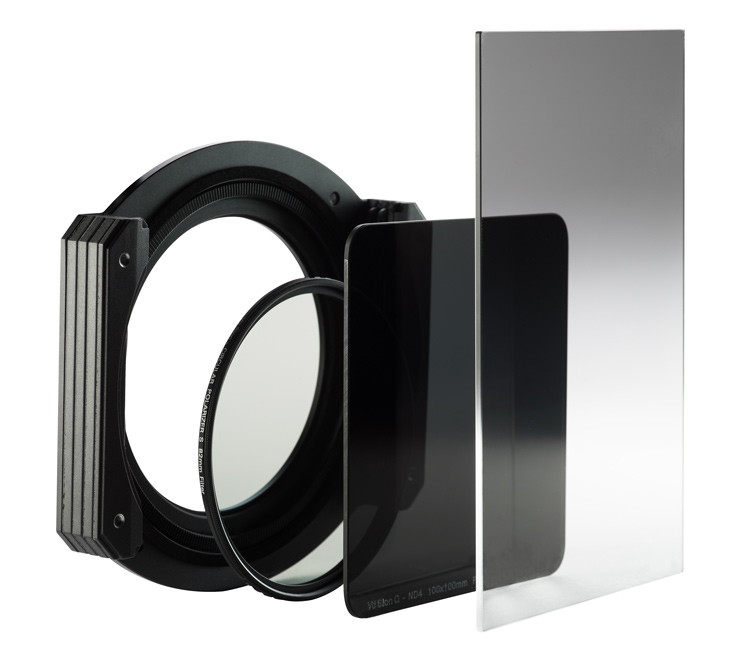
VFH100_FilterGroup

Drop-in style filter system with a graduated neutral density filter on the right.

The second item you will need is a graduated neutral density filter (aka grad ND). You may already have this one since it is also useful for landscape photography. However, it is remarkably useful in coastal photography and you will use it all the time. In landscape photography, you may have trees, mountains, or other items sticking up into the sky such that you cannot use the grad ND.

In coastal photography, however, very often the horizon line is clear and unbroken in your picture. It makes is easy to use the grad ND in a lot more situations. For this reason you will use it all the time. In addition, the sky is often a significant portion of your picture in coastal photography. So making the sky look its best is incredibly important.

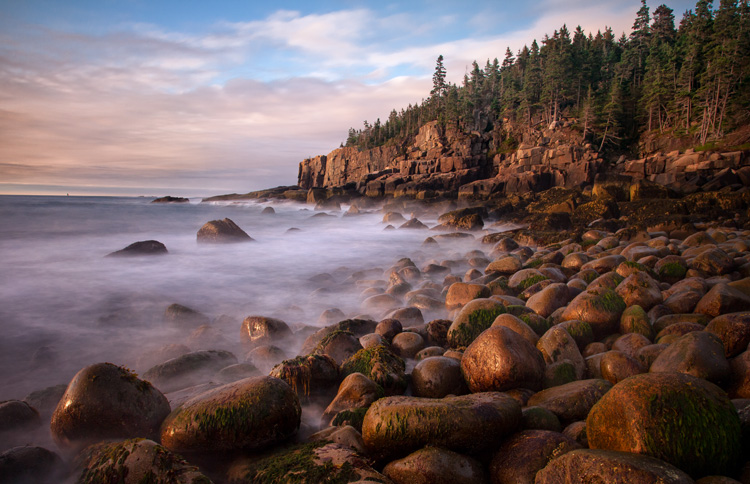
Acadia-6

Where to go

Now that you have the right gear, it is time to head out. Before you do, spend some time thinking about where you will go. When you first get started in coastal photography, you will have a tendency to go one of two places: either a scenic overlook or a beach. Both have problems though, so let me explain a bit.

A great view does not always translate into a great picture. Therefore, just going to a scenic overlook will often not result in great photos. It can, so I’m not saying to avoid them, but just be aware of a few problems you are going to face. The primary problem is that you will have difficulty establishing any sort of foreground. You are up too high, and there is usually nothing to use to bring the viewer into the picture. We’ll talk more about composition in a minute, but for now just understand that you often need to get down near the coast and sometimes even get right behind something to set up an interesting composition.

On the beach

When you do manage to get right next to the coast, often that will be on a beach. Beaches are great, but they have their own problems when it comes to composition. After all, a beach is just a bunch of sand, and that’s hardly something that is going to look great in your picture. You need to find something to use as a subject or at least a center of interest. Sometimes that’s a physical object in the sand (boulder, boat, moss, etc.), or it might be a pattern in the sand itself.

The best places to go are where there are interesting features to use as foreground, and you can get down to the coast. While I just warned about beaches, very often they are the best place. They allow you access to the coast, easy parking, etc. Just don’t stay in the middle of the beach. Look for interesting features, walk to the periphery, or even go beyond the beach.

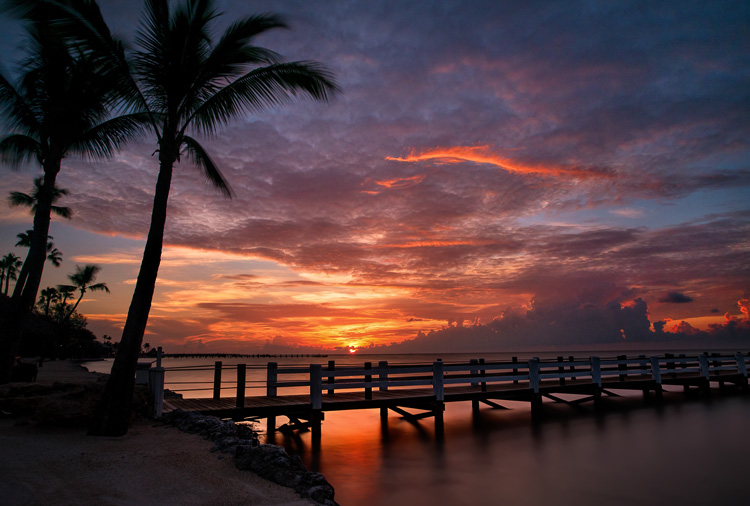
Cheeca-Sunrise-5

When to go

Next you need to decide when to go take your coastal photos. This one is easy. You want to go before sunrise or at sunset.

While this tip is easy, it is also absolutely critical. The sky will often take up a healthy chunk of your picture, so you need it to be interesting. Further, if you go in the middle of the day, you will face harsh contrasts that will ruin your picture. Avoid doing that whenever possible.

This leads to another problem, which is access. Many beaches and scenic coastal areas are closed and blocked off until sunrise or even later. You’ll miss the best light waiting around for them to open. Pay attention to opening hours and access to make sure you can get your shot.

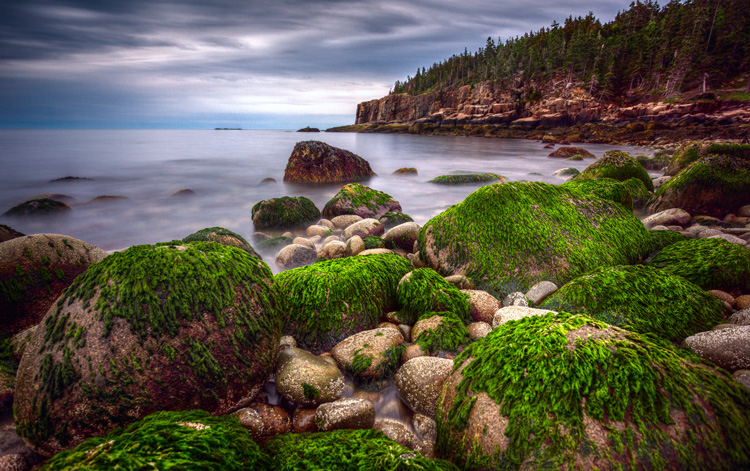
Green-Rocks

How to compose your coastal photos

When it comes to composing your pictures, you always want to think about the foreground, subject or center of interest, and the background. You’ll generally want to set these up in your picture according to the Rule of Thirds.

Background

Let’s start with the easy one first, the background. In coastal photography, the background of your picture will usually be the sky. That’s one of the reasons why heading out before dawn or at sunset is so important. The sky just looks better at those times. When it comes to composition, the background will be determined by how the sky looks. Therefore, you hardly need to think about the background of your picture.

Foreground

That leaves the foreground and some sort of subject or center of interest to worry about. The subject is very important, but it varies dramatically from person to person and scene to scene. It can be a physical thing like boulders or plants, or it can be a man-made item like a boat or a lighthouse. Your subject can even be an intangible thing like a leading line or a shape. Just make sure there is something tying the picture together. If you don’t, you will be left with a mere snapshot.

And finally we get to the foreground. This is often the hardest part of the picture to set up, but at the same time it is also the most important. You want to use foreground to create a sense that your viewer can walk into the picture. If you are on the beach, look for interesting sand patterns to use. Otherwise, look for rocks, boulders, or vegetation that can serve this purpose. Of course, the water and waves will often serve as your foreground. How this looks will depend largely on how you expose the picture, we’ll cover that next.

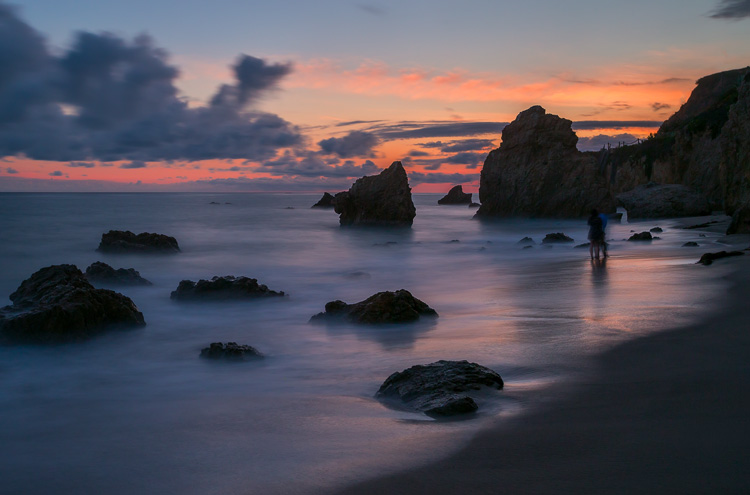
El-Matador-4-2016-05-10

How to expose your coastal photography

In coastal photography, your exposure controls affect more than just how bright or dark your picture looks. Your exposure controls also affect much more than just depth of field (aperture) or digital noise (ISO). How you expose your picture will also control things like the the subject and mood. That is partially true in other forms of photography, but it is especially true in coastal photography.

This is because your exposure settings will control how the water and waves appear in your picture. Specifically, how fast or slow you set your shutter speed will change the look of the water. If you want to stress the power and harshness of the sea, use a fast shutter speed (faster than 1/250th of a second). That will stop the action of the moving water. To create a sense of movement, use a slower shutter speed (between 1/8 second and 1 second). For a more serene scene, you can blur out the water entirely by using a very slow shutter speed (longer than 10 seconds). This is just a introduction to this concept, but to see the full range of options, check out this article: 7 Tips to Help Improve Your Seascape Photos by Controlling the Waves.

To go about using these different shutter speeds you can start by making sure you are in Manual mode and moving your aperture and ISO. To use a faster shutter speed, make your aperture a little larger (a smaller f-number) and your ISO a little higher. More often, however, you’ll want to use a slower shutter speed, for which can you should stop down your aperture to a small setting (f/16 – f/22) and use your lowest native ISO (usually ISO 100).

El-Matador-5

Using the neutral density filter

Frequently, however, there will be too much light to use the slow shutter speed you want. That’s where the neutral density filters come in. When you attach one of these filters to the front of your lens, it will restrict the amount of light allowed into your camera. That will allow you to use a slower shutter speed to achieve a proper exposure (without overexposing your picture).

Let’s make this a little more concrete with some specific numbers. Let’s say you have your shot set up with a correct exposure and you are at 1/50th of a second for your shutter speed, and your aperture is set at f/16 with an ISO of 100. You have a 6-stop neutral density filter in your bag, and you want to use a much slower shutter speed to create some blur in the water. In that case, attach the neutral density filter to your lens and now the amount of light coming into your camera is restricted by 6 stops. If you do nothing else, your picture will be severely underexposed (probably pitch black). This allows you to increase (i.e., slow down) the shutter speed by 6 stops to achieve a proper exposure, and the slow shutter speed desired.

Okaloosa-2

Let’s walk through the process of slowing down the shutter speed by 6 stops, which you will do manually.

  • Remember that a stop is a doubling of light, so slowing the shutter speed by the first stop from our starting point of 1/50th of the second will move it to 1/25th of a second.
  • After that, moving it another stop will get you to 1/13th of a second.
  • Next is 1/6th of a second.
  • 4 stops is ? or 0.3 seconds.
  • 5 stops is ? of a second
  • Finally, slowing the shutter speed by 6 stops will result in a shutter speed of 1.3 seconds.

Take the picture with that shutter speed and your picture should be properly exposed with a nice blur to the water.

Variations

This is just one example, and there are a lot of variations you can do on that. For example, you could use a 10 stop neutral density filter instead. That would allow you to set your shutter speed as slow as 20 seconds in our scenario above. That would really blur out the water. You can also adjust the aperture and ISO to bring the shutter speed in exactly where you want it.

You’ll note in our example above, we could have made our aperture smaller (to f/22 in most lenses) and restricted the amount of light by another stop. Or we could have increased the aperture or the ISO to increase the exposure and use a slightly faster shutter speed. Think of these controls as fine tuning after you have your neutral density filter on your lens.

Destin-Wave

Getting started with coastal photography conclusion

Hopefully you now have a little better sense of where to go, when to go, and how to set up your shots for coastal photography. Armed with this knowledge, just head to the coast when you can and put these tips to work.

But be careful – the coast can be a harsh and unforgiving environment for both your equipment and for you. That said, I think you’ll find there is no better place to be than on a coast at sunrise or sunset.

googletag.cmd.push(function() {
tablet_slots.push( googletag.defineSlot( “/1005424/_dPSv4_tab-all-article-bottom_(300×250)”, [300, 250], “pb-ad-78623” ).addService( googletag.pubads() ) ); } );

googletag.cmd.push(function() {
mobile_slots.push( googletag.defineSlot( “/1005424/_dPSv4_mob-all-article-bottom_(300×250)”, [300, 250], “pb-ad-78158” ).addService( googletag.pubads() ) ); } );

The post Tips for Getting Started with Coastal Photography by Jim Hamel appeared first on Digital Photography School.


Digital Photography School

 
Comments Off on Tips for Getting Started with Coastal Photography

Posted in Photography


How Birds Can Help You Learn About Your Photography Journey

05 Oct

When you feel like you don’t know what to do, what’s the next step? Frustrating, isn’t it? I think wisdom is found anywhere, from renaissance statues to butterflies, and even birds. Speaking of which, here’s a weird photography insight that I got by observing them.

Photography Journey

Why birds are amazing

Birds are really awesome. Well, I guess they are, depending on what aspect you are looking at. I mean, we all know they can litter a lot, right? But one thing that has always amazed me is how birds can reach their destination halfway around the world, without ever having been there nor knowing how to get there. Take the Arctic Tern, for example, it’s a bird that goes from Greenland all the way to Antarctica. They make the trip without ever knowing where it is.

Life will find a way?

There’s this scene in Jurassic Park where raptors that were not supposed to reproduce ended up making babies on their own. That’s when Jeff Goldblum said, “Life will find a way”. That is weird but it is true. Birds fly miles upon miles, butterflies too and even turtles. They all reach their destinations without knowing how to get there.

Now, call me crazy but I think that the same hand that made them also made me and you. And if these animals have an internal GPS, I am sure I have one too and so do you. A GPS that allows us to reach our destination as a photographer, wherever that may be. I don’t think any of us have any problem with that GPS concept. But between where we are and where we want to be is a big, scary gap, it’s called process. And if there’s something I’ve learned from nature, it is to embrace it.

Photography Journey

Embrace the process

Try to think like the birds think (don’t worry it’s not that hard with your brain not being larger than theirs). They probably feel a strong urge to go in a certain direction, and I am pretty sure that’s it. They can’t possibly know 100% how to get to their destination for sure because they’ve never been there. All they did was start, and also began embracing the process of life.

Normally when someone talks about the process of photography, they usually refer to stuff like exposure and the making of photographs. But what I would like to talk about here is more about the overall process of photography. I think it is all about accepting where you are and knowing paths will open up along the way. It is up to us to be open to it, and to be brave enough to take step after step, just like millions of birds, butterflies, and turtles.

Photography Journey

Just start even if you don’t know the end yet

But unlike birds, sometimes our destination is not as we expected when we started, that’s where we need to be open. I remember a while back, when I was thinking of what to do with my life, I had no idea what to do next. I accepted that and felt that I would end up figuring it out somehow. I started with the lowest hanging fruit: Video Games. At first, I wanted to go into Video Games, then I realized what I really liked were the graphics. I did not want to spend all that time learning about art, so I entered Graphic Design. From there I got a camera on an impulse and started photography.

When I started with photography, I had no idea what I would do, nor did I have an idea of what I needed to do. All I knew was I needed to start, even if I knew not what I was doing. I had all of the intent of being a wedding shooter but now I am more a street photographer more than anything!  You see, I think photography in an overall sense works that way. Decide to be a photographer, start right now, then be open to other paths that are in front of you. Providence will take care of you. Embrace the process.

Getting past road blocks

Of course, at every turn there are frustrations. No one said this stuff would be easy! But the thing is, you can recognize that you are in the middle of a process so that you can learn to embrace it.

  • Learning your exposure is frustrating you? Embrace the process.
  • Keep missing shots? Embrace the process.
  • Still not where you want to be? Embrace the process.
  • Have no clients knocking at your door? Embrace the process.

Embracing the process is simply accepting the fact that you are where you are supposed to be right now. Once it is time for you to move on, you will. But you will never be able to move any step further if you do not accept the process. Say no clients are knocking at your door, you haven’t gone trough the process of marketing your work yet. It’s pretty simple really, your situation will probably never outgrow your own skills.

Photography Journey

Conclusion

I don’t know where you are, reading this. But I’m pretty sure you know what you want out of photography. Will you trust your inner GPS and take the first step? God only knows what’s in store for you.

All I know for sure is that you can always figure things out along the way. Embrace the Process. Be yourself, stay focused and keep on shooting. Please share your experiences in the comments below as well.

googletag.cmd.push(function() {
tablet_slots.push( googletag.defineSlot( “/1005424/_dPSv4_tab-all-article-bottom_(300×250)”, [300, 250], “pb-ad-78623” ).addService( googletag.pubads() ) ); } );

googletag.cmd.push(function() {
mobile_slots.push( googletag.defineSlot( “/1005424/_dPSv4_mob-all-article-bottom_(300×250)”, [300, 250], “pb-ad-78158” ).addService( googletag.pubads() ) ); } );

The post How Birds Can Help You Learn About Your Photography Journey by Olivier Duong appeared first on Digital Photography School.


Digital Photography School

 
Comments Off on How Birds Can Help You Learn About Your Photography Journey

Posted in Photography


5 Tips for Using a Kit Lens for Travel Photography

03 Oct

There are many good reasons not to use a kit lens for travel photography. If a kit lens is the only lens you own and you have a photography trip planned, you may be thinking about buying a better quality mid-range zoom or even a prime lens to replace or accompany it.

Kit lens in travel photography

But before you do so, I want to tell you a story.

Why a kit lens isn’t so bad after all

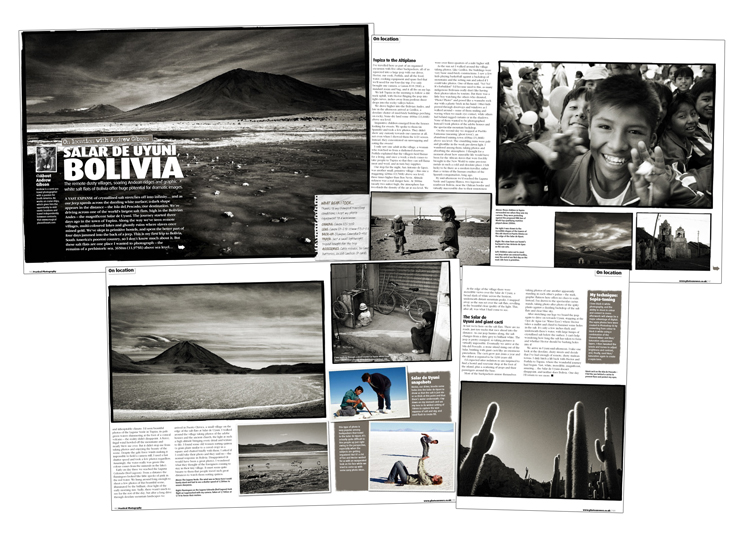
10 years ago I bought my first digital SLR, a Canon EOS Digital Rebel XT. I had switched systems from Pentax so I didn’t have any lenses to use with it. The camera came with an 18-55mm kit lens, and undecided about what other lenses I needed, I took it with me on an extended trip to South America.

I soon realized that the quality of the lens was not as good as it could be (I nearly used the word horrible). It wasn’t sharp and there was lots of chromatic aberration and purple fringing in my photos. Canon have since discontinued that early kit lens and replaced it with another, better one.

But that lens and camera combination gave me a tremendous amount of freedom. It was light enough enough to carry with me everywhere. I never had to change lenses, which helped keep the sensor reasonably free of dust. I had a wide-angle lens at 18mm, a short telephoto at 55mm, and all the focal lengths in-between.

It was during this trip that I had time to think about my future and what I wanted to do with it. I decided that I wanted to write about photography for a living.

Five months later I sold my first feature to Practical Photography magazine, illustrated with photos taken in South America with the Digital Rebel XT and that same kit lens. Yes, the lens may have been horrible, and I’d never want to go back to that camera and lens combination, but the photos I took with it were good enough to be published in a major photography magazine.

Kit lens in travel photography

What lessons can we learn from this? Here are some of the key lessons.

1. Your equipment matters, but not in the way you think

The key thing is that the equipment you chose to take with you is light enough for you to take just about everywhere, so that you don’t miss any photo opportunities that present themselves. That’s one of the reasons that mirrorless cameras and high end compacts have become popular with travellers.

Relating this back to lenses, one of the benefits of prime lenses is that they tend to be smaller and lighter than better quality mid-range zooms.

Kit lens in travel photography

2. Location and timing are more important than gear

Travel photography is about getting yourself to interesting places, when the light is beautiful, so that you can take photos that evoke the mood and atmosphere. If you don’t do this, it doesn’t really matter what camera and lens you have. Your photos won’t be as interesting as those from people who do take the trouble to do these things.

Kit lens in travel photography

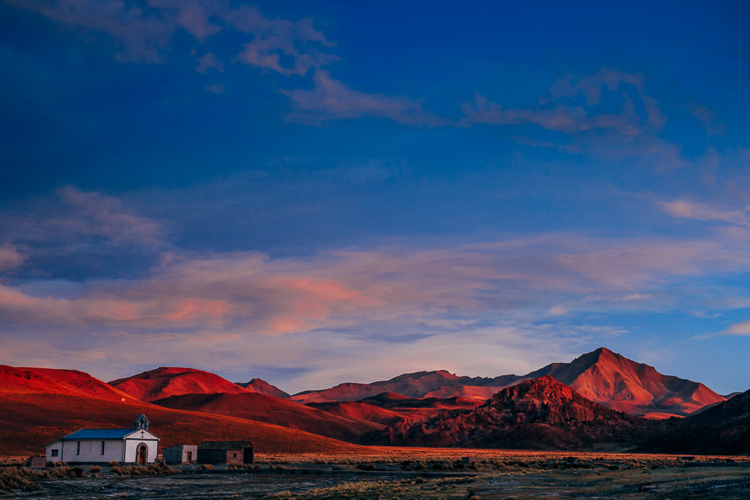
The photo above was taken during a 4-day jeep trip in south-west Bolivia. It’s a remote location at 4200 meters above sea level in the Andes that I never would have seen without going on that trip. It doesn’t matter what camera and lens you have, you’ll never take photos like this if you don’t make the effort to get to places like this one.

3. You need to interact with the locals

You get more out of the journey on a personal level when you talk to local people. The ability to confidently communicate gives you the chance to learn about their lives and the way of life of people from a different place or country.

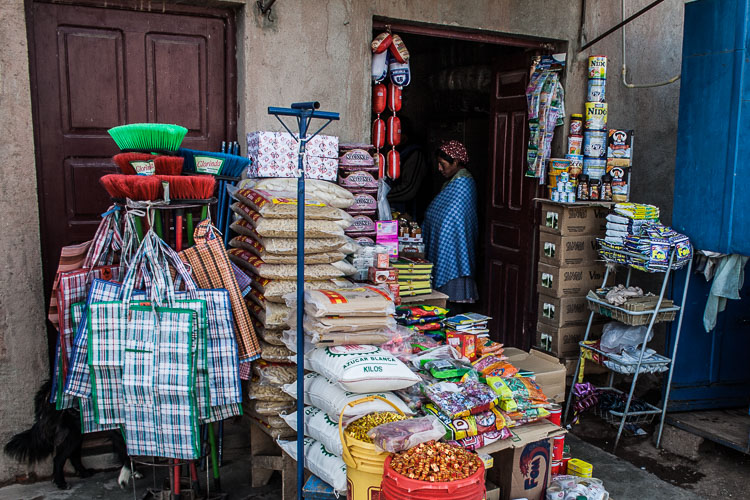
It also opens up the number of photographic opportunities that come your way. Perhaps the people you talk to would like to have their photos taken, if you ask. Or you can ask people what local sights they can recommend for you to visit with your camera. You will learn about local temples, markets, festivals and other interesting cultural events or places that make good subjects.

Kit lens in travel photography

I came across this scene in Punta Arenas, Chile (above) and was struck by the contrast between the expensive looking racing car and the houses. These two guys were happy for me to take a photo. The confidence to talk to people in this type of situation, and ask for permission to take a photo, is just as important as your gear.

4. Money is always a factor

Travel can be expensive, and it may be wiser spending money on experiences than gear. You don’t want to be in the situation of having spent so much on lenses that you don’t have enough money left to do all the things you would like on your journey.

Kit lens in travel photography

5. Kit lenses are not perfect

I think it’s wise to acknowledge at this point that there are many reasons why you might want to buy a better lens than your kit lens. You might need a prime lens with a wide aperture for shooting in low light or experimenting with shallow depth-of-field. Or you may need a shorter focal length or a longer one. A weatherproof lens so you can shoot with confidence in the rain might also be handy.

These are all valid reasons for buying a better lens. Most photographers who start out with a kit lens end up buying better ones eventually. My photos were published in spite of me using a kit lens, not because of it.

But if a kit lens is all you have, there is no need to worry. You will have plenty of opportunities to buy better lenses in the future. For now, just get out there and seize the moment. Enjoy your trip, have a wonderful experience and make as many beautiful images as you can.

Kit lens in travel photography


Mastering Lenses

If you want to know more about buying and using lenses then please check out my ebook Mastering Lenses: A Photographer’s Guide to Creating Beautiful Photos With Any Lens.

googletag.cmd.push(function() {
tablet_slots.push( googletag.defineSlot( “/1005424/_dPSv4_tab-all-article-bottom_(300×250)”, [300, 250], “pb-ad-78623” ).addService( googletag.pubads() ) ); } );

googletag.cmd.push(function() {
mobile_slots.push( googletag.defineSlot( “/1005424/_dPSv4_mob-all-article-bottom_(300×250)”, [300, 250], “pb-ad-78158” ).addService( googletag.pubads() ) ); } );

The post 5 Tips for Using a Kit Lens for Travel Photography by Andrew S. Gibson appeared first on Digital Photography School.


Digital Photography School

 
Comments Off on 5 Tips for Using a Kit Lens for Travel Photography

Posted in Photography


5 Tried and True Landscape Photography Tips used by the Pros

02 Oct

Have you ever found yourself wondering how do the professionals (pros) consistently turn out amazing photos day after day, year after year and what are some of their secrets? So besides knowing their camera like their best friend, what are some of the things that the pros do? Here are some tried and true landscape photography tips used by the pros.

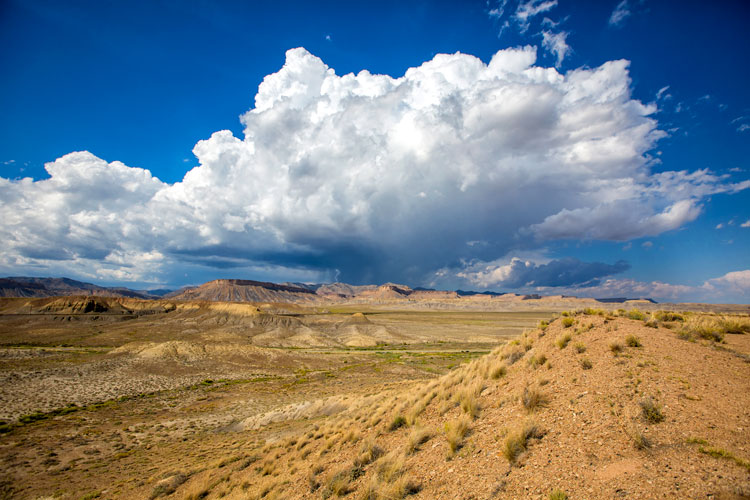
DesertStorm Landscape Photography Tips used by the Pros

1. Experimentation

Experimenting is one of the best ways to shake yourself up out of the doldrums and yes even pros use it to get their creative juices flowing.

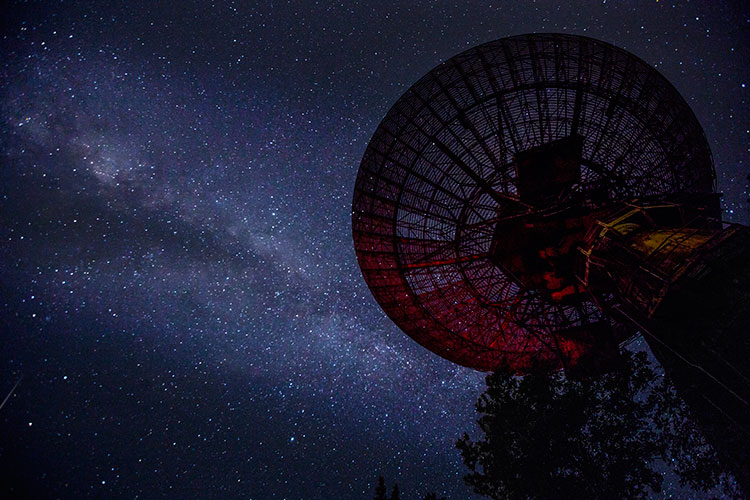
Try photographing something totally outside your comfort zone or even a different subcategory within your preferred genre. If landscape photography is your thing, you are probably already a master of the golden hours (sunrise and sunset). So experimentation can start with shooting a nightscape or even a long exposure in the middle of the day.

Note: I would highly advise against experimenting at someone’s wedding!

Night Sky Landscape Photography Tips used by the Pros

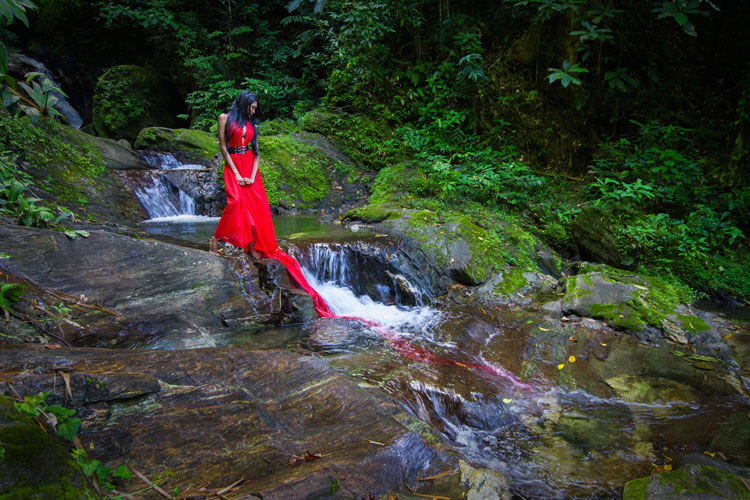
How about introducing a human element into your landscape and allowing them to be a part of the story? Experimenting keeps you on the learning path and when you learn, you grow as a photographer. It is about challenging yourself to do something different and pushing your boundaries.

Landscape Model Landscape Photography Tips used by the Pros

2. Making it your own

Many places on your photography list have already been captured hundreds of times. That thought can make you throw your hands up in the air and decide you may as well just recreate it. Before you think of recreating, try to showcase it differently. What else can you do? Is there another foreground element you can add or take away? One of the things that make pro’s work stand out from the rest, is their perspective and ability to make a place seem like you are seeing it for the first time.

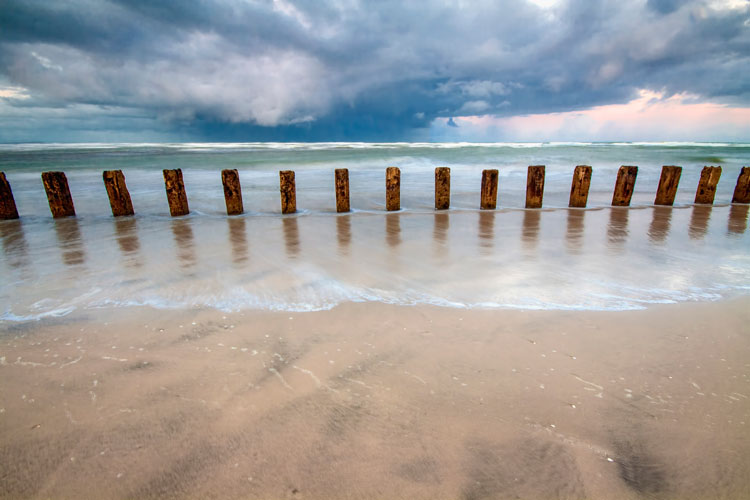
Maracas Bay, Trinidad - landscape photography tips from the pros

While it’s not always easy to create something unique and new, your originality is one of the things that will set you apart. Can you get a different angle, add or detract an element when composing, or shoot it differently (e.g. with light trails or multiple exposures)? How about getting off the trail and the popular view areas and charting your own course to find another perspective? There is no problem in finding inspiration in someone else’s work, but at all times keep in mind that you want your work to stand out

There is no problem in finding inspiration in someone else’s work. But keep in mind that you want your work to stand out, as your own.

Guardians - landscape photography tips from the pros

3. Tell a story

Someone said that “being a good photographer does not necessarily translate into being a good storyteller.” Being able to evoke the emotions of your audience should always be a goal, though. Keep in mind that the purpose of your photo story is to interest, instruct, or amuse your audience.

Decide how you want the image to affect them and then how to achieve that goal. Is your story going to be in black and white or infrared? Is it going to be realistic or abstract? Pros use different styles of photography to keep producing interesting stories consistently.

Boat Friends - landscape photography tips from pros

4. Less can be more

In landscape photography, being more selective with the views you present tells a more effective story, so pros understand the power of good composition (a vast topic all on its own). One of the rules of good composition is that your image should contain just enough detail. In landscape photography you do not have the luxury of physically moving things around, so you must arrange the elements of an image by changing your position. This also helps with finding the most flattering view, or one that tells a different story.

Ocean Sunrise landscape photography tips from pros

Choosing the important elements in your photo to highlight helps you decide what to include in the frame and what to leave out. Make your subject dominate by accentuating it with one or few related elements, remembering to declutter as much as you can. As a general rule, if an element in your image doesn’t enhance the subject, it may be detracting from it.

Lily Pond - landscape photography tips from pros

 5. Know your post-processing

Ideally, you want to get the shot right in-camera and eliminate or minimize your post-processing. With so many features and settings on DSLRs now, it is possible to produce the image you want. If this does not materialize, then you need the ability to do basic adjustments. These include changes to color and contrast, exposure adjustments, straightening, and cropping.

Check out these dPS articles for tips on processing:

  • How Cropping in Post-Production Can Improve Composition
  • 4 Key Lightroom Sliders That Will Supercharge Your Photos
  • How to Enhance Urban Night Photographs Using Luminosity Masks in Photoshop
  • 3 Fun Ways to Enhance Your Landscape Images in Photoshop

Glass Bottomed Boat -  landscape photography tips from pros

Pros know the importance of post-processing. That is one of the main reasons they shoot in RAW to capture all the uncompressed image data, which leads to higher quality images in the end.

Post-processing can also add that unique element of you. Decide if the shot you took is what you wanted to achieve or you can choose to adjust elements until you get the image you want to present. Digital photography has made it easier to post-process than the dark rooms of yesteryear but it also makes it easier to  go overboard easily. So determine your vision for the final image and learn to execute it properly so you produce an image that represents you.

South Beach -  landscape photography tips from pros

Conclusion

These are just a few of the things to keep in the back of your mind when you are creating images. Staying consistent means staying creative or constantly challenging yourself to try something different or learn something new. When you get to your location, think about how you can make the image your own. There is nothing more amazing than producing a piece that someone can identify as yours even before they confirm you did it. Share with us how else you stay consistent when shooting.

When you get to your location, think about how you can make the image your own. There is nothing more amazing than producing a piece that someone can identify as yours even before they confirm you did it. Share with us how else you stay consistent when shooting and any other landscape photography tips you have learned.

googletag.cmd.push(function() {
tablet_slots.push( googletag.defineSlot( “/1005424/_dPSv4_tab-all-article-bottom_(300×250)”, [300, 250], “pb-ad-78623” ).addService( googletag.pubads() ) ); } );

googletag.cmd.push(function() {
mobile_slots.push( googletag.defineSlot( “/1005424/_dPSv4_mob-all-article-bottom_(300×250)”, [300, 250], “pb-ad-78158” ).addService( googletag.pubads() ) ); } );

The post 5 Tried and True Landscape Photography Tips used by the Pros by Nisha Ramroop appeared first on Digital Photography School.


Digital Photography School

 
Comments Off on 5 Tried and True Landscape Photography Tips used by the Pros

Posted in Photography


Weekly Photography Challenge – Blue

01 Oct

Color is an important element of composition in photography. Cool colors have a very different feeling then do warm colors. See how the color blue appears in some images here.

Tim Green

By Tim Green

Weekly Photography Challenge – Blue

This week we challenge you to find and photography some subjects which are blue. Then photograph it in a compelling way. Remember to consider lighting, composition, and center of interest to create a unique image.

Neil Tackaberry

By Neil Tackaberry

Di_Chap

By Di_Chap

Alvaro

By Alvaro

Darlene Hildebrandt

By Darlene Hildebrandt

Share your images below:

Simply upload your shot into the comment field (look for the little camera icon in the Disqus comments section) and they’ll get embedded for us all to see or if you’d prefer, upload them to your favorite photo-sharing site and leave the link to them. Show me your best images in this week’s challenge. Sometimes it takes a while for an image to appear so be patient and try not to post the same image twice.

Share in the dPS Facebook Group

You can also share your images on the dPS Facebook group as the challenge is posted there each week as well.

googletag.cmd.push(function() {
tablet_slots.push( googletag.defineSlot( “/1005424/_dPSv4_tab-all-article-bottom_(300×250)”, [300, 250], “pb-ad-78623” ).addService( googletag.pubads() ) ); } );

googletag.cmd.push(function() {
mobile_slots.push( googletag.defineSlot( “/1005424/_dPSv4_mob-all-article-bottom_(300×250)”, [300, 250], “pb-ad-78158” ).addService( googletag.pubads() ) ); } );

The post Weekly Photography Challenge – Blue by Darlene Hildebrandt appeared first on Digital Photography School.


Digital Photography School

 
Comments Off on Weekly Photography Challenge – Blue

Posted in Photography


Add Motion to Your Fall Photography to Help it Stand Out

30 Sep

This tutorial brought to you by The New York Institute of Photography. NYIP is the largest and longest running online photography school in the world. Offering ten online photography classes to choose from, the school makes learning photography fun and accessible to aspiring artists on a global scale. Whether you are interested in a new career or are in pursuit of a hobby, NYIP students get the personal attention they need to achieve their goals. They have access to professional photographers as their teachers and mentors to guide them through the course and help them improve.

NYIP is a paid partner of dPS.

Motion fall photography01

If you are gearing up to capture foliage photos this fall, you may want to brainstorm some ways to adjust your typical compositional style in an effort to produce more unique shots within such a commonly photographed category. How to add some motion to your fall photography will help it stand out.

Add motion to fall photography

One interesting way to update a lackluster landscape is to display some motion in your image. People are more likely to be drawn to your pictures if you can effectively incite some feeling that may be attached to the subject you are shooting. Considering the topic of the changing seasons, including some motion is a fun way to invoke that feelings associate with a shift from summer to fall.

Motion fall photography02

Bulb

Many photographers, new and experienced alike, overlook the BULB mode feature on their cameras. Some aren’t entirely sure what it does and therefore tend to skip past it altogether while adjusting their shutter speeds. This year, take a closer look at this functionality and explore its potential for adding some spark to your seasonal shots.

When working in BULB mode, you will be able to use shutter speeds that are several minutes long. For example, by keeping the shutter open for a mere few seconds, you will have just the right amount of time to move your camera during the actual exposure, allowing you to create a dreamy effect many others are only able to achieve on a computer with the help of post-production tools.

Motion fall photography03

In practice, let’s say you are trying to capture a shot of two different sunflowers growing several feet away from each other in a field. Rather than stepping back to include both flowers in a static, motionless frame, this is a great opportunity to slow your shutter speed and get creative with some movement. To capture a fluid, wistful effect while including both plants in the shot, simply focus on one flower first, start your exposure, and then quickly move the camera to the second flower while the shutter is still open.

Motion fall photography04

Capture falling leaves

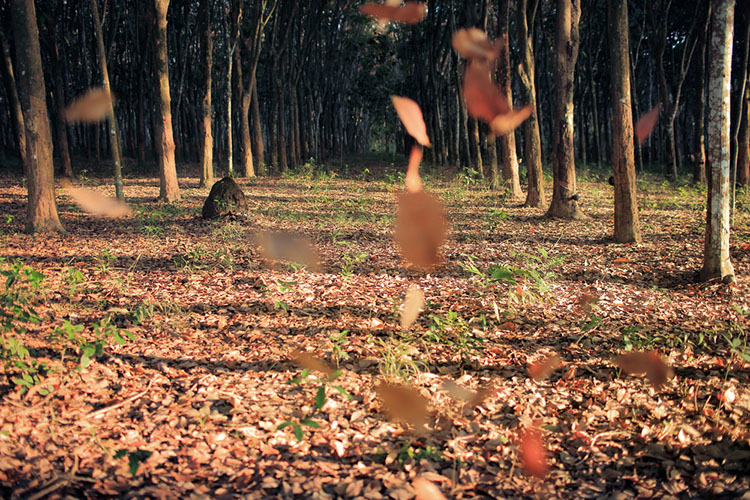
Falling leaves are another perfect subject to explore when experimenting with slower shutter speeds. This autumn, try heading to a local park or hiking trail on a windy day to try out these new techniques. Find a tree with some pretty foliage that you’d like to use as your subject. Set up your gear and wait for the right moment to capture the natural motion of the outdoors.

As a gust of wind blows a handful of leaves from the nearby tree, get creative with the ways in which you can capture that windy motion. One method could be to try zooming in and out mid-exposure. Another could be to get into manual focus mode. Start capturing your shot in focus, then abruptly twist out of focus at the end of the exposure. You could even physically start moving your camera while the shutter is still open.

Motion fall photography05

Fall décor

If you’re interested in capturing some similarly unique shots of Halloween decorations, you can employ the same aforementioned techniques in an effort to add a dragging, spooky motion effect to candles or outdoor lights. Again, with open shutter exposure of a few seconds, you can create a look much more compelling than an otherwise stationary image of a home’s exterior décor. When experimenting with creative compositions such as these, you can toss the typical rulebook aside and just focus on trying to produce something innovative and exciting.

Motion fall photography06

Moving water

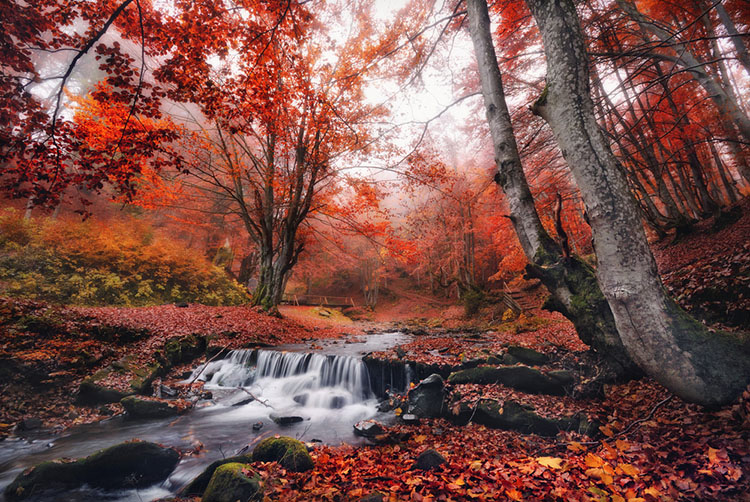
If you’re traveling to a hiking trail in search of captivating foliage shots, make sure to keep your eye out for any opportunity to capture images of water as well. At a speed like 1/30th of a second, you can transform an ordinary waterfall shot into a compelling silky cascade with a flourishing fall backdrop. If you can’t locate a waterfall and are instead working with a more slower-moving subject like a stream or brook, you might want to try a speed a bit slower, such as 1/15th or 1/4th. In general, we recommend you try fluctuating between speeds of around ¼ and 1/60 until you find one that you’re comfortable with. Make sure to experiment with the exposure time to find your favorite water effects.

Motion fall photography07

Getting Started

Before you head out to try these new techniques this year, here’s a checklist of some last minute tips you might want to keep in mind.

Keep the camera steady

When you’re working with such slow exposure times, your shot is prone to be affected by even the slightest jostle of your camera. You might want to consider packing a tripod. If you don’t own one (or lugging one along isn’t practical for your excursion) try to find something outdoors like a boulder as a means for stabilizing your camera before you get started. If you can’t locate a helpful natural prop, you could also try using the 2-second timer and propping the camera up on your gear bag.

Waterfalls

When shooting waterfalls, if you want to capture a more even exposure without the often inevitable inclusion of heavy, distracting shadows, try to head out very early in the morning. If this doesn’t work with your schedule, a cloudy day is your next best option for avoiding this.

Raise the ISO

If you’re trying to photograph fall décor indoors but the exposure is repeatedly too dark, try cranking your ISO (and using a simple noise reduction software).

Blur the background

If you’re trying to focus on a foreground subject but struggling to effectively blur the background, try using the widest possible aperture, and the longest focal length of your lens. Slowly move your subject further and further away from the background as you capture your shot.

Motion fall photography08

By effectively employing these tips and displaying the motion of your subjects, you’ll be able to capture the essence of autumn in a uniquely captivating way.

This tutorial has been brought to you by The New York Institute of Photography. NYIP is the largest and longest running online photography school in the world. Offering ten online photography classes to choose from, the school makes learning photography fun and accessible to aspiring artists on a global scale. Whether you are interested in a new career or are in pursuit of a hobby, NYIP students get the personal attention they need to achieve their goals. They have access to professional photographers as their teachers and mentors to guide them through the course and help them improve.

NYIP is a paid partner of dPS.

Jacob Boller is the School Director at The New York Institute of Photography and has been in his role for the past decade. Jacob first fell in love with photography taking wildlife photos with his Grandfather and still uses that same Olympus 35mm from time to time. Jacob is honored to be the Director at NYIP, the largest and longest running online photography school in the world, and is proud that via the NYIP Online Learning Center, course updates are made as fast as the camera technology develops.

googletag.cmd.push(function() {
tablet_slots.push( googletag.defineSlot( “/1005424/_dPSv4_tab-all-article-bottom_(300×250)”, [300, 250], “pb-ad-78623” ).addService( googletag.pubads() ) ); } );

googletag.cmd.push(function() {
mobile_slots.push( googletag.defineSlot( “/1005424/_dPSv4_mob-all-article-bottom_(300×250)”, [300, 250], “pb-ad-78158” ).addService( googletag.pubads() ) ); } );

The post Add Motion to Your Fall Photography to Help it Stand Out by Jacob Boller appeared first on Digital Photography School.


Digital Photography School

 
Comments Off on Add Motion to Your Fall Photography to Help it Stand Out

Posted in Photography


Avoid These 5 Common Mistakes in Black and White Photography

29 Sep

Black and white photography has been around for nearly 180 years, ever since Louis Daguerre introduced the daguerreotype process to the world. It is still hugely popular despite the rise and ease of color photography. And yet, whenever I look at other people’s black and white photos, I see the same mistakes over and over. Are you making any of these? Let’s find out!

Black & white photography mistakes

Mistake #1: Shooting in JPEG format

Ouch! This is a big one. It’s the single worse thing you could do.

The difference between RAW and JPEG

To understand why, you need to appreciate the difference between Raw files and JPEGs. Raw files contain all the information captured by your camera’s sensor. A Raw file is not a finished picture file. It has to be processed (using software like Lightroom or Adobe Camera Raw) and converted to a JPEG or TIFF file in order to be usable.

You can think of a Raw file as the equivalent of a negative (as in from film photography). You can’t send a Raw file to a photo library or a magazine any more than you could send a negative. You need to process the Raw file (or scan and process the negative) first.

JPEG files are created by the camera. It takes the information captured by the sensor, processes it (much like you would do with a Raw file in Lightroom, but according to the camera’s built-in parameters), compresses it, discards the unused information, and saves it as JPEG. They don’t necessarily need processing in software like Photoshop or Lightroom, although most can be improved by doing so.

Advantages of shooting RAW

Using the Raw format gives you the following advantages.

  • Control: You process the file yourself, rather than letting the camera do it. You can process it to your taste from a stylistic point of view. Using Raw lets you interpret the file as many ways as you want. Using JPEG means the file gets interpreted one way only – the way the camera does it.
  • More data: The Raw file contains much more information than a JPEG, especially in the highlights and shadows, that you can draw out when you process the file. The extra information helps prevent banding in areas of smooth continuous tone like clear skies.

Black & white photography mistakes

Black & white photography mistakes

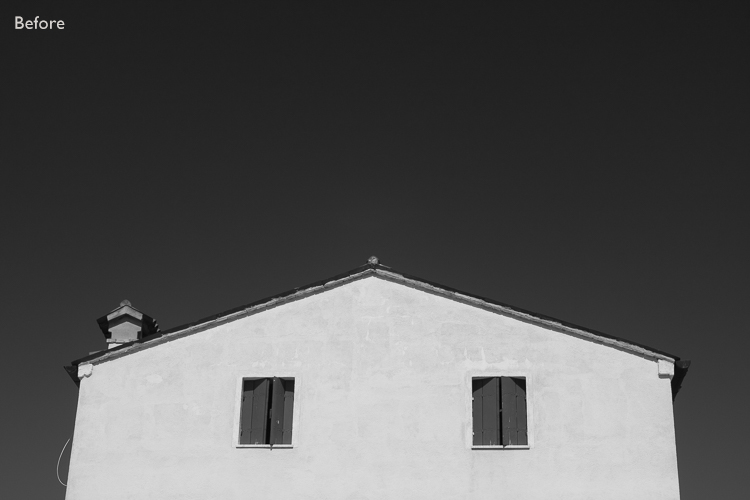
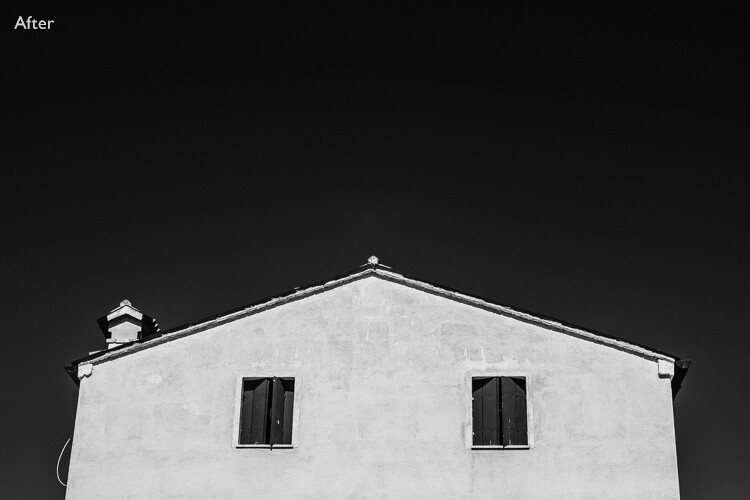
Using Raw helps you get from the before image shown above to the processed version here. With Raw, you can increase contrast and make the sky darker without introducing banding in the sky or halos along the edges of buildings. You can’t do this with JPEG files.

More advantages of shooting RAW

  • Adjust sharpness: JPEG files created by your camera are sharpened. The sharpening limits the amount you can change tonal values before introducing halos and artefacts. Yes, you can turn JPEG sharpening off in-camera – but how many people bother?
  • RAW format keeps the color info: Raw files contain all the color information captured by the sensor, so you can create a color version of the photo in Lightroom, Photoshop, etc., as well.
Black & white photography mistakes

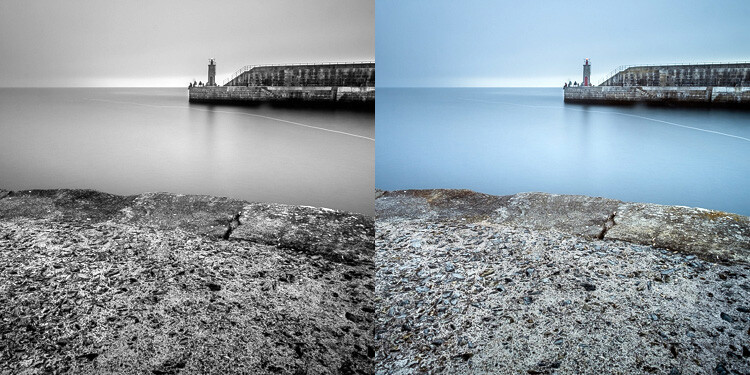
Using Raw let me create both a color and black and white version of the same image in Lightroom, without any loss of image quality.

  • Improvements: The software gets better every year. The version of Lightroom or Photoshop you use in five or 10 years time will be much better than the current one. With Raw, you can take advantage of these new improved tools and reprocess your images in the future.

So please, don’t use the JPEG format any more for black and white photography. There are, however, advantages to using your camera’s monochrome mode, as discussed in my article Mastering Monochrome Mode.

Mistake #2: Trying to save photos by making them black and white

Black and white is not a method for rescuing poorly crafted color photos. If your photo is bad in color, it will be bad in black and white too (although there are always photos that work better in black and white for compositional reasons).

There is nowhere to hide in black and white. In color, if the lighting or composition isn’t as good as it could be, the emotional impact of the colors in the photo may rescue the image (or, depending on how you look at it, cover up its shortcomings). Black and white images rely on factors like tonal contrast, textural detail, line and strong composition to work.

That’s why some photographers consider black and white to be a kind of higher art form than color photography.

Black & white photography mistakes

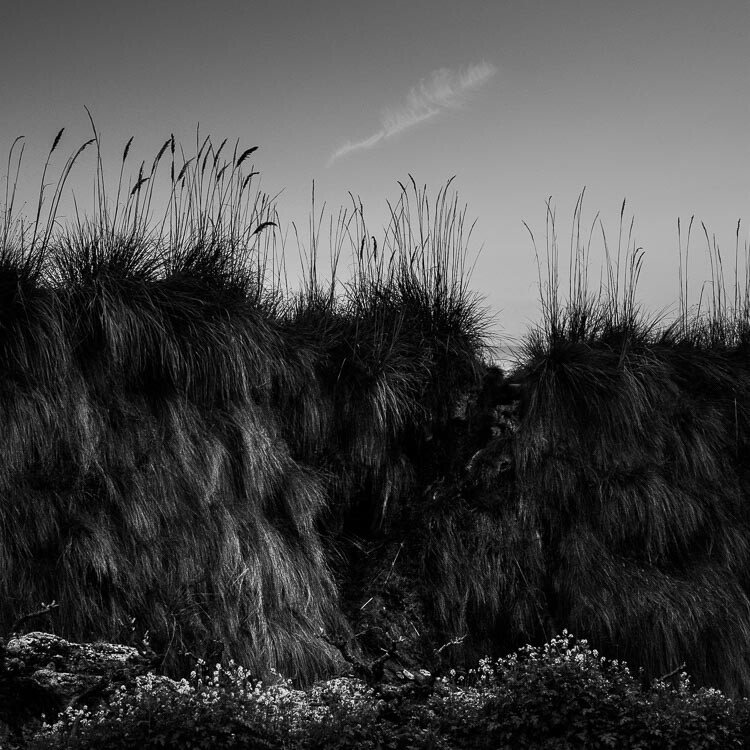
The texture in this photo is essential to make it work in black and white.

Mistake #3: Not processing the photos properly

Before digital cameras and Lightroom came along, many pro photographers used a professional printer to print their images. Creating top quality black and white prints in the darkroom is hard, and it was often outsourced to professionals.

This was a beneficial arrangement that let photographers concentrate full-time on photography and left printing to the specialists. Perhaps the best known pro printer in the UK is Robin Bell, who has worked with big names such as David Bailey, Terry O’Neil, and Eve Arnold.

Nowadays it is much easier to create beautiful black and white images in programs like Lightroom, Photoshop, or Silver Efex Pro 2, than it is to master the chemical darkroom process. But, sadly, many photographers don’t get to grips with the basics. The result is that their black and white photos are not nearly as good as they could be.

Take the time to learn how to use your software properly and your photos will get better.

Black & white photography mistakes

Black & white photography mistakes

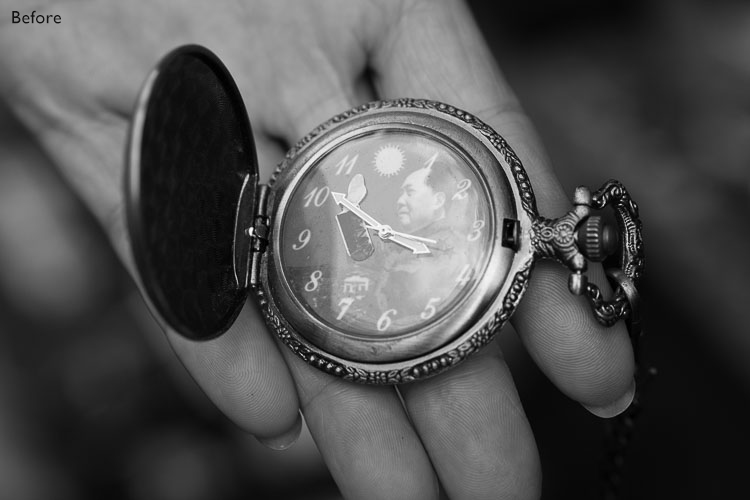
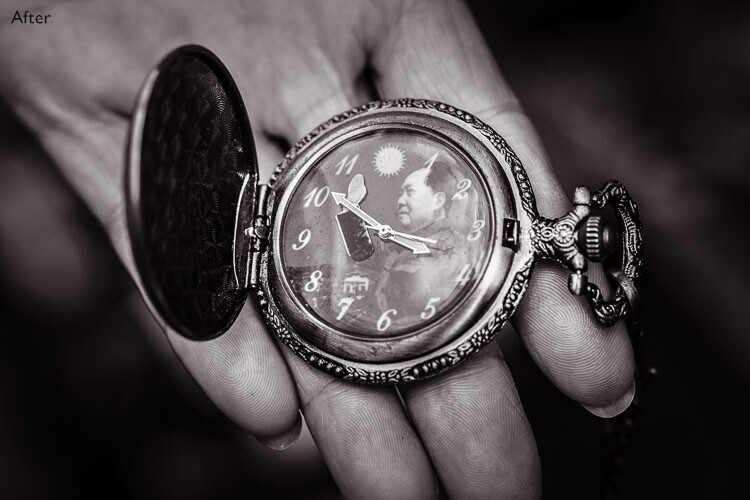
This before and after example shows the photo how it looked straight out of the camera compared to the final version, processed in Lightroom. Learn how to get from one to the other in order to get the most out of your black and white images.

Mistake #4: Not shooting in the best light

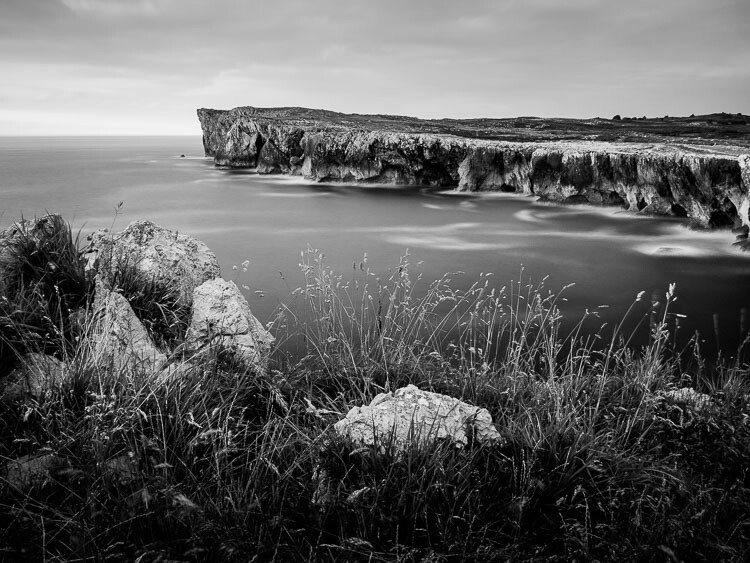
One of the advantages of black and white is that you can often shoot in lighting conditions not suitable for color photography. For example, on a cloudy day you can create beautiful black and white seascapes with a tripod and neutral density filters (this is called long exposure photography). Yet, in color, you would really need to shoot close to dawn or sunset to make the most of the scene.

But what some people do is use black and white to shoot in lighting conditions that are simply unsuitable for the subject. Using black and white isn’t the solution. The important skill is in matching the light to the subject. This takes a while to learn but it’s very important. Don’t be lazy just because it’s black and white.

Black & white photography mistakes

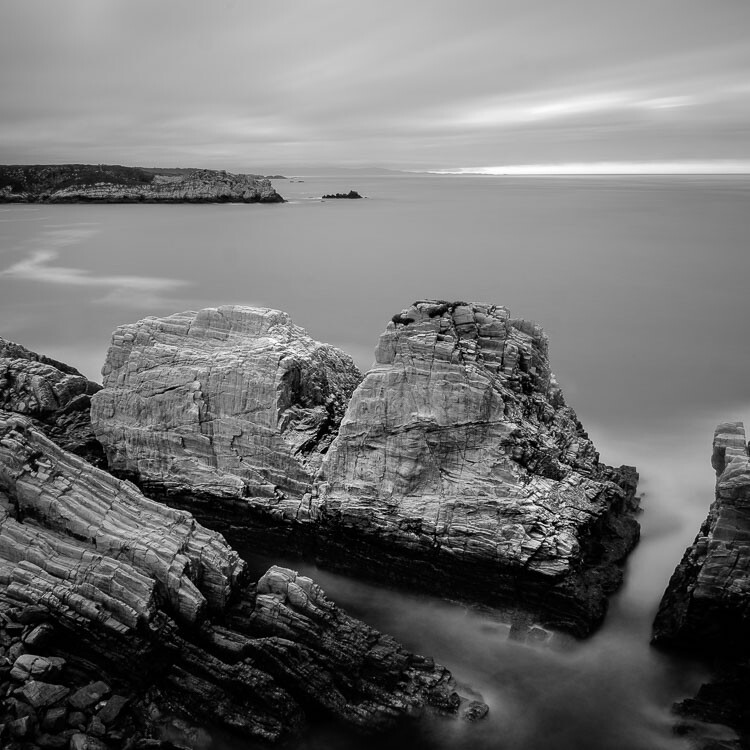
A long exposure photo made on a cloudy day. The light suits the subject – it wouldn’t have worked in sunny weather.

Mistake #5: Not having a strong composition

Black and white is a true test of your compositional skills. The best monochrome images use visual elements like tonal contrast, texture, line, shape, pattern, and negative space. The emotional power of color can mask poor composition. But in black and white there is nowhere to hide. You have to learn how to use these building blocks of composition effectively.

That starts with learning how to see them. For example, you can’t use lines in your compositions if you haven’t trained yourself to see straight, diagonal, or curved lines in the scene.

The good news is that once you understand the fundamentals of composition in black and white, you will instinctively apply them to your color photos as well.

Black & white photography mistakes

I took a lot of care with the composition of this landscape photo. It has foreground interest and plenty of texture – important elements in black and white landscapes.

Have you made any of these mistakes?

Can you think of any other mistakes that photographers make when working in black and white? Please share your thoughts in the comments below.


If you’d like to learn more about black and white photography then please check out my ebook Mastering Lightroom: Book Three – Black & White.

googletag.cmd.push(function() {
tablet_slots.push( googletag.defineSlot( “/1005424/_dPSv4_tab-all-article-bottom_(300×250)”, [300, 250], “pb-ad-78623” ).addService( googletag.pubads() ) ); } );

googletag.cmd.push(function() {
mobile_slots.push( googletag.defineSlot( “/1005424/_dPSv4_mob-all-article-bottom_(300×250)”, [300, 250], “pb-ad-78158” ).addService( googletag.pubads() ) ); } );

The post Avoid These 5 Common Mistakes in Black and White Photography by Andrew S. Gibson appeared first on Digital Photography School.

Digital Photography School

 
Comments Off on Avoid These 5 Common Mistakes in Black and White Photography

Posted in Photography


How to Connect With Your Photography Followers Through Instagram Stories

28 Sep

Recently Instagram released on of their biggest updates this year, Instagram Stories. It was met with both love and hate and I’ve found it interesting to see how it has been used since its release. Regardless of what you feel about this “Snapchat-copy”, it could be a great tool to connect with your Instagram audience. Here are my best tips on how you can benefit from Instagram Stories and improve your reach!

IMG_0193

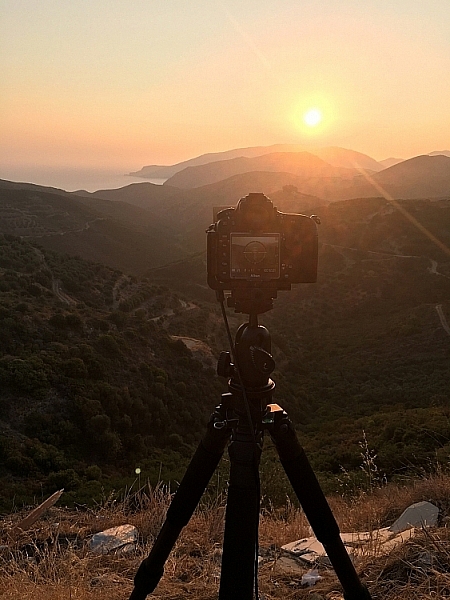
During a recent trip to Greece I was able to interact with my followers through Instagram Stories

What is Instagram Stories?

Instagram Stories is Instagram’s latest feature which allows you to share pictures and videos that, similar to Snapchat, will disappear after 24 hours.  This lets you share images with your followers that you don’t want in your feed. Instagram itself describes their new feature like this:

With Instagram Stories, you don’t have to worry about overposting. Instead, you can share as much as you want throughout the day — with as much creativity as you want. You can bring your story to life in new ways with text and drawing tools. The photos and videos will disappear after 24 hours and won’t appear on your profile grid or in your feed.

Why should you use Instagram Stories?

The big question is then; why should you use Instagram Stories? Perhaps you already use Snapchat to share your day-to-day stuff, why do it another place?

Personally, I wasn’t on Snapchat until a few months ago but after enough nagging from friends and clients, I decided to finally jump on board. Talking to the phone and taking pictures of my travels felt a bit strange, to begin with, but I soon got used to it. However, I did feel like the time it would take to build a new audience, on a new platform, might not be worth it.

Instagram, however, is where I have the majority of my followers. With Instagram Stories I’m now able to do the exact same as I did for a while on Snapchat but with a much larger reach. Already I’ve received hundreds of emails and Direct Messages from people letting me know how much they enjoy my stories.

instagram-stories

Obviously, if you have a greater following on Snapchat than Instagram you might not want to ditch Snapchat completely. Uploading images and videos from Snapchat to Instagram Direct is rather easy, though, so you can be present at both.

I’ve found Instagram Stories to be an excellent way to connect with my audience and get to know them better. The reach and engagement in my feed have also increased slightly (I haven’t done any extended research so this increase might not be related). Instagram Stories is also a great way for your audience to get to know you better.

What should you share on Instagram Stories?

Since the release of Instagram Stories, I’ve paid attention to how photographers use it. What surprised me is how poorly they exploit this new tool. Sorry, but what you had to dinner or a picture of your dog laying on your lap isn’t interesting to most of us. The fact is if you start by uploading that type of content most people won’t come back and look at your stories even though you start creating more interesting content later.

If you wish to benefit from this tool and connect better with your audience you should be more aware of what you upload. If you just want to send pictures of your food perhaps it’s better to stay with Snapchat and send those images directly to your friends.

Here are some examples of interesting content to share with your audience:

Behind the Scenes

IMG_0439

When you’re out traveling or photographing, uploading images and videos from behind the scenes is something many people will find interesting. I love to see behind the scenes images from the photographers I follow and I enjoy seeing how the image turns out later on.

This can be done with both video and images. Perhaps you even could talk a little about the place you’re at or the subject you’re photographing.

Tips and Tricks

You don’t need to be an expert to share tips and tricks with your followers. In fact, it’s often interesting to see how beginners process their images or choose their settings.

I’ve gotten a lot of positive feedback on my short tutorials, tips, and tricks that I share on Instagram Stories. Many people have said that they don’t follow anyone else’s stories but mine due to this.

Gear talk

Another interesting thing you could talk about is your equipment. “What camera do you use” is one of the questions I get asked the most, so going through your camera bag every now and then is a good way to answer these questions, while also creating interesting and engaging content.

IMG_0402

I got much positive engagement when sharing my first impressions of the NiSi filter system

Q&A Sessions

Unfortunately, when you grow a large following online you don’t always have the time to reply to all the questions you receive through email or through social media platforms. Many of these questions take time to answer, so a good and efficient way of replying to as many as possible, is through Instagram Stories. When I receive questions now I answer them through videos in my story. This saves me a lot of time but my followers still get most of their questions answered.

Since Instagram Stories is still a rather new feature there’s still much to be taken from it. There are many  ways to benefit from this tool but this is how I’ve found it to be most beneficial.

Have you started using Instagram Stories yet? What do you think about this new feature?

googletag.cmd.push(function() {
tablet_slots.push( googletag.defineSlot( “/1005424/_dPSv4_tab-all-article-bottom_(300×250)”, [300, 250], “pb-ad-78623” ).addService( googletag.pubads() ) ); } );

googletag.cmd.push(function() {
mobile_slots.push( googletag.defineSlot( “/1005424/_dPSv4_mob-all-article-bottom_(300×250)”, [300, 250], “pb-ad-78158” ).addService( googletag.pubads() ) ); } );

The post How to Connect With Your Photography Followers Through Instagram Stories by Christian Hoiberg appeared first on Digital Photography School.

Digital Photography School

 
Comments Off on How to Connect With Your Photography Followers Through Instagram Stories

Posted in Photography