RSS
 

Posts Tagged ‘Photography’

Tips for Better Forest Photography

24 Oct

Humans have always been drawn to forests. We have found food, building and clothing materials, and inspiration in forests. There are innumerable stories told about them, the creatures that live there, and the dangers that lurk inside them. But it’s not all mythology and ancient history. Peace, adventure, colour, that perfect light – whatever you’re looking for, you can find in a forest.

Are you yearning for a place that will offer you something new to photograph? Let’s take a look at the opportunities these magical places can offer an open-minded photographer!

Forest photography 01

So what exactly is a forest?

Once a student told me that there are no threats to forests in Finland (where I was teaching) because they have so many trees. It might seem like a logical conclusion, but it’s sadly wrong. As anyone who has spent time in forests will tell you, they’re much more than just an aggregation of trees; each forest is a collection of innumerable organisms and interactions. Sure, trees are an essential part of a forest, but the whole is much more than that.
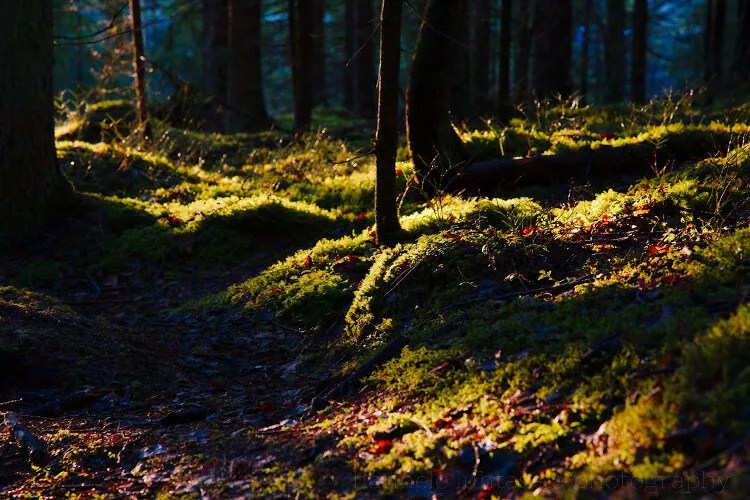
Forest photography 02

Without microbes, earthworms, and plants there would be no nutrient-rich soil for trees to grow in. Without insects, birds, and mammals there would be no one to spread their seeds – without everything else, a collection of trees is not a forest, it’s a plantation. And that richness is what makes forests such a fantastic place for photography.

Forest photography 03

For some humans, forests are also places for recreation and the creation of fond memories. What a forest is might seem like a silly question, but it’s not as easy to answer as one might initially think.

What is there to do in the forest?

So let’s cut to the chase: what does all of that have to do with you as a photographer? Well, forests offer opportunities for many different kinds of photography, thanks to their unique light, animal and plant life, and atmosphere. Nature will always be present in whatever photo you take in a forest, but as you will see, it doesn’t have to be the only thing. Let’s begin.

Forest photography 04

The big picture

The most obvious photos to take in a forest are wide-angle shots of the forest itself. Ones which give an overview of the kind of forest it is, what kinds of creatures live there, what season it is, what state the forest is in, and so forth. But obvious, doesn’t have to mean boring. Try to find an angle that tells a story, has unique atmosphere or mood, or can surprise the viewer. Don’t just point and shoot, but think, plan, and frame your photo (as always).

Forest photography 05

Photographing trees is also a pretty self-evident thing to do in a forest. The longer one looks at trees, the more personality they seem to have, and the more impressive they seem to be. If a particular tree catches your fancy, observe it, let your imagination roam free, and then try to find a way to capture that in a photograph.

Forest photography 06

Large wildlife is another wonderful thing that forests offer eager photographers. The tricky thing here, apart from coming across such wildlife (remember to be careful) and not having it run away right when you’re bringing the viewfinder to your eye, is that forests are often quite dark.

If you have something exciting and highly mobile in your view, don’t hold back on the ISO so you can make that shutter speed as fast as possible. Otherwise, you’ll end up with just a blur and disappointment (unless a blur is what you were aiming for).

Forest photography 07

The smaller picture

For those more interested in detail and the richness of life in the undergrowth, forests are an unending source of treasure. A plethora of wildlife can be found on this scale: small mammals, amphibians, insects, spiders, worms, reptiles, millipedes, centipedes, and so forth. And those are just the animals! If you’re willing to look a bit closer, maybe lie down in the moss, you’ll also find stunning mushrooms, intriguing plants, handsome lichens, and yes, all that moss you’re lounging on.

Forest photography 08a

Forest photography 08b

Don’t forget the beautiful leaves, especially in the fall. In short, forests are marvelous for macro photography.

Forest photography 09

Experimental photography

If you’re not actually interested in nature photography and you were dragged out to a smelly forest full of biting insects and other nuisances, don’t despair. There’s something to do, even for you.

Forest photography 10

Forests offer great opportunities for trying out different kinds of experimental photography. The generally low light conditions and diverse scenery work well for techniques that require long shutter speeds, such as ICM (Intentional Camera Movement) and light painting. Give it a shot!

Forest photography 11

Portraiture

Last, but in no way least, forests provide plenty of possibilities for portrait photography. It’s easy to find a flattering background in a different kind of setting. With patience, the light, albeit difficult at times, can be used to your advantage. You might be able to create some beautiful bokeh, interesting light patterns on your subject, or just have pleasant, diffuse light fall through the treetops.

Forest photography 12a

Forest photography 12b

If you don’t have a willing model to photograph, do not despair – pet portraits are also fun, as are creative self-portraits.

Conclusion

What does the forest mean to you? Do you have a special relationship with forests and do you like photographing them? I’d love to see your photos and hear your thoughts in the comments below.

The post Tips for Better Forest Photography by Hannele Luhtasela-el Showk appeared first on Digital Photography School.


Digital Photography School

 
Comments Off on Tips for Better Forest Photography

Posted in Photography


 7 Photography Exercises To Help You Be a Better Photographer

23 Oct

Photography is like most other professions or hobbies in that you will improve and get better with training. But, like other skills, you need to try and set yourself a structure and actively try and improve the areas that you may not be good at. Sure, like anything else, there are those that are naturally skilled at seeing a scene and pre-visualising a shot, but the following photography exercises will help anyone become a better photographer.

 7 Photography Exercises That Will Help Make You a Better Photographer

#1 – Use a Film Camera

Like most photographers who grew up in the 90s, my first introduction to photography was at college and university using film. I spent hours in the darkroom developing the photos I had taken. Whilst, like most, I love the romantic notion of shooting with film, the reality is that digital photography offers so much more freedom.

However, the one downside of digital photography is that it also allows you to snap away without really having to worry about the number of photos taken. Not like using film where literary every photo taken cost a few cents.

But also, without the ability to review the photo instantly on the back of your camera, it meant that you had to trust your instincts and ability for capturing a great photo. All of this combined to ensure that you really had to think before taking a photo – thus meaning you had to be better at seeing something and capturing it.

 7 Photography Exercises That Will Help Make You a Better Photographer

If you have been photographing for a while and want to take your skills to the next level, get or rent a film camera and spend a while using it. You may find yourself pleasantly surprised when you go back to your DSLR camera.

2 – Set Yourself a Limit of Six Photos

Another way that you can train yourself to make every shot count is by setting yourself a limit on a photo session. Say you are planning on photographing a local market, set yourself a limit of six shots for the day only. So if you reach six you’ll need to delete one before taking any more.

The reason for this is that you will have to become really analytical about your photos. Setting yourself a small shot list can help ensure you capture six photos with variety that capture the whole experience rather than just a small element.

 7 Photography Exercises That Will Help Make You a Better Photographer

As an example, if you were photographing a market you could set out your six shots as such:

  • A great portrait of a market vendor.
  • An environmental portrait (i.e. when a vendor is making/cooking something or making a sale).
  • A close up of the produce on sale.
  • Wide-angle shot of the venue.
  • Other people at the market (i.e. tourists enjoying their day out, a performer, etc.).
  • Something unique about the market (i.e. it could be a unique plaque or sign, or a famous old stall).

You would then work through your shot list and aim to capture the best photo that you can for each one and in theory replacing each shot you have taken with something better. You will then end up with six fantastic photos from a shoot rather than 300 mediocre ones. Do this enough times and you’ll notice that your “great” photos from a shoot will begin to rise.

Do this enough times and you’ll notice that your number of “great” photos from a shoot will begin to rise.

 7 Photography Exercises That Will Help Make You a Better Photographer

3 – Photograph What is Least Uncomfortable

Every photographer has something that they are the least comfortable with photographing. For you, it might be something technical like photographing in low light conditions. For others, it might be capturing landscapes or a fear of photographing people.

Whatever you are least comfortable with, you should aim to improve that. Not necessarily because it is something you will use in your branch of photography, but because it will teach you new skills that will become useful in your genre of photography.

For example, you may be a wedding photographer and decide that you are going to improve your sports photography. That genre requires you to work fast as the action moves quickly, so learning skills that can help you do that will no doubt come in useful at weddings.

Trying a new aspect of photography will also give you a glimpse into something different and you never know, you may end up loving it.

 7 Photography Exercises That Will Help Make You a Better Photographer

4 – Work With a Managed Stock Agency

New photographers often ask me what I would recommend they do when starting out in travel photography. I always respond that I think they should get a portfolio together and approach a managed stock agency. The key word in the previous sentence is “managed”. So what is a managed stock agency? Fundamentally there are two types of stock photo agencies. There are ones that you simply upload photos and as long as they pass technical quality checks (i.e. there are no chromatic aberrations, they are sharp, no nudity, etc.) they will be accepted regardless of composition or subject.

Then there are managed stock photo agencies where not only do your photos go through the same rigorous quality checks, but someone at the agency also edits them. This means someone might look through the 100 photos that you have submitted and choose 20 to go up for sale on their site. They obviously choose photos that they feel will sell and this is a really good way to gauge how sellable your photos are and also if you are improving over time.

 7 Photography Exercises That Will Help Make You a Better Photographer

For example, for your first few submissions, you may find that the agency accepts an average of 10 photos but by your 20th submission that average might be getting to 30 or 40. This shows that you are improving.

5 – Shoot in Difficult Conditions

The general rule of photography is that you photograph certain subjects at certain times to be able to capture the best photos. For example, landscape shots will be shot during the golden hour, portraits on overcast days, food outdoors in the shade, and so on. While there is a reason for these rules and wherever possible you should aim to follow them as you will capture great photos, sometimes breaking them will give you far more dramatic photos.

But photographing in harsh conditions like midday for outdoor photography, low light conditions or backlit for portraits, will also mean you have to think outside the traditional photography box and work out how you can tackle the difficult conditions. Not only will this help you gain valuable skills but it may also come in handy when you are on a real shoot and encounter these conditions.

 7 Photography Exercises That Will Help Make You a Better Photographer

6 – Work on a Brief

Another great exercise to improve your photography is to work on a brief. You can either set yourself a brief or you can ask someone you know to set you one, but treat it as a real-life brief that you might get from a client. Get the person setting the brief to give you as much detail as possible and when you have taken the photos, present them to him as if he is the client.

Get their feedback and if you need to shoot things again, do so. The great thing about working on a brief is that you have a very specific remit of what is needed and as such you will find yourself being much more focused. If you work with a stock photo agency then you can always ask them for a brief as they will often have specific photo needs that they will be more than happy to share.

 7 Photography Exercises That Will Help Make You a Better Photographer

7 – Don’t do any Post-Production

I have lost count of the number of times I have heard someone say, “I’ll fix that in post-production”. The purpose of post-production should be to enhance your photos rather than create them. You should always aim to get as much right when you are taking the photo rather than trying to fix it in post-production later.

By setting yourself a photography exercise that you won’t use any post-production you will have to try and get the photo right at the time of shooting. So if there’s a rubbish bin (garbage can) in your frame you’ll need to try and find a way to crop it out. Or if the light isn’t great you’ll need to wait until it is.

By removing the safety blanket of post-production you will find yourself getting better at taking photos.

 7 Photography Exercises That Will Help Make You a Better Photographer

Conclusion and Time for Action

The exercises above are not the only options. As you progress through your photography journey whether that is a profession or a hobby you will come up with your own photography exercises that you can do. The key is to constantly look to improve and never stop learning.

Have you got any other good photography exercises? Please share them below.

The post  7 Photography Exercises To Help You Be a Better Photographer by Kav Dadfar appeared first on Digital Photography School.


Digital Photography School

 
Comments Off on  7 Photography Exercises To Help You Be a Better Photographer

Posted in Photography


Bye bye backpack: The Pixentu photography jacket lets you carry your gear ON you

21 Oct

An intriguing set of photographer-specific jackets just popped up on Kickstarter. Dubbed Pixentu, these jackets have been designed to meet the gadget-toting needs of photographers, providing an extended hoodie for the rain and a large number of pockets intended for items a photographer is likely to carry around, including memory cards, film, lenses, cards, a camera, and even a travel tripod—bye bye backpack.

Pixentu exists in three different iterations: as an outdoor jacket, a travel blazer, and a street photography jacket.

While the three varieties mostly offer the same pockets, there are some small differences. The travel blazer, for example, is a 2-in-1 combination unit that can be used as a jacket or as a vest, but lacks compartments for a tablet, travel tripod, and camera. The outdoor jacket, in comparison, doesn’t transform into a vest and is a lighter option than the street photography jacket, which is better for cold temperatures.

Neither the blazer nor the outdoor jacket have the extended hoodie featured on the street photography jacket; with that hoodie, photographers can shield their camera from rain while taking a shot. Pixentu says its jackets are made from unspecified durable Japanese material, while the lens pockets are water-resistant and feature a soft lining.

The Pixentu jackets are currently seeking funding on Kickstarter, where they’ve very nearly reached their goal. The super early bird units are offered for pledges starting at £99 / $ 132, and shipping to backers is estimated to start in February of 2018.

To learn more or pledge for your own, head over to the Pixentu Kickstarter page.

Articles: Digital Photography Review (dpreview.com)

 
Comments Off on Bye bye backpack: The Pixentu photography jacket lets you carry your gear ON you

Posted in Uncategorized


Weekly Photography Challenge – Black and White Landscape

21 Oct

Landscape photography is a popular genre, but it can be hard to do it really well.

If you want to take your landscape images to the next level – try shooting some in black and white! There is some help here if you need it: Video Tutorial – Tips for Making Dramatic Black and White Landscape Photos. 

Photo by Yuriy Garnaev on Unsplash

Weekly Photography Challenge – Black and White Landscape

Simply upload your shot into the comment field (look for the little camera icon in the Disqus comments section) and they’ll get embedded for us all to see or if you’d prefer, upload them to your favorite photo-sharing site and leave the link to them. Show me your best images in this week’s challenge. Sometimes it takes a while for an image to appear so be patient and try not to post the same image twice.

Share in the dPS Facebook Group

You can also share your images on the dPS Facebook group as the challenge is posted there each week as well.

The post Weekly Photography Challenge – Black and White Landscape by Darlene Hildebrandt appeared first on Digital Photography School.


Digital Photography School

 
Comments Off on Weekly Photography Challenge – Black and White Landscape

Posted in Photography


7 Photography Myths Exposed

19 Oct

Photographers, of all people, should know that the world is not black and white. There are many shades of grey between black and white, between good and bad, and between right and wrong. It’s all a matter of perspective and circumstance. Yet photography is full of blanket statements about what you should and shouldn’t do. In this article, I expose (pun intended!) a few of the most common photography myths every photographer should know.

North Algodones Sand Dunes, California - 7 Photography Myths Exposed

1. Full frame cameras are better

A full frame camera has a larger sensor than a crop sensor camera. That means you might get more megapixels or you might get larger megapixels or even both. But there are many more important factors to consider when choosing a camera than megapixels.

First, crop sensor cameras are generally smaller, lighter and much less expensive. Second, if you like to shoot wildlife, you’ll get extra reach with your telephoto lens on a crop sensor camera. A 400mm lens on a full frame camera is equivalent to over 600mm on a crop sensor camera. Also, if you like to photograph wildlife, a more important factor to consider above megapixels is frames per second.

A few years ago I went to Africa to photograph wildlife and took two cameras: a full frame Canon 6D and a crop sensor Canon 7D. I learned that the 7D was much better for my purposes because of the frames per second rate it was capable of shooting. The 6D (at the time) did 4.5 fps and the 7D did 8. That was a huge difference in the field.

Lion and cub at Ngorongoro Crater, Tanzania - 7 Photography Myths Exposed

2. Always use a tripod

A tripod is an essential piece of gear for any photographer and usually, you will notice a huge improvement in image quality when you start using one. However, “always” is one of those blanket statements that doesn’t always make sense (see what I did there?). I often notice photographers arrive on a scene, set up their tripod, and then try to find a composition they like. That tends to limit their possibilities since they are already stuck on the tripod.

A better approach is to go free hand until you find your composition. Then, when you find it, try to make your tripod fit in the exact position necessary. Sometimes you’ll find it won’t fit. Either the angle is lower than your tripod will allow you to go, or the tripod is not tall enough, or the position isn’t stable. When that is the case, ditch the tripod in favor of getting the composition.

Plateau lizard by Anne McKinnell - 7 Photography Myths Exposed

3. To make better photos, you need better gear

Undoubtedly, you will reach a point in time when you need better gear to carry out your vision for what you are trying to achieve with your photography. But the most important thing is to have that vision. Before getting new gear, make sure you exhaust your current gear. Use every single function and feature it has and know exactly what it is you need that your current gear doesn’t have before you move on. Blaming crappy gear is just a crutch. A really good photographer can make great images with pretty much any camera.

4. Never put your subject in the middle

Ah, the rule of thirds. The golden ratio. The fibonacci spiral. All good tools when it comes to learning composition. But don’t forget about the beauty to be found in simple symmetry.

When you think about a person’s face, the most beautiful face is the most symmetrical face. It’s all about balance, equality of proportion, and harmony. The key to making a compelling symmetrical composition is in the perfection of the symmetry. A composition that is almost symmetrical will seem off, but one that is perfect will seem awe inspiring.

Baobab tree in Tarangire National Park, Tanzania - 7 Photography Myths Exposed

5. Manual is the best shooting mode

It’s beneficial to all aspiring photographers to learn to shoot in manual mode so you have independent control over every factor in making your exposure including aperture, shutter speed and ISO. It’s no doubt that it’s one of the best ways to learn how your camera works. However, once you’ve learned how to use manual mode, why not let your camera do what it’s good at? Cameras these days are smart and the fewer things you have to do manually, the quicker you will be at responding to a changing scene.

When you are on a scene, decide which factors are important to you before you select your shooting mode. For example, if you are trying to intentionally blur a subject, shutter speed is important. You can use shutter priority mode and let the camera choose the aperture and ISO. That way when you want to shorten or lengthen the shutter speed, you only have one thing to change and the camera will figure out the rest. Similarly you might decide that depth of field is most important, and if you’re using a tripod, shutter speed might not matter at all. In that case, aperture priority mode is most convenient.

Summer flower in Butchart Gardens, Victoria, British Columbia - 7 Photography Myths Exposed

6. RAW format is better than JPEG

This refers to the image quality you select in your camera’s settings. You can choose to have your images saved as either RAW files, JPEGs, or both.

RAW is better than JPEG only if you are planning on post-processing your photos, which most people do. A RAW file contains more data and therefore you have more leeway in your post-processing. However, if you are just starting out and you haven’t gotten to the point where you’re processing your photos yet, it’s probably better to shoot JPEGs.

In JPEG mode, your camera will make some decisions for you when it comes to color and contrast and your photos will look better straight out of the camera. Ultimately you’ll likely come to the point where you want to make those decisions yourself. That’s when it is time to make the switch to RAW.

7. Good photography requires good light

All light is good light. The trick is to know what kind of images to make under the lighting conditions that are available. Do you have harsh (hard) light? Look for interesting shadows or photograph in the shade. Soft light? Perfect for macro shots. Looking into the sun? Find subjects with interesting shapes for silhouettes.

Saguaro in silhouette at Tucson Mountain State Park, Arizona by Anne McKinnell

Conclusion

Remember, as an artist, you are free to go about making your art any way you like. You can use your tools any way you see fit. The most important thing is to have a vision and then use your tools and techniques to help you achieve it.

Do you know of any other photography myths you want to expose here? Please share in the comments below.

The post 7 Photography Myths Exposed by Anne McKinnell appeared first on Digital Photography School.


Digital Photography School

 
Comments Off on 7 Photography Myths Exposed

Posted in Photography


How to Supercharge Your Photography with Highlight-Weighted Metering

17 Oct

Modern digital cameras have a variety of metering modes that they use to evaluate the light coming through the lens and help you choose your exposure settings. Each one is different and designed to fit a specific need. As you gain experience with them you will start to know which metering mode to use for any given scene you are shooting.

If you’re shooting portraits you might want to use Spot or Center-weighted metering, while landscape shooters may prefer the versatility of matrix or evaluative mode. Knowing which mode to use often comes with time and practice. But what if I told you there was a metering mode built-in to some cameras that could basically guarantee your shots would come out properly exposed every single time? Well, if you believe that then I’ve got a bridge in New York I’d like to sell you.

Highlight-Weighted Metering Mode

However, if your camera has Highlight-Weighted metering it will certainly help you get better results from your photos. While I can’t guarantee your pics will be perfect every single time, it can really come in handy if you’re not sure how to meter your scene and want a solution that you know you can rely on.

How to Supercharge Your Photography with Highlight-Weighted Metering

Different metering modes for different situations

The reason photographers use specific metering modes when shooting various scenes is that they want to make sure the right thing is properly exposed. For example, if you’re shooting a portrait it’s important to make sure your subject’s face is neither too bright nor too dark, even is it means some background elements will end up bright white or pitch black.

Center-weighted metering can solve this problem by helping you arrive at an exposure setting such that whatever is in the middle of the frame (i.e. your subject’s face) is exposed just right. Other metering modes such as Spot, Matrix/Evaluative, and Partial Metering all perform similar functions in that they help you make sure you have just the right camera settings to get precisely the important part of your composition properly exposed.

Highlight-weighted metering tosses all that out the window. In the process, it could also dramatically alter your approach not only to metering a scene but to photography as a whole.

How to Supercharge Your Photography with Highlight-Weighted Metering

I used Center-weighted metering here to make sure this couple was exposed just right, even though the background is a bit too bright. I cared more about the couple looking good than the tree leaves behind them.

Enter Highlight-Weighted Metering for Select Nikon Cameras

Available on only a few Nikon cameras, (D5, D850, D810, D750, D500, and D7500 as of the time of this writing) Highlight-weighted metering utilizes the incredible dynamic range of modern image sensors to give you a massive degree of control over your photos. Provided you don’t mind doing a bit of legwork in Lightroom, Photoshop, Luminar, or other post-processing software.

It works by looking at the brightest elements of a scene (instead of specific areas like the center or the focus point) and using those as the basis for taking an exposure reading. On the surface, this might seem like a terrible idea because doing so would obviously mean a great deal of your photo could, as a result, be much too dark and underexposed to be usable.

Accessing Highlight-Weighted Metering

I’ve talked to some photographers who own cameras that can do Highlight-Weighted metering, and some of them aren’t even aware that their cameras have this capability. It’s not that surprising since Nikon doesn’t seem to go out of its way to advertise the feature, and even if you know about it you still may not know how to enable it.

To access this feature, press the metering button on your camera and then turn the control dial until you see an icon that looks the same as spot metering, with the exception of an asterisk in the top-right corner.

How to Supercharge Your Photography with Highlight-Weighted Metering

You will see the same icon if you look at the rear LCD screen of your camera, and as soon as it appears you’re good to go. However, figuring out how to enable Highlight-Weighted metering is one thing but understanding how it works, when to use it, and how to get the most out of it is another matter entirely.

Exposing for the Highlights

Before I get too deep into what this all means, it’s important to understand that Highlight-Weighted metering isn’t really the best solution to use for everyday shooting. It’s designed to make sure the brightest portions of your composition are not overexposed, which means a great deal of the photo is going to be shrouded in darkness.

You also won’t really see the advantages of using it unless you shoot RAW because it’s designed to give you an image that is extremely flexible due to the amount of data you have to work with during the post-production phase. Since JPEG files toss out such a huge amount of image data, they’re not much use with Highlight-Weighted metering because you simply don’t have much room to edit your photos when developing them in Lightroom.

Metering Mode Comparison

As an illustration of how Highlight-Weighted metering works, consider this series of three images. I took the following shot using Matrix metering mode, which tries to get a good overall balance between highlights and shadows. It’s a mode that many people use by default since it helps you get properly-exposed images in most shooting situations.

How to Supercharge Your Photography with Highlight-Weighted Metering

Matrix metering resulted in a good overall exposure but the sky is so bright that it can’t be fixed in post-production.

You can see that the camera tried its best to balance out the highlights and shadows, and the resulting image is decent but there is a massive portion of the sky that is simply too bright and can’t be recovered in Lightroom, Photoshop, or any other post-processing software.

Using Highlight-Weighted metering meant that my camera helped me adjust the exposure settings such that the brightest parts (i.e. the sky) were not overexposed, which resulted in an image that seems unusable at first.

How to Supercharge Your Photography with Highlight-Weighted Metering

Highlight-weighted metering preserved the brightest portions of the image but left the rest vastly underexposed. This is the image as it came right out of the camera.

Fortunately, due to the incredible dynamic range in modern camera sensors, an image like this is perfectly usable. The key is that the highlights haven’t been lost or clipped, so the sky is exposed just fine while the dark portions of the image still contain so much data (because I shot in RAW) that it can still be transformed into a print-worthy photo with just a few clicks.

How to Supercharge Your Photography with Highlight-Weighted Metering

The sky was exposed properly, with plenty of shadow details still available for editing. This is the same image as above, after processing to pull detail out of the shadow areas.

Some Caveats

As you might expect, there are some caveats to using this approach as well as a few questions.

First of all, experienced photographers might wonder what the big deal is with this approach since similar results can be had by simply using exposure compensation. That is if you take a shot and see that the image is overexposed, just compensate by underexposing it a few stops. The problem with this approach is that it’s a multi-step solution which means a critical moment can sometimes pass you by while you are adjusting the exposure. However, using Highlight-Weighted metering ensures that the brightest parts of your image will never be clipped and therefore have plenty of data to use when editing.

It’s also worth pointing out that in order to get the benefits of Highlight-Weighted metering you need to be willing to edit your photos afterward in order to bring up the shadows and adjust your images accordingly. If you’re used to shooting JPG or doing minimal editing, it might not be worth the additional time that this solution adds to your workflow.

Finally, to get the most benefits you need to use low ISO values since the data from the sensor will be more usable. Sensor dynamic range drops off at higher ISO values so if you find yourself shooting at ISO 6400, 3200, or even 1600 you won’t be able to bring up the shadows nearly as well as you could with images shot at ISO 100 or 200.

Another example

For one more example, here’s a series of photos of a goose that illustrate this concept in action. This first image was taken using standard Matrix metering which did its job pretty well. Overall the scene is properly exposed, except for one glaring exception: the overexposed part right at the base of the bird’s neck.

How to Supercharge Your Photography with Highlight-Weighted Metering

Matrix metering, unedited RAW file.

After seeing my results I quickly switched to the Highlight-weighted metering mode. In doing so, my camera made sure that the brightest part of the image was properly exposed, which left the rest extraordinarily dark.

How to Supercharge Your Photography with Highlight-Weighted Metering

Highlight-weighted metering, unedited RAW file

Fortunately, there was plenty of color data to extract from the shadows, so a little finessing in Lightroom resulted in an image that I’d be happy to post to my Instagram feed.

How to Supercharge Your Photography with Highlight-Weighted Metering

Highlight-weighted metering, edited in Lightroom to pull out the shadow detail.

What if you don’t have a Highlight-weighted metering mode?

If you don’t have Highlight-weighted metering built into your camera you can approximate its effects by using Spot metering and the exposure lock button on your camera. This would allow you to set exposure values based on what you deem to be the brightest part of the composition, lock in your settings, and then recompose your shot before snapping the shutter. It’s not as simple or elegant as having the camera automatically meter the scene based on the brightest part of the composition, but it’s worth trying if your camera doesn’t have this function.

Conclusion

I like to think of Highlight-weighted metering as another useful arrow to have in my photography quiver, but not something I use all the time for every one of my shots. For most images, I tend to default to Matrix metering since it will usually give me a properly-exposed shot that I can tweak if I need to.

However, when I find myself in situations with extreme contrast between the lightest and darkest portions I will often switch over to Highlight-weighted metering so I can stop worrying about checking my settings and dialing in exposure compensation. That way I know that I’ll end up with images that I can edit however I need to in Lightroom because nothing will be overexposed.

The post How to Supercharge Your Photography with Highlight-Weighted Metering by Simon Ringsmuth appeared first on Digital Photography School.


Digital Photography School

 
Comments Off on How to Supercharge Your Photography with Highlight-Weighted Metering

Posted in Photography


Horizontal or/and Vertical Format in Kayak Photography

17 Oct

Like most paddlers I have a tendency to shoot pictures in a horizontal (landscape) format. It is more tricky to shoot in a vertical format from my tippy kayaks, especially, when I have to use a paddle to stabilize my camera.
paddling with a camera

 
Comments Off on Horizontal or/and Vertical Format in Kayak Photography

Posted in Photography


Landscape Photography: It’s All About the Light

16 Oct

There are many tools that photographers use for creating compelling landscape photography, but some fail to realize that light is the most important element. We only shoot in those magic hours when the sun’s rays hit our subject at an angle to create a warm glow.

Landscape Photography: It's All About the Light

What many people don’t realize is that there are lots of different types of light that can affect the quality of your landscape images. How you approach this light will make a huge difference in the quality of your photographic portfolio. Let’s get started and talk about a few of our favorite examples of beautiful light.

That magic time for landscapes, of course, is sunrise and sunset, but specifically what other types of light will make or break your images?

Reflected Light

Zion-Narrows- Reflected Light Landscape Photography: It's All About the Light

This picture was taken on one of our expeditions to Zion National Park in Utah. Part of the beauty and excitement of this trip is strapping on your water shoes, grabbing your hiking stick and wading through the river to get some amazing shots.

Reflected light, which can also be called bounced or diffused light occurs when there is direct sunlight reflected off an adjacent surface. The canyons in the Southwest are perfect for this type of light as the color of the canyon is bounced back and reflected giving a warm glow to the walls. The quality of this light is soft, even, and beautiful.

Overcast Light

Morro-Bay- Overcast Light Landscape Photography: It's All About the Light

Morro Bay on the Central Coast of California has many faces depending on the weather. It’s just as striking in the fog as it is on a beautiful sunny day.

This quality of light is found on overcast and foggy days and is very soft and bluish. The color of this light comes from the whole sky, which acts like one big softbox and in the right situation can be very dramatic.

Backlight

Big-Sur-morning-light Landscape Photography: It's All About the Light

This image was taken in Big Sur, one of our favorite shooting locations. It boasts incredible sunsets, especially in the winter.

A typical backlit picture will have a rim of the sun’s rays around the subject, or you will be able to see the sun as a bright spot in the photograph. If you are using a small aperture, you will be able to get a “sun star” or sun flare effect like this one.

Direct Light

White-Sands-Direct-Light Landscape Photography: It's All About the Light

Because of the reflection of light off the sand, White Sands, New Mexico is an unparalleled photography location.

Direct sunlight is usually found approximately one to two hours after sunrise and one to two hours before sunset. It can be hot and unforgiving while casting strong shadows. This light works great for black and white but can sometimes be overly intense for color photography.

Morning and Evening Horizontal Light

This light is warm and horizontal and is caught during sunrise and sunset. It is horizontal because the sun’s rays are cast at an angle as the sun is rising and setting. This is the prime light for photography due to its combination of low contrast and warm tones. Objects lit directly by this light may seem to glow, as if illuminated from within, with details emerging clearly. Learn to use this light on a regular basis and you will be amazed at the results.

Canadian-Rockies-Morning-Light

The Canadian Rockies in the fall never fails to disappoint us. The crisp mountain air and the deciduous larch trees make this an amazing photographic location.

Open Shade

In landscape photography, open shade consists of areas not lit by direct sunlight. This is very soft light and is common in forested areas. The best part about this type of light is you can shoot all day and still have the benefit of this soft, dreamy light.

Redwood-Forest-Big-Sur

This redwood forest is one of our favorite stops on California’s Big Sur coast.

Combination Light – Direct and Diffused

Here is an example of combination light, both direct and diffused. This was shot on Mt. Whitney in the Eastern Sierra, the highest mountain in the contiguous United States. This image depicts a highly unusual phenomenon. There were rays of morning horizontal sunlight shining from behind us while we were shooting. Only a portion of the mountain was shaded or diffused by the clouds overhead creating a spotlight effect.

Mt-Whitney-Spotlight

This shot was a result of several hours of “waiting for the light” and we were greatly surprised and rewarded for our efforts.

Manmade Light

You don’t really think of manmade light in landscape photography, but here is a great example!

This image was captured on the Big Sur coast at dusk. There were rows of cars waiting to get through a construction site. As the cars were let through, we captured the row of car lights with a long exposure and the camera mounted on a tripod.

Big-Sur-Highway

Photography Exercise

Try shooting the same subject in the exact same location before sunrise and after sunset. Notice the differences in the light? Are the color and tone different? Do the details look different in the light areas and in the shadows? Comment below and let me know how you do. Enjoy!

The post Landscape Photography: It’s All About the Light by Holly Higbee-Jansen appeared first on Digital Photography School.


Digital Photography School

 
Comments Off on Landscape Photography: It’s All About the Light

Posted in Photography


How to do Abstract Nature Photography

16 Oct

Photography, especially nature photography, is the art of capturing a scene to represent a slice – in space and time – of reality. Right? Well, not exactly, not always. That’s definitely part of it, but from very early on in the history of the art, photographers have experimented with the possibilities and limits of technique and imagination to create abstract art. Art that aims not to be accurate, but to let the imagination run free to create an effect disconnected from the obvious.

Abstract nature photography 01

So what exactly is abstract photography? And can nature photography be abstracted? Should it be?

What is abstract photography?

The word itself comes from the Latin abstractus, which means drawn away or detached, and is often used in opposition to concrete. In terms of art, the abstract is a space for impression and imagination, for the elusive, for fuzzy borders. That doesn’t mean abstract photography is blurry and dim – it can be bright, clear, and sharp. It just doesn’t aim at the common, concrete representation of the world that we’re used to. That’s why abstract nature photography is so intriguing.

Abstract nature photography 02

By creating a distance from form, abstract art opens up a space to explore associations, feelings, and reactions. Because it lacks an anchor for your interpretation, there is room for an uninhibited association. Through detachment from the concrete, you’re allowed to create your own way.

Abstract nature photography 03

Capturing nature with photography

In nature photography, most work tries to clearly capture an object, a scene, or a process – to the point where the photography might cross from artistic into scientific. Abstract nature photography is obviously different in that it doesn’t try to represent physical reality. Its potential is to create something ethereal from the ordinary, to find something unique in the mundane.

To create abstract nature photographs, you need to step beyond the obvious and try to capture a sensation, a mood, a movement – things that might not be part of physical reality, but are just as real to the artist and the viewer. Think of it as music, using very concrete instruments and elements to create a reaction beyond that of the individual notes and sounds.

Abstract nature photography 04

Getting started

To create something abstract, you need to begin with something concrete. Painters create abstract art using concrete tools: their paints, their substrate, brushes or other painting tools, and their imagination.

Photographers use different tools, but a more significant difference is that the artist is inescapably aware of the reality from which the abstraction in the finished work stems. However, the viewer’s vantage point is the same, whether the piece of art is an abstract painting or an abstract photograph.

Abstract nature photography 05

The camera and your imagination are the only limitations on how you create abstract art. Below I list some easy ideas to begin experimenting with because by now I hope you’re intrigued enough to try your hand at abstract nature photography. To be clear, all of these tips also work for abstract art that has nothing to do with nature photography, but they focus on abstract art rooted in nature photography.

1. Distance

Getting very close to something or far away from it are great ways to create abstractions. We don’t often get that view in our everyday life, so it’s easy to disconnect what’s captured from what’s immediately familiar.

Here is an example from the realm of macro photography:

Abstract nature photography 06

And an abstract photograph taking advantage of an unusually distant perspective:

Abstract nature photography 07

2. Focus

Just because something is abstract doesn’t mean it has to be blurry or unfocused, but playing with focus is certainly one way to make a scene abstract. This requires that you use manual focus.

By either squinting or defocusing your eyes, you can get an idea of what the scene might look like as an out-of-focus image. Use that to find an interesting scene – just because something is out of focus doesn’t mean it’s interesting! Play around, and also try combining it with movement (see next point).

Abstract nature photography 08

3. Time

Time is always of the essence when it comes to photography, and abstract photography is no exception. By combining a chosen exposure time with some movement you can create some really interesting abstract art. Your exposure time can be anything from a tiny fraction of a second to several minutes (or even longer), and in terms of movement, it can either come from the subject moving (e.g., light painting), or from the camera moving (e.g., intentional camera movement).

Abstract nature photography 09

A bonus for advanced (and daring) photographers

Early photographic attempts at abstract art were based on the medium itself: the metallic or glass plates or sensitized paper in combination with the necessary chemicals used to create photographs, and light (without a lens). This kind of extreme back-to-basics experimentation also works with a digital camera.

For instance, through something called refractography, where a naked sensor is exposed to light reflected from a refractive object. It’s both beyond the scope of this article and my photographic experience, so I won’t talk more about it, but I thought it was worth mentioning. A quick warning, though: removing your lens from your camera always exposes the sensor to dust, so doing photography without a lens is obviously not healthy for your sensor. You’ve been warned.

Abstract nature photography 10

Conclusion

For photography newbies, trying your hand at abstract photography is a great way to get to know your camera and try out different photography techniques: using manual focus, light painting, intentional camera movement, and so much more. For more advanced photographers, it’s a fun way to explore and expand your art and to try something new.

Abstract nature photography 11

What do you think of abstract nature photography? Have you tried it? Please share your photos and thoughts in the comments below.

The post How to do Abstract Nature Photography by Hannele Luhtasela-el Showk appeared first on Digital Photography School.


Digital Photography School

 
Comments Off on How to do Abstract Nature Photography

Posted in Photography


Weekly Photography Challenge – Light Painting

14 Oct

Earlier I rounded up a couple videos on how to do two very different styles of light painting. You can see them here. Below are two images of my own where you can see the two different techniques and the results.

In this image, I have light painted the building with a regular flashlight.

This shot is a combination of 3 people doing the light painting to make this happen. One on the building with a flashlight, another on the train tracks with an orange colored wand, and me on the wagon making the funky shape.

Note: the image above was done using some special tools. Read this for more info: Review: Light Painting Brushes – Tools for Creativity.

Weekly Photography Challenge – Light Painting

Before you give up before you even start, assuming this is too hard for you – wait!

Light painting does not have to be hard at all, and I’ll give you some articles to check out that can help you. But you can keep it simple and try a sparkler like this:

Or a cell phone which was used to light up the car in this shot.

If you need more help try these articles:

  • How to do Light Painting with a Piece of Fruit and a Cell Phone
  • Beginner’s Guide to Light Painting
  • Light Painting Part One – the Photography
  • Light Painting Part Two – Photoshop
  • How to Make Unique Portraits Using Light Painting
  • How to do Light Painting Photography Art with Endless Possibilities
  • How to Create Beautiful Light Painting Images With an Illuminated Hoop
  • Fire Spinning with Steel Wool – A Special Effects Tutorial

Share your images below:

Light painted train caboose.

This was created using gloves that glow different colors. My husband did the light painting, it’s the name of his favorite beer in Nicaragua.

The ultimate light painting is fire spinning.

Simply upload your shot into the comment field (look for the little camera icon in the Disqus comments section) and they’ll get embedded for us all to see or if you’d prefer, upload them to your favorite photo-sharing site and leave the link to them. Show me your best images in this week’s challenge. Sometimes it takes a while for an image to appear so be patient and try not to post the same image twice.

Share in the dPS Facebook Group

You can also share your images on the dPS Facebook group as the challenge is posted there each week as well.

The post Weekly Photography Challenge – Light Painting by Darlene Hildebrandt appeared first on Digital Photography School.


Digital Photography School

 
Comments Off on Weekly Photography Challenge – Light Painting

Posted in Photography