RSS
 

Posts Tagged ‘Photographic’

CP+ 2019 Olympus Interview: Micro Four Thirds can be appreciated in almost all photographic fields

15 Apr
[L-R] Toshi Terada and Shigemi Sugimoto, pictured at the CP+ 2019 show in Yokohama

We spoke to Olympus at the CP+ trade show in Yokohama, Japan, shortly after the announcement of the OM-D E-M1X. We spoke to Shigemi Sugimoto: Executive Officer, Head of Imaging Business Unit and our old friend Toshi Terada: General Manager, Global Marketing Department, Imaging Business Unit.

We discussed a range of topics, from the company’s new camera to its overall ambitions for Micro Four Thirds.

Please note that this interview was conducted partly via an interpreter, and has been edited for clarity and flow.


What’s the response to E-M1X been like?

We’ve been holding touch-and-try events in many places and have received a lot of very positive feedback from customers. Pre-sales orders are at expected levels and we have had a good start worldwide.

The E-M1X is a model that requires a lot of consideration before users make a purchase, so we believe the users will read many reviews and learn about benefits of E-M1X before buying.

I’ve attended some touch and try events and I was very pleased to see so many customers at these events. We’re also been getting positive feedback from professional photographers.

Some people may feel that the E-M1X is big for a Micro Four Thirds system. However, the feedback we’re getting from customers that have actually tried the product is that it has changed their view. So we hope people will pick up our product and try it.

Who is the E-M1X it aimed at?

It’s a part of our professional line, along with E-M1 Mark II. One of the user groups we’re targeting is professional photographers, but also the high-level amateur, the enthusiast: they make up much of our target audience, along with the professionals.

Do you think there is significant demand for sub full-frame professional cameras?

Having received feedback from professional photographers, we feel that Micro Four Thirds’ benefits of being compact and lightweight can be appreciated in almost all photographic fields.

We feel that Micro Four Thirds’ benefits of being compact and lightweight can be appreciated in almost all photographic fields

Actually, we are seeing that there are many photographers who started using the Micro Four Thirds as their second camera, are going on to use it as their main camera.

How would you like the ‘X’ line to evolve? (and how will it need to evolve?)

As a part of the professional series with E-M1 Mark II, we will evolve the basic performance and continue to offer innovative features. Also the E-M1X line-up will further improve the level of operability and reliability.

The OM-D E-M1 II continues alongside the E-M1X as part of Olympus’s products for professional and enthusiast photographers.

How did you choose the subject-types for the subject detection/recognition AF?

Initially, we’ve chosen those three subjects that are really difficult to track by yourself, without any help, just using the single point or even using the group target area. They’re really hard to chase, with a fast-moving subject.

We also chose subjects where you need pinpoint focus – the kind of moving subject where it’s really hard to focus precisely on one specific point, for example to focus on the rider’s helmet rather than just to detect a motor bike. That’s the kind of subject where it’s most helpful to have subject detection.

If you get feedback from users, how difficult is it to train the system to recognize a new subject?

At the moment we have three specific subjects that can be detected automatically and we’re also looking to enhance the range of subjects, the types of subject. That is, if we can manage it using the current hardware, of course: at some point there is a limitation to the hardware. Also, subject detection maybe not be effective for every subject.

We have prioritized the other subjects we could look at: I cannot tell you specific subject names but, as I said, the benefit of subject detection is pinpoint autofocus, [in situations] where we should focus on a specific point. And the kind of subject that’s not easy to chase – that’s the kind of subject we should select in future.

In a lot of other brands’ systems, the machine learning efforts have mainly concentrated on human subjects. Do you feel your system is already good enough at this?

Humans are the most important subject for many photographers. We have face and eye detection already, of course. We know it’s possible to improve those kinds of detection, though, so we feel we should somehow improve [our cameras’ performance] in the future.

Could you imagine a time where we might see different subject recognition modes in different models?

This is one possibility: to choose which type of product should have what kind of subject tracking.

We are just launching that kind of new technology, so we should listen to the market to find out how they are using it, or what kind of demand they are looking for. Depending on feedback from market we can consider how to implement this kind of function in a future model.

The Micro Four Thirds system is fairly comprehensive, where are the gaps in your lens lineup right now?

Our lens roadmap has been well received by customers. We have more plans for the future, and we will continue to listen to our customers’ requirements.

What kinds of lenses are your professional customers asking for?

The high resolution of our lenses continues to satisfy professional customers, therefore we will continue building compact, high resolution lenses.

The 150-400mm F4.5 TC 1.25x IS PRO is going to launched in 2020: providing a level of reach that’s difficult to match in such a compact form.

We plan to launch several lenses every year and, of course, there will be releases of lenses before the 150-400mm PRO launch in 2020. So, please look out for a more information about our forthcoming product releases.

How much demand are you seeing for video features in your cameras?

As you may recognize, the demand of video capability is increasing. We are, of course, trying to catch up that kind of technology. Videographers are seeing our potential in terms of superb image stabilization performance in a compact and lightweight package.

Our stance for video is not changed: our products are stills-based cameras that also can capture video. We’re not a pioneer in video technology but we know it’s become a necessary technology for photographers, and we have heard from videographers saying they see the benefits of our powerful image stabilization and lightweight system for their video recording. So we’re working to offer a unique video capability for these videographers as well as for photographers who record video.

What effect, if any, do you see HDR displays having on photography?

If that kind of display is getting popular in the market, then maybe we should consider our output take advantage of that display character.

If performance of current displays makes it worthwhile, to have some other kind of the gamma, perhaps Log character, then why not? It’s just a different kind of Raw development, effectively. We can process images to suit the current display technology or for printing or we can process for a wider DR display: it’s really flexible.

In the case of video footage the data file becomes larger to accommodate the dynamic range, but in stills it’s easier. In still photography the dynamic range is defined by the image sensor [so the information is already in the Raw file]. It’s a kind Raw development challenge, we’d just need to optimize the algorithm.

We are a very R&D-orientated company: we focus on the technology which is necessary for photographers

We will keep looking at the standards and the level of performance of these displays: if we find we need to optimize for the display, why not? It all depends on whether there’s a market for this kind of display, whether it’s worth developing.

We have our own perspective because we’re a camera and lens maker. For consumer electronics manufacturers, who are also making monitors, there might also be an element of marketing strategy.

As you know, we are a very R&D-orientated company: we focus on the technology which is necessary. We’re not from the marketing world, so we can look at these technologies solely from the perspective of whether they’re valuable for photographers.

How will you reassure fans of smaller, lighter cameras? Is there still interest?

As you know, the E-M1X is a new product line for offering the benefit of a compact and lightweight system for users that require an integrated battery grip for telephoto shooting such as wildlife.

The E-M5 line is important: we can reassure users we are planning a successor model.

We can’t give you the details of future models today, but we can say that we will continue with current lineup strategy and successor models will be coming. We’d like to mention that the E-M5 line is an important product category for middle users: we can reassure users we are planning to introduce a successor model.

What advantages can you offer by using a smaller sensor (compared with those who’ve rushed to full frame)? Small/fast readout/easier to stabilize?

The Olympus ILC system has been defined by the benefits of being compact and lightweight, right back to the time of the film camera. We will continue to offer the same benefit while focusing on Micro Four Thirds, this means our brand offers a single mount system for all customers, which makes it to easily understand and can be used for a long time with confidence.

The OM-D E-M5 II demonstrates the company’s ability to make small, capable cameras with excellent handling

A single Interchangeable lens camera system offering high image quality, will continue to evolve as a system, to provide the significant values of compact and lightweight, high resolving power and image stabilization that full-frame cameras cannot offer.

We consider our strengths to be that our cameras are compact and lightweight. High resolution power (means resolution lens) and also image stabilization as you know. Across our entire product lineup we are always looking to enhance these core technologies.

What are the benefits to offering everything from entry-level to pro-level in a single system?

It means to upgrade the customer doesn’t need to change everything. You can keep using the lenses, of course. Also, if we change the [sensor] format size all sorts of things change. The aspect ratio might change, the depth-of-field changes, the effect of focal length changes: the angle-of-view is different – it’s complicated.

A single format system means don’t worry about that kind of thing. Your existing experience can be carried over to the next model.

Which types of photographer/photography benefit most from balance of size/Image Quality that Micro Four Thirds offers?

We believe that all types of photographers will benefit from shooting with Micro Four Thirds. The value of compact and lightweight system offers photographers greater freedom in shooting across many fields.

For example in landscape or bird shooting, users traditionally have to shoot from a fixed point, using a tripod. However, our system offers new shooting styles such as handheld telephoto shooting thanks to its compact and lightweight system together with strong IS. In this way our system is expanding the photography shooting range for cameras.

Will the Digital Imaging division always be a small part of Olympus’s overall business, or do you hope it might one day rival the medical division?

Olympus has three business domains: Medical, Scientific Solutions and Imaging. Through these, Olympus is contributing to the society by ‘Making people’s lives healthier, safer and more fulfilling’. The role of the Imaging business is to make people’s lives more fulfilling through our products, mainly cameras and lenses including related services. We would like to deliver the joy of capturing and expressing special moments through photography to as many people as possible.

Also, the imaging business is contributing as a technology driver regardless of its business size, in terms of the advanced digital technologies, Low-cost production and design technologies, and Mobile technologies.


Editor’s note:

Olympus is one of the few companies not currently expanding into a new mirrorless format. Given how expensive it is to develop a wholly new system and how much competition there now is (in a market segment whose potential size is still unknown) this is understandable.

The decision leaves Olympus in a position where it needs to clearly communicate the appeal of its system: cameras that can’t necessarily match the image quality of larger systems but that can be smaller and lighter, as a trade-off, and this was a recurring feature of our conversation. The use of a smaller sensor is also part of how Olympus is able to offer the ridiculously good image stabilization in the E-M1X and, potentially, more video-capable models in future.

Mr Sugimoto is right to say that the E-M1X makes a lot more sense once you’ve held it

The thing I was surprised wasn’t mentioned more was how extensive the Micro Four Thirds lens lineup is. As the originator of the modern mirrorless system, Olympus has comfortably the most extensive lens lineup for this style of camera. Of course the quandary is: once you have a lens lineup that stretched from consumer zooms to a trio of F1.2 primes, what else do you do, if the message of small and light isn’t reaching a wide enough audience?

Mr Sugimoto is right to say that the E-M1X makes a lot more sense once you’ve held it: it may look like a massive pro-sports DSLR but is well judged so that it’s big enough to feel comfortable with a large lens on it, but small enough to offer something distinct from the likes of the big twin-grip Canons and Nikons.

Personally, though, the thing that stood out was the confirmation that the company is working on a third-generation of E-M5. I consider the original version to have been the first genuinely great mirrorless camera and think it’s the perfect type of camera to take advantage of the Micro Four Thirds lens range.

Articles: Digital Photography Review (dpreview.com)

 
Comments Off on CP+ 2019 Olympus Interview: Micro Four Thirds can be appreciated in almost all photographic fields

Posted in Uncategorized


9 Pioneering Women Who Shaped Photographic History

11 Jan

The post 9 Pioneering Women Who Shaped Photographic History appeared first on Digital Photography School. It was authored by Megan Kennedy.

The history of women photographers dates back to the beginnings of photography itself. Yet while names like Ansel Adams and Man Ray have floated to the top of the photographic vernacular, the contribution of women in photography has been diluted or erased from history altogether. In this, photography is no less guilty than other forms of art. Yet there is no doubt that the omission of women, both unintentionally and intentionally, leaves a gaping hole in the narrative of photography.

In this article, I turn the spotlight on women who shaped photographic history. These 9 women (and many more) asserted their presence through both technical and artistic ingenuity. Here is a brief recount of their stories.

Julia Margaret Cameron (1815 – 1879)

A portrait by Julia Margaret Cameron. Image courtesy of Wikimedia

Julia Margaret Cameron received her first camera as a gift from her daughter in 1863. Cameron threw herself into photography, crafting portraits and staged scenes inspired by literature, mythology, and religion.

Cameron rejected the meticulous photo-reality sought after by her contemporaries. Instead, she favored a dreamlike softness saying “…when focusing and coming to something which, to my eye, was very beautiful, I stopped there instead of screwing on the lens to the more definite focus which all other photographers insist upon.”

The revolving door of luminaries in Cameron’s home provided her with ample opportunity to produce piercing character studies of some of the most famous people of the period. Her portraits represented some of the earliest examples of art meeting formal practice.

Cameron was a prolific photographer. Over 16 years, Cameron created more than 1,200 images – a staggering amount considering the laborious process involved to create each finished piece.

Mary Steen (1856 – 1939)

Mary Steen excelled at indoor photography. Image courtesy of Wikimedia

Mary Steen was a photographer and feminist from Denmark, Scandinavia. She excelled at indoor photography, a particularly difficult field due to the lack of electrically powered light sources available at the time.

In 1888, Stern became Denmark’s first female court photographer, a role that involved photographing both Danish and British royals. In 1891, she became the first woman on the board of the Danish Photographic Society.

Steen was also a member of the Board of Directors for the Danish Women’s Society. Together with Julie Laurberg, she photographed leading figures in the Danish women’s movement. In 1896, Steen started working as a photographer to Alexandra, Princess of Wales, the later Queen of England.

Steen encouraged other women to take up photography. She campaigned for better conditions at work, including eight day’s holiday and a half day off on Sundays. Leading by example, she treated her staff well, paying them fair wages.

Imogen Cunningham (1883 – 1976)

“Succulent” by Imogen Cunningham. Image courtesy of Wikimedia

Known for her botanical, nude and industrial photography, Imogen Cunningham was one of America’s first professional female photographers.

After studying photographic chemistry at university, Cunningham opened a studio in Seattle. Cunningham drew acclaim for her portraiture and pictorial work. Subsequently, she invited other women to join her, publishing an article in 1913 called “Photography as a Profession for Women.”

Cunningham never confined herself to a single genre or style of photography. In 1915 Cunningham’s then-husband, Roi Partridge posed for a series of nude photographs. The nudes achieved critical appraise, despite being a taboo subject for a female artist at the time.

A two-year study of botanical subjects resulted in Cunningham’s opulently lit magnolia flower. She also turned her lens toward industry and fashion.

It was Cunningham who said “which of my photographs is my favorite? The one I’m going to take tomorrow.”

Gertrude Fehr (1895 – 1996)

An example of solarization, a darkroom technique used by the New Photography movement in Paris that can now be emulated in Photoshop

After studying at the Bavarian School of Photography, Gertrude Fehr apprenticed with Edward Wasow. In 1918, Fehr opened a studio for portraiture and theater photography.

During 1933, the political climate forced Fehr to leave Germany with Jules Fehr. Settling in Paris, the couple opened the Publi-phot school of photography. The school specialized in advertising photography, a pioneering program at the time.

Fehr participated in the New Photography movement in Paris. Exhibiting artists alongside Man Ray, Fehr explored the artistic boundaries of photography, producing photograms, photomontages, and solarized prints.

During the 1930s, Gertrude and Jules Fehr moved to Switzerland. There, they opened a photography school in Lausanne, now known as the Ecole Photographique de la Suisse Romande.

Fehr gave classes in portrait, fashion, advertising and journalistic photography at the school until 1960 when she dedicated herself to freelance portraiture. Both her teaching and photography paved the way for contemporary photographic art.

Trude Fleischmann (1895 – 1990)

Trude Fleischmann with her work. Image courtesy of Wikimedia

After studying art in Paris and Vienna, Trude Fleishmann apprenticed with Dora Kallmus and Hermann Schieberth.

Fleischmann opened a studio when she was 25. Working with glass plates and artificial light, Fleishmann created deftly diffused portraits of celebrities. Her studio quickly became a hub for Viennese cultural life.

In 1925, Fleishmann took a nude series of dancer Claire Bauroff. Displayed at a theater in Berlin, the images were confiscated by police, winning Fleischmann international fame.

The Anschluss forced Fleischmann to leave the country in 1938. After settling in New York in 1940, she established a new studio where she resumed photographing celebrities, dancers and intellectuals including Albert Einstein and Eleanor Roosevelt. Her introspective and atmospheric portraiture is viewed as art suffused with technical prowess.

Dorothea Lange (1895 – 1965)

Dorothea Lange’s “Migrant Mother”. Image courtesy of Wikipedia

Known for her work documenting the depression, American photographer Dorothea Lange’s “Migrant Mother” became a symbol of hardship and resilience in the face of economic collapse.

The majority of Lange’s early studio work centered around portraits of the social elite of San Francisco. With the commencement of the Great Depression, however, Lange transitioned from the studio to the streets.

Applying techniques she had developed for photographing portraits of wealthy clientele, Lange’s unapologetic studies led to her employment with the Farm Security Administration. There, she continued to document the suffering of victims of the depression. Soon, her powerful images became an icon of the era.

Described in her own words, Lange used the camera as “…an instrument that teaches people how to see without a camera”. Her unflinching study of the human condition in the 20th century shaped photojournalism in a way that continues to resonate today.

Grete Stern (1904 – 1999)

A self-portrait by Grete Stern. Image courtesy of Wikipedia

Originally a graphic designer, Grete Stern studied under Walter Peterhans in Berlin where she and Ellen Auerbach opened a well-regarded studio, ringl+pit.

Emigrating to England in 1933, Stern then traveled to Argentina with her husband, Horacio Coppola. They opened an exhibition literary magazine Sur hailed as “the first serious exhibition of photographic art in Buenos Aires.”

By the mid-1940s, Stern was well established in Buenos Aires. She worked with women’s magazine Idilio, illustrating reader-submitted dreams through photomontage. Stern incorporated feminist critiques into her pieces which became popular with readers.

In 1964, Stern traveled Northeast Argentina, producing over 800 photos of Aboriginals in the region. The body of work is considered to be the most significant Argentinian record of its time.

“Photography has given me great happiness,” said Stern in 1992. “I learned a lot and [said] things I wanted to say and show”.

Ylla (1911 – 1955)

Ylla photographing a toucan. Image courtesy of Wikipedia – ©Pryor Dodge at the English Wikipedia [GFDL (http://www.gnu.org/copyleft/fdl.html) or CC-BY-SA-3.0 (http://creativecommons.org/licenses/by-sa/3.0/)]

Animal photographer, Ylla (Camilla Koffler) originally studied sculpture under Petar Palavicini at the Belgrade Academy of Fine Arts, moving to Paris to continue her studies in 1931.

Working as an assistant to photographer Ergy Landau, Ylla began photographing animals on holiday. Encouraged by Landau, Ylla started exhibiting, opening a studio dedicated to pet photography shortly after.

Ylla’s first major book, Petits et Grands was published in 1938. That same year she collaborated with British evolutionary biologist Julian Huxley for his book Animal Language.

During 1941 Ylla immigrated to the United States. She opened a new studio in New York, photographing a miscellany of animals from lions and tigers to birds and mice.

In 1955, Ylla fell from a jeep while photographing a bullock cart race in India. She was fatally wounded. Her New York Times obituary read that Ylla “…was generally considered the most proficient animal photographer in the world.”

Olive Cotton (1911 – 2003)

“Teacup Ballet” by Olive Cotton. Image courtesy of Wikimedia

Describing her process as “drawing with light”, Olive Cotton’s Teacup Ballet has become synonymous with her artful command over light and shadow.

After studying English and Mathematics at university, Cotton pursued photography by joining childhood-friend Max Dupain at his studio in Sydney.

Besides assisting Dupain, Cotton also perused her own work. Cotton and Dupain were married briefly and she ran the studio in his absence during the war. She was one of the few professional women photographers in Australia at the time.

In 1944, Cotton married Ross McInerney, moving to a property near Cowra, NSW. Cotton gave up work as a professional photographer until 1964 when she opened a small photographic studio.

In the early 1980s, Cotton reprinted negatives she had taken over the past forty years or more. The resulting retrospective exhibition in Sydney in 1985 earned her recognition as a key figure in the development of Australian photography.

Conclusion

It’s impossible to cover the sheer number of women that have embodied the tenacity and creativity of a photographer’s spirit in a single article. With this piece, however, I hope to have encapsulated some of the resolves of the generations of women who have shaped photographic history. And although we aren’t all the way to achieving equality yet, thanks to the female photographers of the past and present, we’re a lot closer than we used to be.


The post 9 Pioneering Women Who Shaped Photographic History appeared first on Digital Photography School. It was authored by Megan Kennedy.


Digital Photography School

 
Comments Off on 9 Pioneering Women Who Shaped Photographic History

Posted in Photography


4 Tips to Get You Out of Your Comfort Zone for Photographic Inspiration

03 Jan

The post 4 Tips to Get You Out of Your Comfort Zone for Photographic Inspiration appeared first on Digital Photography School. It was authored by Ana Mireles.

Are you feeling uninspired? Perhaps you’re stuck in your photography practice and feel like you’ve reached the best of your abilities? Don’t worry, we all feel like that sometimes. In most cases, all you need is to get out of your comfort zone to find new and exciting challenges. Here are some tips to get you out of your comfort zone for photographic inspiration.

1 - 4 Tips to Get You Out of Your Comfort Zone for Photographic Inspiration

1. Change your focal length.

All of us have a preferred focal length either because it’s the only lens we have, or because it’s the fittest for the kind of photography that we do. So the problem is not that you have it, it is that it impacts a lot of your photographic behaviors as well. You might think it’s not a big deal, but it’s vastly different working with a fixed focal length than a zoom lens, or shooting with a wide angle lens than a telephoto lens.

2 - 4 Tips to Get You Out of Your Comfort Zone for Photographic Inspiration

The focal length you use affects the physical distance you need between you and your subject. With a telephoto lens, you can be further away and still get close detail. A wide-angle lens allows you to fit in a bigger scene even if you are closer to your subject. Making this change means you walk around your subject to get the shot, which helps you find new perspectives and points of view. Sometimes you can’t get closer or further away as you may need, forcing you to reframe and rethink your entire image.

3 - 4 Tips to Get You Out of Your Comfort Zone for Photographic Inspiration

Another thing that changes when you modify the distance between your camera and subject is the Depth of Field. Depth of Field depends on the Aperture (f/stop). If you take two images with the same aperture but one of them is with a wide-angle lens, and the other is with a telephoto, the latter will have a shallower depth of field. If you’d like to understand this concept in more depth, I recommend you read my article How to Use Still-Life to Understand Focal Lengths. In any case, the results of your images may be different to what you are used to, and this inevitably pushes you out of your comfort zone.

4 - 4 Tips to Get You Out of Your Comfort Zone for Photographic Inspiration

2. Change the type of photography you do

One of the beauties about photography is how versatile it can be. You can photograph practically anything. I don’t mean that any photographer can do every kind of photography. Each one needs its own set of skills, and that’s why I recommend this exercise.

You can be a wedding photographer, a landscape photographer, or a food photographer – it doesn’t matter. There is always another type of photography you can try. For example, if you’re a portrait photographer, used to dealing with people, go and shoot some architecture photography or any subject you can’t move or control. If you usually do macro or abstract details, go wider and try to compose a scene from urban photography. You’ll be amazed at how changing what you see also changes the way you think. It opens your mind to new possibilities.

5 - 4 Tips to Get You Out of Your Comfort Zone for Photographic Inspiration

As a photographer, no matter what your specialty, you are working with light. However, it most certainly different working with studio lights doing a still life than natural light while shooting a landscape. One is not better than the other, nor is it easier. They are just different and as a result, require different skills. Studio lighting means learning to set everything from scratch. You create the amount and type of light you want.

However, natural light means learning what time of the day is best, dealing with weather conditions and so on. It also means having the right equipment. I’m not suggesting that you go and spend a lot of money on something you may not use much as there’s always a way to adapt and improvise. This is also part of going out of the comfort zone.

6 - 4 Tips to Get You Out of Your Comfort Zone for Photographic Inspiration

3. A small change can go a long way

Expanding your creativity can be done by changing a small thing from your photographic routine. Change the time of the day that you go out to shoot, go back to a place you visited in a different season, or walk the opposite way when you go out the door. New conditions or new places spark new ideas.

7 - 4 Tips to Get You Out of Your Comfort Zone for Photographic Inspiration

4. Change equipment

I already mentioned focal length, but the lens is not the only thing you can change to challenge yourself. Try a different camera. I’m not suggesting that you go out and buy an extra camera. You can try renting for a day or exchange cameras with a friend. You can switch from your camera to your phone and vice-versa. The composition is different when shooting full-frame and crop-sensor. It’s challenging to photograph a maximum amount of photos with a film camera instead of the (almost) limitless and immediate result of digital. However, it doesn’t matter what you use (more or less professional than your regular equipment), what matters is that it’s different.

8 - 4 Tips to Get You Out of Your Comfort Zone for Photographic Inspiration

Conclusion

There are many ways to push your photography and creativity further. Try some of these tips or come up with some of your own. See where it takes you. One last piece of advice: don’t be afraid of doing bad photos. There is a reason why your comfort zone IS your comfort zone. You’ve mastered it, you like it, and you create great images. Expect that you won’t achieve the same results when you change photographic genres – that’s all the more reason to try it!

The post 4 Tips to Get You Out of Your Comfort Zone for Photographic Inspiration appeared first on Digital Photography School. It was authored by Ana Mireles.


Digital Photography School

 
Comments Off on 4 Tips to Get You Out of Your Comfort Zone for Photographic Inspiration

Posted in Photography


7 Ideas for Rainy Day Photographic Activities at Home

15 Mar

I love rainy days. I always feel more productive when I can hear droplets hitting the ground or pinging off my umbrella. But apparently I’m in the minority, so on this rainy day I thought I’d compile a list of things that I like to do when the clouds open up.

Feeling inspired but stuck indoors at home? Here are a few photography activities that are great for those rainy days or weekends at home, and sunny days too!

1 – Rainy Scenery

7 Ideas for Rainy Day Photographic Activities at Home

An easy way to create atmospheric images on rainy days is to photograph dramatic scenes through the droplets on your window pane. The more droplets, the more drama and contrast your images will have.

Try changing the focal length of your camera lens to reveal rainscapes in the distance or close-up of water droplets.

2 – Get Close

Macro photography is a great activity to do at home. Because the home is a relaxed environment, you’re free to take your time and get that perfect shot. Often, on location, I feel rushed to complete a shot as best I can in a limited amount of time.

macro - 7 Ideas for Rainy Day Photographic Activities at Home

But at home, you can slow down and experiment which is great for macro photography because it is such a sensitive process. You don’t need to look far for interesting subject matter either. Macro photography reveals a hidden world wherever you look.

Try photographing plant life in your garden or droplets of rain on your window pane.

macro - 7 Ideas for Rainy Day Photographic Activities at Home

3 – Making Do

Photography isn’t always about traveling around. Sometimes it’s nice to just stay home and relax with some in-house photography.

You may interact with it every day, but your house is a treasure trove of photographic opportunity. But often, familiarity can fatigue the creative eye. What forgotten bits and pieces do you have hidden away in the craft box? Imagine yourself as a stranger seeing your home for the first time, what are the most interesting things you have on display? It’s amazing what you can uncover with a shift in perspective.

Don’t be afraid to “make do” with a bit of craft. This little guy was photographed with a background constructed of aluminum foil and cardboard. Simply grab a piece of cardboard (the size is up to you, but the larger the cardboard the more light you will be able to reflect on your subject) and cover it with aluminum foil.

Here, I sat the figurine on one end of the reflector and propped the other end up to form the background of the image. This is great for product photography too.

7 Ideas for Rainy Day Photographic Activities at Home

7 Ideas for Rainy Day Photographic Activities at Home

4 – Give Scanography a Go

Scan-o-what? Scanography! Scanography is photography with a scanner.

If you have a scanner at home, grab a few bits and pieces and try placing them on the scanner. Flat objects like flowers or paper work the best. Activate the scanner and review the results!

It’s a simple project that yields some very interesting imagery.

7 Ideas for Rainy Day Photographic Activities at Home

7 Ideas for Rainy Day Photographic Activities at Home

5 – Revisit Older Photographs

How long has it been since you looked back over your older work?

On rainy days, I often enjoy revisiting files from a couple of years ago to see if I can uncover some hidden or forgotten gems. Nothing is more telling than the difference between your editing techniques a year ago compared to today.

I’m always surprised by how much my editing has changed and improved, even in a short period of time. Often I’ll come across photos that are definitely worth a re-look and re-edit.

7 Ideas for Rainy Day Photographic Activities at Home

Before and after. My original edit for this image was a conversion to black and white. Recently, when I revisited this file, I realized that I was letting the beautiful colors go to waste!

6 – Lightning Photography

If you are stuck at home during an evening storm? If so, why not try your hand at a bit of lightning photography?

Grab your camera and set it on a sturdy surface or tripod. Point your lens in the direction of the lightning, set your camera to Shutter Priority mode and select about 30-second exposure. At night, it’s best to set the ISO to the lowest setting possible.

Don’t wait for the lightning to hit before pressing the shutter button, you’ll never catch it in time! Instead, depress the shutter and wait for the 30 seconds to lapse. With a bit of luck, you’ll capture a decent bolt while the shutter is open!

More on lightning photography here: How to Photograph Lightning – the Ultimate Guide

7 Ideas for Rainy Day Photographic Activities at Home - lightning

7 – Make a Mood Board

If you’re like me and you love to have plenty of inspirational material around, why not make a mood board?

A mood board includes everything from prints to objects and notes or online sources, anything that informs and inspires your artistic practice. You can also make use of websites like Tumblr and Pinterest to create an online mood board to sort through the myriad of amazing images on the internet.

Having a mood board can also be therapeutic when too many ideas start to become overwhelming. Drawing diagrams and making notes that you can view physically is a proven way of easing anxiety and increasing productivity.

Conclusion

So next time you find yourself stuck at home on a rainy day, count yourself lucky! Take some time to have a look around and change up your photography a little.

The post 7 Ideas for Rainy Day Photographic Activities at Home by Megan Kennedy appeared first on Digital Photography School.


Digital Photography School

 
Comments Off on 7 Ideas for Rainy Day Photographic Activities at Home

Posted in Photography


How to Create a Mini Photographic Typology

09 Mar

Photographic typologies are a unique and interesting form of photography. Have you ever made a collection of something? Stamps, buttons, figurines? If so, then you’ve made a typology, without even knowing it!

Here’s how to translate your collecting skills into creating a mini photographic typology. It’s a fascinating way of comparing and contrasting almost anything visually!

How to Create a Mini Photographic Typology

This series is made up of broken cameras I’ve accumulated over time. With a strong concept, a plain background and simple subject matter, the differences between each camera are more pronounced.

What is a Photographic Typology?

A photographic typology is a study of “types”. That is, a photographic series that prioritizes “collecting” rather than stand-alone images.

It’s a powerful method of photography that can be used to reshape the way we perceive the world around us. In fact, I’ve often heard viewers exclaim that they hadn’t looked at a subject that way before viewing it in a typology.

By extracting visual elements and presenting them in a similarly consistent series, we can create a visual analysis of objects and the larger environment and its inhabitants – often without featuring the occupants themselves.

How to Create a Mini Photographic Typology

This is a typological series I created of microwaved Polaroid paper.

The History

Photographic typologies are believed to have originated from August Sander’s 1929 series of portraits titled “Face of Our Time.” His work depicted portraits of Germans between World War I and II. Sander used typology to record social groupings and classes and the relationship between the different human experiences within. He photographed a wide selection of people including farmers, children, factory workers, upperclassmen, and actors to create a comprehensive example of German society. In fact, his work had such an impact that it was seized and the photographic plates destroyed by the Nazis in 1936.

Sander recognized that displaying his portraits together as a collection revealed much more than stand-alone photographs. His work emphasized the similarities and differences between subjects by maintaining consistency in his overall theme, with all his subjects looking directly into the camera.

Typology of guitar picks.

Typology of guitar picks.

The term “typology” was first used in 1959 when Bernd and Hilla Becher began documenting their architectural photographic series. Depicting decaying urban landscapes, each photograph was taken at exactly the same angle, from the same distance, with the same exposure settings. With the aim of recording a landscape in flux, the Becher couple described their subjects as “buildings where anonymity is accepted to be the style”.

Their work influenced generations of photographic typologists. Jeff Brouws, a well-known photographer uses typology to explore “historical, contemporary [and] everyday aspects of the American cultural landscape”. And  John Cyr’s series depicting the developer trays of famous photographers has become a prime example of photographic typology.

How to Create a Mini Photographic Typology

This typology highlights the different effects polarization has upon various plastic materials.

Getting Started

Concept

Each typology begins with a single photograph. But deciding on a subject is easier said than done. To get started, pick a simple subject that will be easy to find in numbers. It’s funny how things become scarce once you begin looking for them. Some good ideas might include:

  • A rock collection or any collection with a similar concept or subject isolated on a white background.
  • Urban details like cracks in the sidewalk or drain-covers.
  • A variety of doors and windows.
  • Scenes or objects of a particular color.

Of course, going for a walk and selecting a subject you encounter is a great way to get started too. Typologists go to great lengths to seek out subjects for a series. Focusing on simple details and objects that are often taken for granted is an effective way to get into the mindset of a typologist.

How to Create a Mini Photographic Typology

A typology of aircraft flying overhead that I made by laying under the flight path of various airports.

Shooting a Typology

Typological studies can span over years and include hundreds of photographs. Creating a miniature typology of nine photos makes the task both easier, and more difficult. Because you are creating a mini typology, you want a project that clearly outlines the comparisons and contrasts within your subject of choice. Try to look for bold designs, sharp lines, or unusual subject matter.

One of the golden rules in typological photography is consistency. Not only do you need to photograph a certain type of subject, you need to create a body of work that clearly points to the differences and similarities between each one.

To eliminate distractions, try and maintain the same camera angle, lighting, and background. I find that for photographing objects, a clean white background works best. Try photographing at the same time of the day to maintain the same color temperature and lighting conditions.

How to Create a Mini Photographic Typology

For my aviation series, I positioned myself directly under the aircraft for consistent results.

Displaying a Typology

Once you have collated a consistent body of work, it’s time to arrange your typology. Open a Photoshop document and begin dragging your photos onto the page. You want to adjust them so they are exactly the same size as all your other images. To help maintain even spaces between the images I use the New Guide tool.

How to Create a Mini Photographic Typology

To help maintain even spaces between the images I use the  New Guide tool.

How to Create a Mini Photographic Typology

Divide your image up into equal portions with the Guide tool so that you can spread your typology out nice and evenly.

Once evenly spaced, your mini typology is done!

Conclusion

Photographic typologies are a distinctive and unusual genre of photography. By classifying and combining images of similar subject matter, you can highlight the building blocks that form a cohesive image.

Why not complement your collections with some photography? Or head out into the world and visually process an environment into types? I would love to see the results in the comments below.

The post How to Create a Mini Photographic Typology by Megan Kennedy appeared first on Digital Photography School.


Digital Photography School

 
Comments Off on How to Create a Mini Photographic Typology

Posted in Photography


How to Make and Fold a Little Photographic Zine

28 Jan

Basically, a zine (pronounced “zeen”) is a low-budget DIY booklet. The word stems from the shortening of the word magazine and was developed as a rejection of commercialism and mainstream publications. In stark contrast to the mass media industry, zine artists don’t seek to make a profit. Instead, they are designed to share ideas, stories, and artistic work.

Due to the fact that they haven’t gained much of a corporate backing, creators of zines pay homage to their own creative roots, carving an organic niche in visual arts for themselves. Originally churned out by hand, the prospect of a potential zine is an exciting one, with an endless amount of technology, media, and materials readily available.

The constant evolution of technology mixed with older, more traditional techniques means that zines continue to intrigue with highly individual and versatile methodology.

How to Make and Fold a Little Photographic Zine

The contemporary zine emerged alongside technology like the photocopier. The interest and creation of zines grew in popularity during the punk movement of the 70’s and quickly spread from the United Kingdom to Australia and America. Marginalized creatives sought a medium that wouldn’t leave them broke. Graffiti was one solution to the problem, and one of the others was zine-making.

Authors of zines soon developed the DIY magazines to incorporate new ideas, personal observations, poetry, concepts, and artworks within their limited pages. Let’s have a look at one of the predominant zine styles today – and how you can make simple and effective photography books with a printer and a bit of low-grade origami!

How to create your own zine

You will need

  • A few blank pieces of A4 paper
  • Photo editing and printing technology
  • A craft knife
  • A marker, pen, or pencil

Method

Zines are designed as a simple, accessible and low-cost project. With a couple of folds, a simple piece of paper can become a comprehensive creative space.

First, we’ll build a scaffold to get a hold on the zine’s layout. It’s important to visualize the construction of a zine to understand the folding process. The layout will also guide your images later.  Practicing the process will allow you to create work quicker, but also with greater efficacy.

For this project, I’ll be using a blank, A4 sheet of paper –  but different sizes and colors work well too! Let’s get started.

How to Make and Fold a Little Photographic Zine

Folding the paper

Step 1 – Folding

Fold your original paper (1) so the short edges touch and press down on the crease with a finger to create a neat line in the center of the page (2). Always fold the two smaller edges of paper together. Folding length-ways results in a paper fan instead. Fold 2 in half so that the shorter sides of the folded paper intersect. Press down along the center line to make a crisp edge on stage three. The next stage is…you guessed it! Double stage three over and crease at the fold to make stage four.

How to Make and Fold a Little Photographic Zine

Unfold the paper.

Now, open your paper. You’ll see 8 evenly divided rectangles.

How to Make and Fold a Little Photographic Zine

Labeling each of the sections of the paper.

Step 2 – Labeling

The next step is labeling each of the sections of your paper. Looking at the image above, you’ll notice that half of the pages are marked upside down. Folding the final stages of the zine can be tricky. Each image needs to be oriented in a specific way. The end result of the zine will be made up of different orientations of your paper, due to the final folding process. If you want all your images to be one size and right-side up, mapping our the zine’s final orientation like this is invaluable.

How to Make and Fold a Little Photographic Zine

Mark one line and make a cut.

Step 3 – Cutting

Next, you’ll need to put a neat horizontal line in the inner two pages of the layout. Mark a continuous line between page 1 and page 4 and between page 5 and the front cover (as shown above). With a sharp craft knife, cut along the mark you made. Just be sure the knife is sharp, otherwise, it will leave nasty edges all the way up and down your cut.

How to Make and Fold a Little Photographic Zine

Once you have finished cutting the marked horizontal line, you will have a result like this. with a pointed gap in the center of your paper.

Step 4 – Refolding into the zine

Hold onto the outer layers of the paper with your fingers and gently push the outer pages toward the middle slit, so that the slice opens up to accommodate the pages (see below).

How to Make and Fold a Little Photographic Zine

How to Make and Fold a Little Photographic Zine

As you push the push the outside layers of the paper, it will form together like a star.

How to Make and Fold a Little Photographic Zine

As you press the ends together, the other pages will form around the folded slit. Be sure to check that the front and back pages are in the right place with a little bit of fiddling.

How to Make and Fold a Little Photographic Zine

How to Make and Fold a Little Photographic Zine

Your complete layout has folded down into a neat zine. So what’s next?

Photographic Zines

Photographic books are one of the best ways to share your photography. But producing professional-grade art books is a seriously costly undertaking. They may be small, but zines are a powerful and fun way to present your work and build networks.

The DIY nature of zines adds an extra layer of physicality to a body of work. They emphasize tactility, size, and detail. As they are handmade, each zine is a personal, tailored body of work, with the care that can only be imbued by hand. Because they take on an informal appearance, people will be much more inclined to touch and interact with your work. The price of the copies doesn’t hurt the viewer’s hip pocket either. They can take your work and revisit it again later – at minimal cost to creator and viewer.

Making a photographic zine

Because we will be working on the computer, grab a template like the one below and open it in a new document in Photoshop. You can copy mine if you like. Open up a new document and paste the layout onto the page.How to Make and Fold a Little Photographic Zine

How to Make and Fold a Little Photographic Zine

Carefully transpose each of your images to the corresponding page on the layout. Refer to your test dummy zine to visualize each page in the booklet. Remember, each image has to be orientated in the same way as the layout. Otherwise, you will end up with upside down images on your final zine.

For the cover of this zine, I’ve decided to use a joint image that spans over both the back and front page so that the pages will correspond.

How to Make and Fold a Little Photographic Zine

Here is the final layout before I print my zine. I took the time to experiment before sending it off to the printer. Then,  printed in a matter of seconds, I have my zine layout ready for folding!

How to Make and Fold a Little Photographic Zine

Following through the folding instructions above, you’ll have your finished product! Now that you’ve made one, are you tempted to get started on a few more?

Here are a few examples of some recent zines I’ve made.

How to Make and Fold a Little Photographic Zine

This little character is a blood mascot tasked with recruiting more blood donors in Japan. I took a photo of her one day, and it was so cute I upped the contrast and used her as the front cover of a zine.

How to Make and Fold a Little Photographic Zine

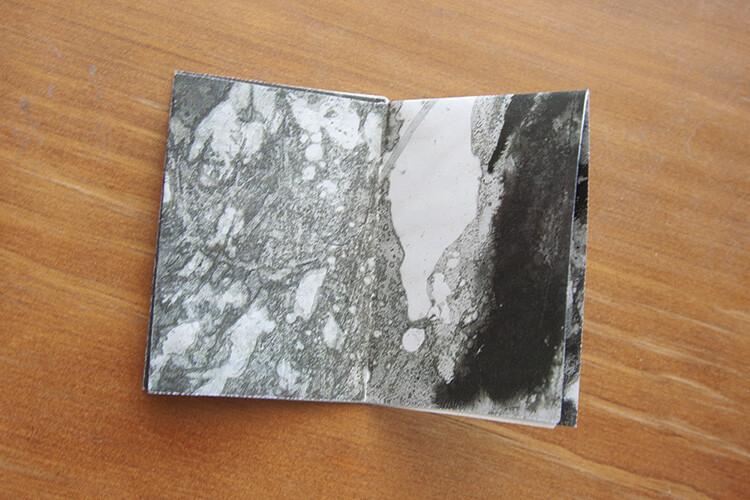
To create this zine, I simply recycled an image I printed by mistake

How to Make and Fold a Little Photographic Zine

How to Make and Fold a Little Photographic Zine

I printed this photo which is a scan of an inky painting. I also added a blank white square to the back page section, for a little message to a reader.

How to Make and Fold a Little Photographic Zine

How to Make and Fold a Little Photographic Zine

How to Make and Fold a Little Photographic Zine

To make this zine I incorporated a few film photographs I took one night. Film makes great material for zines. Note that there is a white strip in the layout, due to a film end. I decided to leave it in the design as a testament to the original image.

Conclusion

Zines are all about sharing art and creativity, founding trades and friendships across the world. Please share your photographic zines below, I would love to see them. Perhaps we could set up a trade!

The post How to Make and Fold a Little Photographic Zine by Megan Kennedy appeared first on Digital Photography School.


Digital Photography School

 
Comments Off on How to Make and Fold a Little Photographic Zine

Posted in Photography


A Fresh Look at Learning Photographic Composition

02 Jan

Popular teaching about photographic composition says to learn the rules and then break them. I prefer to encourage the people who join our photography workshops to learn the rules, understand them well and put them into practice so frequently they become second nature.

If you can apply the rules without even consciously thinking about them you will create more dynamic, interesting photographs which convey more feeling.

A Fresh Look at Learning Photographic Composition

Why do we have rules?

Rules are important as they are the underlying structure of composition. Much like scales are to musicians. Much like grammar is to language.

Successful musicians have typically spent long hours going over and over the same scales until they know them so well they do not need to think about them. When we learned our first language, our “mother tongue”, we never consulted the textbooks to study the grammatical structure of the language, we just absorbed it, (most frequently from our mothers.)

A Fresh Look at Learning Photographic Composition

Some people will have more difficulty learning the rules of composition and applying them effectively than others. Very much like some people can learn to play musical instruments or learn new languages easier.

I think it is because we are all creatively gifted in different ways. If you are gifted with a visual creativity you may find it easier to compose photographs than say someone who is gifted with a musical creativity and finds it easy to play the guitar or trumpet for example.

A Fresh Look at Learning Photographic Composition

I do like what the famous American photographer Edward Weston had to say about learning and implementing the rules of composition:

“Now to consult the rules of composition before making a picture is a little like consulting the law of gravity before going for a walk.”

I doubt any of us can recall studying the law of gravity before we learned to walk. But we certainly knew about it.

A Fresh Look at Learning Photographic Composition

Know them at a subconscious level

Knowing the rules is important as they will help guide our creative thinking, but applying these rules rigidly will generally lead towards making rather static and lifeless photographs. As you learn the rules and know them so well you can incorporate them into your photographs intuitively you will find your images may take on a whole new dynamic. Very much like walking and talking, it’s good to be subconsciously aware of the rules and laws as they are there for good reason.

A Fresh Look at Learning Photographic Composition

Practice constantly

Reading about and studying the rules of composition will help you gain a good understanding of them. Practicing them frequently is the most effective means of consistently integrating them into your photographs. Practice them even when you don’t have your camera with you.

Begin to see in the rule of thirds, discover leading lines and strong diagonals, look for frames and how you can use symmetry. One side effect of seeing like this will likely be that you start taking your camera everywhere with you.

Fill the frame

When I first started working in the photography department of a newspaper it was impressed upon me to “fill the frame”. This encouragement has stuck with me and I am aware, consciously or subconsciously, of wanting to effectively achieve this with every photograph I make. This was important in the newspaper in order to convey the story effectively, (and so sub-editors had less flexibility to horribly crop your photos).

A Fresh Look at Learning Photographic Composition

Filling your frame does not mean that in every photo your subject must be pressed out to the edges of your viewfinder. It means however you are choosing to compose your photograph, make sure whatever is within the four corners and edges is relevant to the picture you are making.

A Fresh Look at Learning Photographic Composition

If empty space is relevant and adds to your composition, use it well. If cropping in so tight that part of your subject is cut off makes a stronger image, then crop tight.

However you decide to compose your image, be happy with it. Don’t get hung up on the rules. But do have a solid understanding of them and explore how you like to incorporate them into the creative photographs you are making. And, if you so come up with any new rules, please do let me know!

Here’s a little video talking about this concept of composition.

The post A Fresh Look at Learning Photographic Composition by Kevin Landwer-Johan appeared first on Digital Photography School.


Digital Photography School

 
Comments Off on A Fresh Look at Learning Photographic Composition

Posted in Photography


Calumet UK and Wex Photographic will officially merge tomorrow

26 Sep

Two of the biggest photography retailers in the UK are going to officially merge tomorrow. This marks the culmination of a process that was set in motion way back in March when Calumet owner (and former Bowens owner) Aurelius bought Wex Photographic and announced that the Calumet competitor would merge with its former adversary.

If you visit the Calumet UK website today, you’re greeted by the following message:

“From 26 September, Calumet Photographic Limited UK will be merging with Wex Photographic, offering an improved experience and wider range of products to photographers across the UK,” reads the statement. “Later this week, this website will be closed and moved to www.wexphotographic.com.”

The statement goes on to assure Calumet customers that there will be “minimal disruption” to service, and any outstanding pre-orders, back-orders, or vouchers will be honored under the new brand.

For more information about the merger and how it will (or won’t) affect customers, you can visit this FAQ page on the Wex Photographic website.

Articles: Digital Photography Review (dpreview.com)

 
Comments Off on Calumet UK and Wex Photographic will officially merge tomorrow

Posted in Uncategorized


21 spectacular photos from Saturn: A photographic ode to Cassini

17 Sep

$ (document).ready(function() { SampleGalleryV2({“containerId”:”embeddedSampleGallery_1611832194″,”galleryId”:”1611832194″,”isEmbeddedWidget”:true,”standalone”:false,”selectedImageIndex”:0,”startInCommentsView”:false,”isMobile”:false}) });

Earlier today, NASA’s Cassini spacecraft ended its 20-year long mission by plunging into Saturn’s atmosphere and incinerating itself. The probe, which arrived at Saturn in 2004, has been one of the most prolific and consistent sources of mind-blowing imagery NASA has ever produced—sending back photograph after photograph of the ringed planet and its moons.

The very thought of humans sending a spacecraft 746 million miles (minimum) away to take pictures of a foreign planet is too incredible to grasp, but the photos Cassini sent back were more incredible still. Over the years, we’ve featured several of Cassini’s highlights on DPReview, but now that the spacecraft has shuffled off this mortal coil in a literal blaze of fire and glory, it’s only right we give it a proper photographic goodbye.

And so we present to you 21 of our favorite photos from the Cassini mission—incredible photographs, mosaics, and radar images of moons, rings, methane lakes, and more. There are even a couple of portraits of Earth thrown in there as well.

Farewell Cassini. The photo community is grateful for your 20 years of service.


All photographs courtesy of NASA/JPL-Caltech/Space Science Institute

Articles: Digital Photography Review (dpreview.com)

 
Comments Off on 21 spectacular photos from Saturn: A photographic ode to Cassini

Posted in Uncategorized


Behind the scenes with Albert Watson: Watch a photographic legend shape light

07 Sep

Profoto recently connected two icons in their respective fields: Albert Watson, the portrait photography legend, and Sergei Polunin, the so-called “bad boy of ballet” and probably the only ballet dancer you could call “mainstream.” Together, they set about capturing some unique portraits, and filmmaker Eric Becker, the director of our own long-form video series, was there to document the process.

Watson’s work—which you can find in galleries and museums world-wide—spans a few genres. But the shots that define his career are his portraits… photographs of influential men and women that often look almost sculpture-like. If you’re interested at all in portrait photography, listening to Watson talk you through his light shaping process will be incredibly inspirational.

And if you’re a fan of high end lighting equipment well… you might just slobber all over your keyboard as you watch his assistants unpack a veritable army of Profoto Pro-10’s ($ 14,000 each) for this shoot.

$ (document).ready(function() { SampleGalleryV2({“containerId”:”embeddedSampleGallery_1445470748″,”galleryId”:”1445470748″,”isEmbeddedWidget”:true,”standalone”:false,”selectedImageIndex”:0,”startInCommentsView”:false,”isMobile”:false}) });

In the end, of course, Watson was less concerned with the gear than the portraits he was trying to capture with said gear. His process is a journey that he describes as, “not a distinct road to the final shot. You don’t know until you get there.”

And when he got there, this is what he captured: three photographs, one showing Sergei in flight, the other two described as “modern sculptures.”

$ (document).ready(function() { SampleGalleryV2({“containerId”:”embeddedSampleGallery_8776530642″,”galleryId”:”8776530642″,”isEmbeddedWidget”:true,”standalone”:false,”selectedImageIndex”:0,”startInCommentsView”:false,”isMobile”:false}) });

All in all, Profoto doesn’t miss the mark when they call the video above “a masterclass in light shaping.” Check it out for yourself, and then head over to the Profoto website to hear the story in their own words.


All photographs courtesy of Profoto

Articles: Digital Photography Review (dpreview.com)

 
Comments Off on Behind the scenes with Albert Watson: Watch a photographic legend shape light

Posted in Uncategorized