RSS
 

Posts Tagged ‘Photograph’

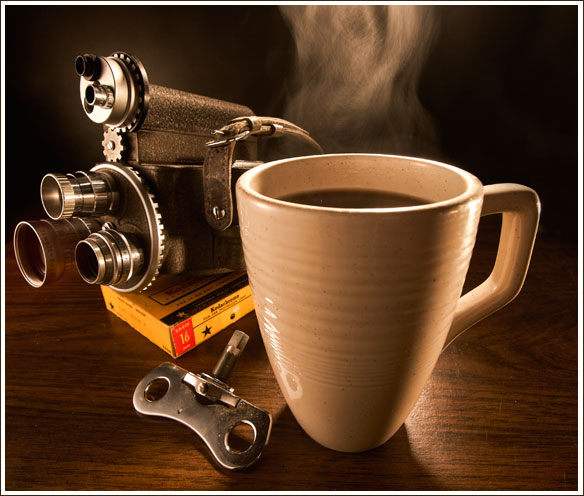
How to Photograph a Steaming Cup of Coffee

08 May

Ever wanted to photograph a steaming cup of coffee?

Steaming Coffee 01

Maybe not – but it could be a fun little evening project to hone your skills.

Here’s a video from the team at Learn my Shot to show you how to do it.

Post originally from: Digital Photography Tips.

Check out our more Photography Tips at Photography Tips for Beginners, Portrait Photography Tips and Wedding Photography Tips.

How to Photograph a Steaming Cup of Coffee


Digital Photography School

 
Comments Off on How to Photograph a Steaming Cup of Coffee

Posted in Photography


How To Photograph Star Trails

24 Apr

Photographing star trails can be challenging but also rewarding. If you’ve never tried it, these tips will help you get started.

Choosing the Place and Time

To make a striking photograph of the stars, there are a few requirements when it comes to choosing the right place and time.

  • You must be far away from any city lights since any ambient light will make the stars less visible. If you live in a big city, this could mean traveling some distance. Recently I was in Nevada, about an hour’s drive away from Las Vegas, and I couldn’t believe the amount of light in the sky from the city.
  • For the photograph to have a sense of place, you will need something interesting in the foreground. It must be something that doesn’t move like a mountain or a building.
  • Plan your star photography adventure for a moonless night. Or at least the moon cannot be above the horizon while you are photographing. Similar to what happens with city lights, the stars are not as visible when the moon brightens the sky.
  • It should also be a clear night with no clouds.
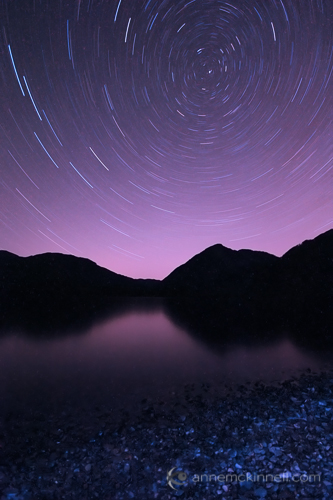
Cowichan Lake Star Trails by Anne McKinnell.

Star trails at Cowichan Lake, British Columbia.

Method

The best way to go about making an image of star trails is to take multiple exposures and combine them in post processing.

While it is possible to take one very long exposure, often the heat coming from the sensor will cause hot spots in your final image.

I usually use a 30 second shutter speed and make 60 images.

Gear You Will Need

The most important thing you will need is a tripod to stabilize your camera during the long exposures.

A cable release or intervalometer is extremely handy but not essential.

You can use the 2 second timer on your camera and manually click the shutter continuously for half an hour. It can be done. But, with a cable release you can set your camera to continuous shooting and lock the cable release and your camera will continue to make images until you unlock it.

If you have an intervalometer, you can program it to take a specific number of images of a particular shutter speed. This is the easiest but most expensive way to go about it.

Finally, make sure you have a fully charged battery since the cold night may cause your battery life to be shorter than usual.

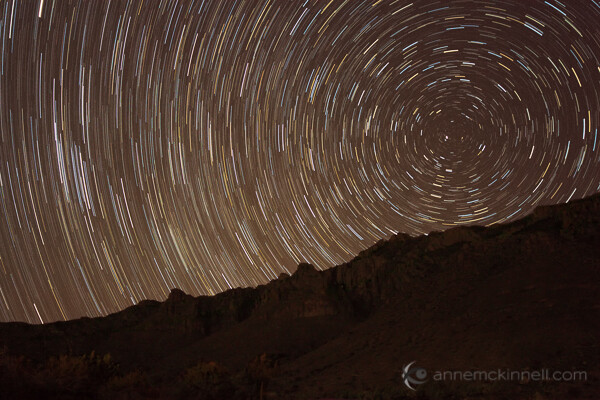
Star trails at Guadalupe National Park, Texas, by Anne McKinnell.

Star trails in Guadalupe National Park, Texas.

Taking the shots

Once you are on location and the gear is ready to go, you can set up your composition.

If possible, go one night ahead of time and locate polaris, the north star, in the sky.  If you can manage to get polaris in the frame, all the stars will circle around it.  If polaris is not in the frame, the stars will appear to travel in a semi-circle.  If you can’t go a day ahead of time, use your compass and try to get as much sky in the frame as possible.

I like to set up my composition during the day so I get just the right amount of foreground in the frame and set the focus so that the foreground is sharp. This is much easier to do during the day than it is once it is dark outside.

Remember once you have set the correct focus to turn your auto-focus off so your camera does not attempt to re-focus at night. Also, your image stabilization should be off anytime your camera is on a tripod.

When it’s dark and you are ready to begin, which will probably be a couple of hours after sunset at least, you can do some tests to make sure you are getting good exposures. You will want to use a large aperture (small F stop number) to ensure you have the greatest amount of light entering the camera as possible. If you try to use a smaller aperture, the star trails we be very dim. So, since you need a 30 second shutter speed and a small aperture, such as f/4, proper exposure will be determined by the ISO. Try taking a test shot at ISO1600 and see if you can see the stars in the image. If not, increase the ISO to 3200.

Also, make sure you turn your in-camera noise reduction off because it will require an additional 30 seconds after you make your exposure to do the noise reduction and you will end up with little gaps in your trails.

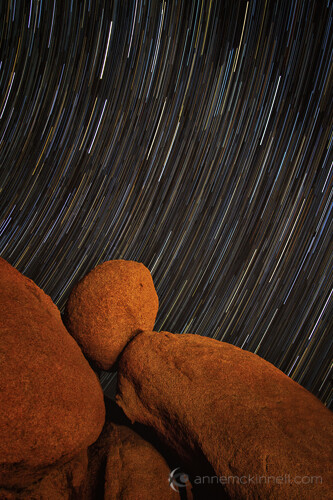
Star Trails at Joshua Tree National Park by Anne McKinnell.

Star trails at Joshua Tree National Park, California.

Processing the Image

To combine your images, I recommend a free program I have been using called StarStaX which is easy to use and it does a great job. Just point StarStaX to the folder that contains all the exposures, selected “lighten” as the blend mode, and let it go to work.

This can be the most exciting part of the whole experience since you finally get to see what you have created!

Once you have the stacked image, you might find you have some UFO’s in it that look like straight lines crossing your curved star trails. Those can be caused by comets or airplanes. I usually use the healing brush in Photoshop to remove them.

You might have to invest a bit of time in planning, making the exposures, and processing the images, but the final result will be well worth the investment. All you really need is a bit of patience.

Post originally from: Digital Photography Tips.

Check out our more Photography Tips at Photography Tips for Beginners, Portrait Photography Tips and Wedding Photography Tips.

How To Photograph Star Trails


Digital Photography School

 
Comments Off on How To Photograph Star Trails

Posted in Photography


How to Photograph Snowflakes with a DSLR

04 Apr

By Don Komarechka

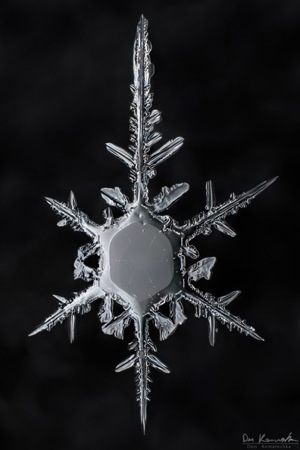
How to Photograph SnowflakesThe winter months are typically uninteresting for macro photographers. Flowers, insects, and tiny details in nature all but disappear. Only one faithful subject is left in abundance – the tiny snowflake.

Thankfully, “abundance” is an understatement. For nearly half of the year, you’ll find countless trillions of them mere feet from the warmth and comfort of home. So, how do you start? How do you capture one of these tiny crystalline subjects and fill the frame behind your lens?

The Gear:

The first thing you’ll need is an old mitten.

You’ll need more than that, however. The average snowflake is around 2-5mm across, so filling the frame with one of these crystals will require powerful magnification and good lighting. Any camera will do, as long as you can get close enough. For snowflake photography, you’re going to need to delve into the world beyond 1:1 lifesize magnification.
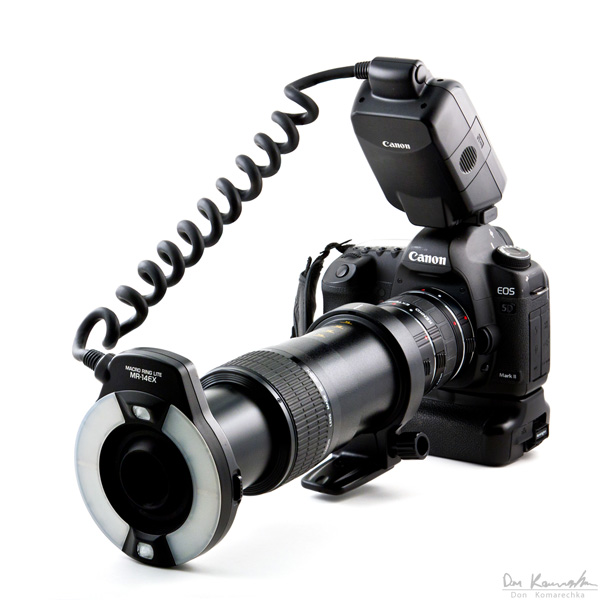
Macro setup

1:1 lifesize is the highest scale of magnification that most macro lenses are capable of. On a full-frame sensor, a 4mm snowflake will only fill about 2% of the image – we need to get closer.

Adding a set of extension tubes to your macro lens will often get you close to 2:1 life-size, and Kenko makes a great set. These are hollow tubes that sit between the camera and the lens, effectively allowing the camera to focus closer to its front element. This is the most convenient way to increase your magnification, but close-up filters are another good option.

Close-up filters are basically reading glasses for your camera. They act as a magnifying glass, and multiple can be stacked together for an increased effect. They cause the edges of the frame to get distorted, but when photographing snowflakes you’ll likely be cropping out the edges anyhow. Close-up filters also interfere with the autofocus capabilities of most DSLRs, but we’ll be shooting manual focus for this subject.
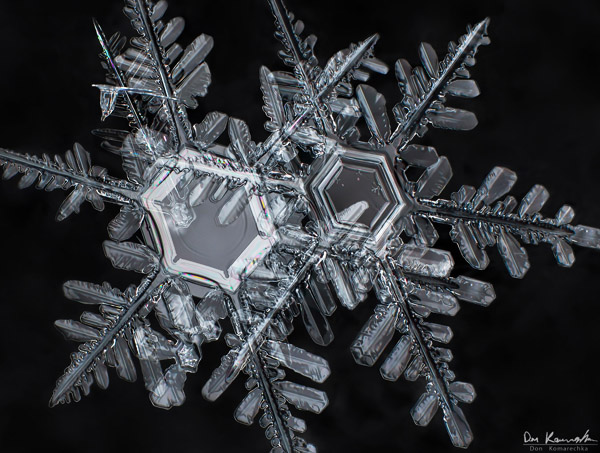
How to Photograph Snowflakes 2

Lighting a snowflake may seem like a challenge, but it’s fairly simple: use a ring flash. Ring flashes may not be favored in all areas of macro photography because they create a distracting reflection in water droplets and some insect eyes. It’s the perfect solution for snowflakes however, and makes capturing them a little easier. Most ring flashes (I use a Canon MR-14EX) allow you to control two banks of light and make one brighter than the other. I nearly completely turn one bank off and use half of the flash – and I aim for the perfect angle.
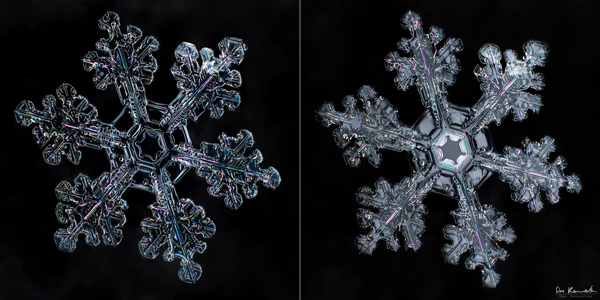
How to Photograph Snowflakes 3

Getting the right angle can drastically change the outcome. The above image is photographed at two different angles only a few degrees apart. It takes plenty of experimenting in the field to find these angles, and I’ll occasionally use a small paintbrush to nudge the snowflake to the proper angle. I avoid this unless necessary, because the crystals often shatter when manipulated too much.

So we’ve got a lens, a light, and now we need a stage. All of my snowflake photographs are made on the same old black mitten. It’s an essential component in my images, and there are plenty of reasons why:

Mitten

  • Dark background: the mitten creates a darker background for the snowflake and allows for some beautiful contrasts. Choose another color besides black for a different feel to your images – but keep it darker for good contrast.
  • Insulation: If the snowflake were to fall on a flat metal surface, and that surface were to transfer even the slightest amount of heat – the snowflake would be a water droplet fairly quickly. With the mitten, the ice gets caught in the fibers and only makes a few contact points with the surface, keeping it insulated from heat.
  • Subject Isolation: Every shot will have some number of woolen fibers present, but these are far easier to edit out than a flat and detailed surface like felt or a BBQ cover in your backyard.

The Process:

Set out the mitten during a snowfall and wait for the snowflakes to land (tip: you shouldn’t be wearing the mitten). Take a close look and see if the snowflakes are of the “beautiful” variety. You’ll commonly see balls of ice or crystals covered in frozen water droplets (called “rime”). It may take a few snowfalls before you see the best crystals for photographing – big, clean snowflakes with lots of branches:
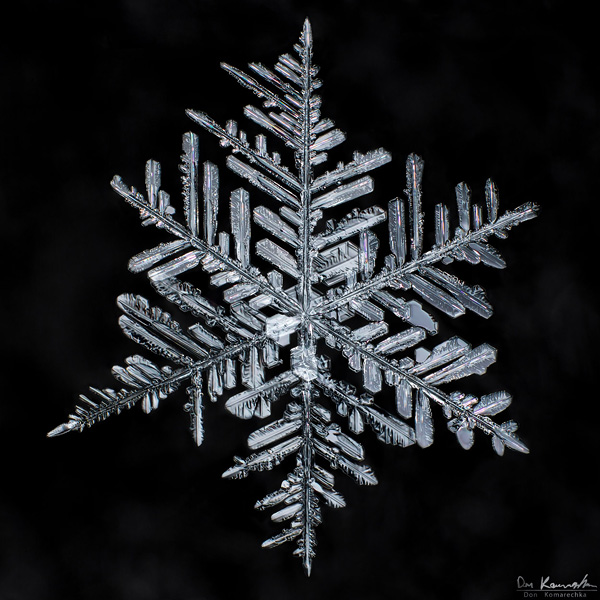
How to Photograph Snowflakes 4

It’s very important to photograph the snowflakes during a snowfall. As soon as one hour afterwards, the crystals will begin to melt or sublimate (evaporate without melting first) and the sharp crystal edges will soon disappear. If you’ve just missed the snowfall, try to place the mitten on freshly fallen snow and pick it up again – the fibers will catch the fallen snowflakes like Velcro and you’ll have a chance at photographing a few before they deteriorate too far.

All of my snowflakes are focus-stacked. This means that I take multiple frames of the same snowflake at many different focus points; I do this by physically moving the camera forward and backward through the focus plane of the crystal, continuously shooting all the while. This process is necessary because they’re often photographed on an angle, giving only a tiny sliver of focus. I photograph them on an angle to bring out surface reflections, prismatic colors and even vibrant center colors as a result of optical interference:
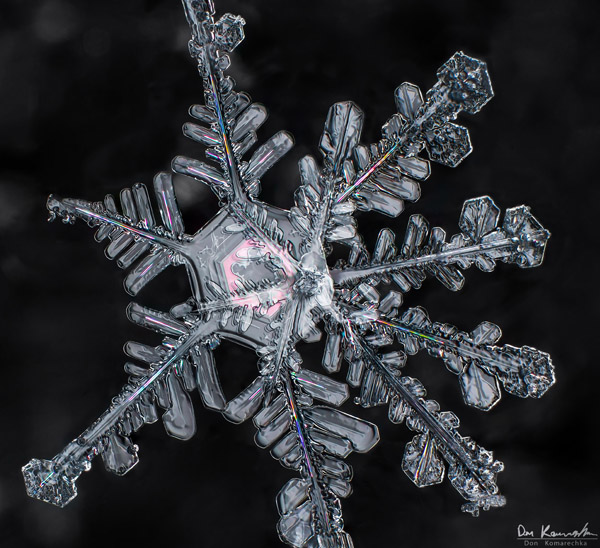
How to Photograph Snowflakes 5

This is not, however, how the image comes out of the camera. The below image is one of 33 images used in the final composition. The process of combining the frames is lengthy, in part because every image is done without a tripod – they’re all hand-held. Because I handhold these images, I need to take far more frames than I’ll actually use (I over-shoot to make sure I cover every point). The 33 frames I used in this image were selected out of 112 in total.
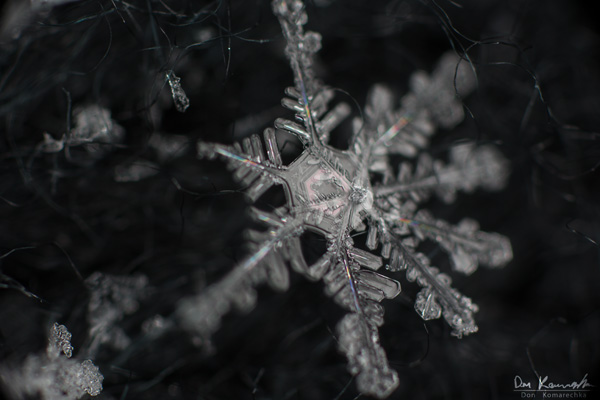
How to Photograph Snowflakes 6

I’m often asked why I don’t use a tripod for these photographs. Getting a tripod set up to exactly the right angle and adjusting a focus-rail to get everything set perfectly would take a significant amount of time. I find the snowflake freehand and adjust the angle of the camera to get the desired reflection by taking test shots, something far more time-consuming if a tripod were involved. Time can’t be spent aligning a tripod in this way – I need to move quickly to be sure the snowflake won’t melt, blow away or get smothered by more falling snow. Photoshop does a pretty good job re-aligning the images, as long as your angle doesn’t deviate too much.

Snowflakes measuring roughly 0.4mm in diameter, photographed at 6:1 magnification and cropped significantly

Snowflakes measuring roughly 0.4mm in diameter, photographed at 6:1 magnification and cropped significantly

The editing and focus-stacking process will be discussed in a future article.

The Book:

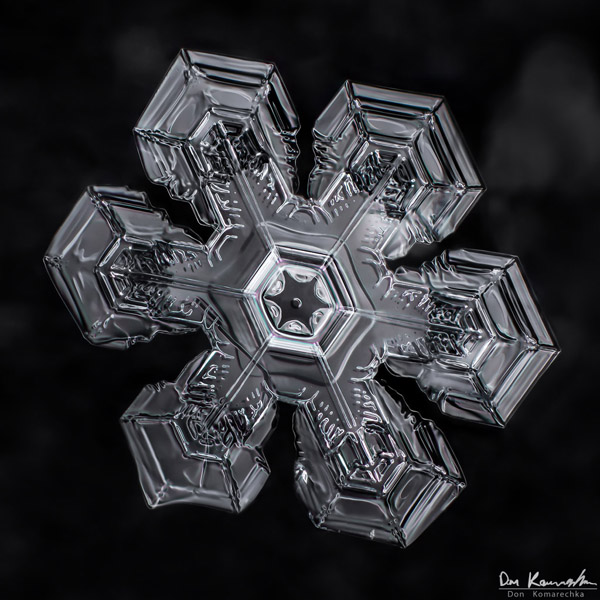
If the tutorial above interests you, it will be spelled out in greater detail in my upcoming book, “Sky Crystals: Unraveling the Mysteries of Snowflakes”. The book is currently being crowd-funded on indiegogo, and a $ 35 contribution will get you a copy when it’s released in October 2013. Support the project and help the book get published!
Mar4 snowflake9

The book will be 300 pages, hardcover and detail all of the photographic techniques, science & physics, and even the psychology and philosophy of why we find snowflakes beautiful. The campaign ends April 30th 2013.

Post originally from: Digital Photography Tips.

Check out our more Photography Tips at Photography Tips for Beginners, Portrait Photography Tips and Wedding Photography Tips.

How to Photograph Snowflakes with a DSLR


Digital Photography School
 
Comments Off on How to Photograph Snowflakes with a DSLR

Posted in Photography


Your Favorite Place To Photograph

03 Apr

As photographers we all have our favorite locations to take photographs.  Mine happens to be in Philly, PA at an old prison (Eastern State Penitentiary) which has been converted to a museum.  I have been there many times and always look forward to going back for more.

waiting-game

So I want to ask you… what is your favorite place to photograph?  Comment below to share.

dslrBlog

 
Comments Off on Your Favorite Place To Photograph

Posted in Photography


2013 GPP Shootout Challenge: Photograph Greg Heisler

09 Mar

The Gulf Photo Plus 2013 Shootout just concluded, and boy was it a doozy.

The challenge: make a portrait of Greg Freakin’ Heisler, soup to nuts, in front of 350 people in 20 mins flat. No pressure there.

Major props to John Keatley, who managed to not crack under the pressure and actually make a portrait of Heisler that was consistent with the slightly off-center Keatley style.

Completely seriously, I want a 16×20 of this for the Strobist Cave.

And here’s the thing: Keatley didn’t even win it. This year’s winner was Zack Arias, who suffice to say has a brass pair for what he did. You’ll definitely want to watch the video when it comes out.

Whatever you have to do to get to Dubai for GPP, make it happen.

-30-


Strobist

 
Comments Off on 2013 GPP Shootout Challenge: Photograph Greg Heisler

Posted in Photography


How To Photograph People You Meet While Traveling

30 Jan

Imagine this scenario: You’re walking down a side street in Bangkok in the late afternoon, and you pass by an old man sitting on his patio. He’s drinking a cup of tea and staring off into the distance, and he just exudes an aura of contentment. The light is perfect, and the viewfinder in your mind’s eye composes the perfect Continue Reading

The post How To Photograph People You Meet While Traveling appeared first on Photodoto.


Photodoto

 
Comments Off on How To Photograph People You Meet While Traveling

Posted in Photography


How to Photograph the Moon Tutorial

14 Jan

Questions? Go here: www.youtube.com Tutorial on how to photograph the moon. Download Lens Sharpness Chart (PDF): tinyurl.com

 
Comments Off on How to Photograph the Moon Tutorial

Posted in Nikon Videos


Advice: How to Photograph Your Car

04 Jan

Cars.com’s Ian Merritt gives some tips on how to photograph your car.

Video samples and impressions of the Carl Zeiss Distagon 2/35 lens paired with a Canon 60d SLR body.


Editing a River Landscape Photograph in Adobe Lightroom

31 Dec

Doing an edit of a photograph I took, trying out different things eeing what I can come up with. We use graduated filters, Black and White, Saturation, Luminance, Distortion correction and more. www.photoix.co.uk Follow me on Twitter for the latest news and updates! http
Video Rating: 4 / 5

Testing video with nikon J1 and lens nikkor VR 10-30. Video 1280×720 60p
Video Rating: 4 / 5


How to Photograph Fireworks Displays

30 Dec
FireworksPhoto by hupaishi

Do you want to know how to photograph fireworks With New Years Eve just days away I thought I’d refresh this article in which I give 10 Fireworks Photography tips to help you get started.

Fireworks Displays are something that evoke a lot of emotion in people as they are not only beautiful and spectacular to watch but they also are often used to celebrate momentous occasions.

I’ve had many emails from readers asking how to photograph fireworks displays, quite a few of whom have expressed concern that they might just be too hard to really photograph. My response is always the same – ‘give it a go – you might be surprised at what you end up with’.

My reason for this advice is that back when I bought my first ever SLR (a film one) one of the first things I photographed was fireworks and I was amazed by how easy it was and how spectacular the results were. I think it’s even easier with a digital camera as you can get immediate feedback as to whether the shots you’ve taken are good or not and then make adjustments.

Of course it’s not just a matter of going out finding a fireworks display – there are, as usual, things you can do to improve your results. With New Years Eve just around the corner I thought I’d share a few fireworks digital photography tips:

Get more Digital Photography Tips like this in your email with our free newsletter

1. Use a Tripod

Fireworks-1Photo by Piero Sierra

Perhaps the most important tip is to secure your digital camera to something that will ensure it doesn’t move during the taking of your shots. This is especially important in photographing fireworks simply because you’ll be using longer shutter speeds which will not only capture the movement of the fireworks but any movement of the camera itself. The best way to keep your camera still is with a tripod (read our series on tripods and how to use and buy them). Alternatively – keep in mind that there are other non Tripod options for beating camera shake.

2. Remote Release

One way to ensure your camera is completely still during fireworks shots is to invest in a remote release device. These will vary from camera to camera but most have some sort of accessory made for them. The other way of taking shots without touching your camera is to use the self timer. This can work but you really need to be able to anticipate shots well and its very very hit and miss (read more on remote shutter releases).

3. Framing Your Shot

One of the most difficult parts of photographing fireworks is working out where to aim your camera. The challenge you’ll face in doing this is that you generally need to aim your camera before the fireworks that you’ll be photographing goes off – anticipation is key. Here are a few points on getting your framing right.

FireworksPhoto by Stuck in Customs
  • Scope out the location early – Planning is important with fireworks and getting to the location early in order to get a good, unobstructed position is important. Think about what is in the foreground and background of your shots and make sure you won’t have people’s heads bobbing up into your shots (also consider what impact you’ll have on others around you also). Take note of where fireworks are being set up and what parts of the sky they are likely to be shot into – you might also want to try to ask some of those setting up the display for a little information on what they are planning. Also consider what focal lengths you might want to use and choose appropriate lenses at this time (rather than in the middle of the show).
  • Watch your Horizons – One thing that you should always consider when lining up fireworks shots is whether your camera is even or straight in it’s framing. This is especially important if you’re going to shooting with a wide focal length and will get other background elements in your shots (ie a cityscape). Keeping horizons straight is something we covered previously on this site and is important in fireworks shots also. As you get your camera on your tripod make sure it’s level right from the time you set up.
  • Vertical or Horizontal? – There are two main ways of framing shots in all types of photography, vertically (portrait) or horizontally (landscape). Both can work in fireworks photography but I personally find a vertical perspective is better – particularly as there is a lot of vertical motion in fireworks. Horizontal shots can work if you’re going for more of a landscape shot with a wider focal length of if you’re wanting to capture multiple bursts of fireworks in the one shot – but I don’t tend to go there that often.
  • Remember your framing – I find that when I photograph fireworks that I spend less time looking in my viewfinder and more looking at the sky directly. As a result it’s important to remember what framing you have and to watch that segment of the sky. Doing this will also help you to anticipate the right time for a shot as you’ll see the light trails of unexploded rockets shooting into the sky.

4. Focal Length?

How-To-Photograph-FireworksPhoto by asmundur

One of the hardest parts of photographing fireworks is having your camera trained on the right part of the sky at the right time. This is especially difficult if you’re shooting with a longer focal length and are trying to take more tightly cropped shots. I generally shoot at a wider focal length than a tight one but during a show will try a few tighter shots (I usually use a zoom lens to give me this option) to see if I can get lucky with them. Of course zoomed in shots like the one to the left can be quite effective also. They enable you to really fill the frame with great color. Keep in mind however that cropping of your wider angle fireworks shots can always be done later to get a similar impact in your photography.

5. Aperture

A common question around photographing fireworks displays is what aperture to use. Many people think you need a fast lens to get them but in reality it’s quite the opposite as the light that the fireworks emit is quite bright. I find that apertures in the mid to small range tend to work reasonably well and would usually shoot somewhere between f/8 to f/16.

6. Shutter Speed

How-To-Photograph-Fireworks-3Photo by *vlad*

Probably more important to get right than aperture is shutter speed. Fireworks move and as a result the best photographs of them capture this movement meaning you need a nice long exposure. The technique that I developed when I first photographed fireworks was to shoot in ‘bulb’ mode. This is a mode that allows you to keep the shutter open for as long as you hold down the shutter (preferably using a remote shutter release of some type). Using this technique you hit the shutter as the firework is about to explode and hold it down until it’s finished exploding (generally a few seconds).

You can also experiment with set shutter speeds to see what impact it will have but I find that unless you’re holding the shutter open for very long exposures that the bulb technique works pretty well.

Don’t keep your shutter open too long. The temptation is to think that because it’s dark that you can leave it open as long as you like. The problem with this is that fireworks are bright and it doesn’t take too much to over expose them, especially if your shutter is open for multiple bursts in the one area of the sky. By all means experiment with multiple burst shots – but most people end up finding that the simpler one burst shots can be best.

7. ISO

Fireworks-2-1Photo by Mr Magoo ICU

Shooting at a low ISO is preferable to ensure the cleanest shots possible. Stick to ISO 100 and you should be fine.

8. Switch off your Flash

Shooting with a flash will have no impact upon your shots except to trick your camera into thinking it needs a short exposure time. Keep in mind that your camera’s flash will only have a reach of a few meters and in the case of fireworks even if they were this close a flash wouldn’t really have anything to light except for some smoke which would distract from the real action (the flashing lights).Switch your flash off.

9. Shoot in Manual Mode

I find I get the best results when shooting in manual exposure and manual focus modes. Auto focusing in low light can be very difficult for many cameras and you’ll end up missing a lot of shots. Once your focusing is set you’ll find you don’t really need to change it during the fireworks display – especially if you’re using a small aperture which increases depth of field. Keep in mind that changing focal lengths will mean you need to need to adjust your focusing on most lenses.

10. Experiment and Track Results

Watching-FireworksPhoto by y entonces

Throughout the fireworks display periodically check your results. I generally will take a few shots at the start and do a quick check to see that they are OK before shooting any more. Don’t check after every shot once you’ve got things set up OK (or you’ll miss the action) but do monitor yours shots occasionally to ensure you’re not taking a completely bad batch.

Also experiment with taking shots that include a wider perspective, silhouettes and people around you watching the display. Having your camera pointed at the sky can get you some wonderful shots but sometimes if you look for different perspectives you can get a few shots that are a little less cliche and just as spectacular. Most of the best shots that I’ve seen in the researching of this article have included some other element than the fireworks themselves – whether it be people, buildings, landmarks or wider cityscape perspectives.

More Tips from DPS Readers

  • “Find Out the Direction of the Wind – You want to shoot up wind, so it goes Camera, Fireworks, Smoke. Otherwise they’ll come out REALLY hazy.”
  • “Also, I find that if you shoot from a little further back and with a little more lens, you can set the lens to manual focus, focus it at infinity and not have to worry about it after that.”
  • “Remember to take advantage of a zero processing costs and take as many pictures as possible (more than you’d normally think necessary). That way, you’ll up your chances of getting that “perfect” shot.”
  • “Make sure you are ready to take pictures of the first fireworks. If there isn’t much wind, you are going to end up with a lot of smoke in your shot. The first explosions are usually the sharpest one.”
  • “Get some black foam core and set your camera to bulb. Start the exposure when the fireworks start with the piece of foam core in front of the lens. Every time a burst happens move the foam core out of the way. You will get multiple firework bursts in one exposure”
  • “Another tip I would add to this is pre-focus if possible (need to be able to manually focus or lock down focus for good) before the show starts so other elements in the frame are sharp They did mention that you only need to focus once but its a lot easier to take a few shots before the show starts and check them carefully rather than wait until the show has begun and you are fiddling with focus instead of watching fireworks!”

Tell us your fireworks display photography tips in comments below. Don’t forget to tell us which city you’re in and what the fireworks are like there!

We post tutorials like this every day – Get more via email with our free weekly newsletter.

PS: Got some fireworks photos to share with us? Head over to our forum where there are a few fireworks photography discussions taking place.

Post originally from: Digital Photography Tips.

Check out our more Photography Tips at Photography Tips for Beginners, Portrait Photography Tips and Wedding Photography Tips.

How to Photograph Fireworks Displays


Digital Photography School

 
Comments Off on How to Photograph Fireworks Displays

Posted in Photography