My Interview and Work Featured in the
Master’s Special of DPP this Month!
I love Digital Photo Pro Magazine. And I LOVE their title for my story. You can only imagine my happiness when they sent me an email requesting an interview with me to do a write up about myself and my fashion photography for their Master’s Issue. You can read the Full Article Here. First of all, the word “Master” sort of hit me sideways. I don’t consider myself a Master yet, but I was very moved by the compliment. It isn’t every day that a magazine like Digital Photo Pro writes me and tells me that they think I’m a master and would like to do a story about me!
At any rate, enough said. I just want to share the article with you. And if you follow my work, it would be nice to pick up a copy of the magazine. If you have not heard of Digital Photo Pro, it is a great magazine for any photographer, honestly. They write great articles featuring photographers like Indira Cesarine and David Alan Harvey, who also are in the Master’s Special Edition. they share the latest information on gear and technology as well as monthly profiles on photographers that we all admire. Not to mention, it has great business advice and tips for both photographers starting up their new businesses to people like myself who constantly need to stay in the know on the latest business practices. You can subscribe and save if you’re interested in getting DPP sent to you in the mail.
www.flashstudioimmagine.com 220 tutorial inediti www.youtube.com Visita il mio canale youtube labottegadellafotografia.blogspot.it IL mio blog Download brushes:myphotoshopbrushes.com You can perform this process using splatter brushes. In this tutorial I explain step by step how to dissolve a photo and spread it like splashes of paint. Powered by Luciano Boschetti, photographer. Video Rating: 4 / 5
These lightweight, soft and refined messenger style camera bags have a hip hugging form and room for a tablet or laptop. The fully removable insert allows you to convert from a camera to messenger bag. CityWalker camera shoulder bags: www.thinktankphoto.com Visit our Channel for product videos, features photographers and how-to’s. www.youtube.com CityWalker: Lightweight, soft, Messenger bags with hip hugging form and room for a tablet or laptop. Removable insert allows for multi-use capability. Top features: • Soft and flexible to conform to your body • Dedicated compartment for iPad or laptop • The CW20 and CW30 both accommodate a 70-200 (detached). • Removable main insert increase functionality and gives multiple use capability • Lightweight materials, high capacity Gear Profile: CityWalker 10: Fits one standard size body with a 24-70 attached + one small lens + flash + tablet CityWalker 20: Fits one standard size body with a 24-70 attached + 1-3 small lenses + flash + iPad. Accommodates a 70-200 detached. CityWalker 30: Fits one standard size body with a 24-70 attached + 2-4 small lenses + flash +15″ laptop. Accommodates a 70-200 detached. Think Tank Photo would like to thank George Larkins for allowing us to follow him around NYC. For more information about George Larkins, please visit: www.grlstudio.com
www.WeeklyPhotoTips.com Today we are reviewing the Delkin Sensorscope System. This is a complete sensor cleaning kit that will allow you up to two dozen camera cleanings. The key component of the kit is the Sensorscope, a 5x magnifier with 4 bright LED lights that allow you a clear complete view of your sensor both pre and post cleaning. There is nothing else you need to get as the kit is complete with all the supplies (swabs, fluids, even the batteries) that you will need to do a thorough cleaning. You can read more about the Delkin Sensorscope System along with links and pricing info at Weekly Photo Tips. www.WeeklyPhotoTips.com
www.STUDIyoPhoto.com Get Sole shoes are highly versatile canvas shoes that you can where to almost any occassion. Mix and match it with different clothes, even the shoes itself can be a fashion statement. You can even try using different shoe laces to add an accent to the shoes. Visit American Boulevard to get your pair NOW! You may also contact STUDIyo Photo to get a PAIR of GET SOLE Shoes. Need a Photographer??? Visit www.STUDIyoPhoto.com Video Rating: 5 / 5
Vinodh succeeds in releasing Madan from jail and Saxena thanks him for helping him, later photographer Gyan indirectly proposes Kanchan, there in saxena house, Vinodh pleads in front of Saroj to return to Vrindavan. A heating argument takes place between Sodhi and Amrit as Sodhi was forcing Amrit to go to Agra to pick Saroj but Amrit strictly disagrees and instead insults Mr & Mrs. Sodhi. Kanchan gets angry on Karuna. Will Kanchan reveal Saxena that she loves Gyan? Will Saroj go to Vrindavan? “Every average girl in India, has a picture of an ideal dream husband in terms of looks, nature and outlook towards life. The expectations from the husband are fairly simple — need to provide security, tender moments of love which may or may not be met. Shubh Vivaah is a story of a father and his five daughters. The love they share, the bonds they cement, the faith they place on each other and the dedication with which they try to change the harsh realities of their lives.” Video Rating: 3 / 5
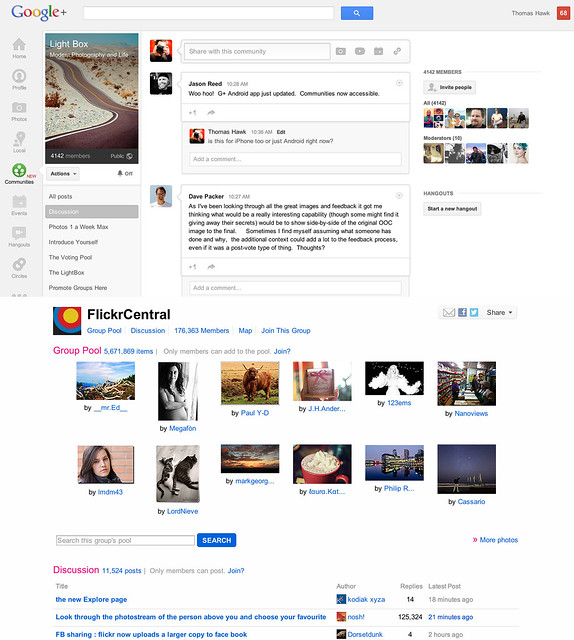
Google+ launched their new communities last week and I’ve spent a lot of time exploring how they work since launch. I’ve also spent quite a bit of time super active over the past eight years in Flickr groups. Google+ communities are a lot like Flickr groups, but there are key differences, advantages and disadvantages to both. I thought I’d write a post comparing the two. I’ve long held that Flickr groups represent Yahoo’s best chance for social going forward.
So here’s the smackdown.
1. Thread bumping. Flickr wins. Probably the most significant problem with G+ communities is that they do not bump threads. With Google+’s new communities discussion topics are only shown by most recent post. Unfortunately the most recent post is not always the most interesting/engaging post. What’s more, because threads are not bumped upon a new comment, almost every thread over 24 hours in an active community on Google+ dies. Good conversations should last more than 24 hours. Flickr solves this problem by simply bumping each thread back to the top of the discussion forum anytime someone makes a comment on it. This is a far better way to keep a discussion forum active and engaged.
2. Muting discussions. Google+ wins. One of the problem with Flickr is that there is no way to screen out discussions that you are not interested in. If I don’t care about football, why should I have to see a thread about football in my favorite photography forum. At Google+ the answer is simple. Just go to the thread and choose to “mute this post.”
3. Photo pools. Flickr wins. At G+ you are forced to try to use typical discussion threads to post photos. Flickr, by contrast has a group photo pool that is associated with each group. Although it’s tempting to see photo pools as more of a photography niche feature, I’d argue that every community potentially has photos to share. Even if the photos are not artistic oriented photography, every group of people will potentially want to share photos with each other. Ideally, a group/community should be allowed to have more than one photo pool/album with settings to allow how content can be shared in those pools.
4. Community activity. Google+ wins. Even less than two weeks old, communities on Google+ are far more active than Flickr. Individuals are far more engaged and the rate of velocity around community conversations is much higher at Google+.
I started a new community called Light Box on Google+. It’s based on a voting game similar to voting groups I’d created on Flickr in the past. On Google+ the group already has over 4,000 members in less than a week. At Flickr it would take me months to build a group up that large. The G+ community is already 20x more active than any voting group/game I’ve ever seen on Flickr. When it comes to community velocity there is simply no comparison. Google+ communities are some of the most active I’ve ever seen anywhere on the web.
5. Invite process. Google+ wins. Google allows you to invite participants in circles up to around 195 people max. Sending out one invitation to 195 people is a lot easier than the way that Flickr allows you to invite people. On Flickr you can only invite a single member one by one by one by typing their individual name — wayyyyy too much work.
6. Sticky threads. Flickr wins. One of the thing Flickr allows a group owner/moderator to do is to make certain threads sticky so that they always stay at the top of the discussion threads. This is helpful if you have a group/community FAQ or other material that is important to stay prominent to the membership. At present you cannot make sticky threads at Google+.
7. Adult oriented communities. Flickr wins. Although there are some deep underground private communities on G+ focusing on nudes, G+ by TOS doesn’t allow nudity and this content is subject to being removed. On Flickr, they do allow nudity as long as it is properly flagged as nudity. In Flickr’s case this has resulted in both communities discussing artistic fine art nudes, but also a pretty seedy amateur underground porn network as well. Flickr routinely deletes many of the most offensive adult oriented communities, but if fine art nudes are your thing, you’re probably more likely to find these communities on Flickr than G+.
8. Moderating community membership. Flickr wins. It’s much easier to moderate community members in Flickr groups than in Google+ communities. On G+ you must scroll through an entire list of community members in order to find the person you wish upgrade to moderator or ban from your community — page after page after page after page. With any large community on G+ this is a very cumbersome process. Flickr by contrast has a powerful search tool which allows you to search for a member my name to upgrade or ban them.
9. Blocking members. Google+ wins. It cannot be overstated how important a good blocking tool is to community management. Inevitably some community members will not get along. Especially since Flickr allows obvious anonymous troll accounts to inhabit communities, users need some way to immediately protect themselves against bullying and harassment. Flickr’s community blocking tools are weak and non-existent. By contrast Google+ provides users a powerful blocking tool which turns anyone invisible that you choose to block.
Even more important than this user option is the tone that is set in communities because of it. When you know that you can be blocked by other people you are nicer and more polite. I wrote a post a while back about how Google+ is the nicer community for photographers on the web. Flickr groups are routinely full of trolls, jerks and assholes. Even the ones who are tolerable oftentime pride themselves on abusing other community members with their snide, disparaging comments. They think it’s cool to be “snarky.” On Google+ these people are routinely dismissed and blocked and the overall tone is far more positive.
10. Mobile tools. Google+ wins Earlier this week Flickr rolled out a new version of their iPhone app that has a simple thread reader for Flickr groups. The app is AWESOME by the way. When Google+ rolled out communities last week they did not have support for mobile, but today they added it for both iPhone AND Android. I would suspect that a group thread reader will be coming to a future Android app for Flickr.
11. Group/Community recommendation. Google+ wins. On Flickr I am recommended groups that are years old, super dead and with zero activity in them. These are old groups that some Flickr employee chose to highlight years ago. By contrast on G+ I’m recommended communities that really are personally directed and targeted towards me. These are communities that are thriving and active. I’m guessing that there may be some Google curation of these recommendations, but what I’m seeing feels much more algorithmically based and the algorithm recommending communities on G+ feels super smart and personalized to me.
12. Hangouts. Google+ wins. From time to time you will want to get more involved with the members of your community than just discussion threads. With Google+ you can hold a hangout and do live video/voice interaction with other members through Google’s hangout feature. Flickr doesn’t have anything like this.
13. SEO. Google+ wins. While both Google+ and Flickr offer you private communities with an option to not index the community for the web, both also allow public communities that can be indexed for the web. With any public community you will want to have your community index well in search on the web. Google promotes Google+ posts by the people that you follow — if you are searching for a group on the web, there is a much better chance that you will find groups by your friends on Google+. Already my new Light Box group indexes for the first page search results for Light Box when I search regular Google and am logged in. Personalized search gives your group an advantage for being found on Google by your contacts and friends.
The final verdict? Google+ communities win. In my opinion Google+ communities are far more engaging, active, positive places to hang out than Flickr groups. As much as I enjoyed Flickr groups in the past, I think all of my community time going forward will be happening on Google+ instead. While I’m optimistic that team Flickr can/should create a better group experience for users, it may be too little too late at this point.
While Flickr does have Google+ beat on some important features like thread bumping and photo pools, these features are not enough to make up for the current velocity and dynamic advantage that Google+ communities have. Social photographers have been leaving Flickr groups over the past few years as they’ve been setting up camp at G+. Now G+ gives them the one thing that they missed from Flickr, a solid community experience. I suspect that communities on G+ will only get better and better in the weeks ahead. Google+ tends to release things in beta form, bugs and all, and then iterate very rapidly. I’m confident that some of their limitations today will be improved in the future. Hopefully they even give us thread bumping and photo pools like Flickr.
Carl Zeiss has announced its annual photo contest for images shot with one of its lenses. Any Zeiss lens is considered valid, from Nokia smartphones through Sony compacts, such as the RX100, to the company’s high-end interchangeable lenses. This year’s theme is ‘The moment that knows no limits’ and first prize is one of the company’s manual focus SLR and rangefinder lenses, with a variety of other Zeiss-branded prizes for runners-up. The contest runs on Flickr until January 15th.
A New York tabloid newspaper has caused controversy by publishing an image of a man about to be killed by a subway train on its front cover, along with a dramatic headline. The image shows a subway train bearing down on a man who’d been pushed into its path. The paper’s handling of the story has been widely criticized and it raises a range of issues over the actions of all the parties involved. Journalism school The Poynter Institute has an interesting summary, separating the different aspects about a controversy that brings a lot of difficult questions about photojournalism and news reporting. What do you think?
Carl Zeiss has announced its annual photo contest for images shot with one of its lenses. Any Zeiss lens is considered valid, from Nokia smartphones through Sony compacts, such as the RX100, to the company’s high-end interchangeable lenses. This year’s theme is ‘The moment that knows no limits’ and first prize is one of the company’s manual focus SLR and rangefinder lenses, with a variety of other Zeiss-branded prizes for runners-up. The contest runs on Flickr until January 15th.




 These photo gift tags have as much personality as the people on your gift list.
 First things first, we’ve made this handy template to help you make these awesome photo gift tags.
 Pick your favorite photo of each person on your gift list.
  Print out your edited, sized photos on to cardstock.
 Use your scissors to trim your photos to the printed edge.
 Now it’s time to trace the gift tag template onto your images.
 Using your Xacto knife and a cutting surface, carefully cut along the lines you just drew.
 Use a hole punch to cut out a center hole for the string to go through.
 Cut enough string for the number of tags you made.
  Attach your gift tags to your presents in your favorite method.
 Place those fancy packages under your tree, in stockings, or just pass them out for everyone to enjoy.
