RSS
 

Posts Tagged ‘Over’

World’s Longest Pedestrian Suspension Bridge Stretches Over 1,000 Feet

04 Aug

[ By SA Rogers in Drawing & Digital. ]

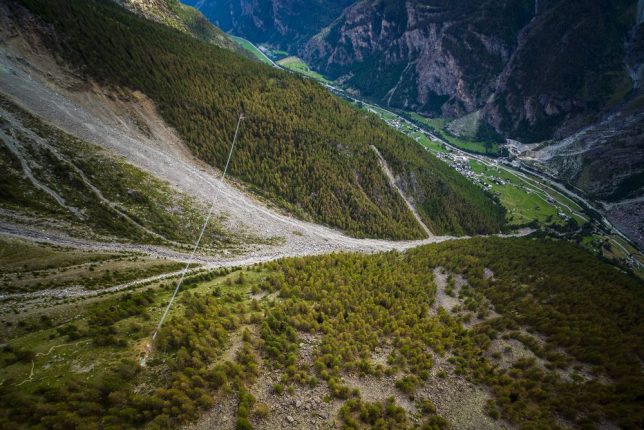
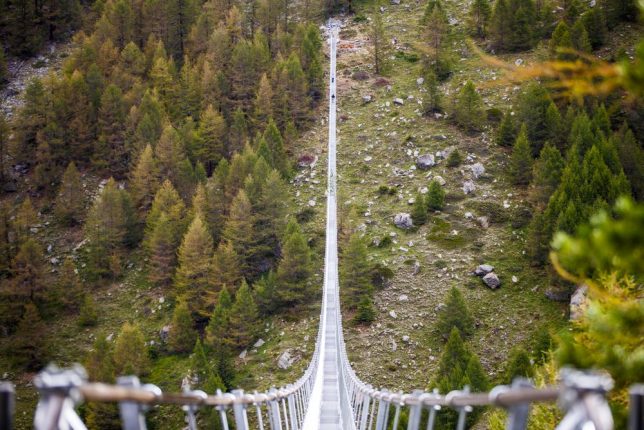
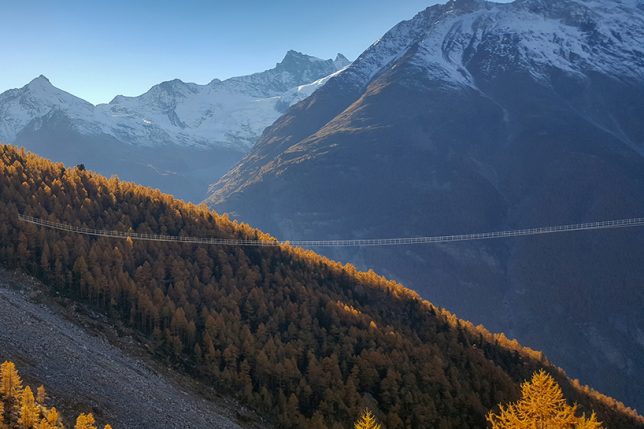
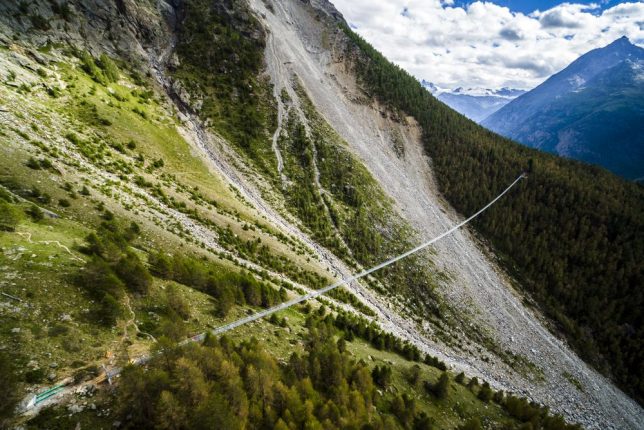
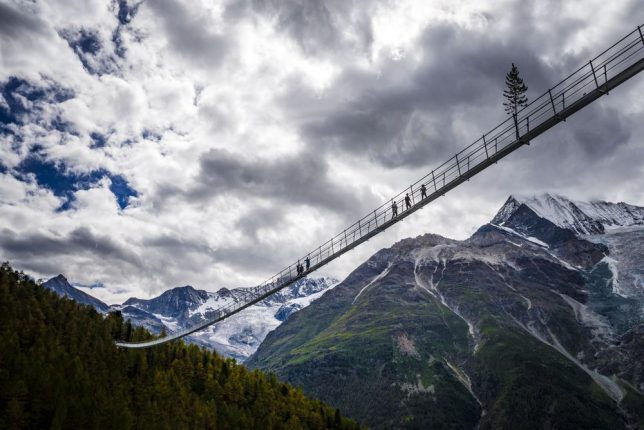
Three hundred feet above the valley floor, a suspension bridge gently sways and bobs as pedestrians cross its 1,621-foot length through the Swiss Alps. These impressive stats have helped the Charles Kuonen Suspension Bridge in Switzerland break previous records, making it the longest pedestrian suspension bridge in the world.

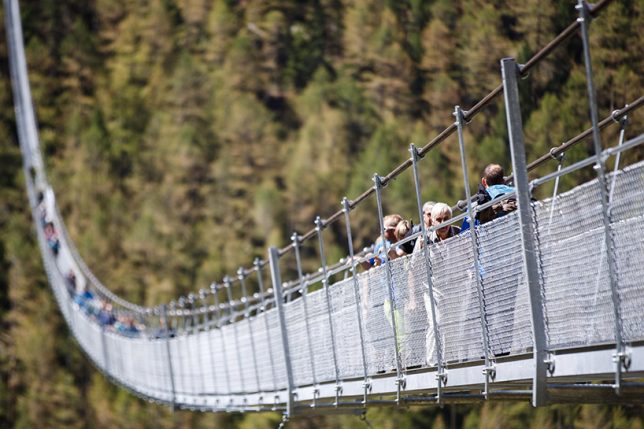
Sure, the glass-floored bridge in China is higher and forces you to look down from your precarious position, but this bridge is almost as scary, considering that it’s not stationary and measures just two feet wide. That means you have to march down its length single-file, making it harder to clutch onto others for dear life.

The bridge was completed in 10 weeks by Swissrope and offers magnificent views of the surrounding mountains, including the Bernese Alps and Matterhorn (if you manage to look up and enjoy them instead of staring at your feet and trying not to hyperventilate.) It features a grated metal floor, runs between 5,000-7,000 feet above sea level, and takes ten minutes to walk cross. The pass through the mountains previously took four hours to navigate.

Photos taken from the air (provided by the Switzerland Tourism Board) give us the best idea of the bridge’s scale. The Charles Kuonen Suspension Bridge links two sections of the Europaweg hiking trail, a two-day link between the towns of Zermatt and Grächen, and replaces an older bridge that was damaged by falling rocks. It’s named for its primary sponsor.

Share on Facebook


[ By SA Rogers in Drawing & Digital. ]

[ WebUrbanist | Archives | Galleries | Privacy | TOS ]


WebUrbanist

 
Comments Off on World’s Longest Pedestrian Suspension Bridge Stretches Over 1,000 Feet

Posted in Creativity


Former Google SVP prefers iPhone over Android for mobile photography

01 Aug

Vic Gundotra was an SVP of engineering at Google for almost eight years before leaving the company in 2014, and heavily involved in running Google’s mobile initiatives. However, despite being one of the main drivers behind Android from 2007 to 2010, Gundotra appears to prefer Apple’s iPhones over Android devices, at least for photography.

In a Facebook post, Gundotra called the results of the background-blurring iPhone 7 Plus portrait mode “stunning” and “the end of the DSLR for most people”. When replying to comments on the post he went on the say that, in terms of imaging, Android phones were years behind the iPhone:

Here is the problem: It’s Android. Android is an open source (mostly) operating system that has to be neutral to all parties. This sounds good until you get into the details. Ever wonder why a Samsung phone has a confused and bewildering array of photo options? Should I use the Samsung Camera? Or the Android Camera? Samsung gallery or Google Photos?

It’s because when Samsung innovates with the underlying hardware (like a better camera) they have to convince Google to allow that innovation to be surfaced to other applications via the appropriate API. That can take YEARS.

Also the greatest innovation isn’t even happening at the hardware level – it’s happening at the computational photography level. (Google was crushing this 5 years ago – they had had “auto awesome” that used AI techniques to automatically remove wrinkles, whiten teeth, add vignetting, etc… but recently Google has fallen back).

Apple doesn’t have all these constraints. They innovate in the underlying hardware, and just simply update the software with their latest innovations (like portrait mode) and ship it.

Bottom line: If you truly care about great photography, you own an iPhone. If you don’t mind being a few years behind, buy an Android.

Apple’s portrait mode doesn’t come without its limitations, but it’s probably fair to say among all the various incarnations of depth or bokeh effects we have seen so far it is the best performing. On the other hand some Android smartphones, such as the Google Pixel or HTC U11, offer an advantage over the latest iPhone models in terms of detail resolution and textures.

So, like with so many things, the smartphone camera that is best for you depends a lot on your personal requirements. Vic Gundotra definitely seems to have made his mind up, though. In another post he says he “would NEVER buy an Android phone again if I cared about photography.” Do you agree? Let us know in the comments.

Articles: Digital Photography Review (dpreview.com)

 
Comments Off on Former Google SVP prefers iPhone over Android for mobile photography

Posted in Uncategorized


Richard Prince must face lawsuit over image theft, judge rules

28 Jul

Controversial artist Richard Prince must face a lawsuit over his unauthorized use of photographer Donald Graham’s photo ‘Rastafarian Smoking a Joint,’ a federal judge has ruled. The ruling concerns a 2015 lawsuit Graham filed against Prince after he failed to heed a cease and desist order. Prince and Larry Gagosian, owner of the Gagosian Gallery where the pilfered image and others were displayed, had claimed the work is ‘transformative’ in an effort to have the case dismissed.

Real Bongo Nyah man a real Congo Nyah ? repost @indigoochild

A post shared by Jay Kirton Kwame Ka Asante (@rastajay92) on

Though Prince has managed to escape past lawsuits unscathed, this latest one may prove different. Talking about the ‘transformative’ claims, U.S. District Judge Sidney H Stein stated, “The primary image in both works is the photograph itself. Prince has not materially altered the composition, presentation, scale, color palette and media originally used by Graham.”

Graham’s version of the image was acquired from another Instagram account where it was featured; he had it enlarged and printed with his own Instagram-style comment beneath the original user’s caption. The exhibit at Gagosian contained a total of 38 of these ‘borrowed’ images, including the Rastafarian photo cited in the lawsuit. The court’s ultimate ruling on the lawsuit could set a major precedent for fair use as it relates to Instagram images.

Via: New York Times

Articles: Digital Photography Review (dpreview.com)

 
Comments Off on Richard Prince must face lawsuit over image theft, judge rules

Posted in Uncategorized


Photographer sues Procter & Gamble for $75M over copyright violations

19 Jul

Mega-company Procter & Gamble is being sued by Cincinnati-based photographer Annette Navarro, who alleges that P&G used some of her photographs beyond the time frame and region for which she was paid.

The company allegedly paid to use Navarro’s photos cited in the lawsuit for the duration of three years and only within North America, but continued to use them after the three years had expired, and put them on international products as well. If found guilty of copyright violations, Procter & Gamble could be on the hook for more than $ 75 million in damages.

According to the lawsuit, Procter & Gamble licensed some of Navarro’s photos for the North American market alone, something allegedly done as a way to reduce costs. However, complaints from modeling agencies alerted Navarro to the images’ use beyond the region for which they were licensed. Though P&G has since paid those modeling agencies, Navarro rejected the company’s proposed payment due to uncertainty about the extent of P&Gs alleged violations.

The complaint, which was filed with the U.S. District Court for Southern Ohio on June 14, also cites Saatchi & Saatchi X and LPK as defendants. Procter & Gamble hasn’t yet issued a statement on the lawsuit.

Articles: Digital Photography Review (dpreview.com)

 
Comments Off on Photographer sues Procter & Gamble for $75M over copyright violations

Posted in Uncategorized


Five reasons to choose a PC over a Mac for photo and video editing

18 Jul

Photographer Manny Ortiz uses both Windows and Mac computers to edit his photos and video work, so when it came time to choose his next laptop he had a choice: 15-inch MacBook Pro or spec-ed out Dell XPS 15. He chose the PC, and in this video he offers the top 5 reasons why he made that choice.

Most Mac vs PC opinions are put out there by people who are heavily invested on one side, which is what makes Ortiz’ point of view refreshing. He has no loyalty. He uses both systems regularly, and spends the last part of the video praising the Mac for its various strengths. Still, when it came time to plunk down a couple grand on a new machine, he chose the PC.

Here’s why:

  1. Money – The spec-ed out Dell cost $ 1,000 less than an equivalent MacBook Pro
  2. Ports – The new MacBook Pros have been lambasted for their lack of ports, and Manny doesn’t hold back either. The dongle life is not for him.
  3. Ability to Upgrade – With the MacBook, what you buy is what you get. If you’re thinking of upgrading the RAM, or swapping out the SSD, forget about it. With the latest builds, it’s all but impossible.
  4. Touchscreen – This one is very subjective, but for Manny, the touchscreen on the XPS is a big win.
  5. Nvidia GTX 1050 GPU – Manny isn’t implying the Radeon Pro chips in the MacBook Pros aren’t great, but he’s had nothing but good experiences with the Nvidia GTX 1050 inside the Dell.

And that’s it. Obviously, there are a lot of other factors you could mention here—wins for both the PC and the Mac—but for Manny the decision was simple. The hardware on the PC was better, and he was getting it for $ 1,000 less.

Ever since the new MacBook Pros with their lack of ports came out, many photographers have been talking about switching to PC for their mobile editing needs. Have you considered it? And why would you choose one over the other? Let us know in the comments.

Articles: Digital Photography Review (dpreview.com)

 
Comments Off on Five reasons to choose a PC over a Mac for photo and video editing

Posted in Uncategorized


Time-lapse captures thousands of fireworks going off over LA on July 4th

10 Jul

Photographer and creative director Dylan Schwartz may have shot the viral fireworks time-lapse of the year this July 4th. Over the course of three hours, Schwartz captured thousands of fireworks going off above LA from his vantage point at Mount Wilson Observatory.

Schwartz shared the story behind the timelapse with Time, telling the magazine, “Everything is spread out in L.A. To really see what L.A. does for the Fourth of July, you have to see the whole thing.” Even with this wide shot captured from 5,700+ feet above LA, Schwartz still says he only captured “a slice.”

According to Time, the final time-lapse is a composite of nearly 250GB of stills and video shot with 4 different cameras. Schwartz used a Sony a9 (he’s a Sony ambassador) with a 70-200mm lens to capture both video and stills of the widest perspective, another camera for video exclusively, and two more were shooting stills of various key locations.

Six hours of editing later, the time-lapse above was ready for posting on social media, where it immediately took off. Here’s an even closer crop posted to Schwartz’ Instagram account. Enjoy.

A post shared by Dylan Schwartz (@dylan.schwartz) on


Articles: Digital Photography Review (dpreview.com)

 
Comments Off on Time-lapse captures thousands of fireworks going off over LA on July 4th

Posted in Uncategorized


Have Fun with Boomerang Over and Over Again

20 Jun

When it comes to phoneography one of our very favorite apps is Boomerang.

Well, it was our fave, then not anymore, then it came back. And we threw it out again, and it came back. (hehe)

The Boomerang app films a tiny clip then plays it back and forth in a loop forever (or three times if you post it as an Instagram story), just like magic. So why is that useful?

Oh you can do the most amazing things with Boomerang. Read along to see all our favorite tricks. From levitation to magical hair-doin’.
(…)
Read the rest of Have Fun with Boomerang Over and Over Again (376 words)


© laurel for Photojojo, 2017. |
Permalink |
No comment |
Add to
del.icio.us

Post tags:

The post Have Fun with Boomerang Over and Over Again appeared first on Photojojo.


Photojojo

 
Comments Off on Have Fun with Boomerang Over and Over Again

Posted in Equipment


Move over Nikon: Gitzo celebrates 100 years with pricey, limited-edition tripods

20 Jun

Gitzo is celebrating 100 years since the founding of its brand by Arsène Gitzhoven, and to commemorate the occasion they’ve released two special edition tripods. The 100 Year Anniversary Edition Tripod features a ‘new high-appeal look and feel’ as well as features standard on the Traveler Series tripods: Carbon tubing, 180-degree leg folding and the company’s G-lock mechanism. Only 1917 of them will be sold, but if that’s not exclusive enough for you, there are only 100 Arsène Gitzhoven Traveler Tripods to be had.

The Arsène Gitzhoven Traveler features an all-carbon fiber construction. Each one will be laser engraved with its production number from 1/100 to 100/100 as well as an engraving of its owner’s signature. It’ll set you back $ 3000; the 100 Year Anniversary Edition will sell for $ 1500. Each will be available from ‘select dealers.’

$ (document).ready(function() { SampleGalleryV2({“containerId”:”embeddedSampleGallery_1432857610″,”galleryId”:”1432857610″,”isEmbeddedWidget”:true,”standalone”:false,”selectedImageIndex”:0,”startInCommentsView”:false,”isMobile”:false}) });
Articles: Digital Photography Review (dpreview.com)

 
Comments Off on Move over Nikon: Gitzo celebrates 100 years with pricey, limited-edition tripods

Posted in Uncategorized


Sea Monsters: Massive Crocheted Sea Urchins Float Over Singapore

14 Jun

[ By SA Rogers in Art & Installation & Sound. ]

Mutant sea urchins seem to have evolved into monstrous, buoyant creatures capable of rising above the surface of the sea, glowing softly against the skyline in Singapore. Made from crocheted lace, these three oversized urchin installations by Choi + Shine invite passersby to pause within them and take in the city through their patterned shells.

Created for this year’s i Light Marina Bay Festival, which focuses on sustainability, The Urchins are hand-crafted and interactive, each one hanging high enough to dwarf even the tallest visitors. Made from UV- and weather-resistant polyester cord stretched on an aluminum frame, the urchins hang from ultra thin cables.

“At night, the mysteriously hovering and glowing large Urchins create a sense of magic as if time has stopped,” says Choi + Shine. “When viewers enter into the Urchins, they will be surrounded by a single layer of glowing, lacy surface, where they can enjoy the detail and texture of the Urchins and see the city, water and the sky through this visual filter.”

“When other viewers see the occupants in the Urchins, the occupants will glow within the lacy room, creating an illusion of ethereal levitation of the occupants, while the occupants become a part of the artwork.”

Share on Facebook


[ By SA Rogers in Art & Installation & Sound. ]

[ WebUrbanist | Archives | Galleries | Privacy | TOS ]


WebUrbanist

 
Comments Off on Sea Monsters: Massive Crocheted Sea Urchins Float Over Singapore

Posted in Creativity


Shooting experience: how the Nikon D7500 won me over

13 Jun
Initially, the D7500 was going to be my secondary camera for a music festival I was shooting, and the D750 was going to be my primary. But ultimately I ended up using the D7500 more.

The arrival of the Nikon D7500 to our office coincided with one of my favorite annual Seattle events, the Big Building Bash, an all-day music festival held in the city’s industrial SoDo neighborhood.

Ordinarily I shoot music with a Nikon D750 and two primes, which vary depending on the space I’m shooting. I run a small publication – along with a group of contributors – documenting the DIY aspects of Seattle’s music community. This mostly means shooting in small, intimate spaces where multiple camera bodies or big lenses would likely raise an eyebrow or two.

But Big Building Bash is a bit more casual in nature than a show in someone’s living room, so I felt comfortable bringing two bodies. My kit included: The D750 with a 24mm F1.8G as my primary camera and the D7500 with an 85mm F1.8D as my secondary. Switching lenses between the two cameras effectively gave me four (equivalent) focal lengths.

Big Building Bash is a charming little music festival held under the West Seattle Bridge in SoDo’s warehouse district. It is a showcase of Seattle’s best up and coming music, with no real emphasis on a specific genre. This leads to a vast array of acts and shooting scenarios, with the strong sun cutting through highway overpass pillars and the occasional passing train engine only adding to the overall charm.

We got to the festival as the first bands on the schedule were starting to play. With attendees trickling in and the mid afternoon sun shining bright and direct, I started dialing in my preferred camera settings.

AF Fine Tune

I fired a couple of test shots with each camera and noticed that the 85mm on the D7500 was front-focused. No problem, the camera has auto AF Fine Tune. A nifty, though strangely hidden feature that automatically corrects front or back focus. It’s great for primes, but less useful for zooms, as only one adjustment value can be saved. A quick Google search pulled up our own video, revealing how to unlock this feature. Within moments my 85mm was perfectly calibrated. It was time to get shooting!

I found myself switching the two lenses back and forth between my camera bodies. I’d forgotten how much I enjoy shooting with both a crop sensor and full frame body. The reach of the 85mm on the D7500 proved extremely useful and I appreciated also being able to go as wide as 24mm with the D750. However 35mm is probably my favorite focal length, so the 24mm on the D7500 was also a joy to use.

3D tracking

I’m a creature of the night, and adjusting to live music in a bright environment took some brain rewiring. Normally, I dial in all my settings manually including ISO, and shoot using AF-C and a single, manually chosen point (the center point if it’s really dark). Instead, I switched both cameras to Auto ISO and decided to give 3D tracking a go on the D7500.

The D7500, D7200 and D750 all use the same 51-point AF system. But each has a different metering sensor, which is also used for image recognition. The metering sensor in the D7500 is borrowed from the company’s flagship APS-C DSLR, the D500, and is the highest-res of the bunch: ninety times higher than the D7200 and twice that of the D750.

3D tracking allowed me the freedom to frame as I pleased, as long as my subject fell within the AF coverage area.

I’d used 3D tracking before while writing about the Nikon D5 and was impressed by its reliability. The D5 also uses the same resolution metering sensor as the D7500, but with triple the AF points. And while the D750 and D7500 use the same 51-point AF system, the AF area covers far more of the D7500’s APS-C sensor than it does on the full-frame D750. The limited AF area coverage and the generally low light nature of my work are the reasons I do not often use 3D tracking on my personal camera.

The AF coverage on the D7500 is the same as on the D7200. However the metering sensor, used for image recognition, has been substantially upgraded.

And my inexperience using/trusting 3D tracking on anything other than the company’s most expensive body lead me to commit the unholy act of ‘chimping’ several times during the first band. In my defense, I did this just to be absolutely certain I was actually getting sharp, in-focus shots. Thankfully Carey Rose has set the ‘OK’ button on the D7500 to zoom images in playback to 100% on the focus point. This made double checking sharpness quite simple.

This was one of the very first frames I shot on the D7500 using 3D tracking. Once I trusted its capability, I was free to concentrate on composition.

Once I felt I could trust the subject recognition, it didn’t take long to get hooked on using the D7500’s 3D tracking. The camera stuck to my subjects of choice with ease. And the 51-point AF system provided enough coverage so that I could even place subjects close to the edge of the frame.

‘It didn’t take long to get hooked on using the D7500’s 3D tracking. The camera stuck to my subjects of choice with ease.’

Ultimately 3D tracking freed me up from having to think about autofocus and allowed me to simply concentrate on composition and exposure, which in turn lead me to use the D7500 as my primary camera for the duration of the festival. That plus I liked the reach of the 85mm on it.

Drummers with long hair are photographic gold. I used the camera’s 8 fps continuous drive to try and get the perfect frame.

Burst, buffer and tilting touchscreen

I don’t normally shoot in continuous drive mode, but with an 8 fps burst and a super-deep buffer of 50 Raw files or 100+ JPEGs, I figured, I’d give it a try. An eccentric drummer provided the perfect opportunity to fire off a long burst. After looking back through those images, I decided to keep the camera in continuous drive mode for the duration of the festival, figuring I might as well come back with as many photos to choose from as possible.

The tilting touch LCD also proved useful: I use Live View on my D750 occasionally, but moving the AF point with the D-pad is a slow and annoying process. With the D7500 I could simply tap on the area I wanted to focus on. Of course, AF in Live View is contrast detect only, so speeds are a bit sluggish.

I used the tilting touch LCD to frame this shot toward the start of the show. This was the view from the beer garden. Did I mention the D7500 has great weather beer-sealing? Because it does.

Other takeaways

As the festival pressed onward, and I became comfortable with my chosen settings, I slipped into autopilot mode and simply tried to enjoy and photograph as many bands as possible. It wasn’t until hours later, with the sun dropping behind the buildings, that I started to lose my faith in 3D tracking and switched to old-fashioned AF-C using a single point. To be honest, switching back felt downright prehistoric after a full day of near-compositional freedom.

I ended up shooting over 8 hours and in that time I put away 2,542 images (Raw + JPEG) with 3/5 battery still left. Not bad for a camera with a CIPA rated battery life of 950 shots per charge.

This was one of the last frames I shot using 3D tracking. As the band Snuff Redux finished their set, the sun ducked behind the buildings and I switched back to AF-C using one point.

Ultimately, I brought the D7500 along to Big Building Bash thinking I’d get some time to test it for work. But I photographed the show primarily for my own purposes/publication and as such, getting the shot was paramount to testing gear. Still, if nothing else, I figured the D7500 would be a good compliment to my trusted D750. But it turns my D750 was more a compliment to the D7500.

Note: Images in this story are all JPEGs edited and occasionally cropped to taste (no ACR support yet). You can see the original out-of-camera JPEGs in the sample gallery below.

$ (document).ready(function() { SampleGalleryV2({“containerId”:”embeddedSampleGallery_9200575231″,”galleryId”:”9200575231″,”isEmbeddedWidget”:true,”standalone”:false,”selectedImageIndex”:0,”startInCommentsView”:false,”isMobile”:false}) });
Articles: Digital Photography Review (dpreview.com)
 
Comments Off on Shooting experience: how the Nikon D7500 won me over

Posted in Uncategorized