RSS
 

Posts Tagged ‘Offer’

CP+ 2017 – Sony interview: ‘We need to offer new imaging experiences’

04 Apr
Yasuyuki Nagata – Senior General Manager Business Unit 2, Digital Imaging Group Imaging Products and Solutions Sector, Sony Corporation. Pictured at CP+ 2017 in Yokohama, Japan. 

Earlier this year, we traveled to the CP+ trade show in Yokohama, Japan. At the show, we met with senior executives from several major manufacturers, including Yasuyuki Nagata of Sony. During our interview we discussed the future of the a7-series, Sony’s strategy for growing the 1-inch camera segment, and the new a99II.

Please note that this interview has been edited slightly for clarity and flow.


Nikon recently canceled the DL series, which would have competed with the RX100-series. Is this good or bad for Sony?

It’s both good and bad. If Nikon had achieved a high-quality wide lens camera with a 1 inch sensor, that would have been a very competitive product. So in that sense, it’s good for us. But actually, from the perspective of driving the 1 inch sensor market, we want to stimulate this market and that means multiple manufacturers.

What is your general strategy for FE lenses in the future?

We’re launching products based on customer feedback – especially professionals. When we started the Alpha a7 series we only had three full-frame mirrorless (FE) lenses, but after we launched the a7R II, a lot of professionals started to use it. So their voices [became more important]. For example they wanted a 24-70mm F2.8, which is why we prioritized that model. So basically our strategy is to listen to our customers.

The GM 24-70mm F2.8 was a lens that Sony’s professional full-frame users wanted the company to make, according to Mr Nagata. 

In the past, we’ve heard that Sony wants to create some longer sports optics. is that something that is being planned in the future?

If a lot of professional photographers [want those lenses] we will have to create them. But for now, our main professional user base is portraits and landscape photographers.

Do you aspire to having a base of professional sports photographers in future?

Maybe. Of course it’s not just the lens, it’s the body as well.

The Olympics in Tokyo is three years away – would you like to see Sony lenses in the arenas alongside Canon and Nikon?

Of course, that’s our dream. And we won’t give up on that. But it’s hard to make a specific comment on future products.

How long will it be before mirrorless products represent the majority of cameras at large sporting events?

I don’t know! Historically, I believe it took Canon 7-10 years to become the dominant brand at professional sports events. It’s not easy. But a lot of professional photographers have already switched from DSLR to mirrorless. Maybe in some cases, we are already satisfying the needs of some sports photographers.

The Sony a7R II is a capable stills camera, but fits equally as easily into a professional 4K video workflow. 

Speaking about the a7-series lineup, how does your customer base divide up in terms of stills photographers versus videographers?

We don’t divide our customers in this way. Most of our customers shoot both video and stills, currently. Until a few years ago, video and stills shooters were totally different, but recently, portrait and wedding photographers have started shooting video too.

We always consider both kinds of users at every stage of development.

Moving on to the RX series, there are a lot of products now, and you’re leaving older models in the lineup – what is your aim with this strategy?

It depends on the region. By adding RX100 models 1-5, we expanded the 1 inch sensor market, and in most regions we enjoy #1 market share. The 1 inch sensor market was developed by Sony, and then other competitors started joining us.

[As such] we started with 100% market share, but even now we enjoy 60-70% market share in most regions. And our high-technology models like the RX100V drives some of that, but for the cost of one Mark V, you can buy three of the original RX100. So the cost factor is also important. With both entry-level and high-end RX models, we hope to be able to drive the 1 inch sensor market and remain at number 1.

The Cyber-shot RX100 V packs a lot of features into its pocketable form-factor, but Mr Nagata insists that older RX models still have their place in the market. 

We understand some of the comments we get from dealers, that because of this strategy they have to carry all five models, which might not be efficient for them, but realistically, those dealers ‘cherry pick’ the models they want to carry. Maybe in an area like the US it doesn’t make sense to [sell] all five models, but in developing countries, the Mark I and Mark II are crucial.

The earthquake last May caused a good deal of disruption – what was the effect on the camera division?

From a supply point of view, we had a month or so’s worth of product in stock. So the effect on our supply chain didn’t really kick in until the June, July timeframe, depending on the model. One inch sensors are easier to make than full-frame sensors, which require at least 2 months to manufacture, so the effect was more profound on full-frame sensors than one-inch. But it was all back up and running by the end of 2016.

What kind of feedback do you get from professionals that have switched from DSLRs to mirrorless?

Some professional photographers have said that G Master lenses were a trigger for switching, and also the [new] STF 100mm lens. Thanks to the short flange-back distance, a lot of E mount customers can use their own lenses with a7 cameras. That’s a benefit of the system. And after they’ve switched to an a7 body, people tend to switch over completely and buy Sony lenses.

Smaller body size is a big factor, and silent shooting is important too.

Is the lens attachment rate different from an a6500 to an a7-series camera?

It’s totally different. Even from the a7 to the a7R II, the attachment rate [with the a7R II] is almost double. From the a6000 to the a6500, again it’s completely different.

What are your plans for developing your pro support network?

We’ve started pro support, but we’re still learning. Professional photographers travel all over the world, so how to provide consistent support not just in their home country, but globally is very important for us.

Sony has ambitions to expand and improve its PRO Support network for professional alpha users. 

Was the choice of a smaller, lower-endurance battery in the a7 series made deliberately to keep the camera size small?

We are fully aware of this feedback. Right now, we’re not getting any negative commentary about the size of our a6000-series and a7-series cameras, so there’s probably no need to make them any smaller. There’s a balance between the size of the body and lens, too. So just making the body smaller doesn’t make much sense. And I’m afraid I can’t comment on how we will tackle this issue without commenting on future products, so I can’t say anything more.

Is Sony interested in joining the 360 imaging market?

We already have an action camera lineup, and it’s a similar category. The market itself is kind of shrinking, so instead of having one camera for 360, we’d probably prefer to support professional users, making 360 imaging using our a7-series and a rig. Rather than chasing after the consumer segment.

Do you see more growth in the high-end of the market in general?

I believe so. Which is why pro support is getting more important for us. But of course it cascades down to lower-end models too, and we don’t deny the important of the entry-level segment.

What’s the most important thing that Sony has to do to maintain its position in the next few years?

We need to offer new imaging experiences. We made the NEX series – APS-C mirrorless. That was a new experience. The RX100, the full-frame a7-series, G Master lenses – STF, too. It’s a new imaging experience. Sony is by far the number 1 sensor manufacturer, and the advantage of this is that is allows us to work together with sensor engineers to create the best image sensor for a specific model we are developing. so we’re aware of the sensor development schedule for the next two or three years. So we know what kind of future is coming, in terms of sensors, so we can plan ahead – what kind of bodies will be required, and what kind of lenses will required. We can take advantage of that.

When it comes to core technologies, we’re making lenses sensors, we’re making imaging sensors, we’re making LSIs and we have a software division. Some of our customers couldn’t believe we made an autofocus STF lens. It’s not easy. But we know light travels through lenses, and we know how light is detected on the sensor. So the total combination [of these technologies] means we can make that product.


The recently-announced a99 II is proof that the A-mount is still a going concern. According to Mr Nagata, Sony needs to maintain the A mount alongside the E mount. 

In the SLT lineup, development is slower than the a7-series. Where will that line go in the future?

Having options is really important, especially for high-end amateurs and professionals. If we just had the same cameras and lenses [as our competitors] the results would be the same. Some people want A-mount, some want E-mount, and depending on the situation, some customers might want both. Having that variety of bodies and lenses is key.

We need both A mount and E mount. Some people thought that Sony was only developing the E mount, until we introduced the a99 II. You’ve seen it, it’s a serious camera. There is a huge number of lenses for A mount, from Sony and Minolta, and we want to maintain a good relationship with those customers by providing great A mount bodies with no compromises compared to the E mount system. But we can start capturing new customers with the E mount. We we need both.

In the long term, do you want those A mount customers to come over to E mount?

That depends on them.

Will we see more A mount lenses, specifically designed to get the most out of the A99 II’s autofocus technology?

We have to prioritize. It’s not easy developing new lenses. Our customers’ expectations are very high, especially after we launched the G Master series. So we can probably only launch a few lenses a year!


Editors’ note:

It was interesting to speak to Mr Nagata in February. This month he is celebrating his 31st year with Sony, and during the course of three decades he has worked in various divisions, from robotics to Handycams. Clearly, he is not afraid of something that Sony has often been criticized for – having ‘too many’ products in the market. Every product has its place, from the high-end a99 II to the old, but still current, CyberShot RX100 Mark I, and Sony appears intent on introducing even more ‘new imaging experiences’ in the future.

Although understandably cautious about giving anything away, it is possible to glean some insights from Mr Nagata’s responses to certain questions. Firstly, it doesn’t look like the Alpha mount is going anywhere for now, although we would expect the relatively slow pace of development to be a continuing feature of that range, compared to the company’s mirrorless ILCs.

Secondly, reading between the lines, we’re optimistic that bigger batteries are coming to the next generation of Sony’s alpha range of mirrorless cameras. As Mr Nagata pointed out (although not in so many words), there’s not much point making a camera really small if you intend it to be used with large, high-quality lenses. And for videographers especially, the limited endurance of the a7R II and a7S II in some conditions is a real frustration – one that Sony is clearly very aware of. 

Sony is also aware that it needs to get better at catering to the needs of professionals in a more general sense – not only when it comes to the spec sheet of their cameras. Post-sales support for professionals is something that Canon and Nikon have perfected over decades, and is one of the main reasons why major news outlets and picture agencies still generally stick with one or the other. It’s early days for Sony’s PRO Support network, but we’d expect the company to put a lot of energy into improving and expanding it on the run-up to the 2020 Olympics – when all eyes will be on Tokyo, and Sony will be hoping for some professional representation on the world’s biggest stage. 

Articles: Digital Photography Review (dpreview.com)

 
Comments Off on CP+ 2017 – Sony interview: ‘We need to offer new imaging experiences’

Posted in Uncategorized


Wesaturate will soon offer free Raw photos for photographers to practice editing

28 Mar

Students Gifton Okoronkwo and Kast Goudarzi have taken the wraps off a new website called Wesaturate, an online learning destination that will offer free Raw images for photographers to download. The intention for the website is to provide these images as learning tools, enabling anyone to practice Raw editing even if they don’t have the time or gear to go out and shoot their own photos.

Wesaturate is tentatively scheduled for a full launch on April 17, though at the moment it is only accepting email addresses from those who want to be notified about the launch. A single image is currently offered on the site in both Raw and JPEG formats; it, and others uploaded later on, are offered with a Creative Commons Zero license. Once the site fully launches, users will be able to share their own photos with the Wesaturate community.

The duo also plans to operate a blog that will publish tricks and tips for beginners. Speaking to PetaPixel, Goudarzi explained, ‘We’re really focusing on the photographer’s experience here and we want to make sure it’s all about them.’

Via: PetaPixel

Articles: Digital Photography Review (dpreview.com)

 
Comments Off on Wesaturate will soon offer free Raw photos for photographers to practice editing

Posted in Uncategorized


PhotoPlus Expo 2016 to offer 22 photo walks covering roster of topics

08 Oct

PhotoPlus Expo 2016 will offer attendees a total of 22 photo walks over a three-day span, giving them the opportunity to learn different skills and gain experience from top educators and photographers, including Me Ra Koh, Jen Rozenbaum, Michael Grecco, Brooke Shaden and Matt Kloskowski. The Photo Walk tours are scheduled to take place before and after Expo hours on October 19 through October 21 in New York City.

The full photo walk lineup:

OCTOBER 19 – 4:00PM – 6:00PM

“Make Every Woman Look Amazing” (PW01) Sold Out
Jen Rozenbaum
Learn how Jen Rozenbaum uses her eight points of posing to make any — and every — woman look amazing. Then, put what you learned into action to create your own “shamelessly feminine” portraits.

“Portraits Unplugged: Under and On the High Line” (PW02) Sold Out
Bobbi Lane / Lee Varis
Join photographers Bobbi Lane and Lee Varis for this photo walk around New York’s famed High Line. The key to successful natural light portraits is learning to “see” and find the light, then successfully place your subject in the light for the mood of the image. Lane and Varis will show participants how to scout for light and will demonstrate porch lighting and backlighting, the use of reflectors and diffusers, and how to make any location work once you have found the appropriate light. Models will be used throughout the session.

OCTOBER 20 – 8:00AM – 10:00AM

“On-Location Portraiture” (PW03)
Miguel Quiles (Sponsored by Sony)
Sony Artisan Miguel Quiles will demonstrate the process of shooting dynamic portraits on location, how to find the best locations, pose the subject and offer guidelines using both available light and off-camera flash. The shoot will include live models and offer a great opportunity to walk away with some amazing photos and invaluable tips.

“Capture the Action with Small Flash” (PW04)
Tony Gale (Sponsored by Sony)
Join Sony Artisan Tony Gale in a unique hands-on experience on the streets of New York City as he shows participants how to enhance their action photography with a small flash. Participants will learn how and why to use flash outdoors, how to use multiple small flash units to capture action, how and when to use high-speed sync, and much more.

“My Way, Your Way: Two Unique Perspectives on Off-Camera Flash” (PW05)
Moshe Zusman/Vanessa Joy (Sponsored by Adorama, Profoto, Miller’s Lab)
Moshe Zusman and Vanessa Joy will demonstrate their unique perspectives on off-camera flash. Start with timeless OCF lighting and posing scenarios with Joy and learning how to switch them up for more edge and drama with Zusman. Learn how to give your clients the best of both worlds quickly and easily while boosting studio sales and client satisfaction.

“The Art of Noticing” (PW06)
David Carol
The streets of major metropolitan cities are fast paced and chaotic. Our job as photographers is to organize the chaos—to be aware and to compose our images within the ebb and flow of humanity. The skills to photograph the subtleties of life can always be learned and improved. David Carol’s class will teach participants how to find your style and present your photographic point of view to the world.

“Fairytales on the Streets of NYC” (PW07) Sold Out
Brooke Shaden (sponsored by WHCC and X-Rite)
Art can be created anywhere, even in the alleyways of NYC. Join Shaden as she discusses ways of masking the hectic and visually distracting streets to create timeless pieces of art that will utilize set design, compositing and storytelling. By using painterly techniques as well as the square format, traditional photographic properties are replaced by other worldly elements.

OCTOBER 20 – 4:30PM – 6:30PM

“Urban Landscapes—Light, Shadows and Utilizing Architectural Shadows” (PW08)
Michael Grecco (sponsored by Panasonic)
Michael will show participants how to hunt for light, manage shadow and use the great architectural background of the city to shoot your own urban landscapes. Michael will walk through some of his favorite New York spots known for their dynamic design, and illustrate how to strategically shoot from the magic hour and into darkness.

“Lite Lighting with Speedlites: The Power of Creative Lighting on Location” (PW09)
Rocco Ancora
Rocco will share his techniques in the art of lighting with Speedlights and remote flash set-ups. This Photo Walk is ideal for the photographer wanting to finesse their off-camera flash techniques and further develop their lighting skills. Models will be provided throughout the Photo Walk.

“Making Great Portraits on Location” (PW10) Sold Out
Scott Kelby (Sponsored by Lexar)
Join Scott Kelby, Lexar Elite Photographer and author of the book Light It, Shoot It, Retouch It, on the streets of New York City for a hands-on Photo Walk that will teach participants how to make amazing portraits on location. Participants will learn the secrets to making natural light work for you—how to harness it, tame it, and balance it with flash—to add more depth and dimension to your location portraits. Working with two New York City-based models, participants will have an opportunity to put what they learned into immediate practice.

“Become a Family of Photo Detectives” (Parents & Kids Photo Walk) (PW11)
Me Ra Koh (Sponsored by Sony)
Bring your child and experience a special, new photo adventure with Disney Jr. host, Me Ra Koh, The Photo Mom. She will teach parents and children alike how to find great light, capture action, hunt for defining details to tell a story, and use ordinary shapes and lines to create extraordinary photos. Sign up for this fun, creative, hands-on session that you and your child will never forget (children must be at least 4 years old).

“NYC from Above: “A Unique Way to Capture the Most Photographed City” (PW12) Sold Out
Vivienne Gucwa (Sponsored by Sony)
Join travel photographer, best-selling author and Sony Artisan Vivienne Gucwa for a different type of Photo Walk that will take you to the rooftops of NYC. In this Photo Walk, attendees will learn how to use ‘view from above’ angles to capture unique perspectives of an urban landscape and how to use changing light to enhance your work.

OCTOBER 21 – 8:00AM – 10:00AM

“Love the Process” (PW13)
David Carol
For David Carol, the most important aspect of street photography is noticing the world around him and showing the viewer something he or she may not have noticed themselves. During this informative and inspiring photo walk, Carol will show you his process and teach you to love it as much as he does. You’ll learn how to harness the environment at-hand to focus on and expand your unique vision for making thought-provoking imagery. Come learn how to be process-oriented rather than results-oriented.

“Landscapes in the City” (PW14)
Matt Kloskowski (Sponsored by Sony)
Join Sony Artisan Matt Kloskowski for a hands-on photo walk that combines creative landscape photography with the urban city setting. Participants will learn about a variety of useful and creative techniques including long exposure photos, using apps to enhance shooting, ND Filters and Polarizers, shooting into the sun, when to use HDR techniques, and much more.

“Learning Headshots: In Front and Behind the Camera” (PW15)
Lori Patrick
Anyone can use a good headshot these days. In a preliminary discussion, Lori Patrick will share insights on finding clients, conduct a posing demo and discuss client intention. Learn about posing, expression, crop, usage, delivery and more. Attendees will practice in pairs, producing headshots of each other, with Lori available as coach.

“Make Every Woman Look Amazing” (PW16)
Jen Rozenbaum
Encore performance from Wednesday, October 19.

“Authentic Street Photography with your iPhone (PW17)
Robert Herman
Join Robert Herman, author of The Phone Book (Schiffer Books), a new monograph shot entirely with the iPhone and the Hipstamatic app, during a photo walk in a neighborhood near Penn Station. If you are interested in making more authentic pictures on the street, the iPhone is the camera for you. And now, with the release of the iPhone 6 and 6S with a 12MP file, the image quality is superb. Learn the techniques Herman used to make the great pictures that led to the publication of The Phone Book.

OCTOBER 21 – 4:30PM – 6:30PM

Lucky Shots: The Zen of Street Photography (PW18)
Doug Menuez
As the old saying goes, “luck favors the prepared.” On this Photo Walk, Doug Menuez will share how he combines his documentary techniques with a deliberate Zen mindfulness that allows him to enter a zone of hyper-awareness and concentration. He’ll also share his philosophy about respecting his subjects, discussing the fine line between telling their stories and exploiting them. Then, he’ll discuss choosing the right equipment and technical issues. Street photography brings a special kind of joy that involves embracing the mystery of life, especially in New York City.

“Beautiful Portrait in Unattractive Environments: No Flash, No Reflectors. Just Natural Light!” (PW19)
Peter Coulson
Peter Coulson will teach you how he finds the perfect lighting in any outdoor location. Participants will spend this hands-on photo walk learning how to see and use natural light, without any reflectors or flash.

“Adding Light to Your Environmental Portrait” (PW20)
Ira Block (Sponsored by Sony)
Environmental portraits are a powerful way to tell a story. Join Sony Artisan of Imagery and National Geographic photographer Ira Block as he teaches participants how to interact with their subjects to make them feel comfortable, relaxed and expressive. He will also discuss how to find locations that compliment and define your subjects controlling the light by adding reflectors, strobes, LEDs, candles or even flashlights.

“NYC Skyline and Hoboken Photo Walk” (PW21)
Katrin Eismann (Sponsored by Sony)
Join Sony Artisan, Katrin Eismann on a ferry ride to Hoboken, New Jersey, to photograph the NYC skyline and wander the parks and neighborhoods of the mile-square city. Participants will explore the tree-lined Stevens Institute of Technology campus, discover quaint streets lined with Brownstones, and wonder at the historical Hoboken Railroad Terminal. Participants will learn how to create unique images in the everyday environment by shifting perspectives, how to shoot during changing light, and tips for low-light shooting.

“The Sensational Portrait on Location” (PW22)
Joel Grimes (Sponsored by Canon)
Learn how to create dramatic portraits on location, using portable battery powered strobes. As an advertising photographer, Joel Grimes has been “strobing” subjects on location for over 30 years. Follow him out in the field as he demonstrates how to mix both strobe and ambient light, overpowering the sun; achieving shallow depth-of-field focus using ND filters while still using strobes and so much more.

Articles: Digital Photography Review (dpreview.com)

 
Comments Off on PhotoPlus Expo 2016 to offer 22 photo walks covering roster of topics

Posted in Uncategorized


Xiaomi Mi 5s and Mi 5s Plus offer high-end camera specs and ultrasonic fingerprint reader

28 Sep

Chinese manufacturer Xiaomi has launched two new high-end devices today, which in terms of specification and product naming, are squarely aimed at Apple’s recently launched iPhone 7 models. 

The Mi 5s is the smaller of the two new devices, featuring a 5.15″ force-sensitive 1080p display and a 3,200 mAh battery in a fully metallic body. The camera specification can compete with some of the current best Android smartphones. Sony’s 1/2.3-inch IMX378 CMOS sensor offers the same large 1.55um pixel pitch as the predecessor IMX 377 that is used in the Google Nexus 6P or HTC 10. It comes with on-sensor phase-detection and is combined with an F2.0 aperture, a dual-tone LED flash, auto HDR and 4K video recording at 30 fps. The front camera is less exciting, offering a 4-megapixel sensor with F2.0 aperture and an 80-degree wide-angle lens. Xiaomi has published a sample gallery on its website.

The Android OS is powered by Qualcomm’s latest top-end Snapdragon 821 chipset, up to 4GB of RAM and 128G internal storage. Another highlight is the ultrasonic fingerprint sensor that is located underneath the front glass. The ultrasonic technology eliminates the need for cutting a hole into the glass and, according to Xiaomi, works better with dirty fingers than capacitive versions. In China the Mi 5s can pre-ordered on September 29th for approximately $ 300 for the base model with 64GB storage and 3GB RAM. The high-end version with 4GB RAM and 128GB storage will set you back $ 345.

The larger Mi 5s Plus comes with a 5.7″ display but no force-sensitivity and a conventional fingerprint reader on the back. On the plus side it has a bigger 3,800 mAh battery and a 13-megapixel dual-camera. The latter works in a similar way to the version in the Huawei P9, combining images from a color and BW sensor for improved detail and dynamic range. Both cameras use Sony’s 1/3.06 IMX258 sensor. The Mi 5s Plus will cost you approximately $ 345 for the model with 4GB RAM and 64GB storage. A premium model with 6GB RAM and 128GB storage will be available for about $ 390. 

Articles: Digital Photography Review (dpreview.com)

 
Comments Off on Xiaomi Mi 5s and Mi 5s Plus offer high-end camera specs and ultrasonic fingerprint reader

Posted in Uncategorized


Cooke Optics to offer miniS4/I lens range in mounts for DSLR and mirrorless cameras

06 Sep

UK lens manufacturer Cooke Optics has announced that it is to produce a much wider range of mounts for its compact miniS4/i family of lenses to allow access for DSLR and mirrorless camera owners. From October the lenses will be available in mounts for Canon EF, Nikon F, Sony E and Micro Four Thirds systems, as well as the normal PL mount for movie cameras. In addition the company will offer the new mounts on their own for existing miniS4/i lens owners who will be able to switch the fittings themselves.

The Cooke miniS4/i series is designed to offer movie makers a smaller, lighter alternative to the company’s S4/i lenses through the use of a T2.8 maximum aperture instead of the T2 opening of the S4/i range. There are ten prime lenses in the series ranging from 18mm to 135mm, and each is capable of covering a Super 35mm frame.

Although the miniS4/i series is considered to be a cost-effective alternative to the company’s larger lenses, a set of all ten costs around $ 69,500 while the individual lenses are priced at about $ 7300 each. The price of the individual mounts has yet to be announced.

For more information see the Cooke Optics website.

Press release

Cooke Optics introduces multiple mounts for miniS4/i lens range

Users of Canon EF, Nikon F, Sony E and micro 4/3 cameras now have access to the Cooke Look

Leicester, UK- Cooke Optics, the multi-award winning manufacturer of precision lenses for film and television, is pleased to announce that it is introducing multiple mounts for its acclaimed miniS4/i lenses, enabling more cameras and productions to benefit from the ‘Cooke Look®’. The new mounts, including Canon EF, Nikon F, Sony E and micro 4/3, will be available to view at IBC 2016 on Stand 12.D10 and will ship from October 2016.

A single mount will fit every focal length lens in the miniS4/i series. For existing miniS4/i lenses, users can simply unbolt the PL mount that comes as standard, bolt on the replacement mount, and shim as required. The mounts can be used on any miniS4/i lens, regardless of delivery date. For new miniS4/i deliveries, starting from October 2016, the lenses will be available with the mount of choice from the factory. The mounts are designed for the MIRRORless cameras.

Les Zellan, Chairman and Owner, Cooke Optics, said, “The miniS4/i lenses are steadily gaining popularity for many genres of production, since they have all the coveted attributes of Cooke prime lenses in a smaller, lighter and more affordable form. With the introduction of these interchangeable mounts, we can now bring the Cooke Look to many more cameras and productions, giving even more choice to directors of photography.”

miniS4/i lenses were recently used to shoot the popular UK TV drama Midsomer Murders and the Spanish feature film El Pregon.

Cooke will also show the new 35-140mm Anamorphic/i zoom lens at IBC 2016, alongside a variety of Anamorphic/i, 5/i, S4/i and miniS4/i lenses.

Articles: Digital Photography Review (dpreview.com)

 
Comments Off on Cooke Optics to offer miniS4/I lens range in mounts for DSLR and mirrorless cameras

Posted in Uncategorized


Huawei Nova phones offer 4K video and OIS at mid-tier pricing

02 Sep

Chinese manufacturer Huawei has taken IFA 2016 as an opportunity to launch a completely new series of devices. Nominally the Nova and Nova Plus are mid-range smartphones, but considering the premium looks and some of the camera specifications they could easily be mistaken for top-end models.

The Nova’s metal body features what Huawei calls a multi-curve design, 2.5D glass screens and diamond cut edges. The back plate comes with a brushed hairline finish and at 1.8mm the bezels of the 5″ full-HD display are very thin. Inside, a Qualcomm Snapdragon 625 chipset is coupled with 3GB of RAM and a ‘high-density design’ of the electronic components means that the battery capacity could be increased by 20%. 3020 mAh sounds like a lot for a device of this size and, according to Huawei, should be good for two days of normal use.

Also included is a USB Type-C connector and fingerprint reader. In the camera department the Nova features a 12MP BSI CMOS sensor with 1.25 um pixel size and on-sensor phase detection. The lens is constructed from six elements and comes with optical image stabilization. In video mode, the camera is capable of recording footage at 4K resolution. The front camera features an 8MP sensor and a range of ‘beautification functions’.

The Nova Plus is very similar but comes with a larger 5.5″ display, a 16MP image sensor with 1.12 um pixel size and a 3340 mAh battery. The Nova Plus will be priced at €429 in Europe. The Nova is 30 Euros cheaper. Pricing information for other regions has not been provided yet.

Articles: Digital Photography Review (dpreview.com)

 
Comments Off on Huawei Nova phones offer 4K video and OIS at mid-tier pricing

Posted in Uncategorized


‘The Darkroom’ bar for photographers to offer a photo studio, functional darkroom… and booze

27 Aug
via Google Street View

A new bar called ‘The Darkroom’ is planned for construction on Florida Ave. in Washington D.C., according to a local news report, and it’ll cater specifically to photographers. The bar’s nature was revealed in a liquor license application submitted to the Alcoholic Beverage Administration in D.C.

According to the application, ‘The Darkroom’ will include a functional darkroom, photo studio, bar, and art gallery. The application also indicates the bar would be used to host classes, lectures, screenings and art shows. Those classes would be ‘designed to preserve the history and explore the future of the medium.’ The individual who filed the application, however, hasn’t issued any comments on the plan.

Via: PetaPixel

Articles: Digital Photography Review (dpreview.com)

 
Comments Off on ‘The Darkroom’ bar for photographers to offer a photo studio, functional darkroom… and booze

Posted in Uncategorized


F-Stop abandons KitSentry Kickstarter, doesn’t offer backers refunds

09 Aug

F-Stop Gear has announced that KitSentry, the bag it sought (and successfully raised) funding for on Kickstarter, will not be brought to market. The notice, which was posted as the final update for Kickstarter backers on Sunday, details various production issues and expenses that ultimately made KitSentry less than ‘economically viable.’ The company’s explanation is at odds with a report published in a recent investigative article by Resource Magazine, however, where an insider claims the Kickstarter campaign ‘was a sham from the beginning.’

The Kickstarter campaign launched on February 23, 2015 and sought funds for KitSentry, a product F-Stop described as ‘the next generation smart bag.’ The campaign was reached its goal on March 3, 2015 and ultimately raised $ 27,039 by its end. The first sign of trouble arose with an August 2015 update in which F-Stop said it would be pushing back all of its deadlines by three or four months. By the time its April 2016 update was posted, backers were agitated and many were demanding refunds.

In the final update posted yesterday, F-Stop cited ‘two big problems’ it couldn’t overcome: trouble getting around existing patents and higher than anticipated production costs. ‘While we may have been able to overcome one of the obstacles,’ the post explains, ‘the two combined have proven to be too much at this time. Even after the additional investment of time and money, it has become obvious that KitSentry is not economically viable.’

It doesn’t appear backers will be refunded, with F-Stop instead offering ‘a goodwill credit toward any f-stop product, equal to the amount pledged on Kickstarter.’

Earlier this month, however, Resource Magazine published an article detailing the troubled campaign and a conversation the piece’s author Jaron Schneider had with a contact he said he ‘greatly’ trusts. That source claimed, in part, that F-Stop’s CEO has been hemorrhaging company money with a lavish personal lifestyle, unsustainable projects, premature promises and mismanagement. 

Among other things, the source stated:

In regards to the KitSentry Kickstarter, it was a sham from the beginning. A former colleague of the CEO apparently ‘stole’ an idea the CEO had and was trying to execute KitSentry in some form or another. Once that former colleague started creating public info about that product, the CEO got spooked and forced his now-former marketing team to create a Kickstarter campaign to raise funding for a half-baked product. Once the funding was raised, he transferred all the funds to himself, leaving nothing to the actual development team to spend on creating KitSentry itself.

Via: Kickstarter

Articles: Digital Photography Review (dpreview.com)

 
Comments Off on F-Stop abandons KitSentry Kickstarter, doesn’t offer backers refunds

Posted in Uncategorized


Brain Food: Vending Machines Offer Books Instead of Snacks

23 Jun

[ By SA Rogers in Design & Products & Packaging. ]

book vending machine 1

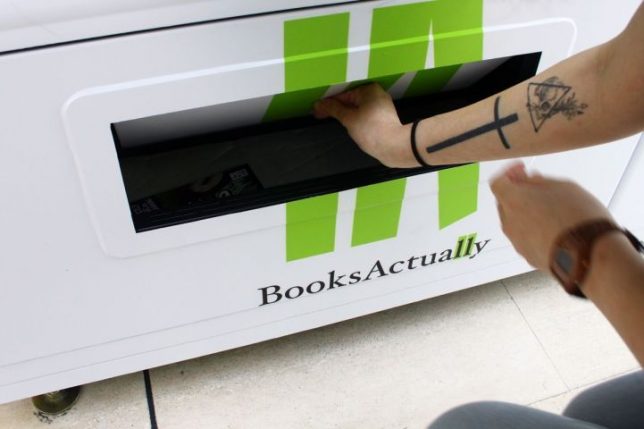
You can buy all kinds of weird things from vending machines these days – from live crabs to blue jeans to gold bars – but this new iteration is more entertaining than most, and it’ll certainly keep you busy longer than a bag of Skittles. Peruse the covers of a curated selection of books through the glass of these BooksActually vending machines in Singapore for a new distraction on demand. If only this idea caught on everywhere, maybe we’d spend a bit less time standing around staring at our phones.

book vending machine 6

Two of the machines are now ready for reading enthusiasts in high-traffic areas, including the National Museum of Singapore and the Singapore Visitor Center. Fittingly for these locations, the selections appear to be Singapore-centric, including books by local authors as well as helpful guides for tourists. Each machine contains about 150 books with up to 22 titles, and the outsides of the machines are painted by local artists to indicate what’s inside.

book vending machine 3

“The whole idea is about accessibility and eyeballs,” says Kenny Leck, owner of BooksActually. “There are not enough bookstores in Singapore… these vending machines could be a visual touchpoint. You may not buy [a book] but we’ll let you know these exist. And from there, there could be more possibilities. We start with visual awareness: books where you see a local author’s name. The ultimate place we want to put them are at train stations.”

book vending machine 5

Of course, book vending machines aren’t entirely new, though they’re far more popular in Asia than they are stateside. The first book-dispensing machine, called the Penguincubator, was installed in London way back in 1937. An Irish company called ‘A Novel Idea’ installed a machine at London’s Heathrow airport, but went out of business. It’s kind of hard to pick out a book when you can’t even read the back cover, but the concept could work with highly recognizable beach-read-type titles that are about the equivalent of junk food for your brain, anyway.


Share on Facebook


[ By SA Rogers in Design & Products & Packaging. ]

[ WebUrbanist | Archives | Galleries | Privacy | TOS ]


WebUrbanist

 
Comments Off on Brain Food: Vending Machines Offer Books Instead of Snacks

Posted in Creativity


MindShift Gear’s Multi-Mount Holster bags offer five wearable configurations

05 May

$ (document).ready(function() { SampleGalleryV2({“containerId”:”embeddedSampleGallery_5331517593″,”galleryId”:”5331517593″,”isEmbeddedWidget”:true,”standalone”:false,”selectedImageIndex”:0,”startInCommentsView”:false,”isMobile”:false}) });

MindShift Gear has launched four Multi-Mount Holsters for photographers in need of a versatile bag that can accommodate a DSLR or mirrorless camera, a lens, and a few accessories. The Multi-Mount Holster 10 is the smallest of the four, with the Multi-Mount Holster 20, 30, and 50 being incrementally larger while retaining the same general design and features.

The entire line of Multi-Mount Holsters can be used in five different configurations: as a belt around the waist, over the shoulder, over the chest, in front on a harness and as a fanny pack. Each holster has a Stabilizer Strap System for securing the bag into the chosen configuration while helping distribute weight. All four models feature a seam-sealed rain cover and interior weather-block under the zippered lid. The Multi-Mount Holster 30 and 50 also have an expandable front pocket.

Other notable features include a removable LCD screen protector, YKK zippers with an anticorrosion coating and enamel finish, a 420D nylon exterior with a ‘Durable Water Resistance’ finish, a security loop in the main compartment for securing a camera, and a clip-on point for water bottles on the shoulder strap. The 30 and 50 models can also hold keys, memory cards, and more in the front pocket.

Each bag offers the following capacities:

Multi-Mount Holster 10 ($ 89.99)

  • Holds one large (un-gripped) Mirrorless body and one standard zoom lens or prime
  • Holds one compact DSLR (Rebel, 3300 or 5300 series) and one lens
  • Compatible Lenses: Prime lens; Kit Lens; 16-85mm (Canon or Nikon) with hood REVERSED; 16-35mm f/2.8 (Sony)

Multi-Mount Holster 20 ($ 99.99)

  • Holds one standard-size DSLR (5DM3 or D810) and one standard zoom lens or two primes
  • Holds one large (un-gripped) Mirrorless body and one standard zoom lens or two primes
  • 16-35mm f/2.8 with hood EXTENDED (Canon); 16-35mm f/4 VR with hood EXTENDED (Nikon); 24-70mm f/2.8 with hood REVERSED (Canon or Nikon); 17-55mm f/2.8 with hood REVERSED (Canon or Nikon)

Multi-Mount Holster 30 ($ 109.99)

  • Holds one standard-size DSLR (5DM3 or D810) and one standard zoom lens
  • Holds one gripped DSLRs (1Dx or D4s) and one standard zoom lens
  • 24-70mm f/2.8 with hood EXTENDED (Canon or Nikon); 70-200mm f/2.8 with hood REVERSED (Canon or Nikon); 300mm f/4 with hood REVERSED (Canon or Nikon); 80-400mm f/4 AF-S/G with hood REVERSED (Nikon)
  • Front pocket holds SB-910 (Nikon Speedlight); 600 RT (Canon Speedlite)

Multi-Mount Holster 50 ($ 119.99)

  • Holds one gripped Pro DSLR (Nikon D3/D4 series or Canon 1D/1Ds/1DX series) and one standard zoom lens
  • Holds one standard DSLRs with L-bracket (Nikon D800/D700) and one standard zoom lens
  • 24-70mm f/2.8 with hood EXTENDED (Canon or Nikon); 70-200mm f/2.8 with hood REVERSED (Canon or Nikon); 300mm f/4 with hood REVERSED (Canon or Nikon); 80-400mm f/4 AF-S/G with hood REVERSED (Nikon)
  • Front pocket holds SB-910 (Nikon Speedlight); 600 RT (Canon Speedlite)

Articles: Digital Photography Review (dpreview.com)

 
Comments Off on MindShift Gear’s Multi-Mount Holster bags offer five wearable configurations

Posted in Uncategorized