We’ve been producing more video content than ever before, including tons of content from our recent PIX show, our ongoing series of long-form Field Tests, overviews of the latest cameras and lenses, as well beginners’ technique guides and interviews. We post videos right here on our homepage when they’re first uploaded, but the best way of not missing anything is to subscribe to DPReview’s channel on YouTube. Read more
Tag: never
-
NYC Secrets: 10 Hidden Sights in The City That Never Sleeps
[ By Steph in Destinations & Sights & Travel. ]

Even if you’re sick of the surface-level, tourist-friendly version of New York City, there are still many sights to be seen, including fun little secret installations right under your nose in busy places like Grand Central Terminal and subway platforms. These 10 unexpected and little-known attractions in the New York City area include a tiny gallery in an elevator shaft, a slice of punk history, an actual piece of Berlin and a scenic tram ride straight to a stunning abandoned hospital on an island in the East River.
Whispering Gallery, Grand Central Terminal
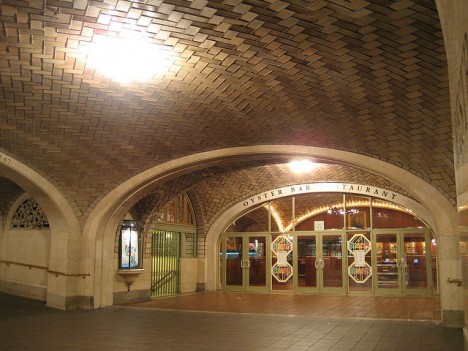
If you see someone with their face in a corner and their lips nearly touching the walls in the middle of Grand Central Terminal, don’t worry – they’re not acting out the last scene of Blair Witch Project. They’re just whispering. The ‘Whispering Gallery’ is an unofficial attraction created by the acoustic properties of the ceiling between two diagonal corners between the archways. Whisper, and the person standing at the opposite end can hear what you’re saying as if you’re talking into a megaphone. Have a friend stand on the other side, or just freak out random passersby, as seen in the video above. It’s located just outside the Oyster Bar.
Pedestrian Shortcut with Waterfall View
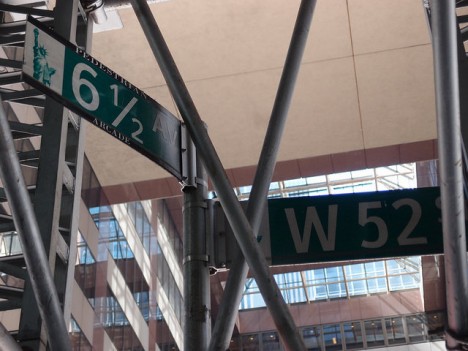
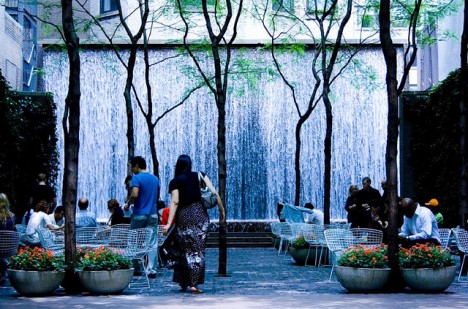
Like something out of Harry Potter, a street marked 6 1/2 Ave offers a semi-secret shortcut from 51st to 57th, and it’s only open to pedestrians. Take a break from screaming cabbies as you stroll (or whatever the New York City version of strolling would be called) down a slightly-slowed-down path through Midtown Manhattan, adjacent to the beautiful 20-foot waterfall in Paley Park. There’s another waterfall at Midtown East’s Greenacre Park at 217 East 51st St., as well as the five located within Central Park.
Remnants of the Berlin Wall

Speaking of Paley Park, this little pocket recreation space in the heart of Midtown at 3 East 53rd also boasts five sections of the Berlin Wall, originally located along the Waldemarstrasse and decorated by German artists Thierry Noir and Kiddy Citny in 1985.
C-Squat: Punk History in the East Village
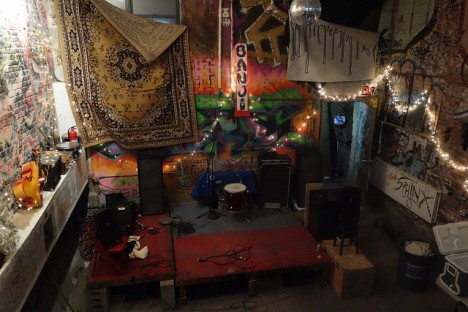
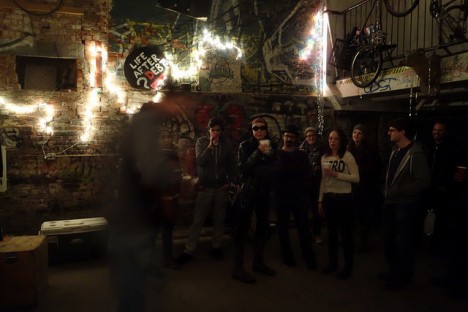
A little bit of New York City’s legendary punk heritage can still be found at 155 Avenue C, nicknamed C-Squat. Squatters claimed the abandoned space in the ‘80s, rebuilding it to make it habitable, and started throwing punk shows in the basement in the ‘90s. The city hammered out an agreement with the long-term residents, allowing them to stay as long as they bring it up to code, so it will soon officially pass into the hands of a bunch of artists and musicians. The walls are still covered in decades’ worth of graffiti and murals. One of the last holdouts of old school punk culture in the city, it’s still used as a location for underground parties.Musical Subway Installation
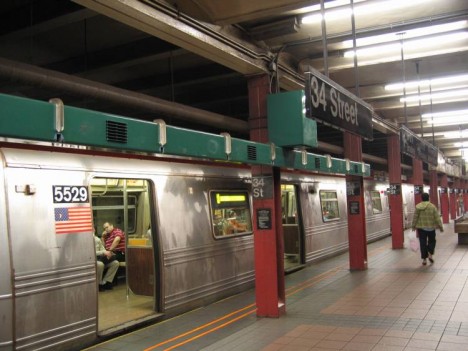
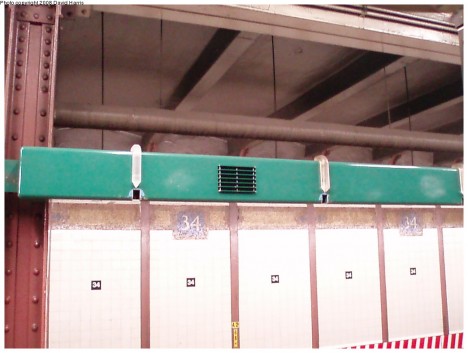
OLYMPUS DIGITAL CAMERA
An unassuming pair of green metal bars blend into the walls of New York City’s 34th Street Subway Station, but pay closer attention and you’ll notice a sign alerting transit riders to an installation called REACH: New York. Created by Christopher Janney in 1995, this weird interactive exhibit features speakers embedded with motion sensors so that when you place your hand in front of one of the holes in the bars, you’ll trigger a sound. Move from one sensor to another to compose your own musical sequence. The artist changes out the sounds every year.
Roosevelt Island Smallpox Hospital

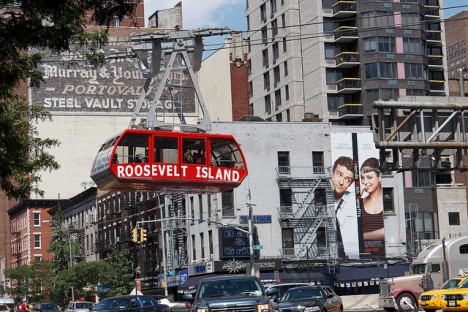
Patients infected with smallpox, leprosy and other highly infectious diseases were once kept quarantined in a hospital on New York City’s Roosevelt Island, which treated about 7,000 people per year between 1856 and 1875. It was abandoned altogether by the 1950s and fell into disrepair before the Landmark Preservation Commission declared it an important part of the city’s heritage, reinforcing the walls. The island has also been home to insane asylums and prisons, and is now a great place to take a riverside walk and get a nice view of the Upper East Side. For the swipe of a MetroCard, you can take a scenic tram to gaze up at the hospital facades, check out a lighthouse and view some public art.
Next Page – Click Below to Read More:
Nyc Secrets 10 Hidden Sights In The City That Never Sleeps
Want More? Click for Great Related Content on WebUrbanist:

Abandoned Hollywood Theater Hidden Above NY Shop
These photos give us a glimpse of a nearly century-old abandoned theater above a grocery store in New York, in a building which is due to be demolished.
Click Here to Read More »»

Extreme Street View: Google Employee Maps Deserted Island
Street View has mapped much more than roads in its, but sending a lone urban explorer through the haunting multistory ruins of a remote island may be one of …
Click Here to Read More »»

Urban Jungle Street View: 3D Hack Uses Hidden Depth Data
An explicitly illicit use of dimensional data buried in Google Street View, the Urban Jungle project adds eerie layers of post-apocalyptic green overgrowth to …
Click Here to Read More »»


[ By Steph in Destinations & Sights & Travel. ]
[ WebUrbanist | Archives | Galleries | Privacy | TOS ]
-
Never Run Out of Photo Space on Your Phone Again
 Extra photos for bloggers: 1, 2, 3
At the very moment your dog FINALLY is balancing a banana on its nose, your phone camera roll is full. The banana falls, the moment is gone. Boo.
It stinks to lose these special moments when you don’t have enough room on your phone. So, we set out to find the best way for you to have (almost) infinite space.
Eureka! Carousel is a gallery app that connects to Dropbox (which saves your photos on the cloud, so they don’t take up space on your phone). You can delete photos from your camera roll, but still have access to them whenever you want. Sounds almost as magical as a real carousel, right?
It’s easy to set up, then you’re worry free FOREVER!
Never Run Out of Camera Space on Your Phone
(…)
Read the rest of Never Run Out of Photo Space on Your Phone Again (466 words)
© Lauren for Photojojo, 2014. |
Permalink |
No comment |
Add to
del.icio.us
Post tags:
-
How to Photograph People: 7 Tips for Photographers Who Never Photograph People

No matter what type of photography you specialize in or prefer, at some point you will find yourself having to photograph a human, or multiple humans. For favor, for fun, or because they share your genetic make-up or home address. If you own a fancy camera, there you will be at least once in your photographic life (but probably many more) where you will find yourself taking a portrait. Taking pictures of people is much different than beautiful mountains, scenic oceanscapes, historic architecture, butterflies, plates of food, or whatever it is that you usually photograph. Here are some basic tips to get the best portrait possible, especially for you if don’t usually see a human on the other side of the lens.
#1 Be realistic
Don’t overpromise your abilities or expect too much out of yourself. If someone asked me to take a picture of the snowcapped Rocky Mountains, which, as they have been my entire life, are right outside my window and something I know like the back of my hand, it would not be a good picture. I lack the skills for landscape photography, and more importantly, the interest. In my favor though, people aren’t likely to ask me to take a landscape image near like a non-portrait photographer will be asked to take portraits. Be upfront if you are willing to try it so that in the event it doesn’t go as planned, it won’t bother you enough to affect how you feel about photography in general.

#2 Simplify everything
Backgrounds, clothing, props, light, etc. – simplify everything. Give yourself a running start out of the gate by having a solid foundation to work with. Look for flat or level backgrounds, horizon lines that don’t run through people’s heads, even lighting, and solid colors. I can’t emphasize this enough. The details which are the focus should only relate to the person, whether it’s a portrait of just the face or a full body, everything else should compliment this, or completely disappear to the viewer’s eye.

#3 The easiest setting I know
At the risk of starting a heated discussion or this becoming a dumping ground for comments debating otherwise, I am going to share what I consider to be my best general setting and equipment advice.
First a few disclaimers: I shoot Canon and have no idea if these will translate to something else. Also, you must promise you will not be upset if this doesn’t work for you; sometimes finding what doesn’t work is just as important as finding what does (I tell myself this often to justify my many mistakes). Lastly, taking a great portrait is a lot more complicated than just one setting, but you have to start somewhere. There are likely to be people who disagree with my advice and I hope that this could start a supportive discussion on what has worked for others, rather than unhelpful commentary. Now, on with it…
- Using natural light only if at all possible, dial in your ISO for something that makes sense; ISO 200 if it’s bright, 400 if it’s cloudy but even, 600 if it’s darker.
- Shooting in Aperture Priority mode will allow you the most room for error, and is how many portrait photographers shoot regularly.
- I like the f-stop to be at f/2.2 for one or two people, and f/2.8 or f/3.2 for groups of three or more (obviously this is speaking very generally and would best be used as a starting point to find what works for you). These settings will give you that “portrait blurry background effect” known as good bokeh.
- Shooting in RAW will give you more wiggle room later when editing, though it takes more space on your memory card.
- Use a prime lens if you can; I shoot nearly everything I take with my 50mm L1.2. This is a fancy lens no doubt, but any prime lens will typically be faster (have a larger maximum aperture) than a zoom lens, and with everything else going on, I find that using my feet as my zoom is one less adjustment my eyes and hands have to do.
- I typically underexpose my images one stop. This works for me because I like to get the details and then bring it back up as needed myself in post.
This may not work for you, and there is absolutely no shame in running everything you aren’t sure about on auto. This doesn’t make you less of a photographer. All it means is that you think in this scenario, your camera – a magnificent piece of machinery that was created by thousands of professionals over decades with countless research, information, and experience – might guess better than you. That’s all.

#4 Shoot from their eye level or higher, and at an angle
While photographing a person from below and not capturing an amazing view of 15 chins they don’t even have is possible, it’s not easy. For the best, most flattering set-up, shoot at their same eye level or above. I often have people kneel down and look up at me while I remain standing. As someone who has 20 different chins that only come out and play for pictures, I’m sensitive about this one and I find that even a child with the most adorable chubby cheeks and double chin is best photographed on a level playing field.
Additionally, taking pictures of someone straight on is both unflattering and uninteresting. Asking them to twist at the waist, shoulders, or neck and not face their body square-on, but rather follow their face’s direction will not only be much more forgiving to any subject (every single human has one eye that is smaller than the other – I’ve researched it), but will also make for a more professional finished portrait.

#5 Don’t command a smile
Don’t command a smile, or instruct “cheese!” or say “hold still!”, or anything that could be interpreted as you attempted to force your feelings, or agenda, onto your subject. Even if you are going for a serious tone, and are trying to catch an image when they don’t realize or least expect it, you are much better off engaging them in conversation than setting up the moment and expecting a single second of utter perfection. A true portrait is genuine at its very least.

#6 Resist the urge to run your final images through every Photoshop trick you’ve ever learned
If you don’t usually photograph people, the idea of playing around with editing tools might be fun. There are so many! This one turns their eyes into laser beams. This one makes their skin look like pure plastic perfection. It’s fascinating, I get it. However, if you’re wanting to stick to the basics, there isn’t much that needs to be done. Clean up blemishes with the Spot Healing Brush Tool, run a basic sharpen (I like the oddly named Unsharp Mask at 60%/2.0/0), and adjust your color and levels if needed. If I get stuck while editing an image, I ask those thousands of professionals what they think by running auto color, tone, and contrast just to see what it does. It nearly always takes everything too far, but it gives me an idea of where I want to go sometimes, just by showing me where I don’t.

#7 Don’t try to turn it into something it’s not
Oh how I wish this image had a little more POW. A little zing. I’d love it if her entire face was showing and her hair was either more haphazard, or more perfectly fanned out. I wish there was more background showing. However, this is not a picture for a fashion magazine cover, but rather an image of my stepdaughter I took with my iPhone. We were on a walk and I spotted the purple flowers on the ground and told her to go lay in them. And because all of my stepdaughters do whatever I say, and think that I am totally magical, she raced right over and did it. Then an enchanted unicorn wandered up and flew us home. It’s drastically cropped, not necessarily for effect, but because she was giving me a snarl and wearing a very busy shirt. Is this a portrait? To me, it is. It’s a perfectly fine, authentic image and the subject herself loves it.
That is probably the most important thing when taking pictures of people.
Do you have any other tips you’d like to share? Please leave a comment below.
The post How to Photograph People: 7 Tips for Photographers Who Never Photograph People by Lynsey Mattingly appeared first on Digital Photography School.
-
Three Tips for Being Ready to Shoot Faster so you Never Miss a Shot
We’ve all heard one of the cornerstones of making better photographs is to slow down; be deliberate and take your time. This is very true. In no way am I advocating not being purposeful in your shooting. However, sometimes there are situations when the difference between getting a good image, instead of a blurred and washed out frame, is separated by only a few precious seconds. This is especially true when it comes to working in action filled situations like sports or street photography, but it can also be just as easy to miss moments in nature and landscape photography if you go into situations ill prepared.
Here are three tips that can improve your reaction time and make you more ready to obtain quality images for processing when you find yourself in those “shoot from the hip” scenarios.
Being Ready to Shoot Faster – Never Miss a Shot
Be Self Aware

“Know thyself.” No, Socrates wasn’t a photographer (though I’m sure he would have been awesome). In this case, the saying of “know thyself” means becoming aware of your surroundings more so than having a deep introspective understanding of your own self, although that’s a good thing to have, usually. We exercise this on a daily basis, albeit almost unconsciously. You notice a stain on your shirt, or you see the little boy chasing a ball towards the street, or you see a dark alley that’s just a little too dark to walk down alone. You can incorporate this same inherent awareness into your photography to make you a faster shooter.
Here’s an example: Let’s say you find yourself taking an afternoon to work on your street photography. When you first begin your expedition, it’s very bright outside. You are probably still able to shoot at a reasonably fast shutter speed and low ISO. As the evening starts giving way to night, there is of course less available light. So, a good idea would be to begin thinking about bumping up your ISO so that you can maintain the same exposure settings. Or alternatively, slowing down your shutter speed or increasing the size of your aperture (remember, low F-number means a bigger opening and more light into the lens such as f/2.8). Keep in mind however, that a higher ISO will introduce more noise into your final image, but it will have less of an overall impact than changing the shutter and aperture settings.
In photography, your surroundings are in a state of constant flux. So, to be a good photographer, you must be aware of the changes in your surroundings and mould yourself the best you can in order to produce consistent and quality work. This means learning to understand what is happening around you, whether it be: changing lighting conditions, approaching weather, wind, the presence or absence of people and objects, – the list goes on indefinitely. Anticipate what is going to happen next and make adjustments now, to save time later.
Shoot Comfortably
This would seem to go without saying, but you still see many photographers looking down right uncomfortable or awkward while they’re out shooting. Sadly, the majority of the pain is self-inflicted. To shoot faster and to be ready for the shot when the time is right, your camera must be available for use at a moments notice without restricting your movement or causing discomfort. One of the best ways to make this happen is to have your camera suspended from a quality camera strap. Camera straps, like most things, can become a very personal item for new and seasoned photographers alike. Don’t buy a strap because its got pretty flowers embroidered on it or because its made from the latest space age whatever-foam. Do a quick search for “camera strap” here on dPS and you will find a large number of reviews and write-ups of great camera straps. But don’t stop there. Shop around, read reviews, ask your photographer friends and sift camera forums. Being able to comfortably retrieve your camera quickly is key to not missing great images.
Have a budget? Most of us do, even more of us can’t afford to spend thousands on the latest lens or camera body that we dream of owning. Luckily, the majority of the accessory market is crammed with makers competing to sell you their wares. It’s easier than ever to strike a balance between what you need and what you can afford. If you can, have more than one camera strap in your kit so you can choose what fits best for a particular outing.

Prepare Beforehand
This is the big one, yet many people don’t seem to understand that preparation is golden. A close cousin to situational awareness, research and preparation prior to any photo work should become second nature and will pay huge dividends. It will also make you a faster shooter and help to prioritize your workflow, not to mention make you appear more competent as a photographer.

Know what you’re walking into beforehand and prepare accordingly. Are you going on a hike? Find out what wildlife and plants are native to the area and pack your bag with long lenses so you can get close to your subjects from a distance. Travelling abroad? Be sure to read up on the local attitudes towards photography before you start snapping away to avoid any awkward confrontations or worse. Of course, the most unpopular, but useful, aspect of being well prepared is practice, practice, pactice. Practice, and then practice some more. Want faster and more smoother lens changes? Practice at home, so you lose less time in the field and have fewer fumbles. Practice finding your camera adjustment buttons without looking. This will save you loads of time and frustration when you find yourself shooting at night. If you haven’t figured it out by now, the key word here is practice. Practice everything and you will be amazed at how much easier quicker most things suddenly become.
Do you have any other tips for shooting faster and being ready? Please share them in the comments below.
The post Three Tips for Being Ready to Shoot Faster so you Never Miss a Shot by Adam Welch appeared first on Digital Photography School.
-
Phottix Mitros+ Review – the Best Flash System You Have Never Heard of
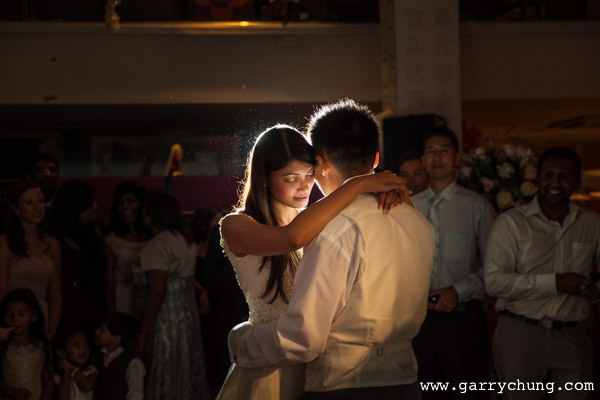
Photo taken using the Phottix Mitros+ system
As a professional wedding and portrait photographer, I would say the most important accessory in my kit bag besides my main camera and lenses would by my flashes. So when it came to making a decision on what flash system use, I did a lot of research and in the end I opted for the Phottix Mitros+/ Odin system. I don’t normally write gear reviews as I think the internet has enough top quality content. I realized however in my research that the Phottix Mitros+, although sold internationally, is comparatively less well known and not well documented on the web.
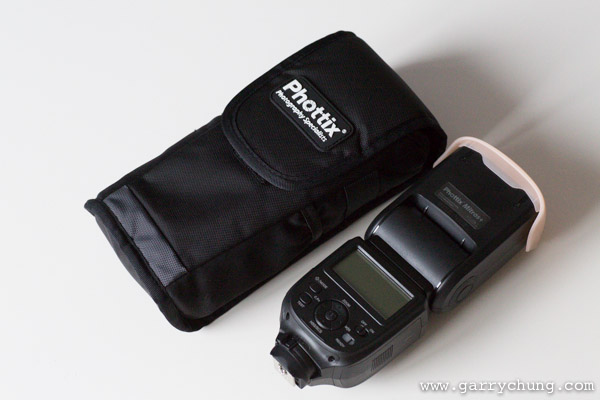
Phottix Mitros+ – comes with carrying case and accessories
I am a big fan of using off-camera flash and as a Canon shooter and have previously been using Canon 580 EX II / Pocket wizard combination for the last 4 years. The Canon 580 EX IIs in all fairness have served me well. They have been dropped many times, and rained on, but never skipped a beat. The problem occurs when I take them off camera. Using the PocketWizard Mini TT1 and TT5 trigger and receiver I have experienced a whole host of reliability problems that eventually was the catalyst for me to look for alternate solution.
I started by looking at the Phottix Odin TTL triggering system, which I have used before and has had excellent reviews. That was when I realized Phottix also sells the Mitros+ flash, that includes the wireless transceiver built into the unit. The “+” denotes that it has radio transceiver built in as they also do a non “+” version with no transceiver. The Mitros+ flash is great for a number of reasons;
- It’s one less piece of equipment to buy and worry about
- There is so need to carry more batteries or worry about connection issues between your radio receiver and your flash
- The Phottix Odin trigger system is also a tried, tested, reliable market leader and so I was confident it would work well
Review – Phottix Mitros+ Flash System
First impressions when you take the Mitros+ out of the box; it comes in a nice pouch and feels solidly built to take a few bumps, which is essential as I will put it though the rigours of professional use. The first thing you notice is that it makes a beep, like studio lights, to tell you the flash is recycled and ready for use. This is especially useful if you are firing at full power, and can be turned off using the custom functions if you don’t like it. I fired off a few successive frames and it seems extremely quick to recycle. This is by no means a scientific test but I set the flash in manual mode 1/2 power and fired consecutive bursts. It seems to recycle at least as fast, if not faster, than a Canon 580 EX II. In the real world, it holds up very well; I tested it all day in different lighting situations and the ETTL worked consistently. The battery consumption seems about the same as the 580 EX II, I did a full day shoot and didn’t need to change batteries, so all in all I am very happy.
The real benefit of the unit however, is taking it off camera. It’s an absolute joy to use; no having to set up the PocketWizard receivers, and no misfires. I don’t have to do my usual five minutes of troubleshooting if the flashes aren’t firing. It just works like it is supposed to. With this system you can also control everything directly from my Odin transmitter, or using another Mitros+ flash. You can alter settings remotely such as TTL exposure compensation, manual power, high-speed sync and even flash zoom level. You can configure three groups of flashes and adjust each one individually. This basically allows you to control everything you need from the camera so no need to walk up and down making adjustments.
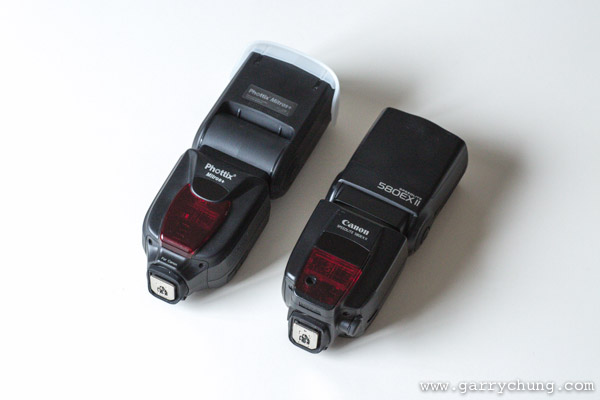
Hands on it’s a quite a large flash as you can see here next to the Canon 580EX II
Features (as listed on the Phottix website)
- E-TTL, M, Multi (Stroboscopic) modes
- Auto/Manual Flash Head Zoom with 180 degree rotation and 97 degree tilt
- High Speed Sync and Rear Curtain Sync
- Flash Exposure Compensation: Manual, Bracketed
- Fast Flash Mode: with 0.1-2.5 sec. recharge times
- USB port for upgrades
- 3.5mm Sync port
- Canon-compatible IR Wireless Triggering with Master and Slave mode
- Optical Slave Sync Mode
- Uses 4 AA batteries
- Port for external battery pack
- Compatible with Phottix Odin TTL Flash Triggers for Canon
- Battery Compartment for 4 AA batteries (below left)
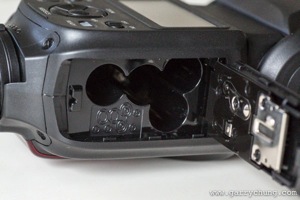
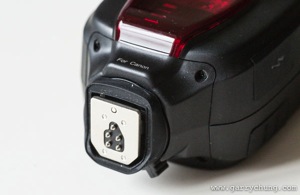
- Rubber seals around metal hot-shoe for weather sealing (above right)
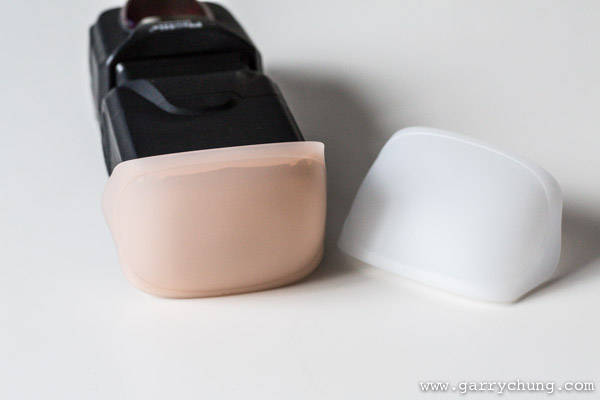
- Mine also came with a plastic diffuser and 1/2 CTO which will come in handy (below left)
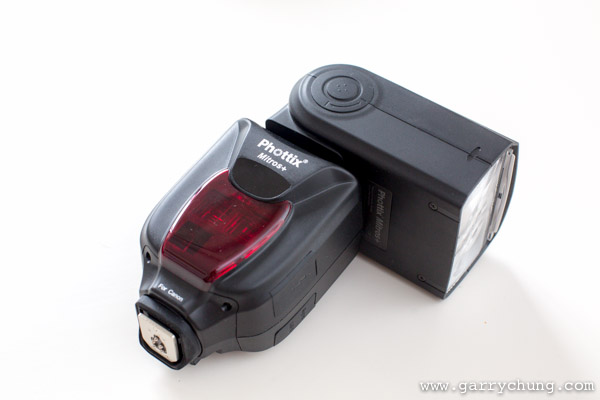
- Swivel and tilt head great for bouncing in all directions (above right)
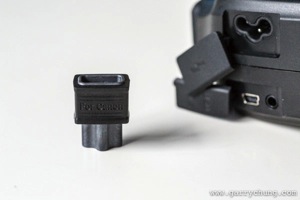
- Connections for USB power, 3.5mm jack for sync and external power the kit also comes with an adapter to convert the head for Canon’s CP-E4
- The display a the back is large backlit and clear
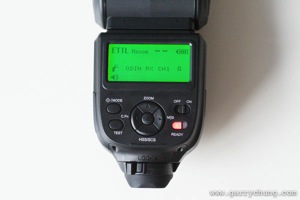
- Menu System identical to Phottix Odin when set to Trigger Mode
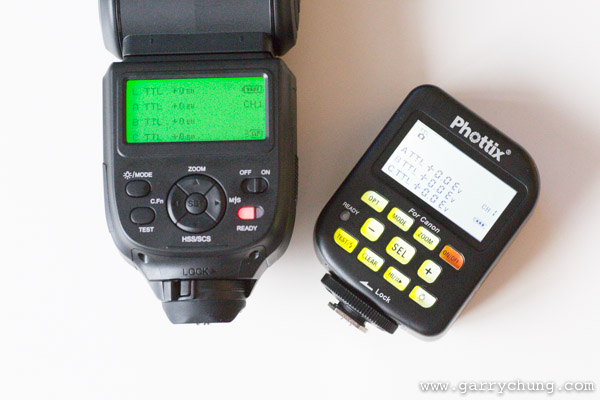
The litmus test for me to judge how intuitive a menu system is; if I need to read the manual, it’s probably not that intuitive. I very quickly figured out how switch from ETTL to Manual, activated high-speed sync and got the radio trigger system working. I actually think the menu system is better than the Canon 580 EX II, which took me a long time to figure out. Like the Canon speedlite, you can also control flash exposure compensation from the Canon 5D Mark III’s menu, although this is not recommended by Phottix. An advantage of the Mitros is that it has an indicator to see how much battery life left, which is absent in the Canon 580 EX II.
I recently took the Mitros+ system for an intensive four day shoot on Tinian Island and I am glad to report it has been flawless. I was asked to do a beach shoot at 1 p.m. in the blazing afternoon heat and managed to overpower the sun with three of Mitros+ flashes set up in cluster.
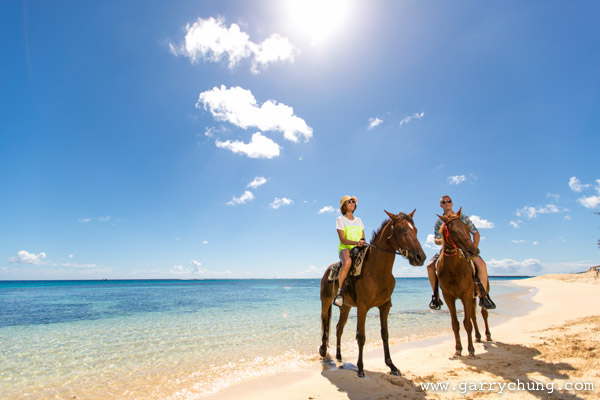
Final image

Lit with three Phottix Mitros+ flashes
The determining factors for choosing the Phottix system were twofold
Firstly, it is an open system. Odin can be used to trigger not just the Mitros+ but other studio lights as well. In comparison the latest Canon 600EX–RT flash and Canon ST-E3 trigger are only compatible with each other. I have also bought Phottix Odin receivers to bolt onto my old Canon 580s, so can use them with the Mitros+/Odin system together.
Another positive for Phottix is that it’s more backwards compatible than the Canon 600 EX-RT, which is not fully compatible with pre-2012 models, such as Canon 5D Mark II, which I also own. I read reports that you lose features like HSS, (High Speed Sync) and the sync speed is lowered to 125th/sec but I haven’t tested it myself. It seemed very odd to me that a third party company can get their flash working with older Canon cameras but Canon can’t. I have tested the Mitros+ system with both the Canon 5D Mark II and 5D Mark III. It works fine and it is even compatible using infrared with the Canon 580 EX IIs, so you can use the Mitros+ to trigger the Canon flashes and vice versa. The Mitros+ also has optical slave which is something Canon never put on the 580 EX for unknown reasons.
The final factor is the Phottix retails at $ 399 USD, which offers a significant saving to the Canon equivalent. At time of print, the Mitros+ is $ 150 USD cheaper than the Canon 600EX–RT flash.
I talked about comparisons with Canon in my review as I am a Canon user, but the Mitros+ is available for Nikon now also. It should be quite attractive to Nikon shooters as I think Nikon have yet to release a flash with a built-in radio transceiver.
Conclusion
Things really have moved on for third party flash manufacturers in the last few years. When I first researched into non-proprietary flash systems, they were generally cheaper, but vastly inferior product to the brand name equivalents. The Mitros+ is a great quality product, at a great price. It’s well built, easy to use and packed with features. Phottix as a company feels like they are selling products designed by photographers, and have really listened to their customers. Looking back at reviews of the original Mitros when it came out, customers were just saying “if only it had the Odin radio system built in that would be fantastic”, not long after the Mitros+ was released.
The Phottix Odin radio trigger system fully deserves all the praise it gets. PocketWizard, which has historically commanded such a market dominance in this sector, should be well aware of the new competition – which I think is a good thing. I remember paying nearly $ 500 USD for a PocketWizard TT1 Trigger and TT5 receiver, but had to as there was just no competition at the time. I experienced range issues, reception/connection problems, broken hot-shoe and general unreliability which is unacceptable for such a premium priced product.
The Mitros+ / Odin combination so far has been solid as a rock in terms of reliability. Time will tell if the build quality is as good as it looks but at least Phottix shipped with a two year warranty peace of mind. For those of you looking to either buy your first flash, or add to existing flash system, it’s worth keeping an eye out for products from third party manufacturers such as Phottix. Light is light at the end of the day, and I don’t care what brand name it says on the side as long as it gives me consistently good results and so far my Mitros+ has done exactly that.
Here are a few more images created with the Phottix Mitros+



The post Phottix Mitros+ Review – the Best Flash System You Have Never Heard of by Garry Chung appeared first on Digital Photography School.
-
Never forget a Photoshop or Lightroom shortcut again

Even longtime Photoshop and Lightroom users sometimes forget the myriad of keyboard shortcuts used to trigger the program’s powerful features. Now web developer Waldo Bronchart has made a web application called ‘Application Shortcut Manager’ to help you remember. It’s an interactive website that displays all the keyboard shortcuts for Photoshop, Lightroom and Blender. Learn more
-
Never lose your lens cap again with HACkxTACK

We all know the situation just too well. You’re out shooting with your DSLR or mirrorless camera when you decide to swap lenses and have no idea where you’ve put the lens cap for the lens that’s mounted on your camera body. Usually it’s in the very last place you look for it. In the worst case scenario you never find it at all. Two Canadian designers have a solution to this problem. Learn more
-
Fisher Price Camera Tripod Modification – It’s Never Too Early Tutorial
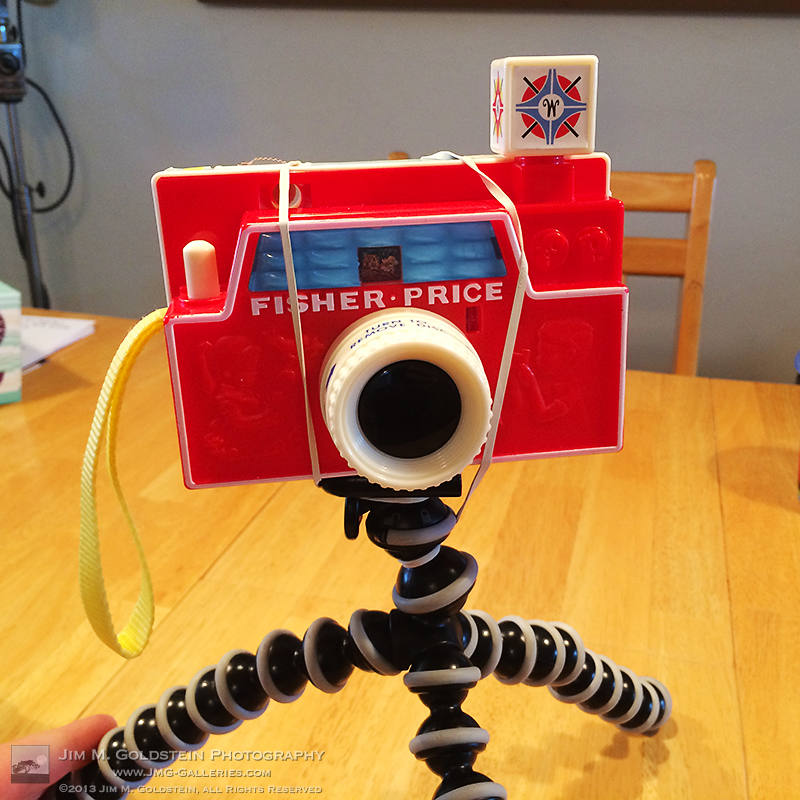
This summer I took my 3 year old son to Big Sur for his first camping trip to show him the Milky Way. Remarkably he held on to this experience beyond expectation and he’s been talking about the Milky Way ever since. On top of that he’s really developed an interest in photography and cameras. I’m not sure how that happened, perhaps it is something in the water supply. Fast forward to last week when he caught sight of my Joby tripod. I gave it to him to play with thinking it’d be one of the few items he could bend and try to destroy that wouldn’t worry myself or his mother. To my surprise he immediately dug up his retro Fisher-Price toy camera and proceeded to put it on the Joby tripod. The kicker is that he was telling me he was photographing the Milky Way. This would be a short story if it wasn’t for the fact that every day since he’s been setting up his camera and tripod all around the house to photograph different things at all times of the day.
If my little guy is going to get serious about make believe photography I felt it was my parental duty to make sure that he was going to develop good habits. To put it bluntly no one in my household is going to take sub-par make believe photos and to avert that we needed a secure way to fasten his camera to the Joby tripod. When I explained the dilemma to my son he was eager to take me up on my offer to modify his camera.
Here for your entertainment is the Fisher-Price camera tripod modification:
(Have a great Christmas!)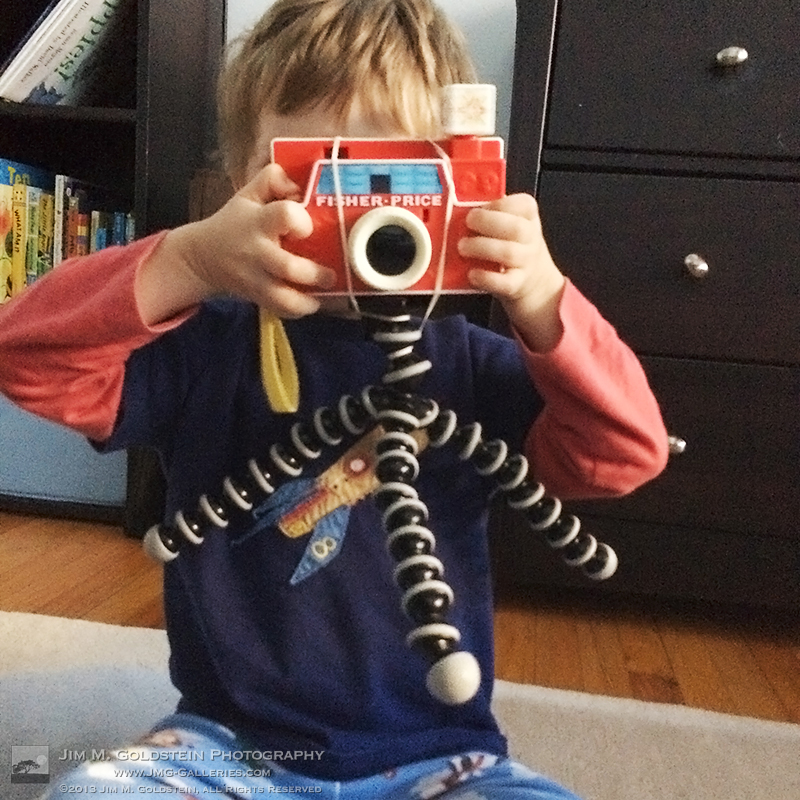
The Fisher-Price rubberband mount wasn’t cutting it. For simple shots sure it worked, but….
The rubberband mount worked well enough for level shots,
but not for all shots.
Any non-level use of the camera resulted in camera instability.
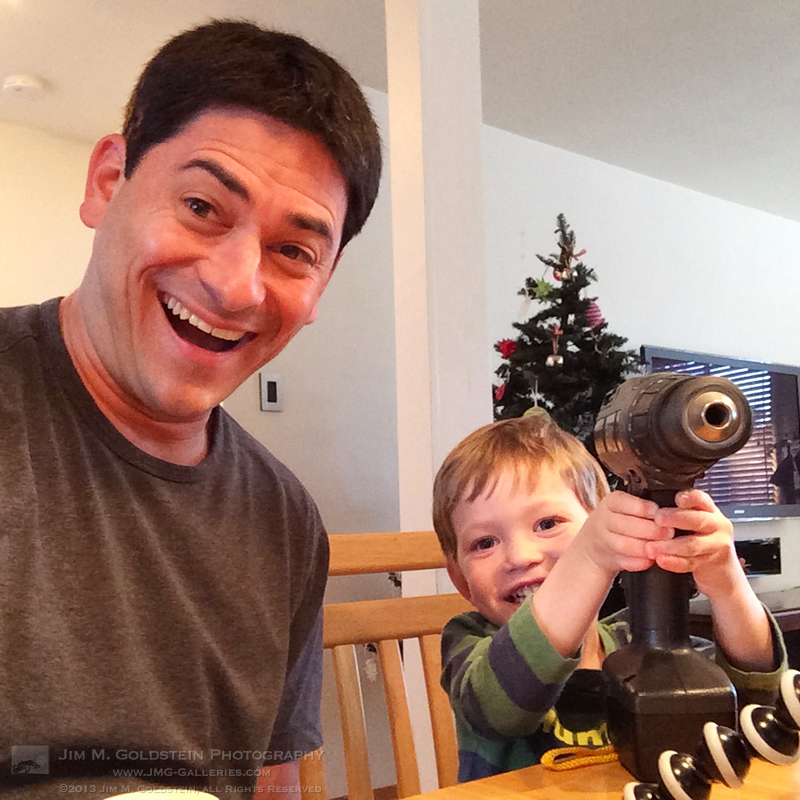
We were pumped to fix the problem and even more so
because we weren’t using toy drills.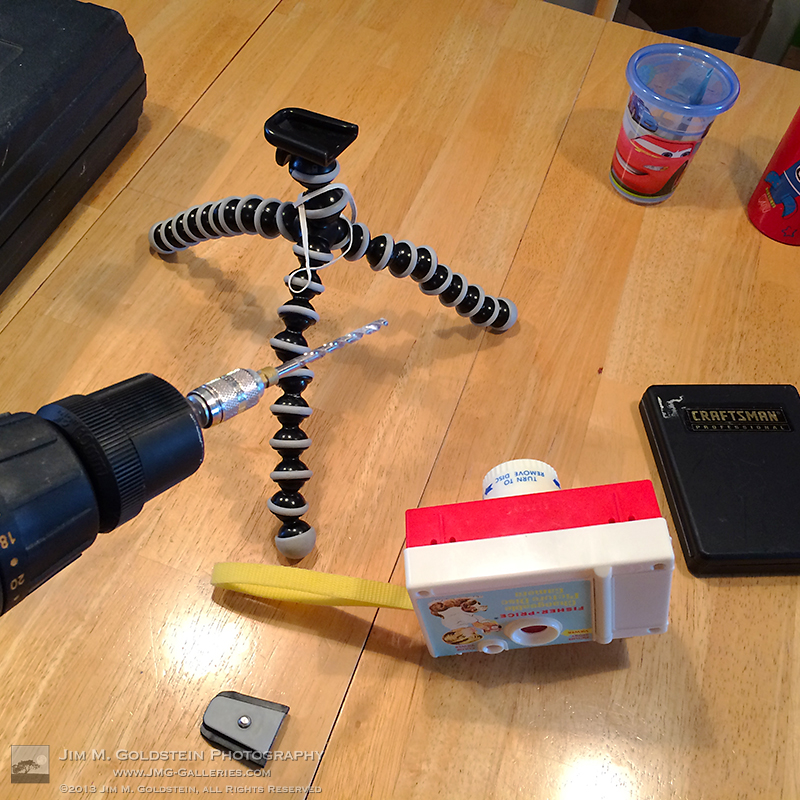
Just before we started the modification.
Things would never be the same again.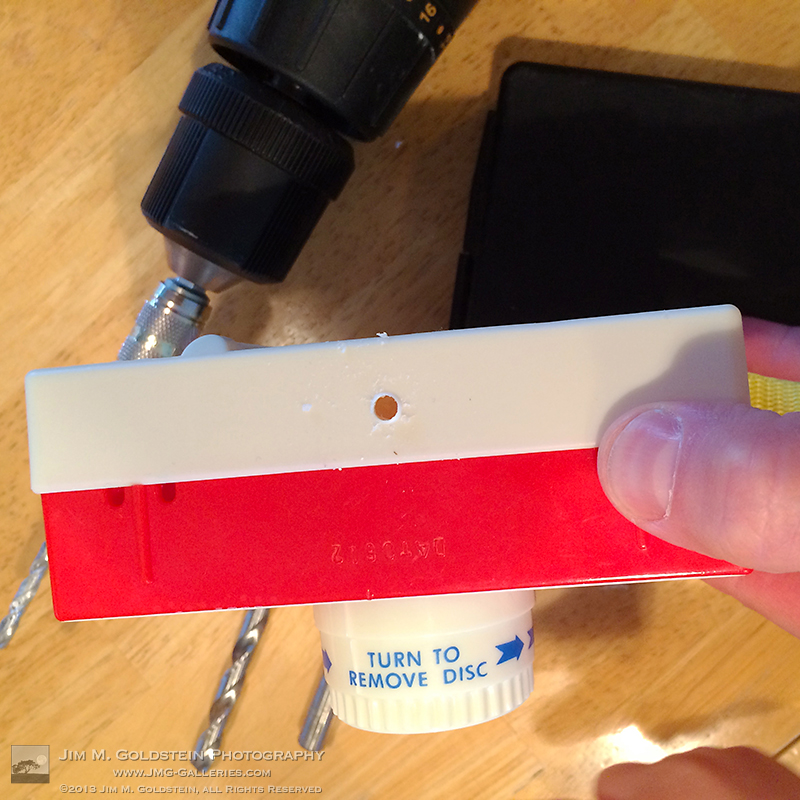
To create a stable mount we had to drill a hole in the bottom
of the camera to install the Joby base plate.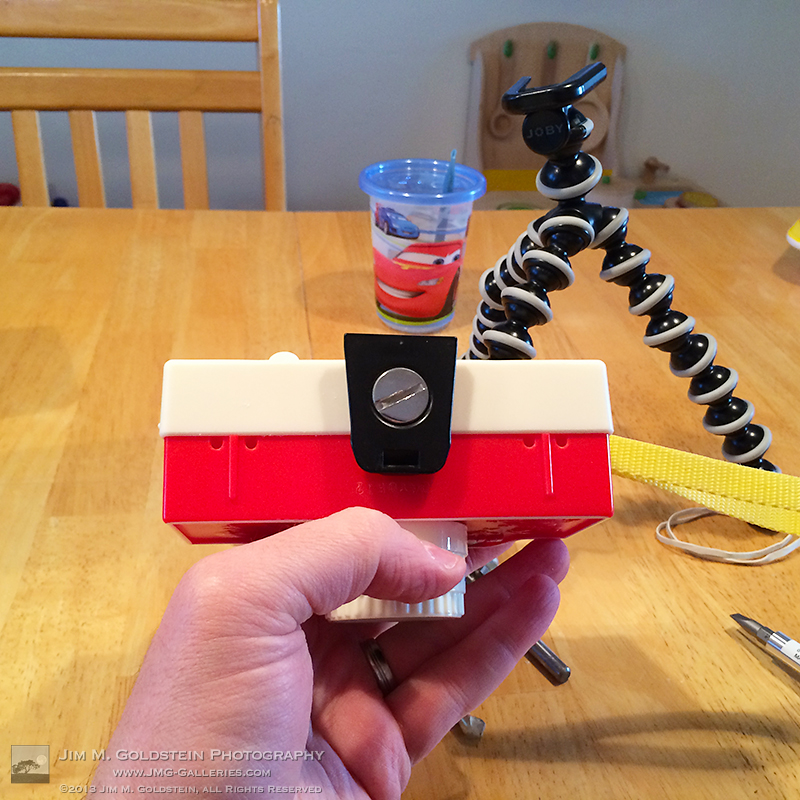
Looks good lets try it out
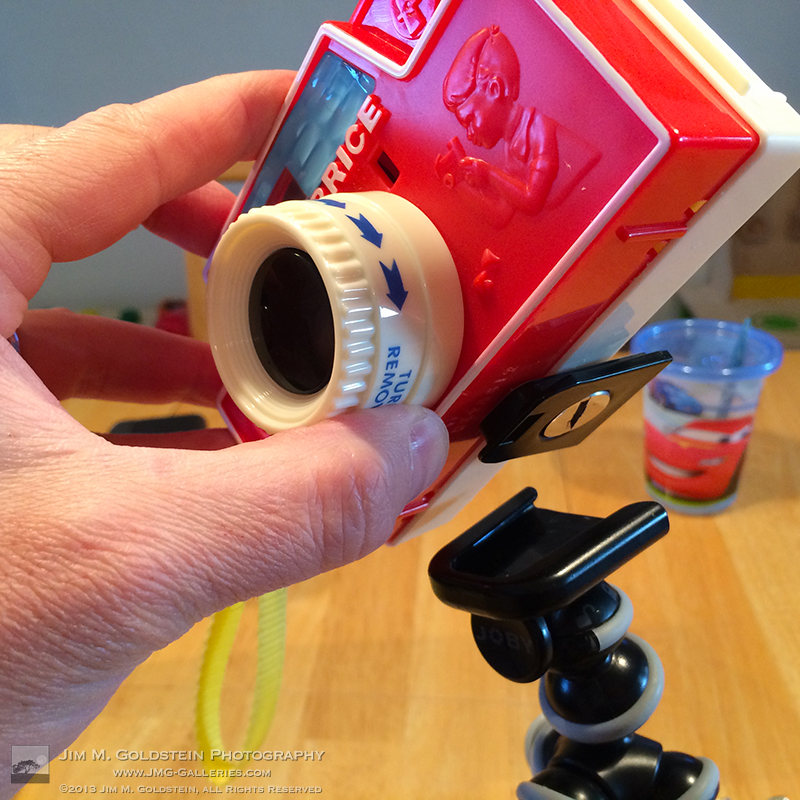
Making sure that the base plate was installed as
level as possible we put it to the test.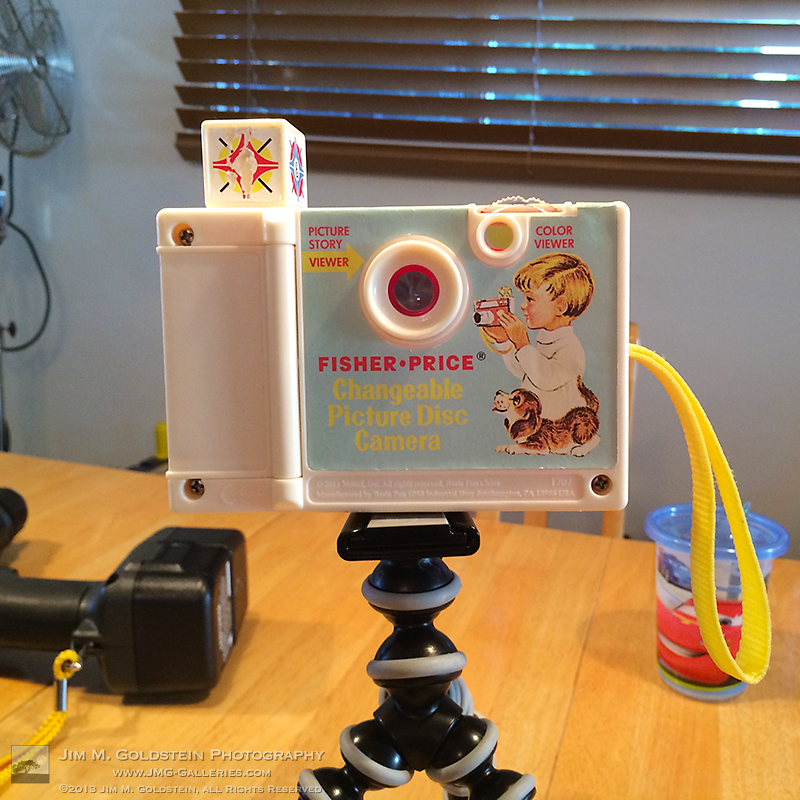
Our first test was a positive one, but what does the photographer think?
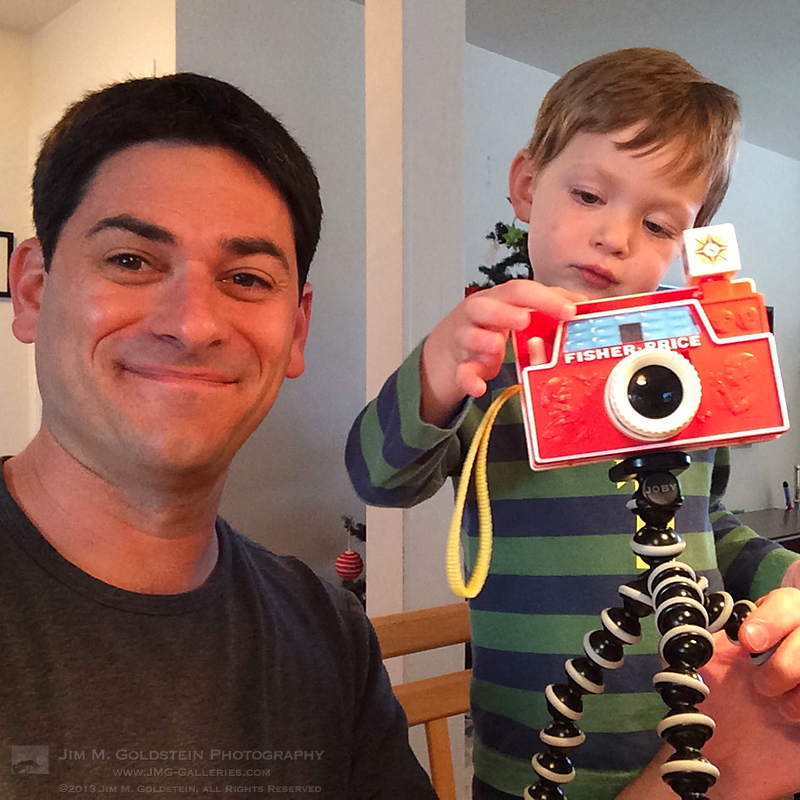
My little photographer was quite content with the new
tripod mount. Now he’s on his way to good make believe
photography technique.Copyright Jim M. Goldstein, All Rights Reserved
Fisher Price Camera Tripod Modification – It’s Never Too Early Tutorial
The post Fisher Price Camera Tripod Modification – It’s Never Too Early Tutorial appeared first on JMG-Galleries – Landscape, Nature & Travel Photography.


Related Stories
- Fisher Price Camera Tripod Modification – It’s Never Too Early Tutorial – Enclosure
- 30 Mile Shadow of Haleakala – Haleakalã National Park
- 30 Mile Shadow of Haleakala – Haleakalã National Park – Enclosure
-
Strange Photography Classes You’ve Never Considered

Sure, you know all about f-stops and composition. You’ve taken classes on lighting and landscape photography. But there’s a lot you don’t know — and a long list of photography classes and workshops that you’ve never even considered.
Here are a bunch of them.
Photograph Ghosts, Ghoulies and Things That Go Bump in the Night
You might have taken a photography class that taught you how to shoot a still life but how about a workshop that will show how to shoot dead things — or at least create photographs that appear to contain dead things?
Night photographer Lance Keimig runs three-night workshops among the historic monuments of Sleepy Hollow Cemetery. Participants have both classroom and field instruction where they learn how to shoot tombstones and mausoleums by moonlight. Ichabod Crane’s headless horseman is also expected to make an appearance and strike a pose. Just don’t ask him for a headshot.
Slightly less scary are Vintage Vixens’ Halloween-themed workshops. Instead of creeping around a graveyard in the middle of the night, you’ll be standing around a stately home in Baltimore, photographing models dressed in Gothic Halloween costumes.
And if that still sounds a little creepy, you can always fake it.
The Spirit Photography Workshop at George Eastman House will teach you the basics of making wet collodion tintypes. With that knowledge under your belt you’ll be able to create the kind of spooky ghost imagery that had 19th-century viewers reaching for their Ouija boards.
Beware of the Bears
Wildlife photography workshops are a dime a dozen (or, more accurately, several hundred bucks a session) but if you’re looking to focus on one kind of wildlife in particular, you can do worse than shoot bears.
The American Bear Association combines lessons in the natural history of the American Black Bear with an opportunity to photograph the animals in their natural environment. The Black Bear Photo Workshops are held at the 360 acre Vince Shute Wildlife Sanctuary in Minnesota. The workshop lasts for three days, and provides an opportunity to photograph the 50 bears known to frequent the park — as well as other wildlife, including whitetail deer, wolves, chipmunks, butterflies and birds.
If you’re looking for something a little more adventurous than Black Bears though, you could take a trip with the Aperture Academy to Norway to photograph polar bears. The academy is runs by master photographer Stephen W. Oachs who takes photographers out to the Svalbard archipelago of northern Norway. Home to about 3,000 polar bears, the archipelago contains one of the world’s largest concentrations of very dangerous, giant-clawed bears.
You’ll be cruising the fjords, shooting in 24-hour sunlight and in addition to photographing very strong and very hungry carnivores, you’ll also have a chance to capture some more sedate glaciers, walruses, reindeer, arctic foxes, whales, seals, puffins and fulmars. Dress warm but try not to look like a seal.
P-P-P Picture a Penguin
Photographing both Black Bears and Polar Bears would be one way to produce some interesting black and white photography. But when you’re finished in the Arctic, you could head to the other side of the world and put both colors in one picture by photographing penguins.
They’re not as savage as polar bears and their teeth aren’t quite as sharp but they are picturesque and they come in more varieties. The trip to the Falkland Islands, which includes a couple of days in Chile, provides an opportunity to photograph Rockhopper, Magellanic, King, Gentoo and perhaps Macaroni penguins too. The trip is timed to coincide with the breeding season so there should be lots of chicks to shoot, as well as striated caracara, skua, pied oystercatchers, upland geese, kelp geese, Falklands flightless steamer ducks, black-crowned night herons, and dolphin gulls.
At $ 4,795 a head (with a $ 200 single supplement) the nine-day January trip isn’t cheap but the next outing is already nearly fully booked.
Capture a Speeding Car
Penguins aren’t known for their speed so if you’re looking for something with a bit more adrenaline, you could go for one of the many car racing workshops.
David Allio’s career as a professional motorsports photographer spans four decades. He has been the official track photographer for at least ten different racetracks and the official series photographer for the NASCAR Winston Racing Series. He takes photographers out to the Las Vegas Motor Speedway and the Neon Garage to learn how to shoot Superspeedway races and drag races. He also runs trips to various sites to run short track oval auto racing sessions.
Classroom topics during the two-day program include: working safely in a high speed environment, lens selection from fisheye to super telephoto, workflow and software, copyright and licensing, preparing photographs for publication, high speed action in low light, establishing your own personal style, and editorial responsibility.
A visit to a Vegas race track is unlikely to be relaxing but Michael Chinnici’s 24 Hours of Le Mans workshop not only lasts nine days but manages to combine high-octane subjects with more sedate wine-filled touring. In addition to photographing the Porsches, Audis, Ferraris, Peugeots, Aston Martins, Bentleys, BMWs, Maseratis, and Corvettes that take part in the 24 hour road race, participants will have an opportunity to photograph the streets of the old city, visit Mont St Michel Castle and take part in Loire Valley wine tours. It’s not Vegas, but that might be a good thing.
Old Folk Get to Preserve Their Memories
Although most of these workshops are aimed at reasonably experienced photographers who want to improve their skills and shoot something different, it’s not too hard to find classes aimed at young beginners just beginning their photographic journeys.
Finding a workshop for old beginners starting their photographic journeys is a little harder.
But that’s what Singapore’s Housing and Development Board offers. In addition to the regular sessions on parents and children, and seven steps to better photography, the board also offers 2.5 hour classes on “Silver Photography for Seniors.”
The seminar introduces basic concepts in photography such as camera handling, how to scene functions and composing pictures. The jargon is kept to a minimum and the memories are preserved forever.