When I quit practicing law ten years ago, I knew I was trading in my briefcase for a camera bag and the courtroom for a studio, but I had no idea that contracts were still going to dominate so much of my time. The importance of the contract between you and your client is pretty much a given, but just as important– if not more– is the model release. If you’ve been shooting professionally for any period of time, you already know (I hope) that securing a model release from the people you photograph is of utmost importance. What you may not be aware of, however, is why it is so important. It is an unfortunate reality that most people neither completely read nor understand the legal documents that they sign or have prepared for them. You may have an iron-clad model release in your bag of tricks, but you may not understand what exactly it’s releasing or the significance of the language. Having a fuller understanding of the basics will help you greatly in the long run, particularly when it comes to assessing whether you even need a model release, and convincing your subject to sign one if you do.
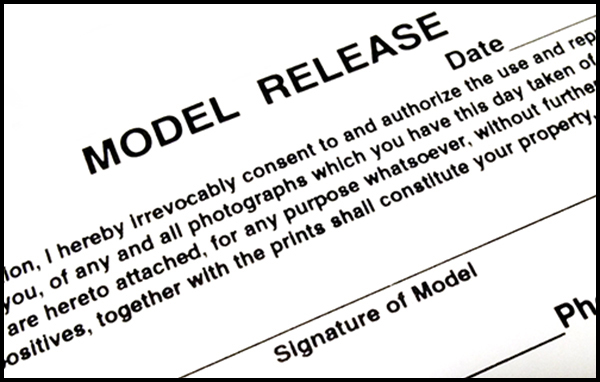
What It Is and Why It’s Important.
At its most basic, a model release is a contract. It is a written and signed agreement between you and the person you are photographing, the purpose of which is to protect– release– you from liability in future lawsuits which that person might file against you for legal claims like invasion of privacy, defamation of character, etc. The document stipulates the terms under which one party may use photos taken of another party. They are usually brief– no more than a paragraph– but they can get quite long, especially if the subject of the photo tries imposing additional conditions (e.g., no Photoshop). We’ll get into the specific contents of the model release in a bit. For now, though, know that a model release is a crucial piece of paper for any commercially used photograph.
How Do I Know if I Need It?
HOW WILL THE IMAGE BE USED? When you start with the premise that the need for a model release is dictated by the use and not the content, you are left with a pretty basic set of questions that need answering. The first is, “Will this photo be used commercially?” If the answer is “yes,” you need a model release. If the answer is “no,” you do not. Simple, right? Not quite. Keep reading. The simple fact of publication does not, in and of itself, automatically mean that the use is commercial. For instance, work that is going to appear in newspapers, educational books, and consumer or trade publications does not need a model release because it is editorial use– sometimes referred to as “fair use.” Commercial usage, on the other hand, can include advertisements, brochures, web use, greeting cards, catalogs, newsletters, etc. For commercial, licensed use, you absolutely, positively MUST have a model release.
What is and isn’t commercial use can sometimes be confusing. Assume that you have taken a photo of a popular local chef and not obtained a signed model release. Your friend is the publisher of a local newspaper and he pays you for the photograph for use in an article they are running about the restaurant. Because the photo is being used as part of a news story, this constitutes editorial use. The fact that money changed hands does not automatically render it a commercially used photograph. If, however, the restaurant’s PR agency wants to use the same photo as part of an ad campaign, you are going to need a model release. Same photo. Two uses. One needs the release and one does not. Ultimately, there is no way of knowing whether you need a model release until you can answer the question of how the photo will be used.
The examples below all illustrate how important the intended use is when determining whether you are going to need a model release. The protest image was taken as part of a news story about cuts to the state budget for publicly funded art programs. It was editorial use, and therefore no model release was required. The chess game photo was for a commercial publication on local tourism. It’s interesting that it required a model release for its original use, but not for its editorial publication here at dPS. The crowd shot at the bottom appeared in a news article about public education, which, as we now know, requires no model release.

The intended use determines whether you need a model release.
IS THE SUBJECT IDENTIFIABLE? If you have determined that the use will be commercial, the next question you have to answer is whether the person in the photo is uniquely recognizable and clearly the subject of the photo. If not, there is no need for a model release. But just like the shifting boundaries mentioned above, what does and does not constitute “uniquely identifiable” is not always cut and dry. Remember, there are ways to identify or recognize someone in a photo other than just their face. Sometimes a silhouette, a tattoo, a uniform, or even a location can still identify a person without necessarily showing their face. You will still need a model release in these situations.
At first glance, the three photos below appear to have no recognizable subjects, which might lead to the conclusion that model releases would not be necessary, regardless of whether the use was commercial or editorial. Let’s assume that all three were classified as commercial use. As far as the Parkview High School students are concerned, let’s face it– their parents and friends can identify each of them easily, body paint, wigs, and sunglasses notwithstanding. Tattoos are also fairly distinctive, rendering it a moot point that you can’t see the tattoo artist’s face in the photograph. The ink on her arms could be enough for someone to recognize her. The artist in the park can theoretically be recognized, not because of anything distinctive about her from this angle, but because of the distinctive nature of her painting.

Are your subjects identifiable? You may think not, but you might have to think again.
HOW AND WHERE WAS THE PHOTO TAKEN? At first glance, it doesn’t seem like this question should make a difference, but it does. This is where things like travel, candid, and street photography come into play. Photos that I take in public places– streets, fairs, parks, festivals, etc.– generally do not require model releases, especially if they are destined to reside only in my portfolio or on my walls. Again, however, if I think there’s even a chance that I might someday want to use that photo commercially, I have to get a model release. That’s why I always suggest that photographers play it safe and get a model release whenever someone is recognizable and clearly the subject of the photo. You just never know what money-making images might be lurking in your archives until someone comes looking for them. It’s always easier to get it first, rather than to retrace your steps later and hope for the best.
In this final set of examples, we see how photos taken in public places may or may not require model releases. As noted, street photography– regardless of recognizable faces– will not require releases, unless they are intended for commercial use. From a legal standpoint, you can photograph anyone in a public setting, as long as you are not violating any other laws by doing so. That doesn’t mean it’s always a good idea, but that doesn’t make it illegal. When photographing children under the age of 18 for commercial purposes, however, a parent or legal guardian must sign the model release.

Be aware of special considerations for candids, children, and public places.
Commercial Use: A Simple Definition
Simply put, commercial use is that which is intended to enhance a business interest. I listed some of them earlier, but it all boils down to whether someone’s use of the photos in question is aimed at generating revenue. When I photograph an author for their book cover, it is clearly commercial. In addition to appearing on the back of the book, the photo may appear in advertisements for the book, as well as in bookstore windows promoting the book, or the author’s appearance at signings and other promotional events. All of this activity is clearly aimed at making money. It’s a pretty simple approach.
What complicates the issue, however, is the photo you take for no reason other than to post it in one of the galleries on your professional website. Clearly, you’re not selling the actual image, so no money is changing hands. You are, however, using that person’s likeness as an example of the type of work you do in order to hopefully bring in more business. Your interest in using the photo is clearly commercial in nature. The lines are blurred, from the standpoint that there is no actual monetary gain from the image itself in this context, but you do have a commercial goal in featuring it on your website. The same reasoning applies to hanging client photos in your studio. There is a commercial benefit to the extent that displaying samples of your work will encourage other potential clients to hire you. It is much better to err on the side of caution and have your subject sign a model release, than to spend your time defending against lawsuits and cease & desist letters.
What Should it Say?
This is where a bit of a disclaimer is in order. Remember that a model release is a contract. Most of the applicable principles are widely accepted, but laws do vary state-to-state and country-to-country. There are many excellent resources out there, so I strongly caution against simply writing your own. Why reinvent the wheel if you don’t have to? If you have questions or are unsure about any aspect of this, play it smart and consult with an attorney.
The most basic tenet of contract law is that there must be a “meeting of the minds.” In other words, a valid contract is a two-way street, obligating each party in some way. Hand-in-hand with this requirement is that of “consideration.” In a legal context, “consideration” simply means something of value. As the photographer, you are asking the person you are photographing to surrender any right or claim they may have to how, where, and when these photos are used. That can be kind of a big deal and you should be prepared to offer them something of value in return. It can be a nominal sum of money, or it can be prints, or anything else to which the two of you can agree. Contracts have been upheld for consideration as low as one dollar. The model release must acknowledge this consideration.
It is also important to remember that the photographer is hardly ever the actual publisher of the photo. The model release must therefore indicate that the subject is not only consenting to your use of the photos, but also that of whomever you authorize to use the photos. Let’s go back to our photo of the chef by way of example. Assume that the chef’s agent or publicist hired you to photograph the chef for the cover of his upcoming cookbook. Obviously, you are not the publisher. You will, however, be licensing the photo for use by the publisher. The only way you can do so is to make sure that the model release authorizes you to grant usage right to a third party.
As noted, a model release can– and should– be short, sweet, and to the point. I keep a stack of this model release printed on 3″x5″ card stock in my camera bag. It’s short enough to be effective and valid, without confusing the subject to the point that they refuse to sign it. I rely on this short release for more spur-of-the-moment photography, as opposed to this longer version for commissioned work.
One additional note on the paperwork– keep it forever. This isn’t like certain records that you can throw out after a certain amount of time. You will need the release if you ever want to license the image, but– more importantly– you’ll need it to defend yourself if you are ever sued.
Wrap-Up
Some people may be hesitant– or even unwilling– to sign a model release, and you have to be prepared to respect that decision. It is certainly easier when you have been hired to take their photos, rather than when you are roaming the streets shooting what interests you. I always make sure that my clients sign the release before we start the shoot. Keep in mind that what can seem like a complicated process, though, can be pretty easily broken down into a fairly quick analysis. Ask yourself if the photo is going to be used commercially in any way. If the answer is “no,” the inquiry stops right there and you are free to hang that photo as big as you want on your living room wall. If you think, though, that there is any chance that you might one day want to license the photo for commercial use, obtaining a signed model release is an absolute necessity.
Post originally from: Digital Photography Tips.
Check out our more Photography Tips at Photography Tips for Beginners, Portrait Photography Tips and Wedding Photography Tips.
Model Releases: What You Need to Know (With Samples)
The post Model Releases: What You Need to Know (With Samples) by Jeff Guyer appeared first on Digital Photography School.

Digital Photography School


