RSS
 

Posts Tagged ‘National’

Rice Hill: Shooting in Riisitunturi National Park

15 May

$ (document).ready(function() { SampleGalleryV2({“containerId”:”embeddedSampleGallery_1500727350″,”galleryId”:”1500727350″,”isEmbeddedWidget”:true,”standalone”:false,”selectedImageIndex”:0,”startInCommentsView”:false,”isMobile”:false}) });

Riisitunturi is a national park in the Posio municipality in Finnish Lapland. It is situated in the south of Lapland and sports a sub-Arctic climate, but due to its inland location it can get extremely cold. I spent a few weeks scouting the area in early 2015 and 2016 to prepare for my workshop there, and I have to admit I fell in love with it.

Covering an area of 77 square kilometers, the park is in a mountainous area and lies almost entirely at an altitude of over 300 meters above sea level. It is most known for its twin hills (Riisitunturi means ‘Rice Hill’ in Finnish), home to a forest of spruce trees, the main (winter) photographic attraction in the area. There are also multiple swamps in the park.

‘The one-hour, mildly-strenuous hike to the top
is very rewarding’

In winter, due to heavy precipitation and a very humid climate, the spruce trees are covered in a thick white blanket of frost-snow. When climbing up the trails to the hilltop, the snow gets deeper and the trees shorter and more sparse. And that is exactly the point: while the trees at the bottom are full-sized and usually too big to capture, the hilltop trees are more manageable and beautifully isolated, and retain their white cover even when the lower trees are stripped bare on a windy or warm day. The one-hour, mildly-strenuous hike to the top is very rewarding.

The spruce trees typical to Lapland’s forests are tall and close together, making them impossible to isolate and hard to photograph.

Due to the unending variety of both the trees and the weather conditions one can witness on the hilltop, I’d definitely recommend spending multiple days exploring the park. The snow-laden trees assume a myriad of shapes and forms, often imitating worldly scenes incredibly accurately.

A completely different atmosphere on a gloomy day. The snow-laden spruces barely stand out from the similarly-colored background, contributing to the magical feel of the image.

The trees look very different during a clear sunrise compared to a foggy day, changing their appearance once more under a cloudy gloom. And once the sun comes out, it’s a whole new ballgame. The colors change – no longer pink and red, but a new element enters the equation and your images can benefit from it.

The star-burst works best when located in small openings – and the snow-laden trees have plenty of those.

I hope you agree the park is amazingly beautiful and photogenic. But what do you need to know and be prepared for in order to shoot there? First of all, be ready for extreme cold. It may not be the case (global warming takes its toll on Lapland, with weather conditions ever more volatile), but early in winter temperatures can sometimes plummet to -30 degrees Centigrade or so.

‘Several thermal layers and
a heavy down jacket are essential’

It is indeed very, very cold, so make sure you’re well dressed. Several thermal layers and a heavy down jacket are essential. Warm gloves and good thermal boots are also needed if you’re to spend several hours shooting the trees.

Secondly, you have to have either snow-shoes or skis. The snow might be packed at the bottom, but the higher up you venture up the hill, the deeper and fluffier it is. Without a way of spreading your weight, you’ll simply sink down to your waist, which makes walking utterly impossible.

Yours truly struggling up the hill. If you look carefully, you can see snow stuck throughout the length of my trousers, remnants of sitting (and occasional sinking) in the snow. Image courtesy of Tiina Törmänen.

While I tend to shoot ultra-wide most often, in Riisitunturi I found myself mostly shooting with a 24-70mm lens, for several reasons.

Firstly, the sheer effort of moving. Snow-shoeing is physically demanding, and sometimes good conditions come and you simply don’t have the time to move to the right location – a task which would require long minutes. A longer focal length gives you a bit more flexibility and the opportunity to get closer without wasting precious time. Please note that I’m not saying that a 24-70 can replace an ultra wide lens – just that it can sometimes be more practical when time is of the essence and movement is problematic. I do use my 16-35mm in Riisitunturi, more and more as time passes.

‘Shooting from farther away gives you the ability to better balance the image’

Secondly, while the spruces on top of the hill are much shorter than the ones below, they are still often higher than a human. This means a lot of perspective issues if you shoot them up close, and potentially having a large part of your image as empty space. Shooting from farther away gives you the ability to better balance the image, and produce more realistic, less contorted shots.

Regarding technique – Riisitunturi has a very special trait which makes shooting with a tripod hard, sometimes impossible. The snow, in some places, is just too darn deep, and tripod legs sink in and can’t be stabilized. The simple solution is to shoot hand-held (or use a monopod), which works pretty well most of the time, especially if you have a stabilized lens. It’s not the end of the world if you need to use higher ISO and a wider aperture to get the shot. It obviously doesn’t work at night or at other low-light scenes, so sometimes you’ll have to fight with the tripod.

All in all, Riisitunturi is a wonderful location for winter photography. It’s not too hard to access, there are decent accommodation options in the area and you can easily spend a few days exploring it, either alone or with a group. I hope this article gives you the needed motivation and knowledge to do so. Enjoy!


Erez Marom is a professional nature photographer, photography guide and traveler based in Israel. You can follow Erez’s work on Instagram, Facebook and 500px, and subscribe to his mailing list for updates.

If you’d like to experience and shoot some of the most fascinating landscapes on earth with Erez as your guide, you’re welcome to take a look at his unique photography workshops around the world:

White Wonderland – Lapland
Land of Ice – Southern Iceland
Winter Paradise – Northern Iceland
Northern Spirits – The Lofoten Islands
Giants of the Andes and Fitz Roy Hiking Annex – Patagonia
Tales of Arctic Nights – Greenland
Earth, Wind and Fire – Ethiopia

Selected articles by Erez Marom:

  • Behind the Shot: Dark Matter
  • Mountain Magic: Shooting in the Lofoten Islands
  • Behind the Shot: Nautilus
  • Behind the Shot: Lost in Space
  • Behind the Shot: Spot the Shark
  • Quick Look: The Art of the Unforeground
  • Behind the Shot: Watery Grave
  • Whatever it Doesn’t Take
  • Winds of Change: Shooting changing landscapes
  • On the Importance of Naming Images
  • Hell on Earth: Shooting in the Danakil Depression
  • Parallelism in Landscape Photography

Articles: Digital Photography Review (dpreview.com)

 
Comments Off on Rice Hill: Shooting in Riisitunturi National Park

Posted in Uncategorized


Upper Yosemite Falls Moonbow, Yosemite National Park

26 Apr
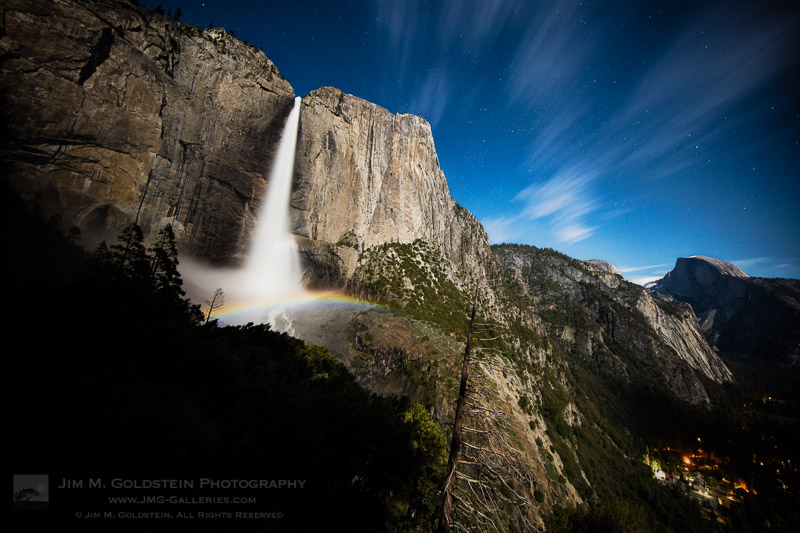
Upper Yosemite Falls Moonbow

A moonbow (AKA lunar rainbow) spans across upper Yosemite Falls with passing clouds and Half Dome in view.

This past week I ventured off to Yosemite to capture moonbows. Midway through my trip I met up with Brian Hawkins who twisted my arm ever so slightly to make a hike to upper  Yosemite Falls for a moonbow shoot. The last time I ventured up to this location I did so solo and while I got great photos it was a grueling hike with the amount of gear I was carrying. For whatever reason this time around while carrying the same amount of gear the hike didn’t seem so hard.  I chalk that up to great company keeping my mind off of the hundreds of switchbacks. Long story short the entire hike and shoot lasted 11 hours leaving on Thursday at 5pm and returning back to the valley floor at 4am.

Photographing Moonbows in Yosemite (taken Thurs. at midnight). Photo courtesy of Brian Hawkins.

A photo posted by Jim Goldstein (@jimgoldstein) on


While the effort was exhausting, the end result is one that I’m proud to share. Conditions turned out great and no one twisted an ankle or squashed one of the dozens of millipedes on the trail.

Photo Details:
Canon 5DS R, Canon 11-24mm at f/4, 11mm, ISO 640 and 30 sec.

The post Upper Yosemite Falls Moonbow, Yosemite National Park appeared first on JMG-Galleries – Landscape, Nature & Travel Photography.


JMG-Galleries – Landscape, Nature & Travel Photography

 
Comments Off on Upper Yosemite Falls Moonbow, Yosemite National Park

Posted in Equipment


Finding your story: National Geographic grant winner Max Lowe

19 Feb

‘If you want to be a better photographer, stand in front of more interesting stuff.’
– Jim Richardson, National Geographic Photographer

Born into a family with a taste for the ‘restless life,’ Max Lowe was indoctrinated into a life of far-flung travel basically at birth. ‘Traveling,’ Lowe says, ‘more than anything, has inspired me.’

It was during his years in college in Salt Lake City that Lowe first picked up a camera. In addition to bringing his camera along while he and friends were ‘chasing pow,’ Lowe found that pitching himself as a photographer often allowed him access to live musical performances for free. ‘This was really the first time I experienced photography as a tool that could take me to these places that I wouldn’t be able to access otherwise,’ Lowe says. ‘It was an addicting thing.’

After receiving his first payment as a photographer in the form of a gift certificate to a local pizza joint (‘the pizza was great’), Lowe decided to explore photography as more than a hobby. He began to experiment with combining his natural inclination for travel with his photography to actually build a career. It was while traveling through India that Lowe received word back from National Geographic that he had won the ‘Young Explorers’ grant. He was to leave India and travel to the Khumbu region of Nepal to document the influence of Western tourism culture on the native Sherpa people. And Lowe’s journey with National Geographic continues from there.

‘I found stories living in the experiences I already craved,’ Lowe says. ‘Find your story. Find something you’re truly hungry for. The rest will follow suit.’

Articles: Digital Photography Review (dpreview.com)

 
Comments Off on Finding your story: National Geographic grant winner Max Lowe

Posted in Uncategorized


US National Park Service looking for the next Ansel Adams

10 Dec
Photo by Jeff Keller

If your dream job hasn’t come along so far and you fancy yourself as a bit of an Ansel Adams, you could do worse than to pay a visit to the US Government’s employment website. The National Parks Service is looking for a full-time photographer to record the glory of the country’s natural treasures, much as Ansel Adams did on contract to the Department of the Interior in the 1940s. The only hitch is that applicants will be expected to use equipment similar to that used by Adams himself, as the job involves shooting with large format film cameras as well as the latest digital kit. 

You’ll need to be a US citizen, have a driving license and be subjected to a background check, but for your efforts you could earn up to $ 100,000 a year for doing what you love. The job isn’t all wandering around with a big camera and a box of film holders though, as you’ll be expected to make large scale prints, mount exhibitions and help review submissions for the service’s photographic collection. According to the advert, you’ll have to put up with ‘moderate discomfort’ out on location and ‘exposure to weather conditions’.

Keen enthusiasts though will already be familiar and well-experienced in ‘physical exertion such as long periods of standing; walking over rough or rocky surfaces; recurring bending, crouching, or stretching; and recurring lifting of moderately heavy equipment and materials.’

The job advert also specifically asks for the following: 

  • Knowledge of the principles and techniques of large format, black and white photography.
  • Knowledge of published standards and guidelines for architectural, engineering and landscape documentation.
  • Knowledge of film and digital photographic processes and techniques.

Those demands shouldn’t be too much of an issue for most photographers already working with large format equipment in the field. To apply for the job you’ll need to get moving as applications have to be in by 15th December. Santa might be coming early to someone. 

Articles: Digital Photography Review (dpreview.com)

 
Comments Off on US National Park Service looking for the next Ansel Adams

Posted in Uncategorized


Q&A: Gearing up for the National Football League with sports photographer Otto Greule

16 Sep

As the National Football League season sweeps in, sports photographers across the United States take to the stadiums to create iconic images. In a Q&A below, veteran sports photographer Otto Greule shares insider knowledge & outstanding imagery to give insight into his fast-paced, visual craft.

Articles: Digital Photography Review (dpreview.com)

 
Comments Off on Q&A: Gearing up for the National Football League with sports photographer Otto Greule

Posted in Uncategorized


National Portrait Gallery announces shortlist for Taylor Wessing Portrait Prize

15 Sep

The four images in the running for the £12,000 Taylor Wessing Photographic Portrait Prize have been revealed by Great Britain’s National Portrait Gallery. The often-controversial award is again set to spark some debate as one of the shortlisted images features a naked boy that many media outlets will have to think twice about reproducing. Read more


Articles: Digital Photography Review (dpreview.com)

 
Comments Off on National Portrait Gallery announces shortlist for Taylor Wessing Portrait Prize

Posted in Uncategorized


InstaMeets: A National Park Meetup For Photogs

15 Jul

You know that feel when you’re left behind in a tour group because you’re too busy snapping photos? All the time. You’re not alone (this time) and a resourceful Park Ranger noticed your dilemma.

Ranger Tim created InstaMeets, in Glacier National Park, as a solution. It’s a meetup for photographers to go on photo walks, safely and slowly, together. They’re a great way to connect with and learn from other photo enthusiasts.

Hopefully this brilliant idea is picked up by other National Parks. In the meantime, if you’re headed toward Glacier, check out when the next InstaMeet is here.

Photo by NPS


© Erin for Photojojo, 2015. |
Permalink |
No comment |
Add to
del.icio.us

Post tags:


Photojojo

 
Comments Off on InstaMeets: A National Park Meetup For Photogs

Posted in Equipment


Death Valley: One of America’s Worst National Parks?

22 Mar
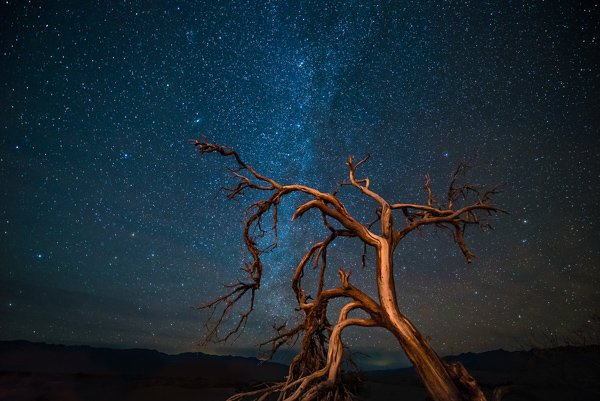
An ages old mesquite tree looking up at one of the darkest rated night skies in America.

An ages old mesquite tree looking up at one of the darkest rated night skies in America.

I recently came across an article by Bill Fink on Yahoo titled “Our Tax Dollars Pay for What? The Nation’s Worst National Parks.” In all fairness, there are some pretty lame national parks and monuments, I’m not going to argue that. Certainly a few of them ended up on this list as expected. But when I got to number five on the list and saw Death Valley National Park, I was astonished.

Fink writes in the brief article that the best way to simulate a visit to Death Valley is to “heat a pan full of sand to about 200 degrees, then pour it on your head,” and that “when it’s not hot [in Death Valley] it’s bitterly cold, so at least you get some variety in your misery.”

I’ve been to Death Valley National Park five times now. Twice on photography trips and three times to lead workshops through the park. All three workshops in Death Valley sold out in less than 24 hours. So either I (and my students) have terrible taste in beauty or Bill Fink doesn’t know what he’s talking about. In fact, after reading through his brief writeup a few times, I’d wager that Bill hasn’t even been to the park. If that’s true, it just goes to show how far we’ve come from true journalism in today’s age of click bait articles.

Death Valley is, in my opinion, one of the absolute best national parks in the country. Here’s a few ways to make certain you agree after your next visit:

Visit the park between January and March

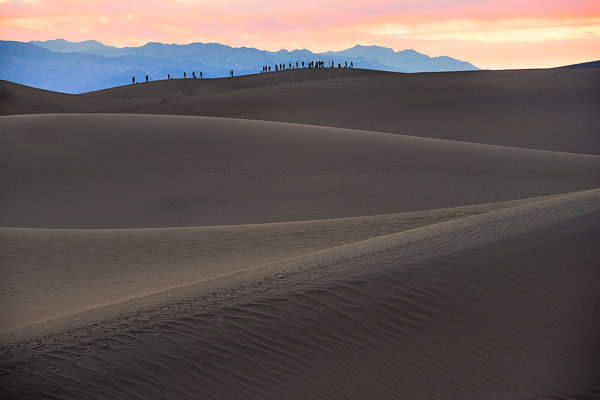
The second time I visited Death Valley was in early September back in 2013. The reported temperate at Stovepipe Wells was right around 118 degrees fahrenheit (47.8c). We knew it was going to be hot in the park, but we didn’t know it would be that hot. We were after some Milky Way images and figured we’d give it a go. Since it was still daylight, we decided to hike out into the Mesquite Flat Sand Dunes where the temperatures were around 10 degrees higher (128f or 53c) because of all the reflective sand.

I had a Camelback on to stay hydrated but if I didn’t continuously drink out of it, the water that gets stuck in the tube would get piping hot. Suffice it to say, the last thing you want to do when you’re experiencing the highest temperatures you’ve could ever imagine is to drink it a mouth full of piping hot water. It was, in a word, miserable.

As sunset approached, we decided to head to Badwater Basin. There, temperatures had cooled down to a much more manageable 113f (45c). The crazy thing is, the temperature didn’t drop as the sun set and darkness approached. It was pitch black outside and my tripod was too hot to touch and my Canon 1Ds Mark III was flashing warnings at me saying it was overheating. Yes, Canon’s flagship (at the time) pro level camera made to endure the harshest elements couldn’t handle the heat.

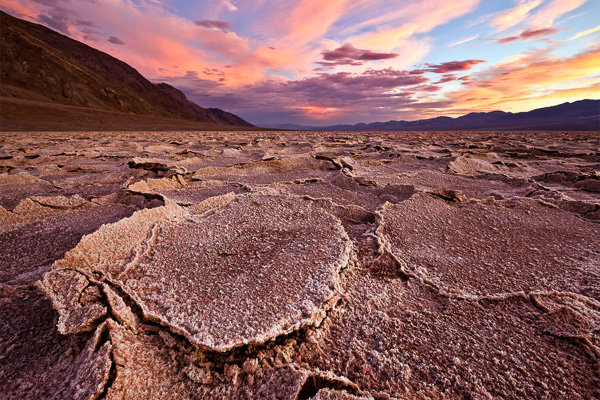
Badwater Basin at a scorching 113?F.

Badwater Basin at a scorching 113f (45c).

You may be thinking at this time that Bill Fink was pretty spot on, and if that had been my only visit to the park, I might be inclined to agree. If you want to enjoy everything Death Valley has to offer, you shouldn’t go when the temperatures are unbearable. The average high/low temps in fahrenheit in January for Death Valley are 67/40 (19.4/4.4C), February is 73/46 (22.8/8C)and March is 82/55 (28/13C). Anything past that and you’re looking at possible highs in the 90s and 100s. All three workshops I’ve done in the park have occurred during these months and they all had absolutely beautiful weather.

Rent a Jeep from Farabee’s

Much of what Death Valley has to offer isn’t accessible with the Ford Fiesta you rented in Vegas. Places like Racetrack Playa, Eureka Sand Dunes and Titus Canyon simply can’t (and shouldn’t) be reached without a good 4×4 vehicle. I’ve been to Racetrack Playa three times now. Once in a VW Toureg, once in a Chevy Tahoe and once in a Jeep from Farabee’s. The Toureg is a great SUV but it wasn’t 4-wheel drive. We got to the playa without any problems, but on the way out we busted something in the transmission and had to limp back to Vegas for three days while we waiting to get the car repaired. The second trip, with the Tahoe, resulted in a flat tire on the way in at Teakettle Junction. I think it goes without saying that the rest of the drive in, as well as the drive out was pretty nerve racking, considering our only spare tire had already been used.

The third trip (and my most recent), I finally decided to rent Jeeps for our workshop group from Farabee’s Jeep Rentals in Furnace Creek. We had to rent three because we had nine students and two instructors so we got two 4-door Jeeps and one 2-door. Getting out to Racetrack Playa in the Jeeps was like a dream. Sure, the road was still rough and unforgiving, but the Jeeps handled it without a problem. They also include coolers in the back full of ice cold water and a radio beacon in case you run into trouble, which will send them to your location immediately.

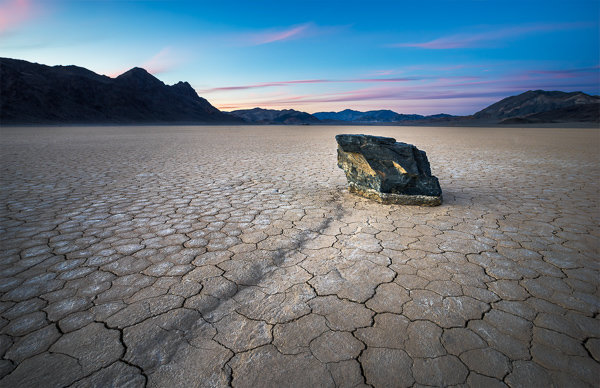
A "sailing stone" at the Racetrack Playa.

A “sailing stone” at the Racetrack Playa.

Parking lots are for tourists – don’t be a tourist

Two of the most incredible places in Death Valley are the Mesquite Flat Sand Dunes and Badwater Basin. Both have large parking lots that can be totally full at any given time and both locations can be pristine or totally useless depending on the recent weather conditions in the park. When the winds calm down for days or weeks on end, the sand dunes get covered in foot prints quickly and become totally un-photogenic. The salt plates at Badwater Basin are always changing and depend on rain to get back to their pristine condition with white salt and low, thin borders. As the plates dry and time goes on, the salt turns brown and the edges rise until they become totally unrecognizable.

The best thing to do at the Mesquite Sand Dunes is to park about a half mile before or after the parking lot on the side of Highway 190. Then, just hike out to the dunes from there. You’ll be free of nearly 90% of all foot traffic and will have mostly untouched dunes at your disposal. Just be smart and do your very best to tread lightly. Only walk were you have to and try not to trample the most beautiful dunes.

If the salt patterns at Badwater Basin look terrible from lack of rain, head over to West Side Road. You’ll actually drive right past this road on the way to the Badwater Parking lot, but most people just keep driving because it just looks like a dirt road. Drive about half mile or so down this road and you’ll have a great chance at finding some incredible patterns here. Just keep in mind that Badwater Basin is always changing and this information could be totally reversed during your visit.

From our location at sunrise (looking toward the parking area) we could see the circus or photographers already underway at sunrise.

From our location at sunrise (looking toward the parking area) we could see the circus or photographers already underway at sunrise.

Scout during the day – shoot at the edges

Blue skies are the norm in Death Valley. So don’t be surprised if you don’t see much in the way of clouds on your trip. I’ve actually lucked out quite a bit during my visits to the park and have experienced some incredible conditions. All that aside, don’t go photographing this place in broad daylight thinking that you’re going to come out with a bunch of keepers. This is the same with any landscape photography, all over the world. If you want to experience this park in all its glory, you need to capture it at sunrise, sunset or at night.

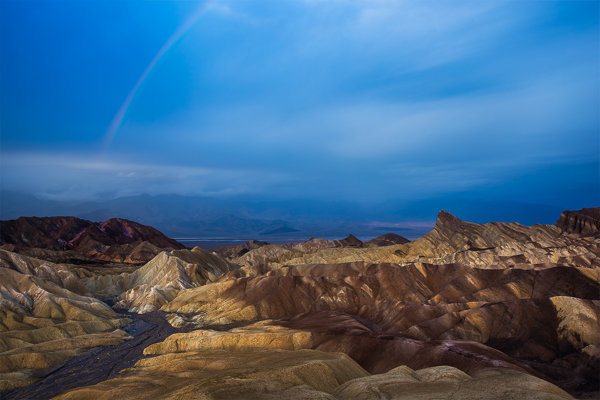
Zabriskie Point at dawn as storms move through the park.

Zabriskie Point at dawn as storms move through the park.

Conclusion

Death Valley is one of the most magnificent, diverse and photogenic national parks in America (USA). You just have to know how to do it right. You can either listen to some editor on Yahoo who just threw a list together (probably) without even going to the places in the article. Or you can listen to the throngs of photographers who visit the park each and every year, including ones like me who keep coming back again and again.

What do you think? Should Death Valley have made this list of worst national parks? Let’s talk in the comments below!

googletag.cmd.push(function() {
tablet_slots.push( googletag.defineSlot( “/1005424/_dPSv4_tab-all-article-bottom_(300×250)”, [300, 250], “pb-ad-78623” ).addService( googletag.pubads() ) ); } );

googletag.cmd.push(function() {
mobile_slots.push( googletag.defineSlot( “/1005424/_dPSv4_mob-all-article-bottom_(300×250)”, [300, 250], “pb-ad-78158” ).addService( googletag.pubads() ) ); } );

The post Death Valley: One of America’s Worst National Parks? by James Brandon appeared first on Digital Photography School.


Digital Photography School

 
Comments Off on Death Valley: One of America’s Worst National Parks?

Posted in Photography


National Media Museum to display three of the world’s oldest photos

08 Mar

Three photographs taken by Joseph Nicephore Niépce, a Frenchman born in 1765, will soon be exhibited by the National Media Museum. These particular images, which their creator called ‘heliographs’, were taken during the 1820s, and are part of a set of 16 image located throughout the world. All three images are said to be amongst the earliest of photographs ever taken. Read more

Articles: Digital Photography Review (dpreview.com)

 
Comments Off on National Media Museum to display three of the world’s oldest photos

Posted in Uncategorized


28 December, 2014 – Fraser Island Australia – Anatomy Of A National Geographic Assignment

29 Dec


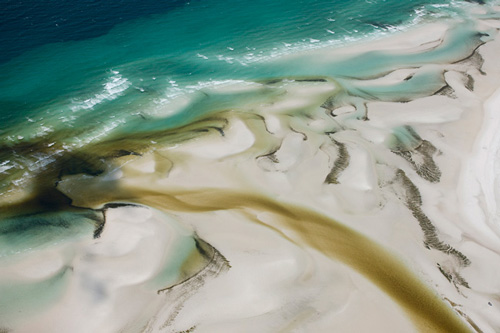
Growing up I had two magazines that I always looked forward to receiving in the mail and they were Life Magazine and National Geographic.  I always wanted to photograph for these magazines and travel the world.  Well, I have traveled the world but never had a chance to shoot for these magazines.  Today’s article is by Peter Essick and he has lived the dream.  He has done a number of assignments for National Geographic and shares one of those with us in his Fraser Island Australia – Anatomy Of A National Geographic Assignment story.  Peter shares what it is like to pitch an assignment and what it takes to shoot one.  Plus, he takes pretty darn nice images.


The Luminous Landscape – What’s New

 
Comments Off on 28 December, 2014 – Fraser Island Australia – Anatomy Of A National Geographic Assignment

Posted in News