RSS
 

Posts Tagged ‘More’

Lighting 103: Becoming More Intuitive with Color

29 Sep

As your understanding of light and color grows, how does it affect your daily shooting? Like most things that seem complex at first, color pretty quickly becomes a secondary thought process, just like tying your shoes.

I just had the above archive photo picked up by a nonprofit, to promote children's books. Looking at it, I'm reminded that creating a natural looking color need not be complicated at all.

This was a little more than a snapshot, done with on-camera flash, and no gels. And the thought process behind the light is a good example of how you'll start to see and control color, even if you're just grabbing a snapshot. Read more »
Strobist

 
Comments Off on Lighting 103: Becoming More Intuitive with Color

Posted in Photography


How Can I Be More ______ As A Photographer?

28 Sep

  The number two*  question that every veteran photographer gets asked is: “How can I be more ______ as a photographer?” You can fill that in with any adjective you’d like:  Creative. Wealthy. Original. Successful. Innovative. * The number one question is always about gear. Always. And, as always, the gear matters 10% as much as you think it does. Continue Reading

The post How Can I Be More ______ As A Photographer? appeared first on Photodoto.


Photodoto

 
Comments Off on How Can I Be More ______ As A Photographer?

Posted in Photography


Snapchat ‘sky filters’ use augmented reality to replace the sky with stars, sunsets and more

27 Sep

File this one under minor smartphone photography news: it seems Snapchat is using its augmented reality powers to expose non-photographers to the magic of dropping a new sky into your photos. The newly released feature—dubbed ‘sky filters’—can take a regular boring old blue sky and replace it with a colorful sunset, starry night scene, and more.

Sky Filters are already rolling out now to both iOS and Android users, and like their other AR features, this one will rotate daily so you can experience a variety of world-bending effects.

Articles: Digital Photography Review (dpreview.com)

 
Comments Off on Snapchat ‘sky filters’ use augmented reality to replace the sky with stars, sunsets and more

Posted in Uncategorized


Learning Digital Photography May Have More Benefits Than You Think

25 Sep

Many people struggle with the different elements of learning photography. Mastering the technical aspects of your camera, on top of applying all of the creative and technical concepts, can make it a daunting pursuit for many. Now, with digital photography the norm for most photographers, there is also the added element of learning post-processing if you are really going to become successful as a photographic artist.

Learning Digital Photography May Have More Benefits Than You Think

Learning Photography and Aging

As you scratch your head trying to put all the pieces together, you may not have realized that you are exercising many aspects of your brain. Studies have found that digital photography keeps your brain sharp and your mind in good shape.

Learning Digital Photography May Have More Benefits Than You Think

I have watched one of my family members pursue digital photography well into his 90s. I always thought there was something about this activity and the creative process that was keeping him active and on track. But I never put much thought into it until I read this study from the University of Texas on digital photography and aging.

The study shows . . .

During the University of Texas study, six groups of individuals aged 60–90 were studied over a 10 week period. Each group was engrossed in a specific activity for 15 hours a week. The primary activities under observation included digital photography, digital quilting, and a variety of activities like playing cards and socializing. Only the groups doing quilting and photography improved their memory abilities when confronted with these continuous and prolonged mental challenges.

Learning Digital Photography May Have More Benefits Than You Think

The results of the University of Texas study showed that digital photography is the best activity to participate in for aging baby boomers interested in maintaining their cognitive health and development.

Benefits of learning digital photography

What were the benefits? The most significant improvement was found in their use of words and phrases as well as their recognition of conceptual and visual imagery. The reason digital photography came up so high in this cognitive study is that it uses many parts of the brain to be successful.

Learning Digital Photography May Have More Benefits Than You Think

It affects the creative and technical sides of your brain in both the shooting and post-processing. It also uses memory to make all of the functions work together. These benefits apply to someone who is shooting in full manual or partially automatic programs on their camera and are using advanced Photoshop or similar post-processing programs.

Learning Digital Photography May Have More Benefits Than You Think

How it works

Here’s an example of some of the brain functions that are used when you create an image: When you are out on a photo shoot, and you want to create a compelling image, it takes some time to think about how to creatively compose the scene. Then, you need to choose the aperture and shutter speed settings based on the best creative application for the image, applying your memory of how the camera works.

Some of the high-end cameras these days will give you a decent point and shoot shot, but if you are intentionally going to create something of value, you need to put some technical thought into the image. At the same time, when you are setting up a shot, it helps to think through what you might do for post-processing the image once you get home.

Learning Digital Photography May Have More Benefits Than You Think

Now that you have conquered the technical aspects of operating the camera, you need to bring the image into post-processing. Whether or not you are using Photoshop or Lightroom, you still need to have some technical ability on the computer and knowledge of how the program works. All of these activities together require memory, creativity, and cognitive abilities to perform these tasks correctly. This is all good exercise for your brain.

Learning Digital Photography May Have More Benefits Than You Think

What does all of this mean for you?

The process of creating a digital image is fun, creative and clinically proven to be good for your mind. Just like we need to keep our heart healthy with diet and exercise, we also need to keep our brain active as we age. It’s not just the activity, but learning new and mentally challenging subjects that is the important part of this puzzle.

If you continue to pursue and learn digital photography well into your later years, it will serve as a good way to keep your brain and memory functions sharp.

Does that sound like a good plan for you to continue practicing the craft of digital photography as you age?

Learning Digital Photography May Have More Benefits Than You Think

The post Learning Digital Photography May Have More Benefits Than You Think by Holly Higbee-Jansen appeared first on Digital Photography School.


Digital Photography School

 
Comments Off on Learning Digital Photography May Have More Benefits Than You Think

Posted in Photography


New product overview videos: Canon EOS 6D II and more

23 Sep

We’re always expanding our collection of product overview content, and we’ve just added videos for the Canon EOS 6D Mark II, the EOS Rebel SL2 and EOS M6. Take a look at some of the key features these cameras offer – demonstrated in the shooting scenarios they were built to handle. For more overviews and gear tests, be sure to subscribe to our YouTube channel.

Canon EOS Rebel SL2 overview

Canon EOS M6 overview


This is sponsored content, created with the support of Amazon and Canon. What does this mean?

Articles: Digital Photography Review (dpreview.com)

 
Comments Off on New product overview videos: Canon EOS 6D II and more

Posted in Uncategorized


Synology launches its first 6-bay NAS tower, updates more affordable options

22 Sep

Storage solution company Synology has introduced its first six-bay NAS device: the DS3018xs. The new model holds six drives of its own, but if that’s still not enough storage for your epic photo library, it can combine with the company’s DX1215 expansion units to control up to thirty.

The company has used the Pentium D1208 dual-core 2.2GHz processor that can boost to 2.6GHz, and provides a PCle slot for users to install an optional dual M.2 SATA SSD adapter to shift processing onto solid state drives for speed and efficiency. The DS3018xs comes with 8GB of RAM installed, but has two memory slots for expansion up to 32GB, and an optional 10GbE network card can provide 2230MB/s sequential read speeds.

At the same time, Synology has launched four other DS and DS+ models that replace existing NAS enclosures. The new DS918+ and DS718+ are upgrades of the DS..16+ models, and bring more memory capacity and options for adding extra slots via DX517 expansion unit. These models and the DS218+ and DS418 get new processors as well, while all are said to be capable of transcoding 4K video on the go.

Synology has started a series of workshops around the world that demonstrate some of these models and show off the company’s technology. They are free to attend to anyone registered via the Synology 2018 events page. For more information about the new NAS enclosures visit the Synology website.

Pricing

DS3018xs – £1298.18 (including VAT), €1190 (excluding taxes)
DS918+ – £518.18 (including VAT), €475 (excluding taxes)
DS718+ – £414.55 (including VAT), €380 (excluding taxes)
DS218+ – £310.90 (including VAT), €285 (excluding taxes)
DS418 – £387.91 (including VAT), €351 (excluding taxes)

Press Release

From Home to Business: Synology® Unveils New XS/Plus/Value-Series Product Lineup

Storage solutions designed to meet a multitude of needs

Synology® Inc. announced the official launch of new product lineup featuring:

DS3018xs: Synology’s first 6-bay tower NAS with optional 10GbE and NVMe SATA SSD supports

Plus-series DS918+, DS718+, and DS218+: Designed to meet your intensive daily workloads

Value-series DS418: Featuring optimized 4K online transcoding capability

To allow for ultra-high performance using SSD cache without occupying internal drive bays, DS3018xs features a PCIe slot, which can be installed with a dual M.2 SATA SSD adapter card (M2D17). DS918+ comes with dedicated dual M.2 NVMe slots at the bottom where you can directly install M.2 NVMe SSDs. DS418 features 10-bit H.265 4K video transcoding, and while supporting the next-generation Btrfs file system in DSM 6.2 official, expected to release in early Q1 next year. Btrfs provides reliable data protection through its cutting-edge self-healing and point-in-time snapshot features.

DS3018xs, Synology’s first 6-bay tower NAS, is compact yet powerful as it features the Intel’s advanced Pentium D1508 dual-core 2.2GHz processor (Turbo Boost up to 2.6GHz) with AES-NI encryption engine; offering scalability of RAM up to 32 GB and storage capacity up to 30 drives with two Synology DX1215. In addition to four Gigabit LAN ports, DS3018xs takes advantage of boosting maximum throughput with an optional 10GbE network interface card, delivering stunning performance at over 2,230 MB/s sequential reading and 265,000 sequential read IOPS.

DS918+ and DS718+ are powered by Intel‘s Celeron® J3455 quad-core processor. DS218+ is powered by Intel’s Celeron® J3355 dual core processor. Both models are equipped with AES-NI hardware encryption engine and support up to two channels of H.265/H.264 4K video transcoding.DS918+’s RAM is scalable up to 8GB, while DS718+ and DS218+ are scalable up to 6 GB, allowing you to operate more intensive tasks at once. DS918+ and DS718+ are equipped with two LAN ports, and their storage capacity can be scaled up to 9 and 7 drives, respectively, with Synology’s DX517 expansion unit.

“Responding to the demands from our customers, DS3018xs is built as a comprehensive business-ready desktop NAS. Running mission-critical applications or planning virtualization deployment with DS3018xs has never been easier.” said Katarina Shao, Product Manager at Synology Inc. “The new DS918+, DS718+, and DS218+ are optimized to be your digital video libraries, and will bring you an excellent viewing experience with high definition live video transcoding, regardless of device limitations.”

DS418 is equipped with a 1.4GHz quad-core processor with hardware encryption engine, 2 GB RAM, and two LAN ports. Powered by the hardware transcoding engine, DS418 supports H.265 4K transcoding allowing it to serve as your media library. Combined with Btrfs and Snapshot supports, DS418 is delivers more efficient data storage and more reliable data protection.

For more information on DS3018xs, please visit https://www.synology.com/products/DS3018xs

For more information on DS918+, please visit https://www.synology.com/products/DS918+

For more information on DS718+, please visit https://www.synology.com/products/DS718+

For more information on DS218+, please visit https://www.synology.com/products/DS218+

For more information on DS418, please visit https://www.synology.com/products/DS418

Articles: Digital Photography Review (dpreview.com)

 
Comments Off on Synology launches its first 6-bay NAS tower, updates more affordable options

Posted in Uncategorized


3D-Printed Muscle Straight Out of ‘Westworld’ Makes Robots More Realistic

21 Sep

[ By SA Rogers in Conceptual & Futuristic & Technology. ]

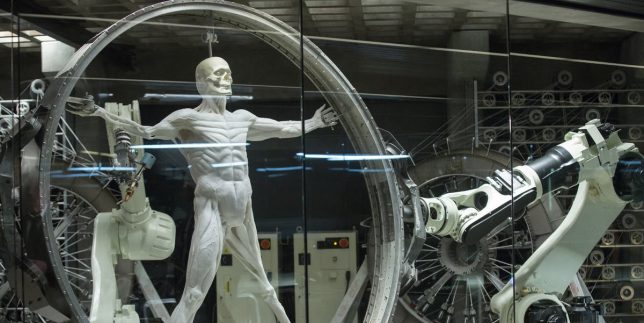
If you watched HBO’s ‘Westworld’ earlier this year, you probably remember the scenes where the nascent humanoid robots were strung up on circular frames like Leonardo da Vinci’s ‘Vitruvian Man,’ with machines printing white muscle fibers onto their skeletons. While the process of constructing androids doesn’t quite resemble this sci-fi vision just yet, it’s surprisingly close, especially with a new breakthrough in synthetic muscle tissue announced by researchers at Columbia Engineering. Their tests show a bundle of white muscle held in the palm of a researcher’s hand, moving and expanding in response to low power sent through a thin resistive wire.

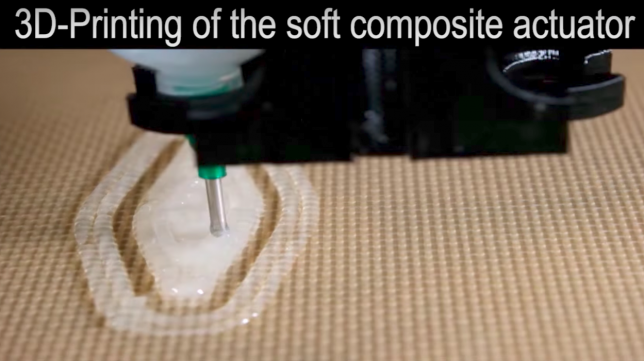
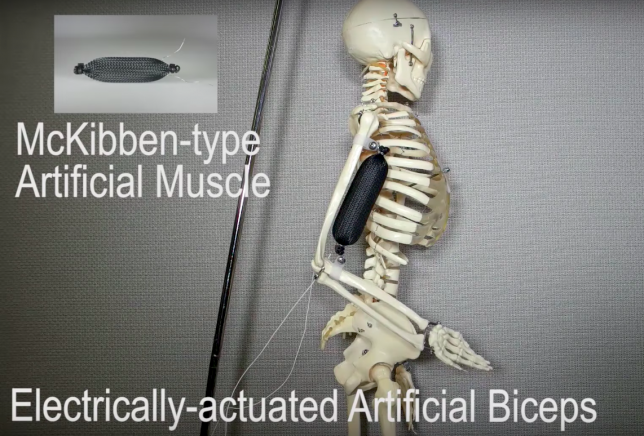
This self-contained ’soft actuator’ is three times as strong as natural muscle, so yes, it’s true: Skynet is going to kill us all. The creators took inspiration from living organisms, using a silicone rubber matrix with ethanol distributed through micro-bubbles to simulate muscle tissue. It’s capable of expanding up to 900% when electrically heated to 80 degrees celsius, and can perform all sorts of motion tasks when controlled by computers.

“We’ve been making great strides toward making robots minds, but robot bodies are still primitive,” says Hod Lipson, Professor of Mechanical Engineering at Columbia and leader of the project. “This is a big piece of the puzzle, and, like biology, the new actuator can be shaped and reshaped a thousand ways. We’ve overcome one of the final barriers to making lifelike robots.”

“Our soft functional material may serve as robust soft muscle, possibly revolutionizing the way that soft robotic solutions are engineered today,” adds Aslan Miriyev, a postdoctoral researcher in the Creative Machines lab and lead author of the study ‘Soft Material for Soft Actuators,’ published by Nature Communications. “It can push, pull, bend, twist and lift weight. It’s the closest artificial material equivalent we have to a natural muscle.”

Share on Facebook


[ By SA Rogers in Conceptual & Futuristic & Technology. ]

[ WebUrbanist | Archives | Galleries | Privacy | TOS ]


WebUrbanist

 
Comments Off on 3D-Printed Muscle Straight Out of ‘Westworld’ Makes Robots More Realistic

Posted in Creativity


How to Understand Reflected Versus Incident Light and Get More Accurate Exposures

14 Sep

Do you ever get under or overexposed photos when you use your camera’s light meter? Do you get frustrated that even in auto-mode you can’t get the correct exposure? That’s because there are two different type of light to deal with when taking a photo.

When you make a photograph the light is your raw material, which is why it’s important to understand how it works. It’s a very broad topic to cover, so for this article, we are just going to focus on the difference between incident and reflective light because that’s the key to getting your exposure right.

Incident versus reflective light


We all know this difference in a very intuitive way; let me give you an everyday example: when there is a sunny day, do you wear white clothes or black ones? Easy! You wear white or at least light colors, but why? If the sun will be the same, why wouldn’t you wear dark colors? Because you know that dark colors absorb light and therefore you’ll feel the heat more than wearing white which will reflect more light and keep you fresher. This is the same principle you need to apply when measuring the light for photography.

The difference explained

Diagram How to Understand Reflected Versus Incident Light and Get More Accurate Exposures

Incident light is that which is illuminating your scene. It falls on the subject before being altered (reflected) by it which is why it’s also a more accurate light reading.

When light hits objects it gets transformed by them and reflected out; this is what we perceive and what the camera captures and reads. This is called reflective light.

Light metering

Let’s see how these two concepts apply to light metering and exposure when you take a photo. In the next examples, I always used the same light for each.

In this first shot, I metered the light once I had framed the image I wanted, so it gave me a reading making an average of the reflective light.

General Reading - How to Understand Reflected Versus Incident Light and Get More Accurate Exposures

The settings were ISO 400, f/5.6, with a shutter speed of 1/80th.

And the resulting photograph looked like this:

General Reading Result - How to Understand Reflected Versus Incident Light and Get More Accurate Exposures

Reflected light from a dark subject

However, like we said when talking about clothes, dark objects absorb light. So if I make the reading by measuring the black part of the photo, the settings that were “correct” before, now appear to be underexposed.

Black Reading - How to Understand Reflected Versus Incident Light and Get More Accurate Exposures

Even if the lighting is always the same, your camera thinks there is less. As a result, your photos will be overexposed.

Black Reading Result - How to Understand Reflected Versus Incident Light and Get More Accurate Exposures

Exposure: ISO 400, f/5.6, shutter speed 1/13th.

Reflected light from a light subject

On the other hand, light objects reflect most of the light, so your camera will receive the message that it needs to reduce the exposure if you meter off something light.

White Reading - How to Understand Reflected Versus Incident Light and Get More Accurate Exposures

And as a result, you will end up with underexposed images.

White Reading Result - How to Understand Reflected Versus Incident Light and Get More Accurate Exposures

Exposure: ISO 400, f/5.6, shutter speed 1/200th.

None of these three readings gave you the correct exposure on your image because none of them were about the incident light. In order to get this accurate reading, you need to use a handheld external light meter, which can be very expensive. Fortunately, there are other ways to get the right exposure without having to spend a fortune.

Black and white… and gray

Back in the 1930s, a photographer called Ansel Adams developed a technique for the optimal exposure of photographs by dividing the degrees from light to dark into 11 zones, therefore it’s called the zone system. Everything in the world has a color and lightness that correspond to a zone. All light meters, including the one integrated into your camera, are designed to give you the middle zone: Gray V that reflects 18% of the light. So, what you need in order to have a correct exposure is to measure the light reflecting off of this tone.

Gray card Reading - How to Understand Reflected Versus Incident Light and Get More Accurate Exposures

You’ll find gray cards on the market which are used to calibrate your exposure and white balance. They are a very practical and economical way to turn the reading of your reflective light into an incident light accuracy.

It is also very easy to use, you just have to put one in front of your subject and frame it with your camera. Once that’s the only thing in your shot, press the shutter button halfway to see the light meter and adjust your exposure accordingly. With those settings, you can have the perfect exposure regardless of the tones in your image.

Grey cardReading Result - How to Understand Reflected Versus Incident Light and Get More Accurate Exposures

Exposure: ISO 400, f/5.6, shutter speed 1/30th.

Real world examples

I know what you’re thinking, that was an unreal example because most of your photos will have much more colors than just black, white and gray V. That’s true, but the principle remains the same. Look at these real life examples:

Bridge Reflective - How to Understand Reflected Versus Incident Light and Get More Accurate Exposures

Reflective reading with an exposure of ISO 400, f/5.6, shutter speed 1/80th.

Compared to the incident reading:

Bridge Incident - How to Understand Reflected Versus Incident Light and Get More Accurate Exposures

Incident reading with an exposure of ISO 400, f/5.6, shutter speed 1/320th.


How to improvise!

What if you don’t want to be carrying around a gray card? Or did the perfect image catch you unprepared? No problem, everything in the visual world has its equivalent in the zone system.

For example, grass or wet cement correspond to the gray V zone so you can always look for elements like that in your photo and you will get a very accurate reading from them.

Take this composition of candle holders. When they are all white the photo is dark, sad and shows all the imperfections of the backdrop because it’s underexposed. However, when I add a gray candle holder and measure the light in it, the exposure is perfect.

Candleholders Reflective

Exposure: ISO 1250, f/11, shutter speed 1/125th.

Candleholders Incident

Exposure: ISO 1600, f/8, shutter speed 1/125th.

Tip: So that you are never caught off guard, you can measure the palm of your hand and figure out how much lighter or darker it is than the gray card, that way you will always have the perfect reading “at hand”.

Things to remember:

  • Get close enough to the gray object so that it’s the only thing you see through the lens, or at least the majority of it, and take that reading to set the exposure values.
  • The gray card or object needs to receive the same light as the rest of the scene. Be careful to not cast a shadow with your body or your camera when getting closer to measure the light.
  • Reflective light depends also on the material and shape of the object so a black car, for example, reflects more light than a black wool sweater.

There you go, understanding the difference between reflective and incident light can transform your photo from snapshots to pro shots!

The post How to Understand Reflected Versus Incident Light and Get More Accurate Exposures by Ana Mireles appeared first on Digital Photography School.


Digital Photography School

 
Comments Off on How to Understand Reflected Versus Incident Light and Get More Accurate Exposures

Posted in Photography


Sony: ‘Our company has a vision which is more important than profit alone’

12 Sep

Recently, DPReview was invited to Japan to visit both the Sony headquarters in Tokyo and Sony’s image sensor factory in Kumamoto. The trip was an opportunity to gain some insight into both the philosophy and the technology that underpins the company.

We spoke to both Sony Semiconductor Solutions, the company making the imaging sensors in your cameras and smartphones, and Sony Digital Imaging (DI), the division of Sony Imaging Products and Solutions (SIPS) that makes everything from interchangeable lens cameras (ILCs) to action-cams and camcorders, and lenses. Sony Corporation itself, the umbrella above all these groups, has its hands in a number of sectors – from consumer electronics to smartphones to professional services and motion pictures. Sony Semiconductor, as we previously reported, is its own company, which has some interesting implications we learned about through the course of our conversations.

Be the guinea pig

“The electronics industry is constantly searching for new ideas and there are still many products for us to make. If the guinea pig spirit means developing innovative ideas and embodying them in new products, then I think this is an admirable spirit.” These are the words of Sony co-founder Masaru Ibuka.

At the Kumamoto sensor factory hangs an image of co-founders Ibuka and Akio Morita arm-wrestling in good spirit.

At the Kumamoto sensor factory hangs an image of a golden guinea pig right below a candid of co-founders Ibuka and Akio Morita arm-wrestling in good spirit. On it these words appear, along with one of the principles set out in the Founding Prospectus: “To establish an ideal factory that stresses a spirit of freedom and open-mindedness, and where engineers with sincere motivation can exercise their technological skills to the highest level.”

“If the guinea pig spirit means developing innovative ideas and embodying them in new products, then I think this is an admirable spirit”

More than 70 years later, the ethos of the co-founders still persists in the mindsets of Sony employees. It’s evident in everything from the philosophy of Sony Semiconductor and its relationship with other manufacturers to Sony’s new flagship: the a9.

Planning innovation: Sony a9

Our testing has shown the Sony a9 to be a formidable camera, not just for stills but also video. At Sony, a new camera like the a9 takes two to three years to develop, we were told. Therefore, the photographic technologies the a9 offers had to be planned for years in advance, not long after Sony introduced the world’s first full-frame mirrorless cameras a mere 3.5 years ago. And as we learned during our visit, most of the advancements in the a9 stem from new sensor technologies.

Two to three years ago, how would it have been possible to predict sensor readout speeds that offer autofocus calculations at 60 fps and a fully electronic shutter that is only a stop behind the speed of mechanical shutters? The answer lies in the constant communication between Sony Semiconductor Solutions and Sony DI. And since Sony’s sensor foundry is one of the best in world, providing sensors for everything from cameras and smartphones to security and medical devices, this in-house knowledge and communication is a key advantage.

It takes 2 to 3 years to develop a camera like the Sony a9. Koji Hisamatsu, Mechanical Engineer of the a9, showed us its magnesium alloy body. It offers improved ergonomics and weather resistance over previous models.

Yasufumi Machitani, project leader on the a9, talked to us about the development of the camera. A number of its features, like blackout-free shooting and fast AF/AE calculation, require sensor readout speeds conventionally thought impossible. A stacked BSI-CMOS sensor with integral memory was necessary for these technologies, and the camera division’s awareness of such coming sensor technology years in advance allowed it to plan the a9.

Daisuke Miyakoshi, in charge of the image sensor portion of the product design division, elaborated on this cross-communication: his team is a bridge between Sony Semiconductor Solutions and SIPS (Sony Imaging Products and Solutions), the latter in charge of both product and system design and Sony DI’s parent company. The system design department sends new imager proposals to the product design teams making cameras, and together the teams evaluate success and pain points of actual sensor designs.

This information is then used to send new specification formulations to the image sensor development department at Sony Semiconductor. The communication between these three groups allows fine tuning of both sensor and camera.

Product strategy

Sony’s product strategy is simple. Imagine a pyramid with three customer types: at the top pros, in the middle high amateurs (‘enthusiasts’), and below that consumers. Products are intended to fall within one or span two of these segments.

Rice fields at dusk. Miyama Sansou, Kurokawa Onsen. Photo: Rishi Sanyal
Sony a7R II | 12-24 F4G @12mm | 1/30s, F4, ISO 5000.

Sony believes there is a growing market of pros and enthusiasts, with shrinking demand at the entry level (it’s hard to argue with that, given the death of the compacts and the rise of the smartphone). This brings a higher demand for better performing products, be it in terms of autofocus, speed, resolution or sensitivity. Therefore, Sony says its product strategy is to pack as much available technology into each product as possible, barring hardware limitations, to meet a certain price point. Machitani-san explicitly told us “there is no intention to limit functions of cameras to certain groups”. In fact, Sony claims it includes many of these functions – where others might remove them in an effort to segment products – just to see what creatives do with them.

It’s a strategy not always taken by other camera manufacturers, but one that makes sense in a post-smartphone era: target customers who want a dramatic step in quality and features from what smartphone imaging offers. It’s not entirely without its issues though. For one, some may find the user interfaces of some Sony cameras overwhelming due to the number of features. Sony is aware of this and constantly iterating – the a9 for example offers an encouraging ergonomic and usability refresh.

Of course, Sony’s own crowded camera lineup can sometimes be at odds with its intended strategy, since Sony is less afraid of cannibalizing itself than other camera companies. Take for instance the short product replacement cycles. Or the almost inevitable focus – since Sony believes in a growing pro and enthusiast market – on full-frame E-mount, which has left the impression among some that Sony is abandoning A-mount1 and APS-C.2 Or the appearance of advanced new technologies in more niche products before they find their way into other product lines. Many of these ‘issues’ stem from the pace of iteration and innovation at which Sony is moving, if not due simply to its relatively newcomer status. But Sony is actively learning, and recent market data suggest its strategy is working.

Vision over profit

You might think that Sony Corporation would like to keep the in-house knowledge of Sony Semiconductor Solutions for its own camera division, but that’s not the case. For one thing, the sales of the semiconductor division to third-parties is a large source of income for the corporation at large, but it goes beyond that.

Although Sony tends to hold its proprietary sensor technology for its own cameras for roughly two years,3 it publicly discloses sensors that are available for sale and their underlying technologies. This allows other manufacturers to integrate Sony sensors into their own products. And this is where it gets interesting: any manufacturer can approach Sony Semiconductor and ask for their own design requirements, often building on Sony’s own sensor advancements that are made public (take full-frame BSI-CMOS or dual-gain for example, two technologies found in the Nikon D850). But if an OEM does so, Sony Semiconductor is not allowed to communicate any intellectual property it gains to Sony’s camera division.

Having this wall (or more accurately, perhaps this two-way mirror) in place makes a lot of sense. After all, OEMs wouldn’t approach Sony about new designs if the sensor division leaked proprietary information to its own camera engineers. So, no folks, Sony’s camera team has not been aware of the Nikon D850’s sensor all along, prepping a response to it years in advance…

There are interesting implications of this wall between Sony Semiconductor and Sony DI: it means that newer, better technologies than those available in Sony’s own cameras may appear in any other manufacturer’s camera, despite using a ‘Sony’ sensor. Indeed, we’ve actually seen multiple examples of this: ISO 64 on the D810 and 16-bit analog-to-digital conversion on the Hasselblad X1D to name just two.

Could this threaten the growth of Sony’s own camera division?

Sony executive round-table. From left to right: Takashi Kondo, Chief Marketing Manager, Hiroshi Sakamoto, Senior General Manager of Marketing, Kenji Tanaka, Global Head of ILCs, and Masanori Kishi, Deputy General Manager of ILC lenses.

When we asked this question, the message from DI executives was clear: “Our focus is to increase the overall market”. Paraphrasing slightly, global head of ILCs Kenji Tanaka said: “Please think about vision. Our company has a vision, which is much more important than profit alone. Of course, if we cut our supply of sensors to other OEMs our camera market share might increase. But this is not our vision. Our vision is to grow the entire imaging market, and Sony alone cannot make every [imaging] product.”

While every manufacturer wants to be number one, no single company can make every product – even within a single sector. It is clear that Sony believes that competition is healthy, and that if Sony sensors help make better products, be it in a Sony device or other OEM device, the consumer wins. And ultimately, that is the purpose of the company.

“Our company has a vision, which is more important than profit alone”

It’s possible that the worst of the camera market collapse is over, but we do wonder whether Sony’s strategy might change if the market continues to shrink. Would the huge current investment in ILCs still pay off? Would sales of class-leading sensors to other OEMs still make sense? The answer from executives was “yes”.

Growing the market

Like every camera manufacturer, Sony wants to grow its market share. But it sees the gain of market share as a secondary effect, almost a byproduct, of growing the market overall. In fact, Sony admitted it doesn’t expect to continue to gain market share simply by getting users to switch systems. Tak Kondo, General Manager at Sony DI, remarked that “the industry is stagnated partly because of a lack of interesting products from camera manufacturers. It’s our obligation to increase the market size.”

We probed Sony about its strategy to move users away from smartphones, arguably the very cause for the declining camera industry. “We want to expand the photo-shooting culture” Tanaka-san told us. “By growing this culture, we hope to stimulate the desire for something [much] better than a smartphone”. Furthermore, Sony chooses to place its focus on mid- to high-end products, which show increased demand. The global decline in the industry is due to a drop in demand for low-end products – both DSLR and mirrorless – thanks to the smartphone.

By making versatile cameras that offer vast benefits over smartphones and more computational photography-oriented devices that widen its user-base, Sony hopes to reverse this trend. That is, grow the market through innovation, a message we’ve heard before.

Why Sony?

Sony believes that it is in a unique position to grow the imaging market. The communication between its image sensor development engineers at Sony Semiconductor and the camera teams at Sony DI give the company a unique advantage: an understanding of important sensor technologies to come two, five, or ten years down the line. The two-way communication between a cutting-edge sensor foundry and camera engineers that need sensor technologies to solve photographic problems is a unique advantage for Sony’s camera division. And Sony’s sensor design and fab group must stay cutting edge simply due to the number of sectors it has its hands in: from smartphones to the medical industry.

Shiraito Falls near Mount Fuji in Fujinomiya, Shizuoka Prefecture. It’s often said that Mt. Fuji is shy, rarely revealing herself. This day was no exception: the entire region was covered in thick mist and rainfall, and the spray from the waterfalls themselves was intense. Photo: Rishi Sanyal

Sony a7R II | 24-70 F2.8GM @46mm | 0.5s, F11, ISO 100

Mirrorless cameras are still in their infancy. However, Tanaka-san stressed that when you compare the development speed of mechanical products vs. semiconductor technology, the latter is far faster. Since much of the capability of mirrorless cameras is derived from the image sensor itself, its development speed is much faster than DSLR. So while mirrorless camera technology is a relative newcomer to the field, Sony’s insight into semiconductor advances puts its camera division in a unique position to innovate and iterate quickly, bringing greater speed and functionality to consumer products across shorter refresh cycles.

Will Sony’s ‘guinea pig’ approach pay off? The latest U.S. dollar-based statistics from NPD are certainly encouraging: the first 6 months of 2017 showed a 36% growth in mirrorless camera sales compared to an 11% decline in DSLR sales. In the same period, Sony’s sales of full-frame ILCs grew 42% compared to a decline of 5% for all other manufacturers. It also maintained a #2 position in sales of full-frame ILCs (likely helped by the release of a flagship camera), while growing 26% in mirrorless ILC sales year-on-year. Sony is now at the top in mirrorless ILC sales in the U.S.

While these sales figures are all dollar-based, with many Sony products retailing at relatively high prices, they’re significant – especially when you consider the impact the Kumamoto earthquake must have had on the company.

Challenges

Despite these encouraging figures, Sony’s path will not be a smooth one. Canon and Nikon have been making cameras for a long time and are widely viewed as photography companies, as opposed to consumer electronics companies. Part of the reason the a9 is being targeted so aggressively at pros, and why Sony is working so hard on expanding pro support, is to overcome the perception of the company as a manufacturer of TVs, Walkmans and PlayStations.

At the opposite end of the pyramid, smartphone cameras offer something that most, if not all, standalone cameras to-date lack: convenience of image ingestion, curation and sharing. While Sony PlayMemories apps offer some solutions,4 they leave much to be desired. Thankfully, Sony is well aware of the importance of integrating with cloud services and smartphones.

The hillsides near the Kuju Mountain Range in Kumamoto prefecture provide endless vistas. I shot this through a window of a moving bus on the way to Kurokawa Onsen. The volcanic region offers many hot springs and resorts within Kurokawa’s ‘enchanted’ forest. Photo: Rishi Sanyal

Sony a9 | 24-70 F2.8GM @35mm | 1/1000s, F2.8, ISO 1250

And then there’s video. Increasingly, cameras that do both stills and video well are more attractive than those that can’t. Sony is on the right track here, offering cameras that are highly capable at both, but there’s still work to be done. The Sony a9 offers some of the sharpest video around thanks to the fact it oversamples a full-frame sensor, yet it lacks a Log profile or an intuitive autofocus interface in video.5

Meanwhile of course, competitors aren’t standing still. Canon’s Dual Pixel AF in video offers a clear user benefit in combining performance and UI/UX. Four Thirds cameras offer 4K video with compelling (mechanical + digital) stabilization. The Panasonic GH5 offers 6K Photo, pre-capture, and effectively simultaneous video and stills capture in its high-resolution anamorphic mode. RED Cinema cameras – albeit in a very different price bracket – can capture at 120 fps for stills extraction or for 24p video.6

But theoretically, these are all challenges that Sony is well placed to face. Sony’s executives see the relationship between Sony Semiconductor and Sony DI as being key to planning for the future, and they assure us that the founders’ spirit of innovation will continue to bring compelling products to the market.


Footnotes:

1 Tanaka-san assured us that ‘the A-mount customer base is small, but loyal, and we need to serve them.’ While Sony does not intend A-mount users to transition to E-mount, it does see the a9 as a potential body for A-mount lenses, via adaption. To that end Sony assures us the disadvantages associated with adapters – like the lack of proper subject tracking – are addressable, though it won’t officially support or offer a solution for Canon lenses natively.

2 Expressing very frank surprise at the idea that some of our readers feel Sony is less committed to APS-C, Sony DI executives assured us that, on the contrary, they are fully committed to APS-C. They pointed in particular to its potential to increase business by its adoption as a second camera for pros (a6300/6500) or a first-time camera for casual users (a5100/6000).

3 While we weren’t explicitly told this, one might surmise it from the fact that the sensor in the a7R II has not appeared in any other manufacturer’s camera since its launch over 2 years ago.

4 For example, ‘Sync to Smartphone’ ensures all my JPEGs from my a7R II end up on Google Photos via my Google Pixel in full resolution original quality without me moving a finger.

5 We asked Sony about the omission of S-Log2 and PlayMemories on the a9. We suggested it ostensibly appeared like forced product segmentation, uncharacteristic of Sony’s product strategy. While it still appears that may indeed have been the case, we were assured that Sony takes our negative feedback about these omissions seriously.

6 Some RED cinema cameras are capable of assembling 24p footage from 120p capture by frame averaging, which removes the stutter that would otherwise result from the higher shutter speeds you’d likely shoot 120p footage at. It’s quite clever.

Articles: Digital Photography Review (dpreview.com)

 
Comments Off on Sony: ‘Our company has a vision which is more important than profit alone’

Posted in Uncategorized


More Lessons from the Photography Masters: David Burnett and Vivian Maier

06 Sep

The more you can learn about photography the better off you will be. Find out everything you can even if it doesn’t seem important to you at the time. The best way to do this is to have a close look at the masters, photographers who molded the photography world as we know it today.

Some of these shooters are still with us and some of them have passed. Whatever the case may be, their legacy remains here to teach us through their experiences. In this installment of the Master’s Series, we’re going to look at two of my personal favorites – David Burnett and Vivian Maier.

David Burnett

More Lessons from the Photography Masters: David Burnett and Vivian Maier

Image By Eric Smith (Own work) [CC BY 3.0 ], via Wikimedia Commons

“He’s been everywhere but only for an hour.” – American Photographer Magazine

David Burnett’s photojournalism career and creative output place him high in the ranking of some of the most influential camera jockeys of the late 20th century. Named one of the 100 most important people in photography by American Photographer Magazine, Dave has photographed it all. From the Vietnam War to the Olympics, from Obama to Bob Marley, his iconic images quite literally empower the viewer’s world to be seen from a different point of view.

Tips from the career of David Burnett

After shooting the world’s beautiful (and sometimes dark) moments of history for the larger part of a half century, Burnett shows us so many ways to improve ourselves as image makers, photographers, and general human beings. Here are a few things you can glean from the career of David Burnett that can help you develop (photo jokes never die) as a photographer no matter what type of photos you make.

See David’s work on his website here.

Go with your gut

So many times we get sidetracked by what is considered normal. As photographers, we rely heavily on the visual influence of other photographers which in turn shapes our own work. That doesn’t mean that we should replicate their work to the letter. Don’t always go with the photographic flow just because that’s what other photographers may be doing.

More Lessons from the Photography Masters: David Burnett and Vivian Maier

So many times you will see David Burnett at sporting events completely separated from the rest of the photo press herd. He shoots what feels right to him, as you should as well. Learn to trust your own artistic instinct. Make your image representations of a mixture of the moment and your own vision regardless of the current photo trends. Don’t be afraid to shoot a scene differently than it has been photographed before. Lay down. Stand on a chair. Shoot weird reflections. Do whatever you have to do to reach that lofty height called individualism. No memorable work has ever been ordinary.

Shun the worship of gear

I’m guilty of this at times. No matter what I do or even how much I might write about not allowing yourself to throw away money on the latest and greatest camera or lens, there’s still a little part of me that loves to read about new cameras and really eyeball that “one lens that could change everything”.

Then there’s Dave – one of the most celebrated photographers of all time, hauling around a 60-year-old Speed Graphic 4×5 with a lens ripped from an aerial reconnaissance camera and a plastic Holga 35mm (considered a toy). While he does shoot digital as well, a large chunk of Burnett’s most enduring photographs was made using film cameras that are essentially antiques and not considered tools of a modern photographic professional.

More Lessons from the Photography Masters: David Burnett and Vivian Maier

The takeaway here is that your gear is just an extension of yourself. Your camera, lens, tripod, are all just tools that perform a job. Don’t let them become something more than they are or even worse, begin to believe you are nothing without the newest piece of camera tech.

Focus (jokes again!) on cultivating your basic skills and creativity using whatever gear you may have and when it’s time, you’ll know when to upgrade. Or in the case of David Burnett, downgrade. Whatever the case may be, use the tools that allow you to produce your work in the way that suits you best.

Give back

It almost feels as if I’ve undersold the importance of David Burnett’s contribution to the world of photography and photojournalism. While his career speaks for itself, there’s one thing that usually isn’t mentioned. That is just how down to Earth, human, and unpretentious Dave has remained despite his success. I’ve been oddly fortunate enough to correspond with him personally on a few occasions over matters photo-related and otherwise (onions?). Each time, I’ve talked to a person and fellow photographer – not David Burnett: Preeminent Photojournalist.

More Lessons from the Photography Masters: David Burnett and Vivian Maier

No matter where your journey takes you as a photographer, always remember that awards or accolades may make you an authority on the photographic medium but they should not make you an elitist. Don’t shy away from sharing your knowledge when it can help someone make better pictures. It can mean a lot. I know it did for me.

Vivian Maier

Vivian, oh dear Vivian. Where to begin? Vivian Maier is something of a paradox. Even now, I’m unsure what personal information about her is fact and what is not. What I do know about is her work and the way it was serendipitously introduced to the world. Vivian Maier was a nanny, an eccentric, and one of the most prolific street photographers of the 20th century. As a child in 1930, she and her mother briefly lived with Jeanne Bertrand, who was an award winning portrait photographer of the early 1900’s. Whether Vivian was taught the craft by Jeanne isn’t certain but it’s quite possible.

Tips from the career of Vivian Maier

Her work was literally stumbled across in a storage unit in 2007. Vivian passed away in near obscurity in 2009 but her photographs continue to inspire and teach us even today. I first learned of Maier’s images through John Maloof’s excellent documentary “Finding Vivian Maier” which is currently on Netflix and really merits a watch if you want to learn more about Vivian Maier and her unbelievable life. Here are some things I learned from one of the best street photographers you’ve never heard of.

There is beauty everywhere

One of the wonderful things about photography is its revealing nature. A photo can portray an otherwise mundane or common scene in a way that shows that there truly is beauty in all things. Some of those things might even be tragic and sad, but the soulful connection and wonderment are there, too. Vivian’s photographs showed not only the scenes of the streets of New York and Chicago, but the unseen emotion to be found there.

More Lessons from the Photography Masters: David Burnett and Vivian Maier

The key to producing a strong photograph anywhere is to learn that there is in fact, meaning in everything. Look for interesting light, interesting people, anything that can bring out the hidden. It’s your job as a photographer to be able to capture those hidden gems into images that can be shared with others. So, if you find yourself in a slump or there seems to just not be anything to shoot, look closer. Find the beauty and make a photo.

Recognize the moment

This echos back to some teachings by the photographic titan, Henri Cartier-Bresson. You can see in some of Maier’s photographs that she waited. She waited until the instant the shutter should be released in order to capture the moment best. This is one of things that makes her photos so powerful.

Whether it was the exact instant the subject’s eyes met hers or when their footsteps were perfectly in sync, the opportune moment was patiently awaited. Also worth mentioning is the unobtrusiveness of Vivian’s technique. Lot’s of her images were made with a 120 Rolleiflex (among others). This type of camera isn’t held up to the photographer’s face but rather cradled below. This made her blend into the scene more and she was able to capture images which were less intruded upon by her presence.

More Lessons from the Photography Masters: David Burnett and Vivian Maier

Work to anticipate photographic moments before they happen. I know, it sounds extremely difficult. But the truth is that the more you practice, the more you shoot, the better you will become at “getting lucky.” You can train yourself to be present in the scene and intuitively recognize when photos will happen. The hard part? Putting in the shooting time to make this kind of skill manifest itself.

It’s okay to be weird

If there’s one thing you can learn about Vivian it’s that she was, for the lack of a better word, weird. Vivian Maier was a weirdo by the common views of her time. She dressed differently, acted differently, and made images that we’re different. In fact, it’s one of the very reasons she’s still being talked about today.

More Lessons from the Photography Masters: David Burnett and Vivian Maier

Even if she didn’t know at the time, her uniqueness would set her apart and lend a fresh perspective to her work and methodology. So, don’t try and hide your weirdness when you photograph things. Be different and celebrate all the little quirks that might make your images completely fresh. Much like the lessons learned from David Burnett, the real breakthroughs in your photography never come from falling into line with accepted norms. Relax, be different.

See her work on the official Vivian Maier Photography site.

Final thoughts

Knowledge is the cornerstone of most anything you will ever undertake. How do you gain knowledge? Well, usually it comes through experience (often mistakes) and it can take a while for us to learn our lessons. As photographers, those giants who came before us offer incredibly valuable teachings. Their lessons are here for us to scoop up if we just take the time to listen. Don’t just study the photographs of the masters but learn how and why they made them.

The post More Lessons from the Photography Masters: David Burnett and Vivian Maier by Adam Welch appeared first on Digital Photography School.


Digital Photography School

 
Comments Off on More Lessons from the Photography Masters: David Burnett and Vivian Maier

Posted in Photography