RSS
 

Posts Tagged ‘Models’

Venus Optics shows eight new Laowa models, including the widest Fujifilm GFX lens

27 Sep

A dramatic flurry of lenses has emerged from independent manufacturer Laowa at Photokina as the company shows a total of eight new models in a wide range of mounts. The company is showing a 17mm F4 for the Fujifilm GFX medium format system that will offer the angle of view we’d expect from a 13mm focal length on a 135 format camera. The lens will be the widest available lens for Fujifilm’s system and, as part of the Zero D series, it should have only the slightest amount of distortion.

Other lenses of note in the collection include a designed-for-cinema 25-100mm T2.9 zoom marking Laowa’s entry into the professional movie market. The lens is claimed to be parfocal, so focus doesn’t shift during zooming, and to display minimal breathing as focus is altered.

Drone and MFT users will both get versions of a 9mm F2.9 super wide, while macro lovers will be able to enjoy a 100mm macro that can reproduce a subject at double size on the sensor.

All the details are below and on the Venus Optics website. Pricing and availability are yet to be confirmed.

Press Release

Venus Optics unveil 8 new & unique Laowa lenses in Photokina, including the 25-100 T/2.9 Professional Cine Lens

Together with the 4 new lenses showed earlier in Beijing P&E, a total of 12 new Laowa lenses will make their Europe debut in Venus Optics’ booth in Photokina (Hall 2.1, D-040)

Venus Optics, the camera lenses manufacturer who had previously launched a number of unique Laowa camera lenses, is proud to unveil 8 new and unique lenses in Photokina.

Laowa OOOM 25-100mm t/2.9 Cine Lightweight Zoom
Laowa 17mm f/1.8 MFT
Laowa 12mm f/1.8 MFT
Laowa 9mm f/2.8 Zero-D (DJI DL)
Laowa 9mm f/2.8 Zero-D MFT
Laowa 7.5mm t/2.1 Cine
Laowa 9mm t/2.9 Zero-D Cine
Laowa 12mm t/2.9 Zero-D Cine
Laowa 10-18mm f/4.5-5.6 FE Zoom
Laowa 100mm f/2.8 2X Ultra Macro APO
Laowa 17mm f/4 GFX Zero-D
Laowa 4mm f/2.8 Fisheye MFT

Laowa OOOM 25-100 t/2.9 Cine Lightweight Zoom

Laowa OOOM Cine lightweight zoom is the first professional cinema style zoom lens offered by Venus Optics. The lens features a wide 25-100mm zoom range, making it a one-size-fits-all lens for different types of productions.

Unlike some cine lens in the market which were re-engineered from a photo zoom lens, Laowa OOOM Cine lens is designed for digital cinematography in the first place. It is truly parfocal, meaning the focus will never shift when you zoom in or zoom back out. It is designed to have nearly zero focus breathing throughout the whole zoom range. The aperture remains fixed at t/2.9 at all focal lengths.

It is built with the true cinema level mechanics. It comes with a stepless, t-stop independent aperture ring with an industry standard 0.8 mod /32 pitch gears. The 270° rotation flow provides room or precise focus pulls and the iris is clickless, enabling smooth iris pulls. The lens weighs only 2.16 pounds, which is fairly light for a cinema zoom that holds focus and aperture throughout the focal length range.

Laowa 17mm f/1.8 MFT

Laowa 17mm f/1.8 is a new compact, standard prime designed for Micro Four Thirds cameras and it gives a 35mm-equivalent field of view. The lens houses 9 elements in 7 groups and have a 5-blade aperture for the best sunstar rendering. The lens is extremely compact and lightweight, weighs only 160g (0.36lbs) and is 5cm (2”) long. A 46cm filter thread is included and the 15cm minimal focus distance make it a perfect lens for videography.

Laowa 12mm f/1.8 MFT

Laowa 12mm f/1.8 is a new compact, wide-angle prime for Micro Four Thirds cameras and it gives a 24mm-equivalent field of view. The ultra-fast f/1.8 aperture allows photographers to take astro photos with ease. The lens houses 13 elements in 10 groups and a 5-blade aperture. The lens can focus as close as 14cm (5.5”) and takes 46mm screw-in filters which gives extra convenience to videographers. It weighs only 165g (0.4 lbs) and its 5cm long (2”).

Laowa 9mm f/2.8 Zero-D (DJI DL)

Following the successful launch of the super compact and lightweight 7.5mm f/2 MFT lens for DJI Inspire drones (X5 gimbals) during 2017, Venus Optics is proud to introduce another ultra-wide option, Laowa 9mm f/2.8 Zero-D DL, to use on DJI Inspire 2 (X7 gimbals).

Featuring an effective 118° angle of view, the Laowa 9mm f/2.8 Zero-D DJI DL is currently the widest available option for DJI Inspire 2 drones with Zenmuse X7 gimbals. The bigger image circle can cover the size of Super35 sensors and the native DL mount allows an easy lens switching. The lens weighs only 215g and it is super tiny and compact. It comes with a 49mm filter thread and features a close-to-zero optical distortion.

Laowa 9mm f/2.8 Zero-D MFT

Laowa 9mm f/2.8 Zero-D (Micro Four Thirds mount) is the 4th variant added to the existing Fuji X, Sony E and EOS-M mounts. The 9mm lens provides a 18mm equivalent angle of view on the Micro Four Thirds sensor. It also has a better vignetting control over the other variants of the same lens. The close-to-zero distortion will remain unchanged.

Laowa 7.5mm t/2.1 Cine / Laowa 9mm t/2.9 Zero-D Cine

The new Laowa 7.5mm and 9mm Cine lenses are the cine-mod version of the existing photo version of Venus Optics best-selling models. Both lenses were re-housed with a step-less aperture rings and focus rings with standard 0.8 mod gears which give videographers extra convenience to use with follow-focus systems. Both of the lenses are the widest available in the market in its class and only weigh 180g (0.4lbs) & 250g (0.55lbs) respectively. Closest focusing distance is both 12cm (0.4 feet). The wide perspective and lightweight makes them the perfect companion for gimbal shooting. MFT mount is available for 7.5mm t/2.1 Cine and Sony E mount is available for 9mm t/2.9 Cine.

Laowa 12mm t/2.9 Zero-D Cine (PL)

The new Laowa 12mm t/2.9 Zero-D Cine in PL mount is the cine-mod version of the existing 12mm f/2.8 Zero-D lens. The lens was rehoused with a step-less, t-stop aperture rings and focus rings with standard 0.8 mod gears for iris and focus pulls. It successfully covers the 35mm Vista Vision sensor size and offers an ultra-wide 122° angle of view, making it one of the world’s widest and fastest available option for shooting with large sensors. Despite the ultra-wide field of view, it is perfectly rectilinear and features a close-to-zero distortion rate. The focus flow is extended to 270° for cinematographers to also take advantage of the 0.6 feet (18cm) closest focusing distance. The super lightweight (650g, 1.4lbs) is also an added benefit for cinematographers.

Laowa 10-18mm f/4.5-5.6 FE Zoom

This lens is currently the widest zoom lens available for Sony full frame E-mount cameras. Designed primarily for travel photography, Venus optics have managed to compress the size to smallest in its class, less than 4 inch (<10cm) and only 1.1 pounds (<500g). The 102? (18mm) to 130? (10mm) angle of view provides flexibility for photographers to compose landscape or architecture photos with ease. The lens houses with 14 elements in 10 groups with 2 aspherical elements & 1 extra-low dispersion element to deliver exceptional performance. It can focus as close as 15cm for some mini-macro shooting. A rear filter slot is included to fit with 37mm filter. A dedicated filter holder is being developed to fit 100mm-wide filters. Click/clickless aperture can be toggled by the switch on the lens barrel. A 5-blade aperture design ensures a pleasing and clean sunstar rendering.

Multiple samples will be available for free rental during Photokina period.

Laowa 100mm f/2.8 2X Ultra Macro APO

Followed by the success of the Laowa 60mm f/2.8 2:1 Macro, the 100mm f/2.8 2:1 Macro is the 2nd member of Laowa 2:1 macro line-up. This new 100mm lens can cover full frame sensor size and focus from 2:1 magnification to infinity. The wide magnification range allows macro photographers to capture subject at any sizes. This 100mm portrait lens also features an apochromatic (APO) characteristic that no chromatic aberration can be found. The 12 elements in 10 groups optics design delivers a crystal sharpness image in both macro and tele distances. Automatic aperture control feature is available for Canon EF version and Aperture coupling is available for Nikon F mount version.

Laowa 17mm f/4 GFX Zero-D

This is currently the widest available native lens option for Fujifilm G-mount cameras. The new Laowa 17mm f/4 GFX has a field of view equivalent to 13mm in 35mm format (113?). Featuring a close-to-zero distortion and 86mm filter thread, this lens is ideally suited for landscape, architecture & interior photography. The 21 elements in 14 groups design with 2pcs of aspherical & 3pcs of Extra-low dispersion elements successfully help to control the distortion & chromatic aberrations to the minimal.

Laowa 4mm f/2.8 Fisheye MFT

Featuring a 210? angle of view, this lens delivers unique circular fisheye field of view on Micro four thirds cameras. The ultra-wide angle view allows photographers to create 360? panorama with ease. Despite the unique & ultra-wide perspective, the lens only weighs 0.3 pounds (135g).

Free Rental Programme
Venus Optics have prepared some copies of the Laowa 10-18mm f/4.5-5.6 FE Zoom and Laowa 24mm f/14 Probe lens (Canon) for free rental during Photokina period. For reservations, please contact Venus Optics via contact@venuslens.net.

Availability
All 12 new lenses will make its Europe debut in Venus Optics’ booth (Hall 2.1, D-040) in Photokina, Cologne during 26th-29th Sept. Pricing and ship date are to be confirmed.

About Us
Anhui ChangGeng Optical Technology Company Limited (Venus Optics) is a new Chinese camera lens manufacturer based in Hefei, Anhui. We currently manufacture and distribute camera lenses under the brand name of ‘Laowa’.

For more information about Anhui ChangGeng Optical Technology Company Limited and our products information, visit http://www.venuslens.net/

Articles: Digital Photography Review (dpreview.com)

 
Comments Off on Venus Optics shows eight new Laowa models, including the widest Fujifilm GFX lens

Posted in Uncategorized


GoPro launches new HERO7 Black, Silver, and White models with HyperSmooth stabilization

22 Sep

GoPro has announced its new collection of HERO7 action cameras, which includes three individual devices: the Hero7 Black, HERO7 Silver and HERO7 White. The three models are set to go on sale next week for $ 399, $ 299 and $ 199, respectively.

If it’s a dramatic redesign you’re looking for with this new generation of GoPro action cams, this isn’t the upgrade for you. On the outside, all three models look almost identical to their respective HERO6 counterparts. The only notable differences are new paint jobs for the HERO6 Silver and HERO6 White to match their respective namesakes and a new logo on the lens-side of the action cams denoting what model you have.

HERO7 Black

The GoPro Hero7 Black is the flagship model in the collection. As with on the outside,, not much has changed inside the camera. GoPro says the Hero7 Black has the same internal components as the HERO6 Black, but notes the custom-built GP1 chip inside has been reworked and an extra bump of RAM has been added (although GoPro doesn’t disclose how much RAM has been added).

The Hero7 Black shoots 4K at 60 frames per second, 2.7K at up to 120 FPS, and 1080p up to 240 FPS. It captures 12-megapixel still images and has built-in RAW and a ‘SuperPhoto’ HDR mode. It also has Wi-Fi and GPS connectivity for geolocation and wireless networking.

The big change this year comes from the software and processing side of things. New this year is an improved stabilization mode GoPro calls HyperSmooth. In GoPro’s own words, ‘HyperSmooth is the best in-camera video stabilization ever featured in a camera. It makes it easy to capture professional-looking, gimbal-like stabilized video without the expense or hassle of a motorized gimbal.’ HyperSmooth even works underwater and in rough, windy environments.

If GoPro’s verbiage sounds like hyperbole, you can check out their claims in the demo video below. A single video montage isn’t much to go off of in terms of real-world use, but from what’s shown, it looks impressive.

There’s also a built-in hyperlapse mode GoPro calls TimeWarp. This feature smooths out timelapse footage to give what GoPro calls a ‘magic carpet ride’ aesthetic. Another new feature is the ability to livestream to online services like YouTube, Twitch, Vimeo and Facebook when connected to a smartphone’s cellular connection.

HERO7 Silver

Externally, the HERO7 Silver looks similar to the Hero7 Black, with the exception of the silver paint job (it’s really more of a gunmetal grey) and the absence of the front-facing settings display.

Internally, the HERO7 Silver appears to be a revamp of the HERO6 Black. It captures 4K video, but only at 30 FPS, and 10-megapixel stills instead of the 12-megapixels of the Hero7 Black. Slow-motion video is also capped at 2x instead of 8x.

Feature wise, the HERO7 Silver lacks the HyperSmooth stabilization, live-streaming and instead of high dynamic range (HDR) images, it only captures wide dynamic range (WDR) images. It still offers the ruggedized, waterproof design, voice control, Wi-Fi and GPS connectivity.

HERO7 White

On the budget-end of things, the HERO7 White keeps it simple. It shoots 10-megapixel stills and 1080p video at 60 FPS — no 4K capture. It lacks the wide dynamic range (WDR) capture mode and also loses the GPS connectivity of its more powerful counterparts.

Pricing and pre-orders

The HERO7 Black, HERO7 Silver and HERO7 White are available for pre-order starting today for $ 399, $ 299 and $ 199, respectively. They are expected to be available at various retailers starting September 30, 2018.

Articles: Digital Photography Review (dpreview.com)

 
Comments Off on GoPro launches new HERO7 Black, Silver, and White models with HyperSmooth stabilization

Posted in Uncategorized


Manfrotto adds Befree Advanced Carbon, GT and Live Carbon models to travel tripod line

08 Jun

Manfrotto has updated its travel tripod range with three new tripod models: the Befree Advanced Carbon Fiber ($ 319.99 USD), Befree GT ($ 239.99 USD), and Befree Live Carbon Fiber ($ 349.99 USD). The first two models feature Manfrotto’s M-lock twist lock, which the company says improves both speed of use and compactness. The Befree Live Carbon Fiber, meanwhile, is designed for recording video using a DSLR or similarly sized cameras.

The Befree Advanced Carbon Fiber tripod, as the name suggests, is a version of the model that features carbon fiber, rather than aluminum, legs. This model feature the 494 Center Ball Head and weighs 1.2kg / 2.75lb.

The Befree GT model brings the Advanced’s ergonomic design and pairs it with the ability to fold down to 43cm / 17in while supporting up to 9.9kg / 22lb of equipment. The latter model is offered in both carbon fiber and aluminum and features the 496 Center Ball Head.

Finally, the Befree Live Carbon Fiber tripod is described as a video travel tripod with an ergonomic, lightweight design. This model weighs 1.3kg / 3lb and features the same carbon fiber legs used with the Befree Advanced Carbon. However, the Befree Live adds a leveling column and includes the Befree Live Fluid Head with a fluid drag system and knobs to independently lock/unlock pan and tilt.

Manfrotto is offering all three new travel tripod models through its website and authorized dealers. The Befree Live Carbon Fiber model will be available starting later this month.

Articles: Digital Photography Review (dpreview.com)

 
Comments Off on Manfrotto adds Befree Advanced Carbon, GT and Live Carbon models to travel tripod line

Posted in Uncategorized


The Photo Studio AR app lets you ‘simulate’ a photo shoot with 3D models

20 Apr

Have you ever been at a beautiful location and wondered what a photo might look like if you had a model and some lighting equipment on hand? Well, you no longer need to wonder. Los Angeles-baased visual effects studio Surpuba AR has released Photo Studio AR, an app for Android and iOS devices that uses augmented reality (AR) to project a model into any real-world scene you can imagine.

The app features a collection of 3D-rendered models, all based off real people. You can pose them in multiple animated positions, change their location in the AR environment, resize them to fit the scene and even switch their outfits (and purchase other 3D models) via in-app purchases.

As for lighting, you can add multiple lights and props to the scene to emulate what a particular setup would look like. You can even alter where the artificial sunlight is in the app so that it reflects the Sun’s current position in the sky.

Finally, there’s also a built-in recording function so you can save your AR location scouting trip for reference down the road.

A collection of screenshots showing off the props and light modifiers available in Photo Studio AR.

You can purchase Photo Studio AR for both Android and iOS devices for $ 10. In-app purchases start at one dollar a piece. To learn more, head over to the company’s website by clicking here.

Articles: Digital Photography Review (dpreview.com)

 
Comments Off on The Photo Studio AR app lets you ‘simulate’ a photo shoot with 3D models

Posted in Uncategorized


Camera Comparison of 3 Popular Nikon Models: D750 – D7100 – D5100

03 Jan

No matter which stage you are into the world of DSLR photography, often the big question comes. Which camera do you buy to start or progress your photography journey and get those creative juices flowing?

In this article, I will compare three widely popular Nikon cameras (the Nikon D750 24 MP FX body – $ 1499, Nikon D7100 24 MP DX body – $ 724, and the Nikon D5100 16 MP DX body – $ 189) of different capability levels and price points. It will give you practical insight into their image quality by using them in real-world shooting scenarios (landscape/social events/sports) that you may want to cover in your photography.

According to statistics from explorecams.com, these three cameras (as of 11 September 2017) rank in Nikon photo-count: D7100 first, D750 second, D5100 sixth. So indeed these are cameras trusted and used by Nikon shooters the world over.

This article is not a photography theory, camera specs, best settings, lenses, or camera technical reviews. There are excellent web resources for that and I do fully encourage you to check these out, both here on dPS and other sites. This comparison will give you real-life examples to see which camera may suit your needs, expectations, and wallet better.

All scenarios will have the following structure:

  • A description of the scene
  • Gear and settings used to ensure comparability
  • The output photographs
  • Summary

Landscape Scenario

The Scene

Most probably you will find yourself at some point outside, camera at hand, wanting to capture the beauty that you see around you. In southern Greece, the picturesque village of Planiteros, with its flowing streams and huge sycamore trees, is the perfect setting for our first scenario.

Gear and Settings

Reasonable companions to this type of photography are a wide angle lens, a tripod, and a remote. The Tokina 12-28 f/4 lens, the Sirui T-025X carbon fiber tripod and the Nikon ML-L3 remote were used. Using the Tokina, which is compatible with both full frame or FX (D750) and crop sensor or DX cameras (D7100 / D5100) allowed photographs of very similar focal lengths to be taken for comparison.

Nikon D5100, capable of handling this situation?

Aiming to give a slightly softer flow rendition of the stream, while maintaining ample depth of field, a longer exposure time and a narrower aperture were desirable. For all three cameras, sensible vibration reducing technique was applied for this type of shooting vision. Mounting the camera on a tripod, using a remote to trigger the shutter, and activating mirror lockup (available on D750 and D7100) or exposure delay (on the D5100, as mirror lockup is not available) are solid steps to getting a good quality landscape photo.

Aperture Priority mode (set at f/8), Matrix Metering, Auto WB, single autofocus mode (AF-S), single point focus, autofocusing on the same point using live view and using the base ISO for each camera (100 for the D750 and D7100, and ISO 200 for the D5100), were the settings applied to extract the best possible quality files from each sensor. Raw files were processed in Lightroom (LR) to produce similar JPGs.

The Landscape Photographs

Look at the photographs below and try to guess which camera produced which picture. The answer comes right after the photographs.

LAND Nikon D750 Nikon Camera Comparison of Three Popular Models: D750 - D7100 - D5100

LAND Nikon D5100 Nikon Camera Comparison of Three Popular Models: D750 - D7100 - D5100

LAND Nikon D7100 Nikon Camera Comparison of Three Popular Models: D750 - D7100 - D5100

Answer: 1) D750 (top), 2) D5100 (middle), 3) D7100 (bottom).

Summary Landscape

If you could not find an edge between one photo over another that makes two of us. I would be glad to hang 12×16″ print from any of them on my wall. Proper technique in this scenario is more important than the camera used and it creates a level playing field for all sensors.

Social Events Scenario

The Scene

Gatherings with friends and family are occasions where you want to grab a candid moment or the ambiance shot that will serve as a memento for many years. Good friends Nikos and Athina were kind enough to invite me and my wife over to their place for a glass of wine. This was the perfect occasion to compare the three cameras in a usual social setting.

Gear and Settings

Contrary to the landscape scenario’s contemplative and slower pace of shooting, social gatherings usually lend themselves more to a handheld, run and gun shooting style. So no particular gear other than the Tokina 12-28 f/4 lens was used here. While this is not a usual focal length for shooting indoors with people, when used from a sensible distance and towards the wider end it can serve the comparison between the three cameras.

Nikon D7100

Aperture Priority mode (at f/4), Matrix Metering, Auto WB, single autofocus mode (AF-S), single point focus, focusing through the viewfinder and using Auto ISO with no High ISO Noise Reduction applied, were the settings used to extract the best possible quality files from each camera.

Using Auto ISO has to do with my individual shooting style. In this scenario, it is actually the same as using ISO 1600 for D5100 and D7100 and ISO 3200 for D750. These are, in my experience, the highest ISO levels that each camera can handle (especially for straight out of camera JPGs) before noise becomes too obtrusive.

Both the out of camera JPGs and those made following similar processing of raw files in Lightroom are provided in the next section.

The Social Event Photographs

Let’s start with the camera JPGs. Which camera produced which photo will come right after both sets of pictures (camera JPGs and LR processed JPGs).

SOCIAL Nikon D7100 CAM Nikon Camera Comparison of Three Popular Models: D750 - D7100 - D5100

SOCIAL Nikon D750 CAM Nikon Camera Comparison of Three Popular Models: D750 - D7100 - D5100

SOCIAL Nikon D5100 CAM Nikon Camera Comparison of Three Popular Models: D750 - D7100 - D5100

And here are the LR processed counterparts in the same order.

SOCIAL Nikon D7100 LR Nikon Camera Comparison of Three Popular Models: D750 - D7100 - D5100

SOCIAL Nikon D750 LR Nikon Camera Comparison of Three Popular Models: D750 - D7100 - D5100

SOCIAL Nikon D5100 LR Nikon Camera Comparison of Three Popular Models: D750 - D7100 - D5100

Answer: 1) D7100 (top), 2) D750 (middle), 3) D5100 (bottom).

Summary Social Events

Again, as in the landscape scenario, you would be hard-pressed to find a winner here. Less than perfect focusing (front or back focus) or camera shake (due to a slow shutter speed) have a lot more impact than the camera model in such shooting environments (e.g. the domestic indoor lighting here).

Sports Scenario

The Scene

Photographing movements, be it your loved ones playing in the backyard or shooting any sport, can generate highly dynamic, catchy, and memorable photographs. Usually, I play football with my friends once a week. For the sake of this article, I put my football gear aside and grabbed my photo kit to shoot the sports scenario.

Gear and Settings

Depending on the sport and the venue, different lenses can be employed in your gear arsenal. The consensus seems to be that a telephoto zoom is an invaluable piece of kit for sports in general. A Tamron 70-300 f/4-5.6 lens was used for this test, as it is compatible with both FX and DX cameras. A Sirui P-224SR Carbon Fiber Monopod and a Manfrotto 410 Junior Geared Tripod Head were used to create the support platform.

Hand holding a DSLR camera with a lens attached is achievable for periods of time. However, when shooting sports, perhaps for hours, and consistently following the action as it unfolds requires more support. This monopod and head combination is working very well for me.

Nikon D750 really excels in this situation.

Usually, sports photography lends its self to shutter priority mode. Select at least a 1/500th of a second. Then take it up from there to freeze action as needed (unless panning is used, where perhaps even 1/60th or slower may be sufficient).

Unfortunately, in the available light conditions of this scenario, not even 1/20th was attainable with any of the three camera-lens combinations, while using reasonable ISOs as discussed before. To somewhat combat this, a minimum of ISO 3200 was used for all cameras. This pushed the limits of acceptable noise, but bought a few more precious tenths of seconds of speed.

With this important point in mind, Aperture Priority mode (varying between f/4 and f/5.6 across the zoom range), Matrix Metering, Auto WB, continuous autofocus mode (AF-C), Dynamic-area AF mode (d9 for comparability), autofocusing through the viewfinder and no High ISO Noise Reduction, were the settings used to extract the best possible quality files from each camera.

Both out of camera JPGs and JPGs following similar processing of raw files in Lightroom are shared in the next section.

Finally, to showcase how high ISO performance has evolved over the years, I will include a bonus JPG with Hi-2 (ISO 51,200) straight out of camera from the D750 (only cropped and lens profiled in Lightroom).

The photographs

First up the camera JPGs, then the LR processed ones. Which is which is shown at the end after both sets:

SPORTS Nikon D7100 CAM Nikon Camera Comparison of Three Popular Models: D750 - D7100 - D5100

SPORTS Nikon D5100 CAM Nikon Camera Comparison of Three Popular Models: D750 - D7100 - D5100

SPORTS Nikon D750 CAM Nikon Camera Comparison of Three Popular Models: D750 - D7100 - D5100

And here are the LR processed counterparts in the same order.

SPORTS Nikon D7100 LR Nikon Camera Comparison of Three Popular Models: D750 - D7100 - D5100

SPORTS Nikon D5100 LR Nikon Camera Comparison of Three Popular Models: D750 - D7100 - D5100

SPORTS Nikon D750 LR Nikon Camera Comparison of Three Popular Models: D750 - D7100 - D5100

Answer: 1) D7100 (top), 2) D5100 (middle), 3) D750 (bottom).

The bonus ISO 51,200 file from the D750.

SPORTS Nikon D750 CAM HI 2 Nikon Camera Comparison of Three Popular Models: D750 - D7100 - D5100

Summary sports

Shooting sports is indeed a completely different animal. Gear that will get perfectly adequate photos in normal situations (e.g. nature and social situations as above) simply will not be enough for sports. It is not an accident that you see big glass and pro bodies used in sporting venues the world over.

Having said that, it is possible with any of the three cameras discussed here to get some usable shots by capturing the peak of the athletes’ movement. My learning is also that increasing ISO even well above 3200 may be sensible for all these cameras. The higher shutter speed benefit offsets the increased noise.

The key differentiator between the three Nikon cameras is not the quality of the keeper photos. It is the vast superiority of the D750’s autofocus system, frame rate and ISO performance that will allow you to create a lot more keepers, long after the other two bodies have given up trying.

Conclusion and proposals

You went through a lot of info here. Now it is time to make some sense of it. I will hopefully help by offering my insights following this Nikon camera comparison and my few years of trying to decipher photography principles and gear choices.

Newest and biggest isn’t always necessary

The latest most expensive camera, with more Megapixels, is neither necessary nor is it a guarantor of getting good photographs. The 4/2011 launched DX D5100 coupled with a suitable (i.e. with built-in focus motor) lens, can create the same quality photographs in many situations as its more capable 2/2013 launched DX D7100 or the 9/2014 launched (and much more expensive) FX D750 siblings.

Solid shooting technique and basic gear (e.g. a tripod) is essential no matter which camera body is used.

In some cases, bigger is better

Higher spec bodies do offer tangible shooting benefits other than image quality. This was apparent in the sports scenario. Be it superior focus performance, internal focus motor, larger viewfinder, commander flash capability, AF fine tune, physical buttons for more functions at hand, prosumer (D7100) or semipro (D750) bodies can help you get your photography to that next level of refinement.

Consider carefully your lens purchases. Ensure the best possible compatibility in case you ever decide to move from DX to FX. A few clever purchases can give you great value-for-money FX and DX compatible lenses (hint: Tokina).

However, do rent or try out gear from friends before you commit. I cannot overstate the real-life ease-of-use factor versus any specs’ sheet excellence.

So here are my proposals to you depending on your stage in the photo journey

Just starting out. Don’t feel pressured to get an expensive high-spec body. A sensible approach may very well be to grab a dirt cheap used D5100 and an 18-200mm inexpensive used lens. See if DSLR photography suits you and your lifestyle and take it from there. Give it time and do not splash out immediately on many different lenses. Plus the D5100 can also act as a great video camera thanks to its rotating screen.

The bug has bitten you. It takes an honest discussion with yourself to see if you really need all the bells and whistles of that new body versus an early D5xxx or a D7000 model. If the answer is yes, then my proposal is to hang in there. Skip the D7100 and save the cash to spring for the D750 (new or used), unless the more recent D7xxx series have similar autofocus and ISO performance for a lower price.

You are ready to make money from your photography and turn semi-pro or even full-time pro. Congratulations! By now you have probably outgrown even the D750 for the sake of other pro FX and DX bodies. There’s not much I can offer in terms of advice here, other than a D750 can always be a light backup body, great for both stills and video.

Conclusion

Thank you for the time reading this article and see where your photography passion takes you next!

Do you have and use any of these Nikon cameras? What types of photograph do you shoot? Please share your experience in the comments below.

The post Camera Comparison of 3 Popular Nikon Models: D750 – D7100 – D5100 by Konstantinos Skourtis appeared first on Digital Photography School.


Digital Photography School

 
Comments Off on Camera Comparison of 3 Popular Nikon Models: D750 – D7100 – D5100

Posted in Photography


Edelkrone beefs up its slider range with new models and a better app

09 Dec

German video accessories manufacturer Edelkrone has introduced a range of new and updated products to its collection of portable camera sliders. It has upgraded its SliderOne with a SliderOne Pro and introduced a new generation of Wing and Wing Pro models, while the App that controls the SliderOne Pro and the new SurfaceOne has been improved with enhanced timelapse features.

The SliderOne Pro is 2 inches (~5cm) longer than the original model, and now has a more powerful and accurate motor that can take more weight as well as control its movements more precisely.

The power of the motor means it can lift more kit at steeper angles, with the company claiming 8lb/3.6kg can be worked at a 45° angle and 4.4lb/2kg can be moved on a vertical incline. The slider itself is lighter than before but can still move kit weighing up to 20lb/9kg on the flat.

The new app offers greater control over timelapse sequences so that the period between shots can be slowed or quickened during a sequence, and the speed at which the camera is moved can also be varied to create zoom and slowed-time effects.

The same app is used to control the new SurfaceOne, a motorized camera support that drives across flat surfaces that was released a couple of months ago.

It is designed to shoot in an arc around a subject and requires only two laser-positioned references for it to circle a subject at a constant distance. The SurfaceOne can work with small or large subjects, and can also be programed to drive the camera in a linear path or to pan outwards to create a panoramic view.

For those wishing to shift their camera manually, Edelkrone has also introduced a second generation of the Wing and the Wing Pro.

These elbow-jointed arms allow users to shift the camera in a straight line from side to side or in a zooming motion, just by pushing it. These models use what Edelkrone calls ‘SteadyMove’—a form of adjustable resistance that irons out uneven pushing pressure to create smooth motion in the footage.

The Wing is the smaller model and can handle up to 16lb/7.2kg, while the Wing Pro can manage 48lb/21.7kg. They both provide 1.3ft/40cm of motion.

The final new product is the StandOne, which is an all-terrain camera stand with four tensioned adjustable legs that can hold the camera level on uneven ground. The stand folds to a compact size for transporting and can hold 15lb/6.8kg of equipment.

For more information on any of the new and improved products, visit the Edelkrone website.

Prices:
StandOne €170 + VAT
SliderOne Pro €590 + VAT
SurfaceOne €1,000 + VAT
StandOne €170 + VAT
Wing/Wing Pro €400/700 + VAT

Articles: Digital Photography Review (dpreview.com)

 
Comments Off on Edelkrone beefs up its slider range with new models and a better app

Posted in Uncategorized


Getty Images bans Photoshopping models to look thinner thanks to French law

27 Sep

In 2015, France passed a law that will require some commercial images with a digitally retouched model to have a label notifying viewers about the alterations. That requirement will be effective starting October 1st, 2017, and Getty Images is preparing for that day with a policy change of its own.

Announced in an email that DPReview has acquired from a reader, Getty has updated its Creative Stills Submission Requirements to specify that it will no longer accept images of models whose bodies have been edited to look either thinner or larger.

The law doesn’t extend to minor digital edits, such as fixing skin blemishes, altering hair color, or altering nose shape; however, edits that change a model’s body shape require a disclosure. In response, Getty Images says that starting October 1st, photographers may not “submit to us any creative content depicting models whose body shapes have been retouched to make them look thinner or larger.”

Submitting this type of altered image will result in the photographer breaching both submission guidelines and their agreement with the company, Getty warns. The same change applies to iStock submissions, as well.

Magazines and other entities in France that use these altered photos without proper disclosure face a fine of up to €37,500 (~$ 45,000 USD).


DPReview has reached out to Getty Images for comment on the policy change, as well as clarification about how broad this change is, and what the company intends to do about the altered images already in its catalog. We will update the post if and when we hear back.

Articles: Digital Photography Review (dpreview.com)

 
Comments Off on Getty Images bans Photoshopping models to look thinner thanks to French law

Posted in Uncategorized


Video: How to pose male models (and friends) for better photos

09 Aug

There are tons of posing tutorials out there for portrait photographers, but almost all of them are directed at how to pose women. So if you’ve been looking for a few solid tips on how to pose male models—or male friends helping you out with a photo shoot—check out this video by Daniel and Rachel of Mango Street.

The duo released a popular posing tutorial a few months back, but that one used a female non-model and, ever since, their audience has been asking for a similar tutorial for posing men.

As with all of Mango Street’s videos, this one is short, to-the-point and useful, particularly if you’re a beginner or work with male friends for your photography and not professional models. The three tips below will definitely help add some drama to bland portrait poses.

  1. Define the Jawline: Use a harsher light source and/or ask your subject to tilt their head so that their jawline is nice and sharp.
  2. Do Something with those Hands: Give your subject something to do with his hands—whether he’s scratching the back of his neck or stroking a killer hipster beard, it’ll keep things looking more natural and less awkward.
  3. Pay Attention to Posture: Have your subject aim for either a relaxed posture, or create sharp angles with his limbs and (if possible) a harsher light source.

Check out the video to see all three tips demonstrated. And if you found this short video useful, you’ll probably like the rest of what Mango Street has to offer on YouTube.

Articles: Digital Photography Review (dpreview.com)

 
Comments Off on Video: How to pose male models (and friends) for better photos

Posted in Uncategorized


Wacom announces new 4K 24-inch and 32-inch Cintiq Pro models

13 Jul

Wacom has preemptively unveiled two new Cintiq Pro models that will be launching in early 2018: the Cintiq Pro 24 and Cintiq Pro 32 models. The numbers refer to each model’s display size, representing a big increase from the current 13-inch and 16-inch Pro models.

Though neither model can be purchased at this time, Wacom explains that it will be sharing ‘behind the scenes details’ over the next half-year as a way to drum up both awareness and excitement for the upcoming Pro lineup expansion.

Hardware details for the Pro 24 and 32 models haven’t been provided at this time; however, Wacom does say that both models will offer 4K edge-to-edge displays with ‘maximum color accuracy’ and a billion colors. Both models will also feature Pro Pen 2 technology.

The smaller of the two models, the Pro 24, will be priced at $ 2,000, while the larger Pro 32 will be $ 3,300 at launch next year.

Wacom encourages interested consumers to sign up for email updates at any of the following websites:

  • USA (English) wacomcintiqpro.wacom.com/en-us
  • Europe (English) wacomcintiqpro.wacom.com/en-eu
  • Japan (Japanese) wacomcintiqpro.wacom.com/ja-jp

Articles: Digital Photography Review (dpreview.com)

 
Comments Off on Wacom announces new 4K 24-inch and 32-inch Cintiq Pro models

Posted in Uncategorized


LEGO-Compatible Tape Lets You Build Gravity-Defying Inception-Style Models

16 Mar

[ By SA Rogers in Design & Products & Packaging. ]

Screen Shot 2017-03-15 at 3.01.43 PM

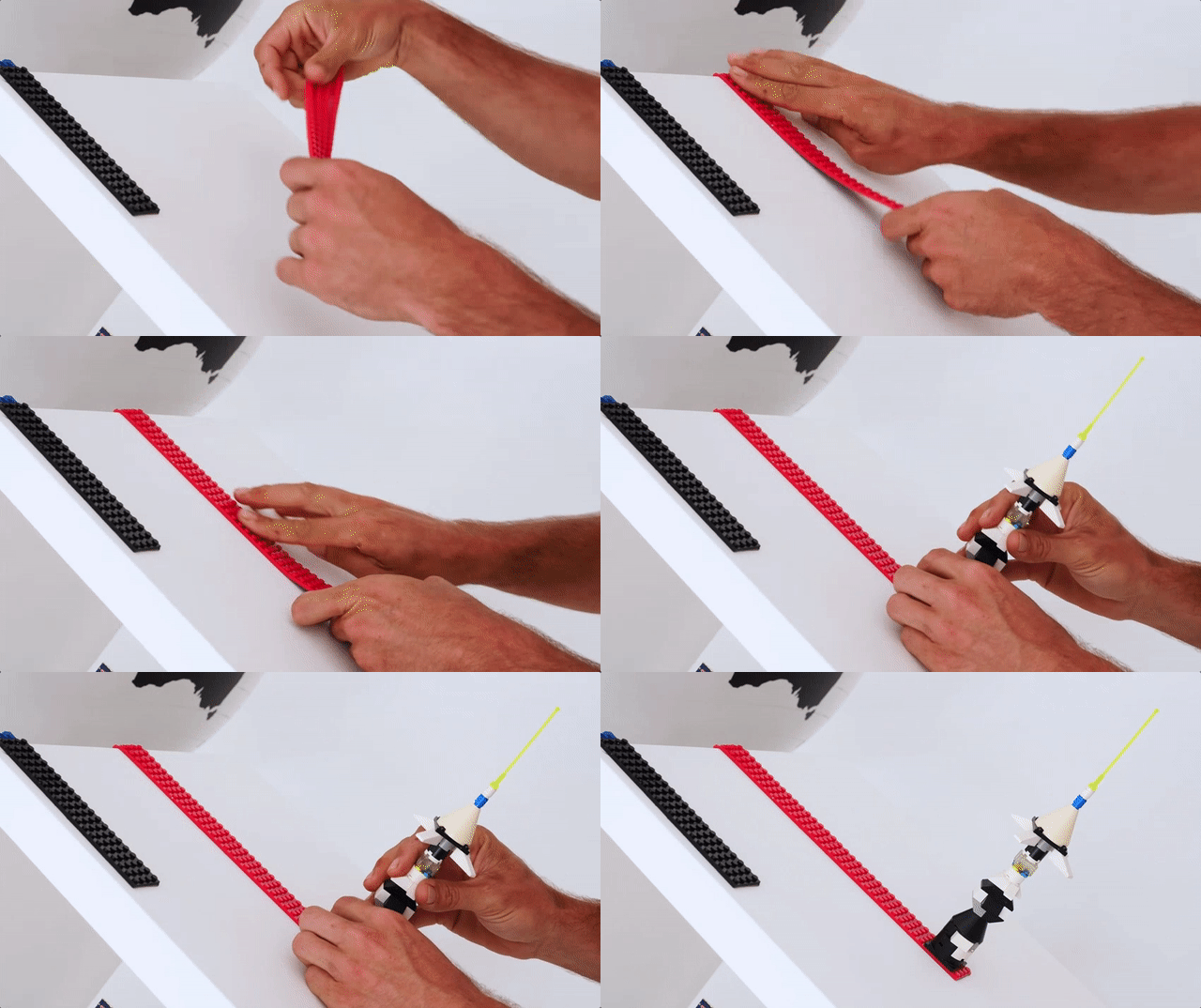
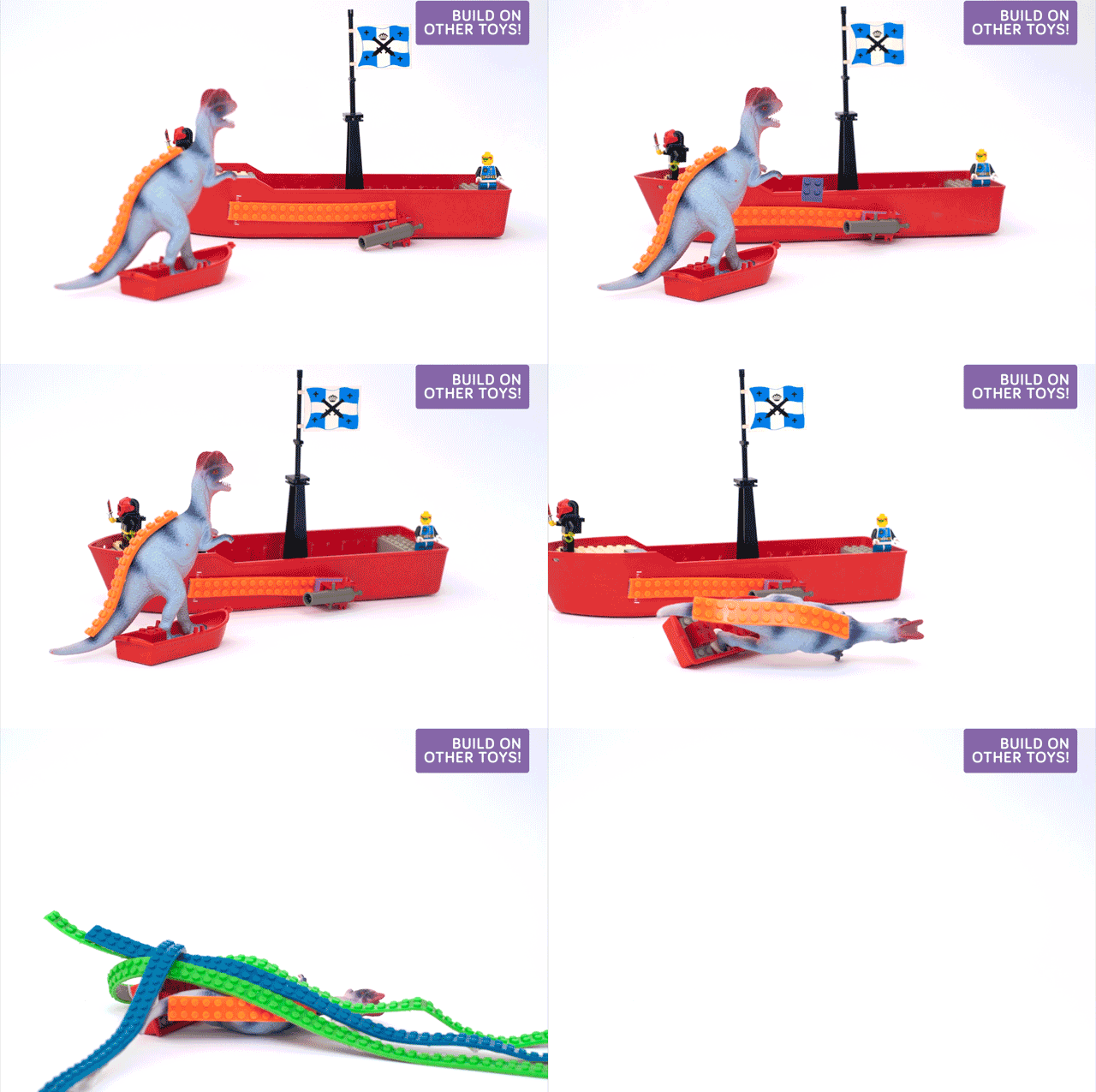
Are plain old LEGO bricks gonna be ruined for you forever now that you’ve seen this flexible, cuttable, reusable LEGO-compatible adhesive tape? ‘Nimuno Loops’ is a crowdfunded creation that comes in rolls so you can stick it onto all kinds of surfaces – including verticals and diagonals – and then use them as a base for your creations. As shown in the product’s promo video, that means you can build gravity-defying structures and cities that practically double back on themselves in the style of the movie Inception.

lego tape gif

Screen Shot 2017-03-15 at 3.02.31 PM

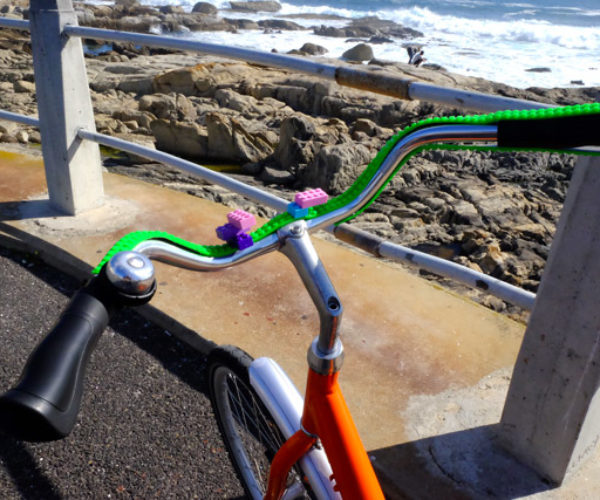
Devised by South Africa-based designers Anine Kirsten and Max Basler, Nimuno Loops starts at just $ 11 plus shipping for two rolls or $ 50 for ten rolls, and it’s available in red, blue, gray and green. Not only can you cut it to size, you can create custom shapes with it You can even stick it to your shoes, bikes, water bottles, strollers and anywhere else that might help you distract your kids for two seconds while you try to brush their hair or check your email.

lego tape 7

lego tape 2

lego tape 3

lego tape 4

People are clearly excited about this innovation, obliterating the original Indiegogo funding goal of $ 8,000 to raise $ 743,000 and counting with a full month left on the campaign. It’ll be interesting to see what LEGO artists do with this stuff. How could Nimuno Loops revolutionize your own LEGO creations?

Share on Facebook


[ By SA Rogers in Design & Products & Packaging. ]

[ WebUrbanist | Archives | Galleries | Privacy | TOS ]


WebUrbanist

 
Comments Off on LEGO-Compatible Tape Lets You Build Gravity-Defying Inception-Style Models

Posted in Creativity