RSS
 

Posts Tagged ‘Master’

Sony prices 70-200mm F2.8 GM OSS G Master at $2600

12 Jul

Sony’s premium telezoom for full-frame will cost $ 2600 when it reaches US consumers in July. The 1.4x and 2.0x teleconverters designed for the 70-200 will each cost $ 550 and are also expected to ship in July.

A recent announcement from Sony Japan indicated that the 70-200 would be delayed until September, but according to Sony US, the lens will indeed be available to customers in North America this month. The September release date still stands for Japan.


Press release:

Pricing and Availability – New FE 70-200mm f/2.8 GM OSS G Master lens. Teleconverters and Wireless Lighting Control System

Today, Sony has also released pricing and ship timing for the FE 70-200mm f/2.8 GM OSS G Master lens, 1.4x and 2.0x teleconverters plus their new wireless lighting control system. All products were introduced earlier this year.

One of the most eagerly anticipated lenses of the year, the Sony FE 70-200mm f/2.8 GM OSS G Master lens takes its place as the flagship telephoto zoom in the Sony lens lineup. Featuring built in Optical Stead Shot (OSS) and a fast f/2.8 maximum aperture across the zoom range, the lens will be an ideal fit for nature, sports, travel, fashion, beauty and wedding photographers. This lens will ship this July for a retail price of $ 2,600 US and $ 3,300 CA.

Designed exclusively to fit the 70-200mm F2.8 G Master lens, the new 1.4x and 2.0x teleconverters (models SEL14TC and SEL20TC) will both be sold for the same retail price of about $ 550 US and $ 700 CA, and will ship this July.

The versatile new wireless flash and control system – comprised of the FA-WRC1M wireless radio commander and the FA-WRR1 wireless radio receiver – was designed to meet the growing demands of professional Sony photographers. With a maximum range of 30m (approx.. 98 feet) and the ability to control a maximum of 15 separate flash units in 5 different groups, it offers a flexible wireless flash shooting experience with exceptional performance.

The FA-WRC1M commander will be sold for about $ 350 US and $ 480 CA. The FA-WRR1 receiver will be sold for about $ 200 US and $ 280 CA. Both products will ship this August.

The new lenses, teleconverters and wireless lighting system will be sold at a variety of Sony authorized dealers throughout North America.

A variety of exclusive stories and exciting new content shot with the new lenses, accessories and other Sony ? products can be found at www.alphauniverse.com, Sony’s new community site built to educate, inspire and showcase all fans and customers of the Sony ? brand.

Articles: Digital Photography Review (dpreview.com)

 
Comments Off on Sony prices 70-200mm F2.8 GM OSS G Master at $2600

Posted in Uncategorized


Reflecting on a Master Architect: 10 Water-Centric Works by Tadao Ando

28 Jun

[ By SA Rogers in Architecture & Public & Institutional. ]

tadao ando fort worth

Tadao Ando’s work consists of more than just the tangible architectural materials making up each structure, masterfully utilizing reflection, simple palettes and negative space to incorporate wind, water and light into the carefully designed compositions. The self-taught yet Pritzker Prize-winning Japanese architect infuses these elements – most notably in the form of reflecting pools and ponds – into almost all of his creations, yet it always seems fresh, each structure standing firm in its own identity.

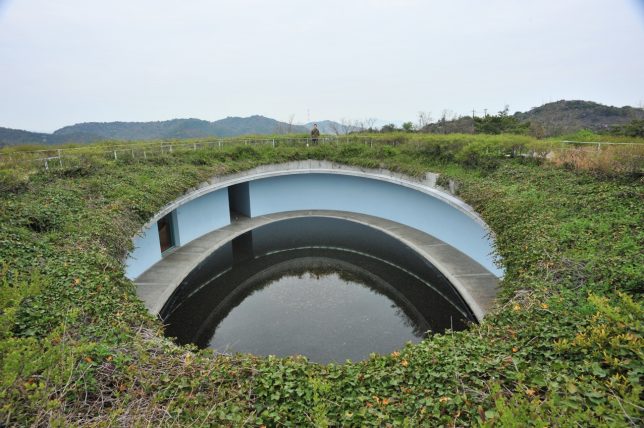
Water Temple, Awaji, Japan, 1991

tadao ando water temple 1

tadao ando water temple 2

tadao ando water temple 3

Serving as the residence for the oldest sect of Tantric Buddhism in Japan, the Water Temple is considered one of Tadao Ando’s most striking achievements. An oval of concrete encloses a lake of lotus flowers, which are symbols of heaven, with a set of stairs leading to its reflective surface. The journey from the gravel path outside up to this pinnacle symbolizes successive places of initiation.

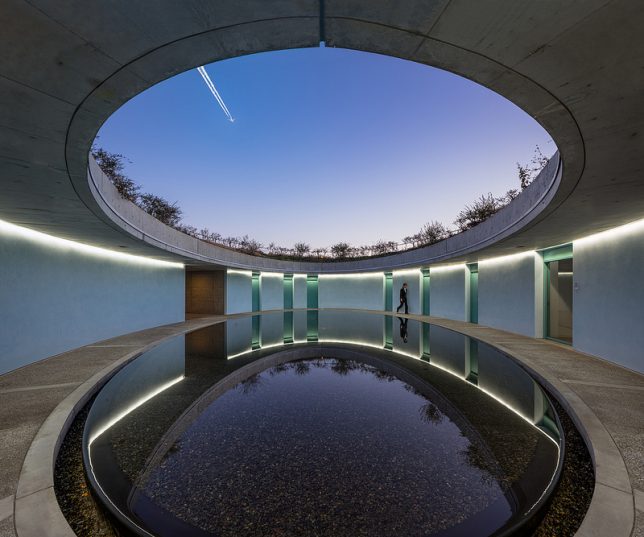
The Oval at Benesse Art Museum Naoshima, Japan, 2004

tadao ando oval 1

tadao ando oval 2

tadao ando oval 3

Says the architect of this space serving as a museum for the town of Naoshima and his own work, “In the ANDO MUSEUM, I nestled a concrete box within the old mink house. The box has a gently curved ceiling. One of its walls aligns with the main axis of the house and is tilted towards the ridge-beam to generate a feeling of openness that extends dynamically into the space above. Sunlight descends down through the deep space from a skylight opening at the top of the wooden roof. My aim was to create a space that conjures a rich sense of depth despite its small size, where oppositional elements such as the past and present, wood and concrete, and light and shadow clash intensely as they are superimposed against each other.”

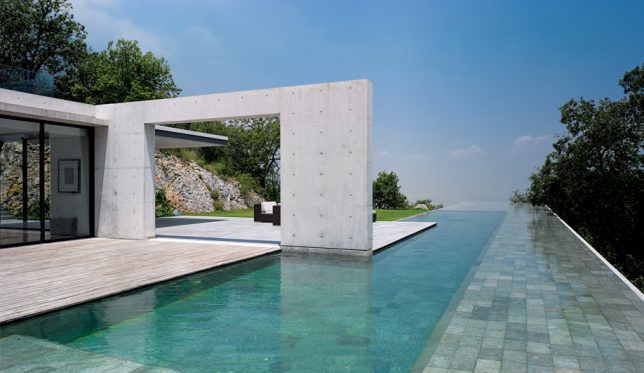
Casa Monterrey, Mexico, 2011

tadao ando monterrey 1

tadao ando monterrey 2

tadao ando monterrey 3

Nestled into a hillside in Mexico, Casa Monterrey’s defining feature is the swimming pool that cantilevers out over the slope, punctuated with concrete walls that strategically frame views of the rocky Cumbres de Monterrey National Park. Designed to accommodate a family, the three-story house is built around a double-height library. A rooftop terrace provides gorgeous views of the landscape as well as that pool, which seems to extend the sky right into the yard.

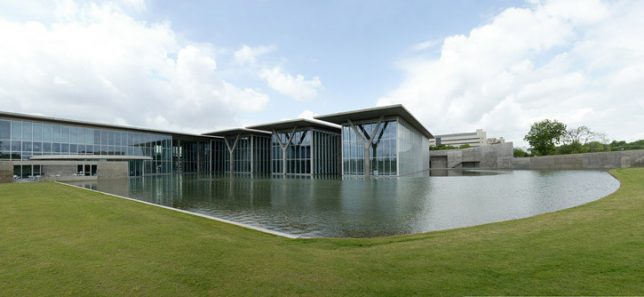
Modern Art Museum of Fort Worth, Texas, 2002

tadao ando fort worth

tadao ando fort worth 2

tadao ando forth worth 3

tadao ando fort worth 4

One of Ando’s most iconic structures, the Modern Art Museum of Fort Worth incorporates Y-shaped concrete supports that are doubled by the 1.5-acre reflecting pool that comes right up to the building’s exterior walls. Five flat-roofed pavilions seem to rise up out of the water, constructed in a limited palette of simple materials that make the landscape and the art inside the main focus but still come together into an elegant whole. “By using glass as a wall, physically there is a barrier, protection from the outside, but visually there is no boundary between outside and inside,” says Ando. “There is also the light that comes off the water through the glass that indicates a lack of boundary an can make its presence felt on the wall.”

Church on the Water, Hokkaido, 1988

tadao ando church on the water 3

tadao ando church on the water 1

tadao ando church on the water 2

This classic Tadao Ando work faces seated congregants inside a minimalist church building so they’re gazing out at a cross in the middle of a pond. The church consists of two overlapping cubes, a steel-and-glass entrance structure and the main volume serving as the chapel. The glass wall overlooking the pond can be opened or closed depending on the weather. Unsurprisingly, Church on the Water is one of Japan’s most popular wedding destinations.

Next Page – Click Below to Read More:
Reflecting On A Master Architect 10 Water Centric Works By Tadao Ando

Share on Facebook


[ By SA Rogers in Architecture & Public & Institutional. ]

[ WebUrbanist | Archives | Galleries | Privacy | TOS ]


WebUrbanist

 
Comments Off on Reflecting on a Master Architect: 10 Water-Centric Works by Tadao Ando

Posted in Creativity


Machine 3D-Paints ‘New’ Rembrandt After Studying the Master

13 Apr

[ By WebUrbanist in Art & Drawing & Digital. ]

remnant design diagram

As part of The Next Rembrandt, a multi-year collaborative project, a team of engineers trained a computer not only to understand the works of this famous Dutch master but also to expand his portfolio. Ultimately, the machine created a portrait that is at once brand new and yet also looks (and feels) like a lost original work of Rembrandt Harmenszoon van Rijn.

next rembrandt studied painting

An incredible combination of both machine learning and 3D printing, the project involved digitally tagging data in scanned versions of the artist’s various known pieces. Resulting patterns were subsequently explored by computers, including: brush strokes, approaches to organic detail and uncanny ability to depict human emotions.

next rembrandt new original lost work

The result is an algorithmic creation that mirrors the style of the master and depicts a Caucasian male in his thirties, with facial hair, black clothes, a white collar and a hat, facing to one side.

lost remnant detail view

Humans input those general parameters, but did not have a say in the look or feel of the final print. A 3D texture was added to the work based on the height and depth of paint applied to Rembrandt’s actual works.

next rembrandt

The two-year project was a collaboration between Microsoft, financial firm ING, Delft University of Technology and two Dutch art museums – Mauritshuis and Rembrandthuis. A public exhibition of the portrait is planned and details of the display will be released at a later date.

From the project creators: “It’s been almost four centuries since the world lost the talent of one its most influential classical painters, Rembrandt van Rijn. To bring him back, we distilled the artistic DNA from his work and used it to create The Next Rembrandt. We examined the entire collection of Rembrandt’s work, studying the contents of his paintings pixel by pixel. To get this data, we analyzed a broad range of materials like high resolution 3D scans and digital files, which were upscaled by deep learning algorithms to maximize resolution and quality. This extensive database was then used as the foundation for creating The Next Rembrandt.”

Share on Facebook


[ By WebUrbanist in Art & Drawing & Digital. ]

[ WebUrbanist | Archives | Galleries | Privacy | TOS ]


WebUrbanist

 
Comments Off on Machine 3D-Paints ‘New’ Rembrandt After Studying the Master

Posted in Creativity


CP+ 2016: A look inside the G Master lenses at the Sony booth

27 Feb

CP+ 2016: Sony stand report and G Master action

Earlier this year, Sony announced a trio of new lenses dubbed G Master, which include the Sony FE 24-70 F2.8 GM, the Sony FE 70-200 F2.8 GM and the Sony FE 85mm F1.4 GM. These three lenses helped to fill noticeable gaps near the higher end of Sony’s lens lineup.

And, no, we didn’t Photoshop in that gap in the lens lineup above just to make a point.

CP+ 2016: Sony stand report and G Master action

The G Master lenses are chock-full of new and advanced technologies meant to maximize image quality, autofocus speed and accuracy, durability, and bokeh. Let’s take a look inside…

CP+ 2016: Sony stand report and G Master action

Here’s the 24-70mm F2.8 GM lens cut in half. This lens comprises 18 elements in 13 groups, and features three aspherical elements, including an extreme aspherical (XA) element – more on that later. An ED (extra low dispersion) and Super ED glass element help minimize chromatic aberration while maintaining high resolution and bokeh characteristics. We believe it – our initial samples show very well-controlled chromatic aberration, and bordering on eye-popping sharpness even on a 42MP sensor, when shooting this lens wide open.

A 9-bladed aperture helps confer a circular shape to out-of-focus highlights, but it’s the autofocus system in this lens that most excites us. A Direct Drive SSM (super sonic wave motor) positions a relatively small group of focus elements accurately and quickly, and when we say quickly we mean with nearly unprecedented speed for this type of lens. We’ve become fans of Direct Drive SSM for AF ever since we saw the speed it confers in the FE 35mm F1.4. Focus, including continuous tracking, is nearly instantaneous on this 24-70 GM, which is fairly unexpected considering its counterparts in the DSLR arena. Focus is also both smooth and quiet, making it a great lens for video as well as stills.

CP+ 2016: Sony stand report and G Master action

The new XA (extreme aspherical) element is claimed to reduce aberration and deliver high resolution throughout the entire zoom and aperture range, across the entire frame. Sony claims to have achieved this via extremely high surface precision, maintained to within 0.01 micron tolerances. This should help reduce imperfections that can lead to onion-ring bokeh, typically an issue with aspherical lenses. 

And speaking of high precision, Sony claims to iterate their internal development of optical design by looking at actual lens MTF performance at 50 lines/mm. That doesn’t mean the lens only resolves to 50 lines/mm, it means that Sony’s threshold for acceptable performance in designing these lenses is quite high. Judging from the sharpness wide open on an a7R II, we’re inclined to believe it’s working for Sony.

CP+ 2016: Sony stand report and G Master action

Sony has also recently announced the FE 85mm F1.4 GM, shown here cut in half. This lens comprises 11 elements in 8 groups, and features a new XA (extreme aspherical) element as well as three ED (extra low dispersion) elements that help optimize both resolution and smooth transitions to out-of-focus areas. It’s also got a ‘Nano’ anti-reflective coating on its front element to reduce flare and ghosting, particularly useful for maintaining contrast in backlit portraits. 

The 85mm GM lens utilizes a ring drive SSM (super sonic wave motor) to drive the lens’ large, heavy focus group. In other words, this lens is much like some of its DSLR counterparts in terms in focusing speed – very fast, but not quite as fast – in our initial impressions – as Sony’s own Direct Drive SSM combined with a relatively small focusing group in the 24-70mm F2.8 GM. Two position sensors support accurate positioning of the focus elements, which should ensure accuracy of focus.

CP+ 2016: Sony stand report and G Master action

Particularly nice is the 11-blade circular aperture in the 85mm F1.4 (and 70-200mm F2.8) GM lenses. The more blades you have, the more circular the aperture remains even when stopped down significantly – especially with the curved blades typical of almost all lenses today. Most modern lenses have between 7 and 9 blades these days, with 9 blades being reserved more pro-level lenses. 11 takes it a step further and, indeed, the opening retains a circular, less polygonal shape as you stop down (here it is in action). This should ensure circular out-of-focus highlights and increased quality of bokeh, even at smaller apertures.

And why go from 9 to 11 blades, skipping 10? Odd numbers of aperture blades are generally better for their more favorable sunstar rendition, creating sunbursts with twice the number of rays as aperture blades when stopped down. Even-numbered designs only create sunbursts with as many rays as aperture blades, so while a 10-blade aperture would produce 10-ray stars, an 11-blade aperture would produce 22-blade stars. Of course, longer focal lengths and circular aperture designs are less prone to creating sunstars at all – and we have no idea if this was the actual thinking behind the choice – but it’s still nice to see the general trend toward odd numbers of aperture blades.

CP+ 2016: Sony stand report and G Master action

Pictured here is the new FE 70-200mm F2.8 GM OSS telephoto zoom lens Sony recently announced, cut in half of course. This lens, like the 24-70mm GM lens, features XA, Super ED, and ED glass elements to help achieve high resolution and desirable bokeh characteristics. It’s got 23 elements in 18 groups. A ‘Nano’ anti-reflective coating ensures reduced flare and ghosting. An additional fluorine coating to the front of the lens help keep it clean, and the lens is dust and moisture resistant.

OSS (Optical Steady Shot) is built into the lens, despite the availability of IBIS in a7-series cameras, because for longer focal lengths, it’s beneficial to do a certain amount of the stabilization in-lens, because of how much the sensor would have to move to compensate for even slight angular displacements. The two systems – OSS and IBIS – theoretically work together to provide even more effective stabilization than any one method might provide.

CP+ 2016: Sony stand report and G Master action

The autofocus system on the FE 70-200mm GM OSS is quite intriguing: it’s a floating focus system, which sees its debut in an ? lens. This floating system design contributes to its impressive minimum focusing distance of 0.96m, and also helps control aberrations that might otherwise be problematic when focusing at close distances. 

Pictured on the left is the more traditional ring-drive SSM motor that’s required to drive the large, heavy glass elements typical of this type of lens. The double linear motor of this system, pictured on the right, allows for effective ‘wobbling’ actuation (typically used in contrast-only AF), which is useful when shooting video. The entire focusing mechanism is also very quiet – and smooth – which ensures AF performance is optimized for both stills and video shooting. 

The 70-200mm F2.8 GM OSS lens also functions with Sony’s newly announced 1.4x and 2x teleconverters, which may somewhat make up for the lack of longer telephoto lenses (for the time being anyway).

CP+ 2016: Sony stand report and G Master action

Lifting our heads back up from the tech demos and turning our attention to other things (wait, where’d Rishi go?), we see that in typical trade-show form, Sony’s provided some subject matter for eager attendees to test the latest tech. But if you were to show up to CP+ hoping to capture some model mayhem using the new GM lenses, you’d have to make do with the 85mm F1.4 GM, the only new GM lens available in front of this display.

And don’t worry, if you’re already missing the lens-cut-in-half thing, you can get your fix when our Editor Barney returns with many more things cut in half later this week. Like nicely packed, and then cut in half (naturally) sandwiches.

CP+ 2016: Sony stand report and G Master action

At first glance, the 85mm F1.4 GM looks a little unwieldy on an a7-series camera, but in hand, the pair balance remarkably well. The lens has a pleasingly solid heft to it without feeling too front-heavy. At 820g, it’s significantly heavier than, say, Nikon’s counterpart (595g), but our initial impressions are that the sharpness wide open – even off-center – and lack of chromatic aberration might make the weight more than worth it.

CP+ 2016: Sony stand report and G Master action

Beyond the price of a CP+ admission ticket, there’s no charge to try out the new 85mm F1.4 GM – but to get one of your very own, you’ll need $ 1800 when it goes on sale in March. Also of note for video shooters is the ability to de-click the aperture dial for smoother operation.

CP+ 2016: Sony stand report and G Master action

Although you’re a little ways away from the real models, you can try out the FE 24-70mm F2.8 GM on some beleaguered Sony reps behind the counter. And though it appears a bit hefty on the smaller a7-series bodies, it balances well – particularly if you have a vertical grip attached. At 886g, it’s not unreasonably heavy, and the extra heft may be well worth it anyway – our preliminary impressions are that this is the sharpest 24-70mm zoom (particularly wide open) we’ve ever seen.

It will be available in March for $ 2200.

CP+ 2016: Sony stand report and G Master action

Last up is the FE 70-200mm F2.8 GM. As you can probably tell from this image, the lens itself isn’t overly large, but it’s definitely got some weight to it. At 1480g, it’s around the weight of Canon’s equivalent lens, which means you’ll really want a grip on an a7-series camera to balance the weight well. The FE 70-200mm F2.8 GM OSS will be available in March, and the price is still TBD.

Overall, the G Master lenses appear to be solid additions to Sony’s FE lens lineup, potentially addressing the need for professional-level lenses for the system. We’ve shot a few shots with these lenses on a 42MP a7R II, and it’s clear from the sharpness and chromatic aberration results, as well as AF speeds, that Sony is clearly targeting professionals, and high-end enthusiasts, with these lenses. And we expect them to compare favorably against even the best counterparts offered by the stalwarts in the industry. We’ll reserve judgement until we’ve had time to do more rigorous, side-by-side testing, but for the time being, it’s safe to say we’re very impressed.

Articles: Digital Photography Review (dpreview.com)

 
Comments Off on CP+ 2016: A look inside the G Master lenses at the Sony booth

Posted in Uncategorized


Video: Hands-on with Sony’s G Master lenses and the a6300 at CP+ 2016

27 Feb

There are lots of new products vying for attention at CP+ 2016, including Sony’s a6300 and new GM series lenses for its full-frame mirrorless cameras. And they are getting plenty of attention from show attendees, especially those eager to try out the FE 85mm F1.4 GM’s portrait capabilities. We took another look at the a6300 and the GM lenses on display at the buzzing Sony booth in Yokohama. 

Articles: Digital Photography Review (dpreview.com)

 
Comments Off on Video: Hands-on with Sony’s G Master lenses and the a6300 at CP+ 2016

Posted in Uncategorized


‘We want to make lenses that can be used forever’: Sony engineer discusses G Master lenses

10 Feb

‘We want to make lenses that can be used forever,’ says a senior engineer behind Sony’s new G master lenses. At the launch of the ‘G Master’ range of high end lenses, we spoke to Motoyuki Ohtake, Distinguished Engineer in Sony’s Lens Design Department about the process and the philosophy behind the latest lenses.

The development process series involved re-thinking several parts of the design and manufacturing process, he says.

Motoyuji Ohtake, Distinguished Engineer, Opto Design Department, Core Technology Division, Digital Imaging Business Group at Sony.

To understand how the lenses came about, he explained the usual process of lens development. ‘Sometimes we propose a new lens but often it comes from the product planning department [the marketing department that assesses potential requirements and demands]. We then make a series of rough designs, some are big, with high optical performance, others are more compact but maybe not so optically strong. We discuss which design to proceed with, based on what we think is the optimal balance or cost, performance and size to make the perfect product.’

After deciding which of the initial designs to pursue, there’s a great deal of collaboration between teams, he explains: ‘we work with the mechanical team, the lens motor team, the lens control team, the lens element team and maybe the equipment team who will have to prepare the manufacturing process.’ Each of these team feeds its expertise into the design. ‘Maybe the optical team proposes a new lens design and the motor team tells us which motor is best. Or warn us if the focus will be too slow. They feed back about the mechanical aspects,’ he says.

The G Master series required many of these teams to re-think their parts of the process, from design to manufacture.

Re-thinking basic assumptions

‘For the G Master lenses we decided we would assess the spatial frequency at 50 lines per mm,’ says Ohtake: ‘Usually lens makers, including ourselves, evaluate lenses at 10 and 30 lpmm (or 10, 20 and 40 for Carl Zeiss-branded optics).’

‘At the start of the process we all agreed we should change the spacial frequency [to a more challenging target],’ he says: ’but which is best to get good performance? We could design for 100 lpmm but the lens would become very bulky and long – which might not be a very practical lens. A balance of the size and the optical performance was very important.’

The target of 50 lpmm wasn’t dictated by the company’s 40MP camera or 4K video, he says. ’All our FE lenses were designed for at least 40MP. Because we have an image sensor team within Sony, we get to see the sensor roadmap, so we’ve been designing for this all along with FE. With the G Master we’d like to make lenses that can be used forever.’

A focus on bokeh

But it’s not just the more stringent frequency assessment that was developed for the G Master lenses, Ohtake explains: ‘We had to discuss what good bokeh means. We have some designers from Minolta who understand that the spirit of the ‘G’ lenses was good bokeh in the background but we had no way to evaluate that.

‘We looked at what is considered good bokeh and how it affects not just the background rendering but also the transition from perfectly sharp to out-of-focus regions. We developed a way to evaluate bokeh and were able to make a simulation. This meant we didn’t have to build a lens to see how it performed, we could now computer model it before taking a design too far.’

This is a significant change, Sony says, as it means bokeh can be one of the primary design considerations, rather than being something that can only be adjusted later in the process, once the main aspects of the design have been settled upon.

Another piece of the puzzle – shape and smoothness

This analysis of the factors that affect bokeh showed that both the precision of the lens molding and the smoothness of the lens surface could have an effect.

‘Traditionally it was very hard to achieve both: current technology gives a roughness on the scale of 20-30nm on the aspheric surface. Improving this usually involved polishing, which can then lead to the lens element being slightly unevenly shaped.’

‘We developed a new way of making the lens element and a new molding process, including a new machine. Now we can get roughness down to around 10nm and get a more accurate shape to the aspherical surface.’

AF technologies

Ohtake wouldn’t budge when we asked which his favorite lens was, but immediately reached for the 85mm F1.4 when we took this group shot.

The first three G Master lenses use three different AF motor technologies between them – emphasizing Ohtake’s point that different technologies work better in different contexts.

The 24-70mm F2.8 uses a Direct Drive SSM system (piezoelectric element). This is very fast, very quiet and very precise. We used a linear motor for the 24-70mm F4 but this lens has a heavier focus element, so direct drive was a better choice.

The focus element in the 85mm F1.4 was even heavier, however. ‘For the 85mm we use a ring type focus motor. This is very good for heavy lens elements and our lens software team developed a good algorithm so that it works well with contrast-detection autofocus’ (a traditional weakness for ring-type designs).

Finally, the 70-200mm uses a combination of a linear actuator and a ring-type focus motor. ‘The focus group had become too heavy so we separated the two focusing lenses. One is very heavy, so we used a ring type motor for that one, then used a linear motor for the other. The ring type is used to quickly achieve approximate focus and the linear motor is used for the high precision aspect.’

Still correct to optically correct

Discussing the idea that bokeh and sharpness have previously been in conflict, we asked Ohtake about other trade-offs. We’ve been told that the ability to correct lateral chromatic aberration in software makes lens design easier, since you don’t have to correct it optically, which can quickly complicate the lens design and detract from other parameters.

Not for G Master lenses, he explains. ‘Light doesn’t separate nicely into red, green and blue’ (the color channels that most cameras capture, and which can be adjusted, relative to one another, to correct lateral CA). It’s a continuum with each wavelength being displaced slightly differently. ‘To get the really high contrast we wanted in G Master, we had to suppress it in the lens.’

The future of APS-C

We also asked Ohtake about Sony’s APS-C lenses for E-mount. His team likes designing APS-C lenses, he says: ‘The focus elements are light, so it’s easier to design. We have all these focus motor technologies in-house and we’d like to try them in APS-C lenses if that’s what the Product Planning team says is required.’

Articles: Digital Photography Review (dpreview.com)

 
Comments Off on ‘We want to make lenses that can be used forever’: Sony engineer discusses G Master lenses

Posted in Uncategorized


‘We want to make lenses that can be used forever’: Sony engineer discusses G Master lenses

05 Feb

‘We want to make lenses that can be used forever,’ says a senior engineer behind Sony’s new G master lenses. At the launch of the ‘G Master’ range of high end lenses, we spoke to Motoyuki Ohtake, Distinguished Engineer in Sony’s Lens Design Department about the process and the philosophy behind the latest lenses.

The development process series involved re-thinking several parts of the design and manufacturing process, he says.

Motoyuji Ohtake, Distinguished Engineer, Opto Design Department, Core Technology Division, Digital Imaging Business Group at Sony.

To understand how the lenses came about, he explained the usual process of lens development. ‘Sometimes we propose a new lens but often it comes from the product planning department [the marketing department that assesses potential requirements and demands]. We then make a series of rough designs, some are big, with high optical performance, others are more compact but maybe not so optically strong. We discuss which design to proceed with, based on what we think is the optimal balance or cost, performance and size to make the perfect product.’

After deciding which of the initial designs to pursue, there’s a great deal of collaboration between teams, he explains: ‘we work with the mechanical team, the lens motor team, the lens control team, the lens element team and maybe the equipment team who will have to prepare the manufacturing process.’ Each of these team feeds its expertise into the design. ‘Maybe the optical team proposes a new lens design and the motor team tells us which motor is best. Or warn us if the focus will be too slow. They feed back about the mechanical aspects,’ he says.

The G Master series required many of these teams to re-think their parts of the process, from design to manufacture.

Re-thinking basic assumptions

‘For the G Master lenses we decided we would assess the spatial frequency at 50 lines per mm,’ says Ohtake: ‘Usually lens makers, including ourselves, evaluate lenses at 10 and 30 lpmm (or 10, 20 and 40 for Carl Zeiss-branded optics).’

‘At the start of the process we all agreed we should change the spacial frequency [to a more challenging target],’ he says: ’but which is best to get good performance? We could design for 100 lpmm but the lens would become very bulky and long – which might not be a very practical lens. A balance of the size and the optical performance was very important.’

The target of 50 lpmm wasn’t dictated by the company’s 40MP camera or 4K video, he says. ’All our FE lenses were designed for at least 40MP. Because we have an image sensor team within Sony, we get to see the sensor roadmap, so we’ve been designing for this all along with FE. With the G Master we’d like to make lenses that can be used forever.’

A focus on bokeh

But it’s not just the more stringent frequency assessment that was developed for the G Master lenses, Ohtake explains: ‘We had to discuss what good bokeh means. We have some designers from Minolta who understand that the spirit of the ‘G’ lenses was good bokeh in the background but we had no way to evaluate that.

‘We looked at what is considered good bokeh and how it affects not just the background rendering but also the transition from perfectly sharp to out-of-focus regions. We developed a way to evaluate bokeh and were able to make a simulation. This meant we didn’t have to build a lens to see how it performed, we could now computer model it before taking a design too far.’

This is a significant change, Sony says, as it means bokeh can be one of the primary design considerations, rather than being something that can only be adjusted later in the process, once the main aspects of the design have been settled upon.

Another piece of the puzzle – shape and smoothness

This analysis of the factors that affect bokeh showed that both the precision of the lens molding and the smoothness of the lens surface could have an effect.

‘Traditionally it was very hard to achieve both: current technology gives a roughness on the scale of 20-30nm on the aspheric surface. Improving this usually involved polishing, which can then lead to the lens element being slightly unevenly shaped.’

‘We developed a new way of making the lens element and a new molding process, including a new machine. Now we can get roughness down to around 10nm and get a more accurate shape to the aspherical surface.’

AF technologies

Ohtake wouldn’t budge when we asked which his favorite lens was, but immediately reached for the 85mm F1.4 when we took this group shot.

The first three G Master lenses use three different AF motor technologies between them – emphasizing Ohtake’s point that different technologies work better in different contexts.

The 24-70mm F2.8 uses a Direct Drive SSM system (piezoelectric element). This is very fast, very quiet and very precise. We used a linear motor for the 24-70mm F4 but this lens has a heavier focus element, so direct drive was a better choice.

The focus element in the 85mm F1.4 was even heavier, however. ‘For the 85mm we use a ring type focus motor. This is very good for heavy lens elements and our lens software team developed a good algorithm so that it works well with contrast-detection autofocus’ (a traditional weakness for ring-type designs).

Finally, the 70-200mm uses a combination of a linear actuator and a ring-type focus motor. ‘The focus group had become too heavy so we separated the two focusing lenses. One is very heavy, so we used a ring type motor for that one, then used a linear motor for the other. The ring type is used to quickly achieve approximate focus and the linear motor is used for the high precision aspect.’

Still correct to optically correct

Discussing the idea that bokeh and sharpness have previously been in conflict, we asked Ohtake about other trade-offs. We’ve been told that the ability to correct lateral chromatic aberration in software makes lens design easier, since you don’t have to correct it optically, which can quickly complicate the lens design and detract from other parameters.

Not for G Master lenses, he explains. ‘Light doesn’t separate nicely into red, green and blue’ (the color channels that most cameras capture, and which can be adjusted, relative to one another, to correct lateral CA). It’s a continuum with each wavelength being displaced slightly differently. ‘To get the really high contrast we wanted in G Master, we had to suppress it in the lens.’

The future of APS-C

We also asked Ohtake about Sony’s APS-C lenses for E-mount. His team likes designing APS-C lenses, he says: ‘The focus elements are light, so it’s easier to design. We have all these focus motor technologies in-house and we’d like to try them in APS-C lenses if that’s what the Product Planning team says is required.’

Articles: Digital Photography Review (dpreview.com)

 
Comments Off on ‘We want to make lenses that can be used forever’: Sony engineer discusses G Master lenses

Posted in Uncategorized


Hands on with Sony’s a6300 and G Master lenses

04 Feb

Hands on with Sony’s a6300 and GM lenses

At a press event in New York City, Sony unveiled a new mirrorless camera and three new lenses – but not just any mirrorless camera, and not just any lenses. The Sony a6300 is the much-anticipated followup to the very successful a6000. And for its full-frame range, Sony introduced a new lens class: G Master. The company has placed the FE 70-200mm F2.8 GM OSS, FE 85mm F1.4 GM and FE 24-70mm F2.8 GM in a category unto themselves, with an emphasis on resolving power and bokeh. We spent some brief moments with all of the new hardware – take a look.

Sony a6300

Front and center of this morning’s announcements is the a6300. Boasting a newly designed 24MP APS-C CMOS sensor, the camera’s most impressive feature is arguably its 425 phase-detect AF points with ‘Advanced 4D Focus.’

The a6300’s 4K video tech is impressive too. The camera reads the equivalent of 6K’s worth of data from its sensor and downsizes it to 4K/UHD – without pixel binning – which promises a big boost in video quality.

Sony a6300

Sony stuck with a familiar design when shaping the a6300, including these top plate mode and command dials, which will look very familiar to a6000 users. 

Sony a6300

It may look like its predecessor on the outside, but the a6300 uses a sturdier magnesium-alloy construction, with weather-sealing.

Sony a6300

The rear panel looks much the same as the a6000 as well, except for the addition of a switch toggling between AEL and AF/MF. The tilting 3″ 921k-dot LCD is still present, and still not a touchscreen, but the viewfinder has been significantly upgraded to a 2.36 million-dot OLED panel.

Sony a6300

A pop-up flash is another welcome carryover from the a6000. With a little pressure, the flash can be tilted backward at a slight angle for a bounce effect.

Sony a6300

The Sony a6300 is expected to ship in March, and will sell for $ 1000 body-only or $ 1150 paired with a 16-50mm F3.5-5.6 power zoom kit lens (not the more expensive 16-70mm F4 seen here).

Sony a6300

Autofocus speed was a strength of the a6000, and the a6300 brings the next evolution of that system with some lofty claims including focus acquisition in as little as 0.05 sec. The a6300 also boasts a minimal blackout period between shots, and can manage to supply a live view feed at up to 8fps – a major breakthrough for mirrorless cameras. 

Sony FE 24-70mm F2.8 GM

The first of Sony’s three ultra premium ‘G Master’ lenses is the FE 24-70mm F2.8 GM. The focus (no pun intended) of the GM lenses is resolution and bokeh, courtesy of high quality glass and a new XA (extreme aspherical) lens element. All three lenses are weather-sealed.

The 24-70 has 18 elements in 13 groups which include the aforementioned XA element, as well as ED and Super ED elements. A Nano AR coating reduces flare and ghosting. The lens also features nine circular aperture blades.

Sony FE 24-70mm F2.8 GM

The minimum focus distance on the 24-70 is 0.38m/15in. with a max magnification of 0.24x. The lens uses 82mm filters. Control-wise the lens has switches for focus mode and zoom lock as well as a stop focus button.

The 24-70mm F2.8 GM will be available in March for $ 2200.

Sony FE 85mm F1.4 GM

Next is the long-awaited fast 85mm prime. This constant F1.4 lens has a whopping 11 circular aperture blades – the most of any Sony lens yet – as well as XD and three ED elements.

The lens’ Super Sonic wave Motor uses a pair of position sensors to ensure accurate focus.

Sony FE 85mm F1.4 GM

As you can see, the 85mm F1.4 GM has a manual aperture dial (with switchable click-stops), AF/MF switch, and focus hold button. 

You’ll be able to pick up this monster of a lens in March for $ 1800.

Sony FE 70-200mm F2.8 GM OSS

The 70-200mm F2.8 steps into Sony’s FE line as the first fast constant aperture tele-zoom, looking the part of a sports shooter’s lens. Sadly, working samples were not available for press to use at the launch event, and its price is still TBD.

Sony FE 70-200mm F2.8 GM OSS

What we do know is that it will have 23 elements in 18 groups, which includes one XD, four ED and two Super ED elements. Like the 85mm lens, the 70-200 has 11 circular aperture blades. It uses two focus motors to optimize speed and accuracy. The front elements have a ring-type SSM while the rear parts use a double linear motor. The minimum focus distance is just 0.96m/38in.

Controls are as you’d expect from a high-end tele-zoom. There are switches for AF/MF, focus distance limit, image stabilization, and IS mode. There are two IS modes: standard (mode 1) and panning (mode 2). The lens also has a zoom lock and buttons for holding focus.

Articles: Digital Photography Review (dpreview.com)

 
Comments Off on Hands on with Sony’s a6300 and G Master lenses

Posted in Uncategorized


Sony releases three premium ‘G Master’ lenses for FE-mount

03 Feb

$ (document).ready(function() { SampleGalleryV2({“containerId”:”embeddedSampleGallery_6678742178″,”galleryId”:”6678742178″,”isEmbeddedWidget”:true,”selectedImageIndex”:0,”startInCommentsView”:false,”isMobile”:false}) });

Sony has created a new lineup of lenses for its full-frame cameras known as G Master (GM). These are the company’s high-end lenses that sit above its ‘G-series’ lenses and, as you might imagine, command a premium price. The first three GM lenses include FE 24-70mm F2.8, FE 85mm F1.4 and FE 70-200mm F2.8 OSS.

In addition to the lenses, Sony also released a pair of teleconverters (1.4x and 2.0x) for use with the new 70-200mm F2.8 lens.

At the press conference announcing the new lenses the company placed enormous emphasis on the importance of high resolution and high quality bokeh. Says Senior Technology Manager Mark Weir: “Being a leader in image sensor technologies, we have a unique insight into where sensor and camera technology is going, and we put this insight into our lens design.”

Sony mentioned they’re now designing G Master lenses to a 50 lines per mm standard, a step up from the 10 and 30 lines/mm MTF traces we’re used to seeing. Regarding bokeh, Sony explained that the lifelike nature of an image in either still or video is determined by the nature of the transition from in-focus to out-of-focus areas, and that an abrupt shift between the sharp region and the background can look artificial. Their research shows that this often comes down to a lack of precision in the preparation of the lens elements, and less than optimal positioning the optical cavity. Sony indicated that G Master lenses can be shaped to within 1/100th of a micron of their design spec to address this problem. 11 aperture blades on the new 85mm and 70-200mm lenses also indicate a serious commitment to smooth out-of-focus areas.

Additionally, each G Master lens employs a different drive mechanism for optimal AF performance. The 24-70mm uses a Direct Drive Supersonic motor (SSM), which we’ve previously noted to confer incredibly fast, accurate, and silent AF to the FE 35mm F1.4 lens. Sony boasts this focus motor to offer 0.01mm precision of focus group placement. The 85mm F1.4 uses a ring drive. The 70-200 sports a dual implementation: two focus groups at either end of the lens are drive by different actuators. A ring drive SSM drives the front AF group while dual linear motors drive a floating rear group. The result is fast continuous autofocus and silent AF for video, as well as in impressive minimum focus distance of <1m.

Sony also emphasized their development of advanced simulation techniques that make it possible to control things like bokeh right from the design stage. Previously, it was difficult to judge the effects of optical design without first building the lens – simulation technologies now help Sony see the effects of iterations on the optical design.

The first G Master lenses will be available in March, with the 24-70mm listing for $ 2200 and the 85mm listing for $ 1800 in the U.S. The 70-200mm will follow in May, with pricing yet to be determined.

Press release:

Sony Launches New G Master Brand of Interchangeable Lenses

Three new models including 24-70mm F2.8 Zoom, 85mm F1.4 Prime and 70-200mm F2.8 Zoom deliver unrivaled imaging experiences 

NEW YORK, Feb. 3, 2016 – Sony Electronics, a worldwide leader in digital imaging and the world’s largest image sensor manufacturer, has today introduced their flagship G Master™ brand of interchangeable lenses.           

Sony’s new brand includes three new E-mount full frame lenses including a 24-70mm constant F2.8 standard zoom, an 85mm F1.4 prime and a 70-200mm constant F2.8 telephoto zoom.   Representing the ultimate blend of high resolution and beautiful bokeh, the new lenses feature Sony’s innovative optical element technology, design and calibration.  This allows them to produce still image and video content with a level of detail and expression that has never before been possible. 

“The new G Master brand represents the finest and most impressive group of lenses that Sony has ever brought to market,” said Neal Manowitz, Vice President of Digital Imaging at Sony Electronics.  “With our knowledge of what the future will bring for digital imaging, we have designed these lenses and can ensure that the G Master brand will inspire and ‘wow’ photographers and videographers for years to come.”

New FE24-70mm F2.8 GM Standard Zoom Lens

Featuring some of the most advanced lens technologies in market today, the new FE 24-70mm F2.8 GM (model SEL2470GM) is the ultimate choice for those seeking the highest possible optical performance for portrait, travel and event photography or even simple everyday shooting1

The new lens is built with three aspherical elements including a newly developed, extremely precise XA (extreme aspherical) element that reduces aberration and delivers the ultimate resolution throughout the entire zoom range and aperture range, as well as from corner to corner of all image files. Additionally, an ED (Extra-low-Dispersion) glass element and Super ED glass element keep chromatic aberration to a minimum while maximizing resolution and bokeh without any unnatural coloration. 

The lens features a 9-bladed aperture that maintains a near circular shape at all settings and is coated with Sony’s original Nano AR coating to suppress reflections and ensure spectacular contrast and clarity.    

The new FE24-70mm F2.8 GM lens has a direct drive SSM (Super Sonic Wave Motor) focusing system that works with incredible efficiency thanks to a new set of algorithms that positions the lens elements quickly and accurately. The motor is smooth and quiet, making it an ideal choice for shooting both still images as well as movies.

To maximize usability, the lens is dust and moisture resistant and features a compact, streamlined design that includes AF/MF switch as well as focus hold, zoom lock and hood release buttons.

Two new matching filters for the FE24-70mm F2.8 GM lens have also been introduced, including the VF-82MP MC protector and VF-82CPAM Circular PL filter..

New FE 85mm F1.4 GM Telephoto Prime Lens

Designed as the ultimate portrait lens, the long-awaited new FE 85mm F1.4 GM telephoto prime lens (model SEL85F14GM) strikes a perfect balance between resolution and bokeh in a compact package.

The lens features a new XA (extreme aspherical) element as well as three ED glass elements that work together to ensure that the in-focus areas are captured in extremely high resolution while the surrounding out-of-focus areas dissolve smoothly into a beautiful soft backdrop. It has a circular aperture with 11 blades – the most ever used in an ? lens – that ensures bokeh is smooth and visually appealing.  Externally, the new model has Sony’s original Nano AR Coating, which is of particular importance in a portrait lens as it reduces flare and ghosting, even with backlit subjects or similarly challenging lighting conditions.

For accurate autofocusing, the FE 85mm F1.4 GM lens includes a ring drive SSM motor system that provides ample power and speed to drive the lens’ large, heavy focus group. It’s also equipped with two position sensors to support flawless focus control of the large, heavy lens elements.   

This new professional portrait lens is dust and moisture resistant and also has an aperture ring with on/off switchable click stops that can be adjusted based on whether a user is shooting still images or movies.  It also has an AF / MF switch and a focus hold button.2

New FE 70-200mm F2.8 GM OSS Telephoto Zoom

Covering the frequently used 70-200mm focal range, the new FE 70-200mm F2.8 GM OSS telephoto zoom lens (model SEL70200GM) offers extremely high rendering, AF performance and image stabilization, making it a versatile choice for shooting wildlife, sports, weddings and a variety of other events and locations1.

The new flagship telephoto zoom model delivers extraordinary sharpness and clarity throughout the entirety of its zoom range thanks to its three advanced lens elements including XA, Super ED and ED glass components, as well as its Nano AR coating. 

The new FE 70-200mm F2.8 GM OSS lens features a floating focusing system – implemented in an ? zoom lens for the first time – that contributes to an impressive minimum focusing distance of merely 0.96m and ensures AF performance is optimized during both still and video shooting. The lens includes a SSM (Super Sonic Motor) plus dual linear motors that work together to move large lens elements quickly – a task that requires a high level of drive control and ensures focus accuracy. The new model also has built in Optical SteadyShot™ image stabilization for capturing sharp, blur-free subjects at all focal lengths and a rotating tripod mount that allows the camera to be quickly removed from a connected tripod as needed. 

The new 70-200mm telephoto zoom lens is dust and moisture resistant with an additional fluorine coating added to the front lens.  It also has a focus hold button as well as a focal range limiter. 

Sony has also announced new compact 1.4x and 2x Teleconverters  – models SEL14TC and SEL20TC respectively – that offer even greater reach while maintaining the overall streamlined design and feel of the 70-200mm lens.3   

Pricing and Availability

The new FE 24-70mm F2.8 GM Standard Zoom and 85mm F1.4 GM Telephoto prime lenses will be available in March for about $ 2,200 and $ 1,800, respectively.  In Canada, they will be sold for $ 2,900 CA and $ 2,400 CA, respectively. 

The new 70-200mm F2.8 GM Telephoto Zoom Lens and its compatible 1.4x and 2x Teleconverters will be available in May.  Pricing is not yet available for these models. 

The new G Master Series of interchangeable lenses will be sold at a variety of Sony authorized dealers throughout North America.  

1.      A software update may be required to provide compatibility of lenses with some cameras. See the Sony support site www.esupport.sony.com for additional details.

2.      Limitations apply to AF operation when shooting movies with certain camera bodies. A software update may be required to provide AF compatibility of FE 85mm F1.4 GM with some cameras during movie shooting. See the Sony support site for lens/body compatibility details.

3.      SEL70200GM is only compatible lens at the time of announcement

Sony 24-70mm F2.8 GM & 70-200 F2.8 GM OSS specifications

  Sony FE 24-70mm F2.8 GM Sony FE 70-200mm F2.8 GM OSS
Principal specifications
Lens type Zoom lens
Max Format size 35mm FF
Focal length 24–70 mm 70–200 mm
Image stabilisation No Yes
Lens mount Sony FE
Aperture
Maximum aperture F2.8
Minimum aperture F22.0
Aperture ring No
Number of diaphragm blades 9 11
Optics
Elements 18 32
Groups 13 18
Special elements / coatings One extreme aspherical, one super ED, one ED element + Nano AR coating One double-side aspherical and one extreme aspherical element + Nano AR coating
Focus
Minimum focus 0.38 m (14.96) 0.96 m (37.8)
Maximum magnification 0.24× 0.25×
Autofocus Yes
Motor type Piezoelectric Ring-type ultrasonic
Full time manual Yes
Focus method Internal
Distance scale No
DoF scale No
Focus distance limiter Yes
Physical
Weight 886 g (1.95 lb) 1480 g (3.26 lb)
Diameter 88 mm (3.45) 88 mm (3.46)
Length 136 mm (5.35) 200 mm (7.87)
Sealing Yes
Colour Black Gray
Zoom method Rotary (extending)
Power zoom No
Zoom lock Yes
Filter thread 82.0 mm 77.0 mm
Hood supplied Yes
Hood product code ALC-SH141 ALC-SH145
Tripod collar No Yes

Sony 85mm F1.8 GM specifications

Principal specifications
Lens type Prime lens
Max Format size 35mm FF
Focal length 85 mm
Image stabilisation No
Lens mount Sony FE
Aperture
Aperture ring Yes
Number of diaphragm blades 11
Optics
Elements 11
Groups 8
Special elements / coatings Extreme Aspherical, Super ED, ED elements + Nano AR coating
Focus
Minimum focus 0.80 m (31.5)
Maximum magnification 0.12×
Autofocus Yes
Motor type Ring-type ultrasonic
Full time manual Yes
Focus method Internal
Distance scale No
DoF scale No
Focus distance limiter No
Physical
Weight 820 g (1.81 lb)
Diameter 90 mm (3.52)
Length 108 mm (4.23)
Sealing Yes
Colour Black
Filter thread 77.0 mm
Hood supplied Yes
Hood product code ALC-SH142

Articles: Digital Photography Review (dpreview.com)

 
Comments Off on Sony releases three premium ‘G Master’ lenses for FE-mount

Posted in Uncategorized


Master of one: Mitakon Speedmaster 135mm F1.4 pre-production sample gallery

09 Dec

You might remember us getting our hands on the Mitakon Speedmaster 135mm F1.4 at the Photo Plus Expo back in October. We handled the lens and wrote up some quick impressions at the show, but we were lucky enough to be given one of the prototype lenses to take home to Seattle with us.

Our sample is an engineering prototype of the E-mount version of this beastly lens, and we’ve spent the past few weeks gathering samples both in our studio and out and about around Seattle, to give you an idea of what it can do. 

The 135mm F1.4 is a massive piece of glass, and in its E-mount flavor, absolutely dwarfs Sony’s a7 bodies. With a 105mm thread, fully manual operation and a weight of over six pounds (about 2.7kg), it can be rather intimidating, and is near impossible to use hand-held. With the proper support in place though it isn’t difficult to use at all, and can reward patient use with dramatic, unique results.

When viewing our samples, it’s worth bearing a couple of things in mind. Firstly, this lens is one-of-a-kind. Almost literally. So it has no direct competitors that we can shoot alongside. Also note what we said earlier – we were using an engineering prototype that was not cosmetically final, and may not be completely representative, optically, of the finished shipping lenses when they become available (although it’s likely to at least be extremely close)

With that in mind, take a look, and enjoy with us this truly unique hunk of metal and glass. Let us know what you think in the comments!

Articles: Digital Photography Review (dpreview.com)
 
Comments Off on Master of one: Mitakon Speedmaster 135mm F1.4 pre-production sample gallery

Posted in Uncategorized