RSS
 

Posts Tagged ‘Magic’

The Magic of Creativity Rarely Happens in Your Comfort Zone

17 Sep

You’re not likely to ever excel at anything unless you push past what you normally do and exit your comfort zone. That’s unless you’re the type of person who’s not comfortable unless they are constantly taking risks.

Python in a Pit © Kevin Landwer-Johan - The Magic of Creativity Rarely Happens in Your Comfort Zone

Becoming more creative with photography requires you to seek out new subjects. It means trying different techniques. It demands you tackle the difficult and uncomfortable at times.

Most creatives seek to improve on what they have already achieved. This can mean photographing what they normally photograph different and better. It could mean working in whole other genre of photography altogether. Both approaches are challenging and vulnerable to failures.

How can you step out beyond your comfort zone and experience real magic in creativity?

Flag performance at a street parade - The Magic of Creativity Rarely Happens in Your Comfort Zone

Watch Your Attitude

I believe the biggest struggle many people have in growing creatively is that they can be too hard on themselves. When they try something new they set themselves up to fail because of negative thought patterns. Sound familiar?

Taking a step outside your creative comfort zone with a positive attitude is the most important factor towards your success. Acknowledging to yourself that what you are doing is new and difficult and that your initial result will probably suck, is important. If you are broken hearted at your photos the first time you try a new aspect of photography, you will never grow. You will not find the magic.

You need to press on and make the most of what you find difficult to help you improve.

Karen pipe smoker - The Magic of Creativity Rarely Happens in Your Comfort Zone

Commit to Learn

Studying the new technique or subject you’re challenging yourself with is a positive step towards creative magic. If you launch headlong into something new without knowing much about it you will most likely fail. I know this to be true from far too much personal experience.

Taking time to study a little more, step by step, you can become an expert. When I first worked in a photography studio with subjects, lights, props, and backgrounds I could manipulate it was all new to me. I had come from working as a newspaper photographer where I often had no control over these things. I didn’t know what to do.

Initially, I wasted a lot of Polaroids, (instant photos which were used to preview the setup, now we chimp our LCD screens).

Then, I found a gem of a book in the local library, (yes, this was when the internet was still a baby.) Light Science and Magic was a superb teacher. This book taught me so much of how to control the lighting. I am also a big fan of Irving Penn and love his still life arrangements. I have always learned a lot by studying the work of high achieving photographers.

Studio photos of food and cocktails - comfort zone

Creating Photos for Someone Else

The main difference between amateur and professional photographers is not that pros take better photos and earn a living doing so. The most significant difference is that professional photographers must consistently produce photos that fit a brief and please someone else, not just themselves.

Photographing what you are passionate about is meaningful for enjoyment and creative growth. Photographing something you have no interest in is often a huge challenge.

When I first started work at the newspaper I learned very quickly that I was well out of my comfort zone. I was having to not only talk to strangers but to go back to my picture editor with publishable photos of those strangers. I was painfully shy and it was so difficult, but I wanted to keep my job, so I took on the challenge.

Later came other challenges like photographing sports events and other action photo situations I had no experience with. The opportunity to attend top international matches was a good incentive. I learned because I had to and I came to love it.

one day cricket action- comfort zone

Role-Play Being a Pro

You don’t need to get a job working for a newspaper. These photography jobs are few and far between nowadays. You can role play effectively and imagine you are a pro.

Set yourself assignments and treat them as though you are working for a newspaper or magazine. Better still, have someone else task you assignments of their choosing. This way you will begin to photograph subjects and in situations, you may never have chosen.

You will discover that you love some of these assignments as you are being stretched beyond what you normally do. As you are outside your comfort zone you will have to think and behave differently.

Set deadlines. Approach this exercise realistically. If someone else has set your assignment, have them review your photographs with you and make a selection.

By role-playing like this, you may have the advantage of rephotographing the same subject if you can see room for improvement. This is a luxury I did not often have when working at the newspapers.

Forest Waterfall - comfort zone

Photographing What is Familiar

I am not advocating only photographing new and different things with techniques you’ve never used. Making great photos of what you love can be equally challenging.

Taking pictures of what you love over a long period of time your photos may begin to lack flair. This is common. If you are truly passionate about what you are photographing you need to press yourself to remain creative.

We are often at the local markets in Chiang Mai taking photo workshops. I told myself after we’d been going there for about a year that I need to come away with at least one new portrait each time. Not of the same people who I knew and were easy to photograph, but of different people in different locations at the market.

I’d passed this guy many times and felt a little intimidated by his tough looking exterior. One winter’s morning he was standing in the sun outside his flower shop watching the world go by. The light was fabulous and he had on a cool beanie. I had to ask him. Turns out he was happy to pose for me. I took him a print of this photo next time we were there and now he often gives my wife or our customer’s flowers when we are passing.

Street portrait of a Thai man - comfort zone

Photographing People

I have become pretty comfortable photographing people, but still, find it challenging. Like with the tough looking flower seller, initial contact and relating to a stranger is not easy for most people. If you step out and ask often the results can be most rewarding.

Photographing people you know can pose other problems. My friends got engaged recently and asked my wife and me to do a photo session for them. My challenge was pressure I put on myself to excel. I wanted to bless them with photos that made the event special.

Working with my wife is always enjoyable. We work well together. I found I could capture different moments, especially when their attention was on her. My expectations and desire to do well for my friends was my biggest challenge. My fear of failing was my biggest hindrance.

Once I relaxed and enjoyed myself as much as they were I was able to take some photos that they told us later were their favorite image of themselves they’ve ever had. This is feedback every portrait photographer loves to hear.

Thai woman and white man in the street - comfort zone

Two New Personal Photography Challenges

My wife and I recently moved to a new home in the countryside. I have never been particularly interested in landscape photography, but now I need to be.

We are running a homestay and need to show off the wonderful environment so people will want to come and stay here. This means I must make the best landscape photos I can. It’s good to be working with a subject that I have not cared for much and to have a reason to be taking these types of photos.

My second challenge is to use my phone for more photography. I am comfortable with my camera, thank you. I have had little interest in using my phone except to take the occasional snapshot. Currently, I think I am using my phone more than I am using my camera.

Bicycle on a road in the rice field - comfort zone

I am using the panorama mode frequently.

I ride my bicycle in the surrounding region each morning. But I don’t like carrying a camera when I ride so I am using my phone to photograph the local landscape.

Part of my motivation to take up the challenge of photographing with my phone is that this is how most photos are being made in the world now. I need to know more about it so I can teach it. The best way for me to learn is to just do it.

The limitations I have with using my phone are a big challenge. I must innovate and be creative to capture the photos I want. Now I am also beginning to use my phone to photograph more than only landscapes. As the challenges continue I hope my creativity continues to grow.

Thai rice landscape - comfort zone

Be encouraged, find something new that’s not easy for you. You will only reap the rewards if you step outside of your comfort zone and try. Tell me in the comments below how you are getting on with your challenge, I’d love to know.

The post The Magic of Creativity Rarely Happens in Your Comfort Zone appeared first on Digital Photography School.


Digital Photography School

 
Comments Off on The Magic of Creativity Rarely Happens in Your Comfort Zone

Posted in Photography


SLR Magic announces new MicroPrime CINE lenses for Sony E-Mount

11 Apr
Credit: SLR Magic

Lens maker SLR Magic is exhibiting a new lineup of cinema lenses at NAB 2018 this year. The new MicroPrime CINE lenses are designed for the Sony E-Mount, and there are five of them in all. The first four—a 25mm T1.5, 35mm T1.3, 50mm T1.2, and 75mm T1.5—will all be released in May, and a fifth 18mm T2.9 will be ready “by Q3 2018.”

According to SLR Magic, the MicroPrime lenses are designed with an image circle large enough to cover full-frame sensors, a similar weight distribution across the lineup for easy lens swapping when using a gimbal, and an internal focusing mechanism. The company also says the focus gears were designed with “a throw slightly longer than photographic lenses but still manageable when a motorized follow focus is not used.”

The image below shows a basic set of specs for all five of the MicroPrime CINE lenses, although there is one mistake in the table: the lineup features an 82mm filter thread across all five lenses, not 77mm as the image below shows.

Basic spec sheet for the 25mm T1.5, 35mm T1.3, 50mm T1.2, and 75mm T1.5 MicroPrime CINE lenses. Credit: SLR Magic

SLR Magic is exhibiting the first four MicroPrimes at NAB 2018 this week, but if you’re not in Vegas you can expect to see these lenses at authorized SLR Magic dealers starting in May for $ 800 each. The MicroPrime CINE 18mm T2.9 will join its siblings sometime in Q3 2018.

Press Release

The SLR Magic MicroPrime CINE lens series in E-mount

Hong Kong, China (April 9th, 2018) – SLR Magic will present a new family of CINE lenses, MicroPrime series, to the public in the upcoming NAB Show 2018 in Las Vegas at the SLR Magic booth (Upper Central Hall, C-2663). The SLR Magic MicroPrime CINE 25mm T1.5, 35mm T1.3, 50mm T1.2, and 75mm T1.5 are the first lenses of the family.

The SLR Magic MicroPrime CINE lenses are designed to be compact and robust for use in a professional setting. The MicroPrime CINE lenses have a large image circle that covers up to full frame. Witness markings on the lenses are all calibrated for the accuracy professionals need in the field. Each lens is balanced, with a similar weight distribution so that recalibration is not required upon switching lenses when using a 3-axis gimbal. Lens gears are built-in with a throw slightly longer than photographic lenses but still manageable when a motorized follow focus is not used. Each lens features an internal focusing mechanism, and comes with a standard 85mm diameter suitable for matte box use. In the situation where a smaller setup is required, each lenses also comes with a 82mm filter thread for use with 82mm Fixed ND filters.

We place the highest priority on the development of our lenses, to fulfill the demands of professional cinematographers.

SLR Magic is exhibiting the first lenses of the MicroPrime cinema series at the 2018 NAB Show. The SLR Magic stand will be in upper central hall (C-2663) during the show, which is to be held in Las Vegas from the 9th to the 12th of April 2018.

The SLR Magic MicroPrime CINE 25mm T1.5, 35mm T1.3, 50mm T1.2, and 75mm T1.5 (MSRP: $ 800 US) will be available from authorized SLR Magic dealers starting in May 2018. The SLR Magic 18mm T2.9 will be ready by Q3 2018.

Articles: Digital Photography Review (dpreview.com)

 
Comments Off on SLR Magic announces new MicroPrime CINE lenses for Sony E-Mount

Posted in Uncategorized


Syrp launches Magic Carpet Pro slider with ‘infinitely extendable’ track

17 Mar

Filmmakers who need really long sliders are the target of the new Magic Carpet Pro, the latest in a series of sliders announced by accessories manufacturer Syrp. The key selling point of the Magic Carpet Pro is its ‘limiteless’ range, a feature made possible by a new track lever design that allow users to lengthen their slide by simply clicking additional lengths of track into place—no tools required.

But that’s not all the Magic Carpet Pro can do.

A newly designed flywheel sits inside the camera carriage, eliminating the need for belts and pulleys while creating smooth motion during manually controlled camera movements. And as with all of Syrp’s other slider systems, automated motion control can be added via a Genie system; in fact, the Genie ll is able to slot directly into the new quick release holder in the carriage itself.

The tracks are made from aluminum, and are expected to manage a payload of up to 70lbs when no extension tracks are in use, and up to 50lb when they are. Here’s a quick video intro from Syrp itself:

The Syrp Magic Carpet Pro can be pre-ordered now for May/June delivery, with kit prices ranging from $ 990 to $ 1470. Three kits will be available, including one with a two foot ‘Short Track’, one with a ‘Medium Track’ of three feet, and a third that includes both the short and the medium tracks to create a combined five foot slider.

For more information, visit the Syrp website.

Articles: Digital Photography Review (dpreview.com)

 
Comments Off on Syrp launches Magic Carpet Pro slider with ‘infinitely extendable’ track

Posted in Uncategorized


CP+ 2018: Hands-on with Laowa ‘Magic Shift Converter’

03 Mar

CP+ 2018: Hands-on with Laowa ‘Magic Shift Converter’

Venus Optics has been making some very interesting lenses in the past couple of years. and at this year’s CP+ show the company is showing off an innovative ‘magic shift converter’, first announced last summer.

CP+ 2018: Hands-on with Laowa ‘Magic Shift Converter’

The magic shift converter fulfills two purposes. It acts as an adapter to allow a Canon or Nikon-mount Laowa 12mm F2.8 Zero-D prime to be used on a full-frame Sony camera, but it also enables a shift movement, to correct for converging verticals.

CP+ 2018: Hands-on with Laowa ‘Magic Shift Converter’

Here’s a 12mm F2.8, coupled with the shift converter, with the movement fully shifted. In this position, a photographer would be able to mitigate the common problem of converging vertical lines in architectural and interior shots.

When used with the converter, the 12mm F2.8 becomes a 17mm equivalent, F4.

CP+ 2018: Hands-on with Laowa ‘Magic Shift Converter’

The mechanism can be rotated, allowing you to shift +/-10mm in both X and Y axes, without vignetting.

CP+ 2018: Hands-on with Laowa ‘Magic Shift Converter’

Unlike a simple mount adapter, the shift converter contains five glass elements arranged in four groups, including two extra low refraction elements. According to the manufacturer, using the adapter has a minimal effect on image quality, and the 12mm should retain its ‘zero distortion’ characteristics.

For around $ 300, the Magic Shift Converter is a relatively low-cost upgrade to the 12mm F2.8. zero-D wideangle prime. Despite its relatively low price, build quality is impressively high. What do you think?

Articles: Digital Photography Review (dpreview.com)

 
Comments Off on CP+ 2018: Hands-on with Laowa ‘Magic Shift Converter’

Posted in Uncategorized


The magic of ultraviolet nature and macro photography

13 Oct

Ultraviolet photography is something that relatively few photographers explore, but it’s a fascinating realm to explore with less of an investment in equipment than most people think.

Much of my photography revolves around the world that we cannot see with our own eyes. This “unseen world” approach can make otherworldly beautiful images from everyday ordinary subjects. Using light beyond our own spectrum is a great way to start these explorations—enter the world of ultraviolet photography.

To clarify: There are two types of ultraviolet photography. UV reflectance and UV fluorescence. UV reflectance is using a light source that contains UV light (such as the sun or a full-spectrum light source) and collecting only the ultraviolet light that hits the camera sensor. This requires a camera modification similar to what you would do for infrared photography, but on the other end of the spectrum.

It can reveal hidden patterns in flowers that only insects can see, like a bulls-eye pattern in sunflowers and what effectively appears as a “landing strip” in many flowers to attract pollinators.

The bottom-right image above is made by collecting UV light. The bottom middle is visible light and the left is an infrared image of the same sunflower. While the dark pattern is certainly interesting, things become almost magical when you make the flower fluoresce (large image). UV fluorescence requires a regular unmodified camera, but careful attention to ensure only pure UV light hits the subject. If anything in the frame fluoresces, visible light bounces back to the camera.

Interestingly, just about everything in nature fluoresces to some degree. You may have heard about scorpions or certain millipedes glowing under UV light, but if you bring forward enough UV-only light, everything can “glow”. The intensity of the light is key, and it needs to be “pure” as even a fraction of a percentage of spill-over into the visible spectrum will contaminate your results.

This is a typical setup for an ultraviolet shot. Each of these Yongnuo 685 flashes has been modified to output exclusively UV light, and the process only takes about five minutes. You need to disassemble the flash (Warning: this is high voltage equipment you’re opening up. You can seriously hurt or kill yourself if the flash isn’t properly discharged and you touch the wrong components. If you’re unsure how to deal with equipment like this, give it to a professional.) and remove two pieces of plastic that are in front of the xenon flash tube. These control the flash beam but also block UV light.

There are two screws and a few clamps under the rubber circles on the sides of the flash, it’s not a complicated procedure. With these gone and the flash reassembled, you need to filter the light down to UV-only. I use a combination of two 77mm filters that do an awesome job: the Hoya U340 and the MidOpt BP365. Each of these filters on their own leak a very small portion of the visible spectrum; one leaks red, the other leaks violet. Together, they block it all. Conveniently, they also allow infrared light to pass through which the camera can’t see either, so they can serve multiple purposes.

The cost for each flash modification was around USD$ 500, so getting into this area of photography costs less than a good lens.

With three of these flashes at point-blank range at 100% output, the above image still needed to be shot at ISO 5000. Aphids being feasted on by a ladybug on a plum leaf never looked so bizarre. I’m unsure of the exact reason, but aphids and small spiders tend to fluoresce green.

Most insect eyes fluoresce blue, but flowers can contain many different colors—a yellow lady slipper orchid maintains its yellow “shoe”, but the ordinarily-green leaves glow red.

The key here is constant experimentation. Some flowers or insects are completely uninteresting in the way they fluoresce, while others are shockingly vibrant. It’s important to note that nothing can ever see the world this way—it requires that all visible light be filtered from the light source. Insects can see reflected UV, like this cicada image:

But when you photograph that same cicada in a dark room and collect the visible light? The clear wings turn into a science-fiction shade of glowing blue. The same is true for certain species of dragonflies, though most insects with smaller wings are unresponsive. Some research has been done into this and seems to link the elastomeric protein “resilin” and its nitrogen content to these glowing features but I’m shocked at the lack of scientific articles on the topic.

As a photographer (and not an entomologist or scientist in any way), I simply explore this unknown realm with childhood curiosity.

$ (document).ready(function() { SampleGalleryV2({“containerId”:”embeddedSampleGallery_8755985974″,”galleryId”:”8755985974″,”isEmbeddedWidget”:true,”standalone”:false,”selectedImageIndex”:0,”startInCommentsView”:false,”isMobile”:false}) });


Don Komarechka is a nature, landscape, and macro photographer based in Barrie, Canada. His macro work has been highlighted in international publications. Don is an author, educator, and adventurer with a passion for revealing “the unseen world.”

To see more of his work, visit his website or follow him on Facebook and Flickr.

Articles: Digital Photography Review (dpreview.com)

 
Comments Off on The magic of ultraviolet nature and macro photography

Posted in Uncategorized


SLR Magic announces CINE 18mm F2.8 lens for Sony E-Mount

14 Sep

SLR Magic has released a new model in its series of manual-focus lenses for full-frame Sony E-Mount cameras: the SLR Magic CINE 18mm F2.8 wide angle. The optical design of the lens incorporates 10 elements in 8 groups and allows for a minimum focus distance of just 20cm (~7.9 inches).

The new lens features a black anodized body, a low weight of only 445 grams and compact dimensions, making it an interesting option for use on gimbals and other video-centric camera supports. It also comes with a 62mm filter thread. The aperture features a manually controlled diaphragm and 9 blades, and allows you to stop down from F2.8 to F16.

The SLR Magic line-up now covers a range from 18 to 75mm, with the latest addition looking like a good option for landscape and architectural photographers, in addition to video-shooters.

The SLR Magic CINE 18mm F2.8 will be available through authorized retailers starting in October, and will set you back $ 500.

Articles: Digital Photography Review (dpreview.com)

 
Comments Off on SLR Magic announces CINE 18mm F2.8 lens for Sony E-Mount

Posted in Uncategorized


The Laowa Magic Shift Converter brings easy lens-shifting to the Sony E-Mount

11 Jul

Venus Optics, the Chinese maker of the Laowa lens brand, has launched the Laowa Magic Shift Converter (MSC). The Magic Shift is designed to be used with Canon or Nikon mount lenses and Sony Full Frame E-mount cameras, and adds shift capabilities to your super-wide-angle lenses.

According to Laowa, the Magic Shift works specifically well with the company’s own Laowa 12mm f/2.8 Zero-D ultra-wide angle lens, which it converts into a 17mm f/4 Zero-D lens with a +/- 10mm shift capability.

Laowa says that, thanks to a patented internal optics system, there is no vignetting even at maximum shift and the impact on image quality is minimal as well. In addition, the MSC comes with a 360° rotation structure which allows photographers to shoot in both horizontal and portrait orientation.

Like conventional shift lenses, the Magic Shift Converter is aimed at architecture photographers, allowing them to compensate for converging parallels when shooting tall buildings or other structures with the lens angled upwards.

The Laowa Magic Shift Converter (MSC) Canon variant is currently available to pre-order on the Venus Optics website and at authorized resellers. Shipping is expected to start in late July/early Aug. The Nikon variant should be available two months later.

Articles: Digital Photography Review (dpreview.com)

 
Comments Off on The Laowa Magic Shift Converter brings easy lens-shifting to the Sony E-Mount

Posted in Uncategorized


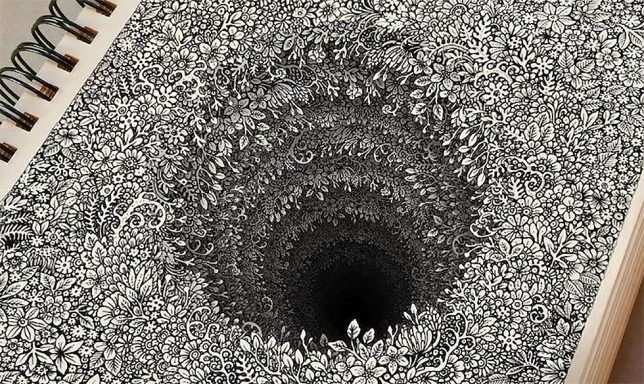
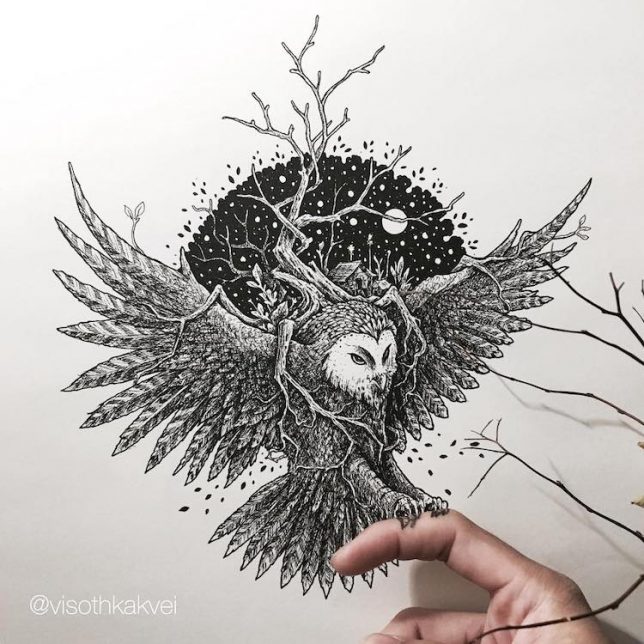
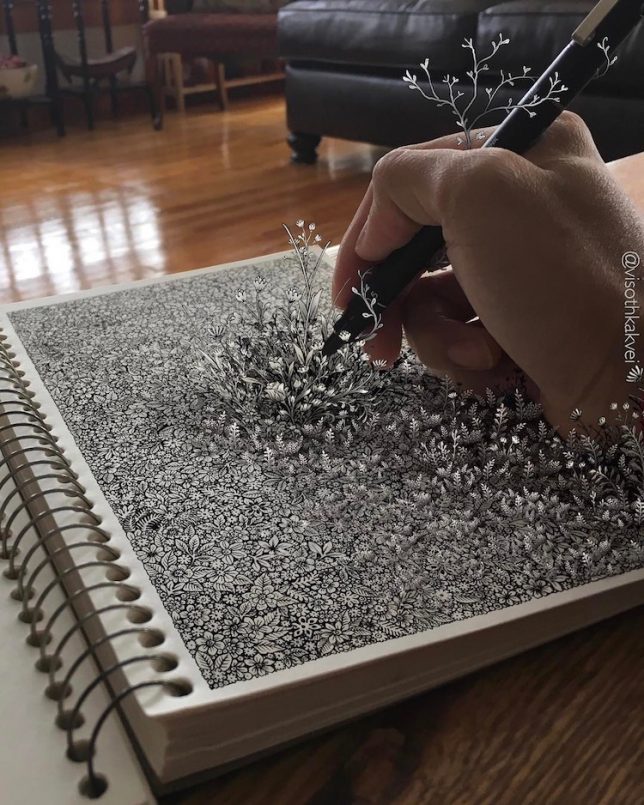
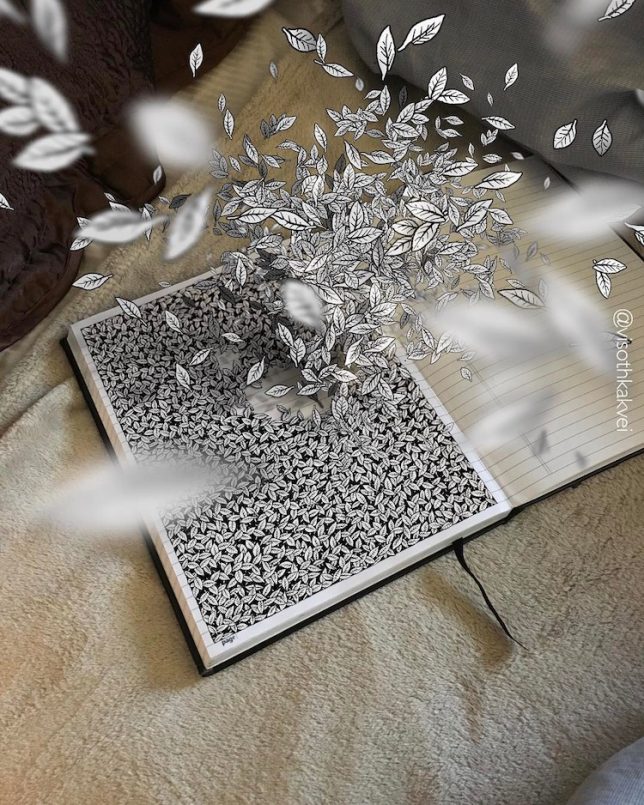
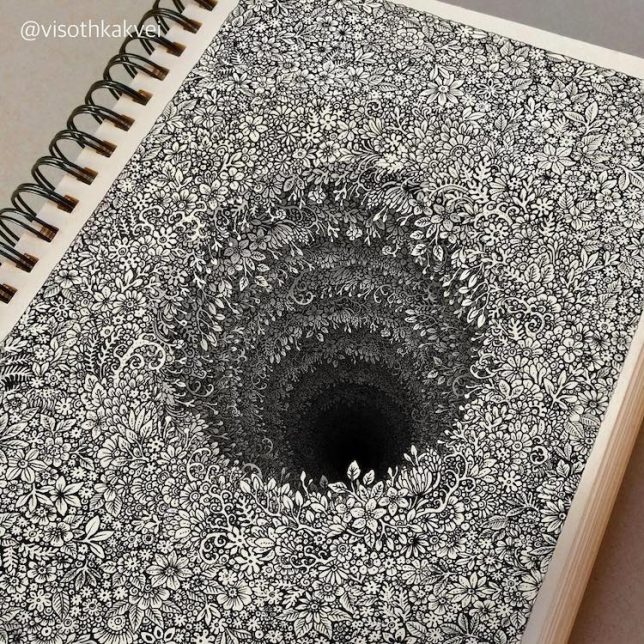
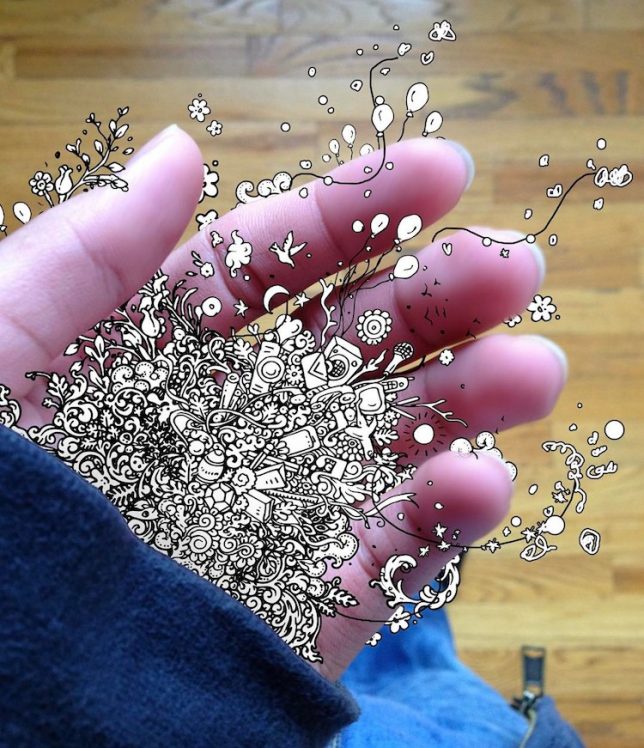
Magic Ink: Highly Detailed Optical Illusion Drawings Pop Off the Page

03 Jun

[ By SA Rogers in Art & Drawing & Digital. ]

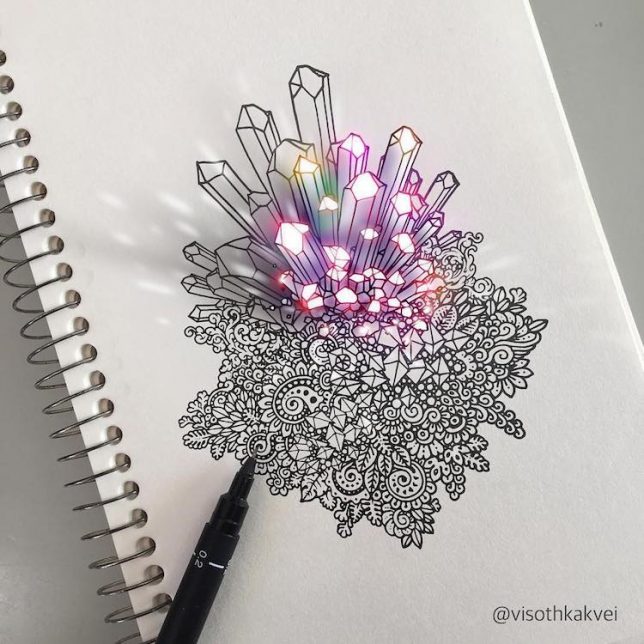
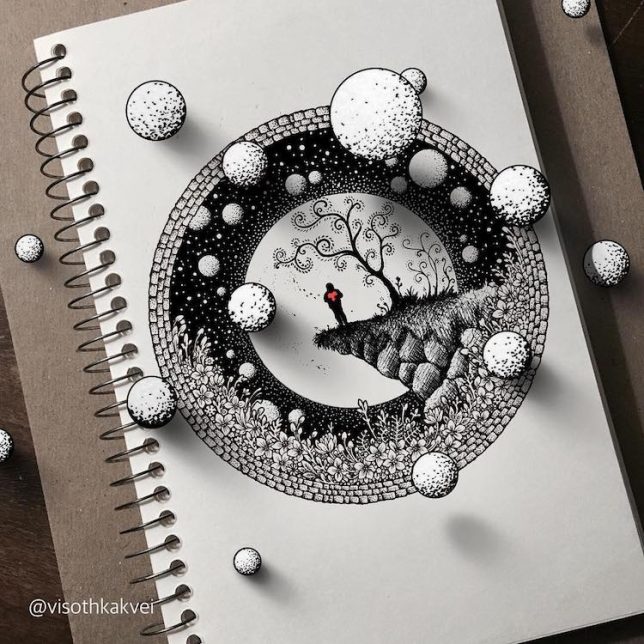
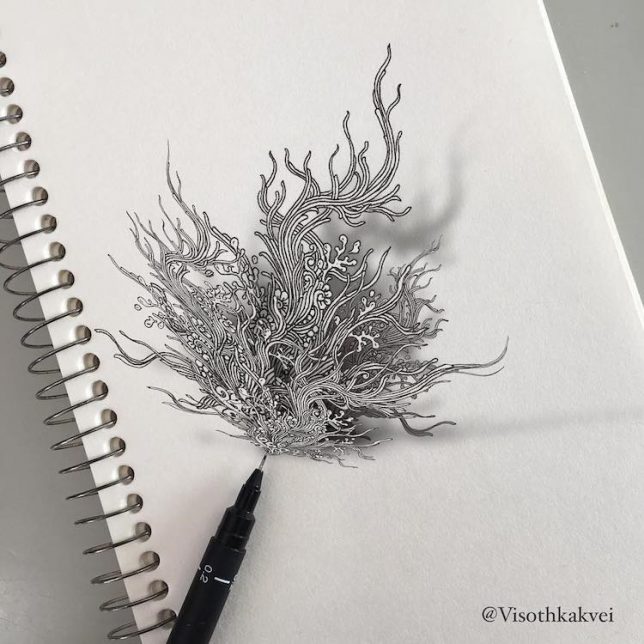
Strategically placed shadows and highlights make these incredibly intricate nature-themed drawings more than just impressive pages in an artist’s sketchbook. The pieces reveal unexpected depths and textures, and sometimes seem to lift right off the pages and into the real world, as if the sketchbook just couldn’t contain their vitality. Artist Visothkakvei shows off a variety of optical illusion techniques on his Instagram.

Fighting for the night. Once he's freed, the world will turn dark forever.

A post shared by Visothkakvei (@visothkakvei) on

Many of Visothkakvei’s works are contained within the bounds of his books. Though the drawings of flowers, leaves, vines and other organic subjects may look like simple doodles, it’s the way the artist layers them, packs them onto the page and adds shadows that makes them special. Some begin to creep beyond the boundaries of the paper.

Awaken #original #art #visothkakvei

A post shared by Visothkakvei (@visothkakvei) on

And, in some cases, it’s clear that more than just two-dimensional physical drawing is involved, though the artist doesn’t reveal his secrets. Some of this looks like he’s taken a photograph of his own hand working on the drawings, and layered digital drawing on top of it in a style that matches, making it unclear where the originals end and the digital additions begin.

Everytime I do the artwork, I see it around me. #original #art #visothkakvei

A post shared by Visothkakvei (@visothkakvei) on

Doodling #art #visothkakvei

A post shared by Visothkakvei (@visothkakvei) on

Check out lots more of these works, along with videos of the drawings in progress, at Instagram.com/visothkakvei.

Share on Facebook


[ By SA Rogers in Art & Drawing & Digital. ]

[ WebUrbanist | Archives | Galleries | Privacy | TOS ]


WebUrbanist

 
Comments Off on Magic Ink: Highly Detailed Optical Illusion Drawings Pop Off the Page

Posted in Creativity


SLR Magic introduces E-mount Cine 25mm F1.4

25 Apr

SLR Magic will be showing off a new prime for videographers at NAB: the Cine 25mm F1.4. Costing $ 400 and available at the end of May, the 25mm F1.4 will be available in E-mount and will be compatible with both APS-C and full-frame Sony cameras. The lens is a quite compact 78.4mm / 3.05in and weighs 520g / 18.34oz. A manually controlled aperture uses 13 blades. NAB attendees can take a look at the lens in person at SLR Magic’s booth.

Press Release:

Hong Kong, China (April 24, 2017) – SLR Magic extends it’s full frame lens lineup with the SLR Magic CINE 25mm F1.4 wide angle lens. This product will be officially introduced during the upcoming 2017 NAB Show in the Las Vegas Convention Center. There will be a demo at the SLR Magic booth (Central Hall, C2663) during the NAB Show from 24 – 27th April 2017.

The field of view of the SLR Magic CINE 25mm F1.4 opens up many new creative composition opportunities, particularly in the fields of interior, architectural and landscape cinematography and photography. The compact size of the SLR Magic CINE 25mm F1.4 wide angle lens also makes it a good choice of lens to be used with gimbals.

We place our highest priority in the development on our lenses to fulfill the demands of professional cinematographers and photographers. The design and build of the SLR Magic CINE 25mm F1.4 is solid and reliable.

SLR Magic is currently looking for volunteers to test the SLR MAGIC CINE 25mm F1.4 E mount lens at a special price. If interested:

1 ) Send an email to support@slrmagic.com with the subject ” SLR MAGIC CINE 25mm F1.4 lens volunteer + (your name)”.

2 ) Include sample videos/photos or link to photo/video reviews you have done in the past.

THE SLR Magic CINE 25mm F1.4 (MSRP: $ 399 US) will be available from authorized SLR Magic dealers by the end of May, 2017.

Technical Data

SLR Magic CINE 25mm F1.4

Lens Type: Fast standard lens

Compatible Cameras: FE-mount and E-mount cameras

Optical Design: 11 elements in 9 groups

Distance Settings:

Distance range: 0.25m to ?, combined scale meter/feet

Aperture: Manually controlled diaphragm, 13 aperture blades, Lowest value 16.

Filter Mount: Internal thread for 52mm filter; filter mount does not rotate.

Surface Finish: Black anodised

Dimensions:

Length to bayonet mount: approx. 78.40mm (approx. 3.05in)

Largest diameter: approx. 64.64mm (approx. 2.54in)

Weight: approx. 520g (approx. 18.34oz)

Articles: Digital Photography Review (dpreview.com)

 
Comments Off on SLR Magic introduces E-mount Cine 25mm F1.4

Posted in Uncategorized


Magic Lantern brings 4K recording to the Canon EOS 5D Mark III

05 Apr

Magic Lantern made April fools of us all by going live with an experimental build for the Canon EOS 5D Mark III on April 1st. It’s in early stages of development but it’s the real deal, and brings experimental Raw 4K video recording to the 5D III, among other things.

The build adds the following recording resolutions to the camera:

1920×960 @ 50p (both 1:1 crop and full-frame – 3×3 pixel binning)
1920×800 @ 60p (same as above)
1920×1080 @ 45p and 48p (3×3 binning)
1920×1920 @ 24p (1:1 square crop)
3072×1920 @ 24p (1:1 crop)
3840×1600 @ 24p (1:1 crop)
4096×2560 @ 12.5p (1:1 crop)
4096×1440 @ 25p (1:1 crop)

Once downloaded, it’ll look like this:

Stills shooters will also find a ‘full-resolution LiveView’ mode that shoots 5796×3870 at 7.4 fps. Magic Lantern notes that this mode is usable at fast shutter speeds, but comes with rolling shutter.

Magic Lantern states that anyone who downloads the build should know that it’s still quite bleeding edge, with plenty of bugs to work through. And of course, ML also wants you to know that using their software will probably void your warranty.

Articles: Digital Photography Review (dpreview.com)

 
Comments Off on Magic Lantern brings 4K recording to the Canon EOS 5D Mark III

Posted in Uncategorized