Ricoh has announced the Pentax K-S2 DSLR, offering a 20MP APS-C sensor, fully articulated LCD, weather-resistant construction and Wi-Fi with NFC. Where the K-S1 took an unconventional approach, the K-S2 is more traditional with a mode dial on the top panel, dual control dials and a standard grip without the preceding model’s flashing LED lights. Read more
Tag: Lights
-
Food Photography – How to Shoot A Beverage With Only Two Lights
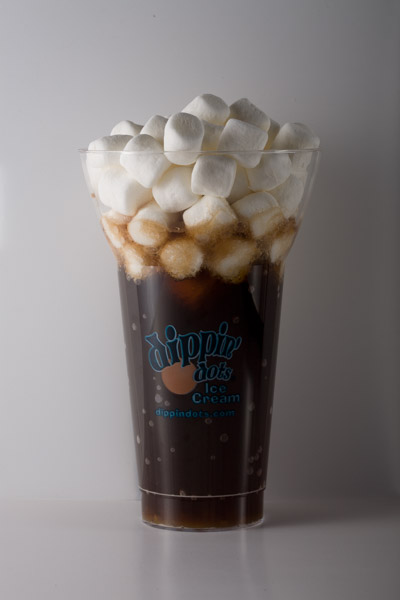
The wonderful thing about food photography is that you can easily turn your apartment, home, or garage into a studio. This image was shot for a local ice cream franchise that offers a different spin on the traditional root beer float. The set was constructed on a coffee table with common household items, and was lit with just two lights.

Final image
You might be thinking that the featured photo does not look like your normal, every-day root beer float, and you would be right. The ice cream pellets in the float were created by flash freezing ice cream mixed with liquid nitrogen.
Because the ice cream was made up of these small pellets, it melted quickly, leaving little time to get the “money shot”. To solve this problem, I created a stand-in cup that was filled with soda and mini marshmallows. This stand-in allowed me to tweak my lights while the ice cream was safely stored in an ice chest filled with dry ice.
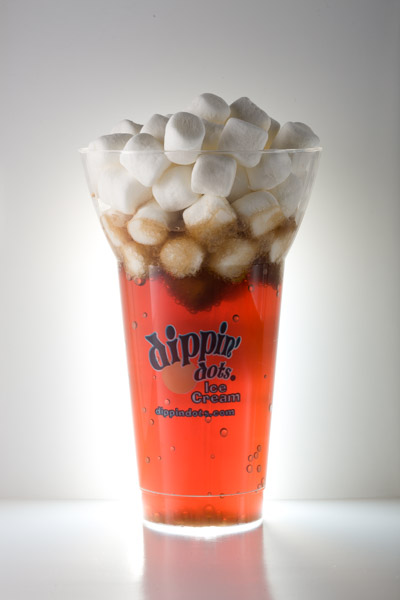
Marshmallows used as stand-in for ice cream, during set up phase.
Two pieces of white poster board were used to construct the set. One for the floor and one for the background. The background piece was attached to sections of PVC tubing, which were re-purposed from homemade DIY light panel frames. Small one pound dumbbells were placed on top of the PVC frame to secure it and keep it from moving around.
Whenever you photograph beverages, it is important to backlight them in order to show the transparency of the container and/or liquid. That is what makes soda, iced tea and beer ads look so delicious.
For this shot, I decided to achieve the effect by creating a really tiny pseudo-softbox behind the glass of root beer. I started by cutting a rectangular hole in the back of the poster board. Careful attention was taken to insure that the hole was large enough to cover the entire lower portion of the glass, while still being hidden from the camera’s view.
A small off-camera flash fitted with a radio trigger was then placed behind the background. Since the hole and glass were tall and narrow, the strobe was placed on its side, to match.
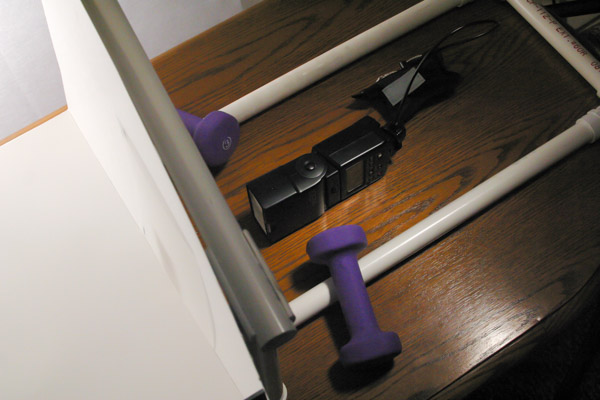
View of PVC frame and hotshoe flash with radio receiver. Notice how flash is placed on its side, vertically.
Next, a small sheet of frosted stencil paper purchased from a local hobby store was placed in front of the hole, to evenly diffuse the light across the opening. The translucent properties of the paper also created a soft falloff to the background, as if it were being lit from the front instead of the back.
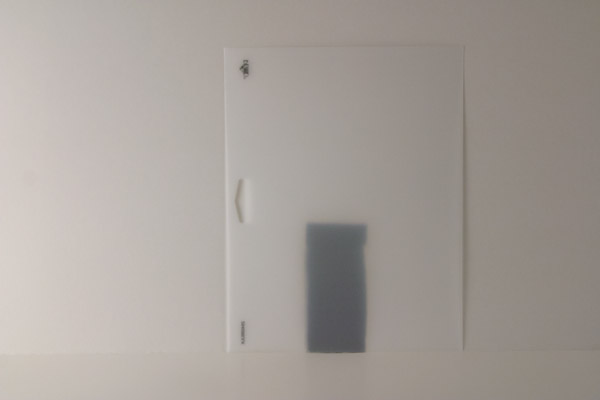
Frosted stencil paper was butted against the background, behind the glass, to evenly diffuse the light shining through the hole in the poster board. The sheet was moved so that the edges, logo and holes were not seen from the camera’s angle of view.
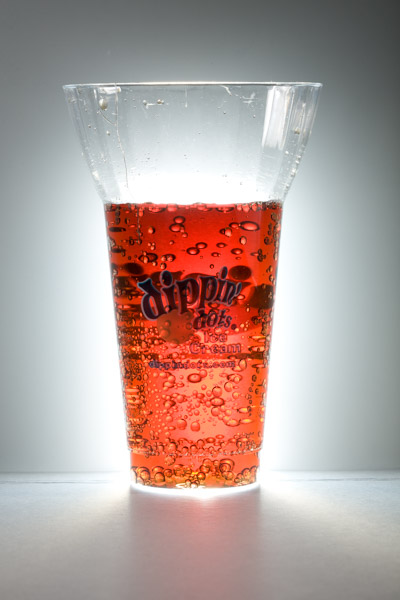
First backlight test, before marshmallows were added.
Now that the liquid was backlit, we needed to add a light to illuminate the ice cream. To do this, a large piece of diffusion fabric attached to a PVC frame was placed just out of frame, towards camera left. A strobe light was then placed behind the panel. The diffusion fabric created a large source of illumination, which created a very soft transition from the highlights to the shadows.
Light shining through diffusion panel with back light turned off
Finally, an acrylic mirror was attached to a light stand and placed just out of frame, towards camera right. The mirror reflected and bounced some of the light from the large panel back into the shadows.

Mirror fill: Before and After
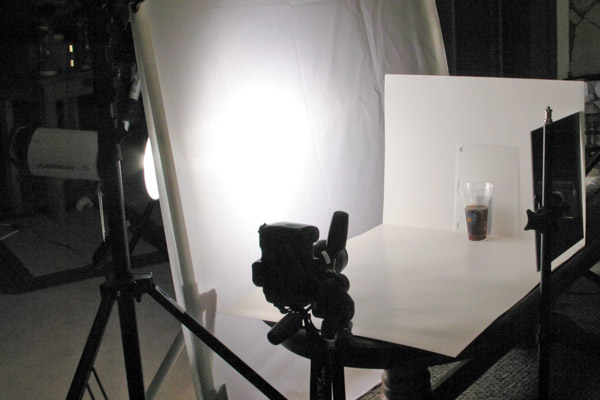
View of entire setup.
The final image was shot using a Canon EF 100mm f/2.8 Macro lens. The camera was set to f/14 at ISO 100.
Final image using real ice cream.
With a little imagination and ingenuity you too can create professional looking food images on a budget, with minimal equipment. In fact, here are a few cheaper alternatives that could have been used to create the image above:
CFL or LED Light Bulbs
The wonderful thing about still photography is that your subject is “still”. This means you can use regular household bulbs to light your scene if you do not have the money for strobes. All you have to do is lower and adjust the shutter speed of your camera, since the bulbs do not emit as much light as a strobe or off-camera flash. Experiment with different bulb wattages, or try alternating the amount of bulbs to create different lighting ratios. Just make sure you have the bulbs placed behind some source of diffusion. By diffusing the lights, you will create a single large light source; otherwise, you will create multiple shadows and weird reflections from the various sources of light.
White Twin Bed Sheet
A white bed sheet is an inexpensive and great form of diffusion. You can attach it to a PVC frame or stretch it between two light stands using spring clamps. The sheets are also great for portrait work. Need a GIANT softbox? Try a king size sheet!
googletag.cmd.push(function() {
tablet_slots.push( googletag.defineSlot( “/1005424/_dPSv4_tab-all-article-bottom_(300×250)”, [300, 250], “pb-ad-78623” ).addService( googletag.pubads() ) ); } );googletag.cmd.push(function() {
mobile_slots.push( googletag.defineSlot( “/1005424/_dPSv4_mob-all-article-bottom_(300×250)”, [300, 250], “pb-ad-78158” ).addService( googletag.pubads() ) ); } );The post Food Photography – How to Shoot A Beverage With Only Two Lights by Joel Dryer appeared first on Digital Photography School.
-
Street Pong: Play with Fellow Pedestrians at Traffic Lights
[ By Steph in Gaming & Computing & Technology. ]

You might not be too concerned about how many light cycles go by before you actually get to cross the street if you’re too busy playing pong with the person waiting on the other side of the intersection. The ActiWait project aims to brings ‘street pong’ to intersections around the world, with two functioning games already installed in the city of Hildesheim, Germany.

The concept made its debut on the web in 2012, with the original video (below) getting so much attention that the interaction design students from HAWK University who created it decided to make it real. Designers Amelie Künzler, Sandro Angel and Holger Michel collaborated with traffic experts and fabricators to create a device that can be installed on traffic poles.

“Yeah well… the idea was simple but traffic engineering isn’t,” say the designers on their IndieGoGo page, where they’re currently raising funds to bring the ActiWait to more cities. “So we got us some support from companies and professionals in the traffic technology industry. The prototype is 3D printed and fully equipped, the first game is programmed and we’ve already launched our product in October so we can proudly say: the world’s first smart pedestrian light button is finally here!”

The product needs funding to develop hardware and software for the final stage, a new professionaly-produced case, and to pass safety tests. The designers also intend to make it wifi capable for news feeds, navigation, traffic education and other applications in addition to pong – even speed dating. Learn more at IndieGoGo.
Want More? Click for Great Related Content on WebUrbanist:
Stop, Look and Love: 8 Redesigns of Classic Traffic Lights
The instantly-recognizable traffic light has been a standard sight on streets around the world for generations, but these designs aim to improve on a classic.
Click Here to Read More »»
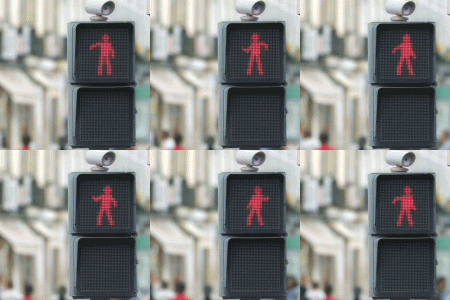
Dancing Traffic Signal Makes Crossing the Street More Fun
Impatient pedestrians eager to get across the street stop, point and laugh when they realize that the usually-static human figure in the crosswalk signal is …
Click Here to Read More »»
Illuminating Inventions: 10 Twists to Simple Street Lights
Functional street lights tend to fade into the background for most of us, but these designers have creatively re-imagined the humble piece of urban furniture.
Click Here to Read More »»


[ By Steph in Gaming & Computing & Technology. ]
[ WebUrbanist | Archives | Galleries | Privacy | TOS ]
-
Choosing Lights
Because big lights and small lights each bring a different set of considerations to the party, I am splitting my recommendations into speedlights and “studio lights.” (Although I hate that term.)For speedlights, you have to decide if you wanna drive stick or automatic—AKA manual or TTL. I live in manual mode, which means I sacrifice some convenience for reliability and repeatability. It also means I can pay about a third as much for each of my flashes.
If you live by TTL, you will die by TTL. Or, at least your wallet will die a small, unnecessary death every time you need to purchase a flash.
__________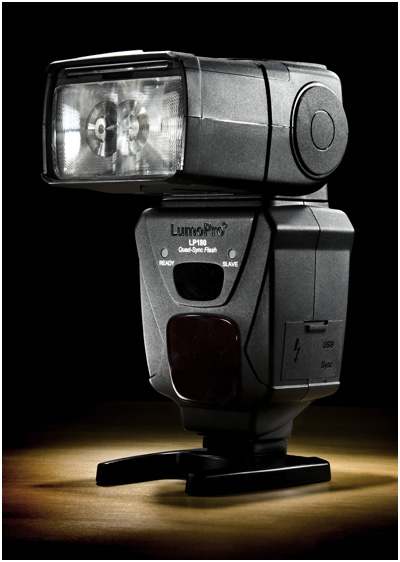
For manual speedlights, I wholeheartedly recommend the LumoPro LP180, about which I go into far more detail here. It’s built like a tank, syncs four different ways, has a fluid and intuitive user interface, a built-in light-stand socket, a built-in gel holder and has a two-year manufacturer’s warranty. No other speedlight comes close to claiming all of those useful features.
That it costs about a third as much as you would pay for an OEM branded flagship TTL flash is icing on the cake. If you can commit to shooting manually, this is your flash.
If you need TTL (and remember, this is the gear acquisition equivalent of joining the TTL mafia) I would consider eschewing the OEM flagship TTL flashes. They can run north of $ 500USD, which is just nuts.
The Phottix Mitros comes in Nikon and Canon variants and sells for about $ 300USD—with twice the warranty length. It does pretty much all the fancy stuff most of the OEM flashes do including the optical TTL triggering of other TTL units, be they other Mitros units or OEM units.
I will say that for the lesser price you will give up some ease of user interface. But this may well be that I was used to the OEM flash user interface and that of the Mitros is pretty radically different.
Finally, for some people the flagship OEM flashes will be just fine. For instance, if your name is Bill Gates they are a perfect choice for you.
On the opposite end of the spectrum, there are a ton of flashes constantly hitting the market from the far east, from a variety of pop-up brands. Some of the brands are recognizable because they bought the rights to use familiar but now bankrupt brands that were formerly trustworthy. They have spotty track records for quality. Factory warranties are short to nonexistent.
Many who read this will be tempted to go that route because of prices that are almost too good to be true. If that’s you, by all means knock yourself out. Some people need to be stung in the wallet to remember a lesson or bit of advice. I know I did when I was young. Good luck with that!
__________As far as big lights go, there is a completely different set of variables to consider. Big lights are system-oriented, and you would do well to choose wisely in what will likely be a long-term relationship.
I spent a lot of time and money auditioning big lights over the past 25 years. I am really happy where I am now, and would have loved to make this good of a choice from the get-go. I wrote about researching and choosing big lights a couple years ago and at the time settled on a Profoto/Paul Buff hybrid choice.
I loved Profoto’s light mods and quality of light, but they were very expensive. And the battery options insanely so. So instead of battery versions of my Profotos, I went with Profoto plug-ins and a full Paul Buff Einstein setup for portable, battery-powered big lights. Sounds crazy, but for the price of just two AcuteB battery generators you can outfit yourself like an Einstein King.
So for the last couple of years I have had two full systems in my gear closet: Profoto plug-ins and Einstein 640s with portable battery packs. (But they also plug in.) And even though the Profotos are far more expensive, rugged and “professional” (whatever) I found myself again and agin choosing the Einsteins to use.
That’s because inexpensive or not, they are simply amazing flashes. And they come with a 2-year warranty (sensing a trend here?) and legendary factory service. Further, Paul Buff has finally taken some time to develop the modifier system that a good flash deserves. The reflectors and accessories are well-designed—and wonderfully inexpensive.
The caveat here is, this is pretty much a US-based choice/suggestion. One of the main reasons Paul Buff lights are so inexpensive is that he only sells direct, and mostly in the US. There are a couple of dealers outside the US but that starts to erode the value proposition pretty quickly.
So, to beginners looking for a great light at an amazing price in the US, I would suggest you strongly consider Einsteins. Not the similarly shaped and even cheaper AlienBees, however. They look similar, but are not in the same league as the Einsteins. Save your money and go Einstein. It is not that much more.
If you are outside of the US, I am sorry that this choice will be either not available or not nearly as good a value to you. So I would suggest that you look at other reputable flash brands (Bowens, Elinchrom, Hensel, Profoto, etc.) and choose the brand that works best for your needs and your wallet. This advice also holds for people for whom the Einsteins aren’t a good fit.
Again, I would suggest avoiding the temptation of the super-cheap mystery brands from the far east. Personal experience. But if you need some personal experience of your own to dissuade you in the future, by all means go right ahead.
Next: Triggers
-
Lighting Tutorial: Types Of Lights & Meters
 TYPES OF LIGHTS + METERS
Hey FashionPhotographyBlog.com readers! Welcome back.
Now that you know different sources of lights that can be used, today we’ll cover the ways in which they can be set up.
TYPES OF LIGHTS
“Key” light is the main light source and generally the brightest.
“Fill” is used to brighten shadows and does bit create a secondary shadow and is generally a diffused source. (Avoid a secondary shadow at all costs! This is the sign of an amateur photographer.)
“Background” lights are used to illuminate the background and aid in separating the subject. They can provide a sense of depth.
“Hair” light is typically overhead and slightly behind a subject. It’s a separation light which only hits the top of the head.

“Kickers” are lights that help separate the subject from the background. Kickers are also known as “Accent,” “Rim” and “Edge” lights.

No Kicker vs. Kicker – This is a more obvious example. Kickers can be use more subtlety.
“Rim” lights are pretty self explanatory. They hit the rim of the subject to serve as a separator from the background.

Rim Lighting
TYPES OF METERS
Reflective Meters are the types of meters build right into your camera. How do they work? Reflective meters measure the light that is reflected back into them. These types of meters take an average reading of the scene and meter for “middle grey.” Be aware of this when using the meter built into your camera (or a reflective meter) to meter a scene!
Experiment: Using a reflective meter, take a photograph of a black card, take a photograph of a white card and take a photograph of a grey card. You’ll notice that all the images essentially come out grey- the black will be over exposed and the white will be under exposed.
The following information and pictures are from Scantips.com

Three cards, f/8, 1/1250 second Nearly exactly Sunny 16

Black card, f/8 1/200 second (result is not black) Result is 2.3 stops overexposed, from first one.

White card, f/8 1/5000 second (result is not white) Result is two stops underexposed, from first one.

18% gray card, f/8 1/800 second Result is 1/3 stop over first one.
Incident Meters are the type professionals typically use. They’re handheld meters which are held at the subject (not at the camera, like reflective meters) and measure the amount of light that falls on to the subject. These are much more accurate than reflective meters and are easiest to use in studio.

The Sekonic L-358 is one of the most commonly used incident meters.
They also come with an attachment to use it as a reflective meter.
Hang tight for tomorrow where we’ll cover different types of lighting modifiers.
See ya tomorrow-
Alana
IMAGE SOURCE:Feature image & image 1: photography by Alana Tyler Slutsky from her Surrealia series. To view the rest of the photos from this series visit her website.
Image 3: StackExchange.com
Image 2, 4 & 9: Alana Tyler Slutsky
Image 5-8: Scantips.com
-
Time-Traveling Trams: 30,000 LED Lights Vanish Street Trains
[ By WebUrbanist in Art & Installation & Sound. ]
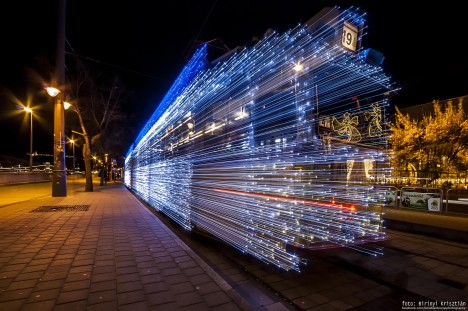
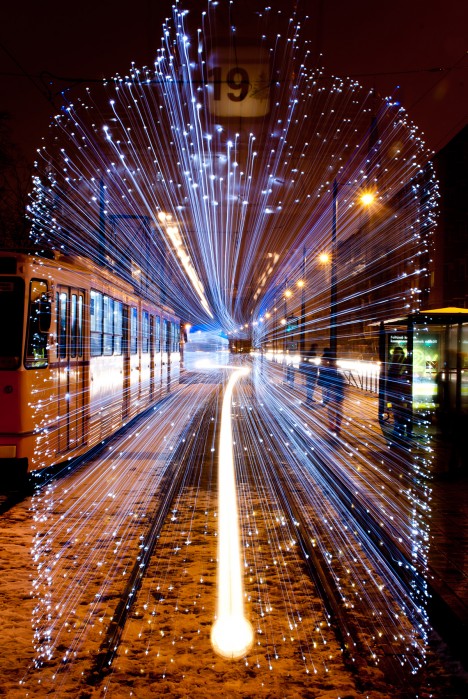
Extended exposure photography combined with a unique art installation project creates an incredible time lapse illusion on the streets of Budapest, making train cars appear to disappear in a burst of light.
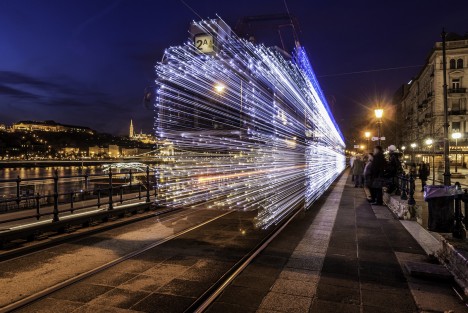
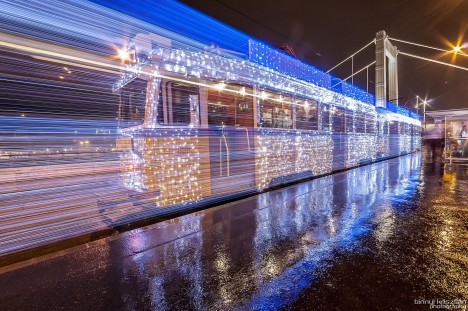
Started for Christmas 2009, this is a project of a regional transport company since captures by a number of intrepid photographers, each showing different speeds and resulting effects.
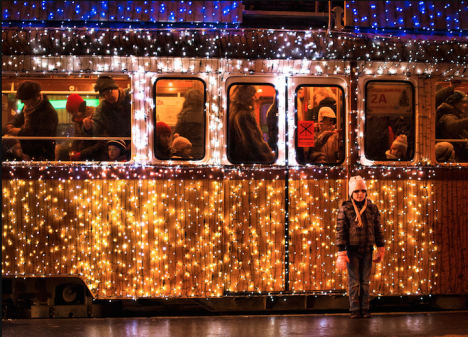
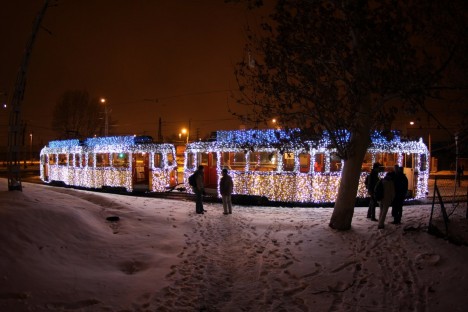
Via Colossal, this seasonal lighting is meant to attract tourists and additional riders, a decorative nod to the holidays as well as a moving work of photogenic art.
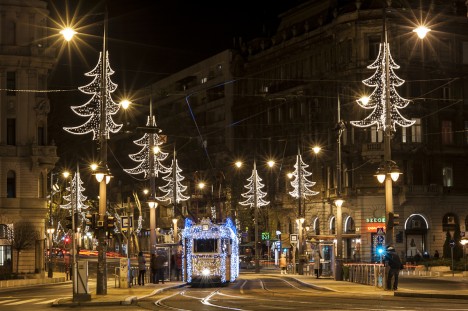
Images here were taken by Andras Csore, Victor Varga, Krisztian Birinyi, Krisztian Birinyi, Zsolt Andrasi English Hungary and the Centre for Budapest Transport.
Want More? Click for Great Related Content on WebUrbanist:
Infrastructural Art: Colorful LEDs Lights Up Shipyard Cranes
The imagination readily fastens onto the anthropomorphic figures like those found in shipyards, turning looming metal giants into huge toy beasts, origami …
Click Here to Read More »»
Subway Parasite: Stealth Projector Lights Up Train Tunnels
Here to lighten the mood a bit during the duller parts of your nighttime or subterranean transit is a quirky little projector that suctions to vehicular shells.
Click Here to Read More »»
Illuminating Inventions: 10 Twists to Simple Street Lights
Functional street lights tend to fade into the background for most of us, but these designers have creatively re-imagined the humble piece of urban furniture.
Click Here to Read More »»
[ By WebUrbanist in Art & Installation & Sound. ]
[ WebUrbanist | Archives | Galleries | Privacy | TOS ]
-
Infrastructural Art: Colorful LEDs Lights Up Shipyard Cranes
[ By WebUrbanist in Art & Installation & Sound. ]
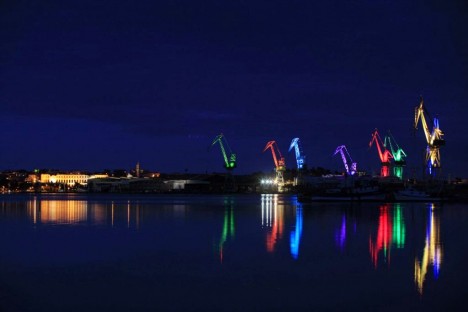
The imagination readily fastens onto the anthropomorphic figures like those found in shipyards, turning looming metal giants into huge toy beasts, origami cranes writ large.
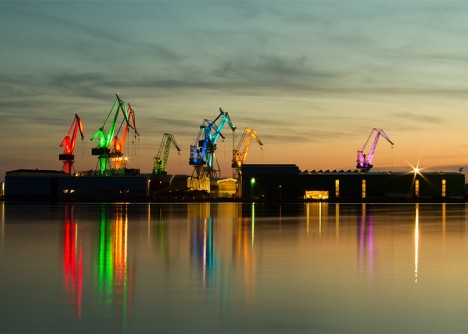
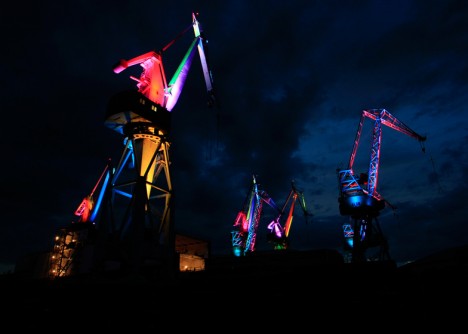
Lighting designer Dean Skira takes things a step further in this public exhibition titled Lighting Giants, using nearly 100 RGB LEDs to produce an array of colorful effects at a massive scale – 16,000 different possible hues in total.
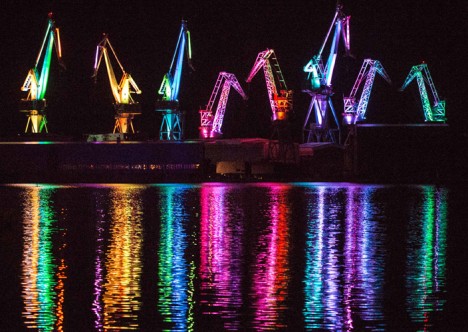
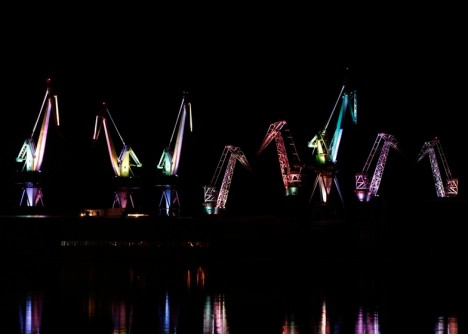
Located in a major Croatian shipyard, the show involves a shifting spectrum of illumination that ranges from pure white to wild rainbows, all directed up into the rugged frameworks of industrial monstrosities.
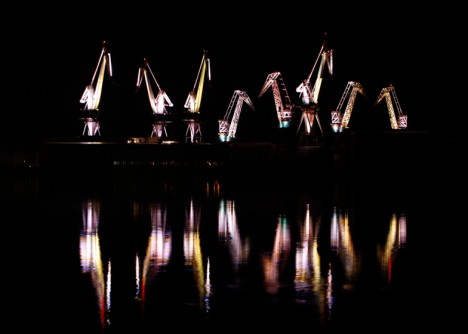
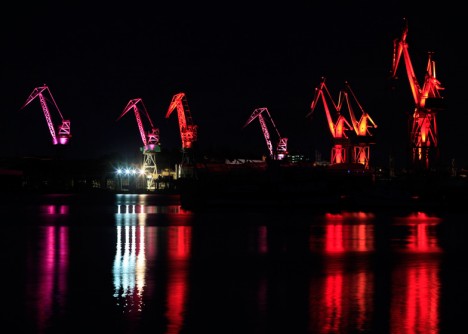
The installation, funded by the ministry of tourism, was in part a response to calls for the relocation of the shipping infrastructure, seen by many as an eyesore. Instead of doing away with the cranes, a part of local industry and history, this work celebrates and highlights them.
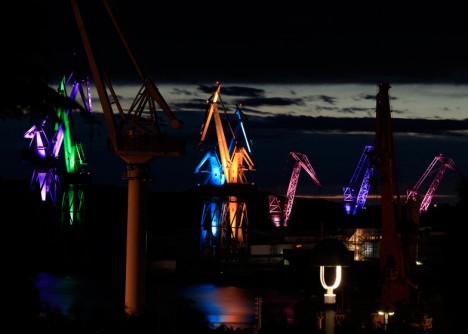
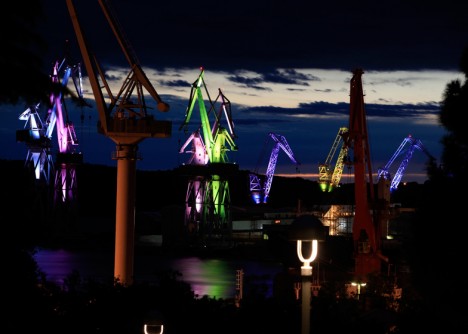
About the artist: he is a “lighting designer with over twenty years of experience in designing innovative lighting solutions for urban, landscape, commercial and residential spaces. Even in his early childhood he was fascinated by light and its sources, strongly influenced by his father’s professional work in stained glass. He promotes an architectural lighting design concept that goes beyond utilitarian where lighting can have high impact on person’s emotional states.”
Want More? Click for Great Related Content on WebUrbanist:
Street Origami: 30,000 Pieces Folded to Create Colorful Art
An urban art play in multiple acts, this staged installation colorfully spans brick walls, stone steps and wood facades as part of an art festival in Angers, …
Click Here to Read More »»
Urban Infill: Colorful Tile Mosaics Patch Potholed Streets
In a city with over a half-million open potholes, one artist is helping address the problem and raising awareness by installing his own creative patches, …
Click Here to Read More »»
Colorful Pop-Up: City Farm Storefront for Produce & Plants
This competition-winning design uses upcycled materials to frame a street-facing experience, in part through a fresh take on ‘window shopping’. …
Click Here to Read More »»
[ By WebUrbanist in Art & Installation & Sound. ]
[ WebUrbanist | Archives | Galleries | Privacy | TOS ]
-
Street Smart: Solar Roadway Lights Up & Feeds Power Grid
[ By WebUrbanist in Conceptual & Futuristic & Technology. ]
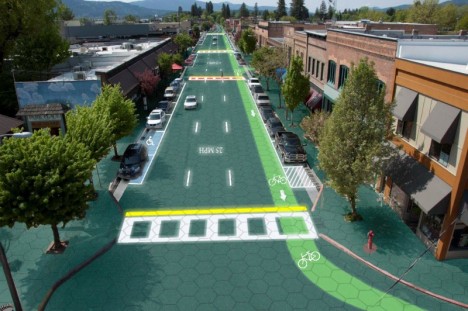
Currently in crowdfunding, these hexagonal pavers can provide energy, melt accumulated snow and ice, light up with LEDs, all while being tough enough to support trucks weighing 250,000 pounds.
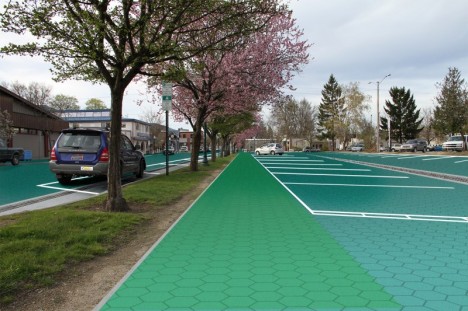
Designed by American electrical engineer Scott Brusaw to work everywhere from roads, parking lots and driveways to sidewalks, bike paths and playgrounds, you can walk, drive or park on these hexagrams with ease. They have been extensively tested for load-bearing capacity as well as traction and impact resistance.
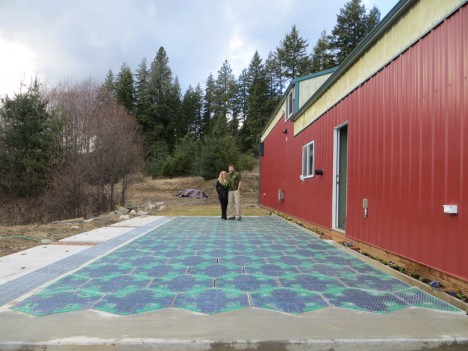
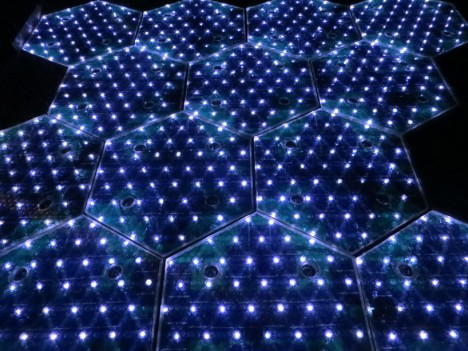
More about the project from IndieGoGo (graphics by Sam Cornett): “Solar Roadways is a modular paving system of solar panels that can … pay for themselves primarily through the generation of electricity, which [in turn] can power homes and businesses connected via driveways and parking lots.”

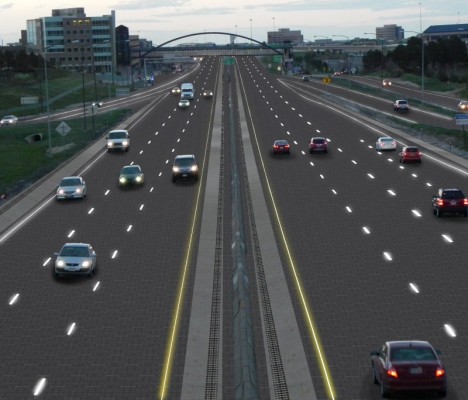
Current working prototypes are already powerful, as demonstrated above. Beyond existing capabilities there are many possibilities for further development, including mutual induction technologies that would allow charging while driving and more complex LED systems to create changing road displays on demand.
Want More? Click for Great Related Content on WebUrbanist:
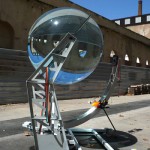
Lunar Power: Solar Spheres Energized by Both Sun & Moon
This sphere is so powerful in its ability to turn light into heat that it can not only harvest the rays of the sun, but even draw on energy reflected from the …
Click Here to Read More »»
Illuminating Inventions: 10 Twists to Simple Street Lights
Functional street lights tend to fade into the background for most of us, but these designers have creatively re-imagined the humble piece of urban furniture.
Click Here to Read More »»
Powerhouse Ideas: 10 Futuristic Clean Power Concepts
Fossil fuels won’t be around forever. Is the world prepared for alternative energy? Judging from these 10 amazing concepts, we’ll be just fine.
Click Here to Read More »»
[ By WebUrbanist in Conceptual & Futuristic & Technology. ]
[ WebUrbanist | Archives | Galleries | Privacy | TOS ]
-
Sanges Indecent Eye & Lyubimkin’s City Lights
 Readers based in London may be interested in hearing that the Hay Hill Gallery, who represent a selection of internationally recognized contemporary artists, will be presenting a double exhibition from the 26th May to the 21st June, showcasing the photographic works of fashion photographer, Marco Sanges, entitled “The Indecent Eye”, and the architectural images of Alexey Lyubimkin, called “City Lights”.
Marco Sanges and possess a matchless photographic eye that creates alluring photography echoing the works of art from the Byzantine, Surrealist and Gothic periods. Not only are his images reminiscent of art paintings but he has ability to transmute and infuse each subject matter with its own and distinctive vibrancy and energy.

From developing and printing black and white photos in his uncle’s photographic lab, Sanges went on, in the pursuit of fashion, to become a photographer for Vogue Italia, before relocating to London where he presently resides. He has been exhibited worldwide, worked with clients such as Cutler and Gross, Agent Provocateur, Sunday Telegraph, Vogue, Trace, Elle, Dolce & Gabbana, and there is even a permanent collection of his work held in the Virginia Museum of Fine Arts, in the United States.

With his exhibition, Marco Sanges invites the public to visit and open their imaginations. As a storyteller, Sanges photographs appear to look more like cinematic narratives, as though we are looking through the lens as the photographer tells his tale. Having been influenced by the silent films of the 1920’s and 30’s, his dark and enchanting images portray the frailty and strength of humanity, confronting the viewer with the conclusion that there can be a funny side to our own mistakes if you choose to see it. Magician, puppet master and photographer, Sanges takes you on a journey of mystique and romantic intrigue in “The Indecent Eye” exhibition.

Having been provoked into deep thought by “The Indecent Eye”, you may wish to proceed through the “City Lights” exhibition in the same venue, displaying the architectural works of photographer, Alexey Lyubimkim. What can be described as love letter to the cities he shoots, revealing the tree and building lines as though they were part of the original city’s design blue-print. With a camera in hand, the lens is like a magnifying glass under Lyubimkim’s scrutinising eye that reveals what our naked eyes can’t see – an ever changing landscape.

Born in Novosibirsk, Russia in 1963, Lyubimkim has worked as a professional architect, published the “Russian Gallery” art magazine, developed the growth of the Moscow’s Artist Center at Tretyakov Gallery and Savvinskaya Arts Center, was a founding member of London’s Hay Hill Gallery (where the exhibitions are held), and holds memberships in both the Russian Photo Artists Union and the International Journalist Union. His works have been sought after in private collections across the globe, including Russia, UK, Germany, Mexico and USA.

How does architecture apply to fashion photography you may ask? Well, according to Alex Lyubimkin he says that “Architecture is the most stylish way of culture representation, and… like many people, I like to make my own discoveries. In this variety of city landscapes and cultural traditions no creative person can remain indifferent. I often carry my camera with me, which becomes my interpreter and even my partner… London is one of the most beautiful cities in the world for me.” Be inspired by the lines, shapes and bold use of color in Lyubimkin’s courtship of the cities he has photographed.
Lyubimkin pays homage to the old technique of tinting images but incorporates a variety of contemporary solero hues. This artist’s colour fascination embodies the double take turn of the head towards beauty in amidst the bustle of a metropolitan city, encouraging the viewer to take notice of their surroundings next time they step outside. He brings to the surface the sense of home and belonging, while making conscious of the world around us at a local scale.

To visit or find more information for both Marco Sanges’ “The Indecent Eye” & Alexey Lyubimkin’s “City Lights” exhibitions, the contact details for the Hay Hill Gallery are below:
Hay Hill Gallery
Address: 35 Baker Street, London W1U 8EN
Phone: 020 7486 6006
Opening hours: Monday – Friday 10.30-6, Saturday 11-5
Website: www.hayhillgallery.com
Email: info@hayhillgallery.com

PHOTO CREDITS:
Pictures 1, 2, 3, 4, 5, 8 & 9: from Marco Sanges’ “The Indecent Eye” Exhibition
Pictures 6 & 7: from Alexey Lyubimkin’s “City Lights” Exhibition
-
Lights. Smartphone. Action!

With just the right accessories, you and your phone can make movie magic.
Might we suggest a dolly that slides, lenses for a new perspective and a constant light to really shine.
Don’t just rely on your hands or zoom to pan your cam. The Table Dolly glides smooth as silk on its four wheels and holds tight to any phone.
Change up your view with the Phone Lens Series. The wide angle and fisheye more than make up for your phone’s auto crop in video mode. The telephoto and macro get you stunning close ups.
For pro-level lighting use the Pocket Spotlight on or off of your phone. Get constant even light right where you want it.
Learn More About the Table Dolly
$ 90 at the Photojojo ShopBuy the Phone Lens Series
$ 20+ at the Photojojo ShopNab a Pocket Spotlight
$ 30 at the Photojojo Shop
© laurel for Photojojo, 2014. |
Permalink |
No comment |
Add to
del.icio.us
Post tags:
