RSS
 

Posts Tagged ‘lighting’

Lighting Setup: The Athlete

29 Apr
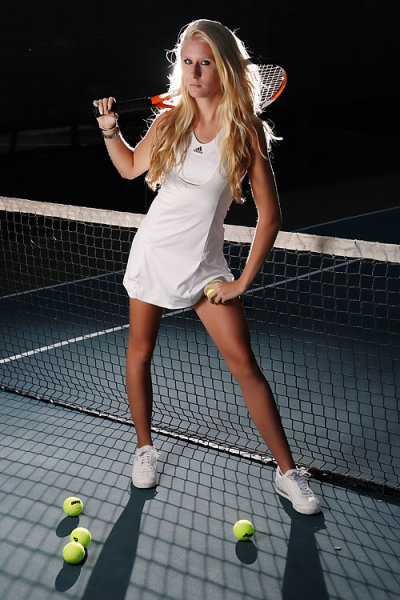
For this shot, only the strip box was used, to camera left. The back light was also used, but I turned the kicker light off for more dramatic lighting.

For this shot, only the strip box was used, to camera left. The back light was also used, but I turned the kicker light off for more dramatic lighting.

I was contacted by a local model who also happened to be a tennis player, and she wanted to do a tennis shoot for her portfolio. We discussed ideas, as well as location.  A tennis court was the obvious choice for location.  I had decided I wanted dramatic lighting, similar to what’s seen in sports drink ads, or athletic apparel ads.  I knew that would require two or three lights, and a darkened overall scene to get the look I was after.

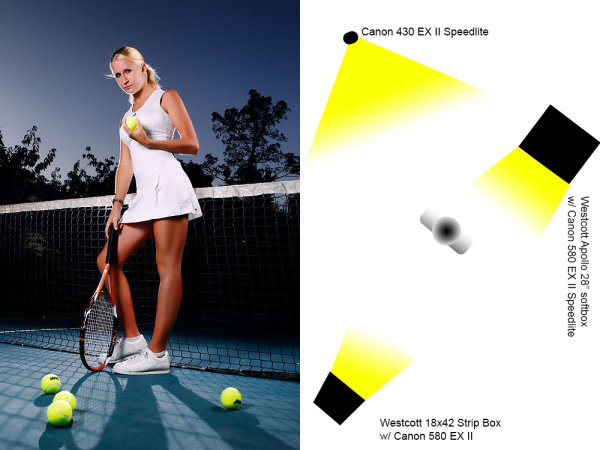
Since the shoot took place in the later afternoon, when there was still plenty of daylight, in order to get the darkened look, I needed to play around with my exposure. I was using the EOS-1D Mark IV, which has a top sync speed of 1/300. For lighting I used two Canon 580 EX II speedlites off camera in softboxes. One softbox was a Westcott Apollo 28″ softbox, while the other was a Westcott 18×42 strip box.  For the shots where the model was backlit as well, I used a Canon 430 EX II speedlite on a light stand with no modifier.  The 18×42 strip box is asymmetrical offers the ability to light a full length figure with soft falloff at the lower legs, while the 28″ Apollo softbox lights the upper half well when close up, or when pulled back can light a full length figure.  I used the strip box to light the model from the front, and the 28″ softbox as the kicker light from the right rear. For the dramatic backlight, I used a bare Canon 430 EX II speedlite pointed back towards the camera.

In order to allow the speedlites to be the main source of light, I needed to deaden the daylight.  I did this by setting the flash to E-TTL, and the camera to shutter priority.  I then dialed back the camera’s exposure compensation to -3.  This served to darken the ambient exposure, allowing the speedlites to provide lighting at the proper exposure.  This made it appear I was shooting at night, or in a darkened stadium.  It’s important to understand that there is a difference between exposure compensation and Flash Exposure Compensation.  Exposure compensation will affect the exposure of ambient light, but will not affect flash output. This allows you to balance the flash exposure with the ambient exposure in any way you prefer. The speedlites were set to ratio their exposure based on E-TTL metering.  Canon speedlites can ratio A:B. If a third group of speedlites is set to Group C, these can be adjusted using flash exposure compensation.  The main ratio used was 4:1, but I did vary this throughout the shoot.  The backlight was set to E-TTL, Group C, with Flash Exposure Compensation set to +3.

For athletes, in order to give them that larger than life look, it’s best to shoot from a low angle. I instructed the model to vary her poses between intimidating looks and stances.  I used tennis balls to add to the theme, and by sending the backlight through the net, added a dramatic shadow to the foreground. This ended up being a set I was really happy with, and the model was happy with her shots.
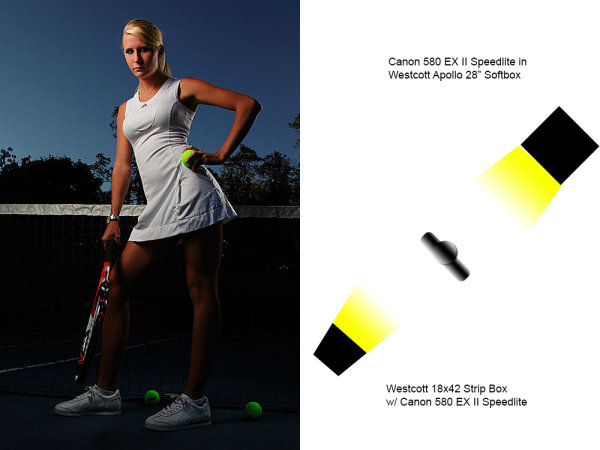
In this shot, the backlight was turned off, and the 28" softbox was positioned behind and to camera right of the model. This created a dramatic shadow to the front of the model while strip box lit her left side. The backlight was turned off for this shot.
In this shot, the backlight was turned off, and the 28″ softbox was positioned behind and to camera right of the model. This created a dramatic shadow to the front of the model while strip box lit her left side. The backlight was turned off for this shot.

For this shot, all three lights were in play.  The backlight caused the dramatic shadows and a highlight effect, while the kicker illuminated the model's right rear, and the strip box lit her face and front side.

For this shot, all three lights were in play. The backlight caused the dramatic shadows and a highlight effect, while the kicker illuminated the model’s right rear, and the strip box lit her face and front side.

Post originally from: Digital Photography Tips.

Check out our more Photography Tips at Photography Tips for Beginners, Portrait Photography Tips and Wedding Photography Tips.

Lighting Setup: The Athlete


Digital Photography School

 
Comments Off on Lighting Setup: The Athlete

Posted in Photography


Studio Lighting: Unravelling the Complexity of Multiple Lights

20 Apr

As one gets started in studio lighting I think it is pretty common to get over ensconced in the lighting scenarios. It is funny because everything you read tells you to start with one light until you really start getting a feel for how to shape, angle and manipulate it with purpose. Most of us end up getting lost in multiple light set-ups struggling to find proper lighting solutions. I was not any different.

Soon after I got started, I found myself using 4-5 lights in every setup and then getting frustrated with the nuclear explosion of light that was going off with each shutter click. It makes me laugh now, because at the time I was solely focused on getting light on the subject, background and in most cases everything else in the room that was touched by the mushroom cloud of illumination. I did not understand the importance of shadow, shape, depth and form.

Maturing with studio lighting takes time and patience, and always remember that each light should have a specific purpose. Understanding how to build the lighting with intent in mind takes plenty of practice and a fair number of mistakes and experimentation. Just remember to keep an open mind and never stop learning from both your successful and failed attempts. So, let’s get down to business and walk through a more challenging lighting set-up being mindful of the reasons and rational for each lights use.

Creative Winter-106(sRGB-websize)

Concept

In pre-planning for any shoot it is always good to have some structure and direction to the idea or concept. Some focus, no matter how vague, will always be helpful. Understand what sort of mood, feel or emotion you hope to portray and have some insight into what you want presented in your final image. In the shoot presented in this article, the overall theme was a creative portrait based on the beauty of ice, winter and cold.

This already set most of my color palette to blues, whites, silvers and other cooler tones. I also wanted to give a feeling like the model was being seen through a pane or block of ice and knew I wanted some crystal like texture incorporated. Simply put, I needed a lighting set-up that would maximize the crystalline texture, but that would also provide a flattering light for the model. Sounds simple right?

Lighting Plan

Let’s think through this lighting for a moment. In order to light for texture, one needs to light from the side so that the light skims the texture and creates shadows that give some shape, depth and form to the surface. Great! We can side light our crystalline forms. Oh but wait, if we side light the model we are likely going to see every blemish, hair or imperfection on the skin and either are going to resort to a lengthy saddle-sore ridden editing session, or have a very unflattering photo of our model.

How can I get a nice beautiful light on my model? I know, butterfly or clam shell lighting provides a very flattering look and has a way of smoothing out the complexion. Awesome! But wait, if I front light the texture, I will lose the depth and form of the crystals. Quite a conundrum, huh? Well, at least it provides a framework to help me set-up my lighting. I want some sort of combination of side lighting and butterfly lighting that will accomplish both of my needs. Lets break it down in a diagram.

LightingSetup

Set-up

All make-up and styling was performed by the amazingly creative Dina Bree. The model, Leslie, was shot against a blue seamless background through a piece of plexiglass that had been treated to create a crystalline or frozen texture. White and silver confetti was released over the model during shooting to gain an effect as if snow was falling lightly.

I had two strip boxes, one on either side of the plexiglass skimming the surface and providing some side lighting to the model. The key light was a diffused beauty dish that was placed directly above the plexiglass and angled down at the model and positioned so that it would not spill light on the textured surface. My fill light was a 7” reflector with blue gel bounced off of the floor beneath the plexiglass up at the model again trying to avoid spill on the plexiglass. I knew I wanted both the textured surface and the model in sharp focus so I chose a very small aperture at f/16 to gain a large depth of field.

Thus, I had found a pleasant combination of side lighting and butterfly lighting to accomplish my goals within the original framework I had outlined.

When I conceived the idea for this shoot, I have to admit I was not sure if I could pull it off effectively. I knew the lighting would be tricky and that it could take some subtle changes or modifications as I progressed through the shoot. I also knew that it could be a complete disaster with an ultimate failed result. Either way it was going to be a great learning opportunity. Lighting with intent and purpose is critical as you move into multiple light set-ups. Planning and understanding the need for each light serves to unravel a lot of the complexity encountered in studio lighting scenarios.

Also, don’t be afraid to experiment within the set-up. This final shot was a fantastic accident as I decided to turn the key light off for some production shots and I got a whole new look and feel to the image. Take your time and think it through and make sure you have an idea of where you are going before you start. There is no need to fly completely blind. Be confident, clever and calculated and you will soon find that you can amaze yourself and satiate that starving creative beast inside you with a nice healthy meal.

Creative Winter-314-Edit(sRGB-websize)

Post originally from: Digital Photography Tips.

Check out our more Photography Tips at Photography Tips for Beginners, Portrait Photography Tips and Wedding Photography Tips.

Studio Lighting: Unravelling the Complexity of Multiple Lights


Digital Photography School

 
Comments Off on Studio Lighting: Unravelling the Complexity of Multiple Lights

Posted in Photography


Doctor Who as Lighting U.

01 Apr

We have a rule in the Hobby household. If the kids can get ready for bed quickly enough, we get to watch an episode of Doctor Who together. It is one of those rare shows that is equally enjoyed by every member of our family—including two middle-aged parents, a 12-year-old boy and a 14-year-girl.

That alone is remarkable. And as good as the show is, I've lately found myself watching it for the lighting as much as the imaginative story lines. A look at perhaps the most Strobist-y show on the TV dial, below.

Read more »
Strobist

 
Comments Off on Doctor Who as Lighting U.

Posted in Photography


The Basics of a One Light Setup: A Lighting Tutorial

15 Mar

Lately we’ve had a lot of readers asking for advice about simple lighting techniques for shooting portraits. Here’s a good video from TheSlantedLens that gives some good basic information on how to set up a one light setup.

Further Reading

  • 6 Portrait Lighting Patterns Every Photographer Should Know
  • Studio Portraits – Getting Started with One Light
  • 5 Classic Lighting Positions for Portrait Photography

Post originally from: Digital Photography Tips.

Check out our more Photography Tips at Photography Tips for Beginners, Portrait Photography Tips and Wedding Photography Tips.

The Basics of a One Light Setup: A Lighting Tutorial


Digital Photography School

 
Comments Off on The Basics of a One Light Setup: A Lighting Tutorial

Posted in Photography


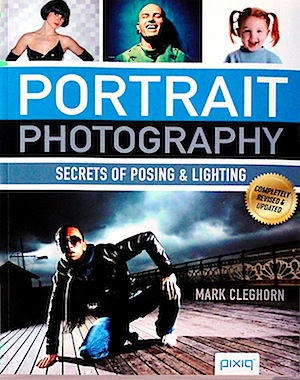
Portrait Photography: Secrets of Posing & Lighting [Book Review]

12 Mar

Portrait Photography.jpgPortrait photography, IMHO, is up there in degrees of difficulty with wildlife and sports/action photography … but at least, when faced with a tiger or a pole vaulter, you don’t have to face a possibly irate subject when you’ve finished the shot. Hopefully!
With portrait photography you not only have to face the sitter during and after the session but you also have to deal with that particular person if they’re also the client!

The book’s author Mark Cleghorn has been a pro photographer for over 30 years, specialising in ‘creative’ wedding and portrait photography. He is a member of a number of pro associations and has won a number of awards for his work as well as running many training workshops and seminars.

In Cleghorn’s view ‘Understanding the fundamentals of posing and lighting is crucial to successful portrait photography.’

You might also add the stricture — KISS! His own personal motto is ‘Natural light before reflector, reflector before flash, and flash as a last resort.’ He also suggests you should understand how to use and manipulate natural ambient light before you complicate things with technology …. Got me!

The chapter headings are informative:

  • So much equipment, so little money.
  • Poses and expressions.
  • Studio lighting made simple.
  • Creative lighting techniques.
  • On location.

First up, choosing a camera and lenses. The advice is that while a bulky, expensive medium format camera gives a better quality of image and delivers huge file sizes that are perfect for advertising, they are overkill for a simple portrait.

The DSLR is a preferable choice due to its comparatively reasonable cost, moderate size, along with access to a wide range of lenses and access to complete camera control.

This is followed by a rundown of the three types of flash available: accessory, shoe-mounted; power pack kits; monolights. Considerable detail is given on how to modify their flash output, the use of gels, metering, softboxes, reflectors, snoots and spotlights, diffusion, etc.

A key chapter covers posing and expression, which is where the human interface is at its most important and Cleghorn displays his extreme knowledge of the human figure and how to show it off at its best: ‘Every pose … starts with the feet, as it is the way in which the subject stands that determines whether or not he or she looks comfortable.’

His advice on how to photograph children is golden: keep things simple, allow the expressions to tell the story, work on the same level and, with very young children, encourage them to move around the studio, make it seem like a game.

And how to cope with problems like a subject’s bald head, spectacles, double chins, squinting and those who are obviously overweight, disabled subjects, those with ‘sleepy eyes’, big ears or noses and (with couples) differing heights. The advice is magic!

Moving on to lighting, there’s detailed discussion on how to place lights, control fill, hair and backlights and control their output. Low, mid and high key lighting is covered in considerable detail, with excellent examples shown.

Some off the wall techniques are demonstrated, like the projection of another image onto the subject, introducing a surreal effect. The use of a single light source and softlight are discussed as well as the role of the cross processing effect achievable in Photoshop.

Quite a few pages are given over to the searching for and use of suitable locations, natural exteriors and shooting in the home.

I often wonder, having read such a useful book, as to the sanity of such a high end and obviously successful photographer in this field in giving away such seriously useful hints, tips and advice.

This is the ‘go to’ book on the subject!

Author: M Cleghorn.
Publisher: pixiq.
Size: 28x22x1cm. 128 pages.
ISBN 978 1 4547 0243 6.
Price: get a price on Portrait Photography: Secrets of Posing & Lighting at Amazon (currently 36% off).

Post originally from: Digital Photography Tips.

Check out our more Photography Tips at Photography Tips for Beginners, Portrait Photography Tips and Wedding Photography Tips.

Portrait Photography: Secrets of Posing & Lighting [Book Review]


Digital Photography School

 
Comments Off on Portrait Photography: Secrets of Posing & Lighting [Book Review]

Posted in Photography


Using Gobos To Create Dramatic Lighting

25 Feb

When lighting a subject, one of the things you want to try to do is create drama, or a context, using the light. This often means modifying your light source. One of the easiest ways to modify your flash to create a context, or drama, is to use a gobo.

In this shot, the gobo was used on the background light, to create the illusion of light shining through window blinds. The off camera flash was a Canon 580 EX II, with the gobo positioned in front of it. The light on the model was a 580 EX II in a Westcott 18x42 strip box.

In this shot, the gobo was used on the background light, to create the illusion of light shining through window blinds. The off camera flash was a Canon 580 EX II, with the gobo positioned in front of it. The light on the model was a 580 EX II in a Westcott 18×42 strip box.

Gobos are templates that go in front of your light source (“Goes Between” your light source and the subject)  that have patterns cut out that control the shape of the light.  They can help add mood, create the idea of a setting or context, and add interest.

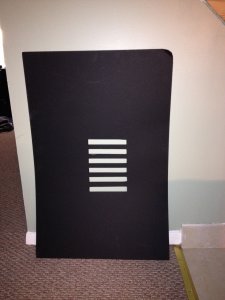
This is my homemade "windowblinds" gobo.  It's probably a bit larger than it needs to be, but this helps ensure that it blocks out any unwanted stray light. You want to use flat black oak tag or mat board, as the black minimizes any reflecting light.  Using a lighter colored material would reflect light that may not be wanted in the image.

This is my homemade “windowblinds” gobo. It’s probably a bit larger (about 20×30) than it needs to be, but this helps ensure that it blocks out any unwanted stray light. You want to use flat black oak tag or mat board, as the black minimizes any reflecting light. Using a lighter colored material would reflect light that may not be wanted in the image.

Gobos can be purchased, but often times, the available patterns may not fit your need.  In addition, they are relatively easy to make yourself and thus customize as needed.

Simply go to the nearest arts and crafts store, choose a piece of black oak tag, and a razor blade or exacto knife, and cut the desired pattern out.  The pattern doesn’t need to be too large, keep in mind how large the flash beam is going to be at the point that it hits the gobo. 

You may need to experiment a bit with the size and distance before getting the desired effect.

I will place the flash on a light stand, and then simply use a second light stand and use an A-clamp or two to hold the gobo in place.  This way I can experiment easily with how far the gobo should be from the flash, and how far from the subject or background.  A magic arm attached the light stand holding the flash will also work for holding the gobo.

For the accompanying photos, I wanted to create a night time mood, light projecting through the window blinds onto the wall from a street lamp.  So I simply took the piece of black oak tag and cut a series of rectangles in it. When projecting flash through it, it resembles light shining through window blinds.

There are myriad other patterns that could be used to create various moods and effects.  Play around and see what you come up with!

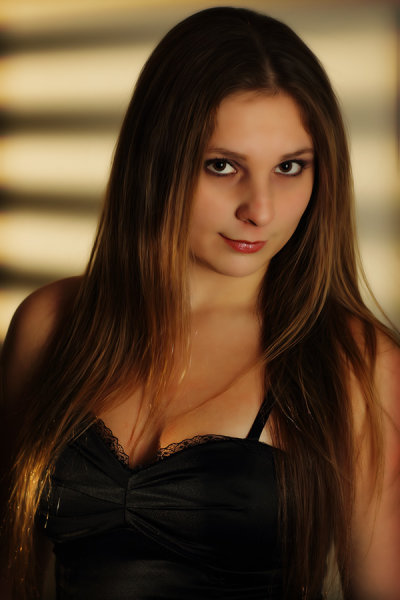
You can also use the gobo to modify light projected onto your main subject. In this instance, it creates an air of mystery about the subject.

You can also use the gobo to modify light projected onto your main subject. In this instance, it creates an air of mystery about the subject.

Post originally from: Digital Photography Tips.

Check out our more Photography Tips at Photography Tips for Beginners, Portrait Photography Tips and Wedding Photography Tips.

Using Gobos To Create Dramatic Lighting


Digital Photography School

 
Comments Off on Using Gobos To Create Dramatic Lighting

Posted in Photography


One Light – Butterfly Lighting

11 Feb

How to setup simple butterfly lighting.


Photography Tips from David Hobby for Exceptional Lighting

10 Feb

www.silberstudios.tv Join us for this behind the scenes interview with David Hobby,when we caught up with him on his FlashBus Tour with fellow master of light, Joe McNally.They were stopping off near Silber Studios on their 29 city, 6 week tour to teach America how to see the light!. David Hobby loves to teach photographers how to improve their control of light, including “how to use off-camera flash with your DSLR to take your photos to the next level. Or the next ten levels,” as he said. David gave use some important photography tips including why you need to get your flash off of your camera, how to use “China ball lighting” for very soft lighting and the “secret setting on the Nikon SB 800, and a lot more, including some inside stories. Grab your flash, and step on board the FlashBus as we talk with David Hobby. Read the transcript here http
Video Rating: 4 / 5


Studio Lighting with Zack Arias: 1:30 pm – Introduction & Philosophy of Studio Space

06 Feb

Full course available at creativelive.com Zack Arias leads a lively three day workshop on studio lighting featuring white seamless backdrops, stages, models, and bands with Q&A and critique rounds to fill it all out.


Trailer: Nikon School: A Hands-On Guide to Creative Lighting

04 Feb

Professional photographers Bob Krist and Joe McNally are featured in what is far-and-away the best resource to date on Nikon’s speedlight system and how to use CLS effectively. It starts with Krist in the studio teaching you the basics — and nuts-and-bolts control how-to’s — then goes out into the field. There, Bob takes on the roll as the color man to Joe’s lead as they work together to pull off a variety of sophisticated shots using Nikon speedlights. Congrats to Nikon for significantly dialing up the educational portion video as compared to the “Speed of Light” DVD of a few years ago. Yes, it is specific to the Nikon system and designed to help sell gear. But the educational content is there — they show everything you would need to know. (Uploaded with permission from Nikon.)
Video Rating: 4 / 5

[HD] Enjoy this release of some of our past and present clients of 2011! We have 1000’s of photos of our clients so we cant put them all in, but we will be releasing videos now and then showing some of our work, so you may be in the next one… stay tuned! BodyIllusions Tattoo Studio is the finest studio in the area with prices that cannot be challenged by any studio in the area… we don’t overprice our tattoos. Check out the others and their portfolios of their work, then come see us and you will see why more and more clients are coming in to get their next piece of eternal artwork on them with one of our experienced artists! We cover all types and styles of tattoos from blackwork, greywork, portraits to coverups and custom pieces. We will also tattoo your artwork and designs, just bring them in and talk to one of the artists at BodyIllusions Tattoo Studio 🙂 BodyIllusions Tattoo Studio also performs all types and styles of brandings, cuttings, scarification and of course every body piercing available with the most eperienced body piercer in the area with over 20+yrs of experience, so you can feel confident with our epert work and high success rate in healings. The cleanest studio around, check us out. Thanks to all the clients in the video, we appreciate the honor of you allowing us to create your piece of art. We look forward to seeing you again in 2012… Thanks for watching and subscribe if you want to be updated on our future video releases. Seasons Greetings
Video Rating: 4 / 5