RSS
 

Posts Tagged ‘Lenses’

Kubrick’s f/0.7 lenses now available for rent (but start saving up)

06 Aug

50mmf07.jpg

Legendary filmmaker Stanley Kubrick pushed the boundaries of moviemaking in many ways, and was responsible for some of the most enduring visuals in cinema. When he made Barry Lydon in 1975, Kubrick shot with two ultra-rare Carl Zeiss primes, which had originally been created for NASA. Using the 50mm and 35mm f/0.7 lenses, Kubrick was able to film some scenes purely by candlelight. Now, Germany-based company P+S Technik has announced that they’ve modified a PS-Cam X35 HD to be able to accept Kubrick’s primes, and the whole package is available to rent. Click through for more details. 

News: Digital Photography Review (dpreview.com)

 
Comments Off on Kubrick’s f/0.7 lenses now available for rent (but start saving up)

Posted in Uncategorized


Do the robot: ‘Locomotion lab’ uses Zeiss lenses to capture motion

06 Aug

Makro_Planar_Lauflabor_Bild01-622x417.jpg

Photographic pioneer Edward Muybridge was fascinated by motion, and today, scientists at the Locomotion Lab of the Friedrich Schiller University of Jena continue to use cameras to research how we walk. As well as looking at human and animal movements, they’ve also created ‘walking robots’, and are capturing their movement using high-speed cameras. According to Zeiss’s blog, the researchers are using the ZEISS Makro-Planar T* 2/50 ZF.2 lens attached to Vosskühler HCC-1000 cameras, which are capable of 923 fps, at 1024 x 512 pixel resolution. Click through for more details. 

News: Digital Photography Review (dpreview.com)

 
Comments Off on Do the robot: ‘Locomotion lab’ uses Zeiss lenses to capture motion

Posted in Uncategorized


Sigma US announces Mount Conversion Service for recent lenses

01 Aug

Sigma_logo.png

Sigma has announced a ‘Mount Conversion Service’ for any of its recent ‘Global Vision’ lenses – a paid-for service designed to reduce the uncertainty of changing camera systems. The company says it will charge between $ 80 and $ 250, plus shipping costs, depending on the specific lens. The Global Vision range currently includes seven lenses – from the huge 120-30mm F2.8 DG OS Sport for full-frame DSLRs, down to the 19mm F2.8 DN Art for Micro Four Thirds. The company has also extended the warranties on all new products to four years.

News: Digital Photography Review (dpreview.com)

 
Comments Off on Sigma US announces Mount Conversion Service for recent lenses

Posted in Uncategorized


Lomography seeks crowd funding for new production of Petzval lenses

26 Jul

Petzval.png

The people at Lomography have built a business around promoting and selling lo-fi cameras and accessories. What’s (really) old is new again in their latest Kickstarter campaign, an effort to bring the centuries-old Petzval lens back into production. The ‘New Petzval’ lenses look and function much like the originals with a brass exterior, and would be produced in both Canon EF- and Nikon F- mounts. Click through and read more about the project.

News: Digital Photography Review (dpreview.com)

 
Comments Off on Lomography seeks crowd funding for new production of Petzval lenses

Posted in Uncategorized


Lenses and Seeing

21 Jul

Lenses and Seeing article

The lens is the ‘eye’ of the camera. The selected focal length and aperture determine the look of the photo. The lens you are using may also have other characteristics that contribute to the look.

These influence your approach to composition. The idea is to work with the visual characteristics of the lens you are using rather than fight against them. Ask yourself how you can get the best out of the lens you are using.

To start, you will need to understand why a telephoto lens is different from a wide-angle, and how depth-of-field is affected by aperture choice and focal length.

Let’s look at some examples taken with lenses that I have owned:

Sigma 50-150mm f2.8 lens
Lenses and Seeing article

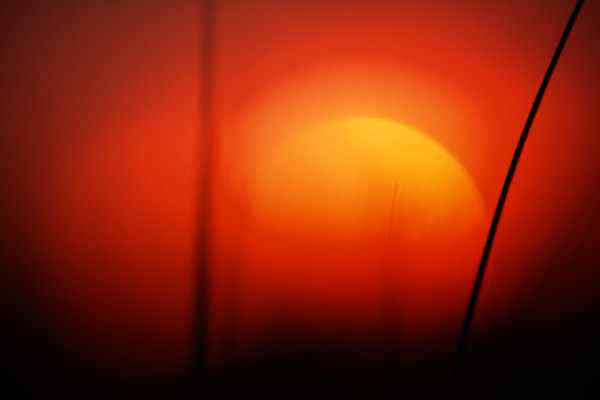
I created this image by setting the focal length of the lens to 150mm and the aperture to f2.8. I focused on the grass in the foreground to throw the setting sun out of focus. By the way, I didn’t look through the viewfinder at the setting sun. That’s potentially dangerous. I used Live View to compose the image instead.

This is how the lens and aperture choice affected the photo:

Narrow depth-of-field: The combination of wide aperture, long focal length and close focusing means the depth-of-field is extremely shallow. Anything other than the blade of grass I focused on is out of focus, including the setting sun.

Compression: The long focal length appears to compress perspective, making the sun look bigger and closer to the foreground than it really is.

Narrow field-of-view: The telephoto lens has a narrow field-of-view and captures just part of the subject. This focal length is good for capturing detail, but not for including the entire scene.

Canon 18-55mm f3.5-5.6 kit lens
Lenses and Seeing article

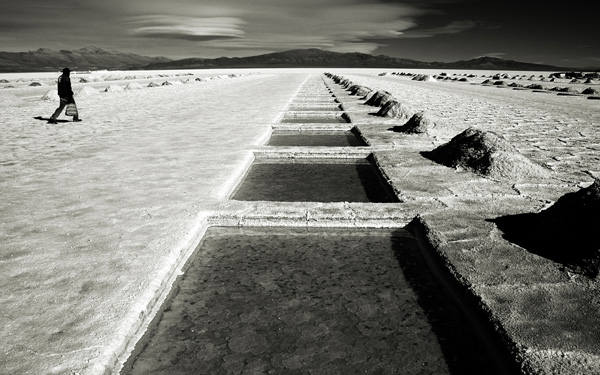
I set the focal length of the lens to 18mm, its widest setting, and the aperture to f11 when I made this image. These are the effects:

Depth-of-field: The small aperture was required because of the bright sun, but it also ensures that the entire scene is in focus. Every detail has been captured by the camera.

Perspective: I was drawn to this scene by the holes cut in the salt, and the lines created as they disappear into the distance towards the mountains. The focal length emphasises the lines and pushes the horizon into the distance, making it seem further away than it really is.

Wide field-of-view: The 18mm focal length has a wide field-of-view, which enabled me to capture the entire scene.

In many ways the focal lengths used to create the photos above are opposites. The telephoto lens brings the subject closer. Only part of the scene is in focus thanks to the wide aperture.

The wide-angle end of the kit lens, on the other hand, captures the entire scene and creates a sense of space by making the horizon seem further away that it really is. A narrow aperture ensures everything is in focus.

Canon 85mm f1.8 lens

Here’s a portrait taken with another of my favourite lens, an 85mm prime set to f2.8:

Lenses and Seeing article

Depth-of-field: My model is in focus, and so is part of the background. There is more depth-of-field than there is in the photo taken with the 50-150mm lens set to 150mm. And there is less than in the photo taken with the wide-angle lens.

Perspective: The 85mm lens is a short telephoto lens and it records perspective accordingly. Again, it falls somewhere in-between the 150mm and 18mm focal lengths. Like the telephoto lens the 85mm lens is good for capturing details. You cannot capture as much of the scene as you can with a wide-angle.

Holga lens

Finally, I’d like to show you a photo taken with a Holga lens. You can buy these plastic lenses for digital cameras from Holga Direct. This really is a good example of how the lens determines the look of the photo:

Lenses and Seeing article

Holga lenses have the following characteristics:

Lack of sharpness: A Holga lens is made from plastic and is not intended to give a good quality image.

Vignetting: Photos taken with this lens are characterised by heavy vignetting at the edges.

Conclusion

Hopefully the examples in this article have drawn your attention to how the focal length of the lens you are using and the aperture affect the look of the photo. The lens is the camera’s eye, and the characteristics of the focal lens you choose determine the look of the photo. With practise, you will learn to make the best use of your lenses.

Mastering Photography
Lenses and Seeing article

My latest ebook, Mastering Photography: A Beginner’s Guide to Using Digital Cameras introduces you to digital photography and helps you make the most out of your digital camera. It covers concepts such as lighting and composition as well as the camera settings you need to master to take creative photos like the ones in this article.

Post originally from: Digital Photography Tips.

Check out our more Photography Tips at Photography Tips for Beginners, Portrait Photography Tips and Wedding Photography Tips.

Lenses and Seeing


Digital Photography School

 
Comments Off on Lenses and Seeing

Posted in Photography


Nikon updates distortion correction data for DSLRs, adding latest lenses

20 Jul

AFS_Nikkor_18_35_ED.png

Nikon has released distortion correction data v1.009, adding support for additional lenses for the D4, D90, D600, D800, D800E, D3100, D3200, D5000, D5100, D5200, D7000 and D7100. The latest update means these cameras can now correct distortion in 107 Nikkor lenses. The latest update includes recent launches such as the Nikon AF-S Nikkor 18-35mm f/3.5-4.5G ED and can be downloaded from Nikon’s global website.

News: Digital Photography Review (dpreview.com)

 
Comments Off on Nikon updates distortion correction data for DSLRs, adding latest lenses

Posted in Uncategorized


DxOMark investigates lenses for Canon EOS 6D, and Sigma 30mm F1.4

19 Jul

DxOMark-logo-520.jpg

Our friends and collaborators over at DxOMark have been investigating lenses for the Canon EOS 6D, and have tested no fewer than 95 lenses from Canon, Samyang, Sigma, Tamron, Tokina and Zeiss to see which score highest. The results are presented in a multipart article, that also compares the EOS 6D results to those from the EOS 5D Mark III and the Nikon D600. Meanwhile for APS-C SLR users, this week DxOMark also reviewed two fast lenses from Sigma, the 30mm F1.4 DC HSM and (in case you missed it earlier this week) the 18-35mm F1.8 DC HSM. Click through for the links.  

News: Digital Photography Review (dpreview.com)

 
Comments Off on DxOMark investigates lenses for Canon EOS 6D, and Sigma 30mm F1.4

Posted in Uncategorized


Going Fishing! Fun With Fisheye Lenses

12 Jul
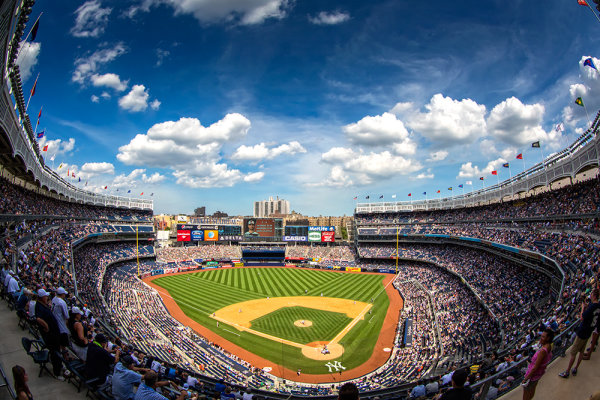
On a recent outing to Yankee Stadium, the only lens I had on my 5D Mark III was the Canon 8-15mm fisheye zoom. I love a fisheye for a situation like this- great foreground, great sky, and an obvious subject.  Most fans go to the game hoping to zoom in on their favorite player. Knowing I would never be close enough, I went the other direction and wanted to get everything.

On a recent outing to Yankee Stadium, the only lens I had on my 5D Mark III was the Canon 8-15mm fisheye zoom. I love a fisheye for a situation like this- great foreground, great sky, and an obvious subject. Most fans go to the game hoping to zoom in on their favorite player. Knowing I would never be close enough, I went the other direction and wanted to get everything.

I used to think I’d never want to shoot with a fisheye lens.  My objections were the same as most others who’ve ever shot with one: “All the shots end up looking the same,” or “there’s too much distortion.”   Then I actually got to use one. And my first results were much as I expected- too much distortion, and a lot of shots that all looked the same.  But the more I started working with it, the more I fell in love with using the fisheye.  It’s a lot more versatile than I gave it credit for.

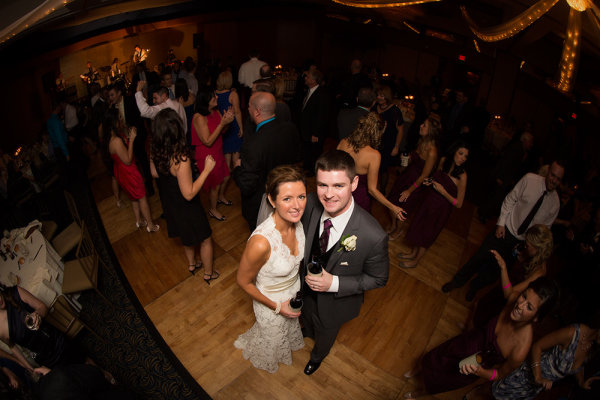
A fisheye lens has become a staple in my bag for shooting weddings. I've found it useful in the church for taking an overall scene, as well as on the dance floor for shots like this, of the bride and groom surrounded by their guests. Simply pop the flash at the same time and put them in the spotlight.

A fisheye lens has become a staple in my bag for shooting weddings. I’ve found it useful in the church for taking an overall scene, as well as on the dance floor for shots like this, of the bride and groom surrounded by their guests. Simply pop the flash at the same time and put them in the spotlight.

St. Patrick's Cathedral in New York City is a prime place to shoot with a fisheye. It can get crowded, and the shooting area can be tight.  In addition, the architecture is incredible, so emphasizing those lines with the extreme wide angel makes a lot of sense. EOS 60D with EF 8-15mm Fisheye zoom.

St. Patrick’s Cathedral in New York City is a prime place to shoot with a fisheye. It can get crowded, and the shooting area can be tight. In addition, the architecture is incredible, so emphasizing those lines with the extreme wide angel makes a lot of sense. EOS 60D with EF 8-15mm Fisheye zoom.

I’ve found fisheye lenses to be useful in many situations. The secret to using a fisheye is to know it’s limitations, as well as it’s strengths, which is true for all lenses.  You can use them for portraits, but you need to be aware of subject placement in the frame, as well as how close you plan to get. The closer you get, the more caricature like the image will be. Stand back a bit, and don’t put your subject too close to the edge, and you can use the surroundings to put your subjects as the main focus.  Add a pop of the flash with the head zoomed slightly, and it will create a spotlit effect. I’ve found a fisheye is a great way to get a group shot without simply lining the subjects up.

Another great use for fisheyes- a fairly obvious one- is tight spaces.  You don’t always have room to step back, and you might want to include most of the scene in front of you in one shot. In many cases, that’s not possible without a fisheye.   You need to be prepared to deal with the inherent distortion, but that can be used creatively to really draw the viewers eye. Use the lines of the image, try an extreme point of view by getting the camera higher or lower.

Fisheyes are great for landscapes as well.  They emphasize the foreground and make it possible to include both foreground and sky.  Distortion is less of an issue here, unless the horizon is prominent. In that case, it’s essential to either embrace the distortion, or be sure to place the horizon in the center to minimize the distortion. If the horizon can be obscured, this point becomes moot.  I love to use fisheyes as the “anti-macro”.  I get close up to a flower, or even underneath them, placing them prominently in the frame.

Finally, architecture is an excellent use for a fisheye lens.  While it’s traditionally not used for architecture due to the distortion, the way a fisheye can emphasize the lines of a beautifully designed building opens it up to a variety of uses, especially interiors of large cavernous buildings like cathedrals and churches, or sports arenas.

I’m still finding new ways to use my fisheye lens.  What are yours?

By getting close to this daisy, it is easily emphasized in the foreground, while the other daisies just behind it get pushed back. EOS 5D Mark III with EF 8-15mm Fisheye Zoom

By getting close to this daisy, it is easily emphasized in the foreground, while the other daisies just behind it get pushed back. EOS 5D Mark III with EF 8-15mm Fisheye Zoom

Fisheyes are great for portraits of kids. The extreme wide angle emphasizes the expressions and movements, creating a cartoon-like effect. EOS 5D Mark III with EF 8-15mm Fisheye zoom.

Fisheyes are great for portraits of kids. The extreme wide angle emphasizes the expressions and movements, creating a cartoon-like effect. EOS 5D Mark III with EF 8-15mm Fisheye zoom.

Post originally from: Digital Photography Tips.

Check out our more Photography Tips at Photography Tips for Beginners, Portrait Photography Tips and Wedding Photography Tips.

Going Fishing! Fun With Fisheye Lenses


Digital Photography School

 
Comments Off on Going Fishing! Fun With Fisheye Lenses

Posted in Photography


DxOMark investigates Samsung NX cameras and lenses

12 Jul

DxOMark-logo-520.jpg

Our friends and collaborators over at DxOMark have been investigating Samsung’s NX system, and have recently published reviews of the NX210 and NX300 cameras, alongside an article covering how the company’s lenses measure up in comparison to those from the Sony NEX system. Other reviews on the site this week include lens tests on Nikon super-telephoto primes, an assessment of the Sony RX100 II’s new back-illuminated CMOS sensor, and the first installment of a multi-part article looking into which lenses score best on the Canon EOS 6D. Click through for the links.

News: Digital Photography Review (dpreview.com)

 
Comments Off on DxOMark investigates Samsung NX cameras and lenses

Posted in Uncategorized


DxOMark looks into lenses for the Sony SLT-A99

03 Jul

DxOMark-logo-520.jpg

Our friends and collaborators over at DxOMark have been looking into how lenses score on specific cameras, and their latest round-up takes a look at Sony’s 24MP full frame flagship, the SLT-A99. The article covers 22 lenses, including both current models from the likes of Sony, Sigma and Zeiss, and some older Konica Minolta optics. They’ve published a number of reviews of new Sony-mount lenses alongside, including the 300mm F2.8 G II SSM telephoto and the Tamron SP 24-70mm F2.8 Di USD, plus the ZEISS Touits for NEX cameras. Click through for the links.    

News: Digital Photography Review (dpreview.com)

 
Comments Off on DxOMark looks into lenses for the Sony SLT-A99

Posted in Uncategorized