RSS
 

Posts Tagged ‘Lenses’

PPE 2014: Sneak peak at forthcoming Olympus ‘PRO’ lenses

02 Nov

When Olympus announced the high-end OM-D E-M1, it promised that it would be making a wideangle zoom and super-telephoto prime in its matching ‘PRO’ line of lenses. The M.Zuiko Digital ED 7-14mm 1:2.8 PRO shares many design features with the current 12-40mm 1:2.8 PRO, while the M.Zuiko Digital ED 300mm 1:4 PRO offers a 600mm equivalent angle of view. We got our hands on some pre-production samples at this year’s Photo Plus Expo in New York. Click through for pictures

Articles: Digital Photography Review (dpreview.com)

 
Comments Off on PPE 2014: Sneak peak at forthcoming Olympus ‘PRO’ lenses

Posted in Uncategorized


Sigma updates USB dock for new lenses

14 Oct

Lens manufacturer Sigma has issued an update to the firmware of its USB dock to make it compatible with the new 150-600mm f/5.6-6.3 DG OS HSM S and 18-300mm f/3.5-6.3DC Macro OS HSM lenses. Although these lenses are available in Sigma, Canon and Nikon mounts, the update for the USB dock does not yet cover these lenses in the Nikon fit, and Sigma hasn’t indicated when it will. Read more

Articles: Digital Photography Review (dpreview.com)

 
Comments Off on Sigma updates USB dock for new lenses

Posted in Uncategorized


Change Lenses for a New Perspective and Story

12 Oct

Recently we’ve had a few articles by dPS writers about lenses on such topics as:

  • Which Three Lenses do You Need for Photography?
  • The Only Three Lenses You Need for Travel Photography
  • Ready to Upgrade Your Kit Lens? Tips for Which Lens to Invest in Next
  • Buyers Guide – Prime Lenses vs Zoom Lenses

change-lenses-new-storyThis video produced by Canon shows the photographers using pretty much the same three lenses as mentioned on the second article above: a really wide-angle lens, a 50mm, and a medium telephoto. See how the photographers used each lens to create a very different look and feel from each of the scenarios they encountered.

The lenses mentioned in the video are (Nikon equivalents also listed):

  • Canon EF 10-18mm f/4.5-5.6
  • Nikon 10-24mm f/3.5-4.5G
  • Canon EF 50mm f/1.4
  • Nikon 50mm f/1.4G AF-S
  • Canon EF 70-200 f/2.8L IS
  • Nikon 70-200mm f/2.8G AF-S

There are also many other great options for lenses including Pentax, Olympus and Sony. You could also consider some of the third party brands like Tamron and Sigma which are making some really  nice, highly rated, lenses.

What can you take away from that? How can you use the lenses you already have to tell different, or perhaps even better, stories?

Show us the same subject shot with three different lenses and let’s see your stories!

The post Change Lenses for a New Perspective and Story by Darlene Hildebrandt appeared first on Digital Photography School.


Digital Photography School

 
Comments Off on Change Lenses for a New Perspective and Story

Posted in Photography


Why Prime Lenses are Better Than Zooms

07 Oct
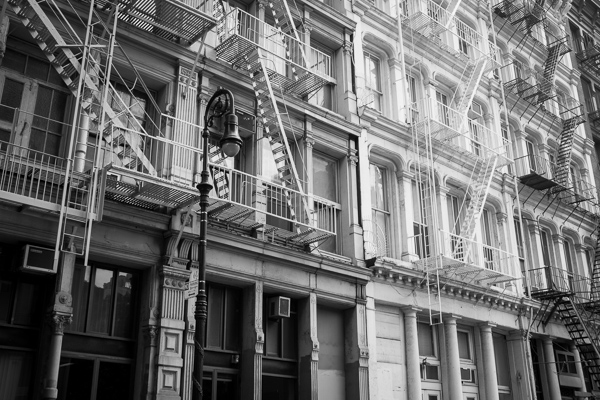
35mm - SoHo Fire Escapes.

35mm – SoHo Fire Escapes, NYC

How heavy is your camera?

If you have an SLR with a zoom lens attached, the answer is pretty damn heavy. A large SLR body, such as a Canon or Nikon with a 24-105mm lens attached feels like a tank; forget the 70-200mm.

Of course there are many situations when using a zoom lens is ideal. However, I’m hoping to try and convince you to ditch the zoom lens for a prime.

But what if I need the zoom? What if I don’t have the perfect focal length? – I have heard those questions more times than I can count. A wise photographer once told me that you will get the same amount of good shots no matter what lens and camera you use; they will just be different. Zoom lenses can be just as limiting as prime lenses, and prime lenses can be much more freeing than zoom lenses.

By walking out the door with a single prime lens, you are limiting yourself. There are certain shots that you will not be able to capture, that is a fact. However, the benefits can far outweigh that single negative. Prime lenses cause you to take more time to compose your shot, since will you need to zoom with your feet. This can make you think more critically about your composition. A prime lens will free you up to focus on the subjects in the range that the prime lens works best at. You will become much better at finding things within that range and your work will be more consistent because of these limitations. A prime lens makes you think in a certain way, since it is tougher to use. The limitation ends up being an advantage in the long run.

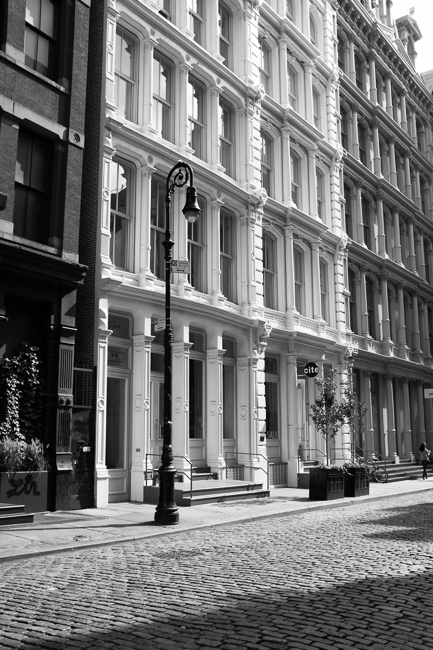
35mm - Cast Iron Building, SoHo

35mm – Cast Iron Building, SoHo NYC

Think about how many famous photographers throughout history used prime lenses.

Prime lenses are lighter. They make your camera more fun to take out. You don’t need a heavy camera bag and you will be able to walk further, explore more, and capture more images. You will have a bounce in your step that you didn’t before. You will be able to bring your camera with you on a daily basis. That will more than make up for missing out on a few shots that a zoom lens could capture. Photography will become more fun! It will become more of an element of your everyday life, versus something that takes planning to do.

After awhile you will learn to see specifically in that focal length, and this is where things really click. It will almost feel like the camera isn’t there. You will be faster and more intuitive as a photographer. This is all because you ditched the zoom in favor of the more limited prime lens.

Oh, and did I mention that prime lenses are cheaper than zooms? Any money that you will spend purchasing a new prime lens will be saved in medical bills from your neck and back eventually giving out from the weight of that gigantic zoom lens that you use now.

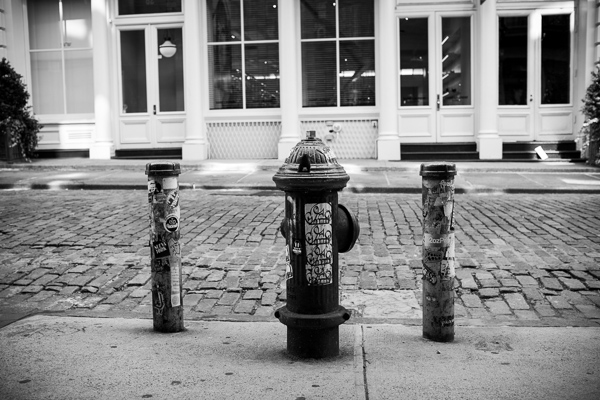
35mm - Fire Hydrant, SoHo

35mm – Fire Hydrant, SoHo NYC

So what focal length should you choose? I prefer a 35mm lens (on a full frame). It is just wide enough to work well anywhere but not too wide. Other common focal lengths are 28mm, 50mm, and 85mm (which is a fantastic focal length for portraits). Rent a few lenses and try them to see what you like best.

After a few days of using a prime you may realize that the real limitation was with your zoom lens.

The post Why Prime Lenses are Better Than Zooms by James Maher appeared first on Digital Photography School.


Digital Photography School

 
Comments Off on Why Prime Lenses are Better Than Zooms

Posted in Photography


DynaOptics wants to bring zoom lenses to smartphones

01 Oct

Camera modules in smartphones have rapidly improved over the past few years, but on the whole their lack of optical zoom is still a major limitation. Traditional zoom lens designs are generally too bulky for increasingly slim mobile devices, so tech startup DynaOptics is introducing something a bit different. Read more

Articles: Digital Photography Review (dpreview.com)

 
Comments Off on DynaOptics wants to bring zoom lenses to smartphones

Posted in Uncategorized


Sony shows off upcoming full-frame lenses at Photokina

25 Sep

We were so busy playing with new Leica cameras and giant telephoto lenses at Photokina that we totally missed Sony’s announcement of four upcoming full-frame E-mount lenses. Four FE lenses are coming in the first quarter of 2015, including three primes and one zoom. Sony didn’t reveal too much, but you still get the idea by reading this.

Articles: Digital Photography Review (dpreview.com)

 
Comments Off on Sony shows off upcoming full-frame lenses at Photokina

Posted in Uncategorized


Photokina 2014: Sony interview – ‘we still need to create more lenses’

24 Sep

At Photokina last week we sat down with Shigeki Ishizuka, the global head of Sony’s Imaging Business. As well as talking us through Sony’s current Alpha strategy, Ishizuka-san also explained why the name ‘NEX’ was dropped and told us a little about how Sony’s sensor business works. Click through for the full interview

Articles: Digital Photography Review (dpreview.com)

 
Comments Off on Photokina 2014: Sony interview – ‘we still need to create more lenses’

Posted in Uncategorized


Photokina 2014: Sneak peek at upcoming Fujifilm XF lenses

20 Sep

Fujifilm announced two cameras on the runup to Photokina – the X100T and X30. But the company is also showing off mockups of several new lenses, slated for release next year. We sat down with senior executives from Fujifilm earlier today, and got our hands on the samples. Click through to take a look at what’s in store.

Articles: Digital Photography Review (dpreview.com)

 
Comments Off on Photokina 2014: Sneak peek at upcoming Fujifilm XF lenses

Posted in Uncategorized


Photokina 2014: Hands on with new Tamron lenses – including 15-30mm F2.8

19 Sep

We caught up with Tamron at Photokina 2014 to get a peek at the new 15-30mm F2.8 ultra-wide angle zoom. It’s designed to cover a full frame sensor and was shown to us in a late prototype form, though its official launch date is unconfirmed. We also got some hands-on time with the manufacturer’s latest all-in-one zoom lenses as well as the always-impressively-huge 150-600mm F5-6.3. Read more

Articles: Digital Photography Review (dpreview.com)

 
Comments Off on Photokina 2014: Hands on with new Tamron lenses – including 15-30mm F2.8

Posted in Uncategorized


Choosing Lenses

03 Sep

If you date your cameras, you marry your lenses. That’s because, unlike digital cameras, a well-chosen lens can serve you for a very long time.

I still have one lens that I bought thirty two years ago. And I bought it used. I doubt that will be the case with any of my digital cameras, ever.

In the past, I was a lens speed freak and was willing to spend great sums of money to have very fast glass. I now realize that lust was misplaced. If I had it to do over again (and I do, and have) I would lean more on reasonably fast primes and here’s why.

Moderately fast primes are (much) lighter, (much) cheaper and often just as sharp (or sharper) than their speedy siblings. For Nikon shooters, the Nikon 28, 50 and 85 f/1.8 trio of lenses are great examples of this. They weigh next to nothing in my bag and offer great performance. Also, I have moved away from primarily using fast zooms. Rather than a fast 24-70/2.8, I’d now opt for a trio of fast-ish primes and a decent, slower zoom to back them up.

This way, you get a stop (plus) faster at each focal length, backups throughout the 24-70mm range and you lose the most daunting aspect of the speed zoom: an expensive single point of failure.

In general, remember this when it comes to ultra-fast DSLR lenses: you pay through the nose for them when you buy them. And then you pay again, in weight, every time you lug them around. Remember that cameras have amazing high-ISO performance these days. And they are just going to get better as we go.

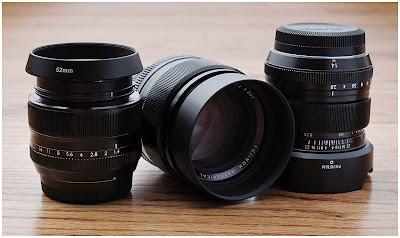
As for my Fuji lenses, it is pretty hard to go wrong with their primes (although I’m not a huge fan of the 60mm macro…) But the others are small, gorgeous and fast. I love the built-in 23mm (35 equiv.) of the X100s. It’s sharp wide open and it has beautiful flare when you point it right into the sun as seen above. It’s my most-used lens. Which is a good thing, given that it’s welded to x100s.

Along with that, the 35/1.4 (50mm equiv., seen at top on left) and 14/2.8 (21mm equiv., on right) are my go-to lenses on the interchangeable lens Fuji bodies. If I am shooting tight headshots, maybe the 56/1.2 in the middle.

As a backup, I like the 18-55 kit zoom (not shown). Which, although not a speed lens at f/2.8->f/4, is great optically and has stabilization.

Good performance from a kit lens (the zoom that often comes packaged with a camera) is not a given, as many of them are crap. If you are using a kit zoom as your main lens, know that it will be be sharpest near the middle of the aperture scale—let’s say around f/8. In fact, most lenses are great at f/8.

If you like to hang out close to wide open, grab a (used, if necessary) prime at your most-used focal length. You’ll be a happy camper—and have a backup if needed.
__________

What to buy? And when? That should be driven by what/how you shoot.

Here’s my thinking on lens progression, driven by how I shoot. Most of the time I am going to go out with a single, prime lens. I like the size, the weight, the speed and sharpness. Actually, I also like the discipline of having a single focal length. It helps me to see better.

With a new system I’d build out my wide/normal/short-tele primes, then get a decent wide- to short-tele zoom as a backup or for times when I would want one-lens variability. Only then do I start going for more exotic lengths if needed.

The reason is simple: most of my work will be done with the bread-and-butter focal lengths of moderate wide to short tele. So I want good quality, speed and backup in those lengths before I start to get crazy with a superwide or whatever.

You can easily try out a lens for no risk. Buy a good example used, from someone with a good return policy. If the lens is a dog, return it immediately. If it is good enough to where you want to keep it and play, you can always resell the used lens for about what you paid for it within a year or two.

So, very little risk. (In fact, if I was going to need to rent a lens for more than a week I’d do it this way. Your rental would be practically free.

And obviously, if you love a lens and decide to marry it and keep it forever that’s best possible case.

NEXT: Lights

Strobist

 
Comments Off on Choosing Lenses

Posted in Photography