RSS
 

Posts Tagged ‘Lens’

What the Numbers on your Lens Mean

10 Jun

Some things seems pretty straight forward and like they’re common knowledge, but I’ve run into this a few times with my students that feel embarrassed to ask what all the numbers on the lens mean. There is no reason to feel stupid or embarrassed if you don’t know this, it is sometimes confusing. So I’m going to run through them one by one.

Common settings seen on newer digital lenses

FOCAL LENGTH

If you have a zoom lens you will have a ring that turns to zoom in and out and it will also indicate what focal length you are currently set to. For example of your lens is a 70-200mm like mine you may see this which indicates I’m at 100mm currently.

focal-length-600px

If you are using a prime or fixed lens you won’t have a zoom ring, it will simply indicate the focal length on the lens barrell, as you see on my 85mm lens below.
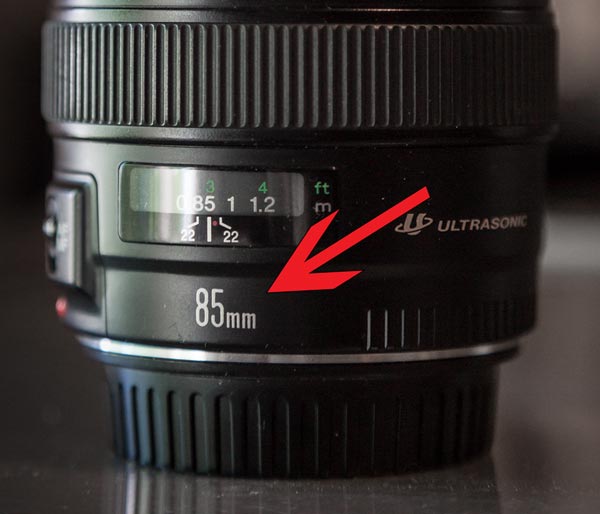
focal-length85mm-600px

MAXIMUM APERTURE

The maximum aperture is the largest opening (the smallest number) on the aperture scale that your lens is capable of opening to.  Larger apertures like f2.8 or even f1.8 are highly desirable because they let in more light and allow you to shoot in low light conditions without getting camera shake.  (for more on that read 5 Tips for getting sharper images or Why the 50mm lens is your new best friend) This will vary from lens to lens and you may actually see a range of numbers such as 3.5-6.3.

You can usually find this information in one of two places on your lens, or perhaps even in both places:

  1. right on the end of the lens barrel on the edge
  2. on the front of the lens inside the filter ring area.

In the example below you can see two different lenses.  My Tamron 17-35mm (notice the focal length range is shown there also) and my 85mm. On the Tamron you see “1:2.8-4″ and on the 85mm you see “1:1.8″.   What that means is that the maximum aperture on the 85mm lens is f1.8, but on the Tamron zoom it changes from f2.8 to f4 as you zoom the lens.  At the lenses widest, 17mm, I can open the aperture to f2.8, but if I zoom all the way in to 35mm now my maximum aperture is only f4. This is pretty common with kit lenses and ones that have a large focal length range such as 28-300mm or 18-200mm.
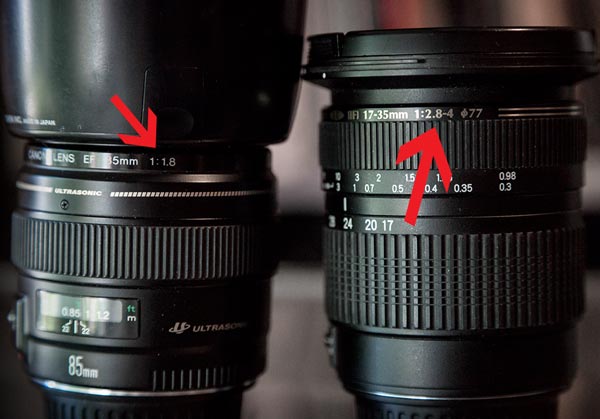
maximum-aperture-600px

FOCUSING RANGE AND DISTANCE SCALE

Some lenses, not all digital ones have this now, you will see a range of distances – usually marked in two scales, feet and meters. Look for the infinity symbol at one end, the other end will show how close your lens can focus, or its minimum focusing distance. Some lenses have built in MACRO settings which allow you to get a bit closer. They aren’t a true macro and you can’t get in super close but it’s a handy thing to have if you want to get closer without the expense and weight of an extra lens.

In the two lenses below you can see the scale on the Tamron (on the right) is in the outside of the lens and on the Canon 70-200 you can see it inside under a cover. Both will move if you manually focus your lens (**note: please remember to turn off auto focus if you do this because turning the focusing ring while autofocus is on can damage the gears and mechanisms inside your lens**)
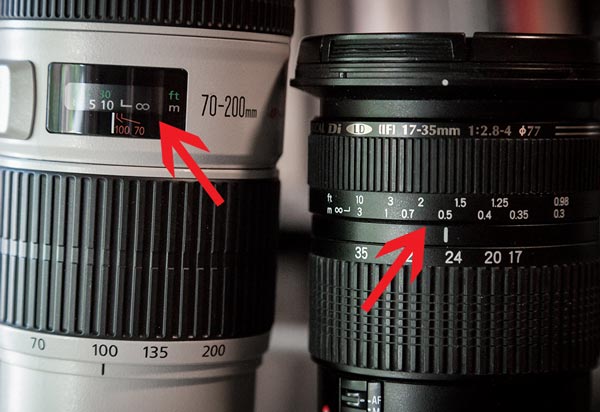
focus-ring-distance-600px

FILTER SIZE OR LENS DIAMETER

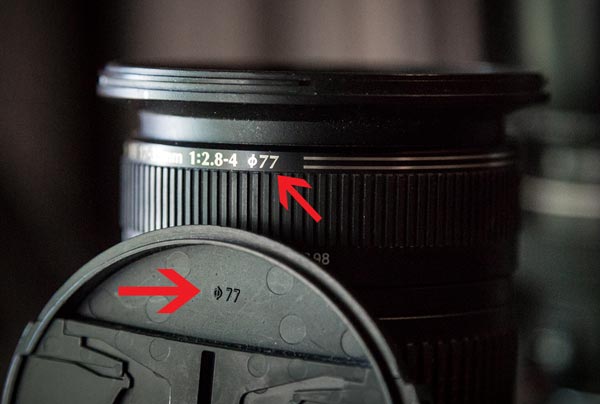
Also on the end of your lens you may see a funny symbol that looks like a zero with a strike through it, then a number.  That indicates the diameter of the front of your lens or the size of filter required to fit on it. You can also find that same number on the back side the lens cap, see below – for this lens it is 77mm. Handy to know if you want to go to the camera store to buy a filter, or you’re buying something online.
filter-size-600px

Less common settings often seen on older manual focus lenses

APERTURE RING

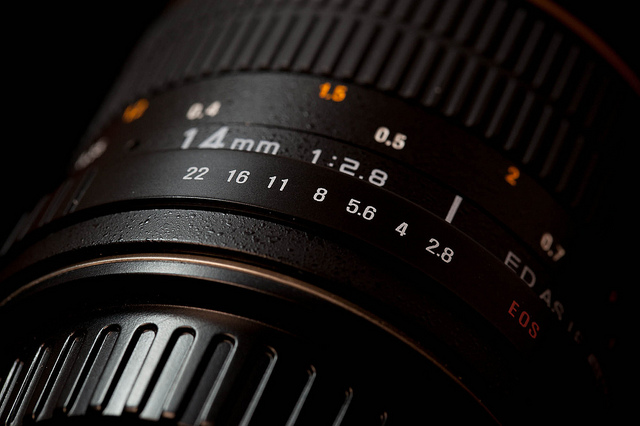
This is one that you may or may not have on your lens, most newer digital lens do not have this as the aperture is set and controlled by the camera body now. Back in the days of film and manual focus lenses, the shutter speed was set on the camera and the aperture was set on the lens. You can pick up some great deals on older film lenses for specialty uses like macro, or fixed lenses with large apertures often for a fraction of the price of a new digital lens (you just need to get a special mount adapter ring to attach them to your camera). Just be aware that they will be manual focus and some of them you have to set the aperture on the actual lens itself. If you have one of these it may look something like either of the ones below:
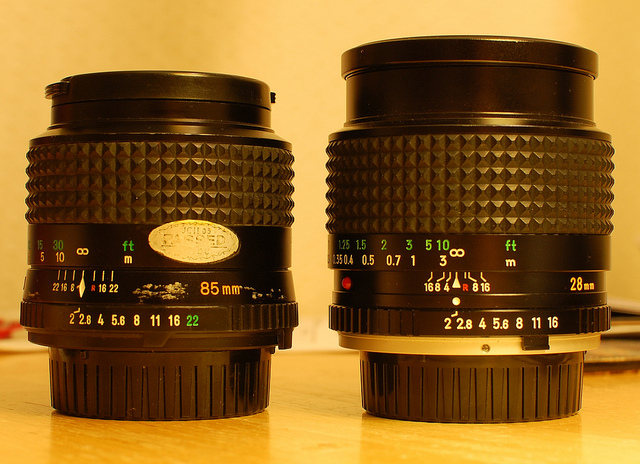
6849853919_313cb31dae_z

Photo by Alvin Trusty

aperture ring example

Photo by Andrew Sales

HYPER-FOCAL DISTANCE SCALE

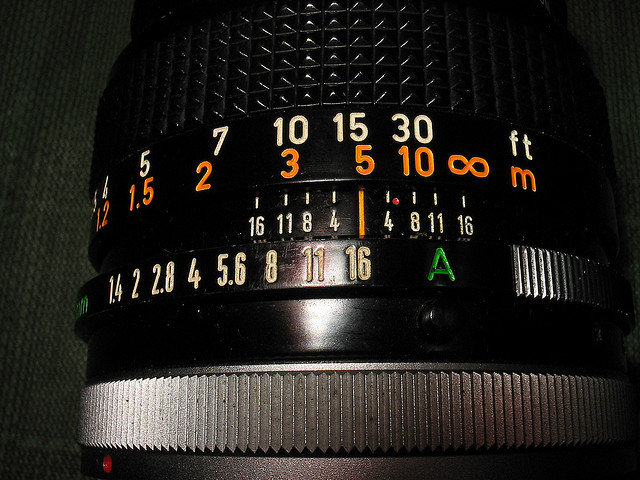
This is a bit of a trickier one to find and explain. If you have all zoom lenses, you will not find this on your lens. If you have a prime lens, especially an older model you may see an extra ring of numbers on your lens such as in the image below (the numbers in the middle radiating out from the central orange line).
1782641653_5e7c6f2280_z

Photo by Bob Usselman

The numbers on the lens above represent (in order from top to bottom ring)

  • the distance scale
  • the hyperfocal distance scale
  • the aperture ring that actually sets the lens aperture

You use the hyperfocal distance scale to know which parts of your image will be in focus at different aperture settings. Notice the lens above is set to f16 and it is focused at 5m (15 ft). Now look at the middle scale and go to f16 on the left side of the orange line – that is indicating the closest point that will be sharp when focused at that distance, using that aperture – in this case it looks like about 2.75m (approx. 9ft). Now look at the f16 on the right of the orange line and you see it’s at infinity. So what we can tell from this is that at f16 we can get from about 9ft to infinity in focus, but the trick is to focus in the right spot.

Using the hyperfocal distance scale you’d actually put the infinity mark at the f16 mark on the right and that will give you the most depth of field possible at f16 (notice you don’t actually focus ON something, you set it on the lens by the numbers).  Note:  if you focused on infinity you’d only get from about 15ft to infinity in focus (estimating here) or if you focused at 7ft you would not get infinity sharp.  There’s a bit more to it than that but if you pick up a lens that has such a ring – do some research on how to use it and you’ll get a lot more of out of your small apertures.

If you’re curious what the little red dot means, that’s the infrared focusing mark. When shooting with infrared film you actually had to focus at a different place  than normal because the infrared spectrum of light is different than what we see with our eyes.  I used to shoot infrared film now and then, fun stuff, but tricky to handle, focus and you need to know what you’re doing with it.  There’s now ways to replicate fairly closely that same look digitally, even though now and again I think about shooting some film.

That’s it for lens numbers (I hope!) if I missed anything let me know.  Share a photo of your lens and any numbers you can’t decipher and if I don’t know what it means I can try and find out for you, or maybe someone else can help out in the comments section.

Post originally from: Digital Photography Tips.

Check out our more Photography Tips at Photography Tips for Beginners, Portrait Photography Tips and Wedding Photography Tips.

What the Numbers on your Lens Mean


Digital Photography School

 
Comments Off on What the Numbers on your Lens Mean

Posted in Photography


Tokina offers US pricing for AT-X 12-28 F4 lens

07 Jun

tokina_12_28dx_270.png

Tokina has announced a US price of $ 599 for its AT-X 12-28 F4 lens. Soon to be available in both Canon and Nikon mounts for APS-C bodies, this lens was announced at the CP+ tradeshow back in January and will replace the company’s existing 12-24mm F4 wideangle zoom for APS-C cameras. 

News: Digital Photography Review (dpreview.com)

 
Comments Off on Tokina offers US pricing for AT-X 12-28 F4 lens

Posted in Uncategorized


Canon patent describes novel liquid lens design

01 Jun

canonliquid3.jpg

Another interesting patent has been discovered by Japanese blogger Egami, which shows a new method devised by Canon to adjust the shape of meniscus lens that seems different from the more straightforward method used by competitors. Canon’s method uses the same ‘electrowetting’ principle as existing designs but does so to create a series of pumps, allowing faster and more precise control over the resultant lens.

News: Digital Photography Review (dpreview.com)

 
Comments Off on Canon patent describes novel liquid lens design

Posted in Uncategorized


Lens reviews update: DxOMark data for 400mm telezooms compared

29 May

lensreview-thingsmall1.png

DxOMark has tested two recently-announced announced long telezooms, the Sony 70-400mm F4-5.6 G SSM II and the Nikon AF-S Nikkor 80-400mm f/4.5-5.6G ED VR, as well as the older AF Nikkor 80-400mm f/4.5-5.6D ED VR. As part of our ongoing collaboration we’ve added the test data to our lens comparison widget, and to add a little more context we’ve also included a couple of super-tele primes from Canon. Click through to see how these lenses compare, with links to view the results in our lens widget, and for the full data on DxOMark.

News: Digital Photography Review (dpreview.com)

 
Comments Off on Lens reviews update: DxOMark data for 400mm telezooms compared

Posted in Uncategorized


Canon announces production of 90 millionth EF lens

29 May

canon-ef-90mil.jpg

Canon has announced that it has now produced 90 million EF lenses since the launch of the EOS system in 1987. The proliferation of digital SLRs has seen a rapid increase in lens production in recent years, and the company’s 90 millionth lens – an EF 24-70mm f/2.8L II USM – was manufactured on May 23 2013, just over 9 months after its 80 millionth. The company’s lens lineup currently consists of no fewer than 84 models, ranging from the inexpensive EF 50mm f/1.8 II to high-end exotica such as the recently-announced EF 200-400mm f/4L IS USM Extender 1.4x – the world’s first SLR lens with a built-in switchable teleconverter. 

News: Digital Photography Review (dpreview.com)

 
Comments Off on Canon announces production of 90 millionth EF lens

Posted in Uncategorized


Buy our New Trick Photography eBook and Go into the Draw to a DLSR or Lens to the value of $1500

29 May

Last week we let you know about our brand new Trick Photography eBook with a 25% discount for early birds.

Whilst only a week old, this eBook is already inspiring thousands of people to charge out of their creative comfort zone, knowing they have one of the best in the business by their side.

Given the popularity of this ebook in such a short time, we’re going to up the ante a little more

On top of the tidy 25% discount you already get, order in the next two weeks and you’ll also go into the draw to win a new DLSR or a new lens to the value of $ 1,500 USD!

The Prize

The winner can choose either a new DLSR or combination of lenses to suit their needs up to the value of $ 1500 USD.

The winner can choose to spend their $ 1500 USD on a single camera or lens. Alternatively they might choose to buy 2-3 lenses (as long as the total does not exceed $ 1500 USD).

So, Canon owners can choose Canon mount lenses. Nikon owners can choose Nikon mount lenses. Micro 4/3 camera owners can choose lenses to suit their cameras.

FAQ

Based upon previous competitions I know we’ll get a number of questions on this so here’s some FAQs:

  • What if I already purchased Photo Magic? You’re in the draw and don’t need to do anything else.
  • Is this open to all international readers?  Yes. We’ll ship the lenses to you anywhere at our cost. Our preference is to use B&H Photo and Video but if you live outside of their delivery area we’ll work with a local supplier to get your prize to you.
  • Can I enter more than once?  No, there is only one entry per person. Multiple purchases of the eBook only get you one entry.
  • Are there any conditions of entry?  Yes, just one. The only condition of entry is that you allow us to publish your name on the blog when you’re drawn as a winner (we’ll keep any other details private). This way everyone will know who has won (we’ve previously had winners ask not to be named which has been difficult to be transparent about winner announcements).

Here’s the deal in a Nutshell

Buy Photo Magic before Tuesday 11th June and you get:

  • 25% off the eBook – worth $ 19.99, you get it for $ 15
  • An entry into the $ 1500 USD DLSR or lens giveaway
  • Plus (and most importantly) you’ll come away from reading the eBook with some amazing trick photography skills – this eBook teaches you how to take photos your friends and family won’t believe are possible!

To enter, simply buy Photo Magic before midnight on Tuesday 11th June (Eastern US time). We’ll draw the winner that evening and notify them of their win and then publish their name here on the dPS blog. If the winner doesn’t respond within 7 days we’ll draw another winner and publish their name on the blog.

As this post goes up you have 2 weeks to take advantage of this offer – so don’t hesitate and pick up your copy of Photo Magic here today!

Post originally from: Digital Photography Tips.

Check out our more Photography Tips at Photography Tips for Beginners, Portrait Photography Tips and Wedding Photography Tips.

Buy our New Trick Photography eBook and Go into the Draw to a DLSR or Lens to the value of $ 1500


Digital Photography School

 
Comments Off on Buy our New Trick Photography eBook and Go into the Draw to a DLSR or Lens to the value of $1500

Posted in Photography


Fujifilm updates X-Pro1 and X-E1 to improve AF with 55-200mm lens

23 May

xf55-200-xe1-34-news.png

Fujifilm has updated the firmware for its X-Pro1 and X-E1 mirrorless cameras, to improve the autofocus speed with the recently-launched XF 55-200mm F3.5-4.8 R LM OIS telephoto zoom lens. Versions 1.05 for the X-E1 and 2.04 for the X-Pro1 are available to download from the Fujifilm website. Click through for the links.

News: Digital Photography Review (dpreview.com)

 
Comments Off on Fujifilm updates X-Pro1 and X-E1 to improve AF with 55-200mm lens

Posted in Uncategorized


Just posted: Tamron SP 24-70mm F/2.8 Di VC USD lens review

20 May

tamron2470news.png

Just posted: Our review of the Tamron SP 24-70mm F/2.8 Di VC USD. In our latest lens review produced in collaboration with DxOMark, we look at Tamron’s fast standard zoom for full frame cameras – the first in its class to include optical stabilisation. With its Ultrasonic Drive focus motor and drip-proof construction, it looks like a very tempting option for full frame shooters, especially as it costs rather less than its counterparts from Canon, Nikon or Sony. But is this all too good to be true? Click through to read our review and find out.

News: Digital Photography Review (dpreview.com)

 
Comments Off on Just posted: Tamron SP 24-70mm F/2.8 Di VC USD lens review

Posted in Uncategorized


Sony RX1 wins Camera Grand Prix 2013, Sigma 35mm F1.4 lens of the year

16 May

logo2013.png

Sony’s RX1 fixed 35mm full frame compact has received the prestigious Camera Grand Prix 2013 title, while Sigma’s 35mm F1.4 DG HSM was named lens of the year. The awards, organized by the Japanese Camera Journal Press Club have a history of recognizing what prove to be historically significant cameras. Meanwhile, the Editors Awards were given to the Canon EOS 6D and Sigma’s DP Merrill series of compacts.

News: Digital Photography Review (dpreview.com)

 
Comments Off on Sony RX1 wins Camera Grand Prix 2013, Sigma 35mm F1.4 lens of the year

Posted in Uncategorized


Nikon introduces 1 Nikkor 32mm f/1.2 portrait lens for 1 System

14 May

32_main.png

Nikon has introduced the 1 Nikkor 32mm f/1.2 portrait lens for its 1 System of mirrorless cameras. The lens, which will provide the angle of view and depth of field control of an 86mmm F3.2 lens for a full-frame system, making it the most enthusiast-friendly lens yet released for the 1 System. The lens, whose development was announced in October 2012, is also the first to use a silent wave motor for focus and to incorporate the company’s ‘nano crystal coat.’ Consistent with these loftier ambitions, Nikon will ask around $ 900 for the lens when it becomes available in June.

News: Digital Photography Review (dpreview.com)

 
Comments Off on Nikon introduces 1 Nikkor 32mm f/1.2 portrait lens for 1 System

Posted in Uncategorized