RSS
 

Posts Tagged ‘Lens’

Fujifilm unveils XF 56mm F1.2 R portrait lens for X system

06 Jan

56mm-news-520.png

CES 2014: Fujifilm has announced the XF 56mm F1.2 R, a fast short telephoto ‘portrait’ lens for its X system mirrorless cameras. With an angle of view equivalent to an 85mm lens on full frame, it uses an internal focus design for fast, silent autofocus. It has an aperture ring, but unlike the company’s wide angle primes, no distance or depth of field scales. It’ll be available in February, with a suggested retail price of $ 999.99 / £999.99. 

News: Digital Photography Review (dpreview.com)

 
Comments Off on Fujifilm unveils XF 56mm F1.2 R portrait lens for X system

Posted in Uncategorized


27 December, 2013 – Field Review – Zeiss Touit 12mm lens

27 Dec

 All of us at Luminous-Landscape hope you had a good holiday.  In less than a week we start a new year and you can count on new articles, reviews and videos as well as a new line up of workshops.

Legendary glass maker Zeiss has gotten a lot of attention in the last few years as they started to make lenses for the DSLR camera systems.  They didn’t miss a beat when it came to the APS-C sensor category either. Earlier this year they released two lenses with the family name of Touit. The two new lenses are a 12mm 2.8 and a 32mm 1.8 for the Fuji X system and the Sony NEX cameras.  Today’s article by István Nagy takes a closer look at the Zeiss Touit 12mm lens.  There are plenty of reviews of this lens out there but István takes a look at the lens in real world use. Read . . . Field Testing the Zeiss Touit 12mm f/2.8 Lens

If you are a Fuji X system user and you haven’t heard, there is now new firmware updates available for the X-Pro1 as well as most of the lenses.  This is a nice update and you should visit the Fuji Update page to learn more.  You’ll also be able to update your lenses.  Fuji also updated firmware on the original X100.  We have to give Fuji Kudos for keeping there cameras updated with the latest firmware features.


It wouldn’t be the holiday season without a sale, now would it? So we’re having a 25% Off Sale on everything in our online store.

The sale runs from right now through the end of New Year’s Day. To obtain your 25% off on any purchase just enter

HappyNewYear-25pc 

in the Coupon Code box when you check-out.


New Travel Video Online for Subscribers

Video Subscribers will find that there is a new travel video online as of today. It is titled The Palouse: A Washington State Photo Trip. You’ll find it in your Video Library of your device, or it can be viewed online in your browser. The video is also available for purchase and may be streamed or downloaded. Check under Subject / Travel & Locations.

You can win an all-expenses paid photographic expedition to Antarctica, along with air fare from anywhere in the world. The value of this prize is $ 15,000.

The Luminous Landscape wants you to try any of our more than 60 training or travel videos and our new free video player. Each purchase is an entry, and an annual subscription that includes all previous as well as new videos counts as six entries. The winner of a free lifetime subscription is also chosen from each month’s entries.

 FIND OUT MORE 


The Luminous Landscape – What’s New

 
Comments Off on 27 December, 2013 – Field Review – Zeiss Touit 12mm lens

Posted in News


Have Your Say: Best Lens of 2013

20 Dec

bestlenses.jpg

A lot of lenses were released in 2013, for a growing number of camera systems. As well as additions to established mounts this year also saw newer systems grow substantially as ‘road map’ lenses became a reality. We’ve shot with a lot of this year’s most interesting lenses and reviewed some, but we want to know your opinion. What was this year’s best lens? We’ve whittled the selection down to 10, but now it’s over to you. Click through for a look at the lenses, and a chance to cast your vote.

News: Digital Photography Review (dpreview.com)

 
Comments Off on Have Your Say: Best Lens of 2013

Posted in Uncategorized


Have Your Say: Best Mirrorless Interchangeable Lens Camera of 2013

19 Dec

bestilcs.jpg

2013 saw a lot of new mirrorless cameras, from minor updates to older models to all-new products like the waterproof Nikon 1 AW1 and the world’s first full-frame enthusiast mirrorless cameras with Sony’s Alpha A7 and A7R. We’ve used almost all of this year’s crop of mirrorless cameras, published numerous samples galleries, wrote first impressions articles and reviews, but now it’s your chance to have your say. What was the best mirrorless interchangeable lens camera of 2013? Click through to cast your vote. 

News: Digital Photography Review (dpreview.com)

 
Comments Off on Have Your Say: Best Mirrorless Interchangeable Lens Camera of 2013

Posted in Uncategorized


Lens reviews update: test data for the Sigma 24-105mm f/4 DG OS HSM

16 Dec

lensreview-thingsmall1.png

DxOMark has just reviewed the Sigma 24-105mm f/4 DG OS HSM, a general-purpose zoom for full frame SLRs. As part of our ongoing collaboration we’ve added the test data to our lens widget, and looked to see how it compares to the Canon equivalent. We’ve also added test data for the Nikon mount version of Zeiss’s stellar Apo Sonnar T* 2/135. Click through for our full analysis, and a link to DxOMark’s own reviews.

News: Digital Photography Review (dpreview.com)

 
Comments Off on Lens reviews update: test data for the Sigma 24-105mm f/4 DG OS HSM

Posted in Uncategorized


SLR Magic announces 17mm T1.6 lens for Micro Four Thirds

14 Dec

17mmT16-2.png

Hong Kong-based lens maker SLR Magic has announced an addition to its family of video-oriented manual focus fast primes for Micro Four Thirds. The 17mm T1.6 offers an angle of view equivalent to 34mm on full frame, and has geared focus and aperture rings. It will be available at the end of December 2013.

News: Digital Photography Review (dpreview.com)

 
Comments Off on SLR Magic announces 17mm T1.6 lens for Micro Four Thirds

Posted in Uncategorized


Lomography offers pre-order package for Petzval 85mm F2.2 SLR lens

13 Dec

Petzval-news.png

Lomography has announced that its Kickstarter-funded Petzval portrait lens is now available for pre-order in Canon and Nikon mounts. Based on a 19th century optical design, the 85mm F2.2 lens has a brass lens barrel, a ‘gear rack’ manual focusing mechanism using a knob on the side of the barrel, and a set of drop-in ‘Waterhouse stops’ to change the aperture. The pre-order package costs $ 599 from Lomography’s website, with a current delivery estimate of May 2014.  

News: Digital Photography Review (dpreview.com)

 
Comments Off on Lomography offers pre-order package for Petzval 85mm F2.2 SLR lens

Posted in Uncategorized


Maximizing Sharpness with a Telephoto Lens

11 Dec

Telephoto lenses are perhaps one of the first people buy to add to their kit, as they are useful in many genres of photography.  The reach that a telephoto lens can offer is crucial for a lot of sports, wildlife or other ‘action’ photography. However, it is that same reach that can introduce the problems that prevent people getting sharp results.  Here are six tips to help you perfect the technique of maximizing sharpness with a telephoto lens.Maximising Sharpness when shooting with a telephoto lens
1. Shutter Speed Selection

One of the biggest hurdles to overcome when shooting with a telephoto lens is camera shake – softness introduced by not being able to hold the camera steady for the duration of the exposure.  One of the easiest ways to overcome this is to make sure that the shutter speed you select is faster than the reciprocal of the focal length. For example, in order to minimize the effect of camera shake with a 300 mm lens, a shutter speed faster than 1/300th second is recommended.

To take this one step further, it is best to consider the “effective focal length” (EFL) of the lens by taking the crop factor of your sensor into account.  If you are not shooting with a full frame camera, you are most likely shooting with a crop sensor (or APS-C) camera.  The sensors within these cameras are smaller than full frame sensors and, as such, give the result of multiplying the focal length of any lens put on the camera (see Crop Factor Explained for further explanation).  The result is, when you are using a 300 mm lens, on a camera with a 1.5x crop factor, the effective focal length is 450 mm. Thus meaning you need to be looking to use a shutter speed quicker than 1/450th second.

So just make sure you are aware of the crop factor of your camera, so that you can quickly approximate the required shutter speed, if shooting handheld.
Maximising sharpness when shooting with a telephoto lens

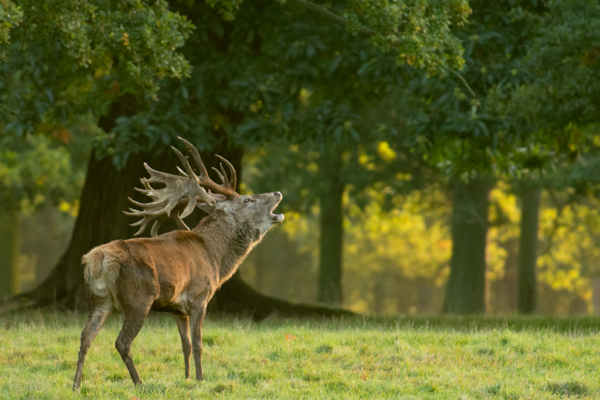
Shot at 340 mm (510 mm EFL), f/5.6, ISO2500 using 1/320th second shutter speed. Use of a tripod here meant that I could be confident that the resulting images of this Red Deer stag would be sharp, even though shot only at 1/320th second.

2. Use a Tripod

Another very simple way to overcome image softness due to camera shake is to use a tripod.  Not everyone enjoys carrying or using a tripod at all times. However, it is a really quick and simple way to help minimize camera shake and to give you more flexibility in using slower shutter speeds, compared to shooting handheld (i.e. not a necessity to stay at “1/EFL”, though still recommended where possible).

There a numerous tripod heads available that have the freedom of movement that is often needed when shooting sports or wildlife. You can also be safe in the knowledge that even at the end of a long day of shooting, when your arms would usually be tired, the tripod will continue to hold the camera steady.

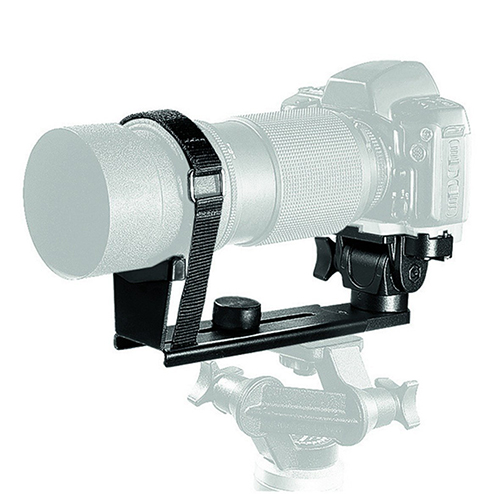
A lot of larger lenses come with a tripod collar which mounts the lens to the tripod, rather than the camera. Most of the smaller, lower budget (but still very long, in terms of focal length) telephoto zoom lenses do not have one, meaning that the camera is mounted to the tripod and the lenses are left dangling off of the camera, susceptible for small vibrations.  Some tripod manufacturers make special brackets to overcome such situations, allowing smaller telephoto zoom lenses to be tripod mounted and become more stable (see image below).
Maximising sharpness using a telephoto lens

Consider tripod mounting your telephoto lens to improve stability when shooting at extreme focal lengths.  Pictured: a Manfrotto 293 telephoto lens support.

3. Image Stabilization

Obviously if shooting handheld, image stabilization (IS or VR) can again help overcome camera shake.  Though you will want to avoid this if you are opting to shoot on a tripod, as image stabilization will actually introduce movement in that situation.

4. Aperture Selection

Shutter speed selection, as mentioned above, was all about considering shutter speed in relation to freezing motion. Aperture selection, however, is two-fold:

a) Diffraction – this is generally a rule for all, but the top of the range telephoto lenses, but shooting at the widest aperture (smallest f/ number) your lens allows will often result in image softness due to diffraction.  This is where light entering the camera is diffracted before hitting the sensor, resulting in the appearance of soft focus throughout the frame (though generally far more noticeable in the corners).  Therefore, if you choose a slightly smaller aperture, e.g. from f/5.6 to 6.3 or 7.1 (known as stopping down) you will minimize the diffraction and see an increase in the sharpness of the resulting images.

b) Ensuring you have enough depth of field – a key component of wildlife and action photography is depth of field.  Often, you shoot as wide an aperture (small f/ number) as possible, to try and isolate the subject and give a soft diffuse background.  However, at long focal lengths, with a close subject, the depth of field (i.e. the region of the image which will be captured in sharp focus) can be as small as a few millimetres, meaning that tiny errors in focusing accuracy will mean that the crucial part of your wildlife shot that needed to be in focus, will be soft.  There are plenty of mobile apps or websites that help you calculate the depth of field for your given camera, aperture and focal length, so make sure you have an awareness how small an aperture you actually need in order have enough depth of field.
Maximising sharpness using a telephoto lens

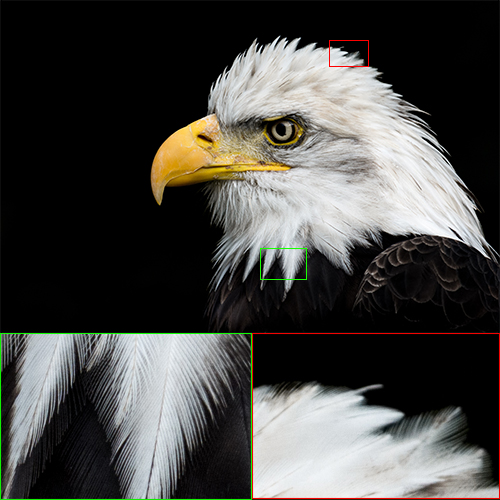
Here, even though shot at f/9.0, you can see that there was not sufficient depth of field to render all of the head feathers of this bald eagle, completely sharp.

5. Bump the ISO

Don’t be afraid to boost the ISO on your camera.  Wildlife and sports photography is a constant compromise between shutter speed and aperture to ensure that you are using a quick enough shutter speed to freeze motion and overcome camera shake, and a suitable aperture to give you enough depth of field and avoid diffraction.  To alleviate this, you can increase the sensitivity of your sensor by increasing the ISO.  This will let you use quicker shutter speeds for the same given aperture and exposure.  Increasing the ISO will introduce more noise into the final image, but it’s better to have a sharp, yet noisy photo, than to have missed whatever fleeting moment you were trying to capture by not being able to use a fast enough shutter speed.

6. Teleconverters

Often available in 1.4x or 2x magnifications, teleconverters are great for extending the focal length of your lenses on a budget.  The increase in focal length does come at a cost however, as they increase the maximum aperture of your lens by one or two stops respectively.  Most consumer DSLRs do not allow autofocus with lenses with a smaller aperture than f/8.0 (i.e. f/5.6 + one stop) so you are limited in what teleconverter/lens combinations you can use. You need a fairly fast lens to begin with, i.e. a wide maximum aperture of f/2.8 or f/4.0, to make the most of a teleconverter.  Once the teleconverter is attached, autofocus will generally be slower (less light to play with) and any flaws of your current lens will be magnified – so stopping down, as per in point #4 above, becomes even more important.
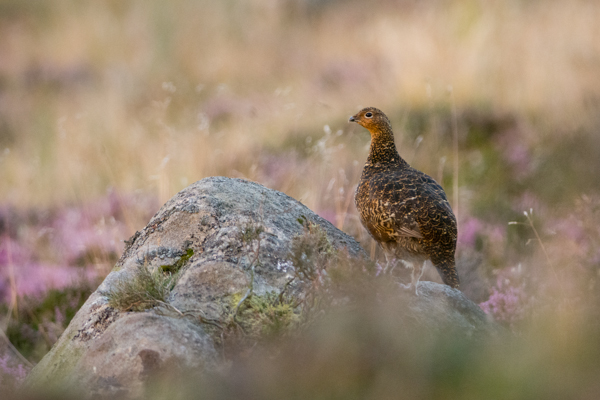
Maximising sharpness when shooting with telephoto lenses

Red grouse at sunset. This is a shot of compromises: 300mm (450mm EFL), f/5, ISO4000, 1/125th second, tripod mounted. Even at ISO4000, the shutter speed was still only 1/125th of a second, but mounted on a tripod the results were nice and sharp.

Summary

Overall, the above tips are just a few considerations for maximizing performance of your telephoto lenses. It’s easy to get carried away thinking that you need more focal length, just to get that little bit closer to your subject. However, it is important to understand the complications of working with such lenses and learn the techniques you can use to overcome the difficulties introduced by such long focal lengths.

Do you have any other techniques that you frequently use to help ensure sharp images when shooting with your telephoto lenses?  Please share them in the comments below.

Post originally from: Digital Photography Tips.

Check out our more Photography Tips at Photography Tips for Beginners, Portrait Photography Tips and Wedding Photography Tips.

Maximizing Sharpness with a Telephoto Lens

The post Maximizing Sharpness with a Telephoto Lens by Elliot Hook appeared first on Digital Photography School.


Digital Photography School

 
Comments Off on Maximizing Sharpness with a Telephoto Lens

Posted in Photography


DPReview Recommends: Interchangeable Lens Cameras for Under $1000

05 Dec

under1000.jpg

A few years ago, the idea of a DSLR under $ 1000 was just a distant dream, but these days the financial bar to entry is much lower than it was in the past. And DSLRs aren’t the only game in town anymore either – mirrorless interchangeable lens cameras are maturing quickly, and there are plenty of affordable options on the market. Here’s our list of the top five interchangeable lens cameras that we’d currently recommend for under $ 1000 – including a kit zoom lens.

News: Digital Photography Review (dpreview.com)

 
Comments Off on DPReview Recommends: Interchangeable Lens Cameras for Under $1000

Posted in Uncategorized


Anamorphic adapter lens makes for widescreen iPhone photos

04 Dec

lens.jpg

A new Kickstarter project from Moondog Labs hopes to bring a wider view when shooting with the iPhone 5 and 5s. With Moondog Labs’ 1.33x Anamorphic Adapter lens, a video shot on the iPhone in the standard 16:9 aspect ratio gains about 33% more width. Still images shot in 4:3 are expanded to 16:9. Learn more at connect.dpreview.com.

News: Digital Photography Review (dpreview.com)

 
Comments Off on Anamorphic adapter lens makes for widescreen iPhone photos

Posted in Uncategorized