RSS
 

Posts Tagged ‘Lens’

Novoflex introduces electronic lens reversing system for Sony E-Mount

02 Nov

German accessories manufacturer Novoflex has launched a version of its Retro Reverse Adapters for the Sony E-mount system. The adapter allows users to reverse-mount lenses for macro shooting while maintaining full electronic control of the lens via the body controls.

The system works by using a pair of cable-connected rings that communicate information from the camera to the rear of the lens, even when it is mounted away from the body.

Reversing a lens is a quick way of achieving macro and close-up abilities, but Sony E-mount lenses need to be connected to the camera to operate at apertures other than the widest. This adapter, which has been available for Canon EOS users for some years, allows the lens to be mounted in reverse with no loss of control or EXIF information.

The adapter also allows a bellows unit to be fitted between the camera and any Sony E lens, reversed or not, for extra-high magnification work while still maintaining contact between lens and body.

The Novoflex NEX-RETRO will retail for $ 440/£309/€350. For more information, visit the Novoflex website.

Press Release

Sony Users Now GO RETRO with NOVOFLEX!

New NEX-RETRO from NOVOFLEX

Allows users with Sony E-Mount cameras (e.g. Sony Alpha 7/Alpha 9 series, Alpha 6000 series, etc.) to reverse mount their existing lenses to achieve closer focus. NEX-RETRO transfers all electronic functions such as aperture control, EXIF data and autofocus, from the reversed lens to the camera body as if it were mounted directly.

Look More Closely

With a 18-105 mm zoom lens in reverse position, you get an image ratio of 1:7 at 105 mm and 2.8:1 at 28 mm expanding the versatility of your zoom lens exponentially. The adapter itself has a 58mm filter thread. Stepping rings are available for other filter sizes.

The Common Thread

In addition to reversing the lens on the camera, NEX-RETRO allows the Sony E-Mount system user to incorporate NOVOFLEX bellows systems for even closer focus and greater magnification ratios.

Highlights

  • Bring to life the finest details: NEX-RETRO allows reverse mounting of Sony E-mount lenses for close focus macro applications.
  • No compromise in flexibility: NEX-RETRO retains complete electronic functionality between Sony E-mount lenses and bodies.
  • Precision engineering: NEX-RETRO is the perfect tool to make the perfect picture even better.

Articles: Digital Photography Review (dpreview.com)

 
Comments Off on Novoflex introduces electronic lens reversing system for Sony E-Mount

Posted in Uncategorized


Review: Sigma 100-400mm F5-6.3 DG OS HSM Contemporary Lens

29 Oct

I believe it was Robert Capa who said, “If your pictures aren’t good enough, you’re not close enough.” While this is not incorrect nor is it bad advice, the fact remains that there will be times when our feet simply can’t do the zooming for us. To facilitate getting up close and personal without actually being up close and personal, photographers rely on telephoto lenses to bridge the gap between themselves and their subject.

Review: Sigma 100-400mm F5-6.3 DG OS HSM Contemporary Lens

The Sigma 100-400mm F5-6.3 Contemporary Lens

With each lens I evaluate with every passing year, I am fortunate enough to bear witness to the staggering advances lens manufacturers are making in the world of photographic optics. Today, there are many instances where aftermarket “non-native” third-party camera lenses either meet or even surpass the performance of their more expensive cousins manufactured by their respective camera brand. We now have a high-grade glass without the high-grade price tags. This is especially true when it comes to long range telephotos and fast primes.

So, when the opportunity arose for me to get my hands on one of the newest budget-conscious telephotos, the Sigma 100-400mm F5-6.3 DG OS HSM Contemporary lens, I lept at the chance. I have a couple of friends who spoke quite favorably of this particular lens, so I had to see it for myself. Take a few minutes, sit back and relax, and let me tell you exactly why the Sigma 100-400mm might be a good choice for you if your bag is missing a good long-range zoom lens.

Build Quality

The main housing of the Sigma 100-400mm lens is made from a solid-feeling hard plastic. Being from the Sigma Contemporary line, it lacks the metallic-feeling TSC (thermally stable composite) construction of their Art series lenses. Even without this type of material, the lens feels incredibly solid in the hand and feels great. The zoom and focus rings are both rubberized and work smoothly.

The Sigma 100-400mm is exceptionally balanced. Overall, for a lens of this size, it feels surprisingly nimble when mounted on my Canon 7D.

Review: Sigma 100-400mm F5-6.3 DG OS HSM Contemporary Lens

Review: Sigma 100-400mm F5-6.3 DG OS HSM Contemporary Lens

Oddly enough, the balance seems to improve when the lens is extended out to its maximum focal length of 400mm. The lens hood included with this lens also offers a great hand-hold which facilitates easy “push/pull” zooming.

Review: Sigma 100-400mm F5-6.3 DG OS HSM Contemporary Lens

The lens sports a zoom-lock switch which is quite useful for carrying around a telephoto lens. This prevents gravity from slowly extending the lens while hiking or walking. The zoom-lock switch on the Sigma 100-400mm firmly locks the lens into place at its 100mm focal length.

Review: Sigma 100-400mm F5-6.3 DG OS HSM Contemporary Lens

Weather sealing

The folks at Sigma have beefed up the weather sealing of their lenses considerably. As primarily an outdoor and wilderness shooter, I am constantly at the mercy of the elements. The weather sealing of this lens is superb.

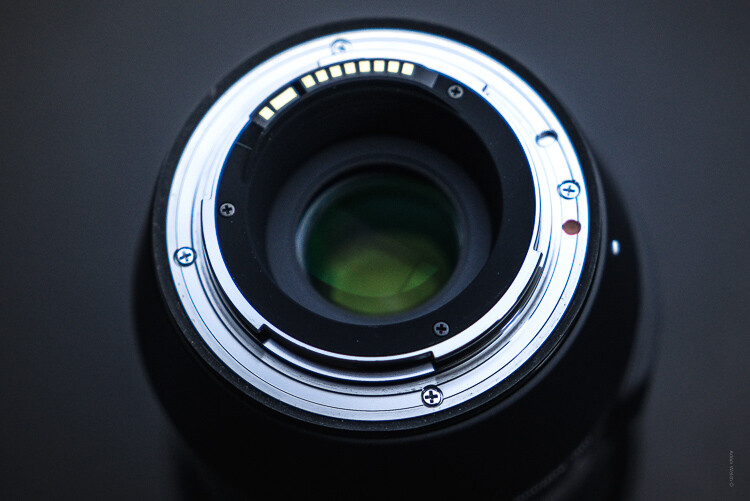
Something that I love to see is a visible rubber gasket on the lens bayonet mount. This type of extra assurance and protection against dirt and moisture making their way to my camera’s sensor makes me feel all warm and fuzzy inside even when the conditions outside are decidedly not.
Review: Sigma 100-400mm F5-6.3 DG OS HSM Contemporary Lens

Review: Sigma 100-400mm F5-6.3 DG OS HSM Contemporary Lens

One thing to note on the overall design of the 100-400mm is that it certainly has a lot of external switches. While these switches are each quite actionable and serve a purpose, they also make it difficult to manipulate the various lens functions without looking. With high range zoom lenses such as this such problems aren’t uncommon.

Review: Sigma 100-400mm F5-6.3 DG OS HSM Contemporary Lens

Image Quality

Sharpness

The sharpness of the Sigma 100-400mm is wonderful for the price range of this lens. In fact, I was stunned to see just how crisp the images produced at the maximum apertures actually were. Both at 100mm and 400mm the sharpness was impressive.


Review: Sigma 100-400mm F5-6.3 DG OS HSM Contemporary Lens

400mm at f/9.

Review: Sigma 100-400mm F5-6.3 DG OS HSM Contemporary Lens

100mm at f/6.3.

Review: Sigma 100-400mm F5-6.3 DG OS HSM Contemporary Lens

400mm at f/6.3.

There was slight edge softening while at 100mm f/5 and at 400mm f/6.3. The incredible thing about the sharpness, which I feel speaks to the true quality of this lens, was only noticed while I was examining test images for this review at 3:1 magnification. Look closely at these two photos. The first was made at 100mm.

Review: Sigma 100-400mm F5-6.3 DG OS HSM Contemporary Lens

100mm

The second is the same scene but zoomed to 400mm.

Review: Sigma 100-400mm F5-6.3 DG OS HSM Contemporary Lens

At 400mm.

Look closely at the left side of the clock tower. Here, let me help you. Below is the same image magnified in post-processing to about 1:1.

Review: Sigma 100-400mm F5-6.3 DG OS HSM Contemporary Lens

The Same image viewed at 1:1 (100%) in Lightroom.

Yes, those are wasps or some other type of insects swarming around the clock tower! Considering the small size of the insects coupled with the distance, approximately 600 yards, the resolving power of this lens is exceptional.

Chromatic Aberration

Chromatic aberrations detected with the Sigma 100-400mm are barely worth mentioning. At 100mm using a relatively wide f/5 aperture, there is a minutely observable purple/magenta fringe in high contrast areas. Other than that, there is nothing remarkable to speak of with this lens.

Autofocus Performance

Fast and responsive is the best description I can give to the 100-400mm Sigma autofocus. The AF performed well and focused locked well while in AI Servo mode on my Canon. The autofocus was quite silent and worked great for not disturbing “temperamental” wildlife.

Review: Sigma 100-400mm F5-6.3 DG OS HSM Contemporary Lens

Can you spot the hiding deer?

Review: Sigma 100-400mm F5-6.3 DG OS HSM Contemporary Lens

There she is, A 400mm reach helps out immeasurably.

Optical Stabilization

The point of vibration reduction, sometimes referred to as optical stabilization, is where the Sigma 100-400mm didn’t exactly impress. Not that the OS didn’t work but the overall improvement was not as drastic as I have observed with some other lenses of this type.

Review: Sigma 100-400mm F5-6.3 DG OS HSM Contemporary Lens

With no stabilization.

Review: Sigma 100-400mm F5-6.3 DG OS HSM Contemporary Lens

With OS1 Mode turned on.

There are two OS modes present on the 100-400mm not including the “Off” mode. They are OS1 and OS2. The OS1 mode is general OS. This serves to reduce multi-directional camera shake and what I generally left the lens set to during my tests. OS2 is geared exclusively towards panning with the 100-400mm and works to reduce single plane vibration.

Customization

Sigma offers a USB dock so that firmware and custom modes can be uploaded directly to the lens via computer with the Sigma Optimization utility. That’s where the custom mode switch comes into play. You can customize Autofocus and Optical Stabilization functions within the lens. I have never used the functionality but if you want ultimate control over every aspect of your gear, this is a great option.

The Tripod Collar Conundrum

The common complaint I’ve gathered about the Sigma 100-400mm F5-6.3 is concerning the lens’s tripod collar; there isn’t one. This comes as somewhat of a surprise to some photographers, myself included. Although, it seems to be of more importance to some than others.

Personally, the lack of a tripod ring is not a huge problem for me. The featherlike balance of the lens negates the need for a tripod mount in my opinion. Still, if you plan on using the lens with a smaller, adapted camera body, the weight of the lens could be an issue. If you want a lens with a tripod ring or collar, this might not be the choice for you.

Final Thoughts on the Sigma 100-400mm F5-6.3

So, what’s the bottom line on the Sigma 100-400mm F5-6.3 DG OS HSM Contemporary Lens?

First of all, the sharpness is outstanding. Even at its widest aperture, the sharpness is exceptional with very little edge softening.

The build quality is more than capable of serving as a “go-to” telephoto for sports and outdoor work and the beefy weather sealing only enhances the workability of this lens.

If you absolutely MUST have the capability of a tripod collar then look elsewhere because the Sigma 100-400mm lens simply doesn’t have one. If you don’t care about that, then for around $ 799 USD, this telephoto from Sigma won’t fail to impress.

The post Review: Sigma 100-400mm F5-6.3 DG OS HSM Contemporary Lens by Adam Welch appeared first on Digital Photography School.


Digital Photography School

 
Comments Off on Review: Sigma 100-400mm F5-6.3 DG OS HSM Contemporary Lens

Posted in Photography


This ‘pancake lens’ is a wireless charger for your phone

24 Oct

Pancake lenses are small and inconspicuous, making them ideal for street photography and similar applications. However, the LightPix Labs Power Lens 40mm F2.8 lens we are looking at here won’t be of much help when out shooting in the street. That’s because it is a wireless smartphone charger that has been designed to look like a pancake lens.

That said, it still looks like a useful accessory, especially if you like charging your phone in style.

The Power Lens works with all devices supporting the Qi wireless charging standard and that’s most of them, including the iPhone 8 / 8 Plus, iPhone X, Galaxy S8 / S8+ / Note 8, and many other high-end devices. The makers of the gadget say the Power Lens can also charge your smartphone up to 1.5 times faster than a standard wireless charger if used in combination with a QC 2.0 / 3.0 compatible wall adapter.

The lens makes a shutter sound when charging starts but can be muted if you prefer peace and quiet.

The Power Lens will start shipping November 28th and comes with an introductory price tag of $ 30 for the first 200 units—the regular price is $ 40. More information is available on the LightPix Labs website.

Articles: Digital Photography Review (dpreview.com)

 
Comments Off on This ‘pancake lens’ is a wireless charger for your phone

Posted in Uncategorized


Zeiss reveals Milvus 25mm F1.4 lens, the 11th in the manual-focus family

22 Oct

Zeiss has added a new wide-angle lens to its Milvus line of full-frame, manual focus lenses for Nikon and Canon DSLRs. The new Milvus 25mm F1.4 is now the fourth widest lens in the family—which ranges from 15mm to 135mm—and brings the total number to Milvus lenses to 11, four of which boast fast F1.4 apertures.

According to Zeiss, the Milvus 25mm F1.4 is “suitable primarily for landscape and architecture photography, and for journalistic shots and videos” thanks to its fast aperture and a new optical design that uses 15 elements in 13 groups to deliver “high-contrast photos and a harmonious bokeh.” They also claim “hardly any color fringes,” even when you’re shooting with the lens wide-open.

Like the entire Milvus line, the new 25mm F1.4 is manual focus only, and features a robust all-metal housing as well as ‘special seals’ for protection against dust and splashes.

The new Milvus 25mm F1.4 will be available starting November 2nd for 2,400 Euros (including tax) or $ 2,400 USD. To learn more about this lens or the entire Milvus line, head over to the Zeiss website by clicking here.

Press Release

ZEISS Unveils High-Speed DSLR Lens: ZEISS Milvus 1.4/25

With its new wide-angle focal length, the ZEISS Milvus family now boasts eleven lenses for single-lens reflex cameras, including four focal lengths with a maximum aperture of 1.4, which are perfect for videographers too.

OBERKOCHEN/Germany, 2017-10-18.

The ZEISS Milvus 1.4/25 is the latest focal length to be added to ZEISS’s largest range of lenses for full-frame single-lens reflex cameras. The lens, which was developed for the DSLR systems from Canon and Nikon is suitable primarily for landscape and architecture photography, and for journalistic shots and videos. “The completely new optical design ensures superior performance across the entire image field,” says Christophe Casenave, Product Manager at ZEISS. “This results in high-contrast photos and a harmonious bokeh.”

High-speed wide-angle lens

Thanks to a maximum aperture of 1.4, this lens can even capture exceptional images in poor light. “Even at full aperture, there are hardly any color fringes,” says Casenave. “The finest details can be reproduced in high definition and contrast all the way into the corners.” The metal housing is what makes the lens robust, and its dirt and dust protection even makes the ZEISS Milvus 1.4/25 ready for action in adverse weather. The large 172-degree focus rotation angle enables precise manual focusing for adding creative touches to photos and videos.

The largest ZEISS lens family yet

Featuring eleven focal lengths ranging from 15 to 135 millimeters, including two macros, the ZEISS Milvus family covers a host of applications, such as portrait, landscape, architecture and street photography. “We can offer every photographer just the right lens,” says Casenave.

Perfect for videographers too

The four ZEISS Milvus focal lengths 25, 35, 50 and 85 millimeters with an aperture of 1.4 are just perfect for filming. Thanks to their high speed, they are suitable primarily for interviews and documentaries where the videographer can utilize natural light. Thanks to the de-click function in the version for the Nikon-Mount the aperture can be adjusted continuously. ZEISS Lens Gears in a range of sizes permit the use of follow-focus systems.

Price and availability

The ZEISS Milvus 1.4/25 retails for 2,400 Euros including 19 percent sales tax (RRP) or $ 2,400 USD and will be available starting November 2nd 2017 at dealers and from the ZEISS online shop.

Articles: Digital Photography Review (dpreview.com)

 
Comments Off on Zeiss reveals Milvus 25mm F1.4 lens, the 11th in the manual-focus family

Posted in Uncategorized


Leica is resurrecting the soft-focus Thambar 90mm F2.2 portrait lens from 1935

18 Oct

$ (document).ready(function() { SampleGalleryV2({“containerId”:”embeddedSampleGallery_3871588870″,”galleryId”:”3871588870″,”isEmbeddedWidget”:true,”standalone”:false,”selectedImageIndex”:0,”startInCommentsView”:false,”isMobile”:false}) });

Leica is getting into the lens resurrection game, announcing earlier today that it will bring back the Thambar-M 1:2.2/90: a portrait lens from 1935 that’s famous for exceptional spherical aberration that creates extremely soft images. The Thambar-M will be an accurate reproduction of the original lens, only this time around in the M mount instead of the L screw mount.

The lens features a 20-bladed iris that produces round, out-of-focus highlights, and only four elements arranged in three groups. Its softness comes about through uncorrected spherical aberrations that are more obvious when the lens is used wide open, and which can be emphasized via the use of an included centre spot filter that prevents axial light passing through the construction.

With the light from the centre of the lens blocked, the majority of image recording light comes from the edges where the aberration is at its strongest.

$ (document).ready(function() { SampleGalleryV2({“containerId”:”embeddedSampleGallery_1148566037″,”galleryId”:”1148566037″,”isEmbeddedWidget”:true,”standalone”:false,”selectedImageIndex”:0,”startInCommentsView”:false,”isMobile”:false}) });

Without the centre spot filter the lens is still soft, but becomes sharper as the aperture is closed and the aberration subsides. The barrel of the Thambar has twin aperture markings that show in white the reduced aperture values when the spot filter is used, as well as the recommended range of apertures that can be used with the filter in place.

Originally made only in a run of 3,000 in 1935, this new version will be much more widely available starting mid-November, and will cost you £5095/$ 6495. For more information see the Leica website, or read this article on the Leica blog.

Press Release

Leica Camera AG presents a modern renaissance of the classic lens – the Leica Thambar-M 1:2.2/90

A legend reborn: following the Leica Summaron-M 1:5.6/28, Leica Camera AG has further expanded its lens portfolio with the Thambar-M 1:2.2/90, the modern renaissance of another classic lens. Just like its namesake from 1935, the contemporary incarnation of the lens is distinguished by its characteristic soft-focus effect and unmistakeable bokeh. Its focal length of 90 mm is suitable for photography in a multitude of scenarios and is as good as predestined for capturing portraits with a uniquely aesthetic atmosphere that cannot be reproduced in digital postprocessing. The new Thambar-M is thus an exciting addition to the existing Leica M lens portfolio and brings photographers entirely new possibilities for creative composition.

The optical design of its ancestor remains almost unchanged in the new Thambar-M 1:2.2/90. It has therefore also inherited the characteristic properties of its predecessor. The only difference is that the four elements in three groups that make up the design have now been single-coated to protect the glass against environmental influences and surface corrosion. The 20 blades of its iris deliver a unique bokeh with perfectly round rendition of point light sources.

The soft look of the Thambar is the result of intentionally accepted under-correction of spherical aberration. This under-correction increases towards the edges of the optical system with the consequence that not only the depth of focus, but also the degree of softening can be precisely controlled by means of the stepless aperture setting. The effect is more pronounced as apertures increase, and is continually reduced as the lens is stopped down to smaller apertures.

The design of the original lens has been almost completely preserved in today’s Thambar-M 1:2.2/90. The black paint finish, the proportions of the lens and its aperture engravings in red and white correspond to the appearance of the original. In addition to this, slight modifications have been made that bring the lens into line with the current, minimalist design of modern M-Lenses. These include the knurling, the lettering and scales and the specific use of sharp edges and bevelling that underline the precision of the lens design.

‘The name Thambar has always been preceded by the adjective ‘legendary’ – rightly so. It portrays people with a wonderful aura, in a romantic way – but landscapes too are raised to a higher, incomparably aesthetic plane. The addition of a new incarnation of this classic lens to our selection of vintage lenses was one of our greatest wishes – to my great delight, this wish has now been fulfilled.’ emphasises Dr. Andreas Kaufmann, majority shareholder and chairman of the supervisory board of Leica Camera AG.

As is the case with all Leica lenses, the Leica Thambar-M 1:2.2/90 is also manufactured in strict compliance with the most stringent quality criteria. The use of only the best materials in its construction guarantee the familiar long working life of all Leica lenses. As was the case with the original lens, the lens hood, the ring of the centre-spot filter and both front and rear lens caps are made of metal. Even smallest details, like the felt lining of the lens hood and the front cap, contribute to the exceptional perceived quality of this lens. The design of the rigid lens keeper in ‘Vintage Brown’ leather is identical to that of the original from 80 years ago in almost every respect and, as in the past, the centre-spot filter can be safely and conveniently stowed away in its lid.

The Leica Thambar-M 1:2.2/90 will be on sale from mid-November 2017.

Articles: Digital Photography Review (dpreview.com)

 
Comments Off on Leica is resurrecting the soft-focus Thambar 90mm F2.2 portrait lens from 1935

Posted in Uncategorized


Nikon releases official D850 lens recommendation list

12 Oct

Nikon has published a list of lens recommendations for D850 owners, highlighting a total of eleven lenses that are suitable for use with its newly-launched, high-res, high-speed DSLR. The list covers prime, zoom, and speciality lenses, all of which are Nikon products (duh).

Here they are for your perusing pleasure below, just in case you want to make sure your glass is up to snuff with your fancy new camera:

Prime Lenses

  • 20mm f/1.8G – $ 796.95
  • 28mm f/1.4E – $ 1,996.95
  • 105mm f/1.4E – $ 2,196.95
  • 200mm f/2G – $ 5,696.95
  • 400mm f/2.8E – $ 11,196.95

Zoom Lenses

  • 14-24mm f/2.8G – $ 1,896.95
  • 24-70mm f/2.8E – $ 2,396.95
  • 70-200mm f/2.8E – $ 2,796.95
  • 80-400mm f/4.5-5.6G – $ 2,296.95

Specialty Lenses

  • 8-15mm f/3.5-4.5E – $ 1,246.95
  • 19mm f/4E PC – $ 3,396.95

Articles: Digital Photography Review (dpreview.com)

 
Comments Off on Nikon releases official D850 lens recommendation list

Posted in Uncategorized


Review of the Fujinon XF23mm F2 WR Lens

11 Oct

In this review, I’ll take a look at the Fujinon XF23mm F2 WR Lens. If you shoot Fuji and have considered this one – read on to see why I rate it top marks!

Review of the Fujinon XF23mm F2 WR Lens

The Fujinon 23mm f2 lens

First look

With the Fuji XF 23mm F2 WR lens now being offered as a kit with the X-Pro2, and the new X-E3, it’s probably a good time to look at this little wonder if you shoot Fuji. This weather-sealed prime lens is 35mm equivalent field of view in full frame terms and makes a perfect street and general photography lens.

The fast f/2.0 aperture is a stop slower than it’s f/1.4 predecessor, but it’s leaps and bounds faster in the focus department. It also has a much quieter motor, which is important for video and it’s weather resistant.

Quiet motor great for video

As the Fuji X-T2 body has 4k video, and with a firmware update to add 4K video to the X-Pro2 due, this is an essential feature for current users looking to do video. Personally, I’m shooting a lot more video of late, both for my YouTube channel and in the creation of shorts in general, so this feature made the lens enticing for me. The original Fuji X camera is, of course, the X100, which has a built-in 23mm f2 lens. The new 23mm lens is a better design though, making it a great option instead of getting an X100F.

Review of the Fujinon XF23mm F2 WR Lens

For this article, I’m including some “tourist in my own town” style shots as I’ve not had this lens long enough to travel with it – yet!

Review of the Fujinon XF23mm F2 WR Lens

The f/2.0 Trinity

The 23mm is the widest currently in this range, which includes the XF35mm F2 and the XF50mm F2. In the community, they’ve been nicknamed the Fujicrons, as a kind of homage to the Summicron range of f/2 lenses from Leica. This weather sealed range offers great quality lenses in small, light packages, with quiet motors suited to video work as well as stills.

They focus faster than the higher range primes in the Fuji range, such as the 23mm f/1.4, 35mm f/1.4, and the 56mm f/1.2. (It’s not fair to directly compare the 50mm and 56mm as they’re not quite the same, though they are close enough for this purpose). The F2 lenses are also really well priced; You can get two of them for the price of one of the faster primes.

Review of the Fujinon XF23mm F2 WR Lens

Specs of the XF23mm F2

The XF23mm F2 WR lens has 10 elements in six groups which includes two aspherical elements. The original f/1.4 lens has only one. These elements increase the sharpness, a big plus for this small lens. The housing is metal, making this a robust lens in keeping with most of the Fuji range.

The aperture ring runs in 1/3 EV steps and uses nine blades internally which leads to a smoother bokeh. The minimum focusing distance is 22cm (about 9″). The lens comes in at a sprightly 180 grams (0.4 lbs) too. Good news if you’re looking to shoot video on a gimbal or flying on budget airlines with low weight baggage limits! Fi, ally the filter size is 43mm.

Review of the Fujinon XF23mm F2 WR Lens

Comparisons

The first lens people want this lens compared with is the Fuji 23mm f/1.4, because that’s usually the choice they’re trying to make. The XF23mm f/2.0 is a stop slower than then the 23mm f/1.4 but is faster to focus. The additional element makes it sharp, but the original 23mm is quite a sharp lens anyway. Weightwise the f/2.0 is 180g (0.4 lbs) versus the 300g (0.67 lbs) of the f/1.4.

For close focusing the f/2.0 has a minimum focus distance of 22cm (9″) compared to the 28cm (11″) of the f/1.4. In terms of cost, the f/2.0 is half the price of the f/1.4 at $ 449 versus $ 899. The real question to ask yourself is, does the additional stop of light justify spending twice the money? Only you can decide that.

Review of the Fujinon XF23mm F2 WR Lens

The f/2 lens has a slightly wilder field of view than the f/1.4 below.

Review of the Fujinon XF23mm F2 WR Lens

For street work, a lot of people choose the XF27mm f/2.8 pancake lens. This makes your Fuji very pocketable. The lens doesn’t protrude much and is really unobtrusive. It’s the smallest lens Fuji makes. Yes, it is cute. The XF23 is much longer (52mm versus 23mm), but isn’t too obtrusive. Again it’s a faster lens and wider. Both are the same price, so it’s a question of speed and depth in this choice. The 23mm is the superior lens, but if you must have a pancake, the 27mm is the only choice really.

Using the XF23mm F2 Lens

Review of the Fujinon XF23mm F2 WR Lens

I’ve found 23mm to be a great focal length to have with you. In fact, it’s probably the most versatile prime lens you could travel with. There’s no issue with general streets scenes, or even general landscapes. It’s great for shots including people in the scene. While it’s not a typical portrait focal length, it looks great for 3/4 length shots in landscape mode (a vertical composition) or portrait mode at a push.

Review of the Fujinon XF23mm F2 WR Lens

Even with just f/2, you still have the opportunity to shoot handheld evening shots while traveling.

Photos from the lens have nice contrast and are generally sharp, even wide open. The lens focuses quickly, even in low light and I can’t say I’ve particularly noticed many misfires. Couple it with the XF56mm f/1.2 or even the XF50mm f/2.0, and you would have a great two-lens kit that covers most shooting situations.

Review of the Fujinon XF23mm F2 WR Lens

A typical low light situation where fast primes can help.

Pros

  • Lightweight
  • Fast Focus
  • Quiet operation
  • One of Fuji’s less expensive lenses

Cons

  • Not the fastest aperture at this focal length

Verdict

If you absolutely need a faster aperture, don’t get the Fujinon XF23mm F2 WR lens. Otherwise it’s utterly fantastic at what it does. I voted with my cash and got this over the 23mm f/1.4 and it hasn’t disappointed.


The post Review of the Fujinon XF23mm F2 WR Lens by Sean McCormack appeared first on Digital Photography School.


Digital Photography School

 
Comments Off on Review of the Fujinon XF23mm F2 WR Lens

Posted in Photography


Samyang unveils 35mm F1.4 autofocus lens for Sony full-frame mirrorless

10 Oct

Samyang has officially unveiled its fourth autofocus lens for Sony FE mount cameras: the long-rumored Samyang AF 35mm F1.4 FE. The new 35mm joins Samyang’s three other AF lenses—the AF 14mm f/2.8 FE, AF 35mm f/2.8 FE and AF 50mm f/1.4 FE—and offers Sony full-frame mirrorless shooters yet another affordable (and fast) prime to shoot with.

As with all previous Samyang autofocus FE lenses, the company claims that they offer exceptional image quality across the whole image field.

This particular lens features 11 lens elements in 9 groups, including 2 aspherical lenses and 2 high-refractive lenses. At its core is a 9 (circular) blade aperture that opens up all the way to F1.4, and a Linear Super Sonic Motor promises “fast, precise and quiet autofocus performance.”

The lens is scheduled to ship in November at a suggested retail price of £600 and €650, which should put US pricing around $ 750. To learn more about the new lens, head over to the Samyang website.

Press Release

Samyang Announces the Fourth Autofocus Lens – AF 35mm F1.4 FE

October 10th, 2017, Seoul, South Korea – Global optics brand, Samyang Optics (http://www.samyanglensglobal.com) is pleased to announce the release of their fourth autofocus lens: AF 35mm F1.4 FE. The bright F1.4 aperture and absolute resolution turn every moment into artwork. This lens now expands Samyang’s autofocus lens line-up to four which includes three existing autofocus lenses, AF 14mm F2.8 FE, AF 35mm F2.8 FE and AF 50mm F1.4 FE.

Aim High, Create Artwork

This new AF 35mm F1.4 FE works in harmony with full frame mirrorless cameras in Sony E mount such as Sony ?7 or ?9 series. It is designed to appeal to enthusiasts and professionals who are ready to take the next step up in photography. It is the excellent companion to create artworks from everyday moments, while the tiny AF 35mm F2.8 FE released in June of this year is the perfect partner for everyday photographers.

High Performance beyond Expectation

Absolute resolution across the entire image field is the key feature of Samyang AF 35mm F1.4 FE. The lens includes 11 elements in 9 groups and features 2 aspherical lenses and 2 high-refractive lenses, plus Ultra Multi Coating. The optical design minimises various aberrations and unnecessary light dispersion to deliver outstanding resolution. Fast, precise and quiet autofocus performance meets Samyang’s exceptional optical technology to capture any moments clearly. The bright F1.4 secures fast shutter speed and creates shallow depth of focus images in wide-standard angle of view. The new 35mm F1.4 lens is ideal for professional photography including low-light events, landscapes and portraits with expressive characteristics.

Available from November 2017

Samyang AF 35mm F1.4 FE, a lens for photographers aiming high in photography, will be available globally from November and will carry a suggested retail price of EUR 649.

To celebrate launching, Samyang Optics will hold various consumer events on Facebook (http://www.facebook.com/samyanglensglobal) and Instagram (http://www.instagram.com/samyanglensglobal). For more information on product, visit Samyang Optics official website (http://www.samyanglensglobal.com/).

Articles: Digital Photography Review (dpreview.com)

 
Comments Off on Samyang unveils 35mm F1.4 autofocus lens for Sony full-frame mirrorless

Posted in Uncategorized


Sigma to reveal new lens at PDN PhotoPlus Expo 2017

05 Oct

Lens maker Sigma will showcase its full range of Sigma Global Vision lenses, Cine high-speed primes and zooms as well as the Foveon sensor-based sd Quattro and Quattro H cameras at the upcoming PDN PhotoPlus Expo 2017 Expo trade show in New York City later this month, but that’s not all they’re doing.

The company has also announced it will reveal one completely new lens at the show, teasing us with this little detail without revealing anything else about the upcoming glass.

Additionally, a number of photographers and other imaging professionals will take the stage at the Sigma booth and talk about how they use Sigma products in the areas of aviation, editorial, glamour, landscape, travel and wedding photography.

As if those weren’t enough reasons to pay a visit, PPE 2017 attendees who visit Sigma’s booth (#837) will also have a chance to enter and win a Sigma 24-70mm F2.8 Art lens. Something to think about if you happen to be in New York at the end of October…

Sigma Reveals its PDN PhotoPlus Expo 2017 Line Up and a Brand New Lens

The breakthrough year for Sigma Global Vision Art, Contemporary and Sport lenses on display; brand new lens addition to be unveiled; Sigma Pros light up stage with new presentations

Ronkonkoma, NY – October 4, 2017 Sigma Corporation of America, a leading still photo and cinema lens, camera, flash and accessory manufacturer, will showcase its full line up of Sigma Global Vision lenses, including a brand-new addition to the line, at the upcoming PDN PhotoPlus Expo 2017 Expo held at the Jacob Javits Convention Center in New York City from October 26-28, 2017 (booth 837).

The company will also have on hand its breakthrough optics for the cinema market – the Sigma Cine high-speed Primes and Zooms – as well as the Foveon sensor-based sd Quattro and Quattro H cameras.

“Sigma has had a landmark year with the introduction of seven new lenses across our Global Vision and Cine product lines,” states Mark Amir-Hamzeh, president of Sigma Corporation of America. “Our research and development team is dedicated to creating superior optics that meet the ever-growing requirements of today’s high resolution cameras, taking advantage of every possible design and element to capture the greatest picture detail for both still and moving images. We look forward to showcasing the culmination of what has been a remarkable year in optical advancements for Sigma at this year’s PPE event.”

Sigma 2017 introductions include the award-winning 14mm F1.4 DG HSM Art, 24-70mm F2.8 DG OS HSM Art, 135mm F1.8 DG HSM Art, 100-400mm F5-6.3 DG OS HSM Contemporary Sigma Global Vision lenses and the new Sigma Cine FF High Speed 14mm T2 and 135mm T2 prime lenses.

Sigma Special PPE Presentation – Sigma Pro Phenom Jen Rozenbaum
Sigma Pro Jen Rozenbaum will take the PPE stage on Wednesday, October 25, 11:00 AM – 12:30 PM to deliver a PPE Master Class on “How to make every woman look amazing.”Jen will share with attendees her vast experience in boudoir photography, providing top tips and secret tricks – from wardrobe to posing – that flatter all women. Jen’s presentation will help attendees understand how to best dress and pose any woman of any size and shape as well as gain confidence behind the camera whether they are shooting boudoir, wedding or seniors!

Master Photographers Take the Sigma Stage
Showcasing the very best in photography craft, the expanded Sigma Pro family will headline the Sigma stage and offer attendees a behind the lens look at the techniques and technology that captured some of the year’s most outstanding photographs in the areas of aviation, editorial, glamour, landscapes, travel and weddings.

This year’s prestigious Sigma Pro PPE stage line-up includes outdoor sports and adventure travel photographer Liam Doran, aviation photo expert Jim Koepnick, renowned bird and travel photographer Roman Kurywczak, fearless woman photographer Jen Rozenbaum, and glamour and wedding photographer Jim Schmelzer.

The exciting topics include (listed by Sigma Pro) and showcase lenses from Sigma Global Vision Art, Contemporary and Sport lines:

  • Liam Doran – Adventure Sports Photography: Get a behind the scenes look at the fast-paced world of editorial adventure sports photography with Liam Doran clients Powder, Bike, Ski, Mountain, Outside, Aka Skidor and many more. Showcasing Art and Sport lenses.
  • Liam Doran – Signature Images – A Visual Journey: From skiing in Switzerland to mountain biking in Colorado, Liam shares the backstory on how some of his favorite images were shot and which Sigma lenses helped him capture some of his best work. Showcasing Art and Sport lenses. Liam shoots extensively with the 12-24mm F4 DG HSM Art, 24-70mm F2.8 Art, 100-400mm F5-6.3 Contemporary and the 150-600mm F5-6.3 DG OS Contemporary and the 70-200mm F2.8 EX DG OS HSM lenses among others.
  • Jim Koepnick – Documentary Photography…A Single Lens Solution: While there is a mystique about street photography with an old rangefinder camera and one lens, the bottom line is the photo that is captured, and the story that photo tells the viewer. Jim shares what a pro can do with a Sigma 18-300mm F3.5-6.3 DC Macro OS HSM Contemporary lens.
  • Jim Koepnick – Air Show Photography – Sigma Has It Covered: Air shows are one of the most popular spectator events in the country, and the wide variety of Sigma lenses make it easy to photograph every aspect of exotic aircraft in the air and on the ground. Learn the best techniques for capturing fast moving planes in flight and making creative images of planes and personalities on the ramp using the Sigma 12-24mm F4 Art, 24-70mm F2.8 Art, 100-400mm F5-6.3 Contemporary and the 150-600mm F5-6.3 Contemporary lenses.
  • Roman Kurywczak – For the Love of Landscapes: Roman will take attendees on an inspirational journey showcasing the magic of landscape photography through useful tips, suggested camera settings, instruction on innovative techniques and recommendations for the optimal Sigma brand lenses and gear for capturing stunning images of your very own. Showcasing the Sigma 12-24mm F4 Art, 14mm F1.4 Art, 100-400mm F5-6.3 Contemporary and the 150-600mm F5-6.3 Contemporary lenses.
  • Roman Kurywczak – Getting Close for Impact: This educational lecture will show you the technical tips and tricks needed to take your close-up photography to the next level. Attendees will learn how to consistently capture sharp images, front to back, handheld, and all in a single frame with a variety of Sigma lens options including the Sigma 105mm F2.8 EX DG OS HSM, 150mm F2.8 EX DG HSM, APO Macro 180mm F2.8 EX DG HSM, 18-300mm F3.5-6.3 Contemporary, 100-400mm F5-6.3 Contemporary and the EM-140 DG Macro Flash.
  • Roman Kurywczak – Photographing Wildlife – from Portraits to Action: This exciting photographic journey will give attendees the important information they need to know about photographing wildlife out in the field – from camera settings to Sigma lens and accessory choices. Roman will share striking examples illustrating how the right lens choice positively impacts the image without breaking your budget. Showcasing the Sigma100-400mm F5-6.3 Contemporary, 150-600mm F5-6.3 Contemporary, 300-800mm F5.6 EX DF APO HSM and the 500mm F4 DG OS HSM Sport lenses.
  • Roman Kurywczak – Photography After Dark: This informative how-to program is designed to open up your eyes to the possibilities of photographing landscapes after dark, whether a natural landscape with the star filled sky as a backdrop, or dazzling city lights photographed from a helicopter using a variety of Sigma lenses including the Sigma12-24mm F4 Art, 14mm F1.4 Art and the 24mm F1.4 DG HSM Art lenses.
  • Jen Rozenbaum – Bulletproof Posing for All Women: Confidence is just as important behind the lens as it is in front of it! Posing women is a creative challenge for all photographers. Join Jen as she shows her bulletproof tips and tricks for posing women to make them look simply amazing, and give the photographer and subject the confidence that generates an incredible shoot. Showcasing the Sigma 50mm F1.4 DG HSM Art,85mm F1.4 DG HSM Art, and the 24-105mm F4 DG OS HSM Art lenses.
  • Jim Schmelzer – Glamour Photography Using Exotic Lenses for Impact: Jim will showcase a variety of glamour images shot with Sigma Art and Sport lenses. He will deconstruct shots –sharing tips, including those that he used to capture the stunning images of world-class models from his latest commercial glamour shoot in Cancun Mexico. Showcasing the Sigma 85mm F1.4 DG HSM Art, 120-300mm F2.8 DG OS HSM Sport and the 135mm F1.8 Art lenses.
  • Jim Schmelzer – Choosing the Right Lens for Your Wedding Day Assignment:Wedding day photographers must wear a variety of hats. They need to be an architectural photographer, photojournalist, portrait artist and most importantly, they need to be fast and accurate. Look over Jim’s shoulder as he demonstrates how he captures the versatility in images required of today’s modern wedding photographer. Showcasing the Sigma 12-24mm F4 Art, 24-105mm F4 Art, 35mm F1.4 DG HSM Art and the 85mm F1.4 Art lenses.

For the Sigma Pro presentation schedule days and times, please visit:https://blog.sigmaphoto.com/event/photoplus-2017/ ?

Sigma Super Giveaways at PPE 2017
PPE 2017 attendees who visit Sigma at booth 837 will have a chance to enter and win a Sigma grand giveaway – a 24-70mm F2.8 Art – an MSRP value of $ 1299.00 USD!

Re-engineered and introduced in 2017, the newly updated 24-70mm F2.8 Art lens is Sigma’s workhorse zoom lens. It touts a brand new Optical Stabilizer (OS), Hypersonic Motor (HSM) for highly efficient and fast autofocus, as well as a dust- and splash-proof mount with rubber sealing.

The 24-70mm F2.8 Art lens embodies all the technical qualities and finesse that define the high-performance Sigma Global Vision Art series. A popular industry focal range covering a wide array of shooting scenarios, the 24-70mm’s optical design also includes three SLD (Special Low Dispersion) glass elements and four aspherical elements to ensure image accuracy and sharpness. The 24-70mm F2.8 Art aspherical elements use Sigma’s thicker center glass design and highly precise polishing process, delivering stunning images and bokeh effects. The lens’ purpose-built structure boasts a new metal barrel for optimal durability with TSC composite internal moving components designed to resist thermal contraction and expansion. Available for Canon, Nikon and Sigma camera mounts.

Articles: Digital Photography Review (dpreview.com)

 
Comments Off on Sigma to reveal new lens at PDN PhotoPlus Expo 2017

Posted in Uncategorized


The clockwork lens: Lensrentals tears down famed Minolta 40-80mm F2.8 Gearbox Zoom

27 Sep

Lensrentals tears down famed Minolta 40-80mm F2.8 Gearbox Zoom

Photograph by Tom Leonard

The Minolta MC Rokkor X 40-80mm F2.8 zoom is a unique lens, which uses a gearbox for controlling focus and zoom. The advantage of this design? It’s pretty small for an F2.8 zoom, especially one made in the 70’s, and more precise than a conventional helicoid. The downside? It’s fiendishly hard to take apart – as Roger Cicala and Aaron Closz at Lensrentals recently found out…

Lensrentals tears down famed Minolta 40-80mm F2.8 Gearbox Zoom

Image courtesy of Lensrentals

Roger and his team started by removing parts of the rear lens assembly, including the aperture ring. So far, so conventional. In Roger’s words: “We were starting to feel a little confident now. That confidence, as you will see, was entirely misplaced.”

Lensrentals tears down famed Minolta 40-80mm F2.8 Gearbox Zoom

Image courtesy of Lensrentals

Removing the leatherette that covers the lens barrel revealed several screws which – once unscrewed – allowed the gearbox housing to be removed, revealing the complicated mechanism for controlling zoom and focus.

Lensrentals tears down famed Minolta 40-80mm F2.8 Gearbox Zoom

Image courtesy of Lensrentals

Inside the housing, you can see the macro selection and focusing mechanisms, both of which move what Roger is calling ‘The Magic Slot’ (indicated with a red arrow). If this looks complicated, that’s because it is. In Roger’s words, “this is a mechanical art of the highest order”, ensuring that even when the lens is zoomed, the focus point remains unchanged. That was impressive stuff for the 1970’s (and even today).

Lensrentals tears down famed Minolta 40-80mm F2.8 Gearbox Zoom

Image courtesy of Lensrentals

Back to the lens barrel, and things are getting even more complicated…

Here, the green arrow is pointing to the zoom stem, while the red arrow indicates a heavy duty brass post covered with a white bumper. Since “normal lens terms like helicoid and cam don’t work here” Roger is calling this ‘The Golden Post’.

Lensrentals tears down famed Minolta 40-80mm F2.8 Gearbox Zoom

Image courtesy of Lensrentals

For a full explanation of exactly how all of this works, we’d recommend heading over to Roger’s original blog post, which explains things in fascinating detail. In the meantime, here’s a picture of the mechanical zoom and focus assembly, removed from the lens barrel.

Lensrentals tears down famed Minolta 40-80mm F2.8 Gearbox Zoom

Image courtesy of Lensrentals

With this assembly removed, the 40-80mm starts to look rather more like a conventional lens. To completely disassemble it, though, the team referred to ‘Aaron’s Second Rule of Disassembly’. Specifically – All leatherette must be removed. Because underneath leatherette, you’ll invariably find screws.

Lensrentals tears down famed Minolta 40-80mm F2.8 Gearbox Zoom

Image courtesy of Lensrentals

Finally, after “about an hour of time and a thorough and complete use of our full lexicon of unprintable words”, Roger and Aaron managed to get the inner barrel out of the outer casing.

Lensrentals tears down famed Minolta 40-80mm F2.8 Gearbox Zoom

Image courtesy of Lensrentals

With the front optics taken out, the aperture blades were revealed. After such a complex disassembly, Roger and Aaron “were glad to see something that looked familiar”.

Lensrentals tears down famed Minolta 40-80mm F2.8 Gearbox Zoom

Image courtesy of Lensrentals

And here is the 40-80mm F2.8, reduced (almost) to its component parts. Roger’s final takeaway, from one of the most complex disassemblies he’s ever done?

“There were some slick engineers working on things at Minolta back in the 1970s, thinking way outside the box”.

If this article whetted your appetite, we’d encourage you to head to Lensrentals for a full explanation of the entire process (including MTF charts!) and read more about the unique 40-80mm F2.8 in Tom Leonard’s article, ‘A forgotten solution: Why this strange 1975 zoom lens is so sharp’. See links below.

Read the full article on Lensrentals.com

Read Tom Leonard’s writeup of the Minolta MC Rokkor-X 40-80mm F2.8

Articles: Digital Photography Review (dpreview.com)

 
Comments Off on The clockwork lens: Lensrentals tears down famed Minolta 40-80mm F2.8 Gearbox Zoom

Posted in Uncategorized