RSS
 

Posts Tagged ‘Learning’

Learning Zeppelin: Wooden Airship Docked on Museum Roof as a Reading Room

01 Apr

[ By SA Rogers in Architecture & Public & Institutional. ]

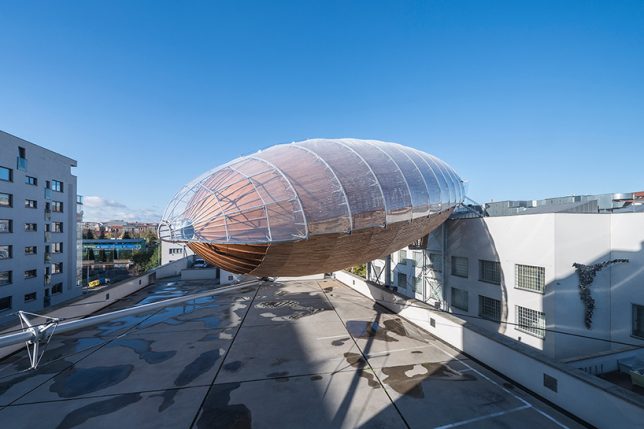
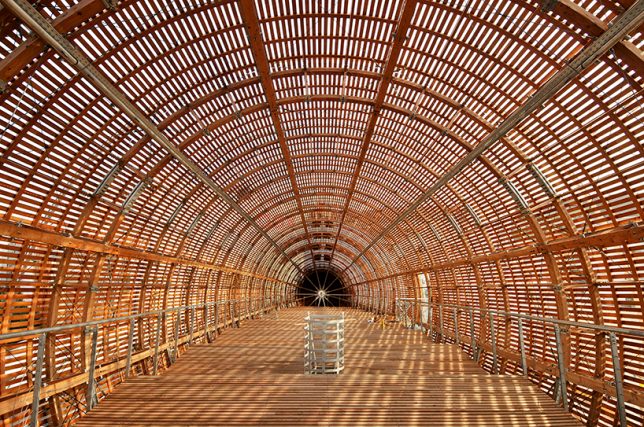
airship 1

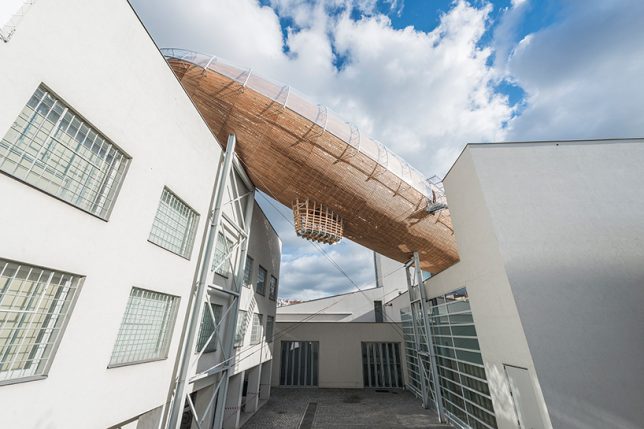
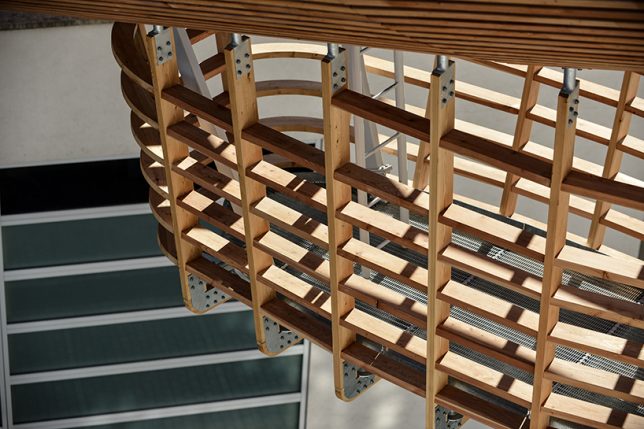
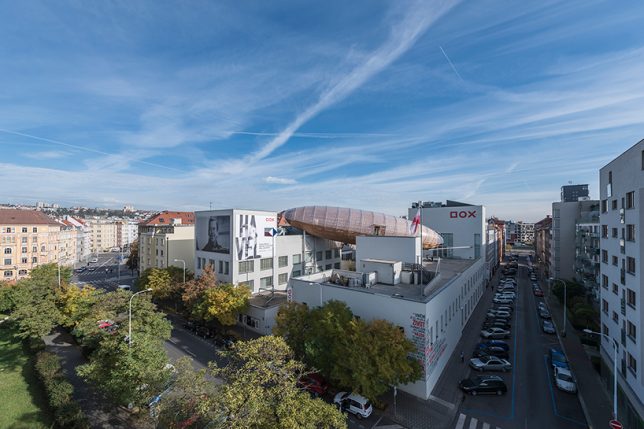
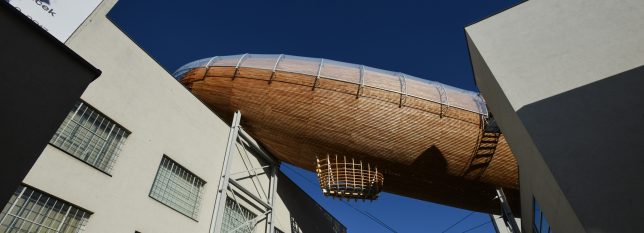
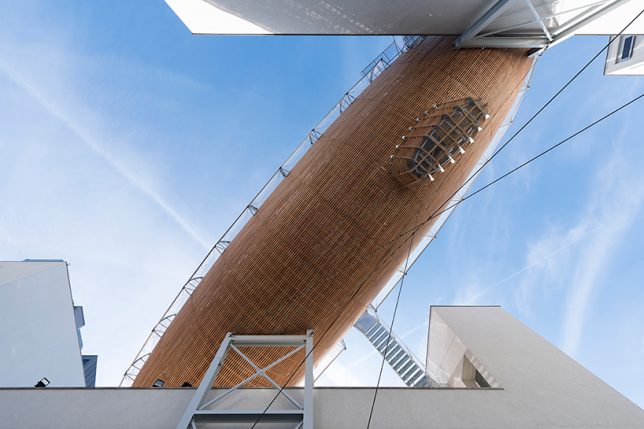
A wooden airship has seemingly crash-landed onto the roof of the DOX Centre for Contemporary Art in Prague, wedged between two white museum buildings for dramatic effect to serve as a new space for literature and reading. Conceived by Leos Valka, director of DOX, and completed by Hut Architektury, the Gulliver Airship measures nearly 138 feet long and features a basketweave-like construction open to the air, protected from the rain by a transparent roof.

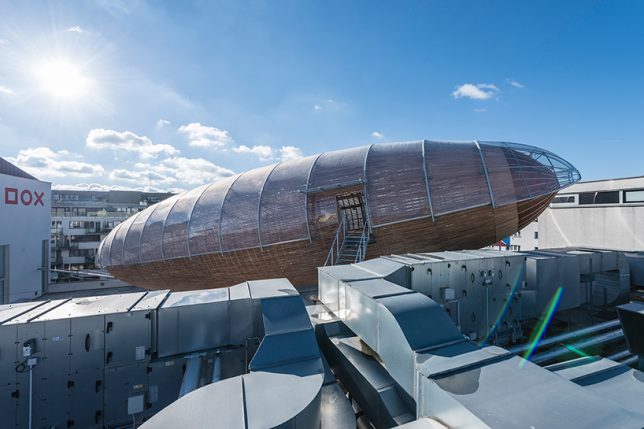
airship 2

airship 3

Taking inspiration from the zeppelins of the early 20th century, the airship aims to reflect the optimism, technological advancements and futurism of the era, inciting a sense of wonder when you gaze up at it from the ground level. Valka says he dreamed of “an absurdly fascinating organic shape” that would have a parasitic appearance, alien to the concrete and glass of the museum itself.

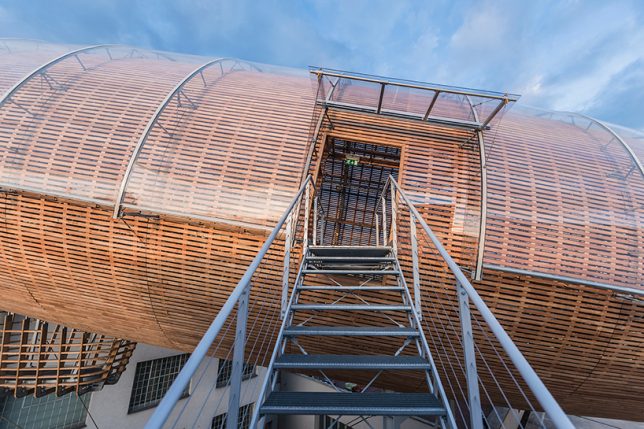
airship 4

airship 5

The ‘ship’ is accessible from the museum’s roof, and takes advantage of plentiful natural light for a pleasant reading environment. Adding such an unconventional structure is in line with the museum’s hope to encourage innovative thinking and take risks.

airship 6

airship 7

The DOX facility is a reclaimed factory, its renovation nominated for the prestigious Mies van der Role Award, and its purpose is “to create a space for research, presentation and debate on important social issues, where arts in dialogue with other disciplines encourage a critical view of the so-called reality of today’s world.”

airship 9

airship 10

“The shape of the zeppelin is symbolic,” reads a statement on the DOX website. “The early zeppelins represented the optimistic ideals of a new era of unprecedented technological advancements. With their remarkable monumentality and hypnotic dignity that would continue to fascinate generations to come long after they had vanished from the skies, they have always embodied the eternal human desire to fly, and have represented a certain utopian ideal.”

Share on Facebook


[ By SA Rogers in Architecture & Public & Institutional. ]

[ WebUrbanist | Archives | Galleries | Privacy | TOS ]


WebUrbanist

 
Comments Off on Learning Zeppelin: Wooden Airship Docked on Museum Roof as a Reading Room

Posted in Creativity


Free learning provider Alison launches build-your-own camera drone course

02 Mar

Online e-learning platform Alison has launched a new course aimed at those who want to build their own camera drones. Over four modules the course claims to teach students about the components that go into a drone and their functions, as well as how to assemble, check and fly your own quadcopter.

The course uses video tutorials that already exist on Drones Garage but adds step-by-step summaries and introductions to guide students through the information. Students must take an assessment at the end of the course to ensure knowledge has been retained and a score of 80% has to be achieved to pass. Those who pass can buy a certificate or download a free PDF that shows a record of what courses have been taken and passed.

The course is free to take after sign-up as most of the content already exists and pre-roll adverts fund the site. For more information see the Alison e-learning website.

Press release

Aerial photography and exploration: Discovering drone technology

  • Alison launches free course on building your own drone
  • Hobbyists use the course to build drones and use them to take stunning aerial photos and video
  • Multinationals and governments are piloting the use of drones for deliveries, surveillance and much more

Alison, one of the world’s largest free e-learning platforms, has announced the launch of a new course teaching people how to build their own drones. Aimed at beginners, the course is taught by experts through a series of videos.

Mike Feerick, CEO of Alison, said: “On a personal level, I find the ever-expanding field of drone technology absolutely fascinating. The opportunity for UAVs to transform industry is extraordinary; from providing new sources to journalists and delivering orders, to criminal surveillance and assisting the emergency services with search and rescue operations.”

The course teaches students how to build a Rush 4 drone for the first time. The curriculum involves learning about the process of preparing the motors, electronic speed controllers and power distribution board. Learners are also guided on how the first-person view is attached in order to film while flying the drone.

Finally, students learn about the steps that need to be taken before flying a drone, and introduced to the software tools that can prepare the drone for flying.

Mike added: “I’m excited by the idea of giving people the ability to put something this powerful together with their own hands, but also by the beauty it can capture – from photographing the coastline at angles that were previously impossible, to taking videos of kids’ birthday parties. There is a seemingly endless range of uses for these devices.”
The course is available here.

About Alison

Alison is one of the world’s largest free online learning platforms, providing free education to more than 10 million registered learners worldwide. Alison is a for-profit social enterprise with a goal to drive the cost of education and skills training to zero.
Headquartered in Galway, Ireland, Alison was founded by CEO Mike Feerick, social entrepreneur, Ashoka fellow (2010) and Harvard MBA. Alison has over one million registered learners in the United States, United Kingdom, and India with 180,000 registered learners in Ireland.

Awards
* UNESCO Award for Innovation in ICT for Education (2011)
* World Innovation Summit for Education Award (2013)
* Finalist ‘Social Entrepreneur of the Year’ World Economic Forum/Schwab Awards (2016)

Articles: Digital Photography Review (dpreview.com)

 
Comments Off on Free learning provider Alison launches build-your-own camera drone course

Posted in Uncategorized


Google RAISR uses machine learning for smarter upsampling

16 Nov
 Top: Original, Bottom: RAISR super-resolved 2x, Image: Google

Upsampling techniques to create larger versions of low-resolution images have been around for a long time – at least as long as TV detectives have been asking computers to ‘enhance’ images. Common linear methods fill in new pixels using simple and fixed combinations of nearby existing pixel values, but fail to increase image detail. The engineers at Google’s research lab have now created a new way of upsampling images that achieves noticeably better results than the previously existing methods.

RAISR (Rapid and Accurate Image Super-Resolution) uses machine learning to train an algorithm using pairs of images, one low-resolution, the other with a high pixel count. RAISR creates filters that can recreate image detail that is comparable to the original, when applied to each pixel of a low-resolution image. Filters are trained according to edge features that are found in specific small areas of images, including edge direction, edge strength and how directional the egde is. The training process with a database of 10000 image pairs takes approximately an hour. 

Once RAISR has been trained it is capable of selecting the most appropriate filter for each pixel in a given low-resolution image to fill in new pixels in order to create a higher-resolution version. RAISR can also remove aliasing artifacts, such as moiré patterns or jagged lines in the low-resolution images when creating the larger version, something that linear methods are not capable of doing.

Eventually, Google may be able to use the technology to upsample images that are sent at mobile bandwidth-friendly resolutions. More information on RAISR is available on the Google Research Blog.

 Left: Original, Right: RAISR super-resolved 3x, Image. Google

Articles: Digital Photography Review (dpreview.com)

 
Comments Off on Google RAISR uses machine learning for smarter upsampling

Posted in Uncategorized


Adobe and UC Berkeley demonstrate image editing tool powered by machine learning

01 Oct

Researchers with Adobe and the University of California-Berkeley have detailed a new AI-powered photo manipulation tool that enables sophisticated photo modification using ‘target images’ and/or crude user sketches. The end result is a realistically altered photo that has been machine-modified (or, in the case of blank images, completely machine generated) to match a target image without extensive ‘natural’ user editing.

According to a newly published study detailing the technology, this tool involves a ‘generative adversarial neural network’ that works to modify images in near-real time. As one example demonstrated in the video below, drawing a general shape over a photo of a bag causes the software to automatically adjust the bag’s size to match the sketched shape without compromising its realistic nature. The software can also generate images based on crude user ‘scribbles’ – no artistic talent required.

Articles: Digital Photography Review (dpreview.com)

 
Comments Off on Adobe and UC Berkeley demonstrate image editing tool powered by machine learning

Posted in Uncategorized


Instagram profiles reveal user depression in new machine learning study

19 Aug

A team of researchers with the University of Vermont and Harvard have published a new study detailing Instagram profiles and the hidden clues they may hold about the photographer’s mental state. Using machine learning, the team was able to identify signs of depression based off an Instagram profile’s photos, metadata, and things like facial recognition. The study looked at 43,950 photographs from 166 individual Instagram users, and had a 70-percent accuracy rate when identifying users with clinical depression.

The artificial intelligence system ultimately proved more capable of detecting depression than general practitioners, which have been found to have somewhere around a 42% accuracy rate. Hints about the photographer’s mental state lie in many things the researchers refer to as ‘markers’: the type of lighting used in the photographs, for example, and the colors of filters applied to photos. 

Dark and gray colors are often signs of depression, as well as gap in posting frequency which may indicate a depressed mental state. The number of times a photo is ‘liked’ and commented on, as well as the number of faces detected in the photos, are also notable markers. Interestingly enough, the study found that depressed Instagram users are less likely to use any photo filter, but if they do, they tend to go with ‘Inkwell.’

Via: Digital Trends

Articles: Digital Photography Review (dpreview.com)

 
Comments Off on Instagram profiles reveal user depression in new machine learning study

Posted in Uncategorized


Tips for Learning How to See Photographically

09 Aug

Open your eyes: learn to appreciate the wonder that is all around you

The camera is definitely a tool that can be used to capture moments in time, and record memories for posterity. However, the potential is there for so much more than that. If you think of the assembly of plastic, metal, and electronic gadgetry you hold in your hands as a paintbrush, and the world around you as paint, then untold possibilities await.

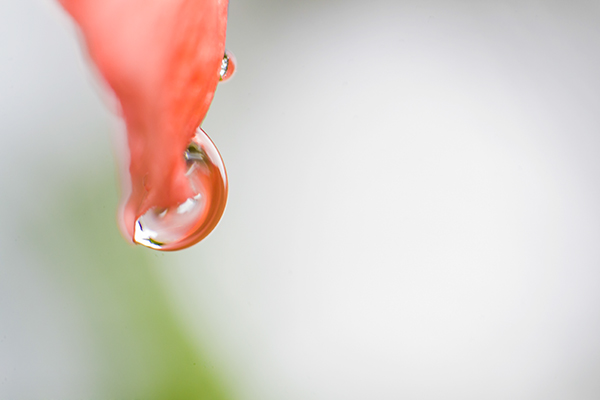
1 rain drops 9682

Look at ordinary objects in a new way

One way to investigate this idea is to use your camera as an instrument, to turn the ordinary and mundane aspects of life into something unique. For example, when you take your vehicle to the car wash and sit inside while the machines do their work on the vehicle’s exterior, what do you do? Sit and wait patiently? If you’ve got your camera with you, why not turn those few minutes into an opportunity to look through your window and consider the colours, details, and shapes that the lights, water, soap and wax make as they go through their different cycles.

2 car wash 4994

While there is certainly a whole world of possibilities when considering the abstract, sometimes a scene will present itself that simply stops you in your tracks. The subject and its background are arranged in such a way, that all you have to do is look through the camera’s viewfinder and press the shutter release.

3 fall leaves 1376

Slow down and take notice

Of course if you go about your day in a hurried manner, if you’re rushing here and there, so focused on the task at hand that you don’t notice your surroundings, then your chances of appreciating the beauty around you will be dramatically decreased. Here’s a non-exhaustive list of some ideas (and examples) to help guide your photography adventures:

  • Slow down – when you’re rushed, you will be less likely to notice interesting details.
  • Look for juxtapositions, such as the motion of water against the solidity of a rock.
  • Look for lines and shapes – like standing on a railway track, you could photograph the tracks as they converge towards the horizon.
  • Look around in all directions – if you go for a walk on a path, stop every once and a while and look back at what you’ve passed, look down at what you are walking on, or look up to the sky.
  • Photograph ordinary items in non-traditional ways – try and photograph a stream of water falling on an inflated balloon.
  • Photograph the same subject in different light and seasons – if you have a favourite tree, photograph it from the same perspective at different times of the day, or do a seasonal series.
  • Look for things that shouldn’t be there but are – a leaf poking it’s way through the snow in the middle of winter, for example.
  • Use both standalone images, and image sequences to tell a story – ski tracks in the snow leading their way up to a mountain.

4 susie triptych

Practice and practice some more

In time, and with much practice, you will most certainly develop your own style and discover what appeals to you. At first, there may be a temptation to make several exposures, which is fine. When you look at the photos later you can use the many different images to compare them with each other. This practical exercise of discovering what you like, and don’t like, is a great way to learn. Try different techniques on the same scene and compare the results later.

5 corduroy snow 0118

With practice, you’ll be able to consider a scene and learn how it speaks to you, even before you make a single exposure. Then use the knowledge you’ve gained to minimize the number of images you make, until you end up with a photograph you’re ultimately happy with.

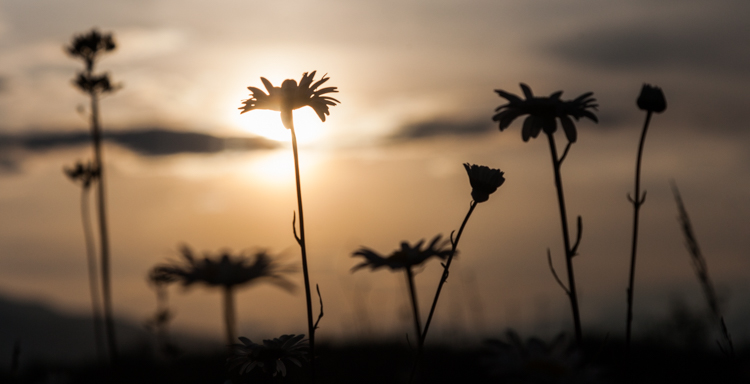
6 backlit flowers 8935

Do you take photos, or make images?

Lastly, consider the words make and take. One suggests theft and aggression (take), the other, contemplation and creation (make). Perhaps it’s only a minor thing, but when talking about your own photography, how do you describe your method? Are you a taker or a maker?

Ultimately, photography is about how you respond to a scene, and with the idea of being an image maker in mind, you’ll be in a better position to creatively express your feelings. Case in point, the following photograph of some snowflakes.

It was a very cold day on the ski hill when I stopped on a trail to consider some snowdrifts on my left. The bright sun was illuminating the snow in a brilliant way, and after half an hour or so, I left with a handful of images. This particular one stands out because of the visible details in the snowflakes. It’s a testimony to the power of something so tiny and delicate, for without it and untold billions of its friends, no ski hill would exist.

7 snow flake 1220

Time to go apply and get shooting

Homework time. Your mission, should you choose to accept it, is to go out and have fun. In the words of a former photography tour leader, go and play. I’d love to see the results!

8 crater lake hike 9995

googletag.cmd.push(function() {
tablet_slots.push( googletag.defineSlot( “/1005424/_dPSv4_tab-all-article-bottom_(300×250)”, [300, 250], “pb-ad-78623” ).addService( googletag.pubads() ) ); } );

googletag.cmd.push(function() {
mobile_slots.push( googletag.defineSlot( “/1005424/_dPSv4_mob-all-article-bottom_(300×250)”, [300, 250], “pb-ad-78158” ).addService( googletag.pubads() ) ); } );

The post Tips for Learning How to See Photographically by Curtis Cunningham appeared first on Digital Photography School.


Digital Photography School

 
Comments Off on Tips for Learning How to See Photographically

Posted in Photography


Learning curve: LensRentals examines a series of linear focus motors

21 Apr

To the point…

Quick and to the point: that’s the reasoning behind the use of linear focus motors, but it’s less true of the latest blog post on the subject, over on LensRentals.com. That’s what we love about the crew’s in-depth teardowns. In their latest post they tear apart a series of linear drive lenses and discuss the various designs they’ve encountered. Some are pretty robust and others, well, take a look for yourself…

The need for new designs

The ring-type focus motors [pictured above] that were traditionally the default choice for high-end DSLR lenses are not especially well suited to the needs of mirrorless cameras or video shooting. Contrast detection autofocus requires not just being able to move a focus group quickly but also the ability to stop it, then drive it back in the other direction, all with high precision. Video requires silent and carefully-controlled focus drive, to allow smooth refocusing while the camera is recording. These different requirements have prompted the adoption of new types of focus motors.

Linear electromagnetic motors

Among the more popular alternatives to ring-type drive is the linear motor, which features a permanent magnet and a coil of wire that, when electricity is run through it, slides along a bar parallel with the magnet. In principle these fulfill the things demanded of them: fast, precise and quiet (we’ve been very impressed by how fast some of the linear motor lenses we’ve used can be).

Surprisingly, the internet has very few good diagrams of these designs, but you can sometimes recognize lenses that use this type of motor because the focus element rattles around when the camera is switched off. This is because in many linear motor lenses the focus element is only held in position when power is being provided to the focus coil – the rest of the time, the focus carriage can just slide up and down its rails. This isn’t true of the Sony and Zeiss designs that much of the blog post discusses – these appear to have some sort of brake to stop this disconcerting behavior.

Rattle and, er, break

Generally we don’t worry too much about this rattling, but perhaps we should. LensRental’s experience with large numbers of hard-worked lenses reveals that not all linear motor designs are the same. Early Sony motors attach the moving coil to the focus element carriage with just a single blob of glue. Oddly enough, this can fail; leaving the coil racing up and down the rail but with the focus element uncoupled. Later designs do a better job of securing the moving coil to the carriage, prompting Roger Cicala to define two categories within lenses of this kind: Type 1 motors and Type 1a designs that are very similar but don’t break so readily.

No right answer

As well as highlighting a failure mechanism of poor designs, Cicala and Co’s teardowns hint at a fundamental shortcoming of linear motor’s capabilities. Fujifilm’s use of two, three and four linear motors in some lens designs suggests that they struggle to move large, heavy lens elements quickly, taking a brute-force approach.

This is also likely to explain why Sony adopted three different focus drive technologies (linear electromagnetic motor, piezoelectric direct drive and ring-type motors, sometimes in combination) in its recently-announced GM series of lenses: because there isn’t yet a single technology that provides all the necessary characteristics in a way that works for all lens designs.

Results, not technologies

Like LensRentals, we’ve seen very different results between the best and the worst examples of each lens motor type, which is why we try to concentrate on performance, rather than technology, when we write about lenses. We’ve also been lucky not to experience any of the motor failures (perhaps better described as motor detachments), that LensRentals has seen, but it’s interesting to see the designs of lenses improve as manufacturers become more experienced at using each technology. Or, as in the case of the Sony 70-200mm F2.8 pictured here, a mixture of technologies.

We also hope Cicala makes good on his promise to look at other emerging focus technologies, and the ways in which they’re developing, in the coming weeks.

Articles: Digital Photography Review (dpreview.com)

 
Comments Off on Learning curve: LensRentals examines a series of linear focus motors

Posted in Uncategorized


Tip of the iceberg: Learning photography in Antarctica

18 Mar

$ (document).ready(function() { SampleGalleryV2({“containerId”:”embeddedSampleGallery_3701426939″,”galleryId”:”3701426939″,”isEmbeddedWidget”:true,”standalone”:false,”selectedImageIndex”:0,”startInCommentsView”:false,”isMobile”:false}) });

People become interested in photography in many different ways, and at different stages of life. Some are hooked early on, and others discover the joy of making photos much later. For Kira Morris, it was the isolation and natural beauty of life in Antarctica that inspired her to take up photography. With a Nikon D7000, 18-105mm F3.5-5.6 lens and a tripod, Morris experienced the highs and lows of learning to take photographs just like the rest of us, but unlike the rest of us, her subject was both breathtaking and potentially dangerous.

Morris shared her early experiences with photography to Resource Travel, which happened to be in the coldest place in the world. She describes a place where removing thick gloves to operate dials poses a real danger, where it’s business as usual even as Auroras fill the sky, and laying down in the snow with your camera can be rewarded with a close-up portrait of one of the feathered native residents. See a few of her images here and head over to Resource for the full story.

Articles: Digital Photography Review (dpreview.com)

 
Comments Off on Tip of the iceberg: Learning photography in Antarctica

Posted in Uncategorized


Composition and Learning to See

05 May

How many times have you captured the perfect picture, only to download it and discover a rogue tree branch jutting into your frame from the side, or a random person’s head sneaking into your foreground? At one time or another, maybe even often, it’s happened to all of us – and it’s a bad habit that’s easy to repeat if we allow it. Let’s call this photo ailment of ours blind excitement; letting the excitement of our subject blind us to all other elements that are in our frame. Is there a cure? Absolutely.
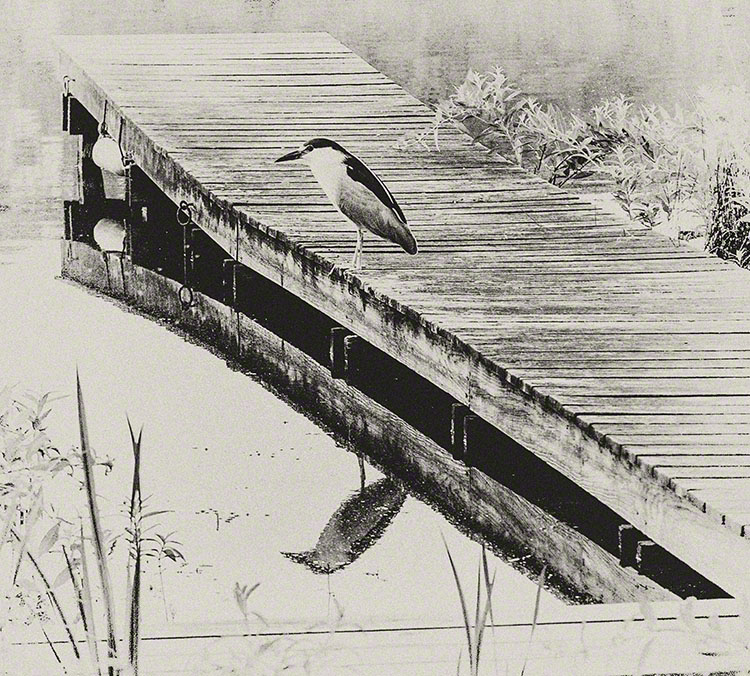
“On The Dock” – There was a lot going on here, much to see and evaluate before pressing the shutter. Other birds, kayakers on the lake, and windblown reeds all played a role in my “seeing” this image the way I wanted to capture it.

“On The Dock” – There was a lot going on here, much to see and evaluate before pressing the shutter. Other birds, kayakers on the lake, and windblown reeds all played a role in my “seeing” this image the way I wanted to capture it.

Blind Excitement

You know the feeling of looking through your viewfinder at that beautiful, rare subject that you have been waiting to capture, that’s all you see. Blind excitement, or being overcome by your subject, has kept you from seeing the other elements in your viewfinder; elements that very well may ruin your treasured image to be. You know that feeling, don’t you?

One of the best tips that I ever received on creating artistic photography came years ago from a mentor helping me to hone my photographic skills. Keep it simple; eliminate all unnecessary elements in the image, take your time, and be sure to really see what you are shooting before pressing the shutter. That’s the tip. Simple, right? Sounds like a no brainer doesn’t it? Keep reading!
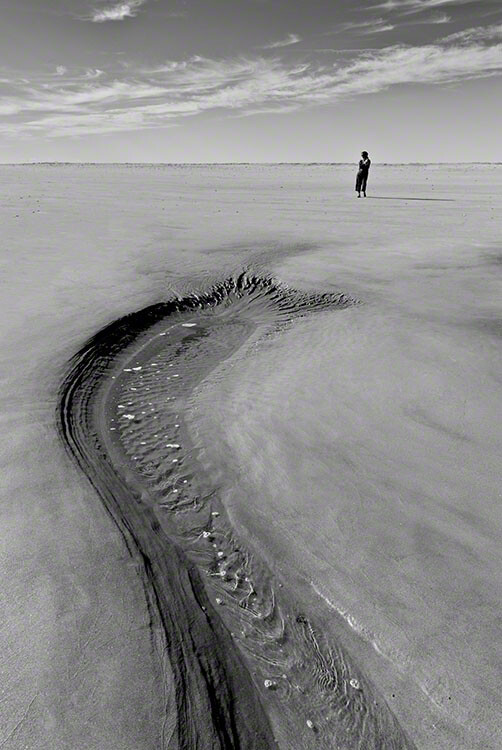
 “Beware The Serpent” – an example of being able to quickly and accurately see the whole frame and capture. The illusion of a “sea serpent “reaching for a female in background lasted but a moment.

“Beware The Serpent” – an example of being able to quickly and accurately see the whole frame and capture. The illusion of a sea serpent reaching for a female in background lasted but a moment.

Seeing…and Believing!

It does takes some work learning to slow down, breaking the ol’ trigger finger on the shutter habit for you to truly see what’s in the frame – but with that tip my photography really did start to become art. I looked through the viewfinder and began to see things that I never noticed before; things that had added no value to my image, things that only served to detract from the intended message of my work. I slowed down and LOOKED through the viewfinder before pressing the shutter, I mean REALLY looked. I walked around and found better angles, lower and higher to shoot from that eliminated photo clutter. I was no longer blinded by the main subject of my frame, but now saw everything within it.

It’s amazing what appears when you take the time to see! I had made a conscience decision to actually compose my photograph BEFORE pressing the shutter. Yes, I know…I, too, thought I was doing that all along, but surprise, surprise – I learned differently.

A Boat or Two

Baker Ashore Antigua 1

Take a look at these two images taken in Antigua. The day was amazing, the sun, the surf, music, and colors of the Caribbean all filling my head and eyes – with blind excitement. The whole idea was to capture some island flavor for a client with the colorful boat sail, the sand, and the beautiful blue water of the Caribbean. I looked and pressed the shutter, but I didn’t see! I didn’t see the second boat sneaking in behind my subject – you see it now, don’t you? Image #2 is free of this distraction and makes a much better photograph; keep it simple and clean. When the full sail came around with all that color, my blind excitement pressed the shutter and that’s all I saw. Fortunately I had other opportunities this time, and got the shot – but that won’t always be the case!

Baker Ashore Antigua 2

On Second Thought

I then began to review some of my older work scrutinizing each for the importance of the things in my images. “Wow, how could I have missed that?” was the phrase I found myself uttering more often than I care to admit. I couldn’t believe how many things I discovered stuck into my image from the edge, or lurking without value in the background. I was truly amazed at what I was now seeing. Why didn’t I see that in my frame before I took the shot? Answer: Because I didn’t know how to see.

It’s always a great exercise to take some time and look at your work from a year ago, from three years ago, etc., and compare to your latest. I am always working at my photography. To see the difference in my work from several years ago is rewarding and it also acts to confirm that compared with today, I was flying half blind back then.

See below, one of my photographs that garnered considerable attention and won multiple awards, including Best Seascape in a national exhibit. I think this is a good example of eliminating all unneeded elements in capturing the desired mood – calmness. Read what the gallery director wrote of my work Morning Calm:

BobbyBaker Morning Calm

The exhibition is showing four of Baker’s pieces, but my favorite is Morning Calm. This photograph shows how little is needed to create a beautiful and amazing image; and, while there is very little in this photograph, one can also say that there is so much in this photograph. There are so few physical elements…the horizon, a hill, a boat and its shadow. There is, of course, a lack of color. There is even a lack of shades of gray, being basically a black boat, a light gray backdrop, and a medium gray horizon and hill. But the photograph says so much with so little. The photograph has tremendous spirit and depth. It speaks…with silence. It surely says different things to different people, but, without question, this photograph speaks. A beautiful and amazing image.

While there is so little in this photograph, one can say that there is so much in this photography. Exactly! What do you want your image to say? What are the elements in your frame acting to say in your desired overall message? If you don’t know, or they are sending the wrong message, something is amiss. It’s time to recompose, time to slow down and actually SEE what you are shooting.

While Morning Calm leans towards the extreme of minimalism, you could say that I succeeded in capturing a message of calmness. That early, quiet, spectacular morning on Cape Cod when I captured this shot, I knew it would be special. I was excited looking at the subject, but I took my time, I looked at everything in my viewfinder, and positioned myself to be sure that none of the other boats would be in my frame. I waited to be sure no birds were flying in the space, absolutely still water, nothing but what I wanted my audience to see – and feel – when viewing Morning Calm. Click. I breathed and smiled, as I knew that I had learned to see and got the shot that I wanted. Knowing that you got the shot is such a great feeling, isn’t it?

BobbyBaker AloneTogether

In my image, Alone Together there are more elements in the frame than in Morning Calm; you have an angry sky, rocks and water sculpted sand. Here all the elements work together in supporting the subject (a person in thought contemplating a lone tree); they do not detract from the main subject, but add to the mood that will evoke thought and emotion from the viewer. One of the keys to creating this shot was to see, before pressing the shutter, that I needed a space between the subject’s head and the land; without this space the shot would have been ruined.

To this day, I can still recall that cold February day on Cape Cod knowing that I needed to be sure the person’s head was clear of the land and adjusting my shooting angle to be certain I had that needed space. A couple of years earlier, I know that in my blind excitement to capture the shot (believe it or not, this was not posed) I would have just gone ahead and pressed the shutter only to be disappointed later when viewing in my studio and realizing the person was attached to the land at her head. Years of practicing how to see before pressing the shutter allowed me to act quickly in surveying what was in my frame, and keying on a most important must have compositional item, the space above the subject’s head – before the subject moved and/or learned I had arrived behind them.
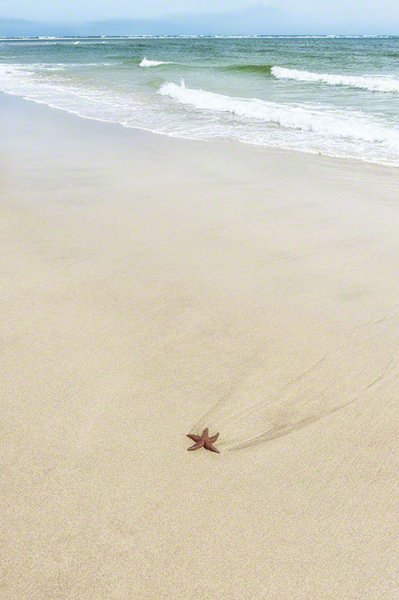
BobbyBaker_Shooting Star

“Shooting Star” – most of my work is coastal. Not only do you need to be aware of intrusions into the frame (people, birds, etc.) you must also consider the potential of intruding on beach goers privacy by placing them in your frame unwanted! Also, parents are understandably super sensitive to anyone near their child with a camera. Don’t put yourself in that position by not seeing everything!

Are you excited? Now look, and SEE!

Take a good look at your work. Look at all the elements in your image. The next time you are out shooting, pause and REALLY look before pressing the shutter. Set yourself apart from the glut of shutter-happy shooters with well thought out, well seen, well composed photography. Trust me, this exercise of making yourself pause, look, and see, will make a BIG difference in your photography and with practice will become your way of composing before shooting.

Now go make some art!

All images in this article are © Bobby Baker Photography
BobbyBaker_Rock Harbor Romp

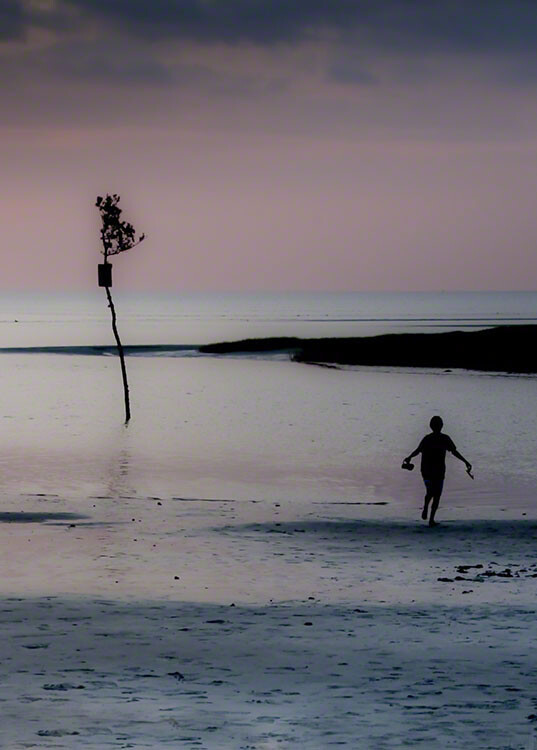
“Rock Harbor Romp” – The isolated, silhouetted person was not created by cropping, rather by moving my camera to the left while framing the image. The girl’s friends are to the right side of the frame, and I was able to see that they would create clutter in the image if captured. The lone tree and lone girl act to balance each other in this image.

googletag.cmd.push(function() {
tablet_slots.push( googletag.defineSlot( “/1005424/_dPSv4_tab-all-article-bottom_(300×250)”, [300, 250], “pb-ad-78623” ).addService( googletag.pubads() ) ); } );

googletag.cmd.push(function() {
mobile_slots.push( googletag.defineSlot( “/1005424/_dPSv4_mob-all-article-bottom_(300×250)”, [300, 250], “pb-ad-78158” ).addService( googletag.pubads() ) ); } );

The post Composition and Learning to See by Bobby Baker appeared first on Digital Photography School.


Digital Photography School
 
Comments Off on Composition and Learning to See

Posted in Photography


Reverse Lens Macro: How to use it as a Great Learning Tool

16 Jan

Reverse lens macro photography 03

Reverse Lens Macro: How to Use It as a Great Learning Tool

Yesterday one of my friends called me late and told me that he was going to buy a DSLR and asked me which one he should choose. As a friend, I knew that this was his first camera and he was in fact a complete stranger to the field of photography. I told him to buy a good compact camera in order to get used to the basic concepts of photography and to buy a DSLR only when he feels his equipment is limiting his creativity.

On the other hand are the people how have already bought an SLR, but get confused and overwhelmed by the level of control these cameras offer, and the sheer amount of effort they have to put in to make their photographs look beautiful. I write this article for those people who bought a DSLR, and are in distress seeing none of their photos looking as good as someone else’s.

Considering that you have bought a DLSR and are delving into some advanced levels of photography, let’s see how an interesting and fun technique known as reverse lens macro can teach you a great deal about your camera, light and in effect make the art of photography.

Reverse lens macro photography 01

The basic trio of photography

Before understanding reverse lens macro let’s take a look the basic trio that every photographer needs to know to take a well exposed shot:

  1. Shutter speedreverse-lens-macro-photography-02.jpg
  2. Aperture
  3. ISO

Shutter speed is in essence the duration for which light falls on the camera’s sensor, shown in most cameras as 1/250th or 1/30, lower the denominator, the longer the duration.

Aperture is the opening in the lens which controls the amount of light entering your camera and the area in your image which is in sharp focus (aka depth-of-field) usually shown as f/5.6 or f/7.1. The lower the number, the more light getting to the sensor, and smaller the area in focus.

ISO determines just how sensitive your camera’s sensor is to the light falling on it. ISO usually ranges from 50 to above 100,000 in number. Large numbers represent high sensitivity.

Macro and reverse lens macro

Macro photography is a beautiful way to capture subjects as it gives you a very different and up-close perspective of photography. What macro photography does is to help us see the small world around us in a big picture. What your lens in its normal state does is to make the big world around you small, so just think what it will do when used reverse mounted? Yes, make the small world even BIGGER. But the fact is that dedicated macro lenses cost a fortune which puts it out of the reach of many of us. Reverse lens macro technique allows you to get really close without having to lighten your wallet on expensive lenses.
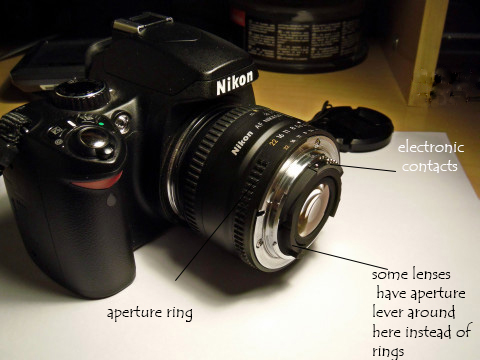
To take reverse lens macro shots, you have to reverse mount your kit lens (as depicted in the picture below).

Reverse lens macro photography 07

HOW DOES REVERSE MACRO TEACHES YOU ABOUT THE ART OF PHOTOGRAPHY?

Everything is a double-headed sword. So is reverse macro, though it allows us to get really close to your subject it also means you have less light at your disposal, a very tight frame, and a very narrow area which is in sharp focus (depth-of-field). Less light means you will have to adjust shutter speed, aperture and ISO to get good exposure and nice depth of field.

But the best part lies ahead, when you reverse mount your lens, the camera loses all the electronic means to communicate with the lens, so you will have to move your camera back and forth to get your focus right and you have to use the small lever on the back (now front) of the lens for controlling the aperture. An interesting point to be noted is that the actual focal length (55mm gets you closest to the subject for 18-55mm lens) of a lens in normal operation is also reversed, meaning that you can get closest to your subject when the lens is at its widest (18mm for the same lens). Now when you look through the viewfinder you will see the magic unfolding right in front of your eyes!

Reverse lens macro photography 06

Reverse lens macro photography 04

Suddenly your viewfinder becomes a visual textbook through which you will see all the subtle changes that aperture, shutter speed and ISO makes on your image and how subtle changes to these can bring amazing clarity and depth to your images. At first this may seem a difficult task because of the extreme stillness needed to take them successfully and clearly, but “practice makes perfect”, doesn’t it?

The interesting part being that you can apply the information you learn, when you use your camera normally. Obviously this can also be learned with time and effort but rest assured many get bored or disheartened because their photos are not looking good before they understand how to use the camera. Reverse macro, as mentioned earlier, magnifies the world beyond what our eye can see. It is because of this magnification that the effect the changes you make to (shutter speed, aperture, ISO) have on our image becomes more apparent than in “normal” use. When doing reverse macro I recommend not using a tripod because that way you will also learn to keep your hands steady (a boon when shooting in dim light).

Reverse lens macro photography 05

So because you get to see the magic of light unfold right in front of your eyes it registers quickly, and with practice becomes rather instinctive. This will startlingly improve the way you approach photography and ultimately your photos.

As Ansel Adams, a master of photography said “A Good photograph is knowing where to stand”. Understand where you stand now (as a photographer) and where you have to be standing to take photographs that exude beauty and share the emotion of the frame with the viewers.

Happy clicking!

The post Reverse Lens Macro: How to use it as a Great Learning Tool by Sharath Prakash appeared first on Digital Photography School.


Digital Photography School
 
Comments Off on Reverse Lens Macro: How to use it as a Great Learning Tool
Posted in Photography