RSS
 

Posts Tagged ‘large’

HTC U11+ combines U11 camera specs with large 6-inch display

03 Nov

HTC has launched the HTC U11+ which shares many characteristics with its smaller cousin U11. Both phones are powered by a Snapdragon 835 chipset and come with, depending on region, 4 or 6GB of RAM. They also share the same camera specifications that made the U11 one of the best camera phones in 2017.

On the back, you’ll find a 12MP sensor with large 1.4µm pixels that is combined with optical image stabilization and a fast F1.7 aperture. In video mode the U11+ can record 1080p footage at 120fps, and 4K clips with Hi-Res audio. At 8MP, the front camera pixel count has been reduced compared to the U11’s 16MP sensor. The front module also offers an 85-degree field-of-view, an F2.0 aperture and 1080p video recording.

The big difference between U11 and U11+ is the latter’s almost bezel-less LCD display with 18:9 format and a 1440×2880 pixel resolution. It means there are now no physical controls on the front and the fingerprint reader was moved to the back. The body is IP68-certified and comes in Ceramic Black, Amazing Silver and Translucent color options. There’s also a microSD card slot and the 3,930mAh battery offers support for Qualcomm Quick Charge 3.0.

In Europe, the HTC U11+ will be available for €800 (approximately $ 930). For now a launch in North America is not planned.

Articles: Digital Photography Review (dpreview.com)

 
Comments Off on HTC U11+ combines U11 camera specs with large 6-inch display

Posted in Uncategorized


Benefits of Using a Large Aperture and Tips for Shooting Wide Open

04 Oct

Upon first glance of one of my most prized lenses, the Canon 50mm f/1.2L USM, a bewildered remark typically arises from professionals and hobbyists alike. Though absolutely spectacular photographers in the industry love working with a wide open aperture, there are equally as many who wouldn’t touch anything lower than a f/4.0 with a ten foot pole.

I’d never shoot as wide as f/1.2” is a common comment I’ve encountered over the years of working as a professional photographer.

Stylistic choices aside, upon further inquiry as to why the response to a f/1.2, f/1.8, or f/ 2.0 f-stop yielded such results the truth came out. There are common misunderstandings of how to use and work with a wide open aperture! If your artistic aesthetic drools over soft, dreamy photographs and creamy bokeh, then you better get ready to play with some low, low, low numbers.

Tips for Overcoming Common Misunderstanding of Shooting Wide Open

Before we get to the “how”, let’s discuss the “why”. There are several beneficial reasons to shoot with a wide open aperture, aside from simply liking the result.

Benefit #1 – Working with a Difficult Location

Depending on the type of photography that you do, you may not always have the option of utilizing an ideal location. Maybe your client is only able to commute to one place? Maybe the location of a shoot that was booked months prior has changed for the worse upon your arrival on site? Or maybe you just have to get a specific photo done pronto and you aren’t able to find a new spot?

Whatever the reason for your woes, a wide open aperture is here to help! With the depth-of-field being so shallow, whatever troubles you about the background can easily melt into a beautiful creamy bokeh. Utilizing an f-stop of f/2.0 or lower helps you work with a less than immaculate location, as the extremely shallow depth of field allows you to mask the flaws.

Tips for Overcoming Common Misunderstanding of Shooting Wide Open

Benefit #2 – Excellent for Detail Shots

A shallow depth of field can make for very beautiful detail shots. If you look through current wedding photography trends, you may find that several heavy-hitters in the industry are turning to wide open apertures to capture photographs of the bouquets, rings, and table settings. This is because photographs taken with a large aperture allow all of the focus to lie on the subject, and the background ceases to remain a distraction.

With events such as weddings, where the arrangements can appear cluttered if you only want to focus on one little aspect of the set-up, a shallow depth of field will keep the interest solely on your single subject. Music photography adores wide apertures for the same exact reason. If you want to bring out a detail while photographing behind-the-scenes of a recording session, f/1.2 is wonderful.

Tips for Overcoming Common Misunderstanding of Shooting Wide Open

Benefit #3 – Create a Dreamy Photographs without Post-Processing

With all of the technology available for photo editing, almost anything is possible with the right knowledge. However, rather than spending countless hours in the editing room creating a specific look artificially, why not get it right in the camera?

For those who adore dreamy, ethereal, or soft photographs, a wide aperture will quickly become your most trusted friend. Filmmakers consistently utilize wide open apertures in order to create a soft focus with a shallow depth of field to give the viewer the illusion of a dream-like state. When we dream, it is often hard to clearly and sharply recollect some of those thoughts when we wake. So the idea of soft and not perfectly in focus images came to mind.

We can replicate this using an aperture of f/1.2 easily, especially if you have objects in the foreground which are just as out of focus as the objects in the background.

Tips for Overcoming Common Misunderstanding of Shooting Wide Open

Benefit #4 – Makes Low Light Photography a Breeze

Possibly one of the most dreaded phrases in photography is “low light”. Two very short, simple words that cause some of the biggest photographer headaches. This is because there isn’t a lot of available light to play with, and as such, getting the right exposure can be hard.

However, if you want to take a well exposed photo in low light, you need a lens with a wide enough aperture to let in more light. Using a lens that goes down to f/1.8, for example, is a great way to let enough light in and make the frame bright. Remember, the aperture is the hole the light passes through in your lens. The wider the aperture, the more light that enters the camera.

Tips for Overcoming Common Misunderstanding of Shooting Wide Open

Now that we’ve covered some of the “why”, let’s have a nice chat about the “how.” Many of the challenges associated with a wide aperture revolve around the focus and photographing in bright light. From a recent poll I took, here are the primary issues troubling photographers about low f-stops, and some solutions to help you solve them.

Tip #1 – Shooting in Bright Sunlight Without Overexposing

With the aperture being the opening that lets light in through the lens, and a wide aperture which lets in a lot of light, one may think that shooting in the bright sunlight is off-limits. The solution to this dilemma is taking advantage of tinted filters that darken your lens, such as a neutral-density (or ND) filter. The purpose (and benefit) of an ND filter is to reduce the amount of light entering the lens. Doing so allows you to utilize a wide aperture that would otherwise produce overexposed pictures.

Benefits of Using a Large Aperture and Tips for Shooting Wide Open

Tip #2 – Getting Critical Focus

To quickly refresh you of the basics, when you focus your camera on a subject, it establishes a focal plane. To get your subject in focus, it has to be on the focal plane. Focal planes happen on an x (horizontal) and y (vertical) axis. This means anything along either of those axes will be in focus, and anything not on them will be out of focus.

Simple, right? Well, the difficulty with a wide open aperture is that your focal plane is quite small. As you decrease your aperture number and make the opening wider, the invisible area in front and behind the plane of focus will get smaller and smaller, leaving you with much less wiggle-room. As such, distance from the subject plays a key role in your focus.

When shooting wide open, even the smallest diversion from either of the focal plane axes will cause your subject to be out-of-focus photo. You cannot take a step forward or back without the need to refocus when shooting at a wide aperture. But by keeping this in mind, you can adjust your photography technique to better accommodate the small focal plane.

Benefits of Using a Large Aperture and Tips for Shooting Wide Open
A trick to help make sure that what you want in focus is indeed sharp, is to use single point autofocus. By default, your camera will probably select either the object that’s closest to the camera or what’s in the center of the frame. By using single point autofocus, you tell the camera exactly where to focus, which is extremely helpful with low aperture numbers. Refer to your camera model’s manual to find how to change the focus setting!

Benefits of Using a Large Aperture and Tips for Shooting Wide Open

Tip #3 – Getting Multiple Subjects Sharp

Keeping in mind how the focal plane works, there are several things you can do to ensure your multiple subjects are all in focus. First, try to set up all of your subjects on the same axis. Keep everything you want perfectly in focus the same distance from the camera.

Secondly, the farther away you are from the subject, the easier it is to get the subjects all in focus. If you have a large group of subjects you’d like in focus, move further away from them!

Benefits of Using a Large Aperture and Tips for Shooting Wide Open

Tip #4 – Getting Sharp Images Generally

Sharpness is an interesting concept. How sharp a subject appears is a matter of two things: the focus the camera captures and the amount of contrast on your subject. The term “sharpness” is, in fact, an illusion. You see, for an image to be considered sharp, it needs to have contrast. If the there is little contrast in the image, the subject will not look three-dimensional regardless of whether the focus is perfect or not.

Biologically, the way that our eyes work, our vision naturally detects edges to register sharpness, and shadows and highlights in order to record the depth in a subject. This is a very important concept to understand when answering the question of how to make images look sharp.

With this now in your knowledge arsenal, proper lighting aids significantly in making your images look sharp. The other factor in an image being sharp is, of course, the focus. Ensuring that your subject is in focus using the aforementioned techniques, combined with great lighting, will make certain that your images come out sharp.

Benefits of Using a Large Aperture and Tips for Shooting Wide Open

Now that you know how to take advantage of those low numbers and wide openings, go forth, and create!

Benefits of Using a Large Aperture and Tips for Shooting Wide Open

The post Benefits of Using a Large Aperture and Tips for Shooting Wide Open by Anabel DFlux appeared first on Digital Photography School.


Digital Photography School

 
Comments Off on Benefits of Using a Large Aperture and Tips for Shooting Wide Open

Posted in Photography


Ultra large and custom film sizes now on order from Ilford Photo

06 Apr

UK black and white film manufacturer Harman Technology has announced that its annual large format and custom film ordering scheme is open from now until May 26th. The scheme allows users of cameras that take unusual film formats to order certain Ilford emulsions within a set window so the company can set aside factory time to bulk-produce formats it wouldn’t otherwise be able to make financially viable.

As was the case last year Ilford FP4 Plus, HP5 Plus and Delta 100 emulsions will be available to order in sheet sizes from 2.25 x 3.25in to 20 x 24in. Rolls are also on offer for 127 film and formats 9cm wide, as well as 50 foot rolls of 20in film. Not all emulsions can be ordered in all formats but most of the more popular formats are covered. 120 backing paper can be ordered in 100ft lengths.

Harman says there are minimum order quantities that need to be reached before manufacturing can go ahead, but in the case of the sheet films usually a single order of a box of 25 sheets is enough. Roll films though need between 2 and 15 orders to make them practical to cut.

The company lists retailers across the world with which orders can be placed and the sizes/emulsions on offer. Prices will need to be checked with those retailers. Shipping to distributors will begin in August 2017. For more information see the Ilford Photo website.

Press release

ILFORD PHOTO ULF, CUSTOM & SPECIALIST FILM MANUFACTURE 2017

Buoyed by ongoing global resurgence in photographic film use, HARMAN technology Limited is delighted to be offering film photographers the opportunity to place orders for a range of specialist film products and formats for the 12th consecutive year.

To enable this film photography revival, it is vital that a wide range of film formats are available including film for ultra large format and collectable cameras.

By consolidating orders HARMAN technology can supply products that would not normally be viable to manufacture.

“This program enables us to further support film photographers who use and value our conventional products” said Giles Branthwaite, Director of Sales and Marketing at Harman technology. “Through running the ULF program each year, we are able to satisfy the strong demand for specialist film formats. Whilst manufacture is not easy, we have been rewarded by high demand ensuring we will continue to address and care for this market.”

Films available for this year are ILFORD FP4 PLUS, HP5 PLUS, and DELTA 100 PROFESSIONAL. Not all films are available in all formats.

For a full list of the 2017 items and participating dealers visit:
http://www.ilfordphoto.com/ulf

The options available reflect what has been asked for over the past 12 years. HARMAN technology is happy to consider any other size suggestions but do not guarantee to make them available.

For sheet sizes an order for just one single box can be made, but for roll sizes this is not possible due to potentially excessive waste. Please see the minimums and multiples required next to the appropriate roll size.

Note:
Orders must be placed with the listed ULF reseller partners no later than Friday 26th May.

The UK factory will start to ship orders to Distributors during August and end users should check with the local ULF reseller for expected arrival dates.

Articles: Digital Photography Review (dpreview.com)

 
Comments Off on Ultra large and custom film sizes now on order from Ilford Photo

Posted in Uncategorized


Honor 8 Pro combines big screen with dual-cam and large battery

06 Apr

Huawei’s sub-brand Honor has today released its latest flagship – the Honor 8 Pro, which plays on a very similar level as the main brand’s Mate 9 and P10 high-end models. The 8 Pro features the same Kirin 960 chipset as the Huawei handsets and combines it with a generous 6GB of RAM and 64GB of built-in storage that can be expanded via a microSD-slot. Despite a large 4,000 mAh battery the device is very slim and the front is covered by a 5.7″ Quad-HD display. 

With a dual 12MP-camera setup the camera specification is on paper identical to the standard Honor 8 but the new Kirin chipset’s more powerful Image Signal Processor should slightly improve image quality compared to its slightly older cousin. As on all Huawei dual-cam a monochrome and a RGB sensor are combined to optimize image detail, noise levels and dynamic range as well as produce a simulated shallow depth-of-field effect. Both lenses come with F2.2 apertures and the camera is capable of recording 4K video. There is no optical image stabilization, though. The front camera uses an 8MP module with F2.0 aperture. 

The Honor 8 Pro has, at least at this point, been officially announced for European markets only and will cost you £475/590 in the UK which makes it an interesting alternative for those who want high-end looks and specs at an affordable price point. It will go up for pre-order today on the Honor vMall store and will be available in regular stores from April 20.

Articles: Digital Photography Review (dpreview.com)

 
Comments Off on Honor 8 Pro combines big screen with dual-cam and large battery

Posted in Uncategorized


LEGO at Large: Modern Block Vehicles Hit the Historic Streets of Rome

11 Nov

[ By WebUrbanist in Art & Photography & Video. ]

block-car

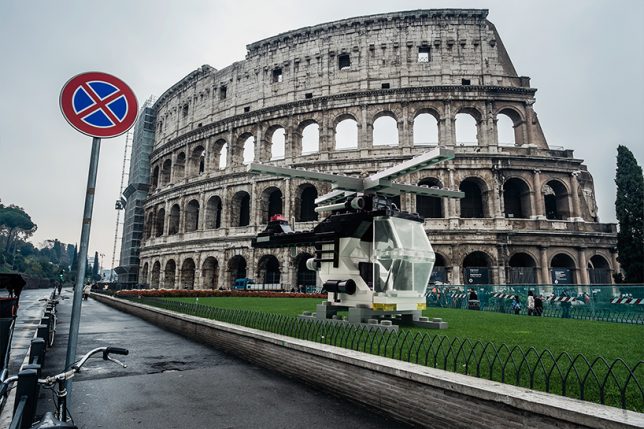
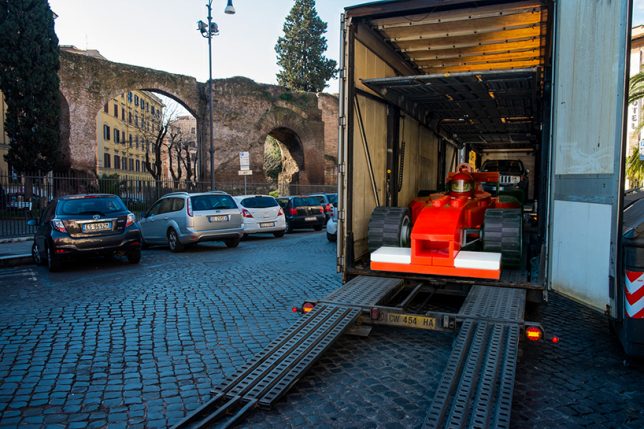
A sports car parked in a residential alley, train emerging from a tunnel and helicopter landing next to the Colosseum are all believable sights in Italy’s capital … except in this case they are constructed from LEGO.

lego-train-tracks-tunnel

lego-landing-helicopter

Italian photographer Domenico Franco imagines these block-built vehicles at human scale in his series LEGO Outside LEGOLAND, masterfully faked scenes of photo-realistic quality.

lego-race-car-unloading

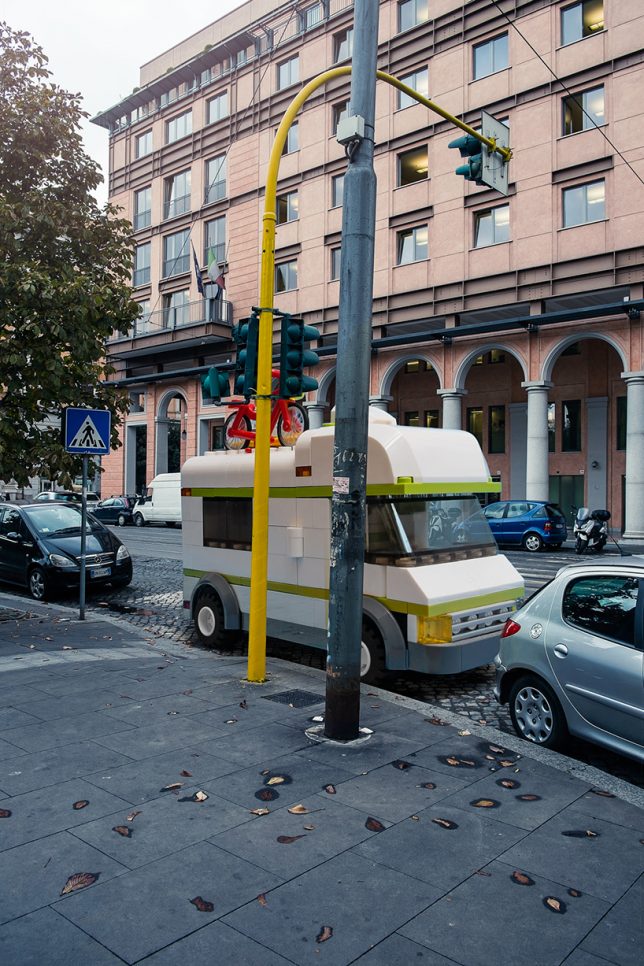
lego-large-in-rome

In his series, normal conveyances are swapped with LEGO creations that stand out as simplified block forms against the rich historical fabric of Rome.

lego-parked-speeder

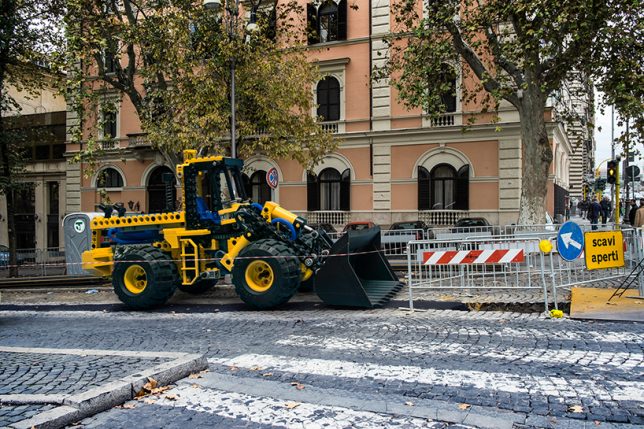
lego-construction-vehicle

While some are clearly toys writ large, others are more convincing: a passing glance at a tractor trailer doing road work might not immediately belie its fictional origins.

lego-car-tight

Landmark buildings and aged cobblestone roads come alive thanks to the contrast created by intervening toys. Ordinary gray-blue weather and aged architecture seems even more real than in a normal photograph.

lego-ambulance-parked

“The aim is to transform ordinary contexts in extraordinary ones,” says the artist, “thus compelling the toys to get out of the idyllic and politically correct landscapes belonging to their perfect and idealistic cities, with the result of instilling in them those vices, virtues and desires typical of human beings.”

Share on Facebook


[ By WebUrbanist in Art & Photography & Video. ]

[ WebUrbanist | Archives | Galleries | Privacy | TOS ]


WebUrbanist

 
Comments Off on LEGO at Large: Modern Block Vehicles Hit the Historic Streets of Rome

Posted in Creativity


Samsung Galaxy Note 7 combines S7 camera with large display, S-Pen and iris scanner

03 Aug

In keeping with its established product innovation cycle, Korean manufacturer Samsung has today launched the latest model in its Note line of large format smartphones, the Galaxy Note 7. Judging by its specifications the new device looks like an impressive package but is in many ways more of a refinement of previous models rather than a radical overhaul.

The camera module, for example, comes with the same specification as the smaller Galaxy S7 and S7 edge devices. A 1/2.5″ 12MP sensor with 1.4-micron pixel size is combined with a fast F1.7 aperture, optical image stabilization and dual pixel on-sensor phase detection AF. The front camera has a 5MP sensor and F1.7 aperture.

Processing specifications are identical to the S7 as well. The US version of the device is powered by a Qualcomm Snapdragon 820 chipset while the international versions will come with Samsung’s own Exynos octa-core chip. All models come with 4GB of RAM and 64GB of internal storage that is expandable via a microSD-slot.

The Note 7’s characteristic 5.7″ dual-edge display offers Super AMOLED technology and a 2560 x 1440 Quad-HD resolution. It’s also the first display to feature Gorilla Glass 5 which should survive a drop from 1.6 meters height. As on the predecessor, the edges of the display are curved and offer Samsung’s unique Edge interface for quick access to contacts and apps. While some competitors have started to dispense with the headphone-jack the Samsung still offers this standard connector, next to a new USB Type-C port. All the components are powered by a 3,500mAh battery, which is a little smaller than the variant in the S7 Edge.

Notable new features include an iris scanner above the display that allows you to unlock the phone or access secured content. Samsung says that in the future the scanner will let you log into accounts or use Samsung Pay, but none of these functions are currently implemented. The design of the Note series’ characteristic S-Pen stylus has been slightly altered, too. It is now water-resistant and at 0.7mm comes with a thinner tip which should make for a more natural writing experience. 

Overall the Galaxy Note 7 looks like an appealing proposition for those users who like to work with larger screens and a stylus for photo editing. The camera module has already been tried and tested on the Galaxy S7 models and currently among the very best. 

Articles: Digital Photography Review (dpreview.com)

 
Comments Off on Samsung Galaxy Note 7 combines S7 camera with large display, S-Pen and iris scanner

Posted in Uncategorized


Dual-camera rumored to be reserved for large iPhone variant

05 Apr

We’ve seen several rumors about the next iPhone generation coming with a dual-lens camera setup. Now it seems that, like image stabilization, this premium imaging feature will be available only in a larger model. Read more

Articles: Digital Photography Review (dpreview.com)

 
Comments Off on Dual-camera rumored to be reserved for large iPhone variant

Posted in Uncategorized


Fotodiox introduces extra large WonderPana Free Arc system for Canon EF 11-24mm wide zoom

31 Mar

$ (document).ready(function() { SampleGalleryV2({“containerId”:”embeddedSampleGallery_4391102760″,”galleryId”:”4391102760″,”isEmbeddedWidget”:true,”standalone”:false,”selectedImageIndex”:0,”startInCommentsView”:false,”isMobile”:false}) });

US accessory manufacturer Fotodiox has announced an XL version of its WonderPana Free Arc filter system for wide angle lenses that it says is designed specifically to allow users of the Canon EF 11-24mm F4L USM lens to use filters over the front element. The Canon super-wide zoom has no filter thread of its own and the front element is heavily convex, so fitting filters in the traditional way is impossible. The WonderPana Free Arc system positions a filter holder over the front of the lens that takes 186mm screw-in filters and/or 80mm rectangular filter sheets. The holder is enormous so that large filters can be used to avoid vignetting when the lens is used at its widest setting.

The Free Arc clamps the hood of the lens between its collar and the screw-on filter-holding cone, and provides a 186mm thread for the company’s screw-in filters. A set of brackets can also be attached to the cone that allow two square filters to be fitted as well. The system makes it possible to fit one round filter and one square filter at the same time, and the whole filter stage is rotatable so graduated filters can be positioned to suit the subject.

The Fotodiox WonderPana Free Arc XL costs $ 225.95 and the 183mm filters start at $ 99.95. For more information visit the Free Arc page on the Fotodiox website.


Wide? Ultra-wide? WonderPana has you covered.

Ultra wide-angle lenses are typically impossible to filter due to their bulbous front lens element, lack of filter threads and potential for severe vignetting. The ALL NEWWonderPana FreeArc XL, however, is the latest in our line of aluminum filter collars that let you to attach our massive 186mm filter options, like ND 4-1000 and circular polarizers, to wide and ultra wide-angle lenses.

Perfect for landscape and architectural photographers and filmmakers, we designed the WonderPana FreeArc XL to suit Canon’s new breed of 11-24mm lens. Durable and lightweight enough for hand-held shooting, it can be ready at a moment’s notice to answer any image challenge that requires filters. You can even keep it installed on your lens as a critical layer of lens protection. Just check out our video below to learn more:

Articles: Digital Photography Review (dpreview.com)

 
Comments Off on Fotodiox introduces extra large WonderPana Free Arc system for Canon EF 11-24mm wide zoom

Posted in Uncategorized


Canon launches a pair of new large format printers aimed at the professional market

09 Mar
The Canon imageProGraf Pro-4000

Canon has announced it will introduce two new large format printers for professional photographers as part of its imagePrograf Pro series. The Pro-2000 and Pro-4000 both use 12-color Lucia pigment ink systems and produce either 24in or 44in prints. With their black bodies and ‘accentuated red line’ the printers are designed to link visually with the Canon EOS range of cameras to emphasise that they are intended for photo-quality printing and made to get the most out of EOS files.

A transparent Chroma Optimiser ‘ink’ is used alongside the colors that Canon says improves ‘print performance on gloss papers’ – which means it evens out the finish between the inks and the paper so the inks don’t stand out.

The printers are due to arrive in the middle of the year priced $ 5995 for the Pro-4000 and $ 2995 for the Pro-2000.

For more information visit the Canon website.


Press release:

Canon launches new imagePROGRAF PRO series for unmatched image quality and productivity

Canon Europe, world leader in imaging solutions, today announced a new range of imagePROGRAF PRO large format professional inkjet printers. The new imagePROGRAF PRO-2000 and imagePROGRAF PRO-4000 are designed to bring stunning image quality to professional photographers and fine art applications, while the new imagePROGRAF PRO-4000S and imagePROGRAF PRO-6000S deliver fast and reliable printing to high-volume print service providers that require photo quality prints such as posters, banners and canvas.

Superior image quality for professional users
The 12-colour PRO-2000 and PRO-4000 enable the full clarity and texture of photographs taken with a Canon EOS camera to be perfectly reproduced. Thanks to Canon’s unique input-output technology and Crystal-fidelity feature, photos look as accurate printed as when they were captured. Available in two sizes (24” and 44”) the PRO-2000 and PRO-4000 feature an attractive black design with an accentuated red line, denoting the link with Canon EOS digital cameras. The new devices use newly developed LUCIA PRO pigment ink to meet the demands of the most critical photographers and graphic artists, as well as transparent Chroma Optimiser ink to improve print performance on gloss paper.
Mathew Faulkner, European Marketing Manager for Wide Format Group, Canon Europe says “At Canon, we understand the importance of fine detail and precise colours to professional users. Images shot on even mid-range cameras can be very high resolution, and with the ability of today’s image editing software, this demands a highly accurate and colour-consistent output. The powerful technology of the new PRO-2000 and PRO-4000 models, not only provide incredible image reproduction, but the small footprint makes them ideal for any office, studio or design department.”

Unbeatable efficiency for print service providers
Also available in two sizes, (44” and 60”), the PRO-4000S and PRO-6000S boast an ergonomic compact design, which is ideal for time and space-pressed print operations in graphic arts, advertising and creative sectors. With a powerful L-COA PRO engine capable of processing large volumes of high-res images and data with ease, the new devices enable poster-quality printing at twice the speed of current imagePROGRAF 8 colour models. Full connectivity and Wi-Fi functionality ensures optimum productivity for busy environments.

Mathew Faulkner continues, “Whether for PSPs or in-house print departments in retailers or educational facilities, the trend towards more operational efficiency and on-demand printing is undeniable. There is a growing requirement not only for high quality imaging, but for ease of use and efficient media handling, as well as high-speed and uninterrupted printing to support high-volume output. These fundamental tools require a powerful and dependable large format printer. The PRO-4000S and PRO-6000S deliver speed, accuracy and colour vibrancy, making them ideal for both print-for-pay and print-for-use environments.”
The new devices feature Canon’s unique dual roll technology to support continuous paper feeding and take-up of printed output, while direct printing from a USB memory stick enables fast and easy prints. The imagePROGRAF PRO series is further improved by the new precision 1.28” wide print head and high-capacity ink tanks for fast, uninterrupted printing.

The new imagePROGRAF series will be available across Europe from the middle of 2016. To see the new imagePROGRAF PRO series in action, visit Canon at FESPA Digital 2016 from March 8-11, Stand F100-F120

Articles: Digital Photography Review (dpreview.com)

 
Comments Off on Canon launches a pair of new large format printers aimed at the professional market

Posted in Uncategorized


Epson introduces quartet of SureColor large format printers, new extra-dense UltraChrome HDX ink-set

26 Sep

Epson has announced that it will be selling four new printers for the professional market starting in November this year. The 24″ and 44″ models are designed for photographers, artists and graphic designers, and offer extended color gamut via improved 8- and 10-ink systems. Read more

Articles: Digital Photography Review (dpreview.com)

 
Comments Off on Epson introduces quartet of SureColor large format printers, new extra-dense UltraChrome HDX ink-set

Posted in Uncategorized