In this video from Photokina, Panasonic’s Matt Frazer walks us through the features of the new Lumix DMC-LX100 compact camera. Matt also explains Panasonic’s use of a multi-aspect four thirds sensor, discusses lens design and manufacture, and explains the camera’s 4K video capabilities. See video
Tag: Interview
-
Interview: Canon’s Chuck Westfall Discusses the 7D Mark II
Join us for a video interview with Canon’s Chuck Westfall, Technical Advisor at Canon U.S.A.’s Professional Engineering and Solutions Division, in which he talks us through some of the features of the new EOS 7D Mark II DSLR, introduced this week at Photokina.
-
Interview: Oded Wagenstein – Author of Snapn Travel Guide and dPS Writer
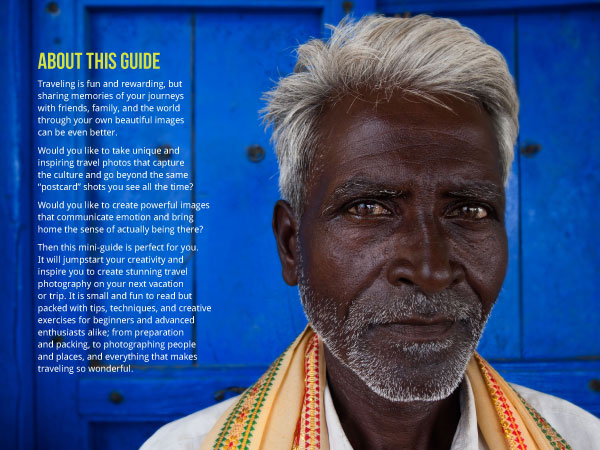
Oded Wagenstein is a travel photographer and writer. He’s built a reputation taking intimate portraits from around the world and is a regular contributor to National Geographic Traveler magazine (Hebrew edition).
Regular readers will be familiar with Oded’s wonderful photography and articles. We’re interviewing him here at dPS because we have just published his new ebook about travel photography.
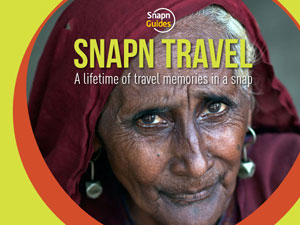 It’s called Snapn Travel – A lifetime of travel memories in a snap, and it’s available from our sister site Snapn Guides. It’s a fantastic ebook that will help any photographer who is planning a trip to another country to take better photos while they are there.
In Snapn Travel Oded writes about the importance of creating images that tell stories. He explores the process that he undertakes on any travel assignment, from initial research to working in the field, to come away with powerful and evocative images. We’ll delve a little deeper into some of those topics in this interview.
The Interview
In your ebook you start by saying that travel photography is all about portraying the stories and emotions we find during our journeys. Can you elaborate on those ideas? How does one go from taking snapshots of places you see on your travels to taking photos that make full use of emotion and story?
Oded: Travel photography is almost as old as photography itself. Magazines and commercial photo publishers used to send travel photographers like Francis Bedford and James Ricalton to “exotic” places in the east to bring back some of that “oriental flavor” that everyone in the west was so badly after in the nineteenth century. Even until recently, if you visited a remote tribe in Africa and got an image of someone with a bone through his nose, you got yourself a “worthy” image.
But those days are over! We live in an era of digital photography, where cameras are so common, that even this tribe might have its own smartphone camera. Today, it is really hard to create fresh images that the world hasn’t yet seen. So, from my point of view, today, an image alone is not enough, as you must be able to tell a visual story. Don’t show me India, I know how India looks, tell me how traveling in India felt for you. If you want to sum up my philosophy: shoot what you feel and make your viewer feel the same.
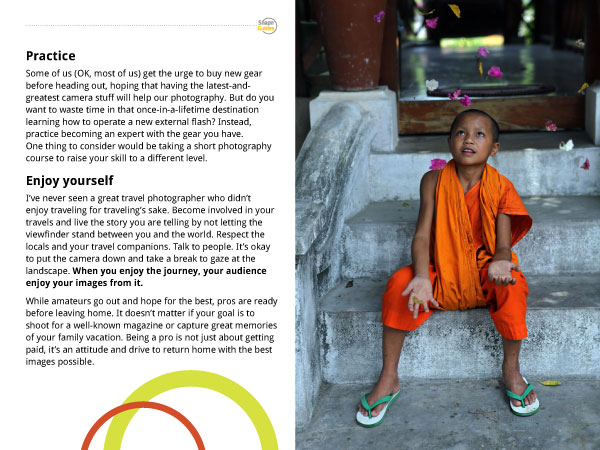
A lot of your photos are portraits. How do you find willing subjects for your portraits when travelling?
Oded: Portrait photography is a “give and take” relationship, not “take and take”. I try to make it as fun as possible for the person I photograph. If he wants to tell me a story, I listen, and always do my best to send the photo to him. I make the process a conversation, and not a photo shoot. This lets my subject forget about the camera.
One of the most important skills I learned is to ask a person a question, shoot while he’s answering, and while I’m thinking about the next question. This makes everything natural and “flow”. Portrait photography is so much more than controlling aperture and shutter speed.
How do you overcome obstacles such as language differences or suspicion of foreigners?
Oded: I always travel with a fixer, who is a local that can serve as a guide and translator.
How do you become involved with the people that you meet? How do you come across as a traveller who is genuinely interested in people rather than a tourist who perhaps sees the local people as little more than subject for photos?
Oded: First, as obvious as it may sound, I am really interested in them. The image for me is just a byproduct: a nice byproduct, but not the goal. I am an image maker because the camera helps me “see” the world in a better way. It lets me start a conversation with a stranger, and maybe have a cup of tea with them. The camera is my bridge to the world and besides being interested in the person’s story, I always try to get inside the story and not watch it from outside. For example, once I was invited to a local Tajik wedding. I took a few pictures but then put the camera down and got on the dance floor. The next time I took out my camera, the pictures were much better.
Can you talk us through the differences between working on an official magazine shoot and going to a location purely under your own initiative?
Oded: I treat both scenarios exactly the same way. In both, the responsibility to come back with the best results is all on the photographer’s shoulders and no one can tell you exactly what to shoot and where to go. The magazine can help you with ideas or hiring a fixer (local guide), but you are your own boss, for better and for worst.
I do my visual research and learn about the culture (history, food, music, religion, etc.). On the ground, I hire a fixer and do my best to come back with the best images, even if it takes me long days, hard walks, and enduring extreme weather.
In my travel photography workshops, I always refer my students to the “client”. From my point of view, we all, professional and amateurs alike, have clients. Our clients are our viewers and friends, and I treat my Facebook viewers and my magazine editor with the same amount of effort and professionalism.
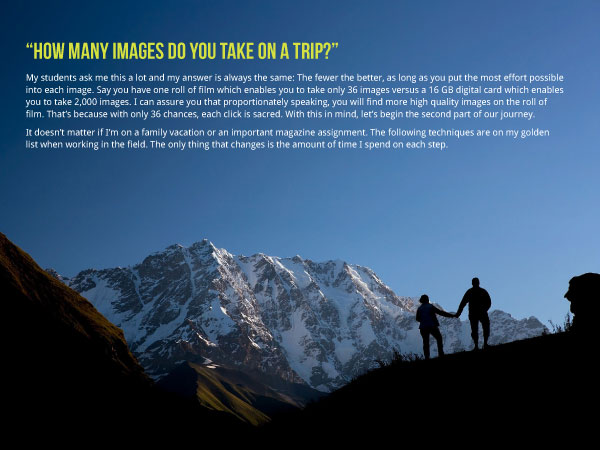
I like this piece of advice: “Discover things not commonly photographed and your stories will always be two steps ahead of the crowd.” Can you explain this in a little more depth? How do you find the things that are not commonly photographed?
Oded: You don’t have to travel far, or trek for miles, to find those places. You just need to think outside the box. For example, I did a story not long ago on Bollywood. India is so complex and rich, but I think that we always see the same things about the country: poor people in really colorful clothes. So I wanted to show a different side of India: rich and glamorous.
My students struggle to find interesting things to photograph in their own towns. And I tell them that one’s ordinary breakfast or road to work is another’s “exotic” country.
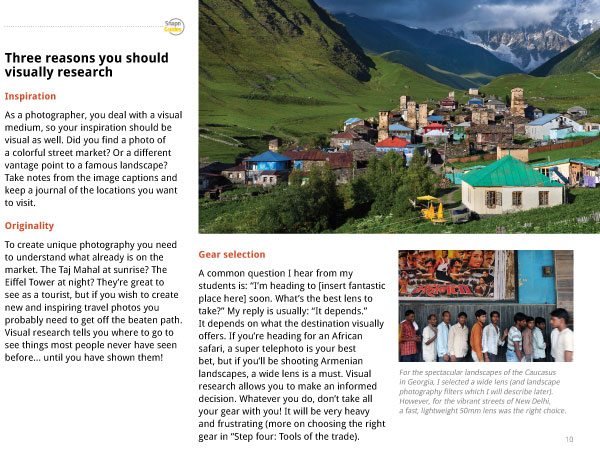
Last year I spent a week in the north of New Zealand’s South Island. I took some landscape photos but I wasn’t really happy with the results. It made me realixe just how hard landscape photography can be – you’re relying on the weather and light to do its part, and in many ways as a photographer, your hands are tied. You have to work with the landscape as it is, and (digital manipulation aside) there is nothing you can do to change it. Bearing in mind there isn’t much happening in a cultural sense in this part of the world, what advice would you give me if I was to go back to the same place and try again? How can I move from taking uninspiring landscape photos to finding and telling an interesting story?
Oded: This is a good question. Here you have two approaches:
The passive approach, or coming at the right time. Just come in the right season, the right day, at the right time. Say a cloudy winter day with golden rays of sunrise.
The active approach, or creating the right time. Good lighting is always needed, but bring a tripod, a good looking hat, a backpack, and capture yourself enjoying the view. You will see how the image becomes better because you added a “main hero” to the image and because people love watching other people. Don’t avoid people in your landscape photography, that’s my advice.
Traveling to a distant and exotic location is one thing, but given that most people can only spend a short time of the year doing this, what about the idea of travel photography in your own back yard?
Oded: Buy the Lonely Planet guide (or any other guide book) on your own country and travel by it. Take a silly tourist’s hat and view some postcards. See your own back yard as a tourist. Think of places you have special access to – maybe there is an interesting story or a person in your family (I have a few), maybe your job is not ordinary, and maybe your mother just cooked a local dish that I, as a foreigner, would love to see.
Do you have any questions for Oded about travel photography? Please let us know in the comments. And don’t forget to check out Snapn Travel – A lifetime of travel memories in a snap.
The post Interview: Oded Wagenstein – Author of Snapn Travel Guide and dPS Writer by Andrew S. Gibson appeared first on Digital Photography School.
-
Interview with Jim Mortram – Small Town Inertia
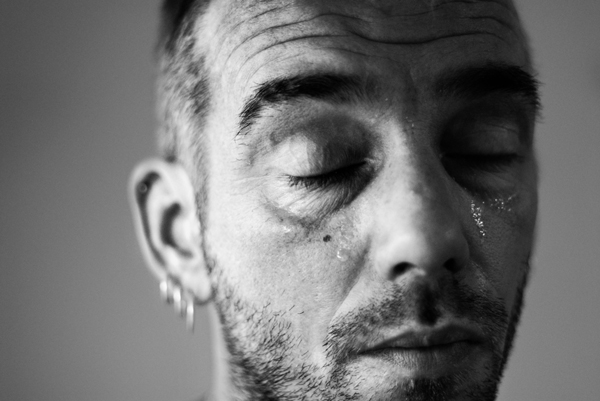
Recently Darren brought to my attention a guy in the UK doing something extraordinary. A project with images so emotion filled and powerful, images that reach into the souls of the people in the photographs and brings them out in the image. I reached out to him and asked him for an interview and he was most gracious to agree!
So I’m proud to share this with you. Jim Mortram and his Small Town Inertia project. The interview is a bit long, but I promise you it’s worth it as we cover a gamut of topics and look through many of his images. If you want to learn about doing photography not as a technician, but as a human being. Photography for the sake of just doing photography and capturing people’s stories – I encourage you to listen.
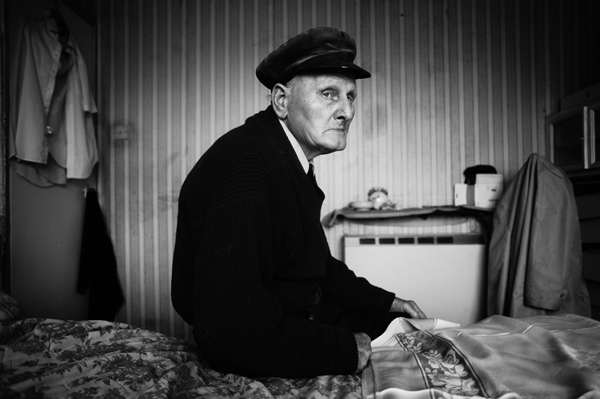
Watch and learn as Jim and I discuss a ton of different photography related things, and a few more deeper philosophical, life things. There’s some good lessons in here – make sure you watch the whole video. Tell me what nugget of information you get. Here are a few of the topics and highlights of our chat:
- shooting with your heart first and your camera second
- listening to people, “shut up and listen”
- creating a legacy of the people in your photos (not subjects, listen and find out why I’m not using that word)
- how he defines himself not as an artist but as a conduit or facilitator to get people’s message across
- that it’s about mutual trust between photographer and person being photographed, trust is key to the afore mentioned success
- thoughts on gear and why Jim believes everyone should be forced to start with a crappy camera – by law
- get a bad camera and learn to get the best out of it, then advance – cameras are just tools
- a camera doesn’t give you any special rights or power – the rules of behaviour still apply
“be nice, be attentive, give a damn, listen”
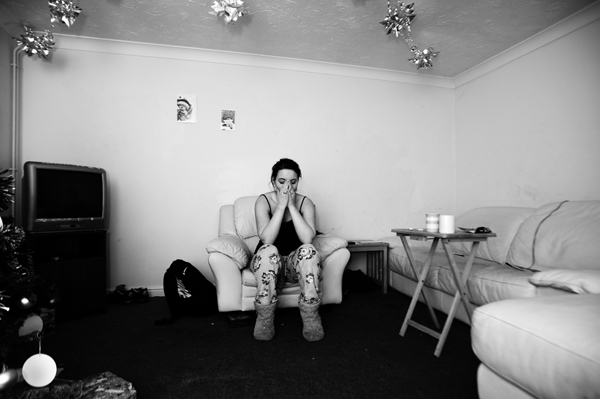
More nuggets from Jim Mortram:
- be really interested in people, their hopes and dreams – otherwise you’re just going to get a picture of someone looking at a camera
- motives – if you start looking for accolades it will change the relationship with that you do – photography
- the story doesn’t stop when you’ve pressed the shutter or edited the images
- why posting photos on Facebook just to get likes isn’t why he does photography, he just wants to be himself and why you want to do the same
- think about the things that matter to you the most before starting any long term projects, especially if it involves another person
“I talk more than I shoot and I listen more than I shoot” – Jim Mortram
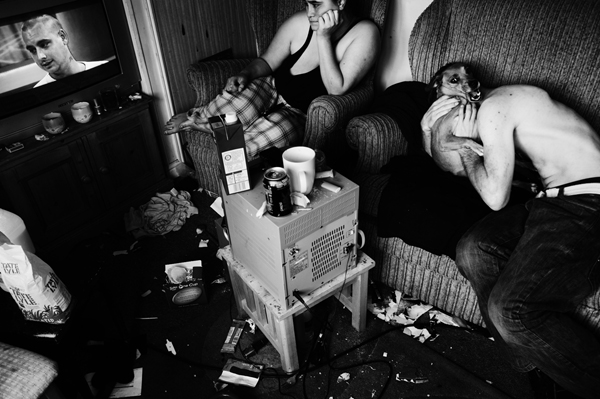
We reference a guy named Simon in the video – here are some images of Simon. You can read about his story on Small Town Inertia here.
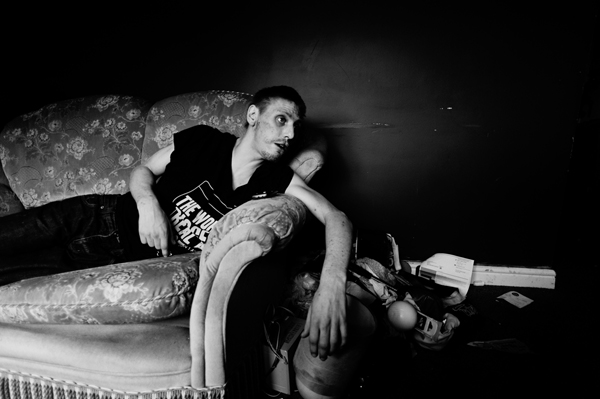
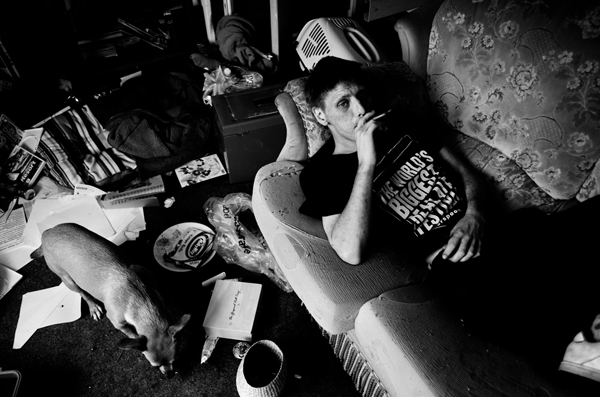
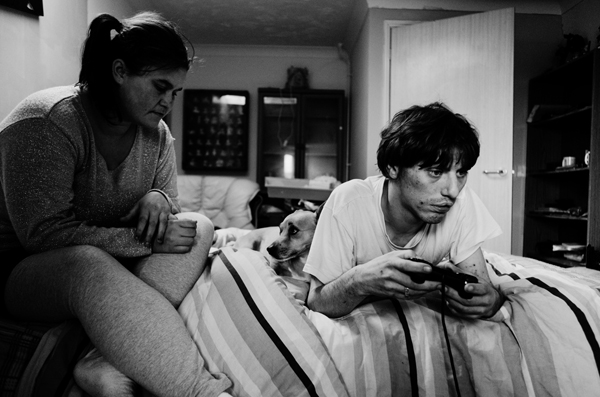
Another one of the stories on Jim’s site that touched me was that of David. A man who lost his eyesight in a tragic accident and depended entirely on his elderly mother for everything, and then suddenly she was gone. The story of his struggles are very real and gut wrenching and I was pulled in to read more. Obviously others have too as a fundraiser was done to buy David a book scanner so he could “read” again. See if his image and story speak to you as well – read more on David here (he is in the image the top of the article also)
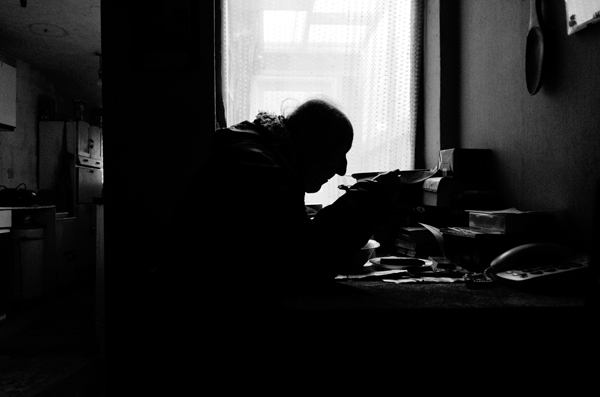
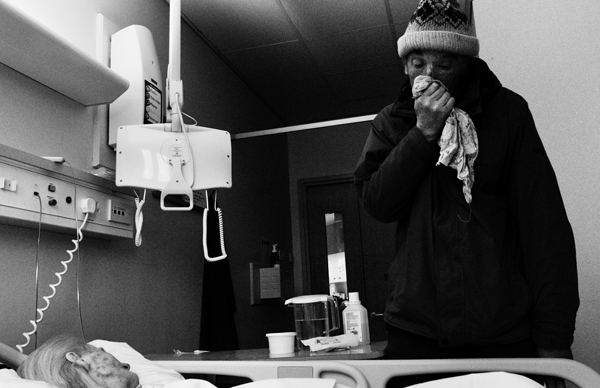
Final goodbye
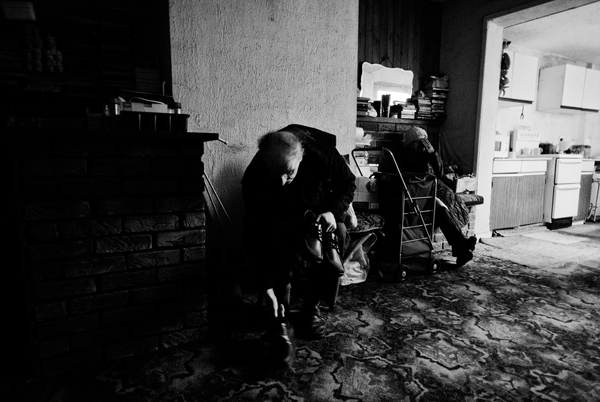
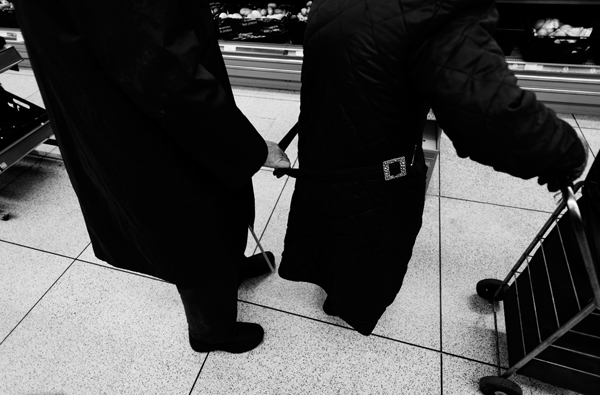
Following Mother
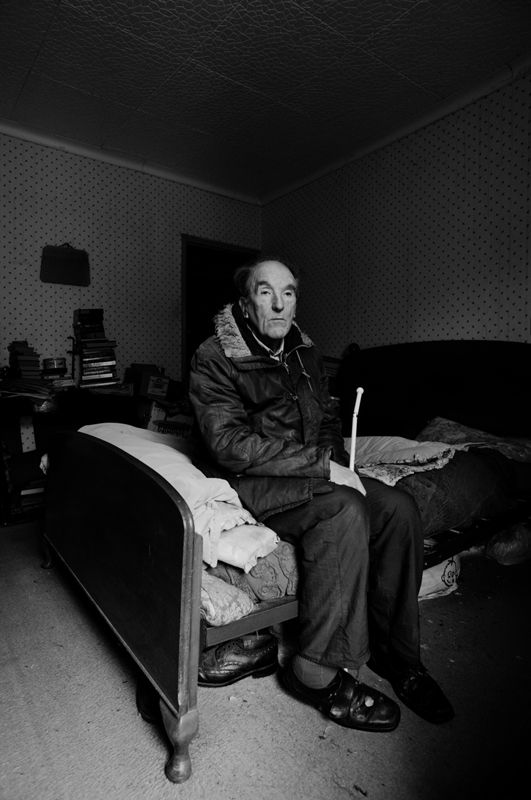
Find Jim online and connect with him. Tell him is his images spoke to you as they did to me.
- Twitter @JAMortram
- Flickr for more photos by Jim
- Small Town Inertia for more stories and photos
- Small Town Inertia blog on Tumblr
Links to other interviews with Jim:
- Out of the Blackness – United Nations of Photography
- BBC News in Pictures
Read more about respecting the people you photograph here on dPS.
Trailer that we mention in the interview where Simon talks about wanting a camper van (RV) and his eyes light up, bringing me and Jim to tears.
Small Town Inertia : A Prison Without Walls : Teaser_Full from J A Mortram on Vimeo.
A PRISON WITHOUT WALLS
Si shares, in his own words, his ADHD, his experiences of life confined by parameters and self medication, and his endurance, fears and dreams whilst living on the fringe.
‘A prison without walls’ was one of a selection of short documentary films commissioned The New British and screened Friday, 27th of September, 2013 at the Victoria and Albert Museum, London, United Kingdom.
The post Interview with Jim Mortram – Small Town Inertia by Darlene Hildebrandt appeared first on Digital Photography School.
-
Canon Interview: ‘We don’t see the smartphone as an enemy’

Recently, editor Barnaby Britton had the opportunity to interview senior figures at Canon Inc. on two occasions, in Japan. The first meetings were held in late 2013 at Canon’s headquarters in Tokyo, and a follow-up interview was arranged at the recent CP+ show in Yokohama. Topics covered include the future of Canon’s mirrorless system, how Canon is innovating in its DSLRs and what 4K video means for photographers. Click through for the full interview.
-
Nikon D4s: CP+ Hands-on and interview

Nikon has officially launched its new flagship DSLR, the D4s. Offering a number of improvements over its predecessor the D4, the D4s features greater ISO sensitivity in stills and video mode, a new 60p video capture option and some minor design changes. At the recent CP+ show in Yokohama, Japan editor Barnaby Britton was able to sit down with the new camera and two of the men responsible for creating it. Click through for a hands-on tour of the D4s and insights from its creators.
-
CP+ 2014: Nikon Interview – ‘our cameras need to evolve’

The CP+ show in Yokohama Japan has just closed, but in between visits to the various booths we made time to sit down with four senior Nikon executives to get their thoughts on the state of the market, future opportunities and the inevitable coming together of stills and video. Click through to read the full interview.
-
CP+ Sigma interview – ‘We survived because we make unique products’

We’re at the CP+ show in Japan this week and one of the busiest stands belongs to Sigma. Best known for manufacturing lenses, Sigma is showing off its latest camera, the dp2 Quattro. Editor Barnaby Britton sat down with Kazuto Yamaki, CEO of Sigma, for a chat about the Quattro, as well as the challenges of the modern photography industry and what it’s like being the head of a family business.
-
CP+ 2014: Fujfilm interview – ‘The only way is to keep innovating’

We’re at the CP+ show in Yokohama, Japan where Japanese camera and lens manufacturers show off their latest products to a domestic and international audience. Today, Toshihisa Iida, senior sales and marketing manager at Fujifilm found time to sit down with editor Barnaby Britton to discuss a range of topics including the reception of the new X-T1, firmware updates to older and existing models and the possibility of larger-format X-Trans cameras in the future… click through to read the full interview.
-
25 January, 2014 – Phase One IQ250 – First Report and Video Interview

Phase One announced today their new IQ250, 50 Megapixel medium format back, which uses a CMOS sensor for the first time in a medium format. This sensor is made by Sony, the first time that a Sony sensor appears in an MF product.
Part One of our on-going analysis of the IQ250 features online a video interview with Phase One executives, a video on how the back’s Live View works, and sample ISO 6400 images, as well as our initial impressions of the back. The article contains price and delivery information, which incidentally begins this coming week.
Kevin and Michael are leaving today (Jan 24) for two weeks in Chile and Antarctica, and will be testing the IQ250 on this expedition. Part 2, full report and video coverage will follow.
And speaking of Antarctica –
we have a few spaces left on our January 31 through February 9, 2015 Antarctic workshop.