RSS
 

Posts Tagged ‘including’

Apple Raw update brings support for 10 cameras, including D610

14 Nov

Aperture.png

Apple recently released Digital Camera RAW Compatibility 5.01 for Aperture 3 and iPhoto ’11. The update adds Raw image support for the following 10 cameras: Canon PowerShot G16, Canon PowerShot S120, Fujifilm X-A1, Nikon COOLPIX P7800, Nikon D610, Olympus PEN Lite E-PL6, Panasonic LUMIX DMC-GX7, Panasonic LUMIX DMC-LF1, Sony Alpha ILCE-3000, and the Sony Alpha NEX-5T. Get the update

News: Digital Photography Review (dpreview.com)

 
Comments Off on Apple Raw update brings support for 10 cameras, including D610

Posted in Uncategorized


Apple Raw update brings support for 10 cameras, including D610

14 Nov

Aperture.png

Apple recently released Digital Camera RAW Compatibility 5.01 for Aperture 3 and iPhoto ’11. The update adds Raw image support for the following 10 cameras: Canon PowerShot G16, Canon PowerShot S120, Fujifilm X-A1, Nikon COOLPIX P7800, Nikon D610, Olympus PEN Lite E-PL6, Panasonic LUMIX DMC-GX7, Panasonic LUMIX DMC-LF1, Sony Alpha ILCE-3000, and the Sony Alpha NEX-5T. Get the update

News: Digital Photography Review (dpreview.com)

 
Comments Off on Apple Raw update brings support for 10 cameras, including D610

Posted in Uncategorized


Add Impact to Your Photos by Including Shadows

17 Aug

In music they say the spaces between the notes are just as important as the notes themselves. Similarly in photography, it can be the spaces that are not in the light that add impact to an image.

Imperial Sand Dunes, California by Anne McKinnell

If it were not for the shadow cast by the dirt bike, it might be difficult to tell it was off the ground.

Shadows help tell a story and enhance the mood and visual power of a photograph. In fact, they can be so interesting, that they “overshadow” the subject itself!

By focussing your attention on the shadows, you can create beautiful compositions full of contrast, form, and minimalist simplicity. An object and its shadow will strengthen each other. Sometimes you might even want to cut the object out entirely, and play with capturing only the interesting shadows that are cast by it.

A small plant and it's shadow by Anne McKinnell

In this image of a small plant, it is really the shadow that is the main subject for the image would have very little interest without it.

Photographing shadows works best with strong, simple shapes that make interesting graphic designs such as flowers, sharp lines, or even human beings. After all, who hasn’t taken a picture of their own shadow as it stretches out across the sidewalk in front of them?

You can use shadows compositionally the same way you would use any other element in the scene: as leading lines, patterns, curves that guide the eye into the scene or to create a balance of negative and positive space.
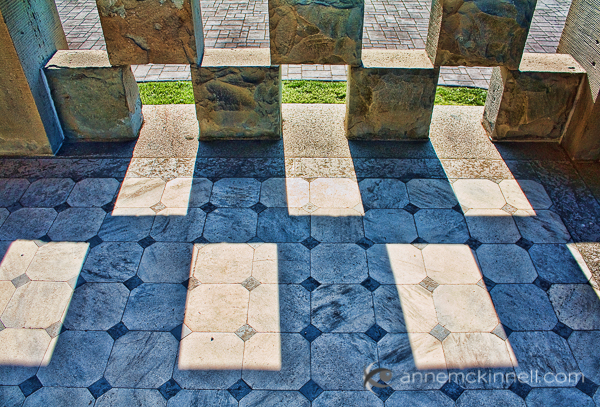
Sandstone blocks and shadows by Anne McKinnell

Look for patterns created by shadows. Here, an interesting pattern is formed by the sandstone blocks and their shadows.

Exposing for the Shadows

If you put your camera on an automatic mode (even aperture or shutter priority mode) and try to photograph a shadow, it’ll probably come out too light. This is, after all, what cameras are designed to do – expose with enough brightness to see detail. Of course, this isn’t always what we want, and shadows are a prime example of when you need to manually change your exposure to make sure the shadow remains in darkness.

There are a few ways that this can be done:

  • Set your camera to manual mode. This is for advanced photographers. On manual mode, you’re responsible for setting your aperture, shutter speed, and ISO value. If you’re not sure what settings to use, you can copy them from the values on your auto setting and then tweak them as you go.
  • Use EV compensation. If you take a shot and see on the LCD screen that it is too bright, you can simply locate the camera’s EV (exposure value) compensation button. Almost every camera will have one, even point-and-shoots and camera phones; it is denoted by a square with a (+/-) symbol. Using that, you can simply turn the exposure up or down to be brighter or darker, as you see fit, and if you’re using live view it will probably render directly in the display. If the shadows come up too bright, just lower the exposure compensation a little to deepen them.

The El Prado Pedestrian Walkway, Balboa Park, San Diego, California, by Anne McKinnell

Late afternoon sidelight created a pattern, an interesting repetition of lines, in this arcade.

  • Lock down your exposure. If you have a DSLR, it probably has an exposure lock feature, though it may need to be configured in the camera’s menu. Using exposure lock, you can fill your frame with the part of your scene that’s not in shadow – or else some well-lit mid-tone – and let your automatic exposure calculate for that. Then you lock it in by pressing the AE-L (auto-exposure lock) button on your camera. This will freeze the settings as they are, so you can recompose the image to include the shadow and the camera won’t re-calculate and brighten the exposure to account for them. This way, you’ll get perfectly exposed highlights and deep shadows. Alternatively, you can simply note the settings, dial them in to manual mode, and bypass the exposure lock altogether.
  • Bracket your shot. When you bracket your image, you take several shots at different exposures. Mid-range cameras and higher will have this feature built in – it might feature a dedicated BKT button, or the option might be available in the menu. If so, you’ll be able to select how many pictures to take and how many stops of difference between them. This makes it simple to take three exposures, for example, one with the exposure the camera thinks is correct, one underexposed by one stop and one overexposed by one stop. If this feature is not available, it can be achieved through changing the settings in manual mode, or by taking several shots with different EV compensations.

Imperial Sand Dunes, California by Anne McKinnell

In this image of a sand dune, the shadow adds form to the dune and creates a strong and balancing line in the image. I made this image mid-afternoon during a scouting trip. It turned out much better than the image I made of the same location later in the day when the right side of the dune was entirely in shadow.

Next time you’re out shooting, make a point of noticing the shapes of the shadows. Challenge yourself to actively use them to create mood, to add dimension to your subject, or to take center stage in a creatively crafted composition.

Post originally from: Digital Photography Tips.

Check out our more Photography Tips at Photography Tips for Beginners, Portrait Photography Tips and Wedding Photography Tips.

Add Impact to Your Photos by Including Shadows


Digital Photography School

 
Comments Off on Add Impact to Your Photos by Including Shadows

Posted in Photography


Sigma sets out its stall at CES – including lens pricing and SPP mono mode

08 Jan

Sigma_120-300mm.png

Sigma has published details of what it will be showing at the CES show, including pricing details for two of the lenses it announced at Photokina 2012. The 17-70mm F2.8-4 DC Macro OS HSM, part of the company’s ‘Contemporary’ line of lenses, will retail for around $ 499. Meanwhile the 120-300mm F2.8 DG OS HSM, which falls into the company’s ‘Sports’ category, will sell for around $ 3,599. Meanwhile, the company has given details of a monochrome processing mode that it’s added to its Sigma Photo Pro processing software for its Foveon-sensored cameras.

News: Digital Photography Review (dpreview.com)

 
Comments Off on Sigma sets out its stall at CES – including lens pricing and SPP mono mode

Posted in Uncategorized


Sony launches five Cyber-shot compacts including Wi-Fi and waterproof models

08 Jan

DSC-WX80.png

Sony has announced five Cyber-Shot compacts, including the Wi-Fi-capable, 16MP CMOS-based DSC-WX80 with its 25-200mm equivalent zoom lens. There are also two CCD-based W-series cameras – the DSC-W730 which shares its lens with the WX80, and the DSC-W710 that has a 5x 28-140mm equiv. zoom. Beyond these are the 16MP CCD-based 5x rugged, waterproof DSC-TF1 and the 26x DSC-H200 superzoom.

News: Digital Photography Review (dpreview.com)

 
Comments Off on Sony launches five Cyber-shot compacts including Wi-Fi and waterproof models

Posted in Uncategorized


Samsung announces six Wi-Fi compacts including WB250F and WB800F

08 Jan

samsung_wb250f.png

Samsung has announced six Wi-Fi capable compact cameras, including compact superzooms and its latest Dual-View model. The WB250F is an 18x, 24-432mm equiv compact superzoom with a 3.0″ touch screen and the company’s latest Wi-Fi implementation – dubbed ‘Smart 2.0.’ The WB250F uses a 14MP BSI CMOS sensor while its near-twin, the WB200F, uses a 14MP CCD chip. Meanwhile the WB800F uses a 16MP BSI CMOS sensor behind a 21x, 23-483mm equivalent lens. The WB30F uses a 16MP CCD with 24-240mm equivalent lens. The latest DualView model shares the same sensor and a 25-125mm equiv zoom and includes a 1.5″ front LCD. The ST150F is a budget style compact – taking most of the DV150F’s features but without the front screen and costing $ 20 less.

News: Digital Photography Review (dpreview.com)

 
Comments Off on Samsung announces six Wi-Fi compacts including WB250F and WB800F

Posted in Uncategorized


Apple Raw update brings support for 8 cameras, including Sony A99

13 Dec

iPhoto.png

Apple has issued Digital Camera RAW Compatibility Update 4.02, adding support for 8 cameras to Aperture 3 and iPhoto ’11. The update includes support for many recently-announced cameras including the Sony Alpha SLT-A99, NEX-6, Olympus PEN E-PL5 and Panasonic Lumix DMC-GH3, but does not yet support recent high-end Fujifilm models.

News: Digital Photography Review (dpreview.com)

 
Comments Off on Apple Raw update brings support for 8 cameras, including Sony A99

Posted in Uncategorized


Apple Raw update brings support for 8 cameras, including Sony A99

01 Dec

iPhoto.png

Apple has issued Digital Camera RAW Compatibility Update 4.02, adding support for 8 cameras to Aperture 3 and iPhoto ’11. The update includes support for many recently-announced cameras including the Sony Alpha SLT-A99, NEX-6, Olympus PEN E-PL5 and Panasonic Lumix DMC-GH3, but does not yet support recent high-end Fujifilm models.

News: Digital Photography Review (dpreview.com)

 
Comments Off on Apple Raw update brings support for 8 cameras, including Sony A99

Posted in Uncategorized


Apple Raw update brings support for 11 cameras, including D600 and RX100

25 Oct

iPhoto.png

Apple has issued Digital Camera RAW Compatibility Update 4.01, adding support for 11 cameras to Aperture 3 and iPhoto ’11. The update includes support for many of the latest cameras including the Nikon D600, Sony Cyber-shot DSC-RX100, Canon EOS-M and Panasonic G5. Many of the latest enthusiast compacts, including the Canon G15 and S110, and Panasonic DMC-LX7 are also covered, though there’s still no support for recent high-end Fujifilm models.

News: Digital Photography Review (dpreview.com)

 
Comments Off on Apple Raw update brings support for 11 cameras, including D600 and RX100

Posted in Uncategorized


Windows 8 – Remove Tiles, Including Animated Tiles, from the Start Menu

16 Oct

Don’t need to see Bing, Finance, Photos, or other tiles on the Start Menu? Remove them quickly.

Are you the kind of person who just wants to get things done with their Windows 8 machine and don’t need to see live tiles such as Bing, Finance, News, Photos, Sports, Travel, or Weather on their Start Menu with their constantly-updated information from the Internet?

To remove a tile or group of tiles from the Start Menu, just do the following:…

Read more at MalekTips.
New Computer and Technology Help and Tips – MalekTips.Com

 
Comments Off on Windows 8 – Remove Tiles, Including Animated Tiles, from the Start Menu

Posted in Technology